Multi-level Representations
for Fine-Grained Typing of Knowledge Base Entities
Yadollah YaghoobzadehandHinrich Sch¨utze
Center for Information and Language Processing LMU Munich, Germany
Abstract
Entities are essential elements of natu-ral language. In this paper, we present methods for learning multi-level represen-tations of entities on three complemen-tary levels: character (character patterns in entity names extracted, e.g., by neural networks), word (embeddings of words in entity names) and entity (entity em-beddings). We investigate state-of-the-art learning methods on each level and find large differences, e.g., for deep learn-ing models, traditional ngram features and the subword model of fasttext (Bo-janowski et al., 2016) on the character
level; for word2vec (Mikolov et al., 2013) on the word level; and for the order-aware model wang2vec (Ling et al., 2015a) on theentitylevel.
We confirm experimentally that each level of representation contributes complemen-tary information and a joint representation of all three levels improves the existing embedding based baseline for fine-grained entity typing by a large margin. Addi-tionally, we show that adding information from entity descriptions further improves multi-level representations of entities.
1 Introduction
Knowledge about entities is essential for under-standing human language. This knowledge can be attributional (e.g., canFly, isEdible), type-based (e.g., isFood, isPolitician, isDisease) or relational (e.g, marriedTo, bornIn). Knowledge bases (KBs) are designed to store this information in a struc-tured way, so that it can be queried easily. Exam-ples of such KBs are Freebase (Bollacker et al., 2008), Wikipedia, Google knowledge graph and
YAGO (Suchanek et al., 2007). For automatic up-dating and completing the entity knowledge, text resources such as news, user forums, textbooks or any other data in the form of text are important sources. Therefore, information extraction meth-ods have been introduced to extract knowledge about entities from text. In this paper, we focus on the extraction of entity types, i.e., assigning types to – ortyping– entities. Type information can help extraction of relations by applying constraints on relation arguments.
We address a problem setting in which the fol-lowing are given: a KB with a set of entities
E, a set of types T and a membership function
m : E×T 7→ {0,1}such that m(e, t) = 1iff entityehas typet; and a large corpusCin which mentions of E are annotated. In this setting, we address the task offine-grained entity typing: we want to learn a probability function S(e, t) for a pair of entityeand typetand based onS(e, t) in-fer whetherm(e, t) = 1holds, i.e., whether entity eis a member of typet.
We address this problem by learning a multi-level representation for an entity that contains the information necessary for typing it. One important source is thecontexts in which the entity is used. We can take the standard method of learning beddings for words and extend it to learning em-beddings for entities. This requires the use of an entity linker and can be implemented by replac-ing all occurrences of the entity by a unique to-ken. We refer to entity embeddings asentity-level representations. Previously, entity embeddings have been learned mostly using bag-of-word mod-els like word2vec (e.g., by Wang et al. (2014) and Yaghoobzadeh and Sch¨utze (2015)). We show below that order information is critical for high-quality entity embeddings.
Entity-level representations are often uninfor-mative for rare entities, so that using only entity
embeddings is likely to produce poor results. In this paper, we useentity namesas a source of in-formation that is complementary to entity embed-dings. We define an entity name as a noun phrase that is used to refer to an entity. We learn character and word level representations of entity names.
For thecharacter-level representation, we adopt different character-level neural network architec-tures. Our intuition is that there is sub/cross word information, e.g., orthographic patterns, that is helpful to get better entity representations, espe-cially for rare entities. A simple example is that a three-token sequence containing an initial like “P.” surrounded by two capitalized words (“Rolph P. Kugl”) is likely to refer to a person.
We compute the word-level representation as the sum of the embeddings of the words that make up the entity name. The sum of the embeddings accumulates evidence for a type/property over all constituents, e.g., a name containing “stadium”, “lake” or “cemetery” is likely to refer to a location. In this paper, we compute our word level repre-sentation with two types of word embeddings: (i) using only contextual information of words in the corpus, e.g., byword2vec(Mikolov et al., 2013) and (ii) using subword as well as contextual in-formation of words, e.g., by Facebook’s recently releasedfasttext(Bojanowski et al., 2016).
In this paper, we integrate character-level and word-level with entity-level representations to im-prove the results of previous work on fine-grained typing of KB entities. We also show how descrip-tions of entities in a KB can be a complementary source of information to our multi-level represen-tation to improve the results of entity typing, espe-cially for rare entities.
Our main contributions in this paper are:
• We propose new methods for learning en-tity representations on three levels: character-level, word-level and entity-level.
• We show that these levels are complementary and a joint model that uses all three levels im-proves the state of the art on the task of fine-grained entity typing by a large margin.
• We experimentally show that an order depen-dent embedding is more informative than its bag-of-word counterpart for entity represen-tation.
We release our dataset and source codes:
cistern.cis.lmu.de/figment2/.
2 Related Work
Entity representation. Two main sources of in-formation used for learning entity representation are: (i) links and descriptions in KB, (ii) name and contexts in corpora. We focus on name and con-texts in corpora, but we also include (Wikipedia) descriptions. We represent entities on three levels: entity, word and character. Our entity-level repre-sentation is similar to work on relation extraction (Wang et al., 2014; Wang and Li, 2016), entity linking (Yamada et al., 2016; Fang et al., 2016), and entity typing (Yaghoobzadeh and Sch¨utze, 2015). Our word-level representation with distri-butional word embeddings is similarly used to rep-resent entities for entity linking (Sun et al., 2015) and relation extraction (Socher et al., 2013; Wang et al., 2014). Novel entity representation methods we introduce in this paper are representation based on fasttext (Bojanowski et al., 2016) sub-word embeddings, several character-level repre-sentations, “order-aware” entity-level embeddings and the combination of several different represen-tations into one multi-level representation.
Character-subword level neural networks.
Character-level convolutional neural networks (CNNs) are applied by dos Santos and Zadrozny (2014) to part of speech (POS) tagging, by dos Santos and Guimar˜aes (2015), Ma and Hovy (2016), and Chiu and Nichols (2016) to named entity recognition (NER), by Zhang et al. (2015) and Zhang and LeCun (2015) to sentiment anal-ysis and text categorization, and by Kim et al. (2016) to language modeling (LM). Character-level LSTM is applied by Ling et al. (2015b) to LM and POS tagging, by Lample et al. (2016) to NER, by Ballesteros et al. (2015) to parsing mor-phologically rich languages, and by Cao and Rei (2016) to learning word embeddings. Bojanowski et al. (2016) learn word embeddings by repre-senting words with the average of their character ngrams (subwords) embeddings. Similarly, Chen et al. (2015) extendsword2vecfor Chinese with joint modeling with characters.
Entity Representation Hidden Layer Output Layer (type probabilities)
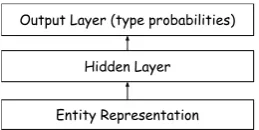
Figure 1: Schematic diagram of our architecture for entity classification. “Entity Representation” (~v(e)) is the (one-level or multi-level) vector rep-resentation of entity. Size of output layer is|T|.
but they rely on entity descriptions in KBs, which in many settings are not available. The problem of Fine-grained mention typing (FGMT) (Yosef et al., 2012; Ling and Weld, 2012; Yogatama et al., 2015; Del Corro et al., 2015; Shimaoka et al., 2016; Ren et al., 2016) is related to our task. FGMT classifies single mentions of named enti-ties to their context dependent types whereas we attempt to identify all types of a KBentity from the aggregation of all its mentions. FGMT can still be evaluated in our task by aggregating the mention level decisions but as we will show in our experiments for one system, i.e., FIGER (Ling and Weld, 2012), our entity embedding based models are better in entity typing.
3 Fine-grained entity typing
Given (i) a KB with a set of entitiesE, (ii) a set of typesT, and (iii) a large corpusC in which men-tions ofE are linked, we address the task of fine-grained entity typing(Yaghoobzadeh and Sch¨utze, 2015): predict whether entity e is a member of type tor not. To do so, we use a set of training examples to learnP(t|e): the probability that en-tityehas typet. These probabilities can be used to assignnew typesto entities covered in the KB as well as typingunknown entities.
We learnP(t|e)with a general architecture; see Figure 1. The output layer has size|T|. Unittof this layer outputs the probability for typet. “En-tity Representation” (~v(e)) is the vector represen-tation of entity e – we will describe in detail in the rest of this section what forms~v(e)takes. We model P(t|e) as a multi-label classification, and train a multilayer perceptron (MLP) with one hid-den layer:
P(t1|e). . . P(tT|e)=σ
Woutf Win~v(e)
(1) where Win ∈ Rh×d is the weight matrix from
~v(e) ∈ Rd to the hidden layer with size h. f is
the rectifier function.Wout ∈R|T|×h is the weight
matrix from hidden layer to output layer of size
|T|. σ is the sigmoid function. Our objective is binary cross entropy summed over types:
X
t
−mtlogpt+ (1−mt) log (1−pt)
wheremtis the truth andptthe prediction.
The key difficulty when trying to compute P(t|e)is in learning a good representation for en-titye. We make use of contexts and name ofeto represent its feature vector on the three levels of entity, word and character.
3.1 Entity-level representation
Distributional representations or embeddings are commonly used for words. The underlying hy-pothesis is that words with similar meanings tend to occur in similar contexts (Harris, 1954) and therefore cooccur with similar context words. We can extend the distributional hypothesis to enti-ties (cf. Wang et al. (2014), Yaghoobzadeh and Sch¨utze (2015)): entities with similar meanings tend to have similar contexts. Thus, we can learn addimensional embedding~v(e)of entityefrom a corpus in which all mentions of the entity have been replaced by a special identifier. We refer to these entity vectors as theentity level representa-tion(ELR).
In previous work, order information of context words (relative position of words in the contexts) was generally ignored and objectives similar to the SkipGram (henceforth: SKIP) model were used to learn~v(e). However, the bag-of-word context is difficult to distinguish for pairs of types like (restaurant,food) and (author,book). This suggests thatusing order aware embedding models is im-portant for entities. Therefore, we apply Ling et al. (2015a)’s extended version of SKIP, Structured SKIP (SSKIP). It incorporates the order of context words into the objective. We compare it with SKIP embeddings in our experiments.
3.2 Word-level representation
Words inside entity names are important sources of information for typing entities. We define the word-level representation (WLR) as theaverage of the embeddings of the wordsthat the entity name contains~v(e) = 1/nPni=1~v(wi) where~v(wi)is
of length n. We opt for simple averaging since entity names often consist of a small number of words with clear semantics. Thus, averaging is a promising way of combining the information that each word contributes.
The word embedding, ~w, itself can be learned from models with different granularity levels. Em-bedding models that consider words as atomic units in the corpus, e.g., SKIP and SSKIP, are word-level. On the other hand, embedding models that represent words with their charac-ter ngrams, e.g., fasttext(Bojanowski et al., 2016), are subword-level. Based on this, we con-sider and evaluate word-level WLR (WWLR)
andsubword-level WLR (SWLR)in this paper.1
Lipofen
Convolution layer Max Pooling
[image:4.595.78.282.281.442.2]Lookup table layer Character-level Representation
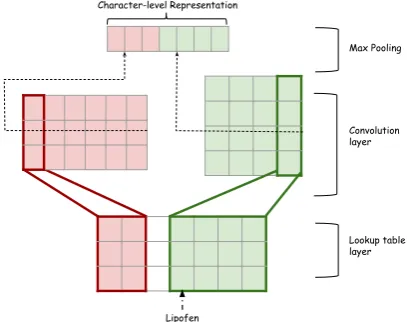
Figure 2: Example architecture for the character-level CNN with max pooling. The input is “Lipofen”. Character embedding size is three. There are three filters of width 2 and four filters of width 4.
3.3 Character-level representation
For computing the character level representation (CLR), we design models that try to type an entity based on the sequence of characters of its name. Our hypothesis is that names of entities of a spe-cific type often have similar character patterns. Entities of type ETHNICITY often end in “ish”
and “ian”, e.g., “Spanish” and “Russian”. Entities of type MEDICINE often end in “en”: “Lipofen”,
“acetaminophen”. Also, some types tend to have specific cross-word shapes in their entities, e.g., 1Subword models have properties of both character-level
models (subwords are character ngrams) and of word-level models (they do not cross boundaries between words). They probably could be put in either category, but in our context fit the word-level category better because we see the granularity level with respect to the entities and not words.
PERSON names usually consist of two words, or MUSICnames are usually long, containing several
words.
The first layer of the character-level models is a lookup table that maps each character to an em-bedding of size dc. These embeddings capture
similarities between characters, e.g., similarity in type of phoneme encoded (consonant/vowel) or similarity in case (lower/upper). The output of the lookup layer for an entity name is a matrix C ∈ Rl×dc where l is the maximum length of a name and all names are padded to lengthl. This length lincludes special start/end characters that bracket the entity name.
We experiment with four architectures to pro-duce character-level representations in this paper: FORWARD (direct forwarding of character em-beddings), CNNs, LSTMs and BiLSTMs. The output of each architecture then takes the place of the entity representation~v(e)in Figure 1.
FORWARD simply concatenates all rows of matrixC; thus,~v(e)∈Rdc∗l.
The CNN uses k filters of different window widths w to narrowly convolve C. For each fil-terH ∈Rdc×w, the result of the convolution ofH over matrixCis feature mapf ∈Rl−w+1:
f[i] =rectifier(C[:,i:i+w−1]H+b)
where rectifier is the activation function, b is the bias,C[:,i:i+w−1]are the columnsitoi+w−1of
C,1 ≤ w ≤ 10 are the window widths we con-sider andis the sum of element-wise multipli-cation. Max pooling then gives us one feature for each filter. The concatenation of all these features is our representation: ~v(e) ∈ Rk. An example
CNN architecture is show in Figure 2.
The input to the LSTM is the character se-quence in matrix C, i.e., x1, . . . , xl ∈ Rdc. It
generates the state sequence h1, ..., hl+1 and the
output is the last state~v(e)∈Rdh.2
The BiLSTMconsists of two LSTMs, one go-ing forward, one gogo-ing backward. The first state of the backward LSTM is initialized ashl+1, the last
state of the forward LSTM. The BiLSTM entity representation is the concatenation of last states of forward and backward LSTMs, i.e.,~v(e)∈R2∗dh.
3.4 Multi-level representations
Our different levels of representations can give complementary information about entities.
Character-level Representation
Word-level Representation
[image:5.595.81.283.62.128.2]Entity-level Representation Entity Representation
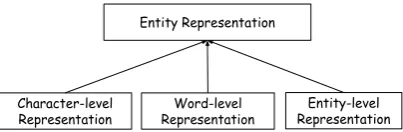
Figure 3: Multi-level representation
WLR and CLR. Both WLR models, SWLR and WWLR, do not have access to the cross-word character ngrams of entity names while CLR mod-els do. Also, CLR is task specific by training on the entity typing dataset while WLR is generic. On the other hand, WWLR and SWLR models have access to information that CLR ignores: the tok-enization of entity names into words and embed-dings of these words. It is clear that words are par-ticularly important character sequences since they often correspond to linguistic units with clearly identifiable semantics – which is not true for most character sequences. For many entities, the words they contain are a better basis for typing than the character sequence. For example, even if “nectarine” and “compote” did not occur in any names in the training corpus, we can still learn good word embeddings from their non-entity oc-currences. This then allows us to correctly type the entity “Aunt Mary’s Nectarine Compote” asFOOD
based on the sum of the word embeddings.
WLR/CLR and ELR. Representations from entity names, i.e., WLR and CLR, by themselves are limited because many classes of names can be used for different types of entities; e.g., person names do not contain hints as to whether they are referring to a politician or athlete. In contrast, the ELR embedding is based on an entity’s contexts, which are often informative for each entity and can distinguish politicians from athletes. On the other hand, not all entities have sufficiently many informative contexts in the corpus. For these en-tities, their name can be a complementary source of information and character/word level represen-tations can increase typing accuracy.
Thus, we introduce joint models that use com-binations of the three levels. Each multi-level model concatenates several levels. We train the constituent embeddings as follows. WLR and ELR are computed as described above and are not changed during training. CLR – produced by one of the character-level networks described above – is initialized randomly and then tuned during
training. Thus, it can focus on complementary in-formation related to the task that is not already present in other levels. The schematic diagram of our multi-level representation is shown in Fig-ure 3.
4 Experimental setup and results
4.1 Setup
Entity datasets and corpus. We address the task of fine-grained entity typing and use Yaghoobzadeh and Sch¨utze (2015)’s FIGMENT dataset3 for evaluation. The FIGMENT corpus
is part of a version of ClueWeb in which Free-base entities are annotated using FACC1 (URL, 2016b; Gabrilovich et al., 2013). The FIGMENT entity datasets contain 200,000 Freebase entities that were mapped to 102 FIGER types (Ling and Weld, 2012). We use the same train (50%), dev (20%) and test (30%) partitions as Yaghoobzadeh and Sch¨utze (2015) and extract the names from mentions of dataset entities in the corpus. We take the most frequent name for dev and test entities and three most frequent names for train (each one tagged with entity types).
Adding parent types to refine entity dataset.
FIGMENT ignores that FIGER is a proper hierar-chy of types; e.g., whileHOSPITALis a subtype of BUILDINGaccording to FIGER, there are entities
in FIGMENT that are hospitals, but not buildings.4
Therefore, we modified the FIGMENT dataset by adding for each assigned type (e.g.,HOSPITAL) its
parents (e.g.,BUILDING). This makes FIGMENT
more consistent and eliminates spurious false neg-atives (BUILDINGin the example).
We now describe our baselines: (i) BOW & NSL: hand-crafted features, (ii) FIGMENT (Yaghoobzadeh and Sch¨utze, 2015) and (iii) adapted version of FIGER (Ling and Weld, 2012). We implement the following two feature sets from the literature as a hand-crafted baselinefor our character and word level models. (i)BOW: in-dividual words of entity name (both as-is and low-ercased); (ii) NSL (ngram-shape-length): shape and length of the entity name (cf. Ling and Weld (2012)), charactern-grams,1≤n≤nmax, nmax =
5(we also triednmax = 7, but results were worse
on dev) and normalized charactern-grams: lower-cased, digits replaced by “7”, punctuation replaced by “.”. These features are represented as a sparse
3cistern.cis.lmu.de/figment/
binary vector~v(e)that is input to the architecture in Figure 1.
FIGMENT is the model for entity typing pre-sented by Yaghoobzadeh and Sch¨utze (2015). The authors only use entity-level representations for entities trained by SkipGram, so the FIG-MENT baseline corresponds to the entity-level re-sult shown as ELR(SKIP) in the tables.
The third baseline is using an existing mention-level entity typing system,FIGER(Ling and Weld, 2012). FIGER uses a wide variety of features on different levels (including parsing-based fea-tures) from contexts of entity mentions as well as the mentions themselves and returns a score for each mention-type instance in the corpus. We pro-vide the ClueWeb/FACC1 segmentation of ties, so FIGER does not need to recognize enti-ties.5 We use the trained model provided by the
authors and normalize FIGER scores using soft-max to make them comparable for aggregation. We experimented with different aggregation func-tions (including maximum and k-largest-scores for a type), but we use the average of scores since it gave us the best result on dev. We call this baseline AGG-FIGER.
Distributional embeddings. For WWLR and ELR, we use SkipGram model inword2vecand SSkip model inwang2vec(Ling et al., 2015a) to learn embeddings for words, entities and types. To obtain embeddings for all three in the same space, we process ClueWeb/FACC1 as follows. For each sentence s, we add three copies: sitself, a copy ofsin which each entity is replaced with its Free-base identifier (MID) and a copy in which each entity (not test entities though) is replaced with an ID indicating its notable type. The resulting cor-pus contains around 4 billion tokens and 1.5 bil-lion types.
We run SKIP and SSkip with the same setup (200 dimensions, 10 negative samples, window size 5, word frequency threshold of 100)6on this
corpus to learn embeddings for words, entities and FIGER types. Having entities and types in the same vector space, we can add another feature vector~v(e) ∈R|T|(referred to as TC below): for
each entity, we compute cosine similarity of its en-tity vector with all type vectors.
For SWLR, we use fasttext7 to learn word
5Mention typing is separated from recognition in FIGER
model. So it can use our segmentation of entities.
6The threshold does not apply for MIDs.
7github.com/facebookresearch/fastText
embeddings from the ClueWeb/FACC1 corpus. We use similar settings as our WWLR SKIP and SSkip embeddings and keep the defaults of other hyperparameters. Since the trained model of
fasttextis applicable for new words, we ap-ply the model to get embeddings for the filtered rare words as well.
model hyperparameters
CLR(FF) dc= 15, hmlp= 600
CLR(LSTM) dc= 70, dh= 70, hmlp= 300
CLR(BiLSTM) dc= 50, dh= 50, hmlp= 200
CLR(CNN) dc= 10, w= [1, ..,8]
n= 100, hmlp= 800
CLR(NSL) hmlp= 800
BOW hmlp= 200
BOW+CLR(NSL) hmlp= 300
WWLR hmlp= 400
SWLR hmlp= 400
WWLR+CLR(CNN) w= [1, ...,7] dc= 10, n= 50, hmlp= 700
SWLR+CLR(CNN) w= [1, ...,7] dc= 10, n= 50, hmlp= 700
ELR(SKIP) hmlp= 400
ELR(SSKIP) hmlp= 400
ELR+CLR dc= 10, w= [1, ...,7]
n= 100, hmlp= 700
ELR+WWLR hmlp= 600
ELR+SWLR hmlp= 600
ELR+WWLR+CLR dc= 10, w= [1, ...,7]
n= 50, hmlp= 700
ELR+SWLR+CLR dc= 10, w= [1, ...,7]
n= 50, hmlp= 700
ELR+WWLR+CNN+TC dc= 10, w= [1, ...,7]
n= 50, hmlp= 900
ELR+SWLR+CNN+TC(MuLR) dc= 10, w= [1, ...,7]
n= 50, hmlp= 900
AVG-DES hmlp= 400
MuLR+AVG-DES dc= 10, w= [1, ...,7]
n= 50, hmlp= 1000
Table 1: Hyperparameters of different models. w is the filter size. nis the number of CNN feature maps for each filter size. dc is the character
em-bedding size. dh is the LSTM hidden state size.
hmlpis the number of hidden units in the MLP.
Our hyperparameter values are given in Ta-ble 1. The values are optimized on dev. We use AdaGrad and minibatch training. For each experi-ment, we select the best model on dev.
We use these evaluation measures: (i) accu-racy: an entity is correct if all its types and no incorrect types are assigned to it; (ii) micro aver-ageF1:F1of all type-entity assignment decisions;
(iii) entity macro averageF1:F1of types assigned
to an entity, averaged over entities; (iv) type macro averageF1:F1of entities assigned to a type,
aver-aged over types.
all entities head entities tail entities acc mic mac acc mic mac acc mic mac 1 MFT .000 .041 .041 .000 .044 .044 .000 .038 .038 2 CLR(FORWARD) .066 .379 .352 .067 .342 .369 .061 .374 .350 3 CLR(LSTM) .121 .425 .396 .122 .433 .390 .116 .408 .391 4 CLR(BiLSTM) .133 .440 .404 .129 .443 .394 .135 .428 .404 5 CLR(NSL) .164 .484 .464 .157 .470 .443 .173 .483 .472 6 CLR(CNN) .177 .494 .468 .171 .484 .450 .187 .489 .474 7 BOW .113 .346 .379 .109 .323 .353 .120 .356 .396 8 WWLR(SKIP) .214 .581 .531 .293 .660 .634 .173 .528 .478 9 WWLR(SSKIP) .223 .584 .543 .306 .667 .642 .183 .533 .494 10 SWLR .236 .590 .554 .301 .665 .632 .209 .551 .522 11 BOW+CLR(NSL) .156 .487 .464 .157 .480 .452 .159 .485 .469 12 WWLR+CLR(CNN) .257 .603 .568 .317 .668 .637 .235 .567 .538 13 SWLR+CLR(CNN) .241 .594 .561 .295 .659 .628 .227 .560 .536 14 ELR(SKIP) .488 .774 .741 .551 .834 .815 .337 .621 .560 15 ELR(SSKIP) .515 .796 .763 .560 .839 .819 .394 .677 .619 16 AGG-FIGER .320 .694 .660 .396 .762 .724 .220 .593 .568 17 ELR+CLR .554 .816 .788 .580 .844 .825 .467 .733 .690 18 ELR+WWLR .557 .819 .793 .582 .846 .827 .480 .749 .708 19 ELR+SWLR .558 .820 .796 .584 .846 .829 .480 .751 .714 20 ELR+WWLR+CLR .568 .823 .798 .590 .847 .829 .491 .755 .716 21 ELR+SWLR+CLR .569 .824 .801 .590 .849 .831 .497 .760 .724 22 ELR+WWLR+CLR+TC .572 .824 .801 .594 .849 .831 .499 .759 .722 23 ELR+SWLR+CLR+TC .575 .826 .802 .597 .851 .831 .508 .762 .727
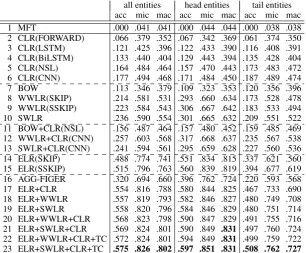
Table 2: Accuracy (acc), micro (mic) and macro (mac)F1
on test for all, head and tail entities.
types: all head tail AGG-FIGER .566 .702 .438 ELR .621 .784 .480 MuLR .669 .811 .541
Table 3: Type macro aver-age F1 on test for all, head
and tail types. MuLR =
ELR+SWLR+CLR+TC
all known? yes no CLR(NSL) .484 .521 .341 CLR(CNN) .494 .524 .374
BOW .346 .435 .065
SWLR .590 .612 .499
[image:7.595.72.379.62.315.2]BOW+NSL .497 .535 .358 SWLR+CLR(CNN) .594 .616 .508
Table 4: Micro F1 on test of
character, word level models for all, known (“known? yes”) and unknown (“known? no”) entities.
4.2 Results
Table 2 gives results on the test entities for all (about 60,000 entities), head (frequency > 100; about 12,200) and tail (frequency < 5; about 10,000). MFT (line 1) is the most frequent type baseline that ranks types according to their fre-quency in the train entities. Each level of represen-tation is separated with dashed lines, and – unless noted otherwise – the best of each level is joined in multi level representations.8
Character-level models are on lines 2-6. The order of systems is: CNN > NSL > BiLSTM > LSTM > FORWARD. The results show that complex neural networks are more effective than simple forwarding. BiLSTM works better than LSTM, confirming other related work. CNNs probably work better than LSTMs because there are few complex non-local dependencies in the se-quence, but many important local features. CNNs with maxpooling can more straightforwardly cap-ture local and position-independent feacap-tures. CNN also beats NSL baseline; a possible reason is that CNN – an automatic method of feature learning 8For accuracy measure: in the following ordered lists of
sets,A<Bmeans that all members (row numbers in Table 2) ofAare significantly worse than all members ofB: {1}< {2}<{3, . . . , 11}<{12,13}<{14,15,16}<{17, . . . , 23}. Test of equal proportions,α <0.05. See Table 6 in the ap-pendix for more details.
– is more robust than hand engineered feature based NSL. We show more detailed results in Sec-tion 4.3.
Word-level models are on lines 7-10. BOW performs worse than WWLR because it cannot deal well with sparseness. SSKIP uses word order information in WWLR and performs better than SKIP. SWLR uses subword information and per-forms better than WWLR, especially for tail en-tities. Integrating subword information improves the quality of embeddings for rare words and mit-igates the problem of unknown words.
Joint word-character level models are
on lines 11-13. WWLR+CLR(CNN) and
SWLR+CLR(CNN) beat the component models. This confirms our underlying assumption in designing the complementary multi-level models. BOW problem with rare words does not allow its joint model with NSL to work better than NSL. WWLR+CLR(CNN) works better than BOW+CLR(NSL) by 10% micro F1, again due
to the limits of BOW compared to WWLR. Interestingly WWLR+CLR works better than SWLR+CLR and this suggests that WWLR is indeed richer than SWLR when CLR mitigates its problem with rare/unknown words
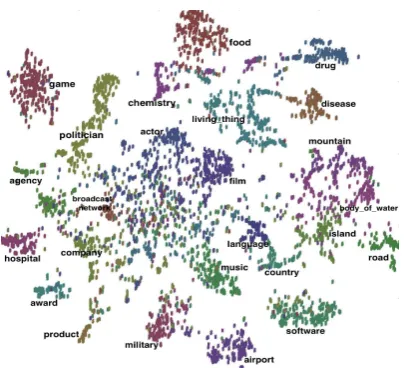
Figure 4: t-SNE result of entity-level representa-tions
1–13. This shows the power of entity-level embed-dings. In Figure 4, a t-SNE (Van der Maaten and Hinton, 2008) visualization of ELR(SKIP) embed-dings using different colors for entity types shows that entities of the same type are clustered to-gether. SSKIP works marginally better than SKIP for ELR, especially for tail entities, confirming our hypothesis that order information is important for a good distributional entity representation. This is also confirming the results of Yaghoobzadeh and Sch¨utze (2016), where they also get better en-tity typing results with SSKIP compared to SKIP. They propose to use entity typing as an extrinsic evaluation for embedding models.
Joint entity, word, and character level mod-elsare on lines 16-23. The AGG-FIGER baseline works better than the systems on lines 1-13, but worse than ELRs. This is probably due to the fact that AGG-FIGER is optimized for mention typing and it is trained using distant supervision assump-tion. Parallel to our work, Yaghoobzadeh et al. (2017) optimize a mention typing model for our entity typing task by introducing multi instance learning algorithms, resulting comparable perfor-mance to ELR(SKIP). We will investigate their method in future.
Joining CLR with ELR (line 17) results in large improvements, especially for tail entities (5% micro F1). This demonstrates that for rare
entities, contextual information is often not suf-ficient for an informative representation, hence name features are important. This is also true for the joint models of WWLR/SWLR and ELR (lines 18-19). Joining WWLR works better than
CLR, and SWLR is slightly better than WWLR. Joint models of WWLR/SWLR with ELR+CLR gives more improvements, and SWLR is again slightly better than WWLR. ELR+WWLR+CLR and ELR+SWLR+CLR, are better than their two-level counterparts, again confirming that these lev-els are complementary.
We get a further boost, especially for tail en-tities, by also including TC (type cosine) in the combinations (lines 22-23). This demonstrates the potential advantage of having a common represen-tation space for entities and types. Our best model, ELR+SWLR+CLR+TC (line 22), which we refer to as MuLR in the other tables, beats our initial baselines (ELR and AGG-FIGER) by large mar-gins, e.g., in tail entities improvements are more than 8% in micro F1.
Table 3 shows type macro F1 for MuLR
(ELR+SWLR+CLR+TC) and two baselines. There are 11 head types (those with ≥3000 train entities) and 36 tail types (those with <200 train entities). These results again confirm the superi-ority of our multi-level models over the baselines: AGG-FIGER and ELR, the best single-level model baseline.
4.3 Analysis
Unknown vs. known entities. To analyze the complementarity of character and word level rep-resentations, as well as more fine-grained com-parison of our models and the baselines, we di-vide test entities intoknown entities– at least one word of the entity’s name appears in a train entity – andunknown entities(the complement). There are 45,000 (resp. 15,000) known (resp. unknown) test entities.
in unknown entities.
Case study ofLIVING-THING. To understand
the interplay of different levels better, we perform a case study of the type LIVING-THING. Living
beings that are not humans belong to this type. WLRs incorrectly assign “Walter Leaf” (PERSON) and “Along Came A Spider” (MUSIC)
toLIVING-THINGbecause these names contain a
word referring to a LIVING-THING (“leaf”,
“spi-der”), but the entity itself is not aLIVING-THING.
In these cases, the averaging of embeddings that WLR performs is misleading. The CLR(CNN) types these two entities correctly because their names contain character ngram/shape patterns that are indicative ofPERSONandMUSIC.
ELR incorrectly assigns “Zumpango” (CITY)
and “Lake Kasumigaura” (LOCATION) toLIVING -THING because these entities are rare and words
associated with living things (e.g., “wildlife”) dominate in their contexts. However, CLR(CNN) and WLR enable the joint model to type the two entites correctly: “Zumpango” because of the in-formative suffix “-go” and “Lake Kasumigaura” because of the informative word “Lake”.
While some of theremaining errorsof our best system MuLR are due to the inherent difficulty of entity typing (e.g., it is difficult to correctly type a one-word entity that occurs once and whose name is not informative), many other errors are due to artifacts of our setup. First, ClueWeb/FACC1 is the result of an automatic entity linking system and any entity linking errors propagate to our mod-els. Second, due to the incompleteness of Freebase (Yaghoobzadeh and Sch¨utze, 2015), many entities in the FIGMENT dataset are incompletely anno-tated, resulting in correctly typed entities being evaluated as incorrect.
Adding another source: description-based embeddings.While in this paper, we focus on the contexts and names of entities, there is a textual source of information about entities in KBs which we can also make use of: descriptions of entities. We extract Wikipedia descriptions of FIGMENT entities filtering out the entities (∼40,000 out of
∼200,000) without description.
We then build a simple entity representation by averaging the embeddings of the topkwords (wrt tf-idf) of the description (henceforth, AVG-DES).9
This representation is used as input in Figure 1 to train the MLP. We also train our best
multi-9k= 20 gives the best results on dev.
entities: all head tail
AVG-DES .773 .791 .745
MuLR .825 .846 .757
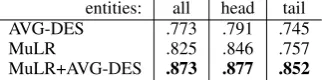
[image:9.595.309.471.63.103.2]MuLR+AVG-DES .873 .877 .852
Table 5: Micro average F1 results of MuLR and
description based model and their joint.
level model as well as the joint of the two on this smaller dataset. Since the descriptions are coming from Wikipedia, we use 300-dimensional Glove (URL, 2016a) embeddings pretrained on Wikip-dia+Gigaword to get more coverage of words. For MuLR, we still use the embeddings we trained be-fore.
Results are shown in Table 5. While for head entities, MuLR works marginally better, the differ-ence is very small in tail entities. The joint model of the two (by concatenation of vectors) improves the micro F1, with clear boost for tail entities. This suggests that for tail entities, the contextual and name information is not enough by itself and some keywords from descriptions can be really helpful. Integrating more complex description-based em-beddings, e.g., by using CNN (Xie et al., 2016), may improve the results further. We leave it for future work.
5 Conclusion
In this paper, we have introduced representations of entities on different levels: character, word and entity. The character level representation is learned from the entity name. The word level rep-resentation is computed from the embeddings of the wordswiin the entity name where the
embed-ding ofwi is derived from the corpus contexts of
wi. The entity level representation of entityei is
derived from the corpus contexts ofei. Our
exper-iments show that each of these levels contributes complementary information for the task of fine-grained typing of entities. The joint model of all three levels beats the state-of-the-art baseline by large margins. We further showed that extracting some keywords from Wikipedia descriptions of entities, when available, can considerably improve entity representations, especially for rare entities. We believe that our findings can be transferred to other tasks where entity representation matters.
References
Miguel Ballesteros, Chris Dyer, and Noah A. Smith. 2015. Improved transition-based parsing by model-ing characters instead of words with lstms. In Pro-ceedings of the 2015 Conference on Empirical Meth-ods in Natural Language Processing, pages 349– 359, Lisbon, Portugal, September. Association for Computational Linguistics.
Piotr Bojanowski, Edouard Grave, Armand Joulin, and Tomas Mikolov. 2016. Enriching word vectors with subword information. CoRR, abs/1607.04606. Kurt D. Bollacker, Colin Evans, Praveen Paritosh, Tim
Sturge, and Jamie Taylor. 2008. Freebase: a col-laboratively created graph database for structuring human knowledge. InProceedings of the ACM SIG-MOD International Conference on Management of Data, SIGMOD 2008, Vancouver, BC, Canada, June 10-12, 2008, pages 1247–1250.
Kris Cao and Marek Rei. 2016. A joint model for word embedding and word morphology. InProceedings of the 1st Workshop on Representation Learning for NLP, pages 18–26, Berlin, Germany, August. Asso-ciation for Computational Linguistics.
Xinxiong Chen, Lei Xu, Zhiyuan Liu, Maosong Sun, and Huan-Bo Luan. 2015. Joint learning of char-acter and word embeddings. In Proceedings of the Twenty-Fourth International Joint Conference on Artificial Intelligence, IJCAI 2015, Buenos Aires, Argentina, July 25-31, 2015, pages 1236–1242. Jason Chiu and Eric Nichols. 2016. Named entity
recognition with bidirectional lstm-cnns. Transac-tions of the Association for Computational Linguis-tics, 4:357–370.
Luciano Del Corro, Abdalghani Abujabal, Rainer Gemulla, and Gerhard Weikum. 2015. Finet: Context-aware fine-grained named entity typing. In
Proceedings of the 2015 Conference on Empirical Methods in Natural Language Processing, pages 868–878, Lisbon, Portugal, September. Association for Computational Linguistics.
C´ıcero Nogueira dos Santos and Victor Guimar˜aes. 2015. Boosting named entity recognition with neu-ral character embeddings. CoRR, abs/1505.05008. C´ıcero Nogueira dos Santos and Bianca Zadrozny.
2014. Learning character-level representations for part-of-speech tagging. In Proceedings of the 31th International Conference on Machine Learn-ing, ICML 2014, BeijLearn-ing, China, 21-26 June 2014, pages 1818–1826.
Wei Fang, Jianwen Zhang, Dilin Wang, Zheng Chen, and Ming Li. 2016. Entity disambiguation by knowledge and text jointly embedding. In Proceed-ings of The 20th SIGNLL Conference on Computa-tional Natural Language Learning, pages 260–269, Berlin, Germany, August. Association for Computa-tional Linguistics.
Evgeniy Gabrilovich, Michael Ringgaard, and Amar-nag Subramanya. 2013. Facc1: Freebase annotation of clueweb corpora.
Zellig S. Harris. 1954. Distributional structure. Word, 10:146–162.
Yoon Kim, Yacine Jernite, David Sontag, and Alexan-der M. Rush. 2016. Character-aware neural lan-guage models. InProceedings of the Thirtieth AAAI Conference on Artificial Intelligence, February 12-17, 2016, Phoenix, Arizona, USA., pages 2741– 2749.
Guillaume Lample, Miguel Ballesteros, Sandeep Sub-ramanian, Kazuya Kawakami, and Chris Dyer. 2016. Neural architectures for named entity recog-nition. In Proceedings of the 2016 Conference of the North American Chapter of the Association for Computational Linguistics: Human Language Tech-nologies, pages 260–270, San Diego, California, June. Association for Computational Linguistics. Xiao Ling and Daniel S. Weld. 2012. Fine-grained
en-tity recognition. InProceedings of the Twenty-Sixth AAAI Conference on Artificial Intelligence, July 22-26, 2012, Toronto, Ontario, Canada.
Wang Ling, Chris Dyer, Alan W Black, and Isabel Trancoso. 2015a. Two/too simple adaptations of word2vec for syntax problems. In Proceedings of the 2015 Conference of the North American Chap-ter of the Association for Computational Linguistics: Human Language Technologies, pages 1299–1304, Denver, Colorado, May–June. Association for Com-putational Linguistics.
Wang Ling, Chris Dyer, Alan W Black, Isabel Tran-coso, Ramon Fermandez, Silvio Amir, Luis Marujo, and Tiago Luis. 2015b. Finding function in form: Compositional character models for open vocabu-lary word representation. InProceedings of the 2015 Conference on Empirical Methods in Natural Lan-guage Processing, pages 1520–1530, Lisbon, Portu-gal, September. Association for Computational Lin-guistics.
Xuezhe Ma and Eduard Hovy. 2016. End-to-end se-quence labeling via bi-directional lstm-cnns-crf. In
Proceedings of the 54th Annual Meeting of the As-sociation for Computational Linguistics (Volume 1: Long Papers), pages 1064–1074, Berlin, Germany, August. Association for Computational Linguistics. Tomas Mikolov, Kai Chen, Greg Corrado, and Jeffrey Dean. 2013. Efficient estimation of word represen-tations in vector space.CoRR, abs/1301.3781. Arvind Neelakantan and Ming-Wei Chang. 2015.
Xiang Ren, Wenqi He, Meng Qu, Clare R. Voss, Heng Ji, and Jiawei Han. 2016. Label noise reduction in entity typing by heterogeneous partial-label em-bedding. InProceedings of the 22nd ACM SIGKDD International Conference on Knowledge Discovery and Data Mining, San Francisco, CA, USA, August 13-17, 2016, pages 1825–1834.
Sonse Shimaoka, Pontus Stenetorp, Kentaro Inui, and Sebastian Riedel. 2016. An attentive neural ar-chitecture for fine-grained entity type classification. pages 69–74, June.
Richard Socher, Danqi Chen, Christopher D. Manning, and Andrew Y. Ng. 2013. Reasoning with neural tensor networks for knowledge base completion. In
Advances in Neural Information Processing Systems 26: 27th Annual Conference on Neural Information Processing Systems 2013. Proceedings of a meet-ing held December 5-8, 2013, Lake Tahoe, Nevada, United States., pages 926–934.
Fabian M. Suchanek, Gjergji Kasneci, and Gerhard Weikum. 2007. Yago: a core of semantic knowl-edge. InProceedings of the 16th International Con-ference on World Wide Web, WWW 2007, Banff, Al-berta, Canada, May 8-12, 2007, pages 697–706. Yaming Sun, Lei Lin, Duyu Tang, Nan Yang,
Zhen-zhou Ji, and Xiaolong Wang. 2015. Modeling mtion, context and entity with neural networks for en-tity disambiguation. InProceedings of the Twenty-Fourth International Joint Conference on Artificial Intelligence, IJCAI 2015, Buenos Aires, Argentina, July 25-31, 2015, pages 1333–1339.
URL. 2016a. Glove project. http://nlp. stanford.edu/projects/glove.
URL. 2016b. Lemur project. http://
lemurproject.org/clueweb12/FACC1. Laurens Van der Maaten and Geoffrey Hinton. 2008.
Visualizing data using t-sne. Journal of Machine Learning Research, 9(2579-2605):85.
Bart van Merri¨enboer, Dzmitry Bahdanau, Vincent Du-moulin, Dmitriy Serdyuk, David Warde-Farley, Jan Chorowski, and Yoshua Bengio. 2015. Blocks and fuel: Frameworks for deep learning. CoRR, abs/1506.00619.
Zhigang Wang and Juan-Zi Li. 2016. Text-enhanced representation learning for knowledge graph. In
Proceedings of the Twenty-Fifth International Joint Conference on Artificial Intelligence, IJCAI 2016, New York, NY, USA, 9-15 July 2016, pages 1293– 1299.
Zhen Wang, Jianwen Zhang, Jianlin Feng, and Zheng Chen. 2014. Knowledge graph and text jointly em-bedding. InProceedings of the 2014 Conference on Empirical Methods in Natural Language Processing (EMNLP), pages 1591–1601, Doha, Qatar, October. Association for Computational Linguistics.
Ruobing Xie, Zhiyuan Liu, Jia Jia, Huanbo Luan, and Maosong Sun. 2016. Representation learning of knowledge graphs with entity descriptions. In Pro-ceedings of the Thirtieth AAAI Conference on Arti-ficial Intelligence, February 12-17, 2016, Phoenix, Arizona, USA., pages 2659–2665.
Yadollah Yaghoobzadeh and Hinrich Sch¨utze. 2015. Corpus-level fine-grained entity typing using con-textual information. In Proceedings of the 2015 Conference on Empirical Methods in Natural Lan-guage Processing, pages 715–725, Lisbon, Portugal, September. Association for Computational Linguis-tics.
Yadollah Yaghoobzadeh and Hinrich Sch¨utze. 2016. Intrinsic subspace evaluation of word embedding representations. InProceedings of the 54th Annual Meeting of the Association for Computational Lin-guistics (Volume 1: Long Papers), pages 236–246, Berlin, Germany, August. Association for Computa-tional Linguistics.
Yadollah Yaghoobzadeh, Heike Adel, and Hinrich Sch¨utze. 2017. Noise mitigation for neural entity typing and relation extraction. InEACL, Valencia, Spain.
Ikuya Yamada, Hiroyuki Shindo, Hideaki Takeda, and Yoshiyasu Takefuji. 2016. Joint learning of the em-bedding of words and entities for named entity dis-ambiguation. pages 250–259, August.
Dani Yogatama, Daniel Gillick, and Nevena Lazic. 2015. Embedding methods for fine grained entity type classification. InProceedings of the 53rd An-nual Meeting of the Association for Computational Linguistics and the 7th International Joint Confer-ence on Natural Language Processing (Volume 2: Short Papers), pages 291–296, Beijing, China, July. Association for Computational Linguistics.
Mohamed Amir Yosef, Sandro Bauer, Johannes Hof-fart, Marc Spaniol, and Gerhard Weikum. 2012. HYENA: hierarchical type classification for entity names. InCOLING 2012, 24th International Con-ference on Computational Linguistics, Proceedings of the Conference: Posters, 8-15 December 2012, Mumbai, India, pages 1361–1370.
Xiang Zhang and Yann LeCun. 2015. Text understand-ing from scratch.CoRR, abs/1502.01710.
Xiang Zhang, Junbo Jake Zhao, and Yann LeCun. 2015. Character-level convolutional networks for text classification. pages 649–657.
All entities
Models 01 02 03 04 05 06 07 08 09 10 11 12 13 14 15 16 17 18 19 20 21 22 23
01 MFT 0 0 0 0 0 0 0 0 0 0 0 0 0 0 0 0 0 0 0 0 0 0 0
02 CLR(FORWARD) * 0 0 0 0 0 0 0 0 0 0 0 0 0 0 0 0 0 0 0 0 0 0
03 CLR(LSTM) * * 0 0 0 0 * 0 0 0 0 0 0 0 0 0 0 0 0 0 0 0 0
04 CLR(BiLSTM) * * * 0 0 0 * 0 0 0 0 0 0 0 0 0 0 0 0 0 0 0 0
05 CLR(CNN) * * * * 0 * * 0 0 0 * 0 0 0 0 0 0 0 0 0 0 0 0
06 CLR(NSL) * * * * 0 0 * 0 0 0 * 0 0 0 0 0 0 0 0 0 0 0 0
07 BOW * * 0 0 0 0 0 0 0 0 0 0 0 0 0 0 0 0 0 0 0 0 0
08 WWLR(SkipG) * * * * * * * 0 0 0 * 0 0 0 0 0 0 0 0 0 0 0 0
09 WWLR(SSkipG) * * * * * * * * 0 0 * 0 0 0 0 0 0 0 0 0 0 0 0
10 SWLR * * * * * * * * * 0 * 0 0 0 0 0 0 0 0 0 0 0 0
11 BOW+CLR(NSL) * * * * 0 0 * 0 0 0 0 0 0 0 0 0 0 0 0 0 0 0 0
12 WWLR+CLR(CNN) * * * * * * * * * * * 0 * 0 0 0 0 0 0 0 0 0 0 13 SWLR+CLR(CNN) * * * * * * * * * * * 0 0 0 0 0 0 0 0 0 0 0 0
14 ELR(SkipG) * * * * * * * * * * * * * 0 0 * 0 0 0 0 0 0 0
15 ELR(SSkipG) * * * * * * * * * * * * * * 0 * 0 0 0 0 0 0 0
16 AGG-FIGER * * * * * * * * * * * * * 0 0 0 0 0 0 0 0 0 0
17 ELR+CLR * * * * * * * * * * * * * * * * 0 0 0 0 0 0 0
18 ELR+WWLR * * * * * * * * * * * * * * * * 0 0 0 0 0 0 0
19 ELR+SWLR * * * * * * * * * * * * * * * * 0 0 0 0 0 0 0
20 ELR+WWLR+CLR * * * * * * * * * * * * * * * * * * * 0 0 0 0
21 ELR+SWLR+CLR * * * * * * * * * * * * * * * * * * * 0 0 0 0
22 ELR+WWLR+CLR+TC * * * * * * * * * * * * * * * * * * * 0 0 0 0 23 ELR+SWLR+CLR+TC * * * * * * * * * * * * * * * * * * * * * 0 0
Head entities
Models 01 02 03 04 05 06 07 08 09 10 11 12 13 14 15 16 17 18 19 20 21 22 23
01 MFT 0 0 0 0 0 0 0 0 0 0 0 0 0 0 0 0 0 0 0 0 0 0 0
02 CLR(FORWARD) * 0 0 0 0 0 0 0 0 0 0 0 0 0 0 0 0 0 0 0 0 0 0
03 CLR(LSTM) * * 0 0 0 0 * 0 0 0 0 0 0 0 0 0 0 0 0 0 0 0 0
04 CLR(BiLSTM) * * 0 0 0 0 * 0 0 0 0 0 0 0 0 0 0 0 0 0 0 0 0
05 CLR(CNN) * * * * 0 * * 0 0 0 * 0 0 0 0 0 0 0 0 0 0 0 0
06 CLR(NSL) * * * * 0 0 * 0 0 0 0 0 0 0 0 0 0 0 0 0 0 0 0
07 BOW * * 0 0 0 0 0 0 0 0 0 0 0 0 0 0 0 0 0 0 0 0 0
08 WWLR(SkipG) * * * * * * * 0 0 0 * 0 0 0 0 0 0 0 0 0 0 0 0
09 WWLR(SSkipG) * * * * * * * * 0 0 * 0 0 0 0 0 0 0 0 0 0 0 0
10 SWLR * * * * * * * 0 0 0 * 0 0 0 0 0 0 0 0 0 0 0 0
11 BOW+CLR(NSL) * * * * 0 0 * 0 0 0 0 0 0 0 0 0 0 0 0 0 0 0 0
12 WWLR+CLR(CNN) * * * * * * * * 0 * * 0 * 0 0 0 0 0 0 0 0 0 0 13 SWLR+CLR(CNN) * * * * * * * 0 0 0 * 0 0 0 0 0 0 0 0 0 0 0 0
14 ELR(SkipG) * * * * * * * * * * * * * 0 0 * 0 0 0 0 0 0 0
15 ELR(SSkipG) * * * * * * * * * * * * * 0 0 * 0 0 0 0 0 0 0
16 AGG-FIGER * * * * * * * * * * * * * 0 0 0 0 0 0 0 0 0 0
17 ELR+CLR * * * * * * * * * * * * * * * * 0 0 0 0 0 0 0
18 ELR+WWLR * * * * * * * * * * * * * * * * 0 0 0 0 0 0 0
19 ELR+SWLR * * * * * * * * * * * * * * * * 0 0 0 0 0 0 0
20 ELR+WWLR+CLR * * * * * * * * * * * * * * * * 0 0 0 0 0 0 0
21 ELR+SWLR+CLR * * * * * * * * * * * * * * * * 0 0 0 0 0 0 0
22 ELR+WWLR+CLR+TC * * * * * * * * * * * * * * * * * 0 0 0 0 0 0 23 ELR+SWLR+CLR+TC * * * * * * * * * * * * * * * * * * * 0 0 0 0
Tail entities
Models 01 02 03 04 05 06 07 08 09 10 11 12 13 14 15 16 17 18 19 20 21 22 23
01 MFT 0 0 0 0 0 0 0 0 0 0 0 0 0 0 0 0 0 0 0 0 0 0 0
02 CLR(FORWARD) * 0 0 0 0 0 0 0 0 0 0 0 0 0 0 0 0 0 0 0 0 0 0
03 CLR(LSTM) * * 0 0 0 0 0 0 0 0 0 0 0 0 0 0 0 0 0 0 0 0 0
04 CLR(BiLSTM) * * * 0 0 0 * 0 0 0 0 0 0 0 0 0 0 0 0 0 0 0 0
05 CLR(CNN) * * * * 0 * * * 0 0 * 0 0 0 0 0 0 0 0 0 0 0 0
06 CLR(NSL) * * * * 0 0 * 0 0 0 * 0 0 0 0 0 0 0 0 0 0 0 0
07 BOW * * 0 0 0 0 0 0 0 0 0 0 0 0 0 0 0 0 0 0 0 0 0
08 WWLR(SkipG) * * * * 0 0 * 0 0 0 * 0 0 0 0 0 0 0 0 0 0 0 0
09 WWLR(SSkipG) * * * * 0 0 * 0 0 0 * 0 0 0 0 0 0 0 0 0 0 0 0
10 SWLR * * * * * * * * * 0 * 0 0 0 0 0 0 0 0 0 0 0 0
11 BOW+CLR(NSL) * * * * 0 0 * 0 0 0 0 0 0 0 0 0 0 0 0 0 0 0 0
12 WWLR+CLR(CNN) * * * * * * * * * * * 0 0 0 0 * 0 0 0 0 0 0 0 13 SWLR+CLR(CNN) * * * * * * * * * * * 0 0 0 0 0 0 0 0 0 0 0 0
14 ELR(SkipG) * * * * * * * * * * * * * 0 0 * 0 0 0 0 0 0 0
15 ELR(SSkipG) * * * * * * * * * * * * * * 0 * 0 0 0 0 0 0 0
16 AGG-FIGER * * * * * * * * * 0 * 0 0 0 0 0 0 0 0 0 0 0 0
17 ELR+CLR * * * * * * * * * * * * * * * * 0 0 0 0 0 0 0
18 ELR+WWLR * * * * * * * * * * * * * * * * 0 0 0 0 0 0 0
19 ELR+SWLR * * * * * * * * * * * * * * * * 0 0 0 0 0 0 0
20 ELR+WWLR+CLR * * * * * * * * * * * * * * * * * 0 0 0 0 0 0
21 ELR+SWLR+CLR * * * * * * * * * * * * * * * * * * * 0 0 0 0
[image:12.595.105.490.74.701.2]22 ELR+WWLR+CLR+TC * * * * * * * * * * * * * * * * * * * 0 0 0 0 23 ELR+SWLR+CLR+TC * * * * * * * * * * * * * * * * * * * * 0 0 0