Knowledge Graph and Corpus Driven Segmentation and
Answer Inference for Telegraphic Entity-seeking Queries
Mandar Joshi∗ IBM Research
Uma Sawant IIT Bombay, Yahoo Labs [email protected]
Soumen Chakrabarti IIT Bombay
Abstract
Much recent work focuses on formal in-terpretation of natural question utterances, with the goal of executing the resulting structured queries on knowledge graphs (KGs) such as Freebase. Here we address two limitations of this approach when ap-plied to open-domain, entity-oriented Web queries. First, Web queries are rarely well-formed questions. They are “telegraphic”, with missing verbs, prepositions, clauses, case and phrase clues. Second, the KG is always incomplete, unable to directly an-swer many queries. We propose a novel technique to segment a telegraphic query and assign a coarse-grained purpose to each segment: a base entity e1, a rela-tion type r, a target entity type t2, and contextual words s. The query seeks en-tity e2 ∈ t2 where r(e1, e2) holds, fur-ther evidenced by schema-agnostic words s. Query segmentation is integrated with the KG and an unstructured corpus where mentions of entities have been linked to the KG. We do not trust the best or any specific query segmentation. Instead, evi-dence in favor of candidatee2s are aggre-gated across several segmentations. Ex-tensive experiments on the ClueWeb cor-pus and parts of Freebase as our KG, us-ing over a thousand telegraphic queries adapted from TREC, INEX, and Web-Questions, show the efficacy of our ap-proach. For one benchmark, MAP im-proves from 0.2–0.29 (competitive base-lines) to 0.42 (our system). NDCG@10 improves from 0.29–0.36 to 0.54.
∗Work done as Masters student at IIT Bombay
1 Introduction
A majority of Web queries mention an entity or type (Lin et al., 2012), as users increasingly ex-plore the Web of objects using Web search. To better support entity-oriented queries, commercial Web search engines are rapidly building up large catalogs of types, entities and relations, popu-larly called a “knowledge graph” (KG) (Gallagher, 2012). Despite these advances, robust, Web-scale, open-domain, entity-oriented search faces many challenges. Here, we focus on two.
1.1 “Telegraphic” queries
First, the surface utterances of entity-oriented Web queries are dramatically different from TREC-or Watson-style factoid question answering (QA), where questions are grammatically well-formed. Web queries are usually “telegraphic”: they are short, rarely use function words, punctuations or clausal structure, and use relatively flexible word orders. E.g., the natural utterance “on the bank of which river is the Hermitage Museum lo-cated” may be translated to the telegraphic Web query hermitage museum river bank. Even on well-formed question utterances, 50% of in-terpretation failures are contributed by parsing or structural matching failures (Kwiatkowski et al., 2013). Telegraphic utterances will generally be even more challenging.
Consequently, whereas TREC-QA/NLP-style research has focused on parsing and precise in-terpretation of a well-formed query sentence to a strongly structured (typically graph-oriented) query language (Kasneci et al., 2008; Pound et al., 2012; Yahya et al., 2012; Berant et al., 2013; Kwiatkowski et al., 2013), the Web search and in-formation retrieval (IR) community has focused on telegraphic queries (Guo et al., 2009; Sarkas et al., 2010; Li et al., 2011; Pantel et al., 2012; Lin et al., 2012; Sawant and Chakrabarti, 2013). In terms of target schema richness, these efforts may
appear more modest. The act of query ‘interpre-tation’ is mainly a segmentation of query tokens by purpose. In the example above, one may re-port segments “Hermitage Museum” (a located ar-tifact or named entity), and “river bank” (the target type). This is reminiscent of record segmentation in information extraction (IE). Over well-formed utterances, IE baselines are quite competitive (Yao and Van Durme, 2014). But here, we are interested exclusively in telegraphic queries.
1.2 Incomplete knowledge graph
The second problem is that the KG is always work in progress (Pereira, 2013), and connec-tions found within nodes of the KG, between the KG and the query, or the KG and unstructured text, are often incomplete or erroneous. E.g., Wikipedia is considered tiny, and Freebase rather small, compared to what is needed to answer all but the “head” queries. Google’s Freebase an-notations (Gabrilovich et al., 2013) on ClueWeb (ClueWeb09, 2009) number fewer than 15 per page to ensure precision. Fewer than 2% are to entities in Freebase but not in Wikipedia.
It may also be difficult to harness the KG for answering certain queries. E.g., answering the queryfastest odi century batsman, the intent of which is to find the batsman holding the record for the fastest century in One Day International (ODI) cricket, may be too difficult for most KG-only sys-tems, but may be answered quite effectively by a system that also utilizes evidence from unstruc-tured text.
There is a clear need for a “pay-as-you-go” ar-chitecture that involves both the corpus and KG. A query easily served by a curated KG should give accurate results, but it is desirable to have a grace-ful interpolationsupported by the corpus: e.g., if the relationr(e1, e2) is not directly evidenced in the KG, but strongly hinted in the corpus, we still want to use this for ranking.
1.3 Our contributions
Here, we make progress beyond the above frontier of prior work in the following significant ways. We present a new architecture for structural in-terpretation of a telegraphic query into these seg-ments (some may be empty):
• Mention/seb1of an entitye1,
• Mentionrbof a relation typer,
• Mentiontb2of a target typet2, and
• Other contextual matching words s (some-times calledselectors),
with the simultaneous intent of finding and rank-ing entities e2 ∈ t2, such thatr(e1, e2) is likely to hold, evidenced near the matching words in un-structured text.
Given the short, telegraphic query utterances, we limit our scope to at most one relation mention, unlike the complex mapping of clauses in well-formed questions to twig and join style queries (e.g., “find an actor whose spouse was an Italian bookwriter”). On the other hand, we need to deal with the unhelpful input, as well as consolidate the KG with the corpus for ranking candidatee2s. Despite the modest specification, our query tem-plate is quite expressive, covering a wide range of entity-oriented queries (Yih et al., 2014).
We present a novel discriminative graphical model to capture the entity ranking inference task, with query segmentation as a by-product. Ex-tensive experiments with over a thousand entity-seeking telegraphic queries using the ClueWeb09 corpus and a subset of Freebase show that we can accurately predict the segmentation and intent of telegraphic relational queries, and simultaneously rank candidate responses with high accuracy. We also present evidence that the KG and corpus have synergistic salutary effects on accuracy.
§2 explores related work in more detail. §3 gives some examples fitting our query template, explains why interpreting some of them is nontriv-ial, and sets up notation.§4 presents our core tech-nical contributions.§5 presents experiments. Data can be accessed at http://bit.ly/Spva49 andhttp://bit.ly/WSpxvr.
2 Related work
Telegraphic query eb1 br tb2 s
first african american nobel prize winner nobel prizenobel prize winner- african americanwinner first african americanfirst - - winner first african american nobel prize
dave navarro first band dave navarrodave navarro bandband band- firstfirst
merril lynch headquarters merril lynch headquartersmerril lynch - headquarters- -
-spanish poet died in civil war civil warspanish died indied poet- spanish poetcivil war
spanish in poet died civil war
[image:3.595.72.521.62.196.2]first american in space -- -- american- first american in spacefirst, in space
Figure 1: Example queries and some potential segmentations.
large corpus may be used to build relation expres-sion models (Yao and Van Durme, 2014), but not as supporting evidence for target entities.
In contrast, the Web and IR community gener-ally assumes a free-form query that is often tele-graphic (Guo et al., 2009; Sarkas et al., 2010; Li et al., 2011). Queries being far more noisy, the goal of structure discovery is more modest, and of-ten takes the form of a segmentation of the query regarded as a token sequence, assigning a broad purpose (Pantel et al., 2012; Lin et al., 2012) to each segment, mapping them probabilistically to a relatively loose schema, and ranking responses in conjunction with segmentations (Sawant and Chakrabarti, 2013). To maintain quality in the face of noisy input, these approaches often additionally exploit clicks (Li et al., 2011) or a corpus that has been annotated with entity mentions (Cheng and Chang, 2010; Li et al., 2010). The corpus provides contextual snippets for queries where the KG fails, preventing the systems from falling off the “struc-ture cliff” (Pereira, 2013).
Our work advances the capabilities of the lat-ter class of approaches, bringing them closer to the depth of the former, while handling telegraphic queries and retaining the advantage of corpus evi-dence over and above the KG. Very recently, (Yao et al., 2014) have concluded that for current bench-marks, deep parsing and shallow information ex-traction give comparable interpretation accuracy. The very recent work of (Yih et al., 2014) is simi-lar in spirit to ours, but they do not unify segmen-tation and answer inference, along with corpus ev-idence, like we do.
3 Notation and examples
We usee1, r, t2, e2to represent abstract nodes and edges (MIDs in case of Freebase) from the KG,
andeb1,r,btb2 to represent their textual mentions or hints, if any, in the query.sis a set of uninterpreted textual tokens in the query that are used to match and collect corpus contexts that lend evidence to candidate entities.
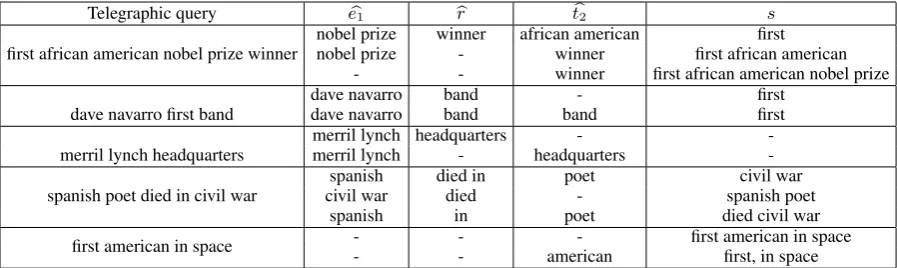
Figure 1 shows some telegraphic queries with possible segmentation into the above parts. Consider another example: dave navarro first band. ‘Band’ is a hint for type /music/musical group, so it com-prises tb2. Dave Navarro is an entity, with men-tion words ‘dave navarro’ comprising eb1. br is made up of ‘band’, and represents the relation /music/group member/membership. Fi-nally, the wordfirstcannot be mapped to any sim-ple KG artifact, so are relegated tos(which makes the corpus a critical part of answer inference). We usesandbsinterchangeably.
Generally, there will be enough noise and uncer-tainty that the search system should try out several of the most promising segmentations as shown in Figure 1. The accuracy of any specific segmenta-tion is expected to be low in such adversarial set-tings. Therefore, support for an answer entity is aggregated over several segmentations. The ex-pectation is that by considering multiple interpre-tations, the system will choose the entity with best supporting evidence from corpus and knowledge base.
4 Our Approach
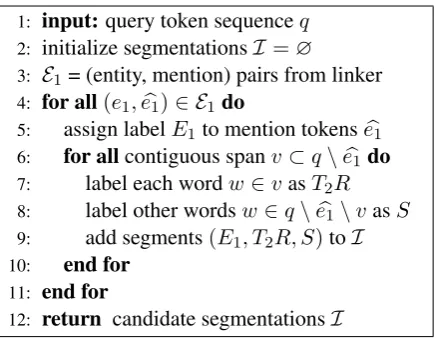
Telegraphic queries are usually short, so we enu-merate query token spans (with some restrictions, similar to beam search) to propose segmentations (§4.1). Candidate response entities are lined up for each interpretation, and then scored in a global model along with query segmentations (§4.2).
1: input:query token sequenceq 2: initialize segmentationsI=∅
3: E1= (entity, mention) pairs from linker
4: for all(e1,eb1)∈ E1do
5: assign labelE1to mention tokenseb1 6: for allcontiguous spanv⊂q\eb1do
7: label each wordw∈vasT2R 8: label other wordsw∈q\eb1\vasS 9: add segments(E1, T2R, S)toI
10: end for 11: end for
[image:4.595.73.292.60.229.2]12: return candidate segmentationsI
Figure 2: Generating candidate query segmenta-tions.
4.1 Generating candidate query segmentations
Each query token can have four labels, E1, T2, R, S, corresponding to the mentions of the base entity, target type, connecting relation, and context words. We found that segments hinting at T2 and R frequently overlapped (e.g., ‘author’ in the query zhivago author). In our implementation, we simplified to three labels, E1, T2R, S, where tokens labeled T2R are involved with both t2 and r, the proposed structured target type and connecting relation. Another reasonable assumption was that the base entity mention and type/relation mentions are contiguous token spans, whereas context words can be scattered in multiple segments.
Figure 2 shows how candidate segmentations are generated. For step 3, we use TagMe (Ferrag-ina and Scaiella, 2010), an entity linker backed by an entity gazette derived from our KG.
4.2 Graphical model
Based on the previous discussion, we assume that an entity-seeking queryq is a sequence of tokens q1, q2, . . ., and this can be partitioned into different kinds of subsequences, corresponding to e1, r, t2 ands, and denoted by a structured (vector) label-ingz = z1, z2, . . .. Given sequencesq andz, we can separate out (possibly empty) token segments
b
e1(q, z),tb2(q, z),br(q, z), andsb(q, z).
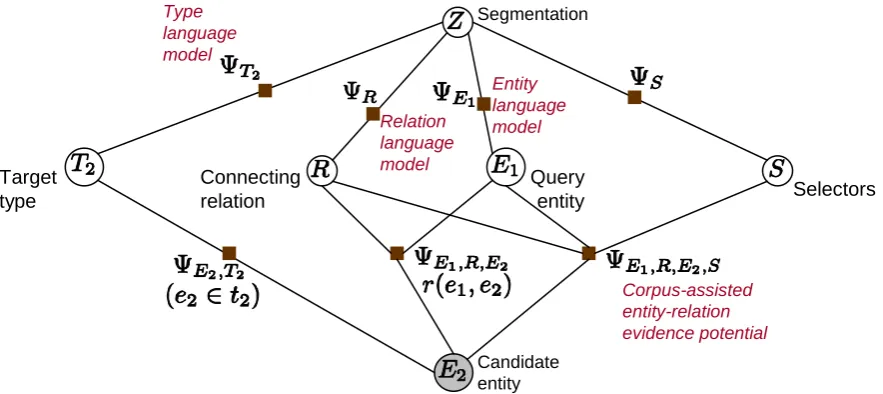
A query segmentation z becomes plausible in conjunction with proposals for e1, r, t2 and e2 from the KG. The probabilityPr(z, e1, r, t2, e2|q) is modeled as proportional to the product of sev-eral potentials (Koller and Friedman, 2009) in a
graphical model. In subsequent subsections, we will present the design of specific potentials.
• ΨR(q, z, r) denotes the compatibility
be-tween the relation hint segment rb(q, z) and a proposed relation typerin the KG (§4.2.1).
• ΨT2(q, z, t2) denotes the compatibility be-tween the type hint segment tb2(q, z) and a proposed target entity type t2 in the KG (§4.2.2).
• ΨE1,R,E2,S(q, z, e1, r, e2) is a novel corpus-based evidence potential that measures how stronglye1 ande2 appear in corpus snippets in the proximity of words inbs(q, z), and ap-parently related by relation typer(§4.2.3).
• ΨE1(q, z, e1) denotes the compatibility be-tween the query segmenteb1(q, z) and entity e1that it purportedly mentions (§4.2.4).
• ΨS(q, z) denotes selector compatibility.
Se-lectors are a fallback label, so this is pinned arbitrarily to 1; other potentials are balanced against this base value.
• ΨE1,R,E2(e1, r, e2) is A if the relation r(e1, e2)exists in the KG, and isB >0 oth-erwise, for tuned/learnt constantsA > B >
0. Note that this is a soft constraint (B >0); if the KG is incomplete, the corpus may be able to supplement the required information.
• ΨE2,T2(e2, t2) is 1 if e2 belongs to t2 and zero otherwise. In other words, candidatee2s must be proposed to be instances of the pro-posedt2 — this is a hard constraint, but can be softened if desired, likeΨE1,R,E2.
Figure 3 shows the relevant variable states as circled nodes, and the potentials as square factor nodes. To rank candidate entities e2, we pin the nodeE2 to each entity in turn. WithE2 pinned, we perform a MAP inference over all other hidden variables and note the score ofe2as the product of the above potentials maximized over choices of all other variables: score(e2) =
maxz,t2,r,e1ΨT2(q, z, t2)ΨR(q, z, r)
ΨE1(q, z, e1)ΨS(q, z)
ΨE2,T2(e2, t2)ΨE1,R,E2(e1, r, e2)
ΨE1,R,E2,S(q, z, e1, r, e2). (1)
We rank candidatee2s by decreasing score, which is estimated by max-product message-passing (Koller and Friedman, 2009).
Target type
Connecting relation
Query
entity Selectors
Type language model
Relation language model
Entity language model
Segmentation
Candidate entity
[image:5.595.80.522.61.258.2]Corpus-assisted entity-relation evidence potential
Figure 3: Graphical model for query segmentation and entity scoring. Factors/potentials are shown as squares. A candidate e2 is observed and scored using equation (1). Queryq is also observed but not shown to reduce clutter; most potentials depend on it.
this case, we allow each of the entity, relation or target type nodes in the graphical to take the value
⊥or ‘null’. To support this, the value of the fac-tor between the query segmentation node Z and
ΨE1(q, z, e1), ΨT2(q, z, t2), and ΨR(q, z, r)) are
set to suitable low values.
Next, we will describe the detailed design of some of the key potentials introduced above.
4.2.1 Relation language model forΨR
Potential ΨR(q, z, r) captures the compatibility
between br(q, z) and the proposed relation r. E.g., if the query is steve jobs death rea-son, and br is (correctly chosen as) death rea-son, then the correct candidate r is /people/ deceased_person/cause_of_death. An incorrectr is/people/deceased_person/ place_of_death. An incorrect zmay lead to b
r(q, z)beingjobs death.
Using corpus: Considerable variation may exist in howr is represented textually in a query. The relation language model needs to build a bridge between the formal r and the textual br, so that (un)likely r’s have (small) large potential. Many approaches (Berant et al., 2013; Berant and Liang, 2014; Kwiatkowski et al., 2013; Yih et al., 2014) to this problem have been intensely studied re-cently. Given our need to process billions of Web pages efficiently, we chose a pattern-based ap-proach (Nakashole et al., 2012): with eachr, dis-cover the most strongly associated phrase patterns
from a reference corpus, then mark these patterns into much larger payload corpus.
We started with the 2000 (out of approximately 14000) most frequent relation types in Freebase, and the ClueWeb09 corpus annotated with Free-base entities (Gabrilovich et al., 2013). For each triple instance of each relation type, we located all corpus sentences that mentioned both participat-ing entities. We made the crude assumption that if r(e1, e2) holds and e1, e2 co-occur in a sen-tence then this sensen-tence is evidence of the rela-tionship. Each such sentence is parsed to obtain a dependency graph using the Malt Parser (Hall et al., 2014). Words in the path connecting the entities are joined together and added to a candi-date phrase dictionary, provided the path is at most three hops. (Inspection suggested that longer de-pendency paths mostly arise out of noisy sentences or botched parses.) 30% of the sentences were thus retained. Finally, we defined
ΨR(q, z, r) = nP(r,rb(q, z))
p0n(r, p0), (2)
wherep0 ranges over all phrases that are known to hint atr, and n(r, p) denotes the number of sen-tences where the phrasepoccurred in the depen-dency path between the entities participating in re-lationr.
of e1 and the given relation hint. Moreover, the remaining noise is further mitigated by the collec-tive scoring in the graphical model. While we may miss relations if they are expressed in the query through obscure hints, allowing the relation to be
⊥acts as a safety net.
Using Freebase relation names: As mentioned earlier, queries may express relations differently as compared to the corpus. A relation model based solely on corpus annotations may not be able to bridge that gap effectively, particularly so, because of sparsity of corpus annotations or the rarity of Freebase triples in ClueWeb. E.g., for the Freebase relation/people/person/profession, we found very few annotated sentences. One way to address this problem is to utilize relation type names in Freebase to map hints to relation types. Thus, in addition to the corpus-derived relation model, we also built a language model that used Freebase relation type names as lemmas. E.g., the word ‘profession’ would contribute to the relation type/people/person/profession.
Our relation models are admittedly simple. This is mainly because telegraphic queries may ex-press relations very differently from natural lan-guage text. As it is difficult to ensure precision of query interpretation stage, our models are geared towards recall. The system generates a large num-ber of interpretations and relies on signals from the corpus and KG to bring forth correct interpre-tations.
4.2.2 Type language model forΨT2
Similar to the relation language model, we need a type language model to measure compatibil-ity between t2 and tb2(q, z). Estimating the tar-get entity type, without generalizing or over-specifying it, has always been important for QA. E.g., whentb2is ‘city’, a good type language model should prefer t2 as /location/citytown over /location/location while avoiding /location/es_autonomous_city.
A catalog like Freebase suggests a straight-forward method to collect a type language model. Each type is described by one or more phrases through the link/common/topic/alias. We can collect these into a micro-‘document’ and use a standard Dirichlet-smoothed language model from IR (Zhai, 2008). In Freebase, an entity node (e.g., Einstein, /m/0jcx) may be linked to a type node (e.g. /base/scientist/
physicist) using an edge with label/type/ object/type.
But relation types provide additional clues to types of the endpoint entities. Freebase relation types have the form /x/y/z, where x is the domain of the relation, and y and z are string representations of the type of the entities partic-ipating in the relation. E.g., the (directed) re-lation type /location/country/capital connects from from /location/country to /location/citytown. Therefore, “capital” can be added to the set of descriptive phrases of entity type/location/citytown.
It is important to note that while we use Free-base link nomenclature for relation and type lan-guage models, our models are not incompati-ble with other catalogs. Indeed, most catalogs have established ways of deriving language mod-els that describe their various structures. For ex-ample, most YAGO types are derived from Word-Net synsets with associated phrasal descriptions (lemmas). YAGO relations also have readable names such as actedIn, isMarriedTo, etc. which can be used to estimate language models. DB-Pedia relations are mostly derived from (mean-ingfully) named attributes taken from infoboxes, hence they can be used directly. Furthermore, oth-ers (Wu and Weld, 2007) have shown how to asso-ciate language models with such relations.
4.2.3 Snippet scoring
The factor ΨE1,R,E2,S(q, z, e1, r, e2) should be large if many snippets contain a mention ofe1and e2, relationr, and many high-signal words froms. Recall that we begin with a corpus annotated with entity mentions. Our corpus is not directly anno-tated with relation mentions. Therefore, we get from relations to documents via high-confidence phrases. Snippets are retrieved using a combined entity + word index, and scored for a givene1,r, e2, and selectorsbs(q, z).
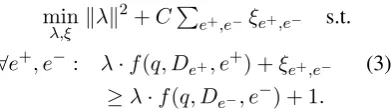
RankSVM-style (Joachims, 2002) optimization.
min λ,ξ kλk
2+CP
e+,e−ξe+,e− s.t.
∀e+, e−: λ·f(q, De+, e+) +ξe+,e− (3)
≥λ·f(q, De−, e−) + 1.
where e+ and e− are positive and negative enti-ties for the queryq andf(q, De, e)represents the
feature map for the set of snippetsDe belonging
[image:7.595.94.290.87.143.2]to entity e. The assumption here is that all snip-pets containing e+ are “positive” snippets for the query.fconsolidates various signals like the num-ber of snippets where e occurs near query entity e1and a relation phrase, or the number of snippets with high proportion of query IDF, hinting thate is a positive entity for the given query. A partial list of features used for snippet scoring is given in Figure 4.
Number of snippets with distance(e2,eb1)< k1(k1= 5, 10) Number of snippets with distance(e2, relation phrase)< k2
(k2= 3, 6)
Number of snippets with relationr=⊥
Number of snippets with relation phrases as prepositions Number of snippets covering fraction of query IDF> k3
(k3= 0.2, 0.4, 0.6, 0.8)
Figure 4: Sample features used for learning weightsλto score snippets.
4.2.4 Query entity model
Potential ΨE1(q, z, e1) captures the compatibil-ity betweeneb1(q, z) (i.e., the words that mention e1) and the claimed entity e1 mentioned in the query. We used the TagMe entity linker (Fer-ragina and Scaiella, 2010) for annotating enti-ties in queries. TagMe annotates the query with Wikipedia entities, which we map to Freebase, and use the annotation confidence scores as the poten-tialΨE1(q, z, e1).
4.3 Discriminative parameter training with latent variables
We first set the potentials in (1) as explained in
§4.2 (henceforth called ‘Unoptimized’), and got encouraging accuracy. Then we rewrote each po-tential as
Ψ•(· · ·) = exp w•·φ•(· · ·) (4) or logQ•Ψ•(· · ·) =P•w•·φ•(· · ·),
withw•being a weight vector for a specific poten-tial•, andφ•being a corresponding feature vector.
During inference, we seek to maximize
max
q,z,e1,t2,rw·φ(q, z, e1, t2, r, e2), (5)
for a fixed w, to find the score of each candidate entitye2. Here allw• andφ• have been collected into unified weight and feature vectorsw, φ. Dur-ing trainDur-ing ofw, we are given pairs of correct and incorrect answer entities e+
2, e−2, and we wish to satisfy constraints of the form
max
q,z,e1,t2,rw·φ(q, z, e1, t2, r, e +
2) +ξ (6)
≥1 + max
q,z,e1,t2,rw·φ(q, z, e1, t2, r, e − 2),
because collectinge+2, e−2 pairs is less work than supervising with values ofz, e1, t2, r, e2 for each query. Similar distant supervision problems were posed via bundle method by (Bergeron et al., 2008), and (Yu and Joachims, 2009), who used CCCP (Yuille and Rangarajan, 2006). These are equivalent in our setting. We use the CCCP style, and augment the objective with an additional en-tropy term as in (Sawant and Chakrabarti, 2013). We call this LVDT (latent variable discriminative training) in§5.
5 Experiments
5.1 Testbed
Corpus and knowledge graph: We used the ClueWeb09B (ClueWeb09, 2009) corpus contain-ing 50 million Web documents. This corpus was annotated by Google with Freebase enti-ties (Gabrilovich et al., 2013). The average page contains 15 entity annotations from Freebase. We used the Freebase KG and its links to Wikipedia.
There are some notable differences between these query sets. For WQT, queries were gener-ated by using Google’s query suggestions inter-face. Volunteers were asked to find answers using single Freebase pages. Therefore, by construction, queries retained can be answered using the Free-base KG alone, with a simple r(e1,?) form. In contrast, TREC-INEX queries provide a balanced mix oft2 andrhints in the queries, and direct an-swers from triples is relatively less available.
5.2 Implementation details
On an average, the pseudocode in Figure 2 generated 13 segmentations per query, with longer queries generating more segmentations than shorter ones.
We used an MG4J (Boldi and Vigna, 2005) based query processor, written in Java, over en-tity and word indices on ClueWeb09B. The in-dex supplies snippets with a specified maximum width, containing a mention of some entity and satisfying a WAND (Broder et al., 2003) predi-cate over words in bs. In case of phrases in the query, the WAND threshold was computed by adding the IDF of constituent words. The index returned about 330,000 snippets on average for WAND threshold of 0.6.
We retained the top 200 candidate entities from the corpus; increasing this horizon did not give benefits. We also considered as candidates fore2 those entities that are adjacent to e1 in the KG via top-scoring r candidates. In order to gener-ate supporting snippets for an interpretation con-taining entity annotation e, we need to match e with Google’s corpus annotations. However, re-lying solely on corpus annotations fails to retrieve many potential evidence snippets, because entity annotations are sparse. Therefore we probed the token index with the textual mention of e1 in the query; this improved recall.
We also investigated the feasibility of our pro-posals for interactive search. There are three major processes involved in answering a query - gener-ating potential interpretations, collecting/scoring snippets, and inference (MAP for Unoptimized andwφ(·) for LVDT). For the WQT dataset, av-erage time per query for each stage was approx-imately - 0.2, 16.6 and 1.3 seconds respectively. Our (Java) code did not optimize the bottleneck at all; only 10 hosts and no clever load balancing
were used. We believe commercial search engines can cut this down to less than a second.
5.3 Research questions
In the rest of this section we will address these questions:
• For telegraphic queries, is our entity-relation-type-selector segmentation better than the type-selector segmentation of (Sawant and Chakrabarti, 2013)?
• When semantic parsers (Berant et al., 2013; Kwiatkowski et al., 2013) are subjected to telegraphic queries, how do they perform compared to our proposal?
• Are the KG and corpus really complementary as regards their support of accurate ranking of candidate entities?
• Is the prediction of r and t2 from our ap-proach better than a greedy assignment based on local language models?
We also discuss anecdotes of successes and fail-ures of various systems.
5.4 Benefits of relation in addition to type
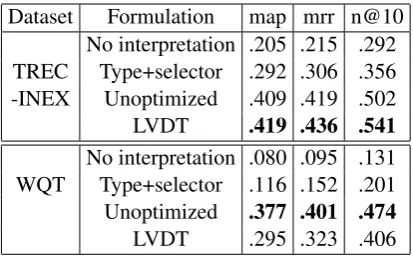
Figure 5 shows entity-ranking MAP, MRR, and NDCG@10 (n@10) for two data sets and vari-ous systems. “No interpretation” is an IR baseline without any KG. Type+selector is our implemen-tation of (Sawant and Chakrabarti, 2013). Unopti-mized and LVDT both beat “no interpretation” and “type+selector” by wide margins. (Boldface im-plies best performing formulation.) There are two notable differences between S&C and our work. First, S&C do not use the knowledge graph (KG) and rely on a noisy corpus. This means S&C fails to answer queries whose answers are found only in KG. This can be seen from WQT results; they perform only slightly better than the baseline. Sec-ond, even for queries that can be answered through the corpus alone, S&C miss out on two important signals that the query may provide - namely the query entity and the relation. Our framework not only provides a way to use a curated and high pre-cision knowledge graph but also attempts to pro-vide more reachability to corpus by the use of re-lational phrases.
Dataset Formulation map mrr n@10 No interpretation .205 .215 .292 TREC Type+selector .292 .306 .356 -INEX Unoptimized .409 .419 .502
LVDT .419 .436 .541
No interpretation .080 .095 .131 WQT Type+selector .116 .152 .201 Unoptimized .377 .401 .474
[image:9.595.78.285.61.189.2]LVDT .295 .323 .406
Figure 5: ‘Entity-relation-type-selector’ segmen-tation yields better accuracy than ‘type-selector’ segmentation.
objective makes matters worse. The bias in our unoptimized model circumvents training noise.
5.5 Comparison with semantic parsers
For TREC-INEX, both unoptimized and LVDT beat SEMPRE (Berant et al., 2013) convinc-ingly, whether it is trained with Free917 or Web-Questions (Figure 6).
SEMPRE’s relatively poor performance, in this case, is explained by its complete reliance on the knowledge graph. As discussed previously, the TREC-INEX dataset contains a sizable proportion of queries that may be difficult to answer using a KG alone. When SEMPRE is compared with our systems with a telegraphic sample of Web-Questions (WQT), results are mixed. Our Unop-timized model still compares favorably to SEM-PRE, but with slimmer gains. As before, LVDT falls behind.
Dataset Formulation map mrr n@10 SEMPRE(Free917) .154 .159 .186 TREC SEMPRE(WQ) .197 .208 .247 -INEX Unoptimized .409 .419 .502
LVDT .419 .436 .541
SEMPRE(Free917) .229 .255 .285 WQT SEMPRE(WQ) .374 .406 .449 Unoptimized .377 .401 .474
Jacana .239 .256 .329 LVDT .295 .323 .406
Figure 6: Comparison with semantic parsers.
Our smaller gains over SEMPRE in case of WebQuestions is explained by how WebQuestions was assembled (Berant et al., 2013). Although Google’s query suggestions gave an eclectic pool, only those queries survived that could be answered
using a single Freebase page, which effectively re-duced the role of a corpus. In fact, a large frac-tion of WQT queries cannot be answered well us-ing the corpus alone, because FACC1 annotations are too sparse and rarely cover common nouns and phrases such as ‘democracy’ or ‘drug overdose’ which are needed for some WQT queries.
For WQT, our system also compares favorably with Jacana (Yao and Van Durme, 2014). Given that they subject their input to natural langauge parsing, their relatively poor performance is not unsurprsing.
[image:9.595.307.526.378.560.2]5.6 Complementary benefits of KG & corpus
Figure 7 shows the synergy between the corpus and the KG. In all cases and for all metrics, using the corpus and KG together gives superior perfor-mance to using any of them alone. However, it is instructive that in case of TREC-INEX, corpus-only is better than KG-corpus-only, whereas this is re-versed for WQT, which also supports the above argument.
Data Formulation map mrr n@10
TREC-INEX
Unoptimized (KG) .201 .209 .241 Unoptimized (Corpus) .381 .388 .471 Unoptimized (Both) .409 .419 .502
LVDT (KG only) .255 .264 .293 LVDT (Corpus) .267 .272 .315 LVDT (Both) .419 .436 .541
WQT
Unoptimized (KG) .329 .343 .394 Unoptimized (Corpus) .188 .228 .291 Unoptimized (Both) .377 .401 .474
LVDT (KG only) .257 .281 .345 LVDT (Corpus only) .170 .210 .280 LVDT (Both) .295 .323 .406
Figure 7: Synergy between KB and corpus.
5.7 Collective vs. greedy segmentation
To judge the quality of interpretations, we asked paid volunteers to annotate queries with an appro-priate relation and type, and compared them with the interpretations associated with top-ranked en-tities. Results in Figure 8 indicate that in spite of noisy relation and type language models, our formulations produce high quality interpretations through collective inference.
Formulation Type Relation Type/Rel Unoptimized (top 1) 23 49 60 Unoptimized (top 5) 29 57 68
LVDT (top 1) 25 52 61
[image:10.595.77.290.61.132.2]LVDT (top 5) 33 61 69
Figure 8: Fraction of queries (%) with correct in-terpretations oft2,r, andt2orr, on TREC-INEX.
evaluation. Collective inference boosts absolute MAP by as much as 0.2.
Dataset Formulation map mrr n@10 Unoptimized (greedy) .343 .347 .432 TREC Unoptimized .409 .419 .502 -INEX LVDT (greedy) 205 .214 .259 LVDT .419 .436 .541 Unoptimized (greedy) .246 .271 .335 Unoptimized .377 .401 .474 WQT LVDT (greedy) .212 .246 .317 LVDT .295 .323 .406
Figure 9: Collective vs. greedy segmentation
5.8 Discussion
Closer scrutiny revealed that collective infer-ence often overcame errors in earlier stages to produce a correct ranking over answer en-tities. E.g., for the query automobile com-pany makes spider the entity disambiguation stage fails to identify the car Alfa Romeo Spi-der (/m/08ys39). However, the interpretation stage recovers from the error and segments the query with Automobile (/m/0k4j) as the query entity e1, /organization/organization and /business/industry/companies as target typet2and relationrrespectively (from the relation/type hint ‘company’), and spider as
se-Figure 10: Comparison of various approaches for NDCG at rank 1 to 10, TREC-INEX dataset
Figure 11: Comparison of various approaches for NDCG at rank 1 to 10, WQT dataset
lector to arrive at the correct answer Alfa Romeo (/m/09c50). The corpus features also play a cru-cial role for queries which may not be accurately represented with an appropriate logical formula. For the query meg ryan bookstore movie, the textual patterns for the relationActedInin con-junction with the selector word ‘bookstore’ cor-rectly identifies the answer entity You’ve Got Mail (/m/014zwb).
We also analyzed samples of queries where our system did not perform particularly well. We observed that one of the recurring themes of these queries was that their answer enti-ties had very little corpus support, and the type/relation hint mapped to too many or no candidate type/relations. For example, in the query south africa political system, the rel-evant type/relation hint ‘political system’ could not be mapped to /government/form_of_ government and /location/country/ form_of_governmentrespectively.
6 Conclusion and future work
[image:10.595.308.532.63.186.2] [image:10.595.74.297.601.722.2]References
Jonathan Berant and Percy Liang. 2014. Semantic parsing via paraphrasing. InACL Conference. Jonathan Berant, Andrew Chou, Roy Frostig, and Percy
Liang. 2013. Semantic parsing on Freebase from question-answer pairs. In Empirical Methods in Natural Language Processing (EMNLP).
Charles Bergeron, Jed Zaretzki, Curt Breneman, and Kristin P. Bennett. 2008. Multiple instance ranking. InICML, pages 48–55. ACM.
Paolo Boldi and Sebastiano Vigna. 2005. MG4J at TREC 2005. In Ellen M. Voorhees and Lori P. Buck-land, editors,TREC, number SP 500-266 in Special Publications. NIST.
Andrei Z. Broder, David Carmel, Michael Herscovici, Aya Soffer, and Jason Zien. 2003. Efficient query evaluation using a two-level retrieval process. In
CIKM, pages 426–434. ACM.
Tao Cheng and Kevin Chen-Chuan Chang. 2010. Be-yond pages: supporting efficient, scalable entity search with dual-inversion index. InEDBT. ACM. ClueWeb09. 2009. http://www.
lemurproject.org/clueweb09.php/. Anthony Fader, Luke Zettlemoyer, and Oren Etzioni.
2014. Open question answering over curated and extracted knowledge bases. In SIGKDD Confer-ence.
Paolo Ferragina and Ugo Scaiella. 2010. TAGME: on-the-fly annotation of short text fragments (by wikipedia entities). CoRR/arXiv, abs/1006.3498.
http://arxiv.org/abs/1006.3498. Evgeniy Gabrilovich, Michael Ringgaard, and
Amar-nag Subramanya. 2013. FACC1: Free-base annotation of ClueWeb corpora. http:// lemurproject.org/clueweb12/, June. Ver-sion 1 (Release date 2013-06-26, Format verVer-sion 1, Correction level 0).
Sean Gallagher. 2012. How Google and Microsoft taught search to ‘understand’ the Web. ArsTechnica article. http://goo.gl/NWs0zT.
Jiafeng Guo, Gu Xu, Xueqi Cheng, and Hang Li. 2009. Named entity recognition in query. InSIGIR Con-ference, pages 267–274. ACM.
Johan Hall, Jens Nilsson, and Joakim Nivre. 2014. Maltparser.http://www.maltparser.org/. Thorsten Joachims. 2002. Optimizing search engines using clickthrough data. In SIGKDD Conference, pages 133–142. ACM.
Gjergji Kasneci, Fabian M. Suchanek, Georgiana Ifrim, Maya Ramanath, and Gerhard Weikum. 2008. NAGA: Searching and ranking knowledge. In
ICDE. IEEE.
Daphne Koller and Nir Friedman. 2009. Probabilistic Graphical Models: Principles and Techniques. MIT Press.
Tom Kwiatkowski, Eunsol Choi, Yoav Artzi, and Luke S. Zettlemoyer. 2013. Scaling seman-tic parsers with on-the-fly ontology matching. In
EMNLP Conference, pages 1545–1556.
Xiaonan Li, Chengkai Li, and Cong Yu. 2010. Enti-tyEngine: Answering entity-relationship queries
us-ing shallow semantics. InCIKM, October. (demo). Yanen Li, Bo-Jun Paul Hsu, ChengXiang Zhai, and
Kuansan Wang. 2011. Unsupervised query segmen-tation using clickthrough for information retrieval. InSIGIR Conference, pages 285–294. ACM. Percy Liang. 2013. Lambda
dependency-based compositional semantics. Technical Report arXiv:1309.4408, Stanford University. http:// arxiv.org/abs/1309.4408.
Thomas Lin, Patrick Pantel, Michael Gamon, Anitha Kannan, and Ariel Fuxman. 2012. Active objects: Actions for entity-centric search. InWWW Confer-ence, pages 589–598. ACM.
Ndapandula Nakashole, Gerhard Weikum, and Fabian Suchanek. 2012. PATTY: A taxonomy of relational patterns with semantic types. In EMNLP Confer-ence, EMNLP-CoNLL ’12, pages 1135–1145. ACL. Patrick Pantel, Thomas Lin, and Michael Gamon. 2012. Mining entity types from query logs via user intent modeling. In ACL Conference, pages 563– 571, Jeju Island, Korea, July.
Fernando Pereira. 2013. Meaning in the wild. Invited talk at EMNLP Conference.
http://hum.csse.unimelb.edu.au/ emnlp2013/invited-talks.html.
Jeffrey Pound, Alexander K. Hudek, Ihab F. Ilyas, and Grant Weddell. 2012. Interpreting keyword queries over Web knowledge bases. InCIKM.
Nikos Sarkas, Stelios Paparizos, and Panayiotis Tsaparas. 2010. Structured annotations of Web queries. InSIGMOD Conference.
Uma Sawant and Soumen Chakrabarti. 2013. Learn-ing joint query interpretation and response rankLearn-ing. InWWW Conference, Brazil.
Fei Wu and Daniel S Weld. 2007. Automatically se-mantifying Wikipedia. InCIKM, pages 41–50. Mohamed Yahya, Klaus Berberich, Shady
Elbas-suoni, Maya Ramanath, Volker Tresp, and Gerhard Weikum. 2012. Natural language questions for the Web of data. In EMNLP Conference, pages 379– 390, Jeju Island, Korea, July.
Xuchen Yao and Benjamin Van Durme. 2014. Infor-mation extraction over structured data: Question an-swering with Freebase. InACL Conference. ACL. Xuchen Yao, Jonathan Berant, and Benjamin Van
Durme. 2014. Freebase QA: Information extrac-tion or semantic parsing? InACL 2014 Workshop on Semantic Parsing (SP14).
Wen-tau Yih, Xiaodong He, and Christopher Meek. 2014. Semantic parsing for single-relation question answering. InACL Conference. ACL.
Chun-Nam John Yu and Thorsten Joachims. 2009. Learning structural SVMs with latent variables. In
ICML, pages 1169–1176. ACM.
A. L. Yuille and Anand Rangarajan. 2006. The concave-convex procedure. Neural Computation, 15(4):915–936.