PaCCSS–IT: A Parallel Corpus of Complex–Simple Sentences for Automatic
Text Simplification
Dominique Brunato, Andrea Cimino, Felice Dell’Orletta, Giulia Venturi Istituto di Linguistica Computazionale “Antonio Zampolli” (ILC–CNR)
ItaliaNLP Lab -www.italianlp.it
{name.surname}@ilc.cnr.it
Abstract
In this paper we present PaCCSS–IT, a Paral-lel Corpus of Complex–Simple Sentences for ITalian. To build the resource we develop a new method for automatically acquiring a cor-pus of complex–simple paired sentences able to intercept structural transformations and par-ticularly suitable for text simplification. The method requires a wide amount of texts that can be easily extracted from the web making it suitable also for less–resourced languages. We test it on the Italian language making avail-able the biggest Italian corpus for automatic text simplification.
1 Introduction
The availability of monolingual parallel corpora is a prerequisite for research on automatic text sim-plification (ATS), i.e. the task of reducing sentence complexity by preserving the original meaning. This has been recently shown for different languages, e.g. English (Zhu et al., 2010; Woodsend and Lapata, 2011; Wubben et al., 2012; Siddharthan and An-grosh, 2014), Spanish (Bott and Saggion, 2011; Bott and Saggion, 2014), French (Brouwers et al., 2014), Portuguese (Caseli et al., 2009), Danish (Klerke and Søgaard, 2012), Italian (Brunato et al., 2015). While English can rely on large datasets like the well-known Parallel Wikipedia Simplification cor-pus (Coster and Kauchak, 2011; Zhu et al., 2010) and, more recently, the Newsela corpus (Xu et al., 2015), for other languages similar resources are dif-ficult to acquire and tend to be very small, thus pre-venting the application of data–driven techniques to
automatically induce simplification operations. This is true for the language we are considering, i.e. Italian, where the only documented corpus for text simplification contains approximately 1,000 aligned original and manually simplified sentences (Brunato et al., 2015).
In this paper we present PaCCSS–IT, a Parallel Corpus of Complex–Simple Aligned Sentences for ITalian. To build the resource we developed a new approach for automatically acquiring a large corpus of paired sentences containing structural transfor-mations which can be used as a developmental re-source for text simplification systems. The proposed approach relies on monolingual sentence alignment techniques which have been exploited in different scenarios such as e.g. paraphrase detection (Ganitke-vitch et al., 2013; Barzilay and Lee, 2003; Dolan et al., 2004) and evaluation (Chen and Dolan, 2011), question answering (Fader et al., 2013), textual en-tailment (Bosma and Callison-Burch, 2007), ma-chine translation (Marton et al., 2009), short answer scoring (Koleva et al., 2014), domain adaptation of dependency parsing (Choe and McClosky, 2015). Specifically in ATS, these techniques are typically applied to already existing parallel corpora; in this case the task of aligning the original sentence to its corresponding simple version can be tackled by ap-plying similarity metrics that consider the TF/IDF score of the words in the sentence (Barzilay and El-hadad, 2003; Nelken and Shieber, 2006; Coster and Kauchak, 2011) or methods taking into account also the order in which information is presented (Bott and Saggion, 2011).
Differently from these methods, our approach
contains two important novelties: the typology of the starting data and consequently the methodol-ogy developed to build the complex–simple aligned corpus. To overcome the scarcity of large paral-lel corpora of complex and simple texts in less– resourced languages like Italian, we started from a wide amount of texts that can be easily extracted from the web for all languages. This makes our method less expensive since it does not need a man-ually created corpus of aligned documents.
The proposed alignment method has been strongly shaped by the perspective from which we investigate text simplification, i.e. syntactic rather than lexical simplification. While lexical simplifi-cation aims at the substitution of complex words by simpler synonyms, syntactic simplification attempts to reduce complexity at grammatical level (Bott and Saggion, 2014). As shown by comparative analy-ses of monolingual parallel corpora in many lan-guages, syntactic simplification concerns transfor-mations affecting e.g. verbal features, the order of phrases or the deletion of redundant or unnecessary words (Brunato et al., 2015; Bott and Saggion, 2014; Coster and Kauchak, 2011; Caseli et al., 2009). Fol-lowing this second perspective we define a method for bootstrapping and pairing sentences that inter-cepts simplification operations at morpho–syntactic and syntactic level typically used by human experts when simplify real texts.
Section 2 illustrates the approach to automatically acquire the corpus of complex–simple aligned sen-tences. In Section 3, the approach is tested and tuned on a development corpus. In Section 4, our approach is applied on a large corpus thus obtaining the final corpus of paired sentences, named PaCCSS–IT. In this last section, we also provide a global evaluation of the whole process and a qualitative analysis of the linguistic phenomena related to sentence complexity that we intercepted.
2 The Approach
Our approach for automatically acquiring the collec-tion of paired sentences combines three steps. In a first step, we devised an unsupervised methodol-ogyi)to collect pools of sentences from a large cor-pus with overlapping lexicon but possible different structures; ii) to rank the resulting candidate
sen-tences according to a similarity metric intended to bootstrap lexical–equivalent pairs undergoing struc-tural transformations. In the second step, the top–list of the ranked pairs was manually revised and used to develop a classifier based on lexical, morpho– syntactic and syntactic features to detect the sen-tences correctly paired. In the third step, the indi-vidual sentences of each pair were ordered with re-spect to linguistic complexity computed by using an automatic readability assessment tool.
This approach has been tuned on PAIS `A1
(Ly-ding et al., 2014) and tested on ItWaC (Baroni et al., 2009). The two analysed corpora were auto-matically POS tagged by the Part–Of–Speech tagger described in Dell’Orletta (2009) and dependency– parsed by the DeSR parser (Attardi et al., 2009).
PAIS `A is a freely distributed corpus of texts with Creative Commons license automatically harvested from the web. This corpus includes approximately 388,000 documents for a total of 250 millions of tokens and it is a large existing corpus of authen-tic contemporary texts in Italian which is free of copyright restrictions. ItWaC is the largest exist-ing corpus of authentic contemporary texts in Ital-ian. It is a 2 billion word corpus constructed from the Web limiting the crawl to the .it domain and us-ing medium-frequency words from La Repubblica
journalistic corpus and Basic Italian Vocabulary lists as seeds.
2.1 Unsupervised Step
The first step is aimed at clustering all sentences contained in a large corpus. To be included in the same cluster, the sentences have to share all lem-mas tagged with the Part–Of–Speech (POS) “noun”, “verb”, “numeral”, “personal pronoun” and “nega-tive adverb”. Nouns and verbs were selected be-cause they capture the informational content of a sentence. The other functional categories have also to be shared, otherwise the meaning of the sentence would be altered. For example, the deletion of the negative adverbnon(not) in one of the two follow-ing sentences would convey the opposite meanfollow-ing:
Non farei mai una cosa del genere! (I would never
do something like that) Non potevo fare una cosa
del genere. (I could not do something like that). In
the overlapping process we did not take into account the linear order of the considered lemma POS. This was meant to capture lexically–equivalent sentences undergoing potential structural transformations (e.g. passivization, topicalization).
All sentences within the same cluster were paired and the pairs were ranked for similarity by calcu-lating the cosine distance between the sentence vec-tors. Each vector is constituted by the frequencies in the cluster of all lemma of the sentence. The co-sine similarity served to discard different and equal or quasi–equal sentences.
The whole unsupervised step was used to select the set of candidate pairs reducing the number of pairs on which the following supervised step had been applied.
2.2 Supervised Step
The supervised step is meant to classify whether candidate pairs were correctly or incorrectly aligned. To this end, we built a classifier based on Support Vector Machines with a quadratic kernel using LIB-SVM (Chang and Lin, 2001) that was trained on a corpus of paired sentences correctly aligned. The classifier used different types of linguistic features, i.e. lexical, morpho–syntactic and syntactic, meant to mainly capture structural transformations occur-ring in the paired sentences.
These features were extracted both calculating their distribution in each sentence and consider-ing their overlap between the two paired sentences. They can be classified into the following types:
cosine similarity feature: it refers to the cosine value calculated for each pair of sentences;
raw text feature: it refers to the sentence length cal-culated in terms of i) tokens of each of the two paired sentences and ii) the different number of tokens be-tween the two sentences;
lexical features: they refer to i) the lemma uni-grams contained in the two sentences excluding the PoS already considered in the pairing process (i.e. nouns, verbs, numerals, personal pronouns, negative adverbs); ii) the distribution of word unigrams over-lapping between the two paired sentences consider-ing all PoS.
morpho–syntactic feature: it refers to the distribu-tion of up to 4–grams of coarse grained Parts–Of– Speech;
syntactic features: they refer to i) the distribution of up to 4–grams of dependency types calculated with respect to the hierarchical parse tree structure and the surface linear ordering of words; ii) the distribu-tion of up to 4–grams of coarse grained Parts–Of– Speech of a dependent (d) involved in a dependency relation and the dependency relation type (t) with re-spect to the hierarchical parse tree structure.
2.3 Readability Assessment Step
In the third step, the individual sentences of each classified pair were ordered with respect to linguistic complexity computed by using an automatic read-ability assessment tool. In text simplification re-search it is widely accepted the use of readability as-sessment metrics for evaluating the transformations that reduce sentence complexity (Zhu et al., 2010; Woodsend and Lapata, 2011; Vajjala and Meurers, 2016). Since our approach is devoted to building re-sources for developing ATS systems, we relied on readability assessment techniques to rank the indi-vidual sentences of the pair. To this aim, we used READ–IT (Dell’Orletta et al., 2011), the only exist-ing NLP–based readability assessment tool devised for Italian. It operates on syntactically parsed texts and assigns to each sentence a score quantifying its readability. The assigned readability score ranges between 0 (easy–to–read) and 1 (difficult–to–read) referring to the percentage probability for the docu-ments or sentences to belong to the class of difficult– to–read documents. The two poles were defined on two typologies of texts belonging to the same tex-tual genre (i.e. newswire texts) but intended for dif-ferent users: adults with a rudimentary literacy level or with mild intellectual disabilities for the easy–to– read pole and readers of a national daily newspaper considered of medium difficulty for∼70% of Italian
laymen for the difficult–to–read pole.
3 Tuning Process and Evaluation
Cosine nocorrectpairs %correctpairs
0.92 54 12.03
0.91 151 29.49
0.90 91 26.76
0.89 157 23.36
0.88 331 48.04
0.87 336 68.15
0.86 674 57.36
0.85 107 57.22
0.84 176 61.75
0.83 1096 40.35
0.71 1092 38.97
0.70 62 27.80
[image:4.612.90.283.56.232.2]Total: 4,327
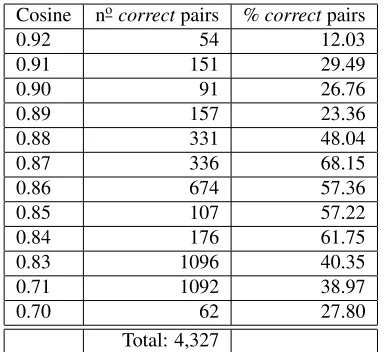
Table 1: Absolute number and % distribution ofcorrect ex-tracted pairs for each manually reviewed cosine threshold in PAIS ´A.
We obtained 256,383 clusters containing at least two sentences. In order to discard different and equal or quasi–equal sentences we empirically set two cosine pruning thresholds: we discarded pairs with cosine below 0.4 since they were too lexically different and above 0.93 since they were too identical.
To build the training set for the supervised step we selected a subset of pairs resulting from the un-supervised step at different cosine similarity scores. This subset was manually reviewed by two native– speaker linguists with a background in text sim-plification. Specifically, they reviewed a subset of 10,543 pairs at different cosine similarity scores, i.e. those comprised between 0.92 and 0.83. In order to evaluate sentence similarity at lower values we also selected cosine scores 0.71 and 0.70. In the end, we obtained 4,327 correct pairs (i.e. about 41% of the whole set of candidate sentence pairs) distributed as in Table 1.
This manually revised set of pairs was then used to test the classifier in two different experimental scenarios. In the first one, named Known Cosine, KC, we tested the classifier in a five–fold cross val-idation process where pairs of sentences belonging to all the cosine scores were contained in each train-ing and test set. In the second experiment, named
Unknown Cosine, UC, the manually–revised corpus
was differently split. In this case, the test set was composed by pairs of sentences with a cosine simi-larity score not contained in the training set and
con-Figure 1:Accuracy of theKCandUCexperiments compared with the distribution of correctly paired sentences at different cosine similarity scores.
sequently twelve classification runs were performed. In order to assess the discriminating power of the linguistic features used in the classification, we car-ried out an Information Gain analysis. This analy-sis showed the effectiveness of all the selected fea-tures in both experiments (i.e. KC, UC). In particu-lar, we observed that the best ranked features are the morpho–syntactic and syntactic ones. This might suggest that our classification approach is intercept-ing pairs of sentences undergointercept-ing different typolo-gies of structural transformations involving e.g. the use of verbal features or the order of phrases. Sen-tence length and lexical features play a lower dis-criminative role with respect to the grammatical fea-tures; this follows from the constraints we put on the unsupervised sentence pairing process. As it can be expected, the best ranked features are those provid-ing information about the overlappprovid-ing characteris-tics of the paired sentences.
Figure 1 and 2 report the results for each cosine threshold considered in the manual revision of the two experiments respectively in terms of i) Accu-racy in the classification of thecorrectandincorrect
alignments, and ofii)Precision, Recall of the classi-fication of thecorrectalignments. As it can be noted in Figure 1, in both experiments the classifier is able to outperform the process of sentence pairing based only on the cosine (i.e. lineCosine, that represents the unsupervised step of the pairing process). As we can expect, Precision, Recall and Accuracy of the
[image:4.612.320.539.62.193.2]Figure 2:Precision and Recall of the two experiments (KCand UC) in the classification of thecorrect alignments.
challenging experimental scenario where the classi-fier is tested on a cosine threshold unseen in training. The overall results for the KC and theUC experi-ments are respectively 73.95% and 58.71% in terms of Precision, 70.3% and 68.1% in terms of Recall; and respectively 77.64% and 67.2% in terms of Ac-curacy. These results are significantly higher when compared with the accuracy of 41% reported for the unsupervised alignment (i.e. lineCosine). Interest-ingly, in the KC experiment, Precision and Recall lines are close and they remain stable with respect to all cosines even if the distribution of correct pairs varies in the different cosine values.
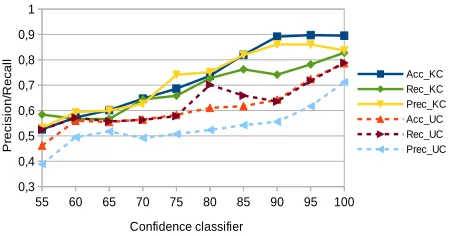
Figure 3 shows the accuracy of our classifier at different confidence thresholds (i.e. the probability assigned by the classifier for thecorrectalignments) for both theKCandUCexperiments. Note that for each confidence intervals we have a different num-ber of total pairs, and of gold-correct alignments and gold-incorrect alignments. As expected, the perfor-mance grows as the confidence grows. Interestingly, in theKCscenario, the classifier reached up to 90% of accuracy in discriminating the correct from the
incorrectalignments when the classifier has a
confi-dence score≥0.90. These results look very promis-ing if we consider that 30% of the pairs of the whole test set classified as correct alignments is comprised in the subset for which the classifier is more con-fident. This is also the case of theUC experiment, where, even if with lower accuracies, more than 56% of thecorrectalignments occurs when the classifier has a confidence score≥0.90.
We carried out a last evaluation to estimate the classifier performance in the UC scenario for low
Figure 3: Classifier performance in theKC and UC experi-ments with probability intervals reported along thexaxis.
cosine ranges not comprised in the manually revised portion of the corpus (from 0.45 to 0.75, exclud-ing cosines 0.70 and 0.71). We considered only the pairs classified ascorrectwith a confidence score of
≥85%. As expected, the system performance grows
as the cosine grows: only few correct pairs occur at cosine<0.60, at cosine 0.60–0.65 the classifier as-signs the correctclass 237 times with an accuracy of 62.97%, at 0.65–0.69 330 times with 71.82% and at 0.72–0.75 256 times with an accuracy of 87.89%. According to these evaluations, we extracted from PAIS ´A those pairs with a confidence score ≥ 85%
and cosine similarity between 0.6 and 0.93, resulting in a collection of about 20,000 pairs.
[image:5.612.315.540.71.189.2]4 PaCCSS–IT
The unsupervised step applied to ItWaC resulted in
∼28 million of clusters with overlapping lexicon for
a total of ∼35 million of single sentences. From
this initial set we pruned sentences with a number of tokens<5 and>40 and clusters containing less than two sentences. We obtained 419,252 clusters for a total of ∼8,5 million of single sentences and an average number of pairs in each cluster of 1,613. Filtering the pairs according to the cosine similarity range defined in the development step, we obtained a subset of 73,142 clusters with an average of∼112
pairs for each. The classifier with the same model tested on PAIS ´A recognised about 1 million of cor-rectaligned pairs. Excluding pairs below the confi-dence score ≥ 85% we obtained ∼284,000 pairs.
This collection was further pruned selecting only those pairs with at least 0.2 points in terms of vari-ation in readability score. PaCCSS–IT is the result-ing resource. It is a freely available resource2
com-posed of ∼63,000 pairs of sentences (∼126k sen-tences) ranked with respect to the readability score of the two sentences. For each pair the cosine sim-ilarity, the probability score of the classifier and the readability level of the sentences are provided.
The following sections report the evaluation and the qualitative analysis we carried out on PaCCSS– IT. The evaluation was performed to assess the re-liability of sentence alignment and of the sentence ranking with respect to readability level. The qual-itative analysis was focused on studying which lin-guistic phenomena typically related to text simplifi-cation are successfully intercepted by our approach in order to show the applicability of the resource in a ATS scenario.
4.1 Evaluation
The evaluation process was intended to calculate the accuracy of i) the automatic classification process in predicting correct sentence alignments and ii) the automatic readability ranking of each pair.
The alignment evaluation was carried out by two trained linguists who manually revised 40 pairs of randomly selected sentences for each cosine score (1,088 paired sentences). It resulted that 85% of pairs were correctly classified (i.e. 921 pairs) and
2http://www.italianlp.it/software-data/
precision increases as cosine grows (from 73.2% at cosine 0.65-0.69 to 90.8% at cosine 0.90-0.92).
The subset of 921 pairs correctly classified was further investigated with respect to the readability level automatically assigned. To this aim we elicited human judgements through the crowdsourcing plat-form CrowdFlower3. We collected judgements from
7 workers that were asked to rate for each pair which of the two individual sentences was simpler. We considered the majority label to be true label for each pair. Comparing the score obtained by our sys-tem with the human judgements we obtained an ac-curacy of 74%. Restricting the evaluation only to pairs with the same label assigned by at least five out seven annotators (i.e. 79% of the whole pairs), the system achieved an accuracy of 78%.
4.2 Qualitative Analysis
Two qualitative analyses were carried out on PaCCSS–IT. The first analysis took into account the subset of 921 revised pairs with the aim of manu-ally investigating what kinds of sentence transfor-mations previously observed in the literature on text simplification were intercepted by our approach. In the second one, the whole resource was automati-cally investigated to study how the alignment pro-cess impacts on the distribution of multi–level lin-guistic features correlated to sentence complexity.
4.2.1 Analysis of Simplification Operations
Following the classification of simplification op-erations proposed in the literature (Brunato et al., 2015; Bott and Saggion, 2014; Coster and Kauchak, 2011; Caseli et al., 2009), we identified the major types of operations occurring in the subset of revised pairs4, namely:
Deletion: the second sentence (S) does not con-tain one or more than two words occurring in the first one (C):
• C:Ma c’`e un altro problema, ancora pi`u grave.
[Lit: But there is another problem, even more serious.]
3www.crowdflower.com
4In each of the following examples the first sentence (C) is
• S:Poi c’`e un altro problema. [Lit: Then there is another problem.]
Verbal Features: the two sentences differ with respect to verbal mood and tense:
• C:I suoi libri sono stati tradotti in molte lingue.
[Lit: His books have been translated in many languages.]
• S:I suoi libri sono tradotti in diverse lingue.
[Lit: His books have been translated in differ-ent languages.]
Lexical Substitution: the two sentences contain synonyms of words tagged with POS which were not considered in the clustering step based on POS over-lapping, e.g. adjectives, adverbs:
• C:Il colore `e un rosso rubino fittissimo, quasi
impenetrabile, limpido. [Lit: The color is
a rubyred very dense, almost impenetrable, clear.]
• S:Il colore `e un rosso rubino vivo quasi
impen-etrabile. [Lit: The color is a bright red ruby
almost impenetrable.]
Reordering: the two sentences contain a differ-ent word order both at single word (e.g. subject in pre- vs. post-verbal position) and phrase level (e.g a subordinate clause proceeds vs. follows the main clause):
• C: Ringraziandola per la sua cortese
atten-zione, resto in attesa di risposta. [Lit:
Thank-ing you for your kind attention, I look forward to your answer.]
• S: Resto in attesa di una risposta e ringrazio
vivamente per l’attenzione. [Lit: I look forward
to your answer and I thank you greatly for your attention.]
Insertion: the second sentence contains one orn -words more than the first one:
• C: In attesa di un sollecito riscontro, distinti
saluti. [Lit: Waiting for an early reply, yours
faithfully.]
• S:In attesa di un riscontro porgiamo distinti
saluti. [Lit: Waiting for a reply, we offer our
regards.]
Sentence Type: the two sentences differ with re-spect to their form (i.e. affirmative vs. interroga-tive):
• C: Quale consiglio darebbe ai genitori? [Lit:
Which advice would you give to parents?]
• S:Diamo un consiglio ai genitori. [Lit: Let’s
give an advice to parents.]
For each operation there can be different degrees of sentence transformation. For example, focusing
onVerbal Feature, the example reported above
rep-resents a “light” transformation while a “stronger” transformation can occur when the verb changes from the conditional to the indicative mood (or vice versa), as in the following pair:
• C:Sarebbe un grave un errore. [Lit: It would
be a serious error.]
• S:Ma `e un grave errore. [Lit: But it is a serious
error.]
Figure 4:Distribution of sentence operations at different cosine ranges.
is quite high if compared to the distribution of the same operation found in hand-crafted simplified cor-pora where it represents about 8% of sentence oper-ations (Brunato et al., 2015). This result gives ev-idence that our approach succeeds in automatically intercepting this kind of syntactic transformation. In the manually revised portion of PaCCSS–IT inser-tion represents 12.72% of the whole operainser-tions. De-spite inserting words or phrases could make more complex a sentence, this operation is used in the simplification process e.g. when it makes explicit missing arguments in elliptical clauses more fre-quently used in non–standard language varieties or sublanguages such as legal language. This is the case of the heterogeneous nature of the corpus from which PaCCSS–IT derives, where documents char-acterized by non–canonical languages (e.g. blogs, e–mails) or domain–specific documents (e.g. ad-ministrative acts) are mixed to texts representative of more standard varieties, e.g. newspapers, novels.
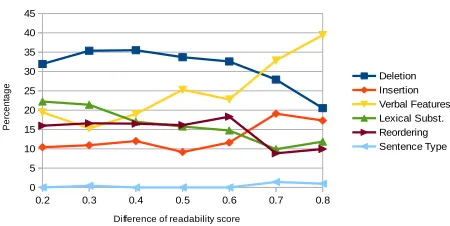
Let us consider the relation between simplifica-tion operasimplifica-tions, cosine values and readability levels. For what concerns the distribution of the operations at different cosines (Figure 4), we observe that dele-tion is the most frequent operadele-tion at all cosines, in particular at lower cosines i.e. <.70. At high cosines, i.e. >.90, operations affecting word order and verbal features increase. The relation between readability score and sentence operations is shown in Figure 5. Specifically, we calculated how the dis-tribution of operations changes with increasing dif-ferences between the readability score assigned to the complex and the simple sentence of each pair. Although it is difficult to study the effect of each
sin-Figure 5:Distribution of sentence operations at different read-ability scores.
gle operation on the readability score variation since these operations are usually applied in combination, we observe some clear tendencies. In particular, operations concerning deletion and verbal features are the most frequent ones both at lower and higher readability scores differences. However, they have an opposite distribution: transformations of verbal features increase at higher readability differences (>0.6) while deletions decrease. For what concerns the other operations, the trend is quite homogeneous along with the different readability scores. In par-ticular, this is the case of reordering thus showing the proposed approach is able to intercept syntactic transformations which impact at different readabil-ity variations.
4.2.2 Analysis of Linguistic Phenomena
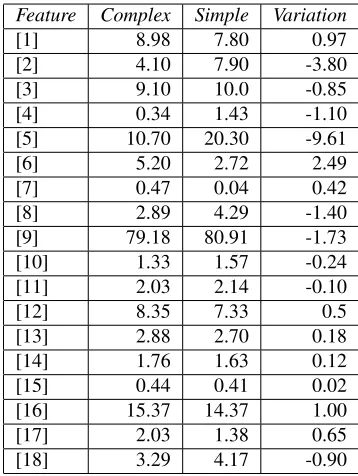
The second qualitative analysis focused on the whole resource which was searched for linguistic phenomena correlating with the process of sentence alignment. To this end, we compared the distribu-tion of a set of different linguistic features, i.e. raw text, lexical, morpho–syntactic and syntactic, auto-matically extracted from the set of complex and sim-ple sentences of PaCCSS–IT, which was previously tagged and dependency–parsed. In Table 2 we report a selection of the features with a statistically signifi-cant variation5between the complex and the simple
sentences. As expected, the average sentence length (feature [1]) of the Simple sentence is lower than
theComplexone. The higher distribution of
adjec-tives [2], adverbs [3] and determiners [4] might be
5Wilcoxon’s signed rank test was used to evaluate statistical
[image:8.612.321.546.67.180.2]related to the insertion of simple lexicon belonging to the Basic Italian Vocabulary (De Mauro, 2000). The distribution of verbal moods is also significantly correlated to a higher readability level: simple sen-tences have a higher percentage of indicatives [6] (a simple mood indicating a state of being or reality) and less participles [7] and gerundives [8] which are non finite moods and thus can be more ambiguous with respect to the reference. In addition, sentences classified as complex have higher parse trees [13], longer dependency links [14] and longer embedded complement chains modifying a noun [15], all fea-tures correlated with syntactic complexity (Gibson, 1998; Lin, 1986; Frazier, 1985). On the contrary, sentences classified as simple are characterised by a more canonical word order (Subject–Verb–Object in Italian) i.e. a lower distribution of post-verbal sub-jects [16] and of pre-verbal obsub-jects [17]. These sen-tences also contain a higher distribution of subordi-nate clauses following the main clause [18], an order easier to process.
Since syntactic features intercepting the structure of the sentence (e.g. parse tree depth and depen-dency length) heavily depend on the overall sentence length, we carried out an analysis only on pairs of sentences where the complex and the simple sen-tence have the same number of tokens (i.e. 15,958 pairs in PaCCSS–IT) and we compared how linguis-tic features vary between the complex and the ple sentences of these pairs. We observed that sim-ple sentences have a more canonical position of the subject (i.e. a lower percentage distribution of post-verbal subjects: C: 18.14%, S: 15.72%) and of the object (i.e. a lower percentage distribution of pre-verbal objects: C: 1.52%, S: 1.18%). Simple sen-tences have also lower parsed trees (C: 2.42,S: 2.37) and shorter embedded complement chains modify-ing a noun (C: 0.27,S: 0.26). Since these variations cannot be due to sentence shortening, they rather fol-low from reordering phenomena e.g. changing from active to passive voice.
The distribution of linguistic features here re-ported has already been observed in hand–crafted corpora of complex and simple sentences for Italian (Brunato et al., 2015). This is a further evidence of the reliability of our method for automatically creat-ing corpora of complex–simple sentences.
Feature Complex Simple Variation
[1] 8.98 7.80 0.97
[2] 4.10 7.90 -3.80
[3] 9.10 10.0 -0.85
[4] 0.34 1.43 -1.10
[5] 10.70 20.30 -9.61
[6] 5.20 2.72 2.49
[7] 0.47 0.04 0.42
[8] 2.89 4.29 -1.40
[9] 79.18 80.91 -1.73
[10] 1.33 1.57 -0.24
[11] 2.03 2.14 -0.10
[12] 8.35 7.33 0.5
[13] 2.88 2.70 0.18
[14] 1.76 1.63 0.12
[15] 0.44 0.41 0.02
[16] 15.37 14.37 1.00
[17] 2.03 1.38 0.65
[image:9.612.336.515.56.294.2][18] 3.29 4.17 -0.90
Table 2:Distribution of a subset of linguistic features with sta-tistically significant variation between the complex and simple sentences. Features [1],[13],[14],[15] are absolute values, the others are percentage distributions. All differences are signifi-cant atp <0.001.
5 Conclusion
In this paper we have presented PaCCSS–IT, a cor-pus of complex–simple aligned sentences for Italian containing∼63,000 paired sentences. To our
References
Giuseppe Attardi, Felice Dell’Orletta, Maria Simi, and Joseph Turian. 2009. Accurate dependency parsing with a stacked multilayer perceptron. Proceedings of the 2nd Workshop of Evalita 2009 - Evaluation of NLP and Speech Tools for Italian, Reggio Emilia, Italy. Marco Baroni, Silvia Bernardini, Adriano Ferraresi, and
Eros Zanchetta. 2009. The WaCky wide web: A collection of very large linguistically processed web-crawled corpora. Language Resources and Evalua-tion, 43(3):209–226.
Regina Barzilay and Noemi Elhadad. 2003. Sentence alignment for monolingual comparable corpora. Pro-ceedings of the Conference on Empirical Methods in
Natural Language Processing.
Regina Barzilay and Lillian Lee. 2003. Learning to paraphrase: an unsupervised approach using multiple-sequence alignment. Proceedings of the Conference of the North American Chapter of the Association for Computational Linguistics: Human Language Tech-nologies.
Wauter Bosma and Chris Callison-Burch. 2007. Para-phrase substitution for recognizing textual entailment.
Proceedings of the 7th International Conference on
Cross-Language Evaluation Forum (CLEF).
Stefan Bott and Horacio Saggion. 2011. An unsuper-vised alignment algorithm for text simplification cor-pus construction. Proceedings of the Workshop on Monolingual Text-To-Text Generation, co-located with
ACL 2011, Porland, Oregon.
Stefan Bott and Horacio Saggion. 2014. Text simplifica-tion resources for Spanish. Language Resources and Evaluation, 48(1):93–120.
Laetitia Brouwers, Delphine Bernhard, Anne-Laure Ligozat, and Thomas Franc¸ois. 2014. Syntactic sen-tence simplification for French. Proceedings of the 3rd Workshop on Predicting and Improving Text Readabil-ity for Target Reader Populations (PITR).
Dominique Brunato, Felice Dell’Orletta, Giulia Venturi, and Simonetta Montemagni. 2015. Design and anno-tation of the first Italian corpus for text simplification.
Proceedings of the 9th Linguistic Annotation
Work-shop (LAW’15), Denver, Colorado, USA.
Helena M. Caseli, Tiago F. P. Pereira, Lucia Specia, Thiago A. S. Pardo, Caroline Gasperin, and Sandra Alu´ısio. 2009. Building a Brazilian Portuguese paral-lel corpus of original and simplified texts. Proceedings of the 10th Conference on Intelligent Text Processing and Computational Linguistics.
Chih-Chung Chang and Chih-Jen Lin. 2001. LIBSVM: a library for support vector machines. Software avail-able at http://www.csie.ntu.edu.tw/∼cjlin/libsvm.
David L. Chen and William B. Dolan. 2011. Collecting highly parallel data for paraphrase evaluation. Pro-ceedings of the Annual Meetings of the Association for
Computational Linguistics (ACL).
Do Kook Choe and David McClosky. 2015. Parsing paraphrases with joint inference. Proceedings of the 53rd Annual Meeting of the Association for Computa-tional Linguistics and the 7th InternaComputa-tional Joint
Con-ference on Natural Language Processing.
William Coster and David Kauchak. 2011. Simple en-glish wikipedia: a new text simplification task. Pro-ceedings of the Conference of the North American Chapter of the Association for Computational
Linguis-tics: Human Language Technologies.
Tullio De Mauro. 2000. Il dizionario della lingua ital-iana.
Felice Dell’Orletta, Simonetta Montemagni, and Giulia Venturi. 2011. READ–IT: assessing readability of italian texts with a view to text simplification. Pro-ceedings of the Second Workshop on Speech and Lan-guage Processing for Assistive Technologies (SLPAT), Edinburgh, UK.
Felice Dell’Orletta. 2009. Ensemble system for Part-of-Speech tagging. Proceedings of Evalita’09,
Eval-uation of NLP and Speech Tools for Italian, Reggio
Emilia, December.
William Dolan, Chris Quirk, and Chris Brockett. 2004. Unsupervised construction of large paraphrase cor-pora: Exploiting massively parallel news sources.
Proceedings of the 20th International Conference on Computational Linguistics, Geneva, Switzerland. Anthony Fader, Luke Zettlemoyer, and Oren Etzioni.
2013. Paraphrase-driven learning for open question answering. Proceedings of the Annual Meetings of the Association for Computational Linguistics (ACL). Lyn Frazier. 1985. Syntactic complexity. Natural
Lan-guage Parsing.
Juri Ganitkevitch, Benjamin Van Durme, and Chris Callison-Burch. 2013. PPDB: The paraphrase database. Proceedings of the Conference of the North American Chapter of the Association for
Computa-tional Linguistics: Human Language Technologies.
Edward Gibson. 1998. Linguistic complexity: Locality of syntactic dependencies. Cognition, 68(1):1–76. Sigrid Klerke and Anders Søgaard. 2012. DSim, a
Dan-ish parallel corpus for text simplification. Proceed-ings of Language Resources and Evaluation Confer-ence (LREC).
Dekan Lin. 1986. On the structural complexity of natural language sentences.Proceedings of COLING 1996. Verena Lyding, Egon Stemle, Claudia Borghetti,
Marco Brunello, Sara Castagnoli, Felice Dell’Orletta, Dittmann Henrik, Alessandro Lenci, and Vito Pirrelli. 2014. The PAISA corpus of Italian web texts. Pro-ceedings of the 9th Web as Corpus Workshop (WAC-9)
EACL.
Yuval Marton, Chris Callison-Burch, and Philip Resnik. 2009. Improved statistical machine translation using monolingually-derived paraphrases. Proceedings of the 2009 Conference on Empirical Methods in Natu-ral Language Processing.
Rani Nelken and Stuart M. Shieber. 2006. Towards ro-bust context-sensitive sentence alignment for monolin-gual corpora. Proceedings of the 11th Conference of the European Chapter of the Association for Compu-tational Linguistics (EACL-06), 3–7 April.
Advaith Siddharthan and Mandya Angrosh. 2014. Hy-brid text simplification using synchronous dependency grammars with hand-written and automatically har-vested rules. Proceedings of the 14th Conference of the European Chapter of the Association for Compu-tational Linguistics (EACL 2014).
Sowmya Vajjala and Detmar Meurers. 2016. Readability-based sentence ranking for evaluat-ing text simplification.arXiv.
Kristian Woodsend and Mirella Lapata. 2011. Learning to simplify sentences with quasi-synchronous gram-mar and integer programming. Proceedings of the 2011 Conference on Empirical Methods in Natural
Language Processing.
Sander Wubben, Antal van den Bosch, and Emiel Krah-mer. 2012. Sentence simplification by monolingual machine translation. Proceedings of the 50th Annual Meeting of the Association for Computational Linguis-tics.
Wei Xu, Chris Callison-Burch, and Courtney Napoles. 2015. Problems in current text simplification research: New data can help. Transactions of the Association for Computational Linguistics, 3.