Aspect Level Sentiment Classification with Deep Memory Network
Duyu Tang, Bing Qin∗, Ting Liu Harbin Institute of Technology, Harbin, China
{dytang, qinb, tliu}@ir.hit.edu.cn
Abstract
We introduce a deep memory network for aspect level sentiment classification. Un-like feature-based SVM and sequential neural models such as LSTM, this approach explic-itly captures the importance of each context word when inferring the sentiment polarity of an aspect. Such importance degree and tex-t representex-tatex-tion are calculatex-ted witex-th multex-tiple computational layers, each of which is a neu-ral attention model over an external memory. Experiments on laptop and restaurant datasets demonstrate that our approach performs com-parable to state-of-art feature based SVM sys-tem, and substantially better than LSTM and attention-based LSTM architectures. On both datasets we show that multiple computational layers could improve the performance. More-over, our approach is also fast. The deep mem-ory network with 9 layers is 15 times faster than LSTM with a CPU implementation.
1 Introduction
Aspect level sentiment classification is a fundamen-tal task in the field of sentiment analysis (Pang and Lee, 2008; Liu, 2012; Pontiki et al., 2014). Given a sentence and an aspect occurring in the sentence, this task aims at inferring the sentiment polarity (e.g. positive, negative, neutral) of the aspect. For ex-ample, in sentence “great food but the service was dreadful!”, the sentiment polarity of aspect “food” is positive while the polarity of aspect “service” is
∗Corresponding author.
negative. Researchers typically use machine learn-ing algorithms and build sentiment classifier in a su-pervised manner. Representative approaches in liter-ature include feliter-ature based Support Vector Machine (Kiritchenko et al., 2014; Wagner et al., 2014) and neural network models (Dong et al., 2014; Lakkara-ju et al., 2014; Vo and Zhang, 2015; Nguyen and Shirai, 2015; Tang et al., 2015a). Neural models are of growing interest for their capacity to learn text representation from data without careful engineer-ing of features, and to capture semantic relations be-tween aspect and context words in a more scalable way than feature based SVM.
Despite these advantages, conventional neural models like long short-term memory (LSTM) (Tang et al., 2015a) capture context information in an im-plicit way, and are incapable of exim-plicitly exhibiting important context clues of an aspect. We believe that only some subset of context words are needed to in-fer the sentiment towards an aspect. For example, in sentence “great food but the service was dread-ful!”, “dreadful” is an important clue for the aspect “service” but “great” is not needed. Standard LST-M works in a sequential way and manipulates each context word with the same operation, so that it can-not explicitly reveal the importance of each context word. A desirable solution should be capable of ex-plicitly capturing the importance of context words and using that information to build up features for the sentence after given an aspect word. Further-more, a human asked to do this task will selectively focus on parts of the contexts, and acquire informa-tion where it is needed to build up an internal repre-sentation towards an aspect in his/her mind.
In pursuit of this goal, we develop deep memo-ry network for aspect level sentiment classification, which is inspired by the recent success of compu-tational models with attention mechanism and ex-plicit memory (Graves et al., 2014; Bahdanau et al., 2015; Sukhbaatar et al., 2015). Our approach is data-driven, computationally efficient and does not rely on syntactic parser or sentiment lexicon. The approach consists of multiple computational layers with shared parameters. Each layer is a content- and location- based attention model, which first learn-s the importance/weight of each context word and then utilizes this information to calculate continu-ous text representation. The text representation in the last layer is regarded as the feature for sentiment classification. As every component is differentiable, the entire model could be efficiently trained end-to-end with gradient descent, where the loss function is the cross-entropy error of sentiment classification.
We apply the proposed approach to laptop and restaurant datasets from SemEval 2014 (Pontiki et al., 2014). Experimental results show that our ap-proach performs comparable to a top system using feature-based SVM (Kiritchenko et al., 2014). On both datasets, our approach outperforms both LST-M and attention-based LSTLST-M models (Tang et al., 2015a) in terms of classification accuracy and run-ning speed. Lastly, we show that using multiple computational layers over external memory could achieve improved performance.
2 Background: Memory Network
Our approach is inspired by the recent success of memory network in question answering (Weston et al., 2014; Sukhbaatar et al., 2015). We describe the background on memory network in this part.
Memory network is a general machine learning framework introduced by Weston et al. (2014). It-s central idea iIt-s inference with a long-term memo-ry component, which could be read, written to, and jointly learned with the goal of using it for predic-tion. Formally, a memory network consists of a memory m and four components I, G, O and R,
wherem is an array of objects such as an array of vectors. Among these four components,I
convert-s input to internal feature repreconvert-sentation,Gupdates
old memories with new input, O generates an
out-put representation given a new inout-put and the current memory state, R outputs a response based on the
output representation.
Let us take question answering as an example to explain the work flow of memory network. Given a list of sentences and a question, the task aims to find evidences from these sentences and generate an answer, e.g. a word. During inference,Icomponent
reads one sentencesiat a time and encodes it into a
vector representation. ThenGcomponent updates a
piece of memorymi based on current sentence
rep-resentation. After all sentences are processed, we get a memory matrixmwhich stores the semantics
of these sentences, each row representing a sentence. Given a questionq, memory network encodes it into vector representationeq, and thenOcomponent uses eq to select question related evidences from
memo-rym and generates an output vectoro. Finally, R
component takesoas the input and outputs the final
response. It is worth noting thatOcomponent could
consist of one or more computational layers (hop-s). The intuition of utilizing multiple hops is that more abstractive evidences could be found based on previously extracted evidences. Sukhbaatar et al. (2015) demonstrate that multiple hops could uncov-er more abstractive evidences than single hop, and could yield improved results on question answering and language modeling.
3 Deep Memory Network for Aspect Level Sentiment Classification
In this section, we describe the deep memory net-work approach for aspect level sentiment classifica-tion. We first give the task definiclassifica-tion. Afterwards, we describe an overview of the approach before p-resenting the content- and location- based attention models in each computational layer. Lastly, we de-scribe the use of this approach for aspect level senti-ment classification.
3.1 Task Definition and Notation
Given a sentence s = {w1, w2, ..., wi, ...wn}
con-sisting ofn words and an aspect wordwi 1
occur-ring in sentences, aspect level sentiment
classifica-tion aims at determining the sentiment polarity of 1In practice, an aspect might be a multi word expression
sentencestowards the aspectwi. For example, the
sentiment polarity of sentence “great food but the service was dreadful!” towards aspect “food” is pos-itive, while the polarity towards aspect “service” is negative. When dealing with a text corpus, we map each word into a low dimensional, continuous and real-valued vector, also known as word embedding (Mikolov et al., 2013; Pennington et al., 2014). All the word vectors are stacked in a word embedding matrix L ∈ Rd×|V|, where d is the dimension of
word vector and |V|is vocabulary size. The word
embedding ofwiis notated asei ∈Rd×1, which is a
column in the embedding matrixL.
3.2 An Overview of the Approach
We present an overview of the deep memory net-work for aspect level sentiment classification.
Given a sentences= {w1, w2, ..., wi, ...wn}and
the aspect wordwi, we map each word into its
em-bedding vector. These word vectors are separated into two parts, aspect representation and context rep-resentation. If aspect is a single word like “food” or “service”, aspect representation is the embedding of aspect word. For the case where aspect is multi word expression like “battery life”, aspect representation is an average of its constituting word vectors (Sun et al., 2015). To simplify the interpretation, we consid-er aspect as a single wordwi. Context word vectors
{e1,e2...ei−1,ei+1...en}are stacked and regarded
as the external memorym ∈ Rd×(n−1), where nis the sentence length.
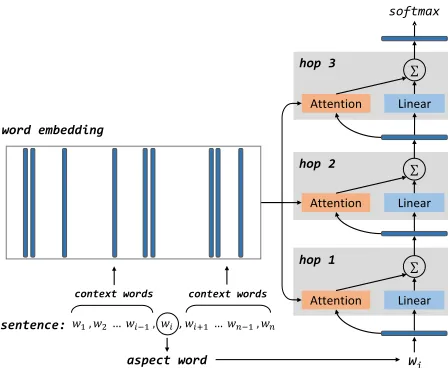
An illustration of our approach is given in Figure 1, which is inspired by the use of memory network in question answering (Sukhbaatar et al., 2015). Our approach consists of multiple computational layers (hops), each of which contains an attention layer and a linear layer. In the first computational layer (hop 1), we regard aspect vector as the input to adaptively select important evidences from memorymthrough
attention layer. The output of attention layer and the linear transformation of aspect vector2 are summed and the result is considered as the input of next layer (hop 2). In a similar way, we stack multiple hop-s and run thehop-se hop-stephop-s multiple timehop-s, hop-so that more abstractive evidences could be selected from the ex-2In preliminary experiments, we tried directly using aspect
vector without a linear transformation, and found that adding a linear layer works slightly better.
Linear Attention
∑
wi Linear Attention
∑ Linear Attention
∑
aspect word
hop 1 hop 2 hop 3
𝑤1, 𝑤2… 𝑤𝑖−1, 𝑤𝑖, 𝑤𝑖+1… 𝑤𝑛−1, 𝑤𝑛
context words context words
sentence: word embedding
softmax
𝛼1𝛼2𝛼3 𝛼𝑘
𝑣𝑐1 𝑣𝑎𝑠𝑝𝑒𝑐𝑡
𝑔1
Linear Tanh Linear
𝑣𝑐2 𝑣𝑎𝑠𝑝𝑒𝑐𝑡
𝑔2
Linear Tanh Linear
𝑣𝑐𝑘 𝑣𝑎𝑠𝑝𝑒𝑐𝑡
𝑔𝑘
Linear Tanh Linear
…… softmax
[image:3.612.314.538.55.239.2]……
Figure 1: An illustration of our deep memory network with three computational layers (hops) for aspect level sentimen-t classificasentimen-tion.
ternal memorym. The output vector in last hop is considered as the representation of sentence with re-gard to the aspect, and is further used as the feature for aspect level sentiment classification.
It is helpful to note that the parameters of attention and linear layers are shared in different hops. There-fore, the model with one layer and the model with nine layers have the same number of parameters.
3.3 Content Attention
We describe our attention model in this part. The basic idea of attention mechanism is that it assign-s a weight/importance to each lower poassign-sition when computing an upper level representation (Bahdanau et al., 2015). In this work, we use attention model to compute the representation of a sentence with re-gard to an aspect. The intuition is that context words do not contribute equally to the semantic meaning of a sentence. Furthermore, the importance of a word should be different if we focus on different aspect. Let us again take the example of “great food but the service was dreadful!”. The context word “great” is more important than “dreadful” for aspect “food”. On the contrary, “dreadful” is more important than “great” for aspect “service”.
Taking an external memory m ∈ Rd×k and an
aspect vectorvaspect ∈ Rd×1 as input, the attention
model outputs a continuous vectorvec∈Rd×1. The
piece of memory inm, namely
vec=
k
X
i=1
αimi (1)
wherekis the memory size,αi ∈[0,1]is the weight
of mi and Piαi = 1. We implement a neural
network based attention model. For each piece of memorymi, we use a feed forward neural network
to compute its semantic relatedness with the aspect. The scoring function is calculated as follows, where
Watt ∈R1×2dandbatt∈R1×1.
gi=tanh(Watt[mi;vaspect] +batt) (2)
After obtaining{g1, g2, ... gk}, we feed them to a sof tmaxfunction to calculate the final importance scores{α1,α2, ... αk}.
αi=
exp(gi)
Pk
j=1exp(gj)
(3)
We believe that such an attention model has two advantages. One advantage is that this model could adaptively assign an importance score to each piece of memorymiaccording to its semantic relatedness
with the aspect. Another advantage is that this at-tention model is differentiable, so that it could be easily trained together with other components in an end-to-end fashion.
3.4 Location Attention
We have described our neural attention framework and a content-based model in previous subsection. However, the model mentioned above ignores the lo-cation information between context word and aspec-t. Such location information is helpful for an atten-tion model because intuitively a context word closer to the aspect should be more important than a farther one. In this work, we define the location of a context word as its absolute distance with the aspect in the original sentence sequence3. On this basis, we study four strategies to encode the location information in the attention model. The details are described below. 3The location of a context word could also be measured by
its distance to the aspect along a syntactic path. We leave this as a future work as we prefer to developing a purely data-driven approach without using external parsing results.
• Model 1. Following Sukhbaatar et al. (2015), we calculate the memory vectormiwith
mi=eivi (4)
where means element-wise multiplication and
vi ∈ Rd×1 is a location vector for wordwi. Every
element invi is calculated as follows,
vki = (1−li/n)−(k/d)(1−2×li/n) (5)
wherenis sentence length,kis the hop number and liis the location ofwi.
•Model 2. This is a simplified version of Model 1, using the same location vectorvi forwiin
differ-ent hops. Location vectorviis calculated as follows.
vi = 1−li/n (6)
•Model 3. We regard location vectorvi as a
pa-rameter and compute a piece of memory with vector addition, namely
mi=ei+vi (7)
All the position vectors are stacked in a position embedding matrix, which is jointly learned with gra-dient descent.
•Model 4. Location vectors are also regarded as parameters. Different from Model 3, location rep-resentations are regarded as neural gates to control how many percent of word semantics is written into the memory. We feed location vectorvito a sigmoid
functionσ, and calculatemiwith element-wise
mul-tiplication:
mi =eiσ(vi) (8)
3.5 The Need for Multiple Hops
and transforms the representation at previous level into a representation at a higher, slightly more ab-stract level. With the composition of enough such transformations, very complex functions of sentence representation towards an aspect can be learned.
3.6 Aspect Level Sentiment Classification
We regard the output vector in last hop as the fea-ture, and feed it to asof tmaxlayer for aspect level
sentiment classification. The model is trained in a supervised manner by minimizing the cross entropy error of sentiment classification, whose loss func-tion is given below, where T means all training in-stances,C is the collection of sentiment categories,
(s, a)means a sentence-aspect pair.
loss=− X
(s,a)∈T
X
c∈C
Pcg(s, a)·log(Pc(s, a)) (9)
Pc(s, a)is the probability of predicting(s, a)as
cat-egory c produced by our system. Pcg(s, a) is 1 or
0, indicating whether the correct answer is c. We
use back propagation to calculate the gradients of all the parameters, and update them with stochastic gradient descent. We clamp the word embeddings with 300-dimensional Glove vectors (Pennington et al., 2014), which is trained from web data and the vocabulary size is 1.9M4. We randomize other pa-rameters with uniform distributionU(−0.01,0.01),
and set the learning rate as 0.01.
4 Experiment
We describe experimental settings and report empir-ical results in this section.
4.1 Experimental Setting
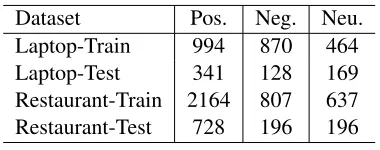
We conduct experiments on two datasets from Se-mEval 2014 (Pontiki et al., 2014), one from laptop domain and another from restaurant domain. Statis-tics of the datasets are given in Table 1. It is worth noting that the original dataset contains the fourth category - conflict, which means that a sentence ex-presses both positive and negative opinion towards an aspect. We remove conflict category as the num-ber of instances is very tiny, incorporating which
4Available at: http://nlp.stanford.edu/projects/glove/.
will make the dataset extremely unbalanced. Evalu-ation metric is classificEvalu-ation accuracy.
Dataset Pos. Neg. Neu.
Laptop-Train 994 870 464
Laptop-Test 341 128 169
Restaurant-Train 2164 807 637
[image:5.612.332.522.95.170.2]Restaurant-Test 728 196 196
Table 1:Statistics of the datasets.
4.2 Comparison to Other Methods
We compare with the following baseline methods on both datasets.
(1) Majority is a basic baseline method, which assigns the majority sentiment label in training set to each instance in the test set.
(2)Feature-based SVMperforms state-of-the-art on aspect level sentiment classification. We compare with a top system using ngram features, parse fea-tures and lexicon feafea-tures (Kiritchenko et al., 2014). (3) We compare with three LSTM models (Tang et al., 2015a)). InLSTM, a LSTM based recurrent model is applied from the start to the end of a tence, and the last hidden vector is used as the
sen-tence representation. TDLSTM extends LSTM by
taking into account of the aspect, and uses two LST-M networks, a forward one and a backward one,
to-wards the aspect.TDLSTM+ATTextends
TDLST-M by incorporating an attention mechanism (Bah-danau et al., 2015) over the hidden vectors. We use the same Glove word vectors for fair comparison.
(4) We also implementContextAVG, a simplistic version of our approach. Context word vectors are averaged and the result is added to the aspect vector. The output is fed to asof tmaxfunction.
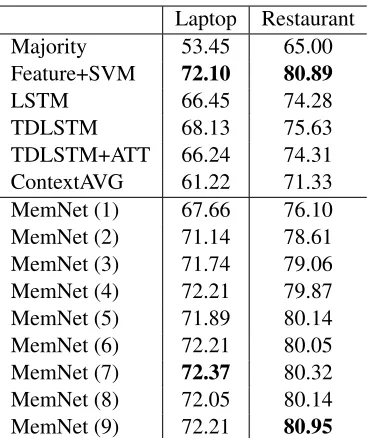
Experimental results are given in Table 2. Our approach using only content attention is abbreviat-ed to MemNet (k), wherekis the number of hops.
as-Laptop Restaurant
Majority 53.45 65.00
Feature+SVM 72.10 80.89
LSTM 66.45 74.28
TDLSTM 68.13 75.63
TDLSTM+ATT 66.24 74.31
ContextAVG 61.22 71.33
MemNet (1) 67.66 76.10
MemNet (2) 71.14 78.61
MemNet (3) 71.74 79.06
MemNet (4) 72.21 79.87
MemNet (5) 71.89 80.14
MemNet (6) 72.21 80.05
MemNet (7) 72.37 80.32
MemNet (8) 72.05 80.14
[image:6.612.94.278.55.274.2]MemNet (9) 72.21 80.95
Table 2:Classification accuracy of different methods on laptop and restaurant datasets. Best scores in each group are in bold.
pects (e.g. “food” and “service”) might be different. It is somewhat disappointing that incorporating at-tention model over TDLSTM does not bring any im-provement. We consider that each hidden vector of TDLSTM encodes the semantics of word sequence until the current position. Therefore, the model of TDLSTM+ATT actually selects such mixed seman-tics of word sequence, which is weird and not an in-tuitive way to selectively focus on parts of contexts. Different from TDLSTM+ATT, the proposed mem-ory network approach removes the recurrent calcula-tor over word sequence and directly apply attention mechanism on context word representations.
We can also find that the performance of Contex-tAVG is very poor, which means that assigning the same weight/importance to all the context words is not an effective way. Among all our models from single hop to nine hops, we can observe that using more computational layers could generally lead to better performance, especially when the number of hops is less than six. The best performances are achieved when the model contains seven and nine hops, respectively. On both datasets, the proposed approach could obtain comparable accuracy com-pared to the state-of-art feature-based SVM system.
4.3 Runtime Analysis
We study the runtime of recurrent neural models and the proposed deep memory network approach with different hops. We implement all these approaches based on the same neural network infrastructure, use the same 300-dimensional Glove word vectors, and run them on the same CPU server.
Method Time cost
LSTM 417
TDLSTM 490
TDLSTM + ATT 520
MemNet (1) 3
MemNet (2) 7
MemNet (3) 9
MemNet (4) 15
MemNet (5) 20
MemNet (6) 24
MemNet (7) 26
MemNet (8) 27
[image:6.612.356.499.164.345.2]MemNet (9) 29
Table 3: Runtime (seconds) of each training epoch on the restaurant dataset.
The training time of each iteration on the restau-rant dataset is given in Table 3. We can find that LSTM based recurrent models are indeed compu-tationally expensive, which is caused by the com-plex operations in each LSTM unit along the word sequence. Instead, the memory network approach is simpler and evidently faster because it does not need recurrent calculators of sequence length. Our approach with nine hops is almost 15 times faster than the basic LSTM model.
4.4 Effects of Location Attention
(a) Aspect:service, Answer: -1, Prediction: -1 hop 1 hop 2 hop 3 hop 4 hop 5 great 0.20 0.15 0.14 0.13 0.23 food 0.11 0.07 0.08 0.12 0.06 but 0.20 0.10 0.10 0.12 0.13 the 0.03 0.07 0.08 0.12 0.06 was 0.08 0.07 0.08 0.12 0.06 dreadful 0.20 0.45 0.45 0.28 0.40
! 0.19 0.08 0.08 0.12 0.07
(b) Aspect:food, Answer: +1, Prediction: -1 hop 1 hop 2 hop 3 hop 4 hop 5 great 0.22 0.12 0.14 0.12 0.20
but 0.21 0.11 0.10 0.11 0.12 the 0.03 0.11 0.08 0.11 0.06 service 0.11 0.11 0.08 0.11 0.06 was 0.04 0.11 0.08 0.11 0.06 dreadful 0.22 0.32 0.45 0.32 0.43
[image:7.612.88.527.57.159.2]! 0.16 0.11 0.08 0.11 0.07
Table 4: Examples of attention weights in different hops for aspect level sentiment classification. The model only uses content attention. The hop columns show the weights of context words in each hop, indicated by values and gray color. This example shows the results of sentence “great food but the service was dreadful!” with “food” and “service” as the aspects.
(a) Aspect:service, Answer: -1, Prediction: -1 hop 1 hop 2 hop 3 hop 4 hop 5 great 0.08 0.10 0.10 0.09 0.09 food 0.08 0.07 0.07 0.07 0.07 but 0.10 0.15 0.16 0.13 0.11 the 0.07 0.07 0.07 0.07 0.07 was 0.07 0.07 0.07 0.07 0.07 dreadful 0.52 0.48 0.48 0.50 0.52
! 0.07 0.07 0.07 0.07 0.07
(b) Aspect:food, Answer: +1, Prediction: +1 hop 1 hop 2 hop 3 hop 4 hop 5 great 0.31 0.26 0.32 0.28 0.32
but 0.14 0.18 0.15 0.18 0.15 the 0.08 0.05 0.08 0.05 0.07 service 0.09 0.09 0.09 0.08 0.09 was 0.09 0.08 0.09 0.08 0.08 dreadful 0.18 0.21 0.18 0.22 0.19
[image:7.612.88.525.213.318.2]! 0.11 0.12 0.10 0.11 0.10
Table 5:Examples of attention weights in different hops for aspect level sentiment classification. The model also takes into account of the location information (Model 2). This example is as same as the one we use in Table 4.
1 2 3 4 5 6 7 8 9
0.72 0.73 0.74 0.75 0.76 0.77 0.78 0.79 0.8 0.81
Number of hops
Accuracy
Content + Location 1 + Location 2 + Location 3 + Location 4
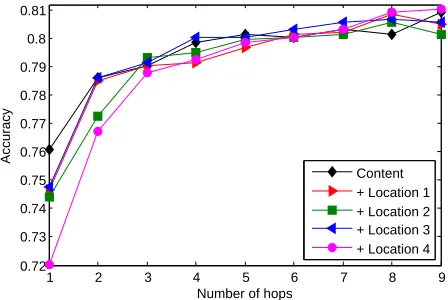
Figure 2:Classification accuracy of different attention models on the restaurant dataset.
Figure 2 shows the classification accuracy of each attention model on the restaurant dataset. We can find that using multiple computational layers could consistently improve the classification accuracy in all these models. All these models perform compa-rably when the number of hops is larger than five. Among these four location-based models, we pre-fer Model 2 as it is intuitive and has less compu-tation cost without loss of accuracy. We also find that Model 4 is very sensitive to the choice of neural
gate. Its classification accuracy decreases by almost 5 percentage when thesigmoidoperation over
loca-tion vector is removed.
4.5 Visualize Attention Models
We visualize the attention weight of each context word to get a better understanding of the deep mem-ory network approach. The results of context-based model and location-based model (Model 2) are giv-en in Table 4 and Table 5, respectively.
[image:7.612.74.298.365.515.2]predict-s the correct predict-sentiment label towardpredict-s “food”. We believe that location-enhanced model captures both content and location information. For instance, in Table 5(a) the closest context words of the aspect “service” are “the” and “was”, while “dreadful” has the largest weight.
4.6 Error Analysis
We carry out an error analysis of our location en-hanced model (Model 2) on the restaurant dataset, and find that most of the errors could be
sum-marized as follows. The first factor is
non-compositional sentiment expression. This model regards single context word as the basic computa-tional unit and cannot handle this situation. An example is “dessert was also to die for!”, where the aspect is underlined. The sentiment expres-sion is “die for”, whose meaning could not be composed from its constituents “die” and “for”. The second factor is complex aspect expression consisting of many words, such as “ask for the round corner table next to the large window.” This model represents an aspect expression by averag-ing its constitutaverag-ing word vectors, which could not well handle this situation. The third factor is senti-mental relation between context words such as nega-tion, comparison and condition. An example is “but dinner here is never disappointing, even if the prices are a bit over the top”. We believe that this is caused by the weakness of weighted average composition-al function in each hop. There are composition-also cases when comparative opinions are expressed such as “i ’ve had better japanese food at a mall food court”.
5 Related Work
This work is connected to three research areas in nat-ural language processing. We briefly describe relat-ed studies in each area.
5.1 Aspect Level Sentiment Classification
Aspect level sentiment classification is a fine-grained classification task in sentiment analysis, which aims at identifying the sentiment polarity of a sentence expressed towards an aspect (Pontiki et al., 2014). Most existing works use machine learn-ing algorithms, and build sentiment classifier from sentences with manually annotated polarity label-s. One of the most successful approaches in
liter-ature is feliter-ature based SVM. Experts could design effective feature templates and make use of external resources like parser and sentiment lexicons (Kir-itchenko et al., 2014; Wagner et al., 2014). In re-cent years, neural network approaches (Dong et al., 2014; Lakkaraju et al., 2014; Nguyen and Shirai, 2015; Tang et al., 2015a) are of growing attention for their capacity to learn powerful text representation from data. However, these neural models (e.g. L-STM) are computationally expensive, and could not explicitly reveal the importance of context evidences with regard to an aspect. Instead, we develop simple and fast approach that explicitly encodes the con-text importance towards a given aspect. It is worth noting that the task we focus on differs from fine-grained opinion extraction, which assigns each word a tag (e.g. B,I,O) to indicate whether it is an aspec-t/sentiment word (Choi and Cardie, 2010; Irsoy and Cardie, 2014; Liu et al., 2015). The aspect word in this work is given as a part of the input.
5.2 Compositionality in Vector Space
In NLP community, compositionality means that the meaning of a composed expression (e.g. a phrase/sentence/document) comes from the mean-ings of its constituents (Frege, 1892). Mitchell and Lapata (2010) exploits a variety of addition and multiplication functions to calculate phrase vector. Yessenalina and Cardie (2011) use matrix multipli-cation as compositional function to compute vec-tors for longer phrases. To compute sentence rep-resentation, researchers develop denoising autoen-coder (Glorot et al., 2011), convolutional neural net-work (Kalchbrenner et al., 2014; Kim, 2014; Yin and Sch¨utze, 2015), sequence based recurrent neu-ral models (Sutskever et al., 2014; Kiros et al., 2015; Li et al., 2015b) and tree-structured neural network-s (Socher et al., 2013; Tai et al., 2015; Zhu et al., 2015). Several recent studies calculate continuous representation for documents with neural networks (Le and Mikolov, 2014; Bhatia et al., 2015; Li et al., 2015a; Tang et al., 2015b; Yang et al., 2016).
5.3 Attention and Memory Networks
Bahdanau et al., 2015). In this line of research, memory is encoded as a continuous representation and operations on memory (e.g. reading and writ-ing) are typically implemented with neural network-s. Attention mechanism could be viewed as a com-positional function, where lower level representa-tions are regarded as the memory, and the func-tion is to choose “where to look” by assigning a weight/importance to each lower position when computing an upper level representation. Such at-tention based approaches have achieved promising performances on a variety of NLP tasks (Luong et al., 2015; Kumar et al., 2015; Rush et al., 2015).
6 Conclusion
We develop deep memory networks that capture im-portances of context words for aspect level senti-ment classification. Compared with recurrent neu-ral models like LSTM, this approach is simpler and faster. Empirical results on two datasets veri-fy that the proposed approach performs comparable to state-of-the-art feature based SVM system, and substantively better than LSTM architectures. We implement different attention strategies and show that leveraging both content and location informa-tion could learn better context weight and text rep-resentation. We also demonstrate that using multi-ple computational layers in memory network could obtain improved performance. Our potential future plans are incorporating sentence structure like pars-ing results into the deep memory network.
Acknowledgments
We would especially want to thank Xiaodan Zhu for running their system on our setup. We greatly thank Yaming Sun for tremendously helpful discussions. We also thank the anonymous reviewers for their valuable comments. This work was supported by the National High Technology Development 863 Pro-gram of China (No. 2015AA015407), National Nat-ural Science Foundation of China (No. 61632011 and No.61273321).
References
Dzmitry Bahdanau, Kyunghyun Cho, and Yoshua Ben-gio. 2015. Neural machine translation by jointly
learning to align and translate. International Confer-ence on Learning Representations (ICLR).
Parminder Bhatia, Yangfeng Ji, and Jacob Eisenstein. 2015. Better document-level sentiment analysis from rst discourse parsing. InProceedings of the 2015 Con-ference on Empirical Methods in Natural Language Processing, pages 2212–2218.
Yejin Choi and Claire Cardie. 2010. Hierarchical se-quential learning for extracting opinions and their at-tributes. InProceedings of the ACL 2010 Conference Short Papers, pages 269–274. Association for Compu-tational Linguistics.
Li Dong, Furu Wei, Chuanqi Tan, Duyu Tang, Ming Zhou, and Ke Xu. 2014. Adaptive recursive neural network for target-dependent twitter sentiment clas-sification. InProceedings of the 52nd Annual Meet-ing of the Association for Computational LMeet-inguistics, pages 49–54.
Gottlob Frege. 1892. On sense and reference. Ludlow (1997), pages 563–584.
Xavier Glorot, Antoine Bordes, and Yoshua Bengio. 2011. Domain adaptation for large-scale sentiment classification: A deep learning approach. In Proceed-ings of the 28th International Conference on Machine Learning (ICML-11), pages 513–520.
Alex Graves, Greg Wayne, and Ivo Danihelka. 2014. Neural turing machines. arXiv preprint arX-iv:1410.5401.
Ozan Irsoy and Claire Cardie. 2014. Opinion mining with deep recurrent neural networks. InProceedings of the 2014 Conference on Empirical Methods in Nat-ural Language Processing, pages 720–728.
Nal Kalchbrenner, Edward Grefenstette, and Phil Blun-som. 2014. A convolutional neural network for mod-elling sentences. InProceedings of the 52nd Annual Meeting of the Association for Computational Linguis-tics, pages 655–665.
Yoon Kim. 2014. Convolutional neural networks for sen-tence classification. InProceedings of the 2014 Con-ference on Empirical Methods in Natural Language Processing, pages 1746–1751.
Svetlana Kiritchenko, Xiaodan Zhu, Colin Cherry, and Saif Mohammad. 2014. Nrc-canada-2014: Detecting aspects and sentiment in customer reviews. In Pro-ceedings of the 8th International Workshop on Seman-tic Evaluation (SemEval 2014), pages 437–442. Ryan Kiros, Yukun Zhu, Ruslan R Salakhutdinov,
Richard Zemel, Raquel Urtasun, Antonio Torralba, and Sanja Fidler. 2015. Skip-thought vectors. In Advances in Neural Information Processing Systems, pages 3276–3284.
Gulrajani, and Richard Socher. 2015. Ask me any-thing: Dynamic memory networks for natural lan-guage processing. arXiv preprint arXiv:1506.07285. Himabindu Lakkaraju, Richard Socher, and Chris
Man-ning. 2014. Aspect specific sentiment analysis using hierarchical deep learning. InNIPS Workshop on Deep Learning and Representation Learning.
Quoc V. Le and Tomas Mikolov. 2014. Distributed rep-resentations of sentences and documents. In Proceed-ings of The 31nd International Conference on Machine Learning, pages 1188–1196.
Yann LeCun, Yoshua Bengio, and Geoffrey Hinton. 2015. Deep learning. Nature, 521(7553):436–444. Jiwei Li, Thang Luong, and Dan Jurafsky. 2015a. A
hi-erarchical neural autoencoder for paragraphs and doc-uments. InProceedings of the 53rd Annual Meeting of the Association for Computational Linguistics, pages 1106–1115.
Jiwei Li, Thang Luong, Dan Jurafsky, and Eduard Hov-y. 2015b. When are tree structures necessary for deep learning of representations? InProceedings of the 2015 Conference on Empirical Methods in Natural Language Processing, pages 2304–2314.
Pengfei Liu, Shafiq Joty, and Helen Meng. 2015. Fine-grained opinion mining with recurrent neural network-s and word embeddingnetwork-s. In Proceedings of the 2015 Conference on Empirical Methods in Natural Lan-guage Processing, pages 1433–1443.
Bing Liu. 2012. Sentiment analysis and opinion mining. Synthesis Lectures on Human Language Technologies, 5(1):1–167.
Thang Luong, Hieu Pham, and Christopher D. Manning. 2015. Effective approaches to attention-based neural machine translation. InProceedings of the 2015 Con-ference on Empirical Methods in Natural Language Processing, pages 1412–1421.
Tomas Mikolov, Ilya Sutskever, Kai Chen, Greg S Corra-do, and Jeff Dean. 2013. Distributed representations of words and phrases and their compositionality. In Advances in Neural Information Processing Systems, pages 3111–3119.
Jeff Mitchell and Mirella Lapata. 2010. Composition in distributional models of semantics. Cognitive Science, 34(8):1388–1429.
Thien Hai Nguyen and Kiyoaki Shirai. 2015. Phrasernn: Phrase recursive neural network for aspect-based sen-timent analysis. InProceedings of the 2015 Confer-ence on Empirical Methods in Natural Language Pro-cessing, pages 2509–2514.
Bo Pang and Lillian Lee. 2008. Opinion mining and sentiment analysis. Foundations and trends in infor-mation retrieval, 2(1-2):1–135.
Jeffrey Pennington, Richard Socher, and Christopher D Manning. 2014. Glove: Global vectors for word rep-resentation. InProceedings of the 2014 Conference on Empirical Methods in Natural Language Processing, pages 1532–1543.
Maria Pontiki, Dimitris Galanis, John Pavlopoulos, Har-ris Papageorgiou, Ion Androutsopoulos, and Suresh Manandhar. 2014. Semeval-2014 task 4: Aspec-t based senAspec-timenAspec-t analysis. InProceedings of the 8th International Workshop on Semantic Evaluation (Se-mEval 2014), pages 27–35.
Alexander M. Rush, Sumit Chopra, and Jason Weston. 2015. A neural attention model for abstractive sen-tence summarization. InProceedings of the 2015 Con-ference on Empirical Methods in Natural Language Processing, pages 379–389.
Richard Socher, Alex Perelygin, Jean Wu, Jason Chuang, Christopher D. Manning, Andrew Ng, and Christopher Potts. 2013. Recursive deep models for semantic compositionality over a sentiment treebank. In Pro-ceedings of the 2013 Conference on Empirical Meth-ods in Natural Language Processing, pages 1631– 1642.
Sainbayar Sukhbaatar, Arthur Szlam, Jason Weston, and Rob Fergus. 2015. End-to-end memory networks. In Advances in Neural Information Processing Systems, pages 2431–2439.
Yaming Sun, Lei Lin, Duyu Tang, Nan Yang, Zhenzhou Ji, and Xiaolong Wang. 2015. Modeling mention, context and entity with neural networks for entity dis-ambiguation. Proceedings of the Twenty-Fourth Inter-national Joint Conference on Artificial Intelligence (I-JCAI 2015), pages 1333–1339.
Ilya Sutskever, Oriol Vinyals, and Quoc V Le. 2014. Sequence to sequence learning with neural networks. InAdvances in neural information processing systems, pages 3104–3112.
Kai Sheng Tai, Richard Socher, and Christopher D. Man-ning. 2015. Improved semantic representations from tree-structured long short-term memory networks. In Proceedings of the 53rd Annual Meeting of the As-sociation for Computational Linguistics, pages 1556– 1566.
Duyu Tang, Bing Qin, Xiaocheng Feng, and Ting Li-u. 2015a. Target-Dependent Sentiment Classification with Long Short Term Memory. ArXiv preprint arX-iv:1512.01100.
Duyu Tang, Bing Qin, and Ting Liu. 2015b. Document modeling with gated recurrent neural network for sen-timent classification.Proceedings of the 2015 Confer-ence on Empirical Methods in Natural Language Pro-cessing, pages 1422–1432.
features. In Proceedings of the Twenty-Fourth Inter-national Joint Conference on Artificial Intelligence (I-JCAI 2015), pages 1347–1353.
Joachim Wagner, Piyush Arora, Santiago Cortes, Utsab Barman, Dasha Bogdanova, Jennifer Foster, and Lami-a Tounsi. 2014. Dcu: Aspect-bLami-ased polLami-arity clLami-assifi- classifi-cation for semeval task 4. In Proceedings of the 8th International Workshop on Semantic Evaluation (Se-mEval 2014), pages 223–229.
Jason Weston, Sumit Chopra, and Antoine Bordes. 2014. Memory networks.arXiv preprint arXiv:1410.3916. Zichao Yang, Diyi Yang, Chris Dyer, Xiaodong He, Alex
Smola, and Eduard Hovy. 2016. Hierarchical atten-tion networks for document classificaatten-tion. In Proceed-ings of the 2016 Conference of the North American Chapter of the Association for Computational Linguis-tics.
Ainur Yessenalina and Claire Cardie. 2011. Compo-sitional matrix-space models for sentiment analysis. In Proceedings of the 2011 Conference on Empirical Methods in Natural Language Processing, pages 172– 182.
Wenpeng Yin and Hinrich Sch¨utze. 2015. Multichan-nel variable-size convolution for sentence classifica-tion. In Proceedings of the Nineteenth Conference on Computational Natural Language Learning, pages 204–214.