Event-Driven Emotion Cause Extraction with Corpus Construction
Lin Gui1, Dongyin Wu1, Ruifeng Xu1,2∗, Qin Lu3 and Yu Zhou1 1. School of Computer Science and Technology, Harbin Institute of Technology,
Shenzhen Graduate School, Shenzhen, China
2. Guangdong Provincial Engineering Technology Research Center for Data Science 3. Department of Computing, the Hong Kong Polytechnic University, Hong Kong
[email protected];[email protected];[email protected]; [email protected];[email protected]
Abstract
In this paper, we present our work in emo-tion cause extracemo-tion. Since there is no open dataset available, the lack of annotated re-sources has limited the research in this area. Thus, we first present a dataset we built using SINA city news. The annotation is based on the scheme of the W3C Emotion Markup Lan-guage. Second, we propose a 7-tuple defini-tion to describe emodefini-tion cause events. Based on this general definition, we propose a new event-driven emotion cause extraction method using multi-kernel SVMs where a syntactical tree based approach is used to represent events in text. A convolution kernel based multi-kernel SVM are used to extract emotion caus-es. Because traditional convolution kernels do not use lexical information at the terminal n-odes of syntactic trees, we modify the kernel function with a synonym based improvemen-t. Even with very limited training data, we can still extract sufficient features for the task. Evaluations show that our approach achieves 11.6% higher F-measure compared to refer-enced methods. The contributions of our work include resource construction, concept defini-tion and algorithm development.
1 Introduction
With the rapid growth of Internet, people can easily share experiences and emotions through this power-ful medium anywhere and anytime. How to analyze the emotions of individuals through their writings becomes a new challenge for NLP. In recent years,
s-∗
corresponding author
tudies in emotion analysis focus on emotion classifi-cation including detection of emotions expressed by writers of text (Gao et al., 2013) as well as predic-tion of reader emopredic-tions (Chang et al., 2015). There are also some information extraction tasks in tion analysis, such as extracting the feeler of emo-tion (Das and Bandyopadhyay, 2010). However, these methods need to observe emotion linked ex-pressions. Sometimes, however, we care more about the stimuli, or the cause of an emotion. For instance, manufacturers want to know why people love, or hate a certain product. The White House may al-so prefer to know the cause of the emotional text “Let us hit the streets” rather than the distribution of different emotions.
There are three main challenges in the study of e-motion cause extraction. The first is that, up to now, there is no open dataset available for emotion cause extraction. This may explain why there are only few studies on emotion causes. The second is that, there is no formal definition about event in emotion cause extraction even though some researches claim that they extract events of emotion causes (Lee et al., 2010; Chen et al., 2010). The third is that, due to the complexity in annotation, the size of corpus for emotion cause extraction is usually very small. Due to this limitation, many machine learning method-s are not method-suited for emotion caumethod-se detection. How to mine deep knowledge of a language for emotion causes is another thorny issue.
In this paper, we first present an annotated dataset for emotion cause extraction to be released to the public. We then propose to use a 7-tuple to define emotion cause events. Based on this general
nition, we then present a new event-driven emotion cause extraction method. The basic idea is to ex-tract events in the context of emotional text through dependency parsing. Then, a syntactic structure is used to represent nearby events. Based on this struc-tured representation of events, a modified convolu-tion kernel which also takes lexical features(as ter-minal nodes) is used to determine whether an event is emotion cause relevant. This method can detect all possible combinations of syntactic structures to obtain sufficient features for emotion analysis us-ing a limited trainus-ing set. Compared to existus-ing methods, which either use manual rules or com-monsense knowledge to extend information, our ap-proach is completely machine learning based and it still achieves state-of-the-art performance. The con-tributions of this work include both resource devel-opment and algorithm develdevel-opment.
The rest of the paper is organized as follows. Sec-tion 2 provides a review of related works on emoSec-tion analysis. Section 3 presents emotion cause relat-ed definitions and the construction of emotion cause extraction corpus. Section 4 gives the event-driven emotion cause extraction method and section 5 is the evaluations and discussions. Section 6 concludes this work and gives the future directions.
2 Related Works
Identifying emotion categories in text is an essen-tial subject in NLP and its applications (Liu, 2015). Moreover, emotion causes can provide important in-formation on why there is any emotion changes. In this section, we introduce related works on the emo-tion analysis and emoemo-tion cause extracemo-tion.
The first issue in emotion analysis is to determine the taxonomy of emotions. Researchers have pro-posed a list of primary emotions(Plutchik, 1980; Ek-man, 1984; Turner, 2000). In this study, we adop-t Ekman’s emoadop-tion classificaadop-tion (Ekman, 1984), which identifies six primary emotions, namely hap-piness, sadness, fear, anger, disgust and surprise, known as the “Big6”1scheme in the W3C Emotion Markup Language. This list is agreed upon by most previous works in Chinese emotion analysis.
The second issue is how to do emotion clas-sification and emotion information extraction.
1http://www.w3.org/TR/emotion-voc/xml#big6
Beck (Beck et al., 2014) proposed a Multi-task Gaussian-process based method for emotion clas-sification. Xu (Xu et al., 2012) used a coarse to fine method to classify emotions in Chinese blog. Gao (Gao et al., 2013) proposed a joint model to co-train a polarity classifier and an emotion classifier. Chang (Chang et al., 2015) used linguistic template to predict reader’s emotions. Das (Das and Bandy-opadhyay, 2010) used an unsupervised method to extract emotion feelers from Bengali blog. There are other studies focused on joint learning with sen-timent (Luo et al., 2015; Mohtarami et al., 2013), emotion in tweets or blog (Hasegawa et al., 2013; Qadir and Riloff, 2014; Ou et al., 2014; Liu et al., 2013; Quan and Ren, 2009), and emotional lexicon construction (Yang et al., 2014; Staiano and Gueri-ni, 2014; Mohammad and Turney, 2013). However, these related works all focused on analysis of emo-tion expressions rather than emoemo-tion causes..
Sophia M. Y. Lee first proposed a task on emotion cause extraction (Lee et al., 2010). They manual-ly constructed a corpus from Academia Sinica Bal-anced Chinese Corpus. Based on this corpus, Chen and Lee (Chen et al., 2010) proposed a rule based method to detect emotion causes. The basic idea is to make linguistic rules for cause extraction. Some studies (Gui et al., 2014; Li and Xu, 2014; Gao et al., 2015) extended the rule based method to in-formal text in Weibo text (Chinese tweets).
Other than rule based methods, Ghazi (Ghaz-i et al., 2015) used CRFs to extract emot(Ghaz-ion caus-es. However, it requires emotion cause and emo-tion keywords to be in the same sentence. I. Rus-so (RusRus-so et al., 2011) proposed a crowd-Rus-sourcing method to obtain emotion cause related common-sense knowledge. But it is challenging to extend the commonsense knowledgebase automatically.
3 Construction of Emotion Cause Corpus In this section, we first describe the linguistic phe-nomenon in emotion expressions. It serves as the in-spiration to develop the annotated dataset. We then introduce details of the annotation scheme, followed by the construction of the dataset.
3.1 Linguistic Phenomenon of Emotion Causes Emotion causes play an important role in emotion expressions. An emotion cause reveals the stimulus of an emotion. Considering linguistic phenomenon of emotion causes, we follow three basic principles in corpus construction: (1) Keep the whole context of emotion expression; (2) The basic processing unit is at the clause level; and (3) Use of formal text.
In written text, there is an emotion keyword, which is used to express an emotion, in the context of the emotion cause. Thus, finding the appropri-ate context of emotion keywords in the annotation is the pre-requisite to identify its cause. It is the reason why we keep the whole context of emotion keywords.
Another important kind of cues is the presence of conjunctions and prepositions. These words indi-cate the discourse information between clauses. In order to make use of discourse information, the ba-sic analysis unit should be at clause level rather than at sentence level.
In the third principle, we choose the formal tex-t in corpus constex-tructex-tion. According tex-to tex-the relatex-ted works, emotion expressions can have overlapping e-motion cause and ee-motion target (Gui et al., 2014) in informal text. This is why some studies even in-corporate cause extraction with target identification to improve performance. However, our focus is on emotion cause identification. We use formal news text to avoid the potential mix up.
3.2 Collection and Annotation
We first take 3 years (2013-15) Chinese city news from NEWS SINA2containing 20,000 articles as the raw corpus. Based on a list of 10,259 Chinese pri-mary emotion keywords (keywords for short) (Xu et al., 2008), we extract 15,687 instances by key-word matching from the raw data. Here, we call the presence of an emotion keyword as an instancein
2http://news.sina.com.cn/society/
the corpus. For each matched keyword, we extract three preceding clauses and three following clauses as the context of an instance. If a sentence has more than 3 clauses in each direction, the context will in-clude the rest of the sentence to make the context complete. For simplicity, we omit cross paragraph context.
Note that the presence of keywords does not nec-essarily convey emotional information due to differ-ent possible reasons such as negative polarity and sense ambiguity. For example, “祝愿/wishes” is an emotion word of “happiness”. It can also be the name of a song. Also, the presence of emotion keywords does not necessarily guarantee the exis-tence of emotional cause neither. After removing those irrelevant instances, there are 2,105 instances remain. For each emotional instance, two annotators manually annotate the emotion categories and the cause(es) in the W3C Emotion Markup Language (EML) format. Ex1 shows an example of an anno-tated emotional sentence in the corpus, presented by the original simplified Chinese, followed by its En-glish translation. To save space, we remove the xml tags in the annotation. The original annotated data is in a subsidiary file3. The basic analysis unit is a clause. Emotion cause is marked by<cause>, and the emotion keyword is marked by<keywords>. E-motion type, POS, position and the length of anno-tation are also annotated in Emotionml format.
Ex.1: 朱 某今年55岁,1979年参加工作时 才19岁,已有36年的手艺。“我当时被分到丹阳南
京理发店工作,这是当时丹阳最大的理发店。我在 那儿获得了好多证书和荣誉。”<cause POS=“v”
Dis=“-1”>说起自己的荣誉</cause>,朱 某很
是<keywords type=happiness>自豪</keywords>。
Mr. Zhu is 55 years old. He started working in 1979 as a barber when he was 19 , and has 36 years of experience. “I was assigned to work at the Barbershop in Danyang, Nanjing. It is the largest barbershop in Danyang. I won many awards and honors there.” <cause POS=“v” Dis=“-1”>Talking
about his honors</cause>, Mr. Zhu is so <keywords type=“happiness”>proud</keywords>.
Ex.1 only contains one cause. However, one key-word may have more than one corresponding emo-tion causes. In Ex.2, there are two relevant causes
Item Number
Instance 2,105
Clauses 11,799
[image:4.612.346.511.56.141.2]Emotion Cause 2,167 Document with 1 emotion 2,046 Document with 2 emotion 56 Document with 3 emotion 3
Table 1:Details of the Dataset
for one keyword. In our dataset, only 59 instances have two or more causes.
Ex.2: 劝说过程中,消防官兵了解到,该
女子是由于<cause POS=“v” Dis=“-2”>对方拖欠 工程款</cause>,<cause POS=“v” Dis=“-1”>家中
又急需用钱</cause>,<keywords type=sadness>无 奈</keywords>才选择跳楼轻生。
During persuasion, firemen realized that the woman attempted suicide because of<cause POS=“v”
Dis=“-2”>the hold back of wages by the employer</cause>, and <cause POS=“v” Dis=“-1”>her family asked for money urgently</cause>, she feels <keywords
type=sadness>helpless</keywords>and thus
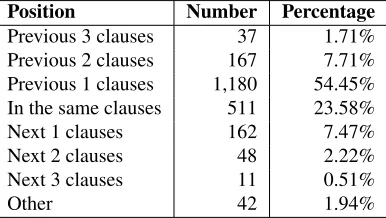
3.3 Details of Dataset and Its Annotations Each instance in our dataset contains only one emo-tion keyword and at least one emoemo-tion cause. It is ensured that the keyword instance and the causes are relevant. The number of extracted instances, claus-es, and emotion causes are listed in Table 1. Note that 97.2% of the instances has only one emotion cause, and instances that have two and three emo-tion causes hold 2.6% and 0.2% respectively. Table 2 shows the distribution of emotion types and Ta-ble 3 shows the distribution of cause positions. In the latter we can see that 78% emotion causes ad-join the emotion keywords at the clause level. Ap-parently, position plays a very important role in e-motion cause extraction. Thus, using distance based features for emotion cause extraction is rational and necessary. Table 4 lists the phrase types of emotion causes. Verbs and verb phrases cover 93% of al-l cause events. Thus, our al-learning aal-lgorithm mainal-ly focus on them.
Two annotators work independently during the annotation process. The key point is to distinguish clause level and phrase level in cause annotation. The clause level labels the clause which contains the emotion cause. The phrase level determines the boundary of an emotion cause. When two
annota-Emotion Number Percentage
Happiness 544 25.83% Sadness 567 26.94%
Fear 379 18.00%
Anger 302 14.35%
[image:4.612.105.270.56.146.2]Disgust 225 10.69% Surprise 88 4.18%
Table 2:Distribution of Emotion Types
Position Number Percentage
Previous 3 clauses 37 1.71% Previous 2 clauses 167 7.71% Previous 1 clauses 1,180 54.45% In the same clauses 511 23.58% Next 1 clauses 162 7.47% Next 2 clauses 48 2.22% Next 3 clauses 11 0.51%
Other 42 1.94%
Table 3:Cause Position of Each Emotion
tors have different opinion on one instance at clause level, we involve a third annotator as the arbitrator. In the phrase level, we use the larger boundary of the two annotations when they have the same anno-tation at the clause level. We reach 0.9287 for the kappa value on clause level annotation which con-firmed the reliability of our annotation.
4 Event-Driven Emotion Cause Extraction Due to the complexity of annotation in emotion cause identification, the size of annotated corpus is usually small. Since we aim to use machine learning methods to automatically learn and identify caus-es, we use a convolution kernel to detect all pos-sible combinations in the syntactic structure. This allows learning from syntactic representations for e-motion cause extraction. The basic idea of our pro-posed method is to use a tree-structure representa-tion to capture features for emorepresenta-tion cause identifica-tion. For training data, we extract all valid tree struc-tures for each event, referred to as the ETs (Even-t Trees). If an even(Even-t is a cause, (Even-the corresponding ET is positive. Otherwise, the corresponding ET is negative. Then, we train a convolution kerneland a
POS/phrase type Number Percentage
Noun/Noun phrase 147 6.78% Verb/Verb phrase 2020 93.21%
[image:4.612.331.524.167.276.2] [image:4.612.330.521.658.696.2]multi-kernel SVMs using the training set to classi-fy candidate ETs in the testing set. Since more than 97% emotion keywords only have one cause, and more than 95% causes are near the emotion key-words, candidate ETs are extracted from the context of emotion keywords. We only choose the ET with the highest probability in the classification result as the emotion cause.
4.1 Event Tree Construction
Even though there are related works on event identi-fication in emotion cause detection, there is no for-mal definition of events In area of artificial intelli-gence (AI), researchers, such as Radinsky (Radinsky et al., 2012), gave a formal definition of an even-t as “aceven-tion, aceven-tor, objeceven-t, inseven-trumeneven-t, locaeven-tion and time”. In our work, we need to give clear definition of event first.
In emotion cause extraction, the components of an event should be simpler. We are only interested in the action, the actor and the object, which are de-noted asP,O1,O2, respectively, following the
con-ventions in AI. Since Chinese is a SVO language, the actor is the subject and the action is the verb. The subject and the object of a sentence may have attributes and a predicate may have adverbial and complement. Since these components may also be helpful in emotion cause extraction, we formally de-fine an emotion cause event as a 7-tuple:
e= (AttO1, O1, Adv, P, Cpl, AttO2, O2).
Here, AttO1 is the attribute ofO1;AttO2 is the
attribute of O2;Adv is the adverbial of the
predi-cate P;andCplisP’s complement. In case syn-tactic components are not present, NIL values are used. Note that the main cue in an event isP, the ac-tion. So, in our algorithm, we extract all verbs from the text, and use dependency parsing4 to extract all relevant syntactic components specified ine. Then, we can construct an ET.
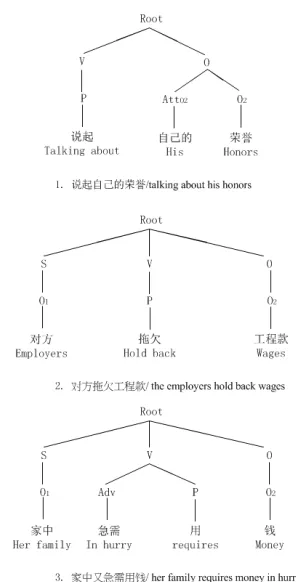
An ET has has a fixed height of four levels. The top level is the root node. Since Chinese is a SVO language, the descendant of the root is S(subject), V(verb), and O(object). Then, the seven even-t componeneven-ts can be caeven-tegorized and filled up in the relevant slots. (AttO1,O1) belongs to S(O1),
[image:5.612.348.496.53.344.2](Adv,P,Cpl) belong toV, and (AttO2,O2) belongs 4https://github.com/HIT-SCIR/ltp
Figure 1:Example ETs of Emotion Causes.
toO. Then we can get the ET based on the definition of an event.
Let us review Ex.1 and Ex.2 again. There are three emotion cause events below with their corre-sponding ETs shown in Figure 1.
1.“说起自己的荣誉/Talking about his honors” 2.“对方拖欠工程款/ the hold back wages by employ-ers”
3.“家中又急需用钱/ her family asked for money ur-gently”
After the construction of the ETs, emotion cause extraction becomes a classification problem. If an ET is an emotion cause, the label should be positive. Otherwise, the label should be negative. A binary classifier should be used.
4.2 Emotion Cause Extraction
After the construction of ETs, we obtain positive and negative ET samples. Due to small amount of train-ing samples, it is necessary to capture all features in the ETs. We choose convolution kernel based SVMs because it can search all possible syntactic features under a tree structure.
The convolution kernel, also known as the tree k-ernel (Collins and Duffy, 2002), is widely used in many NLP tasks (Srivastava et al., 2013; Moschitti, 2006). For any two inputsT1andT2based on a tree
structure , the kernel is defined as:
K(T1, T2) = X
n1∈T1 X
n2∈T2
δ(n1, n2). (1)
Here, n1 and n2 are tree nodes. δ is a function
defined recursively:
1.δ(n1, n2) = 0if the productions ofn1 andn2are
different; 2.Else, δ(n1, n2) = 1 if n1 and n2 are
matching in pre-terminals; 3.Otherwise,
δ(n1, n2) = Y
i
(1 +δ(c(n1, i), c(n2, i))).
Here,c(n, i)is thei-th node ofn.
However, the above tree kernel definition does not consider terminals, which means that the actual words in a sentence are ignored. As emotions causes are semantically meaningful, we need to incorporate lexical information into the convolution kernel.
Modified kernel function
In order to distinguish different ETs, we need to modify the definition of the tree kernel to include lexical words in a clause. So we add one more defi-nition to include the terminals:
4.If n1 and n2 are terminal nodes, δ(n1, n2) = 1
if and only ifn1 andn2 are synonyms. Otherwise
δ(n1, n2) = 0.
Here a synonym is defined in Tongyici Cilin (Ex-tended).5 which has 17,817 synonyms and 77,343 words. We use the synonym rather than word match-ing because the size of the corpus is limited. simple word matching is quite sparse.
Let KET−O denote the original kernel and
KET−M denote the modified kernel, respectively.
It can be easily proven thatKET−M is a valid
ker-nel function. Following the notation in (Collins and Duffy, 2002),KET−O =P
i
hi(T1)·hi(T2), where
hi(T1) = P n1∈N1
Ii(n1),hi(T2) = P n2∈N2
Ii(n2) and
the function Ii(n) is 1 if the sub-tree i is rooted
at node nand 0 otherwise. So the original tree k-ernel is an inner product and the kk-ernel matrix is
5http://ir.hit.edu.cn/demo/ltp/Sharing Plan.htm
semi-definite. In our modified kernel, the func-tion Ii(n) is more complicated. Beside the
nition above, it has the following additional defi-nition : Ii(n) is 1 if i is a terminal node and it
is a synonym of n. The new indicator is marked asPIi0(n). Then we have: KET−M(T1, T2) = n1∈T1
P n2∈T2
P i
Ii0(n1)Ii0(n2). This means that the
modified kernel is symmetrical and the kernel matrix is semi-definite. In our work, KET−M uses SVM
optimization and the code is from SVM-light-TK6. Multi-kernel function
Since there are only syntactic information and synonyms in the convolution kernel based method, we need to add some lexical features. Given a 7-tuple evente, we obtain the bag-of-words based or word embedding based representation for each com-ponent ine, and the distance between a component and emotion keywords are used as the features, re-spectively. Let the features of each component ine be Ri, for everyi ∈ e. Then, we can capture the
feature set,F, of an ET by a joint operation, called the ET features:
F ={RAttO1 ⊕RO1⊕...⊕RAttO2}. (2)
We can join the ET features with syntactic informa-tion by a multi-kernel funcinforma-tion. For any two ETsT1
andT2, with the respective features F1 andF2, the
two new multi-kernels can be defined as:
Knew+O(T1, T2) =KET−O(T1, T2) +Kvec(F1, F2), (3)
Knew∗O(T1, T2) =KET−O(T1, T2)×Kvec(F1, F2), (4)
Knew+M(T1, T2) =KET−M(T1, T2) +Kvec(F1, F2), (5)
Knew∗M(T1, T2) =KET−M(T1, T2)×Kvec(F1, F2). (6)
Here, Kvec denotes a kernel function which can
be a linear kernel, a polynomial kernel or a Gaussian kernel. The next step is to train the classifier based on the multi-kernel function.
The training data is already in labeled ET format. To prepare testing data, we extract all ETs from a given instance as candidate ETs. A classifier is used to obtain the probability of emotion cause for each ET to produce a ranked list of candidate ETs. The ET with the highest rank serves as the cause event for the current instance.
5 Performance Evaluations 5.1 Experimental Setup
In the experiments, we stochastically select 90% of the dataset as training data and 10% as testing da-ta. In order to obtain statistically credible results, we evaluate our methods and the reference methods 25 times. We conduct two sets of experiments. The first one evaluates the performance at the clause lev-el to identify the clauses that contain emotion caus-es. The second one evaluates emotion causes using verb classification. This is because 93.21% of emo-tion causes are verb/verb phrase and verbs serve as the action component in event definition.
5.2 Emotion Cause Extraction
We use the commonly accepted measure proposed by Lee (Lee et al., 2010) for emotion cause extrac-tion (Gao et al., 2015; Li and Xu, 2014). In this measure, if a roposed emotion cause covers the an-notated answer, the sequence is considered correct. Te precision, recall, and F-measure are defined by
P recision= P
correct cause1 P
proposed cause1,
Recall= P
correct cause1 P
annotated cause1,
F−measure= 2×P recision×Recall
P recision+Recall .
In the experiment, evaluation is conducted for the following works:
1.RB(Rule based method): Among several rule based methods (Lee et al., 2010; Gui et al., 2014; Li and Xu, 2014). We use lee2010’s rules (listed in Appendixof this paper).
2.CB(Commonsense based method): In order to re-produce this method (Russo et al., 2011), we use the Chinese Emotion Cognition Lexicon (Xu et al., 2013) as the commonsense. The lexicon contains more than 5,000 emotion stimulations and their cor-responding reflection words.
3.ML(Rule base features for machine learning): Rules are used as features with other manual fea-tures for emotion cause classification (Chen et al., 2010).
4. Kvec: Features are defined in Formula (2) in the
training of classifier.
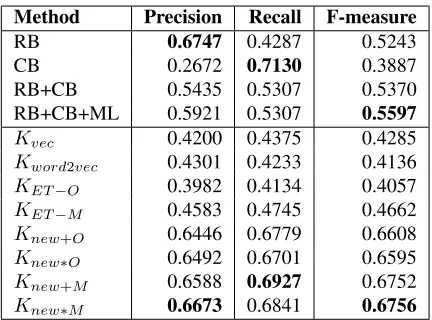
Method Precision Recall F-measure
RB 0.6747 0.4287 0.5243 CB 0.2672 0.7130 0.3887 RB+CB 0.5435 0.5307 0.5370 RB+CB+ML 0.5921 0.5307 0.5597
[image:7.612.319.535.55.215.2]Kvec 0.4200 0.4375 0.4285 Kword2vec 0.4301 0.4233 0.4136 KET−O 0.3982 0.4134 0.4057 KET−M 0.4583 0.4745 0.4662 Knew+O 0.6446 0.6779 0.6608 Knew∗O 0.6492 0.6701 0.6595 Knew+M 0.6588 0.6927 0.6752 Knew∗M 0.6673 0.6841 0.6756
Table 5:Performance on the Dataset
5.Kword2vec: Word2vec (Mikolov et al., 2013) is
used to learn word representation. Use the repre-sentation according to Formula (2) in the training of classifier.
6.KET−O: This is the original tree kernel.
7.KET−M : This is the modified tree kernel in
For-mula (1).
8.Knew+O, Knew∗O, Knew+M and Knew∗M: Use
the multi-kernel gives by formulas from (3) to (6). The performance result is given in Table 5. A-mong all methods,Knew∗M achieves the top
perfor-mance in F-measure. Compared to other methods, the improvement is significant with p-value less than 0.01 int-test.
Even though RB achieves the top precision, its F-measure is limited by the low recall. Since CB is opposite to RB, the performance by RB+CB is im-proved. However, the improvement is quite limited, at 0.0127 in F-measure. The F-measure of our re-produced RB is similar to mentioned result of other references (Gui et al., 2014; Li and Xu, 2014). They repeat Lee’s (Lee et al., 2010) method and achieve the F-measure with 0.55 more or less.
23.6%. (Chen et al., 2010)’s method does not han-dle long distance relations well. This explains why it does not work well for our dataset. Although (RB+CB+ML) does not perform well, there is still 0.0334 improvement in F-measure compare to RB. Among our proposed methods,Kvecon the ET
fea-ture achieves 0.4285 in F-measure. Compare to CB and ML, the performance is not satisfactory. How-ever, as a simple feature to represent lexical informa-tion, the performance is acceptable. word2vec also yield similar result. Maybe the joint operation is too simple to handle composition.
For the modified tree kernelKET−M, the
perfor-mance is 0.0605 higher than the original tree ker-nelKET−Oin F-measure. It means that the
consid-eration of terminal node improves the performance of the tree kernel significantly. The modified tree kernel KET−M is also 0.0377 higher than Kvec,
and 0.0526 higher than Kword2vec in F-measure.
This means kernel based syntactic representation does have better generalization ability. The origi-nal kernel functionKET−O has syntactic
informa-tion but no lexicon, and it not only underperforms compared toKET−M but alsoKvecandKword2vec.
This demonstrates our modified kernel function can effectively turn an inferior method into a superior one. Compared to rule based method, the perfor-mance still needs to be enhanced and a multi-kernel is necessary. After the combination with ET feature using a multi-kernel, the performance of Knew∗M
achieves a higher level with 0.6756 in F-measure. Compare to RB, the improvement in F-measure is 0.1513. Compare to the combination of existing methods, the improvement is 0.1159. The reason is that our method represents events at the syntactic level. Synonym information gives the model more generalization ability.
5.3 Verb Classification for Emotion Cause In this section, we examine the performance of ETs classification with respect to verbs identified in the emotion clauses.
ETs Classification
Our method is based on ETs classification to choose the candidate ET with the highest probabili-ty. The performance is measured by the verbs in the identified ET. Results are shown in Table 6.
Note that Kword2vec performs much better than
Method Precision Recall F-measure
[image:8.612.324.531.57.168.2]Kvec 0.3500 0.2951 0.3192 Kword2vec 0.3200 0.4833 0.3848 KET−O 0.3906 0.2773 0.3228 KET−M 0.3978 0.3303 0.3473 Knew+O 0.4211 0.7219 0.5319 Knew∗O 0.4197 0.7305 0.5331 Knew+M 0.4407 0.7694 0.5651 Knew∗M 0.4532 0.7504 0.5646
Table 6:Performance on ETs Classification
Kvec in verb identification, contrary to their
simi-lar performance in clause identification. The rea-son is that extraction result is based on ranking and only top ranked event affects the performance. In other words, precision is more important than re-call here. For the same reason, Knew+M is better
thanKnew∗M in classification of ETs, although
on-ly marginalon-ly. Nonetheless, using revised convolu-tion kernel with multi-kernel training is still signifi-cantly better than the original kernelKnew∗M which
achieves the best performance in Table 5. When the precision of the two methods are similar, such as KET−O andKET−M, the effect of recall becomes
important.
The multi-kernel not only achieves the best per-formance on both precision and recall, the increase in performance is also significant with at least 0.2173 (betweenKET−M andKnew∗M).
Obvious-ly, multi-kernel is not just a simple voting or joint for the components, it benefits from two kernels to achieve better performance.
5.4 Error Analysis
There are mainly three types of errors in our model. We use case examples to show them.
a) Cascading Events
In some cases, events may happen like a chain re-action. An event that leads to an emotion may be the consequent of another event. Identifying the right event in a chain is more challenging. In the follow-ing example:
Ex.3:约兰·沃森坠入冰冷的水中。<cause>刺骨 的冰水</cause>让他感到极其寒冷与<keywords>害 怕</keywords>,约兰·沃森慌忙用不太流利的中文 大呼“救命”。
John Watson fell into icy water. <cause>The
chilly water</cause> made him feel so cold and
use his broken Chinese to call for help.
the emotion cause should be “刺骨的冰水/the
chilly water”. Our method output “坠入 冰 冷的 水中/fell into icy water” as the emotion cause with
probability 60.83%. The probability of the correc-t cause is 58.89%. As a probabilicorrec-ty based mecorrec-thod, our method does not have the ability to analyze the sequence of events nor the relation between them.
b) Sensory verbs
Sensory verbs usually indicate the emotion cause. There are exceptional cases as shown below:
Ex.4:了解霸凌事件后。教务主任说,这三名学生 知道错了 也感到很<keywords>害怕</keywords>,
他们<cause>可能面临劳动服务</cause>
After investigation on bullying, the head says that the students realized their mistake and were also
<keywords>scared</keywords>. They <cause> may
need to do community service</cause>
In this case, the cause of “scared” is the punish-ment of community service. But the template of“知 道…感到/realized ... and felt”usually indicate that
there is an emotion cause between the two senso-ry verbs. Our algorithm gives“知道错了/ realized their mistake”a probability of 61.65% as a cause, al-though this is incorrect. But, this actually indicates that our method can learn latent patterns in text.
c) Coverage of cause candidates
In the construction of ETs, we use actions as the cue to construct candidate events. However, 6.78% of our clauses do not have action words. So, these clauses are not selected as candidates.
6 Conclusion
In this paper, we present our work on emotion cause extraction. Due to the lack of open resources for this area of study, we first construct an annotated dataset from news text which will be released for public use. We also propose an event-driven emotion cause ex-traction method to capture the triggering events e-motion changes. In this method, we propose a 7-tuple representation of events using syntactic struc-tures to identify events. Based on this structured rep-resentation of events and the inclusion of lexical fea-tures, a convolution kernel based learning method is designed to train a multi-kernel classifier to identify emotion cause events. Compared to manually con-structed rules and commonsense knowledge based
methods, our proposed model can automatically ob-tain structure features and lexical features to achieve state-of-the-art performance on this dataset.
Acknowledgment
This work was supported by the National Natural Sci-ence Foundation of China 61370165, 61632011, National 863 Program of China 2015AA015405, Shenzhen Pea-cock Plan Research Grant KQCX20140521144507925 and Shenzhen Foundational Research Funding J-CYJ20150625142543470, Guangdong Provincial Engi-neering Technology Research Center for Data Science 2016KF09. The project is also partially supported by HK GRF grant PolyU 152111/14E.
Appendix
No. Rules
1 i) C(B/F) + I(F) + E(F) + K(F)ii) E = the nearest Na/Nb/Nc/Nh after I in F iii) C = the nearest (N)+(V)+(N) before I in F/B
2 i) E(B/F) + II/IV/V/VI(B/F) + C(B/F) + K(F)ii) E=the nearest Na/Nb/Nc/Nh before II/IV/V/VI in B/F iii) C = the nearest (N)+(V)+(N) before K in F
3 i) II/IV/V/VI (B) + C(B) + E(F) + K(F)ii) E = the nearest Na/Nb/Nc/Nh before K in F iii) C = the nearest (N)+(V)+(N) after II/IV/V/VI in B
4 i) E(B/F) + K(F) + IV/VII(F) + C(F/A)ii) E = a: the nearest Na/Nb/Nc/Nh before K in F; b: the first Na/Nb/Nc/Nh in B iii) C = the nearest (N)+(V)+(N) after IV/VII in F/A
5 i) E(F)+K(F)+VI(A)+C(A)ii) E = the nearest Na/Nb/Nc/Nh before K in F iii) C = the nearest (N)+(V)+(N) after VI in A
6 i) I(F) + E(F) + K(F) + C(F/A)ii) E = the nearest Na/Nb/Nc/Nh after I in F iii) C = the nearest (N)+(V)+(N) after K in F or A
7 i) E(B/F) + yue4 C yue4 K “the more C the more K” (F)ii) E = the nearest Na/Nb/Nc/Nh before the first yue4 in B/F iii) C = the V in between the two yue4’s in F
8 i) E(F) + K(F) + C(F)ii) E = the nearest Na/Nb/Nc/Nh before K in F iii) C = the nearest (N)+(V)+(N) after K in F
9 i) E(F) + IV(F) + K(F)ii) E = the nearest Na/Nb/Nc/Nh before IV in F iii) C = IV+(an aspectual marker) in F
10 i) K(F) + E(F) + de “possession”(F) + C(F)ii) E = the nearest Na/Nb/Nc/Nh after K in F iii) C = the nearest (N)+V+(N)+“的”+N after de in F
11 i) C(F) + K(F) + E(F)ii) E = the nearest Na/Nb/Nc/Nh after K in F iii) C = the nearest (N)+(V)+(N) before K in F
12 i) E(B) + K(B) + III (B) + C(F)ii) E = the nearest Na/Nb/Nc/Nh before K in F iii) C = the nearest (N)+(V)+(N) after III in F
13 i) III(B) + C(B) + E(F) + K(F)ii) E = the nearest Na/Nb/Nc/Nh before K in F iii) C = the nearest (N)+(V)+(N) after III in B
14 i) C(B) + E(F) + K(F)ii) E = the nearest Na/Nb/Nc/Nh before K in F iii) C = the nearest (N)+(V)+(N) before K in B
[image:9.612.313.540.269.606.2]15 i) E(B) +C(B) + K(F)ii) E = the first Na/Nb/Nc/Nh in B iii) C = the nearest (N)+(V)+(N) before K in B
Table 7:Linguistic Rules inRB
References
Daniel Beck, Trevor Cohn, and Lucia Specia. 2014. Joint emotion analysis via multi-task gaussian processes. In
EMNLP, pages 1798–1803.
Yung-Chun Chang, Cen-Chieh Chen, Yu-Lun Hsieh, and WL Hsu. 2015. Linguistic template extraction for recognizing reader-emotion and emotional resonance writing assistance. ACL-IJCNLP, pages 775–780. Ying Chen, Sophia Yat Mei Lee, Shoushan Li, and
Chu-Ren Huang. 2010. Emotion cause detection with lin-guistic constructions. InProceedings of the 23rd In-ternational Conference on Computational Linguistic-s, pages 179–187. Association for Computational Lin-guistics.
Michael Collins and Nigel Duffy. 2002. New rank-ing algorithms for parsrank-ing and taggrank-ing: Kernels over discrete structures, and the voted perceptron. In Pro-ceedings of the 40th annual meeting on association for computational linguistics, pages 263–270. Association for Computational Linguistics.
Dipankar Das and Sivaji Bandyopadhyay. 2010. Finding emotion holder from bengali blog texts—an unsuper-vised syntactic approach. InPACLIC, pages 621–628. Paul Ekman. 1984. Expression and the nature of
emo-tion. Approaches to emotion, 3:19–344.
Wei Gao, Shoushan Li, Sophia Yat Mei Lee, Guodong Zhou, and Chu-Ren Huang. 2013. Joint learning on sentiment and emotion classification. InProceedings of the 22nd ACM international conference on Confer-ence on information & knowledge management, pages 1505–1508. ACM.
Kai Gao, Hua Xu, and Jiushuo Wang. 2015. A rule-based approach to emotion cause detection for chi-nese micro-blogs. Expert Systems with Applications, 42(9):4517–4528.
Diman Ghazi, Diana Inkpen, and Stan Szpakowicz. 2015. Detecting emotion stimuli in emotion-bearing sentences. In Computational Linguistics and Intelli-gent Text Processing, pages 152–165. Springer. Lin Gui, Li Yuan, Ruifeng Xu, Bin Liu, Qin Lu, and
Yu Zhou. 2014. Emotion cause detection with lin-guistic construction in chinese weibo text. InNatural Language Processing and Chinese Computing, pages 457–464. Springer.
Takayuki Hasegawa, Nobuhiro Kaji, Naoki Yoshinaga, and Masashi Toyoda. 2013. Predicting and eliciting addressee’s emotion in online dialogue. In ACL (1), pages 964–972.
Sophia Yat Mei Lee, Ying Chen, and Chu-Ren Huang. 2010. A text-driven rule-based system for emo-tion cause detecemo-tion. In Proceedings of the NAACL HLT 2010 Workshop on Computational Approaches to
Analysis and Generation of Emotion in Text, pages 45– 53. Association for Computational Linguistics. Weiyuan Li and Hua Xu. 2014. Text-based emotion
clas-sification using emotion cause extraction. Expert Sys-tems with Applications, 41(4):1742–1749.
Huanhuan Liu, Shoushan Li, Guodong Zhou, Chu-Ren Huang, and Peifeng Li. 2013. Joint modeling of news reader’s and comment writer’s emotions. InACL (2), pages 511–515.
Bing Liu. 2015. Sentiment analysis: Mining opinion-s, sentimentopinion-s, and emotions. Cambridge University Press.
Kun-Hu Luo, Zhi-Hong Deng, Liang-Chen Wei, and Hongliang Yu. 2015. Jeam: A novel model for cross-domain sentiment classification based on emo-tion analysis. InEMNLP, pages 2503–2508.
Tomas Mikolov, Ilya Sutskever, Kai Chen, Greg S Cor-rado, and Jeff Dean. 2013. Distributed representa-tions of words and phrases and their compositionality. InAdvances in neural information processing systems, pages 3111–3119.
Saif M Mohammad and Peter D Turney. 2013. Crowd-sourcing a word–emotion association lexicon. Com-putational Intelligence, 29(3):436–465.
Mitra Mohtarami, Man Lan, and Chew Lim Tan. 2013. Probabilistic sense sentiment similarity through hid-den emotions. InACL (1), pages 983–992.
Alessandro Moschitti. 2006. Efficient convolution k-ernels for dependency and constituent syntactic trees. In Machine Learning: ECML 2006, pages 318–329. Springer.
Gaoyan Ou, Wei Chen, Tengjiao Wang, Zhongyu Wei, Binyang Li, Dongqing Yang, and Kam-Fai Wong. 2014. Exploiting community emotion for microblog event detection. InEMNLP, pages 1159–1168. Robert Plutchik. 1980. Emotion: A psychoevolutionary
synthesis.
Ashequl Qadir and Ellen Riloff. 2014. Learning emo-tion indicators from tweets: Hashtags, hashtag pattern-s, and phrases. InEMNLP, pages 1203–1209. Changqin Quan and Fuji Ren. 2009. Construction of a
blog emotion corpus for chinese emotional expression analysis. InProceedings of the 2009 Conference on Empirical Methods in Natural Language Processing: Volume 3-Volume 3, pages 1446–1454. Association for Computational Linguistics.
Kira Radinsky, Sagie Davidovich, and Shaul Markovitch. 2012. Learning to predict from textual data. Journal of Artificial Intelligence Research, pages 641–684. Irene Russo, Tommaso Caselli, Francesco Rubino, Ester
Computational Approaches to Subjectivity and Senti-ment Analysis, pages 153–160. Association for Com-putational Linguistics.
Shashank Srivastava, Dirk Hovy, and Eduard H Hovy. 2013. A walk-based semantically enriched tree ker-nel over distributed word representations. InEMNLP, pages 1411–1416.
Jacopo Staiano and Marco Guerini. 2014. De-pechemood: a lexicon for emotion analysis from crowd-annotated news. arXiv preprint arX-iv:1405.1605.
Jonathan H Turner. 2000. On the origins of human e-motions: A sociological inquiry into the evolution of human affect. Stanford University Press Stanford, CA. Linhong Xu, Hongfei Lin, Yu Pan, Hui Ren, and Jianmei Chen. 2008. Constructing the affective lexicon ontol-ogy. Journal of the China Society for Scientific and Technical Information, 27(2):180–185.
Jun Xu, Ruifeng Xu, Qin Lu, and Xiaolong Wang. 2012. Coarse-to-fine sentence-level emotion classifi-cation based on the intra-sentence features and senten-tial context. InProceedings of the 21st ACM interna-tional conference on Information and knowledge man-agement, pages 2455–2458. ACM.
Ruifeng Xu, Chengtian Zou, Yanzhen Zheng, Xu Jun, Lin Gui, Bin Liu, and Xiaolong Wang. 2013. A new e-motion dictionary based on the distinguish of ee-motion expression and emotion cognition. Journal of Chinese Information Processing, 27(6):82–90.