Training with Exploration Improves a Greedy Stack LSTM Parser
Miguel Ballesteros♦ Yoav Goldberg♣ Chris Dyer♠ Noah A. Smith♥ ♦NLP Group, Pompeu Fabra University, Barcelona, Spain
♣Computer Science Department, Bar-Ilan University, Ramat Gan, Israel ♠Google DeepMind, London, UK
♥Computer Science & Engineering, University of Washington, Seattle, WA, USA
[email protected], [email protected], [email protected], [email protected]
Abstract
We adapt the greedy stack LSTM dependency parser of Dyer et al. (2015) to support a training-with-exploration procedure using dy-namic oracles (Goldberg and Nivre, 2013) in-stead of assuming an error-free action his-tory. This form of training, which accounts for model predictions at training time, improves parsing accuracies. We discuss some modifi-cations needed in order to get training with ex-ploration to work well for a probabilistic neu-ral network dependency parser.
1 Introduction
Natural language parsing can be formulated as a se-ries of decisions that read words in sequence and in-crementally combine them to form syntactic struc-tures; this formalization is known as transition-based parsing, and is often coupled with a greedy search procedure (Yamada and Matsumoto, 2003; Nivre, 2003; Nivre, 2004; Nivre, 2008). The lit-erature on transition-based parsing is vast, but all works share in common a classification component that takes into account features of the current parser state1 and predicts the next action to take
condi-tioned on the state. The state is of unbounded size. Dyer et al. (2015) presented a parser in which the parser’s unbounded state is embedded in a fixed-dimensional continuous space using recurrent neu-ral networks. Coupled with a recursive tree com-position function, the feature representation is able
1The term “state” refers to the collection of previous
de-cisions (sometimes called the history), resulting partial struc-tures, which are typically stored in a stack data structure, and the words remaining to be processed.
to capture information from the entirety of the state, without resorting to locality assumptions that were common in most other transition-based parsers. The use of a novel stack LSTM data structure allows the parser to maintain a constant time per-state update, and retain an overall linear parsing time.
The Dyer et al. parser was trained to maximize the likelihood of gold-standard transition sequences, given words. At test time, the parser makesgreedy
decisions according to the learned model. Although this setup obtains very good performance, the train-ing and testtrain-ing conditions are mismatched in the fol-lowing way: at training time the historical context of an action is always derived from the gold standard (i.e., perfectly correct past actions), but at test time, it will be a model prediction.
In this work, we adapt the training criterion so as to explore parser states drawn not only from the training data, but also from the model as it is be-ing learned. To do so, we use the method of Gold-berg and Nivre (2012; 2013) to dynamically chose an optimal (relative to the final attachment accuracy) action given an imperfect history. By interpolating between algorithm states sampled from the model and those sampled from the training data, more ro-bust predictions at test time can be made. We show that the technique can be used to improve the strong parser of Dyer et al.
2 Parsing Model and Parameter Learning
Our departure point is the parsing model described by Dyer et al. (2015). We do not describe the model in detail, and refer the reader to the original work. At each stagetof the parsing process, the parser state is
encoded into a vectorpt, which is used to compute
the probability of the parser action at timetas:
p(zt|pt) =
exp g>ztpt+qzt P
z0∈A(S,B)exp g>z0pt+qz0, (1)
wheregz is a column vector representing the
(out-put) embedding of the parser action z, and qz is a
bias term for action z. The setA(S, B) represents the valid transition actions that may be taken in the current state. Sinceptencodes information about all
previous decisions made by the parser, the chain rule gives the probability of any valid sequence of parse transitionszconditional on the input:
p(z|w) =
|z| Y
t=1
p(zt|pt). (2)
The parser is trained to maximize the conditional probability of taking a “correct” action at each pars-ing state. The definition of what constitutes a “cor-rect” action is the major difference between a static oracle as used by Dyer et al. (2015) and the dynamic oracle explored here.
Regardless of the oracle, our training implemen-tation constructs a compuimplemen-tation graph (nodes that represent values, linked by directed edges from each function’s inputs to its outputs) for the negative log probability for the oracle transition sequence as a function of the current model parameters and uses forward- and backpropagation to obtain the gradi-ents respect to the model parameters (Lecun et al., 1998, section 4).
2.1 Training with Static Oracles
With a static oracle, the training procedure com-putes a canonical reference series of transitions for each gold parse tree. It then runs the parser through this canonical sequence of transitions, while keep-ing track of the state representationptat each stept,
as well as the distribution over transitionsp(zt|pt)
which is predicted by the current classifier for the state representation. Once the end of the sentence is reached, the parameters are updated towards maxi-mizing the likelihood of the reference transition se-quence (Equation 2), which equates to maximizing the probability of the correct transition,p(zgt |pt),
at each state along the path.
2.2 Training with Dynamic Oracles
In the static oracle case, the parser is trained to predict the best transition to take at each parsing step, assuming all previous transitions were cor-rect. Since the parser is likely to make mistakes at test time and encounter states it has not seen dur-ing traindur-ing, this traindur-ing criterion is problematic (Daum´e III et al., 2009; Ross et al., 2011; Gold-berg and Nivre, 2012; GoldGold-berg and Nivre, 2013,
inter alia). Instead, we would prefer to train the parser to behave optimally even after making a mis-take (under the constraint that it cannot backtrack or fix any previous decision). We thus need to in-clude in the training examples states that result from wrong parsing decisions, together with the optimal transitions to take in these states. To this end we reconsider which training examples to show, and what it means to behave optimally on these training examples. The framework of training with explo-ration using dynamic oracles suggested by Goldberg and Nivre (2012; 2013) provides answers to these questions. While the application of dynamic oracle training is relatively straightforward, some adapta-tions were needed to accommodate the probabilistic training objective. These adaptations mostly follow Goldberg (2013).
Dynamic Oracles. Adynamic oracleis the
com-ponent that, given a gold parse tree, provides the optimal set of possible actions to take for any valid parser state. In contrast to static oracles that derive a canonical state sequence for each gold parse tree and say nothing about states that deviate from this canonical path, the dynamic oracle is well defined for states that result from parsing mistakes, and they may produce more than a single gold action for a given state. Under the dynamic oracle framework, an action is said to be optimal for a state if the best tree that can be reached after taking the action is no worse (in terms of accuracy with respect to the gold tree) than the best tree that could be reached prior to taking that action.
Goldberg and Nivre (2013) define the arc-decomposition property of transition systems, and show how to derive efficient dynamic oracles for transition systems that are arc-decomposable.2
Un-fortunately, the arc-standard transition system does
not have this property. While it is possible to com-pute dynamic oracles for the arc-standard system (Goldberg et al., 2014), the computation relies on a dynamic programming algorithm which is polyno-mial in the length of the stack. As the dynamic ora-cle has to be queried for each parser state seen during training, the use of this dynamic oracle will make the training runtime several times longer. We chose in-stead to switch to the arc-hybrid transition system (Kuhlmann et al., 2011), which is very similar to the arc-standard system but is arc-decomposable and hence admits an efficient O(1)dynamic oracle, re-sulting in only negligible increase to training run-time. We implemented the dynamic oracle to the arc-hybrid system as described by Goldberg (2013).
Training with Exploration. In order to expose
the parser to configurations that are likely to result from incorrect parsing decisions, we make use of the probabilistic nature of the classifier. During training, instead of following the gold action, we sample the next transition according to the output distribution the classifier assigns to the current configuration. Another option, taken by Goldberg and Nivre, is to follow the one-best action predicted by the classifier. However, initial experiments showed that the one-best approach did not work well. Because the neural network classifier becomes accurate early on in the training process, the one-best action is likely to be correct, and the parser is then exposed to very few error states in its training process. By sampling from the predicted distribution, we are effectively increas-ing the chance of strayincreas-ing from the gold path durincreas-ing training, while still focusing on mistakes that receive relatively high parser scores. We believe further for-mal analysis of this method will reveal connections to reinforcement learning and, perhaps, other meth-ods for learning complex policies.
Taking this idea further, we could increase the number of error-states observed in the training pro-cess by changing the sampling distribution so as to bias it toward more low-probability states. We do this by raising each probability to the power of α (0 < α ≤ 1) and re-normalizing. This trans-arcsA, if each arc inAcan be derived fromp, then a valid tree structure containingallof the arcs inAcan also be derived fromp. This is a sufficient condition, but whether it is necessary is unknown; hence the question of an efficient,O(1)dynamic oracle for the augmented system is open.
formation keeps the relative ordering of the events, while shifting probability mass towards less frequent events. As we show below, this turns out to be very beneficial for the configurations that make use of external embeddings. Indeed, these configurations achieve high accuracies and sharp class distributions early on in the training process.
The parser is trained to maximize the likelihood of a correct actionzgat each parsing stateptaccording
to Equation 1. When using the dynamic oracle, a state pt may admit multiple correct actions zg = {zgi, . . . , zgk}. Our objective in such cases is the
marginal likelihood of all correct actions,3
p(zg|pt) = X
zgi∈zg
p(zgi |pt). (3)
3 Experiments
Following the same settings of Chen and Manning (2014) and Dyer et al (2015) we report results4 in
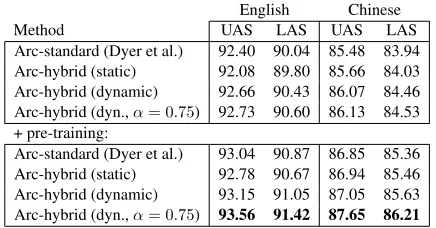
the English PTB and Chinese CTB-5. Table 1 shows the results of the parser in its different configura-tions. The table also shows the best result obtained with the static oracle (obtained by rerunning Dyer et al. parser) for the sake of comparison between static and dynamic training strategies.
English Chinese
Method UAS LAS UAS LAS
Arc-standard (Dyer et al.) 92.40 90.04 85.48 83.94 Arc-hybrid (static) 92.08 89.80 85.66 84.03 Arc-hybrid (dynamic) 92.66 90.43 86.07 84.46 Arc-hybrid (dyn.,α= 0.75) 92.73 90.60 86.13 84.53
+ pre-training:
[image:3.612.313.531.422.536.2]Arc-standard (Dyer et al.) 93.04 90.87 86.85 85.36 Arc-hybrid (static) 92.78 90.67 86.94 85.46 Arc-hybrid (dynamic) 93.15 91.05 87.05 85.63 Arc-hybrid (dyn.,α= 0.75) 93.56 91.42 87.65 86.21
Table 1:Dependency parsing: English (SD) and Chinese.
The score achieved by the dynamic oracle for En-glish is 93.56 UAS. This is remarkable given that the parser uses a completely greedy search proce-dure. Moreover, the Chinese score establishes the state-of-the-art, using the same settings as Chen and Manning (2014).
3A similar objective was used by Riezler et al (2000),
Char-niak and Johnson (2005) and Goldberg (2013) in the context of log-linear probabilistic models.
4The results on the development sets are similar and only
Catalan Chinese Czech English German Japanese Spanish
Method UAS LAS UAS LAS UAS LAS UAS LAS UAS LAS UAS LAS UAS LAS
Arc-standard, static + PP 89.60 85.45 79.68 75.08 77.96 71.06 91.12 88.69 88.09 85.24 93.10 92.28 89.08 85.03
+ pre-training – – 82.45 78.55 – – 91.59 89.15 88.56 86.15 – – 90.76 87.48
Arc-hybrid, dyn. + PP 90.45 86.38 80.74 76.52 85.68 79.38 91.62 89.23 89.80 87.29 93.47 92.70 89.53 85.69
+ pre-training – – 83.54 79.66 – – 92.22 89.87 90.34 88.17 – – 91.09 87.95
Y’15 – – – – 85.2 77.5 90.75 88.14 89.6 86.0 – – 88.3 85.4
A’16 + pre-training 91.24 88.21 81.29 77.29 85.78 80.63 91.44 89.29 89.12 86.95 93.71 92.85 91.01 88.14
[image:4.612.74.539.57.148.2]A’16-beam 92.67 89.83 84.72 80.85 88.94 84.56 93.22 91.23 90.91 89.15 93.65 92.84 92.62 89.95
Table 2:Dependency parsing results. The dynamic oracle usesα= 0.75(selected on English; see Table 1). PP refers to
pseudo-projective parsing. Y’15 and A’16 are beam = 1 parsers from Yazdani and Henderson (2015) and Andor et al. (2016), respectively. A’16-beam is the parser with beam larger than 1 by Andor et al. (2016). Bold numbers indicate the best results among the greedy parsers.
The error-exploring dynamic-oracle training al-ways improves over static oracle training control-ling for the transition system, but the arc-hybrid sys-tem slightly under-performs the arc-standard syssys-tem when trained with static oracle. Flattening the sam-pling distribution (α= 0.75) is especially beneficial when training with pretrained word embeddings.
In order to be able to compare with similar greedy parsers (Yazdani and Henderson, 2015; Andor et al., 2016)5 we report the performance of the parser
on the multilingual treebanks of the CoNLL 2009 shared task (Hajiˇc et al., 2009). Since some of the treebanks contain nonprojective sentences and arc-hybrid does not allow nonprojective trees, we use the pseudo-projective approach (Nivre and Nilsson, 2005). We used predicted part-of-speech tags pro-vided by the CoNLL 2009 shared task organizers. We also include results with pretrained word em-beddings for English, Chinese, German, and Span-ish following the same training setup as Dyer et al. (2015); for English and Chinese we used the same pretrained word embeddings as in Table 1, for German we used the monolingual training data from the WMT 2015 dataset and for Spanish we used the Spanish Gigaword version 3. See Table 2.
4 Related Work
Training greedy parsers on non-gold outcomes, fa-cilitated by dynamic oracles, has been explored by several researchers in different ways (Goldberg and Nivre, 2012; Goldberg and Nivre, 2013; Gold-berg et al., 2014; Honnibal et al., 2013; Honnibal and Johnson, 2014; G´omez-Rodr´ıguez et al., 2014;
5We report the performance of these parsers in the most
comparable setup, that is, with beam size 1 or greedy search.
Bj¨orkelund and Nivre, 2015; Tokg¨oz and Eryi˘git, 2015; G´omez-Rodr´ıguez and Fern´andez-Gonz´alez, 2015; Vaswani and Sagae, 2016). More gener-ally, training greedy search systems by paying atten-tion to the expected classifier behavior during test time has been explored under the imitation learning and learning-to-search frameworks (Abbeel and Ng, 2004; Daum´e III and Marcu, 2005; Vlachos, 2012; He et al., 2012; Daum´e III et al., 2009; Ross et al., 2011; Chang et al., 2015). Directly modeling the probability of making a mistake has also been ex-plored for parsing (Yazdani and Henderson, 2015). Generally, the use of RNNs to conditionally predict actions in sequence given a history is spurring in-creased interest in training regimens that make the learned model more robust to test-time prediction er-rors. Solutions based on curriculum learning (Ben-gio et al., 2015), expected loss training (Shen et al., 2015), and reinforcement learning have been pro-posed (Ranzato et al., 2016). Finally, abandoning greedy search in favor of approximate global search offers an alternative solution to the problems with greedy search (Andor et al., 2016), and has been an-alyzed as well (Kulesza and Pereira, 2007; Finley and Joachims, 2008), including for parsing (Martins et al., 2009).
5 Conclusions
oracles improve the stack LSTM parser, achieving 93.56 UAS for English, maintaining greedy search.
Acknowledgments
This work was sponsored in part by the U. S. Army Research Laboratory and the U. S. Army Research Office under contract/grant number W911NF-10-1-0533, and in part by NSF CAREER grant IIS-1054319. Miguel Ballesteros was supported by the European Commission under the contract num-bers FP7-ICT-610411 (project MULTISENSOR) and H2020-RIA-645012 (project KRISTINA). Yoav Goldberg is supported by the Intel Collaborative Research Institute for Computational Intelligence (ICRI-CI), a Google Research Award and the Israeli Science Foundation (grant number 1555/15).
References
Pieter Abbeel and Andrew Y. Ng. 2004. Apprenticeship learning via inverse reinforcement learning. InProc. of ICML.
Daniel Andor, Chris Alberti, David Weiss, Aliaksei Severyn, Alessandro Presta, Kuzman Ganchev, Slav Petrov, and Michael Collins. 2016. Globally nor-malized transition-based neural networks. InProc. of ACL.
Samy Bengio, Oriol Vinyals, Navdeep Jaitly, and Noam Shazeer. 2015. Scheduled sampling for sequence prediction with recurrent neural networks. arXiv:1506.03099.
Anders Bj¨orkelund and Joakim Nivre. 2015. Non-deterministic oracles for unrestricted non-projective transition-based dependency parsing. In Proc. of IWPT.
Kai-Wei Chang, Akshay Krishnamurthy, Alekh Agarwal, Hal Daume, and John Langford. 2015. Learning to search better than your teacher. InProc. of ICML. Eugene Charniak and Mark Johnson. 2005.
Coarse-to-finen-best parsing and MaxEnt discriminative
rerank-ing. InProc. of ACL.
Danqi Chen and Christopher D. Manning. 2014. A fast and accurate dependency parser using neural net-works. InProc. of EMNLP.
Hal Daum´e III and Daniel Marcu. 2005. Learning as search optimization: Approximate large margin meth-ods for structured prediction. InProc. of ICML. Hal Daum´e III, John Langford, and Daniel Marcu. 2009.
Search-based structured prediction. Machine Learn-ing, 75:297–325.
Chris Dyer, Miguel Ballesteros, Wang Ling, Austin Matthews, and Noah A. Smith. 2015. Transition-based dependency parsing with stack long short-term memory. InProc. of ACL.
T. Finley and T. Joachims. 2008. Training structural SVMs when exact inference is intractable. InIn Proc. of ICML.
Yoav Goldberg and Joakim Nivre. 2012. A dynamic oracle for arc-eager dependency parsing. InProc. of COLING.
Yoav Goldberg and Joakim Nivre. 2013. Training deterministic parsers with non-deterministic oracles. Transactions of the Association for Computational Linguistics, 1:403–414.
Yoav Goldberg, Francesco Sartorio, and Giorgio Satta. 2014. A tabular method for dynamic oracles in transition-based parsing. Transactions of the associ-ation for Computassoci-ational Linguistics, 2.
Yoav Goldberg. 2013. Dynamic-oracle transition-based parsing with calibrated probabilistic output. InProc. of IWPT.
Carlos G´omez-Rodr´ıguez and Daniel Fern´andez-Gonz´alez. 2015. An efficient dynamic oracle for unrestricted non-projective parsing. InProc. of ACL. Carlos G´omez-Rodr´ıguez, Francesco Sartorio, and
Gior-gio Satta. 2014. A polynomial-time dynamic oracle for non-projective dependency parsing. In Proc. of EMNLP.
Jan Hajiˇc, Massimiliano Ciaramita, Richard Johans-son, Daisuke Kawahara, Maria Ant`onia Mart´ı, Llu´ıs M`arquez, Adam Meyers, Joakim Nivre, Sebastian Pad´o, Jan ˇStˇep´anek, Pavel Straˇn´ak, Mihai Surdeanu, Nianwen Xue, and Yi Zhang. 2009. The CoNLL-2009 shared task: Syntactic and semantic dependen-cies in multiple languages. InProc. of CoNLL. He He, Hal Daum´e III, and Jason Eisner. 2012. Imitation
learning by coaching. InNIPS.
Matthew Honnibal and Mark Johnson. 2014. Joint in-cremental disfluency detection and dependency pars-ing. Transactions of the Association for Computa-tional Linguistics, 2:131–142.
Matthew Honnibal, Yoav Goldberg, and Mark Johnson. 2013. A non-monotonic arc-eager transition system for dependency parsing. InProc. of CoNLL.
Marco Kuhlmann, Carlos G´omez-Rodr´ıguez, and Gior-gio Satta. 2011. Dynamic programming algorithms for transition-based dependency parsers. In Proc. of ACL.
A. Kulesza and F. Pereira. 2007. Structured learning with approximate inference. InNIPS.
Andr´e F. T. Martins, Noah A. Smith, and Eric P. Xing. 2009. Polyhedral outer approximations with applica-tion to natural language parsing. InProc. of ICML. Joakim Nivre and Jens Nilsson. 2005. Pseudo-projective
dependency parsing. InProc. of ACL.
Joakim Nivre. 2003. An efficient algorithm for projec-tive dependency parsing. InProc. of IWPT.
Joakim Nivre. 2004. Incrementality in deterministic de-pendency parsing. InProceedings of the Workshop on Incremental Parsing: Bringing Engineering and Cog-nition Together.
Joakim Nivre. 2008. Algorithms for deterministic incre-mental dependency parsing. Computational Linguis-tics, 34(4):513–553.
Marc’Aurelio Ranzato, Sumit Chopra, Michael Auli, and Wojciech Zaremba. 2016. Sequence level training with recurrent neural networks. InProc. of ICLR. Stefan Riezler, Detlef Prescher, Jonas Kuhn, and Mark
Johnson. 2000. Lexicalized stochastic modeling of constraint-based grammars using log-linear measures and em training. InProc. of ACL.
St´ephane Ross, Geoffrey J. Gordon, and J. Andrew Bag-nell. 2011. A reduction of imitation learning and structured prediction to no-regret online learning. In Proc. of AISTAT.
Shiqi Shen, Yong Cheng, Zhongjun He, Wei He, Hua Wu, Maosong Sun, and Yang Liu. 2015. Minimum risk training for neural machine translation. InProc. of ACL.
Alper Tokg¨oz and G¨uls¸en Eryi˘git. 2015. Transition-based dependency DAG parsing using dynamic ora-cles. InProc. of ACL SRW.
Ashish Vaswani and Kenji Sagae. 2016. Efficient struc-tured inference for transition-based parsing with neu-ral networks and error states. Transactions of the As-sociation for Computational Linguistics, 4:183–196. Andreas Vlachos. 2012. An investigation of imitation
learning algorithms for structured prediction. InProc. of the European Workshop on Reinforcement Learn-ing.
Hiroyasu Yamada and Yuji Matsumoto. 2003. Statistical dependency analysis with support vector machines. In Proc. of IWPT.