Irish Squirrel Survey 2012
Irish Squirrel Survey 2012
Colin Lawton
1, Margaret Flaherty
1, Emily A. Goldstein
2,
Emma Sheehy
1,3and Michael Carey
41 Animal Ecology & Conservation Unit, Zoology, School of Natural Sciences, Ryan Institute, NUI Galway, Ireland;
2 School of Biological, Earth and Environmental Sciences, University College Cork, Ireland; 3 Zoology Department, School of Biological Sciences, University of Aberdeen, UK, AB24 2TZ; 4 Forestry and Management Consultant, Furze Lodge, Newcastle, Greystones, Co. Wicklow, Ireland
Citation:
Lawton, C., Flaherty, M., Goldstein, E.A, Sheehy, E. and Carey, M. (2015) Irish Squirrel Survey
2012. Irish Wildlife Manuals, No. 89. National Parks and Wildlife Service, Department of Arts,
Heritage and the Gaeltacht, Ireland.
Keywords: Red squirrel, grey squirrel, pine marten, distribution survey, citizen science.
Cover photos: © Joe Kilroy.
Irish Wildlife Manuals Series Editors: F. Marnell & R. Jeffrey
© National Parks and Wildlife Service 2015
____________________________
Contents
Executive Summary ... 2
Acknowledgements ... 2
Introduction ... 3
Squirrels in Ireland ... 3
2007 Irish Squirrel Survey ... 3
Interim research ... 7
Aims ... 9
Methods ... 10
Survey questionnaire ... 10
Survey circulation ... 10
Compilation of results ... 11
Results ... 16
Discussion ... 28
Ulster ... 29
Connacht ... 29
Leinster ... 30
Munster ... 31
Conclusions ... 33
Recommendations ... 34
____________________________
2
Executive Summary
The 2007 all-island survey of squirrel species in Ireland showed that the range of the invasive grey squirrel covered the eastern half of the island and had negatively impacted the distribution of the native red squirrel. The red squirrel, although generally widespread, was largely absent from areas where the grey squirrel was well established. The 2007 survey noted for the first time that the grey squirrel was now absent from some areas in the midlands of Ireland where it had previously been common. Some survey respondents anecdotally linked the absence of grey squirrels to the resurgence of the pine marten, a woodland-dwelling carnivore, in the area. A comprehensive survey of woodland owners and workers, other stakeholders and the general public was conducted to update the distribution maps of the two squirrel species, and the pine marten. Responses were confined to those received in 2012 and encompassed all counties in the Republic of Ireland and Northern Ireland, including records received during three regional surveys conducted by the authors in the midlands, south and southwest, and west of Ireland. New up-to-date distribution maps were generated for all three species of interest using the 2378 accepted responses. Since 2007, the grey squirrel has retracted in range in a broad area that covers several midland counties and this decline is believed to be a result of a strong negative association between the grey squirrel and the recovering pine marten population as identified by Sheehy and Lawton (2014). The red squirrel had returned to some parts of the island from which it was previously recorded as absent. In other parts of Ireland however, the grey squirrel continues to act as an invasive species, extending further its north-western, western and south-eastern range. These new distribution maps provide vital information for the forestry industry and wildlife conservation bodies on the protection of Irish broadleaf trees from grey squirrel mediated damage and the conservation of the native red squirrel. The authors provide recommendations for future actions to manage the impacts caused by the invasive grey squirrels.
Acknowledgements
____________________________
3
Introduction
Squirrels in Ireland
The red squirrel (Sciurus vulgaris) is considered native to Ireland, despite having almost entirely disappeared from the island during the 16th and 17th centuries. The current population is thought to be descended for the most part from squirrels reintroduced at a number of locations (Barrington, 1880; Finnegan et al., 2008). Nonetheless, the red squirrel is protected in the Republic of Ireland under the Irish Wildlife Act (1976) and Wildlife (Amendment) Act (2000), and in Northern Ireland under the Wildlife (N.I.) Order of 1985. The red squirrel found throughout Europe and Asia, is listed by the International Union for Conservation of Nature (IUCN) as being of 'Least Concern', however, in Ireland its status was raised to 'Near Threatened' in the most recent Red List for Irish Terrestrial Mammals (Marnell et al., 2009). The concern about the long term prospects of this species in Ireland is based on the reduction in its abundance and range that has occurred since the introduction of the North American grey squirrel (Sciurus carolinensis) in 1911. Whereas the earlier 17th century demise of the red squirrel can be attributed to deforestation (Barratt et al., 1999), it is the invasive alien grey squirrel that is the main cause of the loss of red squirrels from some parts of Ireland during the last century (Lawton et al., 2010).
The grey squirrel reduces the long term survival of red squirrel populations through competition caused by the large niche overlap between the two species. Grey squirrels outcompete red squirrels in deciduous and mixed woodland habitats (e.g. Wauters et al. 2000; Gurnell et al. 2004), where sufficient large seeded deciduous trees are available as a food resource (Moller, 1983). The loss of red squirrels from an area following the arrival of grey squirrels may take as long as 20 years. Red squirrels living sympatrically with grey squirrels typically have a reduced body mass, which leads to lower fecundity, and a reduction in recruitment of juvenile red squirrels into the adult population (Gurnell et al., 2004). The impact on the red squirrel population is exacerbated by the presence of the squirrelpox Virus (SQPV), a disease which is carried asymptomatically by grey squirrels and invariably lethal to the red squirrels (McInnes et al., 2012; Rushton et al., 2006).
Grey squirrels also cause economic damage in woods within their introduced range, through bark stripping damage (Lawton, 2003). Damage levels are greatest in plantations of sycamore, beech and oak, and to trees between 10-20 cm diameter at breast height (Lawton, 1999). The financial cost of damage is estimated at €4.5 million per year across the island of Ireland (Kelly et al., 2013).
2007 Irish Squirrel Survey
____________________________
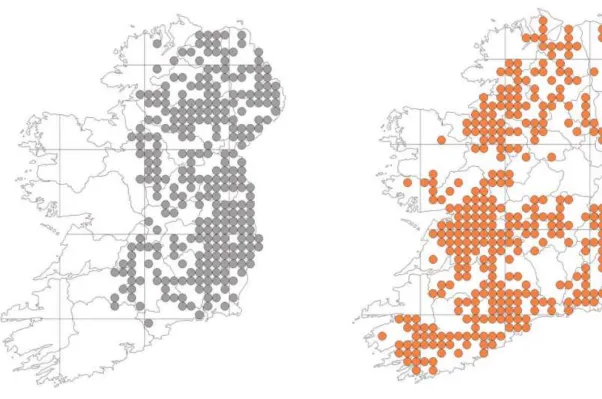
4 was absent from a large area in the midlands including most of counties Westmeath and Meath, where grey squirrels had been established for the longest period. The 2007 distribution maps confirmed that the expansion of the grey squirrel population had continued, having reached the entire eastern coastline, all counties of Northern Ireland, moving into counties Donegal, Waterford and Limerick, and nearing the northeast border of Co. Cork (Figure 1a). However, the report also noted an apparent retraction of their range in the midland counties of Laois, Offaly and Cavan. Meanwhile, the red squirrel was still present across a widespread region of the country, though its distribution was patchy in places, with large gaps in the midlands centred in counties Westmeath, Meath and Louth, and Kilkenny and Carlow (Figure 1b). The region to the west of the river Shannon had mostly remained free of grey squirrels, despite the proximity of the introduction point in Co. Longford. As a result the red squirrel has continued to persist in the region, particularly in Co. Sligo, and eastern areas of Galway and Clare.
____________________________
[image:9.595.81.542.86.763.2]5
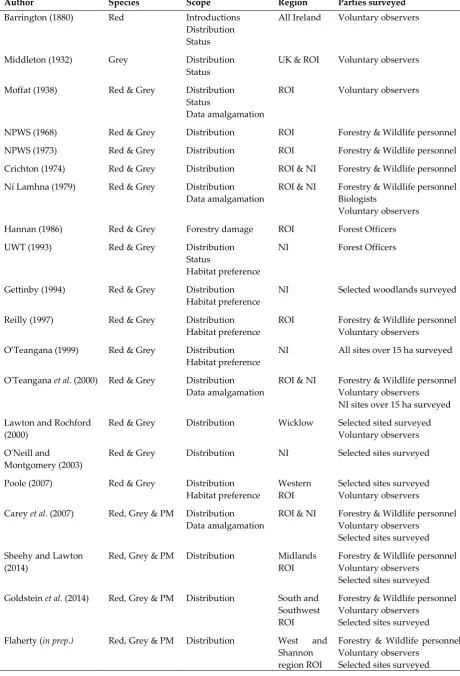
Table 1 Previous Irish squirrel distribution surveys (updated from Carey et al, 2007)
Author Species Scope Region Parties surveyed
Barrington (1880) Red Introductions Distribution Status
All Ireland Voluntary observers
Middleton (1932) Grey Distribution Status
UK & ROI Voluntary observers
Moffat (1938) Red & Grey Distribution Status
Data amalgamation
ROI Voluntary observers
NPWS (1968) Red & Grey Distribution ROI Forestry & Wildlife personnel NPWS (1973) Red & Grey Distribution ROI Forestry & Wildlife personnel Crichton (1974) Red & Grey Distribution ROI & NI Forestry & Wildlife personnel Ní Lamhna (1979) Red & Grey Distribution
Data amalgamation
ROI & NI Forestry & Wildlife personnel Biologists
Voluntary observers Hannan (1986) Red & Grey Forestry damage ROI Forest Officers UWT (1993) Red & Grey Distribution
Status
Habitat preference
NI Forest Officers
Gettinby (1994) Red & Grey Distribution Habitat preference
NI Selected woodlands surveyed
Reilly (1997) Red & Grey Distribution Habitat preference
ROI Forestry & Wildlife personnel Voluntary observers
O’Teangana (1999) Red & Grey Distribution Habitat preference
NI All sites over 15 ha surveyed
O'Teangana et al. (2000) Red & Grey Distribution Data amalgamation
ROI & NI Forestry & Wildlife personnel Voluntary observers
NI sites over 15 ha surveyed Lawton and Rochford
(2000)
Red & Grey Distribution Wicklow Selected sited surveyed Voluntary observers O'Neill and
Montgomery (2003)
Red & Grey Distribution NI Selected sites surveyed
Poole (2007) Red & Grey Distribution Habitat preference
Western ROI
Selected sites surveyed Voluntary observers Carey et al. (2007) Red, Grey & PM Distribution
Data amalgamation
ROI & NI Forestry & Wildlife personnel Voluntary observers
Selected sites surveyed Sheehy and Lawton
(2014)
Red, Grey & PM Distribution Midlands ROI
Forestry & Wildlife personnel Voluntary observers
Selected sites surveyed Goldstein et al. (2014) Red, Grey & PM Distribution South and
Southwest ROI
Forestry & Wildlife personnel Voluntary observers
Selected sites surveyed Flaherty (in prep.) Red, Grey & PM Distribution West and
Shannon region ROI
Forestry & Wildlife personnel Voluntary observers
____________________________
6
(a) (b)
[image:10.842.110.712.78.477.2]
____________________________
7
Interim research
A considerable amount of research on the two squirrel species in Ireland has taken place since the publication of the 2007 survey. A series of recommendations made in the 2007 report formed the basis of much of the subsequent work.
Carey et al. (2007) recommended that a PhD project be initiated to investigate the interaction between pine martens and the two squirrel species in Ireland. This work began in 2009 and was completed in 2013 (Sheehy, 2013). An in-depth investigation into the distribution and population demographics of the three species was conducted in Laois, Offaly and a 30 km radius area surrounding these counties, which included much of Westmeath, Meath, Kildare, Kilkenny, Carlow and north Tipperary. County Wicklow was selected as a control site. In this study, Sheehy found a strong negative correlation between grey squirrel and pine marten distributions, whereas red squirrel and pine marten distributions showed a strong positive correlation. Pine marten density in the midland study sites was higher than reported elsewhere in their range in Europe, and grey squirrels were present there at an unusually low density despite favourable grey squirrel habitat (Sheehy and Lawton, 2014). In the east of Ireland, where pine marten density was considerably lower, grey squirrels were found at normal densities and the alien species featured in pine marten diet significantly more frequently than native red squirrels do when they coexist with pine marten (Sheehy et al., 2014). However, it has yet to be determined whether the negative association between pine marten and grey squirrel distribution is a result of direct predation or a consequence of more subtle behavioural or physiological effects on the grey squirrel.
The 2007 report recommended that spatially explicit population models (SEPMs) should be applied to the grey squirrel invasion in Ireland to assess the degree of possible spread in the coming decades. The report noted that similar work had been carried out in Italy and emphasized that models should be tailored to the Irish situation of the grey squirrel where the invasion had proceeded differently to Britain and Italy, the other locations to which the grey squirrel was introduced in Europe. This work was completed in 2014 (Goldstein, 2014) where extensive live-trapping fieldwork in Irish grey squirrel frontier populations highlighted the differences in the functioning and dynamics between frontier, established, and native grey squirrel populations across the native and introduced range of the species (Goldstein et al., 2015). Tailored and validated SEPMs, created using these compiled population data, indicated that grey squirrels will continue to expand to the south and south-west of Ireland in the absence of coordinated and intensive control programmes (Goldstein, 2014; Goldstein et al., 2015).
____________________________
8 The 2007 squirrel survey was conducted as part of the CRISIS project (Combined Research and
Investigation of Squirrels in Irish Silviculture), which was completed in 2008 (Carey and Hamilton, 2008).
The CRISIS team made a series of recommendations towards a management plan for squirrels in Ireland. These recommendations included ensuring a suitable tree species mix to promote red squirrel survival, by focusing on small-seeded broadleaves such as ash and alder, and interplanting broadleaf species with larch, Scots pine and Norway spruce. Further recommendations centred on grey squirrel control, including the initiation of a trap loan scheme to aid forestry owners and other woodland stakeholders to control grey squirrels within their area.
A broader Red Squirrel Action Plan was also published in 2008, a collaboration between the National Parks and Wildlife Service (NPWS) in the Republic of Ireland, and the Environment and Heritage Service (EHS) in Northern Ireland. Several actions were laid out for the further protection of red squirrels and management of the grey squirrel population. Some of these have been put in place, as stated or in modified form. In Northern Ireland, for example, several local squirrel groups are now in place, monitoring populations, raising awareness and initiating local conservation projects. Similar actions could prove beneficial in the Republic of Ireland. Other actions in the plan have not come to light, such as the appointment of squirrel conservation officers, principally as a result of the downturn in the economy since 2008.
One action proposed using translocation to enhance red squirrel distribution, in particular to suitable squirrel habitat in the far west of Ireland. This region previously held no populations of either squirrel species due to the lack of suitable corridors linking them to existing populations. Although this relative isolation may limit the potential for translocated red squirrel populations to spread, it also reduced the threat of incursion from expanding grey squirrel populations. Two such translocations took place, to Derryclare wood in Connemara (Poole and Lawton, 2009), and to Belleek Forest Park, Ballina, Co. Mayo (Waters and Lawton, 2011). Both these translocations resulted in successfully established populations that have to date continued to survive in their new location. A further translocation took place in Killiney Hill, Dublin in 2012. The translocation was undertaken in conjunction with an ongoing grey squirrel control programme in the Killiney Hill wood by Dun Laoghaire-Rathdown County Council. Unlike the west of Ireland translocations, it was used to augment a pre-existing red squirrel population. The ultimate success of this translocation has yet to be assessed, however the red squirrel population is persisting with some breeding taking place.
A key factor in the replacement of red squirrels by grey squirrels is the presence of SQPV. Grey squirrels that tested positive for SQPV antibodies had been reported in Northern Ireland at the time of the 2007 Irish Squirrel Survey, though no infected red squirrels had been recorded. In 2011, the first cases of infected red squirrels were recorded, confirming the presence of SQPV in both squirrel populations in Ireland (Collins et al., 2014; McInnes et al., 2012). The rate of replacement of red squirrels by grey squirrels can be up to 25 times faster where the virus is present (Rushton et al., 2006).
____________________________
9 a further benefit to the use of citizen science in providing education on the importance of conservation projects (Silvertown, 2009) and helping to connect people to science (Devictor et al., 2010). Goldstein et al. (2014) found a citizen science study to be more accurate in picking up the most up-to-date information than more conventional survey techniques, such as hair-tubing.
Aims
____________________________
10
Methods
The survey incorporated squirrel and pine marten sightings in the Republic of Ireland and Northern Ireland received from the 1st of January to 31st of December 2012. It incorporated the results from three regional surveys that were all active during the twelve months of that year. A survey of Laois, Offaly, Kildare, Westmeath, Meath, Kilkenny, Carlow, north Tipperary and Wicklow was conducted by E. Sheehy from 2010 to 2013 as part of a PhD project, investigating the role of the pine marten in Irish squirrel population dynamics. The counties of Munster (Clare, Limerick, Kerry, Cork, Tipperary and Waterford) were surveyed by E. Goldstein between 2011 and 2013 as part of a PhD investigating squirrel ecology and population spread in the southwest region of Ireland. From 2012 to 2014, counties in the Shannon/west of Ireland (Clare, Galway, Mayo, Sligo, Roscommon, Leitrim, Fermanagh, Cavan, Longford, Westmeath, Offaly, Tipperary and Limerick), were surveyed as part of a PhD project investigating the status of grey squirrels in the Shannon region. Information was also sought and gathered from the remaining counties of the Republic of Ireland and Northern Ireland (Donegal, Derry, Antrim, Down, Armagh, Tyrone, Monaghan, Louth, Dublin and Wexford).
Survey questionnaire
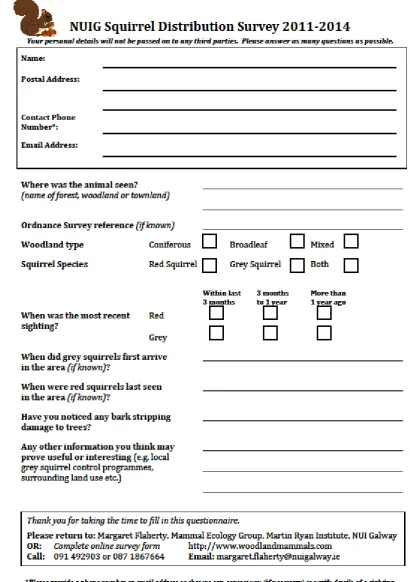
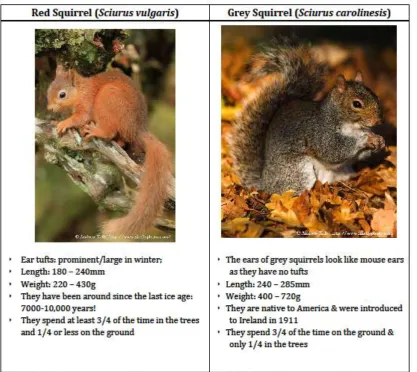
Information about squirrel sightings was sought from respondents through print and online questionnaires. The surveys asked respondents for contact details and information on where the animals were seen (name of forest, woodland or townland) and an Ordnance Survey reference (if known). There then followed a series of tick box questions regarding the woodland type (coniferous, broadleaved or mixed) and the species of animal seen (in the print version this was limited to squirrel species, the online version included a request for information on pine martens, and details on the predator species were also gained in follow up calls to print version correspondents). Further information was requested on the latest and first sightings of grey and red squirrels in the area. The reverse side of the print survey included information on the project and identification information on the two squirrel species, with photos (Figure 2). The online form was hosted on a dedicated website, www.woodlandmammals.com, set up as part of the Irish squirrel and pine marten project (Sheehy, 2013). The website also included information on each of the regional surveys, descriptions of all three species, and a series of colour photos. The website was particularly useful as a quick and easily memorable means of directing the public to the questionnaire during media interviews and other communications.
Survey circulation
____________________________
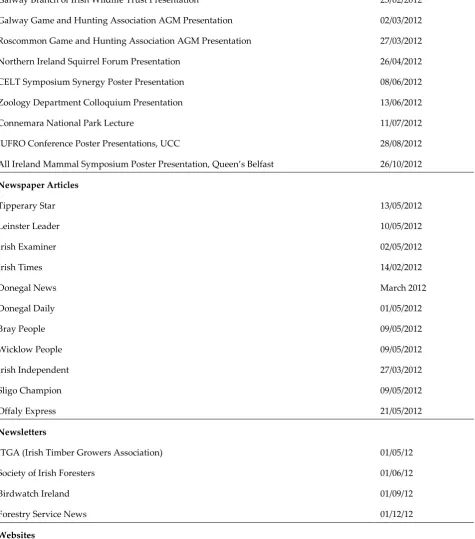
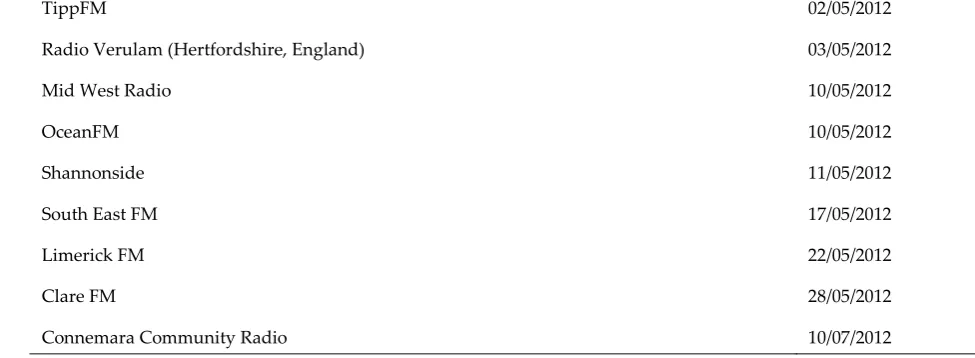
11 and windows throughout the country, particularly in areas where extra information was being sought. A selected list of media events and articles are given in Table 2. Print copies of the questionnaires were also distributed to the list of ‘stakeholders’ (Table 3) (i.e. the targeted individuals with a specific interest in squirrels in Ireland, or following a pursuit in forestry, wildlife and agricultural sectors).
Compilation of results
Reports received were accepted if they satisfied certain criteria. Those accompanied by a photograph of the reported animal, or submitted by a professional (e.g. a forester or ecologist) were automatically accepted. Others, deemed reliable due to the authoritative information given in the initial report, or during follow-up contact by one of the survey team were also accepted. Sightings that were unclear about the species seen, or the exact location, and without sufficient information to follow-up the report, were not accepted and omitted from the survey results. All sightings were assigned a grid reference, either submitted directly by the respondent, or deduced through the geographical information given in the report or follow-up contact.
____________________________
[image:16.595.50.526.112.652.2]12
Table 2 Publicity generated via the media for the Irish Squirrel Survey in 2012
Talks and Presentations Date
Galway Branch of Irish Wildlife Trust Presentation 23/02/2012 Galway Game and Hunting Association AGM Presentation 02/03/2012 Roscommon Game and Hunting Association AGM Presentation 27/03/2012 Northern Ireland Squirrel Forum Presentation 26/04/2012 CELT Symposium Synergy Poster Presentation 08/06/2012 Zoology Department Colloquium Presentation 13/06/2012 Connemara National Park Lecture 11/07/2012 IUFRO Conference Poster Presentations, UCC 28/08/2012 All Ireland Mammal Symposium Poster Presentation, Queen’s Belfast 26/10/2012
Newspaper Articles
Tipperary Star 13/05/2012
Leinster Leader 10/05/2012
Irish Examiner 02/05/2012
Irish Times 14/02/2012
Donegal News March 2012
Donegal Daily 01/05/2012
Bray People 09/05/2012
Wicklow People 09/05/2012
Irish Independent 27/03/2012
Sligo Champion 09/05/2012
Offaly Express 21/05/2012
Newsletters
ITGA (Irish Timber Growers Association) 01/05/12
Society of Irish Foresters 01/06/12
Birdwatch Ireland 01/09/12
Forestry Service News 01/12/12
Websites
www.woodlandmammals.com www.askaboutireland.ie www.newstalk.ie
Radio Stations
Midlands Radio 103 14/02/2012
East Coast FM 22/02/2012
____________________________
13
TippFM 02/05/2012
Radio Verulam (Hertfordshire, England) 03/05/2012
Mid West Radio 10/05/2012
OceanFM 10/05/2012
Shannonside 11/05/2012
South East FM 17/05/2012
Limerick FM 22/05/2012
Clare FM 28/05/2012
[image:17.595.55.543.66.245.2]Connemara Community Radio 10/07/2012
Table 3 Stakeholders contacted directly for information on squirrel sightings in 2012 All respondents to the 2007 Irish Squirrel Survey (Carey et al. 2007)
National Parks & Wildlife Service – Conservation Rangers and District Conservation Officers County/City Council Heritage & Biodiversity Officers
Teagasc - Forestry Development Officers Coillte – Foresters
Forestry Contractors
Register of Foresters & Forestry Companies (Forest Service List) Northern Ireland Forest Service*
National Association of Regional Game Councils (NARGC) Tollymore Red Squirrel Group, Northern Ireland*
Fermanagh Red Squirrel Group, Northern Ireland* National Biodiversity Data Centre (NBDC)*
Centre for Environmental Data and Recording (CEDaR)* Fermanagh District Council, Northern Ireland
Irish Tree Society Irish Wildlife Trust Shankill Tidy Towns
____________________________
14
[image:18.595.73.484.65.648.2]____________________________
15
[image:19.595.111.529.213.585.2]____________________________
16
Results
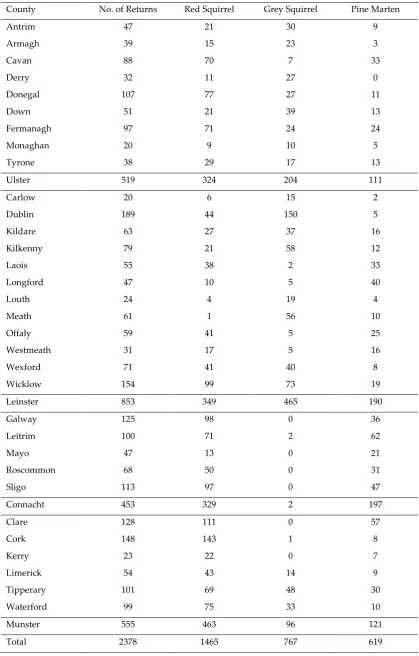
Table 4 shows the number of accepted survey reports received in each county, province and in total, plus the number of sightings recorded for each species under investigation. For reference, counties and provinces of Ireland are shown in Figure 3.
Figures 4 – 12 display the records received on a map of Ireland, including both the location points reported, and hectads (10km x 10km square) in which a species was recorded as present. The maps include points from which a record was received (Figures 4 and 5); red squirrel distribution (Figures 6 and 7); grey squirrel distribution (Figures 8 and 9); hectads in which both species were recorded (Figure 10); and pine marten distribution (Figures 11 and 12). Each set of figures is accompanied by a brief description of points to note, with a more in-depth description and analysis discussed below.
Sightings of both squirrel species and the pine marten were frequently reported during 2012. Grey squirrels were recorded in 26 of the 32 counties. They have continued to spread at the edge of their range, moving further into Co. Donegal, and pushing further into counties Waterford, Limerick and Cork. In midland counties however, they have declined in range, and in areas where they are found, the number of sightings has reduced considerably since 2007. There were no records of grey squirrels west of the Shannon received from respondents in 2012. Red squirrels were recorded in all counties of Ireland, however in some counties (including Meath, Louth and Carlow), they were very rarely reported. These gaps in their range correspond with areas where the grey squirrel is commonly reported. Reports of the native species have increased in some localities where they were not recorded in 2007, and these coincide with the parts of the midlands where the grey squirrel has gone into decline. There were high concentrations of red squirrel sightings in Sligo and Leitrim, Clare and east Galway, Cork and Waterford, and Wicklow. There are 10 x 10km hectads (and some individual sites) where both species are recorded, and these are most common at the edge of the grey squirrel’s range, where they have not been long established.
____________________________
[image:21.595.102.522.89.746.2]17
Table 4 Survey returns, with number of records of red squirrel, grey squirrel and pine marten, received in 2012, per county, province and in total in Ireland
County No. of Returns Red Squirrel Grey Squirrel Pine Marten
Antrim 47 21 30 9
Armagh 39 15 23 3
Cavan 88 70 7 33
Derry 32 11 27 0
Donegal 107 77 27 11
Down 51 21 39 13
Fermanagh 97 71 24 24
Monaghan 20 9 10 5
Tyrone 38 29 17 13
Ulster 519 324 204 111
Carlow 20 6 15 2
Dublin 189 44 150 5
Kildare 63 27 37 16
Kilkenny 79 21 58 12
Laois 55 38 2 33
Longford 47 10 5 40
Louth 24 4 19 4
Meath 61 1 56 10
Offaly 59 41 5 25
Westmeath 31 17 5 16
Wexford 71 41 40 8
Wicklow 154 99 73 19
Leinster 853 349 465 190
Galway 125 98 0 36
Leitrim 100 71 2 62
Mayo 47 13 0 21
Roscommon 68 50 0 31
Sligo 113 97 0 47
Connacht 453 329 2 197
Clare 128 111 0 57
Cork 148 143 1 8
Kerry 23 22 0 7
Limerick 54 43 14 9
Tipperary 101 69 48 30
Waterford 99 75 33 10
Munster 555 463 96 121
____________________________
18
(a) (b)
[image:22.842.84.698.63.466.2]
____________________________
[image:23.595.129.497.65.565.2]19
____________________________
[image:24.595.102.465.56.563.2]20
Figure 5 Hectads (10 km x 10 km squares) from which records were received during the 2012 Irish squirrel survey
____________________________
[image:25.595.131.497.62.566.2]21
____________________________
[image:26.595.101.467.54.564.2]22
Figure 7 Hectads (10 km x 10 km squares) in which red squirrels were recorded during the 2012 Irish Squirrel Survey
____________________________
[image:27.595.130.496.56.563.2]23
____________________________
[image:28.595.101.468.58.560.2]24
Figure 9 Hectads (10 km x 10 km squares) in which grey squirrels were recorded during the 2012 Irish Squirrel Survey
____________________________
[image:29.595.131.495.64.567.2]25
Figure 10 Hectads (10 km x 10 km squares) in which both red and grey squirrels were recorded during the 2012 Irish Squirrel Survey
____________________________
[image:30.595.102.468.57.560.2]26
____________________________
[image:31.595.130.497.62.565.2]27
Figure 12 Hectads (10 km x 10 km squares) in which pine martens were recorded during the 2012 Irish Squirrel Survey
____________________________
28
Discussion
This survey updates the distribution of red and grey squirrels and the pine marten in Ireland, and shows how the species’ ranges have changed since 2007. The survey fulfils the recommendation made by the CRISIS project, that the distributions be reassessed in 2012 (Carey and Hamilton, 2008). The number of returns received in the 2012 survey was over twice those received in Carey et al.’s study (2007). This greatly increased the scope and detail of the results, and must be taken into consideration when directly comparing numbers of sightings for a species in the two surveys. The 2007 survey was predominantly conducted in the first six months of the year, with the report produced later that same year. During the current survey, results were accepted over the full twelve months of the calendar year, and analysed and compiled subsequently. This survey benefitted significantly from the input of squirrel and pine marten sighting results that were generated during the course of recent academic research into these species. Consistent survey methodology ensured that all accepted sighting records from 2012 could be included in this report.
The overall pattern of the survey returns is optimistic for the continued survival of the red squirrel in Ireland, with grey squirrels losing ground in particular in the midlands of the island. The retraction in their range in Laois, Offaly, Westmeath and north Tipperary as reported by Sheehy and Lawton (2014) extends to also include Longford, Leitrim and much of Cavan. These are counties in which the grey squirrel has been established historically. The loss of grey squirrels is evident, not just in absolute terms, with areas where they can realistically be described as absent increasing in size, but also in the declining frequency of sightings, with grey squirrels becoming rare or uncommon in a much wider region. In other parts of the country however, the grey squirrel continues to act in an invasive manner, expanding at the southwest (Goldstein et al., 2014) southeast and northwest extremes of its range.
Red squirrel sightings were high in many areas, with almost twice as many recorded sightings as for the grey squirrel, compared to more grey than red squirrel sightings in 2007 (Carey et al., 2007). Red squirrels have in particular made a return in previous grey squirrel strongholds, lending further support to the hypothesis that it was the historic presence of the invasive species that caused the 20th century decline of the red squirrel, and also demonstrating their ability to return to original levels once pressure from the invasive species is removed.
____________________________
29
Ulster
Carey et al.’s 2007 report showed an increase in grey squirrel range in Northern Ireland, spreading into Co. Antrim for the first time and occupying all of the six counties of Northern Ireland. It was only absent in small regions of Northern Ireland such as the Ards Peninsula (east Co. Down) and the Glens of Antrim (northeast Co. Antrim). Once again, in 2012 grey squirrels were reported in all counties of Ulster (the six Northern Ireland counties, plus Cavan, Monaghan and Donegal), however the number of records of grey squirrels in Co. Antrim had not increased in line with the increased survey returns. In general, grey squirrels are relatively uniformly dispersed throughout Northern Ireland. One exception appears to be in one half of Co. Fermanagh southwest of Lough Erne, which bisects the county. There are fewer records from this area than the northeast of the county. This corresponds with the far greater number of pine marten records received from the southwest region of Fermanagh. The gap in grey squirrel distribution in Cavan and Monaghan reported in 2007 remains, with much of Co. Cavan in particular free of the invasive species. A large cluster of grey squirrel records were received from Co. Donegal, however, and this represents an increase in the grey squirrel range at the northwest invasion frontier. Grey squirrels have expanded into this county from populations in counties Derry and Tyrone, and this is now an area of concern.
Red squirrels continue to be found in all counties of Ulster, and their distribution in Antrim, Derry, Tyrone, Armagh, Down and Monaghan remains broadly similar to that reported in 2007. There remain some large regions in Northern Ireland where red squirrels are seldom seen, particularly in parts of Derry, Antrim, Down and Armagh. Relatively high numbers of red squirrels were reported in Co. Fermanagh and the western half of Co. Cavan, areas in which the grey squirrel has recently disappeared. There was an increase in the number of records of red squirrels in Donegal, in particular in the western half of the county, where they appeared to be absent in 2007. It is unclear whether this represents a spread of red squirrels into a previously unoccupied area, or a more successful survey return from the region, however some respondents did indicate seeing red squirrels for the first time in 2012, despite living in the area for several years. There were a number of recorded ‘no squirrels sighted’ from this part of Donegal in 2007, indicating that the red squirrel is enjoying better fortunes there than previously. There are fewer reports in the region of Donegal where grey squirrels have now colonised, however the two species can be found together in some woodlands in the region. This area is therefore of considerable interest as it offers the opportunity to conduct future squirrel research, examining the interactions between the native and invasive species.
Pine marten numbers are still quite low in Ulster with the exception of Co. Cavan and southwest Co. Fermanagh. In particular it is notable that they were not recorded in Co. Derry and also the parts of Co. Donegal which the grey squirrel has colonised in the last five years.
Connacht
____________________________
30 al.’s 2007 survey report that the river was breached on occasion, with three grey squirrel sightings just west of the Shannon featuring in that report (near Leitrim town and Drumshambo, Co. Leitrim and Mote Park, Co. Roscommon). These were noted as points of potential concern, however it was suggested by Carey et al. that it may not just be the river itself, but also the lack of suitable habitat linking woodlands in the west of Ireland that is preventing grey squirrels from spreading westwards. Greys are almost completely absent from Connacht in the 2012 survey, apart from two sightings in Leitrim east of the river Shannon. Records received during the 2007 survey from west of the Shannon did not lead to established grey squirrel populations, or act as points of invasion into the rest of the region.
Red squirrels continue to thrive in this key area for the species, with high numbers of sightings in east Galway, Sligo and Leitrim in particular. With the Shannon delineating the western edge of the grey squirrel range for so long, the concern existed that the grey squirrel may breach the west by entering through the northeast area, above the river’s catchment. Sightings of grey squirrels are in fact much less frequent in this region in 2012 than in 2007, and thus the possibility of spreading through this corridor is more remote than it was previously. Pine marten numbers are also high in this area, possibly explaining the inability of grey squirrels to colonise. The high number of reports of red squirrels in this area highlights the ability of red squirrels to coexist with pine martens, and not disappear in the same manner as the alien squirrel species. Pine martens are also found throughout other parts of Connacht; together with Co. Clare, this region represents the core range from which pine marten populations have re-established across the island.
There remains a number of woodland sites in the west of Connacht where neither squirrel species is sighted, indicating they are probably absent. This is likely due to the poor habitat connectivity between these sites and established squirrel populations. Two red squirrel populations translocated to Belleek Forest Park, Ballina, Co. Mayo (Waters and Lawton, 2011) and Derryclare wood, Connemara, Co. Galway (Poole and Lawton, 2009) have successfully established and, in the case of Belleek Forest Park, even appear to have spread to surrounding areas. This indicates that suitable habitat exists and therefore supports the assertion that the inaccessibility of forests in the far west of Connacht has prevented red squirrels from inhabiting the region historically.
Leinster
____________________________
31 (Ulster) and north Tipperary (Munster)). In contrast, the numbers of sightings of grey squirrels reported in the rest of Leinster, i.e. in Louth, Meath, Dublin, Kilkenny, Kildare, Carlow and Wexford, continues to be high. The number of sightings reported in Wicklow was also very high, although there may be early signs of reduction there also (Sheehy et al., in prep.). The number of grey squirrel reports in Wexford increased from the previous survey, a trend that can also be seen in Waterford, Limerick, Cork and Donegal, where grey squirrels continue to increase their range.
In general, pine marten records in Leinster have increased greatly since 2007. This may partly be due to increased awareness amongst the public, with the publicity about the impact they are having on grey squirrels making them more readily recognised, where they are found. They have increased in range, and are widespread and common in the areas from which the grey squirrels have disappeared. Numbers of sightings are particularly high in Longford, Westmeath, Laois and Offaly, and the demise of the grey squirrel in this region is in keeping with the link between pine marten density and grey squirrel disappearance as identified by Sheehy and Lawton (2014). However the extent of the loss of grey squirrels is now greater than previously thought. Pine martens are much less common in the eastern half of Leinster, with sightings particularly rare in Louth, Carlow and north Wexford.
Red squirrels remain absent from some regions of Leinster, in particular in one area covering Louth, Meath, north Dublin and north Westmeath, and another between north Wexford, Carlow and mid-Kilkenny. Red squirrels were reported absent from this region in the 2007 survey, representing the area where the impact of competition with grey squirrels was most evident. However, it appears that this area of absence is now shrinking in size with red squirrels returning to several woodlands in Longford, south Westmeath, Tipperary and north Kilkenny. The biggest area of concern identified during the current study is north Wexford. As the grey squirrel has become more common, red squirrels sightings in the middle and north of the county have become very uncommon. Where the negative impacts of grey squirrels on reds are still apparent, there is a need to promote red squirrel conservation by means of grey squirrel control. While it is well established that high grey squirrel numbers can lead to local extinction of red squirrels, it is also now evident that red squirrels can recover relatively quickly when grey squirrels retract or are removed from an area.
Munster
As reported by Goldstein et al. (2014), grey squirrels continue to spread south westerly into Munster, having extended their range since 2007 into east Co. Limerick, the northeast corner of Co. Cork (the first time the species has been recorded in the county), and throughout Co. Waterford. This represents a range increase of up to 25 km in some areas, as was predicted in the 2007 report based on previous expansion patterns. Grey squirrels remain absent from Kerry and Clare. In north Tipperary however, they have undergone a retraction in line with other midland counties. The south Tipperary population persists in high numbers however, providing a source population for the expansion into Limerick and Co. Cork.
____________________________
32 reasons. Firstly, there is a preponderance of vulnerable deciduous plantation forestry in counties Cork, Limerick and Kerry that could suffer from bark stripping damage if grey squirrels were to gain access to them. Secondly, the urban and suburban regions surrounding Cork City and Limerick City are very suitable habitat for grey squirrels and are predicted to act as source populations for the surrounding landscape (Goldstein, 2014). Finally, Killarney National Park, currently a stronghold for red squirrels, is designated as a UNESCO heritage site and is composed of internationally rare deciduous woodland habitats that would be very negatively affected by an invasion of grey squirrels.
Red squirrels continue to be frequently reported throughout Munster, despite the advancing invasion of grey squirrels. The process of replacement of red squirrels by grey squirrels can take a number of years to occur in a site (e.g. Reynolds, 1985) providing SQPV is not a factor. Therefore, red squirrel populations in this region need to be closely monitored into the future, in particular in Waterford, Limerick and north Cork. Red squirrels are particularly numerous in Co. Clare, where grey squirrels have never established.
____________________________
33
Conclusions
Grey squirrels are experiencing mixed fortunes on the island of Ireland. They continue to increase in range and abundance in some regions, including previously unoccupied parts of the northwest, southwest and southeast. There are particularly high numbers of sightings in parts of Donegal, Limerick and Tipperary, at the edges of their current range. This suggests that they are likely to spread further in these directions in the coming years. In these areas where grey squirrel sightings are high, bark stripping damage and a loss of red squirrels is being experienced. In other parts of Ireland however, most notably the midlands, sightings of grey squirrels are not as common as they have been historically, or as would be expected. The normally invasive species has suffered a major decline from a large region in the midlands that includes counties Laois, Offaly, Westmeath, Longford, Leitrim, north Tipperary and parts of counties Cavan. This regional decline has been attributed to the recovery of the pine marten populations in the area.
Red squirrels are still widespread throughout the island of Ireland, and records have increased both numerically and geographically since the last squirrel survey in 2007. There are particularly high numbers of sightings of red squirrels in the northwest, in the south, in Clare and Galway and in Wicklow. The return of red squirrels is noticeable in those areas where grey squirrels have declined particularly in Westmeath, Laois and Offaly. They are less frequently seen in the areas where grey squirrel populations are still robust, in keeping with our understanding of the impacts of grey squirrels on the native species.
____________________________
34
Recommendations
The records received for the 2007 survey (Carey et al.) were forwarded to the National Biodiversity Data Centre in Waterford following publication of the report, for permanent storage. This meant the data was accessible for use in this and other studies. The NBDC also provided reports that had been made directly through their online record system in 2012 to the database used in the current survey. This cooperative approach promotes our overall understanding of species distribution, and the records gathered for this survey should similarly be provided to the NBDC for permanent storage. We recommend this as standard practice for future squirrel distribution studies, and indeed for other wildlife species studied in Ireland.
Another all-island distribution study of squirrels and pine martens in Ireland should be conducted in or before 2022. However, we recommend that further regional studies should be carried out on a more frequent basis in key areas where substantial change has occurred between 2007 and 2012, or where red squirrel populations may be threatened. Areas of particular note include:
The Shannon region, with particular emphasis on breaches of the Shannon by grey squirrels (Flaherty, in prep.);
The midlands region, to assess the spatial and temporal extent of grey squirrel decline and the long term status of the recolonizing red squirrel population;
Wicklow, where both species continue to be found in high numbers but the early stages of a decline in grey squirrel range has been observed very recently (Sheehy, in prep.);
Fermanagh, in which the grey squirrel has disappeared from the southwest, but is frequently encountered in the northeast;
Donegal and Cork, where grey squirrel range expansion continues.
Further monitoring is required in the parts of the midlands where the red squirrel has made a return following the decline of grey squirrels. It is important that vigilance is shown in recording incidences of squirrelpox virus in these regions and others where the two species co-exist.
Areas where red squirrels are living in the absence of grey squirrels continue to be key to the long term survival of the native species. In Ireland these areas are quite large, including the region west of the river Shannon and parts of the southwest. Efforts need to be made to conserve red squirrels in these areas, through protection of forested habitat. Maintaining the ‘grey squirrel free’ status of these areas is also crucial, and so potential routes of invasion must be monitored, using models of spread by Goldstein (2014) and Flaherty (in prep.). Management programmes should be in place, ready to be instigated as a matter of course if grey squirrels are detected.
____________________________
35 principal theories that may be acting independently or in concert, which are (a) direct predation of grey squirrels and (b) an inducement of physiological or behavioural effects in the grey squirrel populations causing numbers and range to decline.
The factors contributing to high densities of pine martens in Ireland ((Lynch and McCann, 2007; Sheehy et al., 2014) require further investigation. These densities exceed those found outside of Ireland i.e. in Britain, Europe and western Russia. A collaborative study, aiming to address the lack of knowledge on pine marten density and the relationship between pine martens and grey squirrels is currently underway at the University of Aberdeen and Waterford Institute of Technology, with support from the Forestry Commission Scotland and Forest Enterprise Scotland.
The 2008 Red Squirrel Action Plan (NPWS and EHS, 2008) contained a series of actions, which would be beneficial to the red squirrel and have a further effect of reducing grey squirrel numbers and protecting Irish forestry. This document should be reviewed in light of research conducted since its publication. Certain actions that were not acted upon, such as the appointment of Squirrel Conservation Officers, should be prioritised. Squirrel Action groups, which have been set up in numerous locations in Northern Ireland, should be encouraged and supported at a local level in the Republic of Ireland as well.
The CRISIS project (Carey and Hamilton, 2008) also made several recommendations, particularly with regards the control of grey squirrel populations, including a trap loan scheme. The NARGC has been running a bounty scheme on grey squirrels in the Republic of Ireland. The number of grey squirrels removed and trapping/culling effort employed in these programmes should be reviewed, in order to determine the impact they have had on grey squirrel populations and determine the efficacy of future control programmes.
____________________________
36
Bibliography & Relevant Literature
Barratt, E.M., Gurnell, J., Malarky, G., Deaville, R. & Bruford, M.W. (1999) Genetic structure of fragmented populations of red squirrel (Sciurus vulgaris) in the UK. Molecular Ecology, 8, S55-S63.
Barrington, R.M. (1880) On the introduction of the squirrel into Ireland Scientific Proceedings of the Royal Dublin Society 2, 614-631.
Carey, M., Hamilton, G., Poole, A. & Lawton, C. (2007) The Irish Squirrel Survey 2007. Council for Forestry Research and Development (COFORD). Dublin
Carey, M. & Hamilton, G. (2008) Securing Ireland’s broadleaf forests and conservation of native red squirrels through integrated management of grey squirrels. Combined Research and Inventory of Squirrels in Irish Silviculture
(CRISIS) Final Report. Coford, Dublin
Collins, L.M., Warnock, N.D., Tosh, D.G., McInnes, C., Everest, D., Montgomery, W.I., Scantlebury, M., Marks, N., Dick, J.T.A. & Reid, N. (2014) Squirrelpox virus: Assessing prevalence, transmission and environmental degradation PLoS one 10.1371/journal.pone.0089521.
Cooper, C.B., Dickinson, J., Phillips, T. & Bonney, R. (2007) Citizen science as a tool for conservation in residential ecosystems. Ecology and Society, 12, 11.
Crichton, M. (1974) Provisional distribution maps of amphibians, reptiles and mammals in Ireland. An Foras Forbatha, Dublin
Delaney, D., Sperling, C., Adams, C. & Leung, B. (2008) Marine invasive species: validation of citizen science and implications for national monitoring networks. Biological Invasions, 10, 117-128.
Devictor, V., Whittaker, R.J. & Beltrame, C. (2010) Beyond scarcity: citizen science programmes as useful tools for conservation biogeography. Diversity and Distributions, 16, 354-362.
Dickinson, J., Zuckerberg, B. & Bonter, D.N. (2010) Citizen science as an ecological research tool: challenges and benefits. Annual Review of Ecology Evolution and Systematics 41, 149-172.
Finnegan, L.A., Edwards, C.J. & Rochford, J.M. (2008) Origin of, and conservation units in, the Irish red squirrel (Sciurus vulgaris) population. Conservation Genetics, 9, 1099-1109.
Gettinby, C.H. (1994) The ecology and distribution of the Red Squirrel (Sciurus vulgaris) and the Grey Squirrel (Sciurus carolinensis) in Northern Ireland. Queens University of Belfast.
Goldstein, E.A., Lawton, C., Sheehy, E. & Butler, F. (2014) Locating species range frontiers: a cost and efficiency comparison of citizen science and hair-tube survey methods for use in tracking an invasive squirrel.
Wildlife Research, 41, 64-75.
Goldstein, E.A. (2014) Ecology of frontier populations of the invasive grey squirrel (Sciurus carolinensis) in Ireland. PhD Thesis, University College Cork.
Goldstein, E.A., Butler, F. & Lawton, C. (2015) Frontier population dynamics of an invasive squirrel: do introduced populations function differently than those in the native range? . Biological Invasions, doi: 10.1007/s10530-014-0787-x.
Gurnell, J., Wauters, L.A., Lurz, P.W.W. & Tosi, G. (2004) Alien species and interspecific competition: effects of introduced eastern grey squirrels on red squirrel population dynamics. Journal of Animal Ecology, 73, 26-35.
Hannan, M. J. (1986) The influence of forests and forest practices on the behaviour of mammals. University College Dublin.
Kelly, J., Tosh, D., Dale, K. & Jackson, A. (2013) The economic cost of invasive and non-native species in Ireland and Northern Ireland. The Northern Ireland Environment Agency and the National Parks and Wildlife Service.
Lawton, C. (1999) Grey squirrel Sciurus carolinensis ecology in managed broadleaved woodland. PhD Thesis, Trinity College Dublin.
____________________________
37
Lawton, C. (2003) Controlling grey squirrel damage in Irish broadleaved woodlands. COFORD Connects, Silviculture/Management No. 7. Council for Forestry Research and Development.
Lawton, C., Cowan, P., Bertolino, S., Lurz, P.W.W. & Peters, A.R. (2010) The consequences of introducing non-indigenous species: two case studies, the grey squirrel in Europe and the brushtail possum in New Zealand. Revue Scientifique et Technique Office International des Epizooties, 29, 287-297.
Lynch, A. & McCann, Y. (2007) The diet of the pine marten (Martes martes) in Killarney National Park. Proceedings of the Royal Irish Academy. Biology & Environment, 107, 67-76.
Marnell, F., Kingston, N. & Looney, D. (2009) Ireland Red List No. 3: Terretrial Mammals. National Parks and Wildlife Service, Department of the Environment, Heritage and Local Government, Dublin Ireland. McInnes, C., Coulter, L., Dagleish, M.P., Deane, D., Gilray, J., Percival, A., Willoughby, K., Scantlebury, M.,
Marks, N., Graham, D., Everest, D.J., McGoldrick, M., Rochford, J., McKay, F. & Sainsbury, A.W. (2012) The emergence of squirrel pox in Ireland. Animal Conservation, 16, 51-59.
Middleton, A.D. (1932) The grey squirrel (Sciurus carolinensis) in the British Isles. Journal of Animal Ecology, 1, 166-167.
Moffat, C.B. (1938) The mammals of Ireland. Proceedings of the Royal Irish Academy. Section B:Biological, Geological , and Chemical Science, 44, 61-128.
Moller, H. (1983) Foods and foraging behavior of red (Sciurus vulgaris) and grey (Sciurus carolinensis) squirrels.
Mammal Review, 13, 81-98.
Ní Lamhna, E. (1979) Provisional distribution atlas of amphibian, reptiles and mammals in Ireland. An Foras Forbatha, Dublin
NPWS (1968) The distribution of red and grey squirrels in Ireland. Unpublished internal report, Office of Public Works, Dublin
NPWS (1973) The distribution of red and grey squirrels in Ireland. Unpublished internal report, National Parks and Wildlife Service, Dublin
NPWS & EHS (2008) All-Ireland species action plan – Red Squirrel. National Parks & Wildlife Service, Ireland and Environment & Heritage Service, Northern Ireland
O'Mahony, D., O'Reilly, C. & Turner, P. (2012) Pine marten (Martes martes) distributon and abundance in Ireland: A cross-jurisdictional analysis using non-invasive genetic survey techniques. Mammalian Biology, 77, 351-357.
O'Neill, K. & Montgomery, W.I. (2003) Recent changes in the distribution of red squirrels in Northern Ireland.
Environment and Heritage Service, Belfast. Environment and Heritage Service, Belfast
O'Sullivan, P.J. (1983) The distribution of the pine marten (Martes martes) in the Republic of Ireland. Mammal Review, 13, 39-44.
O'Teangana, D. (1999) The distribution and ecology of the red squirrel (Sciurus vulgaris) and grey squirrel (Sciurus carolinensis) in Northern Ireland. PhD Thesis, Queen University of Belfast.
O'Teangana, D., Reilly, S., Montgomery, W.I. & Rochford, J. (2000) Distribution and status of the red squirrel (Sciurus vulgaris) and grey squirrel (Sciurus carolinensis) in Ireland. Mammal Review, 30, 45-56.
Poole, A. & Lawton, C. (2009) The translocation and post release settlement of red squirrels Sciurus vulgaris to a previously uninhabited woodland. Biodiversity and Conservation, 18, 3205-3218.
Poole, A.T. (2007) An investigation of translocation as a technique to conserve the red squirrel (Sciurus vulgaris) in
Ireland. Thesis (PhD): NUI, Galway, 2007, National University of Ireland, Galway.
Reilly, S. (1997) Aspects of the ecology of the red squirrel, Sciurus vulgaris, in commerical conifer forests. PhD, Trinity College, Dublin.
Reynolds, J.C. (1985) Details of the geographic replacement of the red squirrel (Sciurus vulgaris) by the grey squirrel (Sciurus carolinensis) in Eastern England. Journal of Animal Ecology, 54, 149-162.
____________________________
38
Sheehy, E. (2013) The role of the pine marten in Irish squirrel population dynamics. PhD Thesis, National University of Ireland, Galway.
Sheehy, E., O'Meara, D.B., O'Reilly, C., Smart, A. & Lawton, C. (2014) A non-invasive approach to determining pine marten abundance and predation. European Journal of Wildlife Research 60, 223-236.
Sheehy, E. & Lawton, C. (2014) Population crash in an invasive species following the recovery of a native predator: the case of the American grey squirrel and the European pine marten in Ireland. Biodiversity and Conservation, 23, 753 - 774.
Silvertown, J. (2009) A new dawn for citizen science. Trends in Ecology & Evolution 24, 467-471.
Ulster Wildlife Trust & Forest Service, D.A.N.I. (1993) Northern Ireland mammal survey. Ulster Wildlife Centre, 3 New Line, Crossgar, BT30 9EP
Waters, C. & Lawton, C. (2011) Red Squirrel Translocation in Ireland. Irish Wildlife Manuals, No. 51. National Parks and Wildlife Service, Department of the Environment, Heritage and Local Government, Dublin, Ireland.
Watt, H.B. (1923) The American grey squirrel in Ireland. Irish Naturalist's Journal, 32, 95.