Abstract— this paper introduces a model for finding the optimal replacement policy for Condition Based Maintenance (CBM) of a system when the information obtained from the gathered data does not reveal the system's exact degradation state. Subsequently, optimal observation interval is found when the collection of data is costly. The proposed model uses the Proportional Hazards Model (PHM) introduced by D. R. Cox to model the system’s failure rate. The PHM takes into consideration the system's degradation state as well as its age. Since the acquired information is imperfect, the degradation state of the system is not precisely known. Bayes' rule is used to estimate the probability of being in any of the possible states. The system's degradation process follows a Hidden Markov Model (HMM). By using dynamic programming, the system's optimal replacement policy and its long-run average operating cost are found. Based on the total long-run average cost, the optimal interval and the corresponding replacement criterion are specified. A numerical example compares the systems when the observation is free and when it is costly, and finds the optimal observation interval and cost.
Index Terms— Condition Based Maintenance (CBM), Costly Observations, Imperfect Information, Proportional Hazard Model (PHM).
I. INTRODUCTION
For a system subjected to a Condition Based Maintenance (CBM) program, inspections are performed to obtain proper information about the degradation state of the system. In this paper, the information acquired during the inspections does not reveal the exact degradation state of the system but represents some data which are stochastically related to the system's degradation state [11], [13]. These data are used to calculate the
Manuscript received July 5, 2007.
Alireza Ghasemi is a PhD. candidate (Department of Industrial Engineering and Mathematics, École Polytechnique of Montréal, C. P. 6079, succursale Centre-ville, Montréal, Québec, Canada, H3C 3A7. e-mail: [email protected]).
Dr. Soumaya Yacout is with the Department of Industrial Engineering and Mathematics, École Polytechnique of Montréal (e-mail: [email protected]).
Dr. M-Salah Ouali is with the Department of Industrial Engineering and Mathematics, École Polytechnique of Montréal (e-mail: msouali @polymtl.ca).
probability of being in a certain degradation state. The hidden degradation state of the system is described by a Markov Chain. In CBM studies, several models have been used to take into account the system's degradation state. One of these models is the Proportional Hazards Model (PHM), introduced by [4], which has been widely used in medical studies. Recently, an increasing application of the PHM to the CBM is reported [10], [1]. According to the PHM, the system's failure rate (also called hazard rate) is estimated based on its age as well as its degradation state. In this paper the PHM is used to calculate the optimal replacement policy and long-run average cost for a system with imperfect information.
Afterwards, the unrealistic assumption of non-costly observation is relaxed and corresponding optimal replacement policy and total long-run average cost are found. In the CBM modeling, if the observations are taken at no cost, the optimal observation interval is zero i.e. the best choice is to monitor the system continuously. That's because the higher frequency of observations will provide more frequent information about the degradation state of the system with no extra cost. Consequently, this will reduce the likelihood of performing unnecessary preventive replacements, hence, will result in a more cost effective maintenance system. When there is considerable cost for collecting and analyzing the observations, an optimal observation interval that minimizes the total maintenance cost including the observations cost should be applied. In reality, in many cases, observations require personnel and equipment, and sometimes it is necessary to stop or suspend the operations when collecting the observations [9]. Also some tests for analysis and extraction of useful information may be needed; therefore some costs are associated to the collection and analysis of observations. Finding the optimal total long-run average cost of the maintenance system with costly observations leads to comparison and selection of the optimal observation interval amongst several possible observation intervals. The replacement criterion that corresponds to the optimal total long-run average cost is then obtained.
This paper consists of four more sections. In section 2 a brief literature review of the principle models in replacement optimization is presented. Section 3 deals with the assumptions, the details of the proposed model and the optimal solution. Section 4 presents a numerical example. The conclusion and the areas of further researches are presented in section 5.
Optimal replacement policy and observation interval for
CBM with imperfect information
II. LITERATURE REVIEW
Reference [9] investigated the maintenance policy for a system whose exact degradation state is known through the observations. The objective is to find the optimal replacement criteria and observation interval that minimizes the long-run average cost of the whole maintenance system. Reference [3] considered a system with perfect information which reveals exactly the system's degradation state. The objective is to determine the next observation schedule, based on the observations' information up to date. Reference [7] modeled a CBM policy where both the replacement threshold and the observation schedule are decision variables. It is allowed to have irregular observation periods. Reference [8] considered a system revealing perfect information with an obvious failure which is detected as soon as it happens. Reference [2] considered an optimal observation time with a hidden failure being detected through observation. A pre-defined threshold for the failure is assumed and associated costs are considered for the observations, repairs and replacements. Reference [12] considered a replacement problem for a system with perfect observation using PHM while the observations are non-costly.
III. PROBLEM FORMULATION
This paper presents a deteriorating system subjected to random failure. The degradation state of the system is represented by a finite set of non-negative integers, i.e. by state space
S
=
{
1,2,,...,
N
}
. State 1 indicates the best possible state for the system which means that the system is new or like new. The degradation state process{
X t
( )
=
1,2,...,
N
}
, is a discrete time homogeneous Markov chain withN
unobservable states. All
N
degradation states are working states and do not include the failure state which is a non-working state. Figure 1 shows the Markov transition process between degradation states along with transition from each degradation state to the failure state.p
ij is the probability of going fromdegradation state
i
to the degradation statej
during oneobservation period knowing that the system has not failed yet, despite the fact that
f
i is the probability of going fromdegradation state
i
to the failure state. The circles represent thestates.
Figure 1: Markov process transition and transition to failure
The degradation states of the system are not observable except at the time
t
=
0
when the degradation state of the system is certainly 1. The transition matrixP
is an uppertriangular matrix, i.e.
p
ij=
0
forj
<
i
and(
)
( )
(
)
Pr
|
,
ij
p
=
X t
+∆ =
j X t
=
i T
> + ∆
t
,0, ,2 ,...
t
= ∆ ∆
otherwise.T
is a random variablerepresenting the system's failure time. The system indicators are observed at times;
t
= ∆ ∆
,2 ,...
. The indicators obtainedcan take a value in a finite set of
M
non-negative integers, i.e.θ
∈ Θ =
{
1,2,...,
M
}
. It is supposed that a value ofθ
isobserved with a known probability
q
jθ, when the degradation state of the system isj
.Q
represents the stochastic matrix which specifies these probabilities, i.e., ,
jQ
=
q
θ
j
∈
S
θ
∈Θ
.The failure is not considered as a degradation state. It is a condition that causes the system to cease functioning and is outwardly obvious. If the failure happens, it is immediately recognized and the only possible action is “Failure Replacement”. Otherwise, at any observation point, we can decide whether to perform “Preventive Replacement” or “ Do-Nothing”. Failure Replacement and Preventive Replacement renew the system and return it to state 1 and period
k
=
0
. The cost for preventive replacement isC
, while a failure replacement costsK
+
C
,
K
,
C
>
0
. Both actions, FailureReplacement and Preventive Replacement, are instantaneous. The system's failure rate is following the PHM. In the PHM the failure rate
h t X
(
,
k)
=
h t
0( ) ( )
ψ
X
k is a product of twoindependent functions, where
h
0()
.
is a function of the system's age only andψ
()
.
is a function of the system's degradation state only.X
k=
X k
( )
∆
is the degradationstate of the system at period
k
and∆
is the fixed observationinterval. We assume that degradation state of the system remains unchanged during each period and each degradation state transfer is assumed to take place at the end of each period, just before observation point.
The objective is to find the optimal replacement policy that minimizes the long-run average cost per unit time for the replacement system and consequently the optimal observation interval.
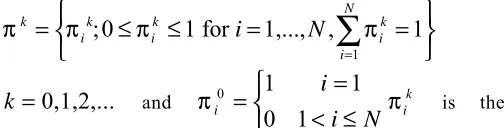
A. Alternative state space
1
;0
1 for 1,..., ,
N1
k k k k
i i i
i
i
N
π
π
π
π
=
=
≤
≤
=
=
∑
0,1,2,...
k
=
and
≤
<
=
=
N
i
i
i1
0
1
1
0π
k iπ
is theprobability of being in degradation state
i
atk
th observation point.B. Alternative state's transition
At the
k
+1st observation point, after observingθ
, the prior conditional distribution of the systemπ
k, is updated to
π
k+1( )
θ
j which is calculated by using the Bayes’ formula
as:
( )
1 1
1 1
for 1,...,
N k i ij j
k i
j N N
k i il l
i l
p q
j
N
p q
θ θπ
π
θ
π
+ = = ==
∑
=
∑∑
This updated conditional distribution carries all the history of the observations and the performed actions since the last replacement. At any replacement, the observation period’s counter
k
, will be reset to 0 and the conditional probability distribution of the system degradation state will be set toπ
0. C. Decision spaceThe decision space of the model is
{ }
0
,
∞
, where0
means “Replace the system immediately”, and∞
means “Do-Nothing until the next observation point or replace at the failure time, if the failure takes place before the next observation point”. D. Dynamic Programming Formulation (non costly observations)Let
( )
kk
V
,
π
denote the minimum cost from periodk
until next renewal point, where the updated conditional distribution of the system degradation state isπ
k:(
,
k)
min
{
( ) (
0,
0,
, ,
k)
}
V k
π
=
C V
+
π
W k
π
g
where( )
0
,
π
0V
C
+
is the expected cost in case of preventivereplacement and
W
(
k
,
π
k,
g
)
is the expected cost of leavingthe system to work until the next observation point.
(
)
( )
(
)
(
)
( )
(
) (
) (
)
0 1 1, ,
0,
1
, ,
, ,
1,
Pr | ,
, ,
k
k k
M
k k k
W k
g
K
C
V
R k
g
k
V k
k
R k
θ
π
π
π
τ
π
π
+θ
θ
π
π
=
=
+ +
−
∆ −
∆
+
+
∆
∑
where
(
, ,
k)
exp
(
( )
k t 0( ) )
)
k k
R k
π
ψ
X
∆+h s ds
∆
∆ =
−
∫
and(
)
(
)
0
, ,
k,
,
k
k
R k X
t dt
τ
π
∆ =
∆∫
are respectively theprobability that the system is still working during the
k
+
1st period and the mean sojourn time of the system duringk
+
1st period when the system state conditional probability distribution at thek
th periodπ
k, is known (see [6]).g
isaverage cost of maintenance policy per unit time over an
infinite horizon.
∑∑
= =
=
N i N j j ij k ik
p
q
1 1
)
|
Pr(
θ
π
π
θ isprobability of observing
θ
atk
+
1st observation epoch.(
,
k,
∆
)
k
g
τ
π
is expected cost of the overlapped time of two [image:3.612.46.298.53.117.2]consecutive renewal period when the first renewal period has ended with a failure replacement as shown in Figure 2.
Figure 2: Observations after a failure replacement
Reference [6] proved the existence of optimal stopping-time,
(
)
(
)
{
}
.inf
0 :
1
, ,
k, ,
k gT
= ∆
k
≥
K
−
R k
π
∆ ≥
g
τ
k
π
∆
and the optimal decision
(
,
k)
a k
π
at observation pointk
with conditional probability distribution of degradation state
k
π
.(
)
1
(
(
, ,
)
)
(
(
, ,
)
)
1
, ,
, ,
if
,
0 if
k k
k k
k
K
R k
g
k
K
R k
g
k
a k
π
τ
π
π
τ
π
π
−
∆ <
∆
−
∆ ≥
∆
∞
=
Next section presents the formulation leading to the optimum long-run average cost
g
*.E. Optimal long-run average cost
Reference [5] found the long-run average cost per unit of
time
(
)
( )
minPr
,
g g T gC
K
T
T
E
T T
φ
=
+
>
where stopping-time isT
g,T
is the time to failure,Pr(
T
g>
T
)
is the probability of a failure replacement, andE
min( , )
T T
g is the expected lengthof a replacement cycle. They proved that the stopping-time *
g
T
, whereg
*=
min
φ
Tg , minimizesφ
Tg and the value of*
g
is the unique solution ofg
=
φ
Tg.(
) ( )
0
,
0Pr
T
g>
T
=
Q
π
andE
min( , )
T T
g(
)
00,
W
π
=
(
)
(
)
00
,
, ,
1
1
j j j g t jj
k
W j
R j
s ds
j
k
A
j
k
π
π
π
− ∆≥
=
= −
< −
∫
and(
)
( )
(
) (
) (
)
0 1 1 , ,1, , , Pr | ,
j
M
j j j
A R j s ds
W j R j j
θ
π
π θ π θ π
∆ + = = + + ∆
∫
∑
also( )
0
( ,
)
1
( , ,
)
1
1
j j j
g
j
k
Q j
R j
t
j
j
k
B
j
k
π
π
π
≥
= −
− ∆
= −
< −
and
( )
11
1
( , , )
(
1,
)Pr( | , ) ( , , )
j
M
j j j
B
R j
Q j
j
R j
θ
π
π
+θ
θ
π
π
=
= −
∆ +
+
∆
∑
where
( )
{
|
1
(
, ,
)
(
, ,
)
}
g
t
π
= ∆ ∈
r
R
+K
−
R r
π
∆ =
g
τ
r
π
∆
. The tools presented so far are used to determine the optimal replacement policy and long-run average cost of a system where no cost is considered for the observations and the observation's interval is prefixed at∆
.F. Dynamic Programming Formulation (costly observations) Now we assume that each observation costs
C
I and restate the( )
kk
V
,
π
as follow:( )
,
kmin
{
( ) (
0,
0,
, , ,
k)
}
I I
V k
π
=
kC
+ +
C
V
π
W k
π
g C
where
kC
I+ +
C V
( )
0,
π
0 is the renewal period's total cost (replacement and observations' cost) atk
-th
observation point if the system is replaced preventively.(
, , ,
k)
IW k
π
g C
is the renewal period's total cost atk
thobservation point if no action takes place and is given as:
(
)
( )
(
)
( )
(
) (
) (
)
(
)
0 1 1, , ,
0,
1
, ,
1,
Pr | ,
, ,
, ,
k I k I Mk k k
k
W k
g C
kC
K
C
V
R k
V k
k
R k
g
k
θ
π
π
π
π
θ
θ
π
π
τ
π
+ ==
+ + +
−
∆
+
+
∆
−
∆
∑
where
kC
i+ + +
K
C
V
( )
0,
π
0
represents the renewalperiod's total cost if the decision is "Do-nothing" and the system fails during the next observation period. By solving the dynamic programming, we have shown that stopping time and decision criterion is similar to that of non-costly observations. Even when the observations are costly the system has to be replaced based on following decision criterion:
(
)
if 1
(
(
, ,
)
)
(
(
, ,
)
)
0 if 1
, ,
, ,
,
k k
k k
k
K
R k
g
k
K
R k
g
k
a k
π
τ
π
π
τ
π
π
∞
−
∆ <
∆
−
∆ ≥
∆
=
Nevertheless, if the observation interval can be altered, on one hand, there is a constant cost that is paid at every observation epoch, so more frequent observation costs more. On the other hand, more frequent observations provide more information that can lead to a more cost effective replacement policy. This means that the optimal observation interval can be selected between several possible (applicable) observation intervals. The measure that helps us to select the optimal observation interval is the minimum total long-run average cost which is the long-run average cost of replacement and observations. In next section we calculate this measure. G. Total long-run average cost and optimal observation interval
In this part we introduce a method to calculate the
minimum total long-run average cost by letting
Tg*C
and
Tg*P
represent the expected total cost and
expected length of the renewal period associated with a
replacement policy in which the optimal time to
replacement is
T
g*and
g
*represents the minimum
run average cost of replacement. The total
long-run average cost per unit of time then is
(
)
( )
* * * * * minPr
,
g g I T g T gC
K
T
T
C
C
G
E
T
T
P
+
>
=
=
+
∆
where
C
,
K
and
C
Iare the replacement cost, failure cost and
observation cost respectively.
Pr
(
T
g*>
T
)
is the probability of a failure replacement when the optimal replacement policy is applied andE
min( )
T
g*,
T
is the expected length of a renewal cycle when the optimal replacement policy is in use. To calculate the total long-run average cost per unit of time, one needs to use the tools provided earlier in this paper to find the optimal long-run average cost of the replacementg
*, with out taking intooptimal stopping time of the replacement system
T
g*, is obtained.Pr
(
T
g*>
T
)
andE
min( )
T
g*,
T
are calculated usingT
g*. Finally the amount ofG
* is calculated.We assume that the optimal observation interval is to be chosen from a finite set of
L
possible observationintervals
∆ =
i, 1,2,...,
i
L
. The optimal observation interval is the one with the minimum total long-run average cost calculated based on the result of this section.In the following section we solve a replacement example without any considerable observation cost and a prefixed observation interval, later we add a considerable cost for the observations and assume two possible observation intervals and we find the optimal observation interval, minimum long-run average cost and the corresponding optimal replacement criteria.
IV. NUMERICAL EXAMPLE
We use the example presented by 0[6] and adapt it to our case of costly observations. In this example, it is assumed that system has a two parameter Weibull like behaviour with baseline distribution hazard function having the following parameters:
1
0
( )
,
0
t
h t
t
β β
β
α
−
=
≥
,α
=
1,
β
=
2
and
( )
0.5(Xt 1)t
X
e
ψ
=
− . The system has two possible degradation states{
1
,
2
}
with the transition probability matrix 10.4 0.6
0
1
P
=
when the observation interval is1
0.5
∆ =
.θ
, the observed value of the system's indicator, can take three possible values. The indicator value and the system's degradation state are related by the probability distribution0.6 0.3 0.1
0.2 0.4 0.4
Q
=
.C
=
5
andK
=
2
represent the replacement cost and the failure cost of the system consecutively. The long-run average cost of replacement, based on the provided method, is found to be
*
1
8.67
g
=
and the optimum stopping time of the system is :(
)
(
)
{
}
*
1 inf 0;2 1 , ,0.5 8.67 , ,0.5
k k
g
T = k≥
−R k π
≥ τ kπNow assume that observation cost
C
I=
1
is applied for each observation to obtain the system's indicator value. We also assume that the there is another possible observation interval∆ =
20.6
with corresponding degradation state transition matrix 20.3 0.7
0
1
P
=
. We are interested infinding the optimal replacement interval and corresponding replacement criteria. The following table shows the final result of the method applied on the data.
TABLE 1:COSTLY OBSERVATION COMPARISON
i
∆
ig
i*G
i1 0.5 8.67 10.67 2 0.6 8.73 10.39
Whereas the long-run average cost of replacement for the shorter observation interval,
∆ =
10.5
is smaller, the total long-run average costG
2, corresponding∆ =
20.6
, is theoptimal one. It means that we will pay less totally, if we observe the system by observation interval equal to 0.6 and apply the corresponding stopping-time:
(
)
(
)
{
}
*
1
inf
0;2 1
, ,0.6
8.73
, ,0.6
k k
g
T
=
k
≥
−
R k
π
≥
τ
k
π
V. CONCLUSION
For a system which is subjected to a CBM program, inspections are performed to obtain proper indicators about the degradation state of the system and decide on an optimal replacement policy. In many practical cases, the observations do not reveal the exact system degradation state. In this work we have considered a model to find the optimal replacement policy and minimum long-run average cost of a system subjected to a random degradation process while the information obtained from the system is imperfect. Later we have relaxed the assumption of non-costly observation and found the optimal replacement policy and the total long-run average cost of the system replacement and observations. This procedure leads to the optimal observation interval. The solved example shows how observation cost can influence the total long-run average cost of the system and the optimal observation interval which in turn will affect the optimal replacement policy.
The introduced developments in CBM methodology help the practitioners to find the optimal observation interval of a system based on the total long-run average cost as well as the corresponding replacement policy that optimizes the total long-run average cost of the replacement and observations.
REFERENCES
[1] Banjevic, D. , Jardine, A. K. S., Makis, V., and Ennis, M., A control-limit policy and software for condition-based maintenance optimization INFOR Journal, vol. 39, pp. 32-50, 2001.
[2] Chelbi, A. and Ait-Kadi, D., An optimal inspection strategy for randomly failing equipment Reliability Engineering and System Safety, vol. 63, pp. 127-131, 1999.
[4] Cox, D. R., Regression models and life tables (with discussion) Journal of the Royal Statistical Society - Series B, vol. 26, 1972.
[5] Ghasemi, A., Condition Based Maintenance Using the Proportional Hazards Model with Imperfect Information 2005. Ecole Polytechnique de Montreal.
[6] Ghasemi, A., Yacout S. , and Ouali, M. S., Optimal condition based maintenance with imperfect information and the proportional hazards model International Journal of Production Research, vol.
45, pp. 989-1012, Feb, 2007.
[7] Grall, A., Berenguer, C., and Dieulle L., A condition-based maintenance policy for stochastically deteriorating systems Reliability Engineering and System Safety, vol. 76, pp. 167-180,
2002.
[8] Hontelez, A. M., Burger, H. H., and Wijnmalen, D. J. D., Optimum condition-based maintenance policies for deteriorating systems with partial information Reliability Engineering and System Safety, vol.
51, pp. 267-274, 1996.
[9] Lam, T. C. and Yeh, R. H., Optimal Maintenance-Policies For Deteriorating Systems Under Various Maintenance Strategies IEEE Transactions on Reliability , vol. 43, pp. 423-430, 1994.
[10] Lin, D., Banjevic, D., and Jardine, A. K. S., Using principal components in a proportional hazards model with application in condition-based maintenance Journal of the Operational Research Society, vol. 2005.
[11] Maillart, L. M., Technical Memorandum Number 778, 2004.
[12] Makis, V. and Jardine, A. K. S., Computation of optimal policies in replacement models IMA Journal of Mathematics Applied in Business & Industry, vol. 3, 1992.