USING PLAUSIBLE I N F E R E N C E RULES IN
DESCRIPTION PLANNING
A l i s o n C a w s e y *
C o m p u t e r L a b o r a t o r y , U n i v e r s i t y o f C a m b r i d g e N e w M u s e u m ~ S i t e , P e m b r o k e S t , C a m b r i d g e , E n g l a n d .
A B S T R A C T
Current approaches to generating multi-sentence text fail to consider what the user may
infer
from the dif- ferent statements in a description. This paper presents a system which contains an explicit model of the infer- ences that people may make from different statement types, and uses this model, together with assumptions about the user's prior knowledge, to pick the most ap- propriate sequence of utterances for achieving a given communicative goal.I N T R O D U C T I O N
Examples, analogies and class identification are used in many explanations and descriptions. Yet current text generation techniques all fail to tackle the problem of
when
an example, analogy or class is appropriate,what
example, analogy or class is best, and exactly what the user may infer from a given example, analogy or class. McKeown, for example, in heridentification
schema (given in fig- ure 1) includes the 'rhetorical predicates'identi-
fication (as
an instance of some class),analogy,
particular.illustration
andattributive
(McKeown, 1985). From each of these, different information could be inferred by the user. In a human expla- nation they might be used to efficiently convey a great deal of information about the object, or to reinforce some information about an object so it may be better recalled. Yet in McKeown's schema based approach the only mechanism for selecting between these different explanation options is the*This work was carried out while the a u t h o r was a t t h e
d e p a r t m e n t of Artificial Intelligence, University of Edin- burgh, funded by a p o s t doctoral fellowship from t h e Science and Engineering Research Council. T h a n k s t o E h u d Re- iter, Paul B r n a and to t h e a n o n y m o u s reviewers for helpful
c o m m e n t s .
Identification (class &: attribute/function) (Analogy/Constituence/At tributive/Renaming/ Amplification}*
Particular-Illustration/Evidence+ { Amplification/Analogy/At tributive) {Particular-Illustration/Evidence)
Note: ' ( ) ' indicates optionality, ' / ' alternatives, '+' that item may appear 1-n times, '*' 0-n times.
Figure 1: McKeown's
identification
schema [McKeown 851initial pool of knowledge available to be conveyed,
and focus
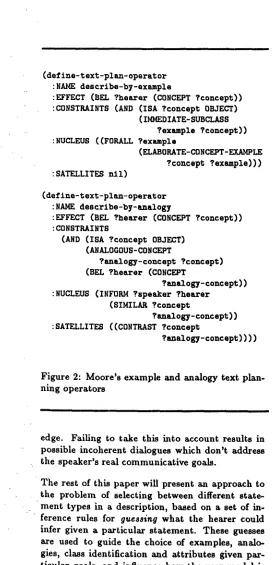
rules, which just enforce some local co- herence on the discourse. A particular example or analogy could perhaps be selected using the func- tions interfacing the rhetorical predicates to the do- main knowledge base, but this is not discussed in the theory.More recently, Moore has included examples, analogies etc. in her text planner (Moore, 1990). She includes planning operators to
deseribe-
by-superclass, describe-by-abstraction, describe-by-
ezample, describe-by-analogy
anddescribe-by.parts-
and.use.
Two of these are illustrated in figure 2. But again there are no principled ways of selecting which strategy to use (beyond, for example, possi- bly selecting an analogy if the analogous concept is known), and theeffect of
each strategy is th~ same - that the relevant concept is 'known'. In re- ality, of course, the detailed effects of the different strategies on the hearer'e knowledge will be very different, and will depend on their prior knowl-( d e f i n e - t e x t - p l a n - o p e r a t o r :NAME describe-by-example
:EFFECT (BEL ? h e a r e r (CONCEPT ?concept)) :CONSTRAINTS (AND (ISA ?concept OBJECT)
(IMMEDIATE-SUBCLASS ?example ?concept)) :NUCLEUS ((FORALL ?example
(ELABORATE-C0NCEPT-EXA~,~LE ?concept ?example))) :SATELLITES n i l )
( def ins - t e x t - p l a n - operat or : NAME d e s c r l b e - b y - a n a l o g y
:EFFECT (BEL ? h e a r e r CCONCEPT ?concept)) : CONSTRAINTS
(AND (ISA ?concept OBJECT) (ANALOGOUS-CONCEPT
?analogy-concept ?concept) (BEL ? h e a r e r (CONCEPT
?analogy-concept) )
:NUCLEUS (INFORM ?speaker ? h e a r e r (SIMILAR ?concept
?analogy- concept) ) :SATELLITES ((CONTRAST ?concept
? a n a l o g y - c o n c e p t ) ) ) )
Figure 2: Moore's example and analogy t e x t plan- ning o p e r a t o r s
edge. Failing to take this into account results in possible incoherent dialogues which d o n ' t address the speaker's real communicative goals.
T h e rest of this p a p e r will present an approach to the problem of selecting between different state- m e n t types in a description, based on a set of in- ' ference rules for guessing what the hearer could infer given a particular s t a t e m e n t . These guesses are used to guide the choice of examples, analo- gies, class identification and attributes given par- ticular goals, and influence how the user model is u p d a t e d after these kinds of s t a t e m e n t s are used. T h e p a p e r first describes the overall framework for explanation generation. This is followed b y a brief discussion of the inference rules and knowledge rep- r e s e n t a t i o n used, and a n u m b e r of examples where the system is used to generate leading descriptions of bicycles. T h e approach is intended to be comple- m e n t a r y to existing approaches which emphasise the coherence of the text, and could reasonable be
combined with these.
O U T L I N E
O F
' P L A N N E R '
E X P L A N A T I O N
T h e system described below 1 aims to show how plausible inference rules m a y be used to guide ex- planation planning given different communicative goals. T h e basic approach is to find some set of possible utterances, and select the one which - as- suming t h a t the user makes certain plausible in- ferences - contributes most to the s t a t e d commu- nicative goal. This process is r e p e a t e d until some terminating condition is met, such as the commu- nicative goal being satisfied.
This explanation 'planning' s t r a t e g y is a kind of heuristic search, using a modified best-first search strategy. T h e search space consists of the space of all possible u t t e r a n c e sequences, and the heuris- tic scoring function assesses how far each u t t e r - ance would c o n t r i b u t e to the communicative goal. Because this gives a potentially very large search space, only certain u t t e r a n c e s are considered at each point. C u r r e n t l y these are constrained to be those which a p p e a r to make s o m e c o n t r i b u t i o n to the communicative goal - for example, the system might consider describing an object as an instance of some class if t h a t class had some a t t r i b u t e s which c o n t r i b u t e d to the target state. These pos- sible utterances are then scored b y using the plau- sible inference rules to predict w h a t might reason- ably be inferred by the user from this s t a t e m e n t , given his current knowledge, and comparing t h a t with the communicative goal.
For example, if the communicative goal is for the user to have a positive impression of the object, and the system knows of some feature which the user believes is desirable in an object, then the system may select u t t e r a n c e s which allow the user to plau- sibly infer this feature given their current assumed knowledge a b o u t this and o t h e r objects.
T h e search space is defined b y the range of possi- ble u t t e r a n c e types. C u r r e n t l y the following types (and associated plausible inference procedures) are allowed, where there m a y be m a n y possible state- ments about a given object of each type:
IReferred to from now on as the GIBBER system - Gen- erating Inference-Based Biased Explanatory Responses.
[image:2.596.28.304.57.622.2]. The
Identification, as an instance (or sub-class) of some class.
Similarity, given some related object with many shared attributes 2.
Examples, of instances or sub-classes, Attributes of that object.
selection of possible utterances, and their scor- ing [given the probable inferences which might be made) depends on the communicative goal set. In the current system, given some object to describe, two different types of communicative goal may be set. The system may either be given an explicit set of attribute values which should be inferrable from the generated description, or it can be given a 'property' that the inferrable attributes should have. This property can be, for example, that the user believes the attribute value to be a !desirable one, where an 'evaluation form' similar to Jame- son's (1983) is used to rate different values. Where a set of attribute values are given these Can be ei- ther specific values, or value ranges.
This approach uses a set of rules which may be used to propose a possible move/statement (given the target/communicative goal), a set of rules which may be used to guess what would be inferred or learned from that statement, given the assumed current state of the user's knowledge, and a scor- ing function which assesses how far the 'guessed at' inferences would contribute to the target. State- ments are generated one at a time, with currently 3 the only relation between the utterances being en- forced by the common overall communicative goal and by the fact that the statements are selected to incrementally update the user's model of the object described.
Using plausible inference rules in this way is un- doubtedly error-prone, as assumptions about the user may be wrong and not all hearers will make the expected inferences. However, it is certainly better than ignoring these inferences entirely. So long as the user can ask follow-up questions in an explanatory dialogue (e.g., Cawsey, 1989; Moore, 1990) any such errors are not crucial.
~Note t h a t full analogies, where a complex m a p p i n g is required between two conceptually distinct objects, are cur- r e n t l y n o t possible in the system.
SAdding f u r t h e r coherences relations and global strate- gies may be the subject of f u r t h e r work.
I N F E R E N C E R U L E S A N D
K N O W L E D G E
R E P R E S E N T A T I O N
For this approach to text planning to be effective, the rules used for guessing what the reader might infer should correspond as far as possible to human plausible inference rules. There are a relatively small number of AI systems which attempt to model human plausible inferences {compared with those attempting to model efficient learning strate- gies in artificial situations). Zuckerman (1990) uses some simple plausible inference rules in her expla- nation system, in order to attempt to block in- correct plausible inferences, while a more compre- hensive model of human plausible reasoning is pro- vided by Collins and Michalski (1989). This latter theory is concerned with how people make plausible inferences given
generalisation, specia|isation, sim-
ilarity
anddissimilarity
relations between objects,using a large number of certainty parameters to in- fluence the inferences. The theory assumes a repre- sentation of human memory based on
dynamic hi-
erarchies, where, for example, given the statement c o l o u r ( e y e s ( J o h n ) ) f b l u e then c o l o u r , e y e s , John and b l u e would all be objects in some hierar- chy. The theory is used to account for the plausible inferences made when people guess the answer to questions given uncertain knowledge.
The GIBBER system uses inference rules some- what differently to Collins' and Michalski's. Whereas they are concerned with the competing inferences which may be made from existing knowl- edge to answer a single question, the GIBBER sys- tem is concerned with mutually supporting infer- ences from multiple given relationships in order to build up a picture of an object. So, although the basic knowledge representation and relation- ship types (apart from dissimilarity) are borrowed from their work, the actual inference rules used are slightly different.
It should be possible to use the inference rules to incrementally update a representation of what is currently known about an attribute, where gener- alisation, similarity and specialisation relationships may all contribute to the final 'conclusion'. In or- der to allow such incremental updates, the repre- sentation used in Mitchell's version space learn- ing algorithm is adopted (1977), where each at- tribute has a pointer to the most specific value that attribute could take, and to the most gen-
eral value, given current evidence. Positive ex- amples (or
Oeneralisation
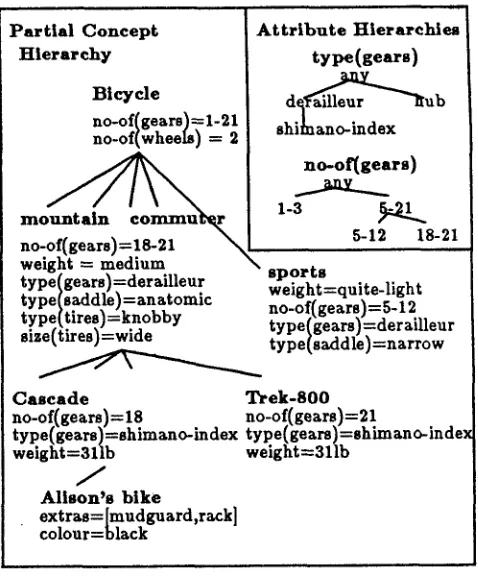
relationships) are used to generallse the specific value (as in Mitchell's algorithm) 4 while class identification (specialisa- tion) is used to update the general value using the inherited attributes. Similarity transforms are done by first finding a common context for the transform (a common parent object), and then transferring those attributes which belong to that • context which are not ruled out by current evi- dence. Explicit statement of attribute values fix the attribute value, but further evidence may be used to increase the certainty of any value. The system also allows for other kinds of domain specific inference rules to be defined - for exam- ple, if a user has just been told that a bike has derailleur gears, a rule may be used to show that the user could probably guess that the bike had between 5 and 21 gears. The different kinds of in- ference rules are used to incrementally update the representation of the user's assumed knowledge of the object and the scoring function, discussed in the previous section, will compare that assumed knowledge of the object with the target.The knowledge representation is based on a frame hierarchy describing the objects in the domain, where the slot values may point to other objects, also in some hierarchy. In figure 4 a small section of a knowledge base of different kinds of bicycle is illustrated, along with some simple hierarchies of attribute values. In the GIBBER system sep- arate hierarchies are defined for the system's and for the user's assumed knowledge, where the latter is initialised from a user stereotype and updated following each query and explanation.
Of course, the knowledge representation and infer- ence rules described in this section are by no means definitive - there is no implied claim that people re- ally use these rules rather than others in learning from descriptions. They simply provide a start- ing point for exploring how explanation generation may take into account possible learning and infer- ence rules, and thus better select statements in a description given knowledge of the domain and of the user's knowledge.
P a r t i a l Concept Hierarchy
A t t r i b u t e Hierarchies type(gears)
Bicycle d ~ ~ u b
no-of(gears)=l-21
no-of(wheels) = 2 shitnano-index
O
~
]
~n°'°i~gears)
1-3 m
no-of(gears)=18-21 ~ [ 5-12 18-21 weight --medium \
type(gears) =deraiUeur sports
type~saddle) =anatomic weight=quite-light no-of(gears) = 5-12 type[tires) =knobby type(gears) =derailleur size(tires) =wide type(saddle) =narrow
Cascade
Trek-S00
no-of(gears)=18 no-of(gears)=21
type(gears) =shhnano-index type(gears)=shhnano-inde:
weight=311b weight=311b
7
Alison's bike
extras= [mudguard,rack] colour=black
Figure 3: Partial Bicycle Hierarchies
E X A M P L E D E S C R I P T I O N S
This section will give two examples of how descrip- tions of bicycles may be generated using this ap- proach. We will assume that the system's knowl- edge includes the hierarchy given in figure 4, and (for simplification) the user's knowledge includes all the items except the 'Cascade', but includes the fact that Alison's bike has shimano indexed gears. The first example will show how the system will select utterances to economically convey informa- tion given some target attribute values, while the second will show how biased descriptions may be generated given a specification of the desired prop- erty of inferrable attributes.
Suppose the user requests a description of the Cas- cade and that the communicative goal set by the system (by some other process) is to convey the following attributes:
4Note that Collins' and Michalski's theory does not ap- pear to allow multiple examples to be used by generalising the inferred values.
type_of(saddle) = anatomic t y p e _ o f ( t i r e s ) ffi
knobby
weight~ 311b
number_of(gears) ffi 18
type_of(gears) ffi shimano_index
[image:4.596.310.549.100.388.2]There are m a n y possible statements which could
be m a d e about the Cascade. T h e user knows Ali- son's bike, so this example could be mentioned. It could be described as an instance of a mountain bike, or just as a bicycle; a comparison could be m a d e with the Trek-800; or any one of the bikes attributes could be mentioned. In this case if it is identified as an instance of a mountain bike the sys- t e m guesses that the user could infer the first two attributes, which gives the highest score given the target s. A comparison with the Trek-800 also gives
two possible inferrable attributes, {though one in- correct value, which is currently allowed}, and this is the next choice. Finally the system informs the user of the n u m b e r of gears, blocking the incorrect inference in the previous utterance. T h e resulting short description is the followingS:
aThe Cascade is a kind of mountain bike. It is a bit like the Trek-800.
It has 18 gears."
If the scoring function is changed so that it is biased further towards highly certain inferences, rather than efficient presentation of information, then given the s a m e communicative goal the de- scription m a y end up as an explicit list of all the attributes of the bike, or in a less extreme case, a class identification and three explicit attributes. This scoring function therefore allows for further variation in descriptions, given a communicative goal, and different scoring functions should be used depending on the type of description required.
Suppose n o w that the s a m e bike is to be described, but the communicative goal is that the user has a positive impression of the Cascade. If the user regards it to be good for a bike to be black with 21
• shimano index gears then the following description
will be generated.
5The scoring function compares the plausibly inferred information with the target, preferring more certain infer- ences, and inferences bring the knowledge of the object closer to the target (given the attribute value hierarchy}. For example, an inference that the bike had 18-21 gears~ or an uncertain inference that it had 18, would be given a lower score than a certain inference that it had 18 gears. The to- tal score is the sum of the scores of each possibly inferred
value.
eOf course this description would be more coherent if a higher level cornpare-contra~t relation was used to generate the last two inferences, with resulting text: Ult is a bit like the Trek-800 but has 18 gears.". Allowing these higer level strategies within an inference-based approach is the subject of further work.
aThe Cascade is a bit like the Trek-800. Alison's bike is a Cascade.
The Cascade has Shimano Index Gears. ~
Here the system evaluates each statement by com-
paring the plausible inferences against an evalua-
tion form {Jameson, 1983). T h e evaluation form describes h o w far different attribute values are ap- preciated by different classes of user. Instead of comparing inferred values with some target at- tribute values the scoring function will score each against the evaluation form. For example, the first utterance (comparison with the Trek-800) is se- lected because the attributes which might be plau- sibly inferred from this statement by this user are rated highly on the evaluation form for that class of user. In this case the system assumes that this type of user will prefer a bike with a large n u m b e r of indexed gears. O f course, one of the plausible in- ferences which can be m a d e will be incorrect (the fact the Cascade has 21 gears). T h e system is not required to block such false inferences if they con- tribute to its goals {though the ethics of generating such leading descriptions might be doubted!).
I t s h o u l d b e c l e a r f r o m t h i s t h a t t h e d e s c r i p t i o n s g e n e r a t e d b y t h e s y s t e m a r e v e r y s e n s i t i v e t o t h e a s s u m p t i o n s a b o u t t h e u s e r ' s p r i o r k n o w l e d g e , a n d t h e i n f e r e n c e r u l e s a n d t h e s c o r i n g f u n c t i o n u s e d , a s w e l l as t o t h e c o m m u n i c a t i v e g o a l s e t . T h e r e is m u c h p o s s i b i l i t y for e r r o r ( a n d f u r t h e r r e s e a r c h r e q u i r e d ) in e a c h of t h e s e . H o w e v e r , t h e a p p r o a c h s t i l l s e e m s t o p r o v i d e t h e p o t e n t i a l f o r g e n e r a t i n g i m p r o v e d d e s c r i p t i o n s , a n d p r o v i d e s a new p r i n c i - p l e d w a y of m a k i n g c h o i c e s in a d e s c r i p t i o n w h i c h
is absent, in schema-based ( a n d RST-based) ap-
proaches. It gives a simple example of how, given a model of h o w people update their beliefs, ut- terances m a y be strategically generated to change those beliefs.
C O N C L U S I O N
T h i s p a p e r h a s d i s c u s s e d h o w , b y a n t i c i p a t i n g t h e u s e r ' s i n f e r e n c e s , b e t t e r e x p l a n a t i o n s m a y b e g e n - e r a t e d a n d a s s u m p t i o n s a b o u t t h e u s e r ' s k n o w l e d g e u p d a t e d in a m o r e p r i n c i p l e d w a y . A l t h o u g h t h e r e a r e p r o b l e m s w i t h t h e a p p r o a c h - p a r t i c u l a r l y t h e d i f f i c u l t y o f r e l i a b l y p r e d i c t i n g t h e u s e r ' s i n f e r e n c e s - it s e e m s t o p r o v i d e a m o r e p r i n c i p l e d w a y o f se-
l e c t i n g certain utterance types than existing multi-
sentence 'text generation systems. Other question
answering systems have attempted to simulate the user's inferences in order to block false inferences (Joshi e t a l . , 1984; Zuckerman, 1990), and par- ticular inferences have been considered in lexical choice (Reiter, 1990) and in generating narrative summaries (Cook et al., 1984). However, it has not been used previously as a general technique for selecting between different options in an descrip- tion.
Considering what is implicitly conveyed in different types of description may also begin to explain some of the empirically derived results used in other sys- tems. For example, the G I B B E R system generally chooses to begin a description with class identifi- cation or with a comparison, as most information may be inferred from these (compared with men- tioning specific attributes). This may be One of the principles influencing the organisation of the dis- course strategies developed by McKeown (1985). The general approach would also suggest that ex- perts might prefer structural descriptions to pro- cess descriptions (Paris, 1988) because they can al-
ready infer the process description from the struc-
tural, the former therefore conveying more implicit information.
By looking at possible plausible inferences when planning descriptions we attempt give a better so- lution to the problem of determining what to say given a particular communicative goal. The ap- proach has potential for generating more memo- rable descriptions, where different types of state- ment are used to re-inforce some information, as well showing us how to economically convey a great deal of information, where some of this information may be implicit. It does not provide a solution to the problem of determining how to structure this communicative content (considered in much other research), though we may find that by: consider- ing further how people incrementally learn from descriptions we may obtain better structured text.
The prototype system has been fully implemented, but much further research is needed. The inference rules, user modelling and scoring functions need to be further developed, and other influences on text structure (such as focus and higher level rhetorical relations) incorporated into the overall model.
R E F E R E N C E S
Cawsey, Alison (1989), Generating Explanatory
Discourse: A Plan-Based, Interactive Ap-
proach, Unpublished PhD thesis, Department
of Artificial Intelligence, University of Edin- burgh.
Collins, Allan & Michalski, Ryssard (1989) The logic of plausible reasoning: A core theory.
Cognitive Science, 14:1-49.
Cook, Malcolm, E., Lehnert, Wendy, G. and Mc- Donald, David, D. (1984) Conveying Implicit
Content in Narrative Summaries. In Proceed-
ings of COLING-84, pages 5-7.
Jameson, Anthony (1983), Impression monitoring
in evaluation-oriented dialogue. In Proceed-
ings of the 8th International Conference on
Artificial Intelligence, pages 616-620.
Joshi, Aravind, Webber, Bonnie and Weiscedel, Ralph, M. (1984) Living up to expectations:
computing expert responses. In Proceedings
of the 7th National Conference on Artificial
Intelligence, pages 169-175.
McKeown, Kathleen, R. (1985), Test Genera-
tion : Using discourse strategies and focus
constraints to generate natural language test.
Cambridge University Press.
Mitchell, Tom, M. (1977), Version spa~es: A can- didate elimination approaA:h to rule learn-
ing. In Proceedings of 5th International Con-
ference on Artificial Intelligence, pages 305-
310.
Moore, Johanna, D. (1990), A Reactive Approach
to Ezplanation in Expert and Advice-Giving
Systems. PhD thesis, Information Sciences
Institute, University of Southern California (published as ISI-SR-90-251).
Paris, Cecile. (1988), Tailoring Object Descrip-
tions to a User's Level of Expertise. In Com-
putational Linguistics (Special Issue on User
Modelling), vol 14.
Reiter, Ehud (1990), Generating descriptions that exploit a user's domain knowledge. In R.
Dale, C. Mellish, a~d M. Zock, editors, Cur-
rent Research in Natural Language Genera-
tion, Academic Press.
Zuckerman, Ingrid (1990), A Predictive Approach for the Generation of Rhetorical Devices. In
Computational Intelligence, vol 6, issue 1.