Learning Adaptable Patterns for Passage Reranking
Aliaksei Severyn(1) and Massimo Nicosia(1) and Alessandro Moschitti1,2 (1)DISI, University of Trento, 38123 Povo (TN), Italy
{severyn,m.nicosia,moschitti}@disi.unitn.it (2)QCRI, Qatar Foundation, 5825 Doha, Qatar
Abstract
This paper proposes passage reranking models that (i) do not require manual fea-ture engineering and (ii) greatly preserve accuracy, when changing application do-main. Their main characteristic is the use of relational semantic structures rep-resenting questions and their answer pas-sages. The relations are established us-ing information from automatic classifiers, i.e., question category (QC) and focus classifiers (FC) and Named Entity Recog-nizers (NER). This way (i) effective struc-tural relational patterns can be automati-cally learned with kernel machines; and (ii) structures are more invariant w.r.t. dif-ferent domains, thus fostering adaptability.
1 Introduction
A critical issue for implementing Question An-swering (QA) systems is the need of designing answer search and extraction modules specific to the target application domain. These modules en-code handcrafted rules based on syntactic patterns that detect the relations between a question and its candidate answers in text fragments. Such rules are triggered when patterns in the question and the passage are found. For example, given a ques-tion1:
What is Mark Twain’s real name?
and a relevant passage, e.g., retrieved by a search engine:
Samuel Langhorne Clemens, better known as Mark Twain.
the QA engineers typically apply a syntactic parser to obtain the parse trees of the above two sen-tences, from which, they extract rules like:
1We use this question/answer pair from TREC QA as a
running example in the rest of the paper.
if the pattern “What is NP2’s ADJ
name” is in the question and the pat-tern “NP1 better known as NP2”
is in the answer passagethenassociate the passage with a high score2.
Machine learning has made easier the task of QA engineering by enabling the automatic learn-ing of answer extraction modules. However, new features and training data have to be typically de-veloped when porting a QA system from a domain to another. This is even more critical considering that effective features tend to be as much complex and similar as traditional handcrafted rules.
To reduce the burden of manual feature engi-neering for QA, we proposed structural models based on kernel methods, (Moschitti et al., 2007; Moschitti and Quarteroni, 2008; Moschitti, 2008) with passages limited to one sentence. Their main idea is to: (i) generate question and passage pairs, where the text passages are retrieved by a search engine; (ii) assuming those containing the correct answer as positive instance pairs and all the oth-ers as negative ones; (iii) represent such pairs with two syntactic trees; and (ii) learn to rank answer passages by means of structural kernels applied to two trees. This enables the automatic engineering of structural/lexical semantic patterns.
More recently, we showed that such models can be learned for passages constituted by multiple sentences on very large-scale (Severyn and Mos-chitti, 2012). For this purpose, we designed a shal-low syntactic representation of entire paragraphs by also improving the pair representation using re-lational tags.
In this paper, we firstly use our model in (Sev-eryn and Moschitti, 2012) as the current baseline and compare it with more advanced structures de-rived from dependency trees.
2If the point-wise answer is needed rather than the entire
passage, the rule could end with:returnsNP1
Search Engine
Kernel-based reranker
Reranked answers Candidate
answers
Query
Evaluation UIMA pipeline
NLP annotators
Focus and Question classifiers
syntactic/semantic graph
q/a similarity features
[image:2.595.96.261.60.216.2]train/test data
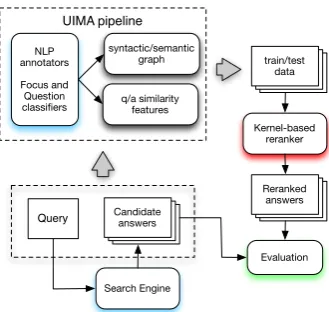
Figure 1:Kernel-based Answer Passage Reranking system
Secondly, we enrich the semantic representa-tion of QA pairs with the categorical informa-tion provided by automatic classifiers, i.e., ques-tion category (QC) and focus classifiers (FC) and Named Entity Recognizers (NER). FC determines the constituent of the question to be linked to the named entities (NEs) of the answer passage. The target NEs are selected based on their compatibil-ity with the category of the question, e.g., an NE of type PERSON is compatible with a category of a question asking for a human (HUM).
Thirdly, we tested our models in a cross-domain setting since we believe that: (i) the enriched rep-resentation is supposed to increase the capability of learning effective structural relational patterns through kernel machines; and (ii) such structural features are more invariant with respect to differ-ent domains, fostering their adaptability.
Finally, the results show that our methods greatly improve on IR baseline, e.g., BM25, by 40%, and on previous reranking models, up to 10%. In particular, differently from our previous work such models can effectively use NERs and the output of different automatic modules.
The rest of the paper is organized as follows, Sec. 2 describes our kernel-based reranker, Sec. 3 illustrates our question/answer relational struc-tures; Sec. 5 briefly describes the feature vectors, and finally Sec. 6 reports the experimental results on TREC and Answerbag data.
2 Learning to rank with kernels 2.1 QA system
Our QA system is based on a rather simple rerank-ing framework as displayed in Figure 1: given a query question a search engine retrieves a list of candidate passages ranked by their relevancy.
Var-ious NLP components embedded in the pipeline as UIMA3 annotators are then used to analyze each
question together with its candidate answers, e.g., part-of-speech tagging, chunking, named entity recognition, constituency and dependency pars-ing, etc. These annotations are then used to produce structural models (described in Sec. 3), which are further used by a question focus detector and question type classifiers to establish relational links for a given question/answer pair. The result-ing tree pairs are then used to train a kernel-based reranker, which outputs the model to refine the ini-tial ordering of the retrieved answer passages.
2.2 Tree kernels
We use tree structures as our base representation since they provide sufficient flexibility in repre-sentation and allow for easier feature extraction than, for example, graph structures. We rely on the Partial Tree Kernel (PTK) (Moschitti, 2006) to handle feature engineering over the structural rep-resentations. The choice of PTK is motivated by its ability to generate rich feature spaces over both constituency and dependency parse trees. It gen-eralizes a subset tree kernel (STK) (Collins and Duffy, 2002) that maps a tree into the space of all possible tree fragments constrained by the rule that the sibling nodes from their parents cannot be separated. Different from STK where the nodes in the generated tree fragments are constrained to include none or all of their direct children, PTK fragments can contain any subset of the features, i.e., PTK allows for breaking the production rules. Consequently, PTK generalizes STK, thus gener-ating an extremely rich feature space, which re-sults in higher generalization ability.
2.3 Preference reranking with kernels
To enable the use of kernels for learning to rank with SVMs, we use preference reranking (Joachims, 2002), which reduces the task to bi-nary classification. More specifically, the problem of learning to pick the correct candidatehi from
a candidate set {h1, . . . , hk} is reduced to a
bi-nary classification problem by creatingpairs: pos-itive training instanceshh1, h2i, . . . ,hh1, hki and
negative instanceshh2, h1i, . . . ,hhk, h1i. This set
can then be used to train a binary classifier. At classification time the standard one-versus-all bi-narization method is applied to form all possible
pairs of hypotheses. These are ranked according to the number of classifier votes they receive: a positive classification of hhk, hii gives a vote to
hkwhereas a negative one votes forhi.
A vectorial representation of such pairs is the difference between the vectors representing the hypotheses in a pair. However, this assumes that features are explicit and already available whereas we aim at automatically generating implicit pat-terns with kernel methods. Thus, for keeping im-plicit the difference between such vectors we use the following preference kernel:
PK(hh1, h2i,hh10, h02i) =K(h1, h01)+ K(h2, h02)−K(h1, h02)−K(h2, h01),
(1)
where hi and h0i refer to two sets of
hypothe-ses associated with two rankings andK is a
ker-nel applied to pairs of hypotheses. We represent the latter as pairs of question and answer passage trees. More formally, given two hypotheses,hi =
hhi(q), hi(a)i and hi = hh0i(q), h0i(a)i, whose
members are the question and answer passage trees, we defineK(hi, h0i)asT K(hi(q), h0i(q)) +
T K(hi(a), h0i(a)), whereT Kcan be any tree
ker-nel function, e.g., STK or PTK.
To enable traditional feature vectors it is enough to add the product(~xh1 −~xh2)·(~xh01 −~xh02) to the structural kernel PK, where~xh is the feature
vector associated with the hypothesish.
We opted for a simple kernel sum over a prod-uct, since the latter rarely works in practice. Al-though in (Moschitti, 2004) the kernel product has been shown to provide some improvement when applied to tree kernels over a subcategorization frame structure, in general, it seems to work well only when the tree structures are small and derived rather accurately (Giordani and Moschitti, 2009; Giordani and Moschitti, 2012).
3 Structural models of Q/A pairs
First, we briefly describe a shallow tree represen-tation that we use as our baseline model and then propose a new dependency-based representation.
3.1 Shallow tree structures
In a shallow syntactic representation first explored for QA in (Severyn and Moschitti, 2012) each question and its candidate answer are encoded into a tree where part-of-speech tags are found at the pre-terminal level and word lemmas at the leaf level. To encode structural relationships for a
given q/a pair a special REL tag is used to link the related structures. The authors adopt a sim-ple strategy to establish such links: lemmas shared between a question and and answer get their par-ents (POS tags) and grandparpar-ents (chunk labels) marked by aRELtag.
3.2 Dependency-based structures
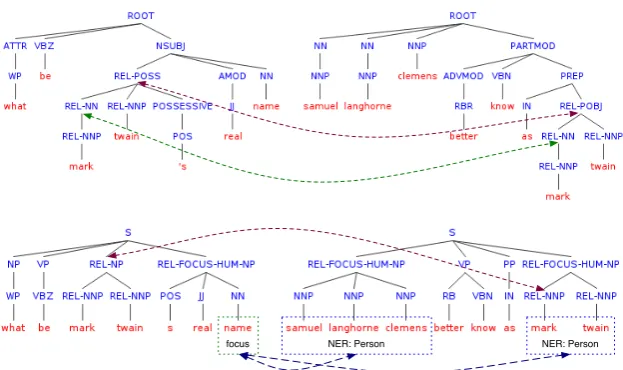
Given the ability of PTK to generate a rich set of structural features from a relatively flat shal-low tree representation, we propose to use depen-dency relations between words to derive an al-ternative structural model. In particular, we use a variation of the dependency tree, where depen-dency relations are altered in such a way that the words are always at the leaf level. This reorder-ing of the nodes in the dependency tree, s.t. words do not form long chains, which is typical in the standard dependency tree representation, is essen-tial for PTK to extract meaningful fragments. We also add part-of-speech tags between the words and the nodes encoding their grammatical roles (provided by the original dependency parse tree). Again a specialRELtag is used in the same man-ner as in the shallow representation to establish structural links between a question and an answer. Fig. 2 (top) gives an example of a dependency-based structure for our example q/a pair.
4 Relational Linking
The use of a special tag to mark the related frag-ments in the question and answer tree represen-tations has been shown to yield more accurate relational models (Severyn and Moschitti, 2012). However, previous approach was based on a na¨ıve hard matching between word lemmas.
Below we propose a novel strategy to estab-lish relational links using named entities extracted from the answer along with question focus and category classifiers. In particular, we use a ques-tion category to link the focus word of a quesques-tion with the named entities extracted from the candi-date answer. For this purpose, we first introduce our tree kernel-based models for building a ques-tion focus and category classifiers.
4.1 Question focus detection
an-NER: Person NER: Person focus
Figure 2:Dependency-based structure DEP (top) for the q/a pair.Q: What is Mark Twain’s real name? A: Samuel Langhorne Clemens, better known as Mark Twain. Arrows indicate the tree fragments in the question and its answer passage linked by the relationalRELtag. Shallow tree structure CH (bottom) with a typed relation tagREL-FOCUS-HUMto link a question focus wordnamewith the named entities of typePersoncorresponding to the question category (HUM).
swers in document passages, thus greatly reduc-ing the search space (Pinchak, 2006). While sev-eral machine learning approaches based on man-ual features and syntactic structures have been recently explored, e.g. (Quarteroni et al., 2012; Damljanovic et al., 2010; Bunescu and Huang, 2010), we opt for the latter approach where tree kernels handle automatic feature engineering.
In particular, to detect the question focus word we train a binary SVM classifier with tree ker-nels applied to the constituency tree representa-tion. For each given question we generate a set of candidate trees where the parent (node with the POS tag) of each candidate focus word is anno-tated with a specialFOCUS tag. Trees with the correctly tagged focus word constitute a positive example, while the others are negative examples. To detect the focus for an unseen question we clas-sify the trees obtained after tagging each candidate focus word. The tree yielding the highest classifi-cation score reveals the target focus word.
4.2 Question classification
Question classification is the task of assigning a question to one of the pre-specified categories. We use the coarse-grain classes described in (Li and Roth, 2002): six non-overlapping classes: Abbre-viations (ABBR), Descriptions (DESC, e.g. def-initions or explanations), Entity (ENTY, e.g. an-imal, body or color), Human (HUM, e.g. group or individual), Location (LOC, e.g. cities or coun-tries) and Numeric (NUM, e.g. amounts or dates). These categories can be used to determine the Ex-pected Answer Type for a given question and find
the appropriate entities found in the candidate an-swers. Imposing such constraints on the potential answer keys greatly reduces the search space.
Previous work in Question Classification re-veals the power of syntactic/semantic tree repre-sentations coupled with tree kernels to train the state-of-the-art models (Bloehdorn and Moschitti, 2007). Hence, we opt for an SVM multi-classifier using tree kernels to automatically extract the question class. To build a multi-class classifier we train a binary SVM for each of the classes and apply a one-vs-all strategy to obtain the predicted class. We use constituency trees as our input rep-resentation.
4.3 Linking focus word with named entities using question class
Question focus captures the target information need posed by a question, but to make this piece of information effective, the focus word needs to be linked to the target candidate answer. The focus word can be lexically matched with words present in an answer, or the match can be established us-ing semantic information. Clearly, the latter ap-proach is more appealing since it helps to allevi-ate the lexical gap problem which makes the n¨aive string matching of words between a question and its answer less reliable.
Table 1:Question classes→named entity types. Question Category Named Entity types
HUM Person
LOC Location
NUM Date, Time, Money, Percentage ENTY Organization, Person
are determined, we link the focus wordwf ocus in
the question, with all the named entities whose type matches the question class. Table 1 provides the correspondence between question classes and named entity types. We perform tagging at the chunk level and use two types of relational tags: plainREL-FOCUSand a tag typed with a ques-tion class, e.g.,REL-FOCUS-HUM. Fig. 2 (bot-tom) shows an example q/a pair where the typed relational tag is used in the shallow syntactic tree representation to link the chunk containing the question focusnamewith the named entities of the corresponding typePerson(according to the map-ping defined in Table 1), i.e. samuel langhorne clemensandmark twain.
5 Feature vector representation
While the primary focus of our study is on the structural representations and relations between q/a pairs we also include basic features widely used in QA:
Term-overlap features. A cosine similarity be-tween a question and an answer: simCOS(q, a),
where the input vectors are composed of: (i) n-grams (up to tri-n-grams) of word lemmas and part-of-speech tags, and (ii) dependency triplets. For the latter, we simply hash the string value of the predicate defining the triple together with its argu-ment, e.g.poss(name, twain).
PTK score. For the structural representations we also define a similarity based on the PTK score:
simP T K(q, a) = P T K(q, a), where the input
trees can be both dependency trees and shallow chunk trees. Note that this similarity is computed between the members of a q/a pair, thus, it is very different from the one defined in Eq. 1.
NER relatedness represents a match between a question category and the related named entity types extracted from the candidate answer. It counts the proportion of named entities in the an-swer that correspond to the question type returned by the question classifier.
In our study feature vectors serve a complemen-tary purpose, while the main focus is to study the virtue of structural representations for reranking. The effect of a more extensive number of pairwise
similarity features in QA has been studied else-where, e.g., (Surdeanu et al., 2008).
6 Experiments
We report the results on two QA collections: fac-toid open-domain QA corpus from TREC and a community QA corpus Answerbag. Since we fo-cus on passage reranking we do not carry out an-swer extraction. The goal is to rank the passage containing the right answer in the top position.
6.1 Corpora
TREC QA.In the TREC QA tasks, answer pas-sages containing correct information nuggets, i.e. answer keys, have to be extracted from a given text corpus, typically a large corpus from newswire. In our experiments, we opted for questions from 2002 and 2003 years, which totals to 824 ques-tions. AQUAINT newswire corpus4 is used for
searching the supporting answers.
Answerbagis a community-driven QA collection that contains a large portion of questions that have “professionally researched” answers. Such an-swers are provided by the website moderators and allow for training high quality models. From the original corpus containing 180k question/answer pairs, we use 1k randomly sampled questions for testing and 10k for training.
Question Focus. We use 3 datasets for train-ing and evaluattrain-ing the performance of our fo-cus detector: SeCo-600 (Quarteroni et al., 2012), Mooney GeoQuery (Damljanovic et al., 2010) and the dataset from (Bunescu and Huang, 2010). The SeCo dataset contains 600 questions from which we discarded a subset of multi-focus questions and non-interrogative queries. The Mooney Geo-Query contains 250 question targeted at geograph-ical information in the U.S. The first two datasets are very domain specific, so we also carried out experiments with the dataset from (Bunescu and Huang, 2010), which contains the first 2000 ques-tions from the answer type dataset from Li and Roth annotated with focus words. We removed questions with implicit and multiple focuses.
Question Classification. We used the UIUIC dataset (Li and Roth, 2002)5which contains 5952 4http://www.ldc.upenn.edu/Catalog/docs/LDC2002T31/ 5although the QC dataset from (Li and Roth, 2002)
factoid questions from different sources (USC, TREC 8, TREC 9, TREC 10). For training the classifiers we excluded questions from TREC 8 to ensure there is no overlap with the data used for testing models trained on TREC QA.
6.2 Models and Metrics
Our models are built applying a kernel-based reranker to the output of a search engine.
6.2.1 BM25
We use Terrier6 search engine, which provides
BM25 scoring model for indexing and retrieval. For the TREC QA 2002 and 2003 task we index AQUAINT corpus treating paragraphs as docu-ments. The resulting index contains about 12 mil-lion items. For the Answerbag we index the entire collection of 180k answers. We retrieve a list of top 50 candidate answers for each question.
6.2.2 Reranking models
To train our reranking models we used SVM-light-TK7, which encodes structural kernels in
SVM-light (Joachims, 2002) solver. In particular, we use PTK on the relational tree structures combined with the polynomial kernel of degree 3 applied to the feature vectors. Therefore, different represen-tations lead to different models described below.
CH- our basic shallow chunk tree (Severyn and Moschitti, 2012) used as a baseline structural reranking model.
DEP- dependency tree augmented with POS tags and reorganized relations suitable for PTK.
V - reranker model using similarity features de-fined in Sec. 5.
DEP+V, CH+V- a combination of tree structures and similarity feature vectors.
+FC+QC- relational linking of the question focus word and named entities of the corresponding type using Focus and Question classifiers.
+TFC+QC- a typed relational link refined a ques-tion category.8
6.2.3 Metrics
We report the following metrics, most commonly used in QA: Precision at rank 1 (P@1), i.e.,
6http://terrier.org/
7http://disi.unitn.it/moschitti/Tree-Kernel.htm
8†is used for showing the results of DEP, DEP+V and
[image:6.595.317.514.87.233.2]CH+V structural representations that are significantly better than the baseline model CH, while‡indicates improvement of +QC+FC and +QC+TFC tagging applied to basic struc-tural representations, e.g. CH+V and DEP+V.
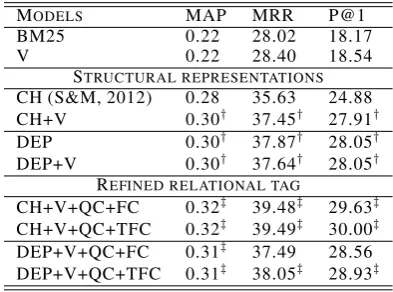
Table 2:Structural representations on TREC QA.
MODELS MAP MRR P@1
BM25 0.22 28.02 18.17
V 0.22 28.40 18.54
STRUCTURAL REPRESENTATIONS
CH (S&M, 2012) 0.28 35.63 24.88
CH+V 0.30† 37.45† 27.91†
DEP 0.30† 37.87† 28.05†
DEP+V 0.30† 37.64† 28.05†
REFINED RELATIONAL TAG
CH+V+QC+FC 0.32‡ 39.48‡ 29.63‡
CH+V+QC+TFC 0.32‡ 39.49‡ 30.00‡
DEP+V+QC+FC 0.31‡ 37.49 28.56
DEP+V+QC+TFC 0.31‡ 38.05‡ 28.93‡ the percentage of questions with a correct an-swer at rank 1, Mean Reciprocal Rank (MRR), and Mean Average Precision (MAP). The reported metrics are averages after performing a 5-fold cross-validation. We used a paired t-test at 95% confidence to compare the performance of our models to a baseline.
6.3 Passage Reranking Results
We first evaluate the impact of two different syn-tactic representations using shallow and depen-dency trees. Then, we evaluate the accuracy boost when such structures are enriched with automati-cally derived tags, e.g., question focus and ques-tion category and NEs found in the answer pas-sage.
6.3.1 Structural representations
Table 2 reveals that using V model results in a small improvement over BM25 baseline. Indeed, similarity scores that are most often based on word-overlap measures even when computed over various q/a representations are fairly redundant to the search engine similarity score. Instead, using the structural representations, CH and DEP, gives a bigger boost in the performance. Interestingly, having more features in the CH+V model results in further improvement while DEP+V seems to re-main insensitive to additional features provided by the V model.
6.3.2 Semantically Enriched Structures
Table 3:Accuracy (%) of focus classifiers.
DATASET ST STK STK+BOW PTK
MOONEY 73.0 81.9 81.5 80.5
SECO-600 90.0 94.5 94.5 90.0
BUNESCU 89.7 98.3 98.2 96.9
Table 4:Accuracy (%) of question classifiers.
DATASET STK+BOW PTK
LI& ROTH 86.1 82.2
TRECTEST 79.3 78.1
with the question category yields QC+TFC model. First, we report the results of training our question focus detector and question category classifier.
Focus classifier results. Table 3 displays the ac-curacies obtained by the question focus detector on 3 datasets using different kernels: the ST (sub-tree kernel where fragments contain full sub(sub-trees including leaves), STK, STK+bow (bag-of-words feature vector is added) and PTK. As we can see, using STK model yields the best accuracy and we use it in our pipeline to automatically detect the focus.
Question classifier results. Table 4 contains the accuracies of the question classifier on the UIUIC dataset and the TREC questions that we also use for testing our reranker models. STK+bow per-forms better than PTK, since here the input rep-resentation is a plain constituency tree, for which STK is particularly suited. Hence, we use this model to predict the question category.
Ranking results. Table 2 (bottom) summarizes the performance of the CH+V and DEP+V models when coupled with QC+FC and QC+TFC strate-gies to establish the links between the structures in a given q/a pair. CH structural representation with QC+FC yields an interesting improvement, while further refining the relational tag by adding a question category (QC+TFC) gives slightly bet-ter results.
[image:7.595.313.516.97.207.2]Integrating the refined relational tag into the DEP based structures results more problematic, since the dependency tree is less suitable for repre-senting multi-word expressions, named entities in our case. Hence, using the relational tag to mark the nodes spanning such multi-word entities in the dependency structure may result in less meaning-ful features than in CH model, where words in a phrase are naturally grouped under a chunk node. A more detailed discussion on the merits of each model is provided in the Sec. 6.5.
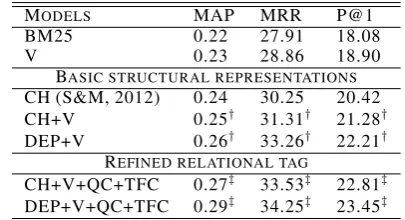
Table 5:Cross-domain experiment: training on Answerbag and testing on TREC QA.
MODELS MAP MRR P@1
BM25 0.22 27.91 18.08
V 0.23 28.86 18.90
BASIC STRUCTURAL REPRESENTATIONS
CH (S&M, 2012) 0.24 30.25 20.42
CH+V 0.25† 31.31† 21.28†
DEP+V 0.26† 33.26† 22.21†
REFINED RELATIONAL TAG
CH+V+QC+TFC 0.27‡ 33.53‡ 22.81‡
DEP+V+QC+TFC 0.29‡ 34.25‡ 23.45‡
6.4 Learning cross-domain pairwise structural relationships
To test the robustness of the syntactic patterns au-tomatically learned by our structural models, we conduct a cross-domain experiment, i.e. we train a model on Answerbag data and test it on TREC. It should be noted that unlike TREC data, where the answers are simply passages containing the cor-rect answer phrase, answers in Answerbag specif-ically address a given question and are generated by humans. Additionally, TREC QA contains only factoid questions, while Answerbag is a commu-nity QA corpus with a large portion of non-factoid questions. Interestingly, the results demonstrate the robustness of our syntactic relational model which captures patterns shared across different do-mains, e.g. TREC and Answerbag data.
Table 5 shows that: (i) models based on depen-dency structures result in a better generalization ability extracting more robust syntactic patterns; and (ii) the strategy to link the question focus with the related named entities in the answer provides an interesting improvement over the basic struc-tural representations.
6.5 Error Analysis
ques-tion category into the basic models.
The model learned by the reranker represents a collection of q/a pairs from the training set (sup-port vectors) which are matched against each can-didate q/a pair. We isolated the following pair from the model that has a high structural similarity with our running example:
Q: What is Barbie’s full name?
A: The toy is called after Barbie Millicent Roberts from Willows.
Despite differences in the surface forms of the words, PTK extracts matching patterns, e.g.[S NP [VP VBN] [PP IN] REL-NP], which yields a high similarity score boosting the rank of the correct candidate. However, we note that at the same time an incorrect candi-date answer, e.g. Mark Twain was accused of racist language., exhibits similar patterns and also gets a high rank. The basic structural repre-sentation is not able to encode essential differ-ences from the correct answer candidate. This poses a certain limitation on the discriminative power of CH and DEP representations. Intro-ducing a focus tag changes the structural repre-sentation of both q/a pairs, s.t. the correct q/a pair preserves the pattern (after identifying word
name as focus and question category as HUM, it is transformed to [S REL-FOCUS-NP [VP VBN] [PP IN] REL-FOCUS-NP]), while it is absent in the incorrect candidate. Thus, linking the focus word with the related NEs in the answer helps to discriminate between structurally similar yet semantically different candidates.
Another step towards a more fine-grained struc-tural representation is to specialize the relational focus tag (QC+TFC model). We propose to aug-ment the focus tag with the question category to avoid matches with other structurally similar but semantically different candidates. For example, a q/a pair found in the list of support vectors:
Q: What is Mark Twain’s place of birth?
A: Mark Twain was raised in Hannibal Missouri.
would exhibit high structural similarity even when relational focus is used (since the relational tag does not incorporate the question class LOC), but refining the focus tag with the question class elim-inates such cases.
7 Related Work
Previous studies similar to ours carry out pas-sage reranking by exploiting structural
informa-tion, e.g. using subject-verb-object relations (At-tardi et al., 2001; Katz and Lin, 2003). Un-fortunately, the large variability of natural lan-guage makes such triples rather sparse thus dif-ferent methods explore soft matching (i.e., lexical similarity) based on answer types and named en-tity types (Aktolga et al., 2011). Passage reranking using classifiers of question and answer pairs were proposed in (Radlinski and Joachims, 2006; Jeon et al., 2005).
Regarding kernel methods, our work in (Mos-chitti et al., 2007; Severyn and Mos(Mos-chitti, 2012) was the first to exploit tree kernels for modeling answer reranking. However, such method lacks the use of important relational information be-tween a question and a candidate answer, which is essential to learn accurate relational patterns. In contrast, this paper relies on shallow and depen-dency trees encoding the output of question and focus classifiers to connect focus word and NEs of the answer passage. This provides more effective relational information, which allows our model to significantly improve on previous rerankers.
8 Conclusions
This paper shows a viable research direction in the automatic QA engineering. One of its main characteristics is the use of structural kernel tech-nology to induce features from structural seman-tic representations of question and answer pas-sage pairs. The same technology is also used to construct question and focus classifiers, which are used to derive relational structures.
An interesting result of this paper is that to de-sign an answer passage reranker for a new do-main, we can use off-the-shelf syntactic parsers and NERs along with little training data for the QC and FC classifiers. This is due to the fact that: (i) the kernel technology is able to automat-ically extract effective structural patterns; and (ii) the extracted patterns are rather robust, e.g., mod-els learned on Answerbag improve accuracy on TREC test data.
Acknowledgements
This research is partially supported by the EU’s 7th
Framework Program (FP7/2007-2013) (#288024 LIMOSINE project) and an Open Collaborative
References
Elif Aktolga, James Allan, and David A. Smith. 2011. Passage reranking for question answering using syn-tactic structures and answer types. InECIR.
Giuseppe Attardi, Antonio Cisternino, Francesco Formica, Maria Simi, and Ro Tommasi. 2001. Piqasso: Pisa question answering system. InTREC, pages 599–607.
Stephan Bloehdorn and Alessandro Moschitti. 2007. Combined syntactic and semantic kernels for text classification. InECIR.
Razvan Bunescu and Yunfeng Huang. 2010. Towards a general model of answer typing: Question focus identification. InCICLing.
Michael Collins and Nigel Duffy. 2002. New Ranking Algorithms for Parsing and Tagging: Kernels over Discrete Structures, and the Voted Perceptron. In
ACL.
Danica Damljanovic, Milan Agatonovic, and Hamish Cunningham. 2010. Identification of the question focus: Combining syntactic analysis and ontology-based lookup through the user interaction. InLREC.
Alessandra Giordani and Alessandro Moschitti. 2009. Syntactic structural kernels for natural language in-terfaces to databases. In Proceedings of ECML PKDD, ECML PKDD ’09. Springer-Verlag.
Alessandra Giordani and Alessandro Moschitti. 2012. Translating questions to sql queries with generative parsers discriminatively reranked. In Proceedings of The 24rd International Conference on Computa-tional Linguistics, India. Coling 2012.
Jiwoon Jeon, W. Bruce Croft, and Joon Ho Lee. 2005. Finding similar questions in large question and an-swer archives. InCIKM.
T. Joachims. 2002. Optimizing search engines using clickthrough data. In ACM SIGKDD Conference on Knowledge Discovery and Data Mining (KDD), pages 133–142.
Boris Katz and Jimmy Lin. 2003. Selectively using re-lations to improve precision in question answering.
Xin Li and Dan Roth. 2002. Learning question classi-fiers. InCOLING.
Alessandro Moschitti and Silvia Quarteroni. 2008. Kernels on linguistic structures for answer extrac-tion. InACL.
Alessandro Moschitti, Silvia Quarteroni, Roberto Basili, and Suresh Manandhar. 2007. Exploit-ing syntactic and shallow semantic kernels for ques-tion/answer classification. InACL.
Alessandro Moschitti. 2004. A study on convolution kernels for shallow statistic parsing. InProceedings of the 42nd Meeting of the Association for Compu-tational Linguistics (ACL’04), Main Volume, pages 335–342, Barcelona, Spain, July.
Alessandro Moschitti. 2006. Efficient convolution ker-nels for dependency and constituent syntactic trees. InECML.
Alessandro Moschitti. 2008. Kernel methods, syntax and semantics for relational text categorization. In
CIKM.
Christopher Pinchak. 2006. A probabilistic answer type model. InIn EACL.
John M. Prager. 2006. Open-domain question-answering. Foundations and Trends in Information Retrieval, 1(2):91–231.
Silvia Quarteroni, Vincenzo Guerrisi, and Pietro La Torre. 2012. Evaluating multi-focus natural lan-guage queries over data services. InLREC.
Filip Radlinski and Thorsten Joachims. 2006. Query chains: Learning to rank from implicit feedback.
CoRR.
Aliaksei Severyn and Alessandro Moschitti. 2012. Structural relationships for large-scale learning of answer re-ranking. InSIGIR.