Multilingual Dependency Learning:
Exploiting Rich Features for Tagging Syntactic and Semantic Dependencies
Hai Zhao(赵赵海赵海海)†, Wenliang Chen(陈文陈陈文文亮亮亮)‡,
Jun’ichi Kazama‡,Kiyotaka Uchimoto‡, andKentaro Torisawa‡ †Department of Chinese, Translation and Linguistics
City University of Hong Kong
83 Tat Chee Avenue, Kowloon, Hong Kong, China ‡Language Infrastructure Group, MASTAR Project
National Institute of Information and Communications Technology 3-5 Hikari-dai, Seika-cho, Soraku-gun, Kyoto, Japan, 619-0289
[email protected], [email protected]
Abstract
This paper describes our system about mul-tilingual syntactic and semantic dependency parsing for our participation in the joint task of CoNLL-2009 shared tasks. Our system uses rich features and incorporates various in-tegration technologies. The system is ated on in-domain and out-of-domain evalu-ation data of closed challenge of joint task. For in-domain evaluation, our system ranks the second for the average macro labeled F1 of all seven languages, 82.52% (only about 0.1% worse than the best system), and the first for English with macro labeled F1 87.69%. And for out-of-domain evaluation, our system also achieves the second for average score of all three languages.
1 Introduction
This paper describes the system of National In-stitute of Information and Communications Tech-nology (NICT) and City University of Hong Kong (CityU) for the joint learning task of CoNLL-2009 shared task (Hajiˇc et al., 2009)1. The system is
ba-sically a pipeline of syntactic parser and semantic parser. We use a syntactic parser that uses very rich features and integrates graph- and transition-based methods. As for the semantic parser, a group of well selected feature templates are used withn-best
syn-tactic features.
1Our thanks give to the following corpus providers, (Taul´e et al., 2008; Palmer and Xue, 2009; Hajiˇc et al., 2006; Surdeanu et al., 2008; Burchardt et al., 2006) and (Kawahara et al., 2002).
The rest of the paper is organized as follows. The next section presents the technical details of our syn-tactic dependency parsing. Section 3 describes the details of the semantic dependency parsing. Section 4 shows the evaluation results. Section 5 looks into a few issues concerning our forthcoming work for this shared task, and Section 6 concludes the paper.
2 Syntactic Dependency Parsing
Basically, we build our syntactic dependency parsers based on the MSTParser, a freely available imple-mentation2, whose details are presented in the paper
of McDonald and Pereira (2006). Moreover, we ex-ploit rich features for the parsers. We represent fea-tures by following the work of Chen et al. (2008) and Koo et al. (2008) and use features based on depen-dency relations predicted by transition-based parsers (Nivre and McDonald, 2008). Chen et al. (2008) and Koo et al. (2008) proposed the methods to obtain new features from large-scale unlabeled data. In our system, we perform their methods on training data because the closed challenge does not allow to use unlabeled data. In this paper, we call these new ad-ditional features rich features.
2.1 Basic Features
Firstly, we use all the features presented by McDon-ald et al. (2006), if they are available in data. Then we add new features for the languages having FEAT information (Hajiˇc et al., 2009). FEAT is a set of morphological-features, e.g. more detailed part of speech, number, gender, etc. We try to align differ-ent types of morphological-features. For example,
2http://mstparser.sourceforge.net
we can obtain a sequence of gender tags of all words from a headhto its dependentd. Then we represent
the features based on the obtained sequences. Based on the results of development data, we per-form non-projective parsing for Czech and German and perform projective parsing for Catalan, Chinese, English, Japanese, and Spanish.
2.2 Features Based on Dependency Pairs
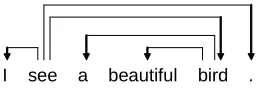
[image:2.612.125.253.195.239.2]I see a beautiful bird .
Figure 1: Example dependency graph.
Chen et al. (2008) presented a method of extract-ing short dependency pairs from large-scale auto-parsed data. Here, we extract all dependency pairs rather than short dependency pairs from training data because we believe that training data are reli-able. In a parsed sentence, if two words have de-pendency relation, we add this word pair into a list namedLand count its frequency. We consider the
direction. For example, in figure 1,aandbirdhave dependency relation in the sentence “I see a beauti-ful bird.”. Then we add word pair “a-bird:HEAD”3
into listLand accumulate its frequency.
We remove the pairs which occur only once in training data. According to frequency, we then group word pairs into different buckets, with bucket LOW for frequencies 2-7, bucket MID for frequen-cies 8-14, and bucket HIGH for frequenfrequen-cies 15+. We set these threshold values by following the set-ting of Chen et al. (2008). For example, the fre-quency of pair “a-bird:HEAD” is 5. Then it is grouped into bucket “LOW”. We also add a vir-tual bucket “ZERO” to represent the pairs that are not included in the list. So we have four buckets. “ZERO”, “LOW”, “MID”, and “HIGH” are used as bucket IDs.
Based on the buckets, we represent new features for a headh and its dependent d. We check word
pairs surroundingh andd. Table 1 shows the word pairs, where h-word refers to the head word, d-word refers to the dependent word, h-word-1 refers to
3HEAD means thatbirdis the head of the pair.
the word to the left of the head in the sentence, h-word+1 refers to the word to the right of the head, d-word-1 refers to the word to the left of the depen-dent, and d-word+1 refers the word to the right of the dependent. Then we obtain the bucket IDs of these word pairs fromL.
We generate new features consisting of indicator functions for bucket IDs of word pairs. We call these features word-pair-based features. We also generate combined features involving bucket IDs and part-of-speech tags of heads.
[image:2.612.384.474.219.289.2]h-word, d-word h-word-1, d-word h-word+1, d-word h-word, d-word-1 h-word, d-word+1
Table 1: Word pairs for feature representation
2.3 Features Based on Word Clusters
Koo et al. (2008) presented new features based on word clusters obtained from large-scale unlabeled data and achieved large improvement for English and Czech. Here, word clusters are generated only from the training data for all the languages. We per-form word clustering by using the clustering tool4,
which also was used by Koo et al. (2008). The cluster-based features are the same as the ones used by Koo et al. (2008).
2.4 Features Based on Predicted Relations Nivre and McDonald (2008) presented an integrat-ing method to provide additional information for graph-based and transition-based parsers. Here, we represent features based on dependency relations predicted by transition-based parsers for graph-based parser. Based on the results on development data, we choose the MaltParser for Catalan, Czech, German, and Spanish, and choose another MaxEnt-based parser for Chinese, English, and Japanese.
2.4.1 A Transition-based Parser: MaltParser For Catalan, Czech, German, and Spanish, we use the MaltParser, a freely available
tion5, whose details are presented in the paper of
Nivre (2003). More information about the parser can be available in the paper (Nivre, 2003).
Due to computational cost, we do not select new feature templates for the MaltParser. Following the features settings of Hall et al. (2007), we use their Czech feature file and Catalan feature file. To sim-ply, we apply Czech feature file for German too, and apply Catalan feature file for Spanish.
2.4.2 Another Transition-based Parser: MaxEnt-based Parser
In three highly projective language, Chinese, English and Japanese, we use the maximum en-tropy syntactic dependency parser as in Zhao and Kit (2008). We still use the similar feature notations of that work. We use the same greedy feature selec-tion of Zhao et al. (2009) to determine an optimal feature template set for each language. Full feature sets for the three languages can be found at website, http://bcmi.sjtu.edu.cn/˜zhaohai.
2.4.3 Feature Representation
For training data, we use 2-way jackknifing to generate predicted dependency parsing trees by two transition-based parsers. Following the features of Nivre and McDonald (2008), we define features for a headhand its dependentdwith labellas shown in
table 2, whereGT ranrefers to dependency parsing
trees generated by the MaltParser or MaxEnt-base Parser and ∗ refers to any label. All features are conjoined with the part-of-speech tags of the words involved in the dependency.
Is (h, d,∗) inGT ran?
Is (h, d, l) inGT ran?
Is (h, d,∗) not inGT ran?
Is (h, d, l) not inGT ran?
Table 2: Features set based on predicted labels
3 n-best Syntactic Features for Semantic Dependency Parsing
Due to the limited computational resource that we have, we used the the similar learning framework as our participant in semantic-only task (Zhao et al.,
5http://w3.msi.vxu.se/˜nivre/research/MaltParser.html
Normal n-best Matched
Ca 53 54 50
Ch 75 65 55
[image:3.612.350.502.56.108.2]En 73 70 63
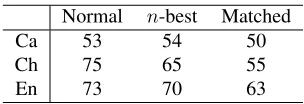
Table 3: Feature template sets:n-best vs. non-n-best
2009). Namely, three languages, a single maximum entropy model is used for all identification and clas-sification tasks of predicate senses or argument la-bels in four languages, Catalan, Czech, Japanese, or Spanish. For the rest three languages, an individual sense classifier still using maximum entropy is ad-ditionally used to output the predicate sense previ-ously. More details about argument candidate prun-ing strategies and feature template set selection are described in Zhao et al. (2009).
The same feature template sets as the semantic-only task are used for three languages, Czech, Ger-man and Japanese. For the rest four languages, we further use n-best syntactic features to strengthen
semantic dependency parsing upon those automati-cally discovered feature template sets. However, we cannot obtain an obvious performance improvement in Spanish by usingn-best syntactic features.
There-fore, only Catalan, Chinese and English semantic parsing adopted these types of features at last.
Our work about n-best syntactic features still
starts from the feature template set that is originally selected for the semantic-only task. The original fea-ture template set is hereafter referred to ’the normal’ or ’non-n-best’. In practice, only 2nd-best syntactic
outputs are actually adopted by our system for the joint task.
To generate helpful feature templates from the 2nd-best syntactic tree, we simply let all feature tem-plates in the normal feature set that are based on the 1st-best syntactic tree now turn to the 2nd-best one. Using the same notations for feature template representation as in Zhao et al. (2009), we take an example to show how the original n-best features
cor-Language Features Catalan p:2.lm.dprel
a.lemma + a:2.h.form a.lemma + a:2.pphead.form
(a:2:p:2|dpPath.dprel.seq) + p.FEAT1
Chinese a:2.h.pos
a:2.children.pos.seq + p:2.children.pos.seq a:2:p:2|dpPath.dprel.bag
a:2:p:2|dpPathPred.form.seq a:2:p:2|dpPath.pos.bag
(a:2:p:2|dpTreeRelation) + p.pos (a:2:p:2|dpPath.dprel.seq) + a.pos
English a:2:p:2|dpPathPred.lemma.bag a:2:p:2|dpPathPred.pos.bag a:2:p:2|dpTreeRelation a:2:p:2|dpPath.dprel.seq a:2:p:2|dpPathPred.dprel.seq a.lemma + a:2.dprel + a:2.h.lemma
[image:4.612.74.541.54.291.2](a:2:p:2|dpTreeRelation) +p.pos
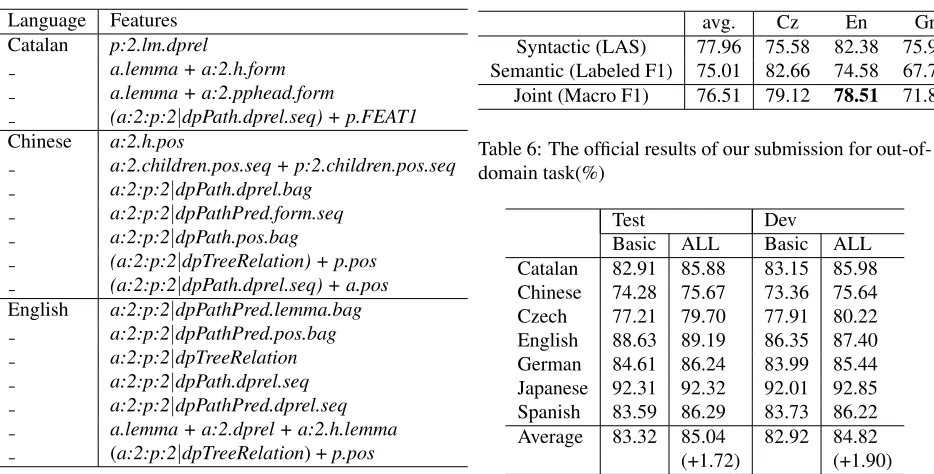
Table 4: Features forn-best syntactic tree
responding 2nd-best syntactic feature will be a : 2.children.dprel.bag. As all operations to gener-ate the feature for a.children.dprel.bag is within
the 1st-best syntactic tree, while those for a : 2.children.dprel.bagis within the2nd-best one. As all these 2nd-best syntactic features are generated, we use the same greedy feature selection procedure as in Zhao et al. (2009) to determine the best fit fea-ture template set according to the evaluation results in the development set.
For Catalan, Chinese and English, three opti-mal n-best feature sets are obtained, respectively.
Though dozens of n-best features are initially
gen-erated for selection, only few of them survive af-ter the greedy selection. A feature number statis-tics is in Table 3, and those additionally selected
n-best features for three languages are in Table
4. Full feature lists and their explanation for all languages will be available at the website, http://bcmi.sjtu.edu.cn/˜zhaohai.
4 Evaluation Results
Two tracks (closed and open challenges) are pro-vided for joint task of CoNLL2009 shared task. We participated in the closed challenge and evalu-ated our system on the in-domain and out-of-domain evaluation data.
avg. Cz En Gr Syntactic (LAS) 77.96 75.58 82.38 75.93 Semantic (Labeled F1) 75.01 82.66 74.58 67.78 Joint (Macro F1) 76.51 79.12 78.51 71.89
Table 6: The official results of our submission for out-of-domain task(%)
Test Dev
Basic ALL Basic ALL Catalan 82.91 85.88 83.15 85.98 Chinese 74.28 75.67 73.36 75.64 Czech 77.21 79.70 77.91 80.22 English 88.63 89.19 86.35 87.40 German 84.61 86.24 83.99 85.44 Japanese 92.31 92.32 92.01 92.85 Spanish 83.59 86.29 83.73 86.22 Average 83.32 85.04 82.92 84.82 (+1.72) (+1.90)
Table 7: The effect of rich features for syntactic depen-dency parsing
4.1 Official Results
The official results for the joint task are in Table 5, and the out-of-domain task in Table 6, where num-bers in bold stand for the best performances for the specific language. For out-of-domain (OOD) eval-uation, we did not perform any domain adaptation. For both in-domain and out-of-domain evaluation, our system achieved the second best performance for the average Macro F1 scores of all the languages. And our system provided the first best performance for the average Semantic Labeled F1 score and the forth for the average Labeled Syntactic Accuracy score for in-domain evaluation.
4.2 Further results
At first, we check the effect of rich features for syn-tactic dependency parsing. Table 7 shows the com-parative results of basic features and all features on test and development data, where “Basic” refers to the system with basic features and “ALL” refers to the system with basic features plus rich features. We found that the additional features provided improve-ment of1.72%for test data and1.90%for develop-ment data.
average Catalan Chinese Czech English German Japanese Spanish Syntactic (LAS) 85.04 85.88 75.67 79.70 89.19 86.24 92.32 86.29 Semantic (Labeled F1) 79.96 80.10 76.77 82.04 86.15 76.19 78.17 80.29 Joint (Macro F1) 82.52 83.01 76.23 80.87 87.69 81.22 85.28 83.31
Table 5: The official results of our joint submission (%)
Data Czech Chinese English normal n-best normal n-best 25% 80.71 75.12 75.24 82.02 82.06 50% 81.52 76.50 76.59 83.52 83.42 75% 81.90 76.92 77.01 84.21 84.30 100% 82.24 77.35 77.34 84.73 84.80
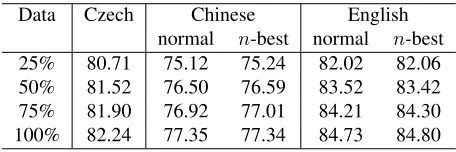
Table 8: The performance in development set (semantic labeled F1) vs. training corpus size
curves are drawn for Czech, Chinese and English. We use 25%, 50% and 75% training corpus, respec-tively. The results in development sets are given in Table 8. Note that in this table the differences be-tween normal and n-best feature template sets are
also given for Chinese and English. The results in the table show thatn-best features help improve
Chinese semantic parsing as the training corpus is smaller, while it works for English as the training corpus is larger.
5 Discussion
This work shows our further endeavor in syntactic and semantic dependency parsing, based on our pre-vious work (Chen et al., 2008; Zhao and Kit, 2008). Chen et al. (Chen et al., 2008) and Koo et al. (Koo et al., 2008) used large-scale unlabeled data to im-prove syntactic dependency parsing performance. Here, we just performed their method on training data. From the results, we found that the new fea-tures provided better performance. In future work, we can try these methods on large-scale unlabeled data for other languages besides Chinese and En-glish.
In Zhao and Kit (2008), we addressed that seman-tic parsing should benefit from cross-validated train-ing corpus and n-best syntactic output. These two
issues have been implemented during this shared task. Though existing work show that re-ranking for semantic-only or syntactic-semantic joint tasks may bring higher performance, the limited computational
resources does not permit us to do this for multiple languages.
To analyze the advantage and the weakness of our system, the ranks for every languages of our sys-tem’s outputs are given in Table 9, and the perfor-mance differences between our system and the best one in Table 106. The comparisons in these two
ta-bles indicate that our system is slightly weaker in the syntactic parsing part, this may be due to the reason that syntactic parsing in our system does not ben-efit from semantic parsing as the other joint learn-ing systems. However, considerlearn-ing that the seman-tic parsing in our system simply follows the output of the syntactic parsing and the semantic part of our system still ranks the first for the average score, the semantic part of our system does output robust and stable results. It is worth noting that semantic la-beled F1 in Czech given by our system is 4.47% worse than the best one. This forby gap in this lan-guage further indicates the advantage of our system in the other six languages and some latent bugs or learning framework misuse in Czech semantic pars-ing.
6 Conclusion
We describe the system that uses rich features and incorporates integrating technology for joint learn-ing task of syntactic and semantic dependency pars-ing in multiple languages. The evaluation results show that our system is good at both syntactic and semantic parsing, which suggests that a feature-oriented method is effective in multiple language processing.
References
Aljoscha Burchardt, Katrin Erk, Anette Frank, Andrea Kowalski, Sebastian Pad´o, and Manfred Pinkal. 2006.
average Catalan Chinese Czech English German Japanese Spanish
Syntactic (LAS) 4 4 4 4 2 3 3 4
Semantic (Labeled F1) 1 1 3 4 1 2 2 1
Joint (Macro F1) 2 1 3 4 1 3 2 1
Table 9: Our system’s rank within the joint task according to three main measures
average Catalan Chinese Czech English German Japanese Spanish Syntactic (LAS) 0.73 1.98 0.84 0.68 0.69 1.24 0.25 1.35 Semantic (Labeled F1) - - 0.38 4.47 - 2.42 0.09
-Joint (Macro F1) 0.12 - 0.15 2.40 - 1.22 0.37
-Table 10: The performance differences between our system and the best one within the joint task according to three main measures
The SALSA corpus: a German corpus resource for lexical semantics. In Proceedings of LREC-2006, Genoa, Italy.
Wenliang Chen, Daisuke Kawahara, Kiyotaka Uchimoto, Yujie Zhang, and Hitoshi Isahara. 2008. Dependency parsing with short dependency relations in unlabeled data. InProceedings of IJCNLP-2008, Hyderabad, In-dia, January 8-10.
Jan Hajiˇc, Jarmila Panevov´a, Eva Hajiˇcov´a, Petr Sgall, Petr Pajas, Jan ˇStˇep´anek, Jiˇr´ı Havelka, Marie Mikulov´a, and Zdenˇek ˇZabokrtsk´y. 2006. Prague De-pendency Treebank 2.0.
Jan Hajiˇc, Massimiliano Ciaramita, Richard Johans-son, Daisuke Kawahara, Maria Ant`onia Mart´ı, Llu´ıs M`arquez, Adam Meyers, Joakim Nivre, Sebastian Pad´o, Jan ˇStˇep´anek, Pavel Straˇn´ak, Mihai Surdeanu, Nianwen Xue, and Yi Zhang. 2009. The CoNLL-2009 shared task: Syntactic and semantic dependen-cies in multiple languages. InProceedings of CoNLL-2009, Boulder, Colorado, USA.
Johan Hall, Jens Nilsson, Joakim Nivre, G¨ulsen Eryiˇgit, Be´ata Megyesi, Mattias Nilsson, and Markus Saers. 2007. Single malt or blended? a study in multilingual parser optimization. In Proceedings of the CoNLL Shared Task Session of EMNLP-CoNLL 2007, pages 933–939, Prague, Czech, June.
Daisuke Kawahara, Sadao Kurohashi, and Kˆoiti Hasida. 2002. Construction of a Japanese relevance-tagged corpus. InProceedings of LREC-2002, pages 2008– 2013, Las Palmas, Canary Islands.
Terry Koo, Xavier Carreras, and Michael Collins. 2008. Simple semi-supervised dependency parsing. In Pro-ceedings of ACL-08: HLT, pages 595–603, Columbus, Ohio, USA, June.
Ryan McDonald and Fernando Pereira. 2006. On-line learning of approximate dependency parsing algo-rithms. InProceedings of EACL-2006, pages 81–88, Trento, Italy, April.
Ryan McDonald, Kevin Lerman, and Fernando Pereira. 2006. Multilingual dependency analysis with a two-stage discriminative parser. InProceedings of CoNLL-X, New York City, June.
Joakim Nivre and Ryan McDonald. 2008. Integrating graph-based and transition-based dependency parsers. In Proceedings of ACL-08: HLT, pages 950–958, Columbus, Ohio, June.
Joakim Nivre. 2003. An efficient algorithm for projec-tive dependency parsing. InProceedings of the 8th In-ternational Workshop on Parsing Technologies (IWPT 03), pages 149–160, Nancy, France, April 23-25. Martha Palmer and Nianwen Xue. 2009. Adding
seman-tic roles to the Chinese Treebank. Natural Language Engineering, 15(1):143–172.
Mihai Surdeanu, Richard Johansson, Adam Meyers, Llu´ıs M`arquez, and Joakim Nivre. 2008. The CoNLL-2008 shared task on joint parsing of syntactic and se-mantic dependencies. InProceedings of the CoNLL-2008.
Mariona Taul´e, Maria Ant`onia Mart´ı, and Marta Re-casens. 2008. AnCora: Multilevel Annotated Corpora for Catalan and Spanish. InProceedings of the LREC-2008, Marrakesh, Morroco.
Hai Zhao and Chunyu Kit. 2008. Parsing syntactic and semantic dependencies with two single-stage maxi-mum entropy models. InProceedings of CoNLL-2008, pages 203–207, Manchester, UK, August 16-17. Hai Zhao, Wenliang Chen, Chunyu Kit, and Guodong
[image:6.612.80.531.58.109.2]