3727
Dialogue Act Classification with Context-Aware Self-Attention
Vipul Raheja Joel Tetreault
Grammarly
Abstract
Recent work in Dialogue Act classification has treated the task as a sequence labeling problem using hierarchical deep neural net-works. We build on this prior work by lever-aging the effectiveness of a context-aware self-attention mechanism coupled with a hierarchi-cal recurrent neural network. We conduct ex-tensive evaluations on standard Dialogue Act classification datasets and show significant im-provement over state-of-the-art results on the Switchboard Dialogue Act (SwDA) Corpus. We also investigate the impact of different utterance-level representation learning meth-ods and show that our method is effective at capturing utterance-level semantic text repre-sentations while maintaining high accuracy.
1 Introduction
Dialogue Acts (DAs) are the functions of ut-terances in dialogue-based interaction (Austin,
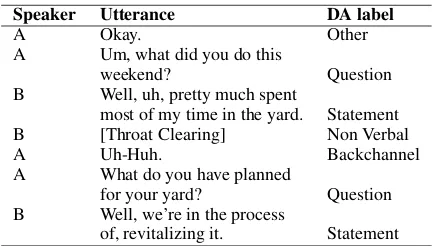
1975). A DA represents the meaning of an utter-ance at the level of illocutionary force, and hence, constitutes the basic unit of linguistic communica-tion (Searle,1969). DA classification is an impor-tant task in Natural Language Understanding, with applications in question answering, conversational agents, speech recognition, etc. Examples of DAs can be found in Table1. Here we have a conver-sation of 7 utterances between two speakers. Each utterance has a corresponding label such as
Ques-tionorBackchannel.
Early work in this field made use of statis-tical machine learning methods and approached the task as either a structured prediction or text classification problem (Stolcke et al., 2000;Ang et al., 2005; Zimmermann, 2009;Surendran and Levow, 2006). Many recent studies have pro-posed deep learning models for the DA classifi-cation task with promising results (Lee and Der-noncourt,2016;Khanpour et al.,2016;Ortega and
Speaker Utterance DA label
A Okay. Other
A Um, what did you do this
weekend? Question
B Well, uh, pretty much spent
most of my time in the yard. Statement
B [Throat Clearing] Non Verbal
A Uh-Huh. Backchannel
A What do you have planned
for your yard? Question
B Well, we’re in the process
[image:1.595.308.526.220.343.2]of, revitalizing it. Statement
Table 1: A snippet of a conversation sample from the SwDA Corpus. Each utterance has a corresponding di-alogue act label.
Vu, 2017). However, most of these approaches treat the task as a text classification problem, treat-ing each utterance in isolation, rendertreat-ing them un-able to leverage the conversation-level contextual dependence among utterances. Knowing the text and/or the DA labels of the previous utterances can assist in predicting the current DA state. For in-stance, in Table1, theAnswerorStatementdialog acts often followQuestiontype utterances.
repre-sentations, which serve as the building blocks of our hierarchical architecture for DA classification.
2 Related Work
A full review of all DA classification methods is outside the scope of the paper, thus we focus on two main classes of approaches which have domi-nated recent research: those that treat DA classifi-cation as a text classificlassifi-cation problem, where each utterance is classified in isolation, and those that treat it as a sequence labeling problem.
Text Classification:Lee and Dernoncourt(2016) build a vector representation for each utterance, using either a CNN or RNN, and use the preceding utterance(s) as context to classify it. Their model was extended byKhanpour et al. (2016) and Or-tega and Vu (2017). Shen and Lee(2016) used a variant of the attention-based encoder for the task.
Ji et al.(2016) use a hybrid architecture, combin-ing an RNN language model with a latent variable model.
Sequence Labeling: Kalchbrenner and Blunsom
(2013) used a mixture of sentence-level CNNs and discourse-level RNNS to achieve state-of-the-art results on the task. Recent works (Li and Wu,
2016;Liu et al.,2017) have increasingly employed hierarchical architectures to learn and model mul-tiple levels of utterance and DA dependencies.
Kumar et al.(2018),Chen et al.(2018) andTran et al.(2017) used RNN-based hierarchical neural networks, using different combinations of tech-niques like last-pooling or attention mechanism to encode sentences, coupled with CRF decoders.
Chen et al. (2018) achieved the highest perfor-mance to date on the two datasets for this task.
Our work extends these hierarchical models and leverages a combination of techniques proposed across these prior works (CRF decoding, contex-tual attention, and character-level word embed-dings) with self-attentive representation learning, and is able to achieve state-of-the-art performance.
3 Model
The task of DA classification takes a conversa-tion C as input, which is a varying length se-quence of utterances U = {u1, u2, ...uL}. Each
utteranceui ∈ U, in turn, is a sequence of
vary-ing lengths of words {w1i, wi2, ..., wNi
i }, and has
a corresponding target label yi ∈ Y. Hence,
each conversation (i.e. a sequence of utterances) is mapped to a corresponding sequence of target
21
⃗
21
⃖
21
⃗
22
⃖
22
⃗
23
⃖
23
21
21 22 23
⃗
1
⃖
1
⃗
2
⃖
2
⃗
3
⃖
3
1 2 3
1
1 2 3 ... ... n
22 23
how
Words Embeddings Bi-Directional RNN Concatenate
2 3
Context-aware Self-Attention Fully Connected Bi-Directional RNN Concatenate CRF
2
1 3
21 22
are
22 23
you
[image:2.595.312.524.61.342.2]23
Figure 1: Model Architecture
labelsY = {y1, y2, ..., yL}, which represents the
DAs associated with the corresponding utterances. Figure 1 shows the overall architecture of our model, which involves three main compo-nents: (1) an utterance-level RNN that encodes the information within the utterances at the word and character-level; (2) a context-aware self-attention mechanism that aggregates word repre-sentations into utterance reprerepre-sentations; and (3) a conversation-level RNN that operates on the utter-ance encoding output of the attention mechanism, followed by a CRF layer to predict utterance la-bels. We describe them in detail below.
3.1 Utterance-level RNN
For each word in an utterance, we combine two different word embeddings: GloVe (Pennington et al.,2014) and pre-trained ELMo representations (Peters et al., 2018) with fine-tuned task-specific parameters, which have shown superior perfor-mance in a wide range of tasks. The word embed-ding is then concatenated with its CNN-based
50-D character-level embedding (Chiu and Nichols,
The word representation layer is followed by a bidirectional GRU (Bi-GRU) layer. Concatenating the forward and backward outputs of the Bi-GRU generates the utterance embedding that serves as input to the utterance-level context-aware self-attention mechanism which learns the final utter-ance representation.
3.2 Context-aware Self-attention
Self-attentive representations encode a variable-length sequence into a fixed size, using an at-tention mechanism that considers different posi-tions within the sequence. Inspired byTran et al.
(2017), we use the previous hidden state from the conversation-level RNN (Section3.3), which pro-vides the context of the conversation so far, and combine it with the hidden states of all the con-stituent words in an utterance, into a self-attentive encoder (Lin et al.,2017), which computes a2D
representation of each input utterance. We fol-low the notation originally presented inLin et al.
(2017) to explain our modification of their self-attentive sentence representation below.
An utterance ui, which is a sequence of n
words{wi1, w2i, ...wni}, is mapped into an embed-ding layer, resulting in ad-dimensional word em-bedding for every word. It is then fed into a bidirectional-GRU layer, whose hidden state out-puts are concatenated at every time step.
− →
hji =−−−→GRU(wij,−−→hji−1) (1)
←−
hji =←−−−GRU(wji,
←−−
hji+1) (2)
hji =concat(−→hji,←h−ji) (3)
Hi={h1i,h2i, ...hni} (4)
Hi represents thenGRU outputs of size2u (u
is the number of hidden units in a unidirectional GRU).
The contextual self-attention scores are then computed as follows:
Si=Ws2tanh(Ws1HiT +Ws3−−→gi−1+b) (5)
Here, Ws1 is a weight matrix with a shape of
da×2u, Ws2 is a matrix of parameters of shape
r ×da, where r and da are hyperparameters we
can set arbitrarily, and Ws3 is a parameter ma-trix of shapeda×kfor the conversational context,
wherekis another hyperparameter that is the size of a hidden state in the conversation-level RNN (size of−−→gi−1), andbis a vector representing bias.
Equation5 can then be treated as a 2-layer MLP with bias, withdahidden units,Ws1, Ws2andWs3 as weight parameters. The scoresSi are mapped
into a probability matrixAiby means of a softmax
function:
Ai=sof tmax(Si) (6)
which is then used to obtain a 2-d representation
Mi of the input utterance, using the GRU hidden
states Hi according to the attention weights
pro-vided byAias follows:
Mi =AiHi (7)
This 2-d representation is then projected to a 1-d embedding (denoted as hi), using a
fully-connected layer. The conversation-level GRU then operates over this 1-d utterance embedding, and hence, we can representgias:
− →g
i =
−−−→
GRU(hi,−−→gi−1) (8)
←g−
i =
−−−→
GRU(hi,−−→gi+1) (9)
gi =concat(−→gi,←g−i) (10)
gi then provides the conversation-level context
used to learn the attention scores and 2-d repre-sentation (Mi+1) for the next utterance in the
con-versation (hi+1).
3.3 Conversation-level RNN
The utterance representationhifrom the previous
step is passed on to the conversation-level RNN, which is another bidirectional GRU layer used to encode utterances across a conversation. The hid-den states−→gi and←g−i (Figure1) are then
concate-nated to get the final representationgiof each
ut-terance, which is further propagated to a linear chain CRF layer. The CRF layer considers the correlations between labels in context and jointly decodes the optimal sequence of utterance labels for a given conversation, instead of decoding each label independently.
4 Data
Dataset |C| |V| Train Validation Test
MRDA 5 12k 78k 16k 15k
SwDA 43 20k 193k 23k 5k
Table 2: Number of utterances by dataset.|C|denotes number of classes and|V|is the vocabulary size.
we use the train, validation and test splits as de-fined inLee and Dernoncourt(2016).
Table 2 shows the statistics for both datasets. They are highly imbalanced in terms of class distribution, with the DA classes Statement-non-opinion and
Acknowledge/Backchannel in SwDA and
Statement in MRDA making up over 50% of
the labels in each set.
5 Results
5.1 Dialogue Act Classification
We compare the classification accuracy of our model against several other recent methods (Ta-ble3).1 Four approaches (Chen et al.,2018;Tran et al.,2017;Ortega and Vu,2017;Shen and Lee,
2016) use attention in some form to model the con-versations, but none of them have explored self-attention for the task. The last three use CRFs in the final layer of sequence labeling. Only one other method (Chen et al., 2018) uses character-level word embeddings. All models and their vari-ants were trained ten times and we report the av-erage test performance. Our model outperforms state-of-the-art methods by 1.6% on SwDA, the primary dataset for this task, and comes within 0.6% on MRDA. It also beats a TF-IDF GloVe baseline (described in Section5.2) by 16.4% and 12.2%, respectively.
The improvements that the model is able to make over the other methods are significant, how-ever, the gains on MRDA still fall short of the state-of-the-art by 0.6%. This can mostly be at-tributed to the conversation/context lengths and la-bel noise at the conversation level. Conversations in MRDA (1493 utterances on average) are signifi-cantly longer than in SwDA (271 utterances on av-erage). In spite of having nearly 12% the number
1
Contemporaneous to this submission, (Li et al., 2018;
Wan et al.,2018;Ravi and Kozareva,2018) proposed differ-ent approaches for the task. We do not focus on them here per NAACL 2019 guidelines, however note that our system out-performs the first two. (Ravi and Kozareva,2018) bypasses the need for complex networks with huge parameters but its overall accuracy is 4.2% behind our system, despite being 0.2% higher on SwDA.
Model SwDA MRDA
TF-IDF GloVe 66.5 78.7
Kalchbrenner and Blunsom(2013) 73.9
-Lee and Dernoncourt(2016) 73.9 84.6
Khanpour et al.(2016) 75.8 86.8
Ji et al.(2016) 77.0
-Shen and Lee(2016) 72.6
-Li and Wu(2016) 79.4
-Ortega and Vu(2017) 73.8 84.3
Tran et al.(2017) 74.5
-Kumar et al.(2018) 79.2 90.9
Chen et al.(2018) 81.3 91.7
Our Method 82.9 91.1
Human Agreement 84.0
-Table 3: DA Classification Accuracy
of labels (5 vs 43) compared to SwDA, MRDA has 6 times the normalized label entropy in its data. Consequently, due to the noise in label depen-dencies, and hence, in the inherent conversational structure, the model is not able to yield as big of a gain on the MRDA as it does on the SwDA. Consequently, learning long-range dependencies is a challenge because of noisier and longer path lengths in the network. This is illustrated in Fig-ures2and3, which show for every class, the vari-ation between the entropy of the previous label in a conversation, and the accuracy of that class. MRDA was found to have a high negative cor-relation2 (-0.68) between previous label entropy and accuracy, indicating the impact of label noise, which was compounded by longer conversations. On the other hand, SwDA was found to have a low positive correlation (+0.22), which could be com-pensated by significantly shorter conversations.
5.2 Utterance Representation Learning
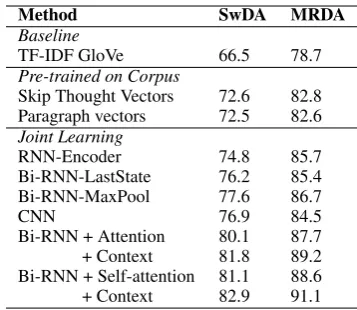
One of the primary motivations for this work was to investigate whether one can improve perfor-mance by learning better representations for utter-ances. To address this, we retrained our model by replacing the utterance representation learn-ing (utterance-level RNN + context-aware self-attention) component with various sentence rep-resentation learning methods (either pre-training them or learning jointly), and feeding them into the conversation-level recurrent layers in the hier-archical model, so that the performance is indica-tive of the quality of utterance representations.
There are three main categories of utterance representation learning approaches: (i) the base-line which uses a TF-IDF weighted sum of GloVe word embeddings; (ii) pre-trained on
[image:4.595.313.524.60.205.2]Method SwDA MRDA
Baseline
TF-IDF GloVe 66.5 78.7
Pre-trained on Corpus
Skip Thought Vectors 72.6 82.8
Paragraph vectors 72.5 82.6
Joint Learning
RNN-Encoder 74.8 85.7
Bi-RNN-LastState 76.2 85.4
Bi-RNN-MaxPool 77.6 86.7
CNN 76.9 84.5
Bi-RNN + Attention 80.1 87.7
+ Context 81.8 89.2
Bi-RNN + Self-attention 81.1 88.6
[image:5.595.90.269.60.215.2]+ Context 82.9 91.1
Table 4: Performance of utterance representation methods when integrated with the hierarchical model
pus, where we first learn utterance representa-tions on the corpus using Skip-Thought Vectors (Kiros et al.,2015) and Paragraph Vectors (Le and Mikolov,2014), and then use them with the rest of the model; (iii) jointly learned with the DA classi-fication task. Table4describes the performance of different utterance representation learning meth-ods when combined with the overall architecture on both datasets.
Introducing the word-level attention mecha-nism (Yang et al., 2016) enables the model to learn better representations by attending to more informative words in an utterance, result-ing in better performance (Bi-RNN + Attention). The self-attention mechanism (Bi-RNN + Self-attention) leads to even greater overall improve-ments. Adding context information (previous re-current state of the conversation) boosts perfor-mance significantly.
A notable aspect of our model is how contex-tual information is leveraged at different levels of the sequence modeling task. The combination of conversation-level contextual states for utterance-representation learning (+ Context) and a CRF at the conversation level to further inform conversa-tion sequence modeling, leads to a collective per-formance improvement. This is particularly pro-nounced on the SwDA dataset: the two variants of the context-aware attention models (Bi-RNN + Attention + Context and Bi-RNN + Self-attention + Context) have significant performance gains.
6 Conclusion
[image:5.595.316.516.61.178.2]We developed a model for DA classification with context-aware self-attention, which significantly outperforms earlier models on the commonly-used
Figure 2: Previous Label Entropy vs. Accuracy on the SwDA Dataset
Figure 3: Previous Label Entropy vs. Accuracy on the MRDA Dataset
SwDA dataset and is very close to state-of-the-art on MRDA. We experimented with different utter-ance representation learning methods and showed that utterance representations learned at the lower levels can impact the classification performance at the higher level. Employing self-attention, which has not previously been applied to this task, en-ables the model to learn richer, more effective ut-terance representations for the task.
As future work, we would like to experiment with other attention mechanisms such as multi-head attention (Vaswani et al., 2017), directional self-attention (Shen et al., 2018a), block self-attention (Shen et al., 2018b), or hierarchical at-tention (Yang et al., 2016), since they have been shown to address the limitations of vanilla atten-tion and self-attenatten-tion by either incorporating in-formation from different representation subspaces at different positions to capture both local and long-range context dependencies, encoding tem-poral order information, or by attending to context dependencies at different levels of granularity.
Acknowledgements
[image:5.595.317.518.226.329.2]References
Jeremy Ang, Yang Liu, and Elizabeth Shriberg. 2005.
Automatic dialog act segmentation and classifica-tion in multiparty meetings. In2005 IEEE Interna-tional Conference on Acoustics, Speech, and Signal Processing, ICASSP ’05, pages 1061–1064.
John Langshaw Austin. 1975. How to do things with words. Oxford university press.
Zheqian Chen, Rongqin Yang, Zhou Zhao, Deng Cai, and Xiaofei He. 2018. Dialogue act recognition via crf-attentive structured network. In The 41st In-ternational ACM SIGIR Conference on Research & Development in Information Retrieval, SIGIR ’18, pages 225–234. ACM.
Jason Chiu and Eric Nichols. 2016. Named entity recognition with bidirectional lstm-cnns. Transac-tions of the Association for Computational Linguis-tics, 4:357–370.
Yangfeng Ji, Gholamreza Haffari, and Jacob Eisen-stein. 2016. A latent variable recurrent neural net-work for discourse-driven language models. In Pro-ceedings of the 2016 Conference of the North Amer-ican Chapter of the Association for Computational Linguistics: Human Language Technologies, pages 332–342. Association for Computational Linguis-tics.
Dan Jurafsky, Liz Shriberg, and Debra Biasca. 1997.
Switchboard SWBD-DAMSL shallow-discourse-function annotation coders manual, draft 13. Tech-nical report, University of Colorado at Boulder Technical Report 97-02.
Nal Kalchbrenner and Phil Blunsom. 2013. Recurrent convolutional neural networks for discourse com-positionality. In Proceedings of the Workshop on Continuous Vector Space Models and their Compo-sitionality, pages 119–126. Association for Compu-tational Linguistics.
Hamed Khanpour, Nishitha Guntakandla, and Rod-ney Nielsen. 2016. Dialogue act classification in domain-independent conversations using a deep re-current neural network. InProceedings of COLING 2016, the 26th International Conference on Compu-tational Linguistics: Technical Papers, pages 2012– 2021. The COLING 2016 Organizing Committee.
Ryan Kiros, Yukun Zhu, Ruslan R Salakhutdinov, Richard Zemel, Raquel Urtasun, Antonio Torralba, and Sanja Fidler. 2015. Skip-thought vectors. In
Advances in Neural Information Processing Systems 28, pages 3294–3302.
Harshit Kumar, Arvind Agarwal, Riddhiman Dasgupta, and Sachindra Joshi. 2018. Dialogue act sequence labeling using hierarchical encoder with CRF. In
Proceedings of the Thirty-Second AAAI Conference on Artificial Intelligence, (AAAI-18), pages 3440– 3447.
Quoc V. Le and Tomas Mikolov. 2014.Distributed rep-resentations of sentences and documents. In Pro-ceedings of the 31th International Conference on Machine Learning, ICML 2014, pages 1188–1196.
Ji Young Lee and Franck Dernoncourt. 2016. Sequen-tial short-text classification with recurrent and con-volutional neural networks. InProceedings of the 2016 Conference of the North American Chapter of the Association for Computational Linguistics: Hu-man Language Technologies, pages 515–520. Asso-ciation for Computational Linguistics.
Ruizhe Li, Chenghua Lin, Matthew Collinson, Xiao Li, and Guanyi Chen. 2018. A dual-attention hierarchi-cal recurrent neural network for dialogue act classi-fication.CoRR, abs/1810.09154.
Wei Li and Yunfang Wu. 2016. Multi-level gated re-current neural network for dialog act classification. In Proceedings of COLING 2016, the 26th Inter-national Conference on Computational Linguistics: Technical Papers, pages 1970–1979. The COLING 2016 Organizing Committee.
Zhouhan Lin, Minwei Feng, Cicero Nogueira dos San-tos, Mo Yu, Bing Xiang, Bowen Zhou, and Yoshua Bengio. 2017. A structured self-attentive sentence embedding. InInternational Conference on Learn-ing Representations 2017 (Conference Track).
Yang Liu, Kun Han, Zhao Tan, and Yun Lei. 2017. Us-ing context information for dialog act classification in dnn framework. InProceedings of the 2017 Con-ference on Empirical Methods in Natural Language Processing, pages 2170–2178. Association for Com-putational Linguistics.
Xuezhe Ma and Eduard Hovy. 2016. End-to-end se-quence labeling via bi-directional lstm-cnns-crf. In
Proceedings of the 54th Annual Meeting of the As-sociation for Computational Linguistics (Volume 1: Long Papers), pages 1064–1074. Association for Computational Linguistics.
Daniel Ortega and Ngoc Thang Vu. 2017. Neural-based context representation learning for dialog act classification. In Proceedings of the 18th Annual SIGdial Meeting on Discourse and Dialogue, pages 247–252. Association for Computational Linguis-tics.
Jeffrey Pennington, Richard Socher, and Christopher Manning. 2014. Glove: Global vectors for word representation. In Proceedings of the 2014 Con-ference on Empirical Methods in Natural Language Processing (EMNLP), pages 1532–1543. Associa-tion for ComputaAssocia-tional Linguistics.
Technologies, Volume 1 (Long Papers), pages 2227– 2237. Association for Computational Linguistics.
Sujith Ravi and Zornitsa Kozareva. 2018. Self-governing neural networks for on-device short text classification. InProceedings of the 2018 Confer-ence on Empirical Methods in Natural Language Processing, pages 887–893. Association for Com-putational Linguistics.
John R Searle. 1969. Speech acts: An essay in the phi-losophy of language, volume 626. Cambridge uni-versity press.
Sheng-syun Shen and Hung-yi Lee. 2016. Neural at-tention models for sequence classification: Analysis and application to key term extraction and dialogue act detection. InINTERSPEECH 2016, 17th Annual Conference of the International Speech Communi-cation Association, pages 2716–2720.
Tao Shen, Tianyi Zhou, Guodong Long, Jing Jiang, Shirui Pan, and Chengqi Zhang. 2018a. Disan: Di-rectional self-attention network for rnn/cnn-free lan-guage understanding. InProceedings of the Thirty-Second AAAI Conference on Artificial Intelligence, (AAAI-18), the 30th innovative Applications of Arti-ficial Intelligence (IAAI-18), and the 8th AAAI Sym-posium on Educational Advances in Artificial Intel-ligence (EAAI-18), pages 5446–5455.
Tao Shen, Tianyi Zhou, Guodong Long, Jing Jiang, and Chengqi Zhang. 2018b. Bi-directional block self-attention for fast and memory-efficient sequence modeling. InInternational Conference on Learning Representations.
Andreas Stolcke, Noah Coccaro, Rebecca Bates, Paul Taylor, Carol Van Ess-Dykema, Klaus Ries, Eliza-beth Shriberg, Daniel Jurafsky, Rachel Martin, and Marie Meteer. 2000. Dialogue act modeling for au-tomatic tagging and recognition of conversational speech.Computational Linguistics, 26(3).
Dinoj Surendran and Gina-Anne Levow. 2006. Dialog act tagging with support vector machines and hid-den markov models. InINTERSPEECH 2006 - IC-SLP, Ninth International Conference on Spoken Lan-guage Processing.
Quan Hung Tran, Ingrid Zukerman, and Gholamreza Haffari. 2017. A hierarchical neural model for learn-ing sequences of dialogue acts. InProceedings of the 15th Conference of the European Chapter of the Association for Computational Linguistics: Vol-ume 1, Long Papers, pages 428–437. Association for Computational Linguistics.
Ashish Vaswani, Noam Shazeer, Niki Parmar, Jakob Uszkoreit, Llion Jones, Aidan N Gomez, Ł ukasz Kaiser, and Illia Polosukhin. 2017. Attention is all you need. InAdvances in Neural Information Pro-cessing Systems 30, pages 5998–6008. Curran Asso-ciates, Inc.
Yao Wan, Wenqiang Yan, Jianwei Gao, Zhou Zhao, Jian Wu, and Philip S. Yu. 2018. Improved dynamic memory network for dialogue act classification with adversarial training.CoRR, abs/1811.05021.
Zichao Yang, Diyi Yang, Chris Dyer, Xiaodong He, Alex Smola, and Eduard Hovy. 2016. Hierarchi-cal attention networks for document classification. InProceedings of the 2016 Conference of the North American Chapter of the Association for Compu-tational Linguistics: Human Language Technolo-gies, pages 1480–1489. Association for Computa-tional Linguistics.
Matthias Zimmermann. 2009. Joint segmentation and classification of dialog acts using conditional ran-dom fields. InINTERSPEECH 2009, 10th Annual Conference of the International Speech Communi-cation Association, pages 864–867.
A Supplementary Material
A.1 Training & Hyperparameters
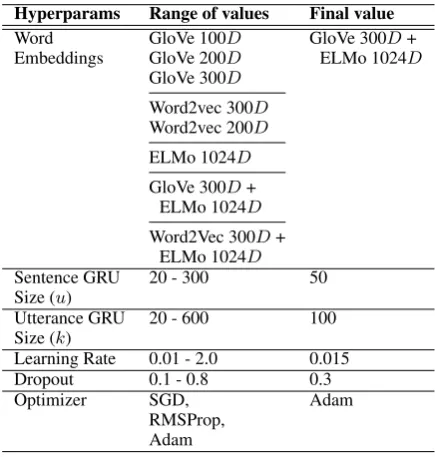
All hyperparameters were selected by tuning one hyperparameter at a time while keeping the oth-ers fixed. Validation splits were used for the tun-ing process. The final set of hyperparameters were then used to train two different models, one each on SwDA and MRDA training splits. Table5lists the range of values for each parameter that we ex-perimented with, and the final value that was cho-sen. Dropout was applied to the utterance embed-dings. Early stopping was used on the validation set with a patience of 15 epochs.
Hyperparams Range of values Final value
Word GloVe 100D GloVe 300D+
Embeddings GloVe 200D ELMo 1024D
GloVe 300D
Word2vec 300D
Word2vec 200D
ELMo 1024D
GloVe 300D+ ELMo 1024D
Word2Vec 300D+ ELMo 1024D
Sentence GRU 20 - 300 50
Size (u)
Utterance GRU 20 - 600 100
Size (k)
Learning Rate 0.01 - 2.0 0.015
Dropout 0.1 - 0.8 0.3
Optimizer SGD, Adam
[image:7.595.307.525.477.706.2]RMSProp, Adam