3384
CAN-NER: Convolutional Attention Network for
Chinese Named Entity Recognition
Yuying Zhu∗
Nankai University Tianjin, China
Guoxin Wang
Microsoft Research Asia Beijing, China
Abstract
Named entity recognition (NER) is a common task in Natural Language Processing (NLP), but it remains more challenging in Chinese be-cause of its lack of natural delimiters. There-fore, Chinese Word Segmentation (CWS) is usually necessary as the first step for Chi-nese NER. However, models based on word-level embeddings and lexicon features often suffer from segmentation errors and out-of-vocabulary (OOV) problems. In this paper, we investigate aConvolutionalAttentionNetwork (CAN) for Chinese NER, which consists of a character-based convolutional neural network (CNN) with local-attention layer and a gated recurrent unit (GRU) with global self-attention layer to capture the information from adjacent characters and sentence contexts. Moreover, differently from other approaches, CAN-NER does not depend on any external resources like lexicons and employing small-size char em-beddings makes CAN-NER more practical for real systems scenarios. Extensive experimen-tal results show that our approach outperforms state-of-the-art methods without word embed-ding and external lexicon resources on differ-ent domains datasets.
1 Introduction
Named Entity Recognition (NER) aims at identi-fying text spans which are associated with a spe-cific semantic entity type such as person (PER), organization (ORG), location (LOC), and geopo-litical entity (GPE). NER has received constant research attention as it is the first step in a wide range of downstream Natural Language Pro-cessing (NLP) tasks, e.g., entity linking (Gupta et al.,2017), relation extraction (Miwa and Bansal,
2016), event extraction (Chen et al.,2015), and co-reference resolution (Fragkou, 2017). The stan-dard approach in existing state-of-the-art models
∗
This work was performed when the first author was an intern at Microsoft Research Asia.
for English NER treats the problem as a word-by-word sequence labeling task and makes full use of the Recurrent Neural Network (RNN) and Condi-tional Random Field (CRF) to capture context in-formation at the word level (Lample et al.,2016;
Ma and Hovy,2016;Chiu and Nichols,2016;Liu et al.,2018). These models for English NER
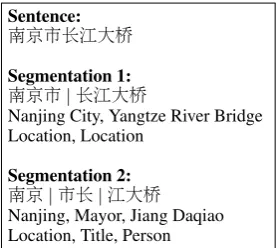
pre-Sentence: 南京市长江大桥
Segmentation 1: 南京市|长江大桥
Nanjing City, Yangtze River Bridge Location, Location
Segmentation 2: 南京|市长|江大桥
[image:1.595.347.486.309.433.2]Nanjing, Mayor, Jiang Daqiao Location, Title, Person
Figure 1: Entity Ambiguity with Word Segmentation.
dict a tag for each word assuming that words can be separated clearly by explicit word separators, e.g., blank spaces. As the Chinese language has no natural delimiters, it would be intuitive to ap-ply Chinese Word Segmentation (CWS) first to get word boundaries and then use a word-level se-quence labeling model similar to the English NER models. However, word boundaries can be am-biguous in Chinese, which leads to the possibility that entity boundaries do not match word bound-aries. For example, the term “西藏自治区
(Ti-bet Autonomous Region)” is a GPE-type entity in NER, but it could be segmented as a single word or as two words “西藏 (Tibet)” and “自
mistakenly detected in segmentation, it will neg-atively affect entity tagging in word-based NER models. Furthermore, most recent neural network-based Chinese NER models rely heavily on word-level embeddings and external lexicon sets (Huang et al., 2017;Zhang and Yang, 2018). The qual-ity of such models strongly relies on the differ-ent word embedding represdiffer-entations and lexicon features. Moreover, word-based models tend to suffer from OOV issues as Chinese words can be very diverse and named entities are an important source of OOV words. Other potential limitations are as follows: (1) Dependency on word embed-dings increases model size and makes the fine-tuning process more costly during training (while negatively affecting latency in testing/decoding); (2) It is hard to learn word representation correctly without enough labeled utterances for named enti-ties are usually rarer proper nouns. (3) Large lexi-cons are very costly for real NER systems as they greatly increase memory usage and latency in fea-ture extraction (matching), which makes models inefficient; (4) It is very costly to remove noise from large lexicons and any update to pre-trained word embeddings or lexicons requires model re-training. Meanwhile, character-level embedding by itself can only carry limited information due to losing word and word-sequence information. For instance, the character “拍” in words “球 拍” (bat) and “拍卖” (auction) has very different meanings. How to better integrate segmentation-related information and exploit local context in-formation is the key feature in a character-based model. Zhang and Yang(2018) leverage lexicons to add all the embeddings of candidate word seg-mentation to their last character embeddings as soft features, and construct a convolutional neural network (CNN) to encode characters as word-level information. Cao et al. (2018) propose a multi-task architecture to learn NER tagging and Chi-nese word segmentation together, with each part using a character-based Bi-LSTM. In this paper, we propose a convolutional attention layer to cap-ture the implicit relations within adjacent char-acters, in which the position features from word segmentation are soft hints for character combi-nations. With the segmentation vector softly con-catenating into character embedding, the convolu-tional attention layer is able to group implicitly meaning-related characters and help bypass the impact of segmentation errors. A BiGRU structure
with a global self-attention layer on the whole sen-tence is utilized to capture sensen-tence-level depen-dencies. Extensive experimental results show that our approach outperforms state-of-the-art methods without relying on external resources (e.g. word embedding, external lexicon) across different cor-pora. The main contributions of this paper can be summarized as follows:
• We first combine CNNs with the local-attention mechanism to enhance the abil-ity of the model to capture implicitly local context relations among character sequences. Compared with experimental results against a baseline with a regular CNN layer, our Con-volutional Attention layer leads to substantial performance improvements.
• We introduce a character-based Chinese NER model that consists of combined CNN with local attention and BiGRU with global self-attention layers. Our model achieves state-of-the-art F1-scores without using any exter-nal resources like word embeddings and lex-icon resources, which make it very practical for real-world NER systems.
2 Methodology
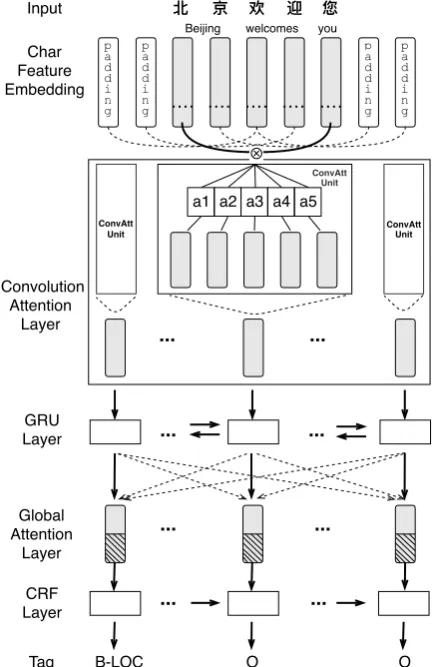
We utilize BiGRU-CRF as our basic model struc-ture. Our model considers multi-level context fea-tures in three layers: i) convolutional attention layer, ii) GRU layer, and iii) global attention layer. The whole architecture of our proposed model is illustrated in Figure2.
2.1 Formulation
In the Chinese NER task, we denote an in-put sentence as Xi = {xi,1, xi,2, xi,3, ..., xi,τ}, where xi,τ ∈ Rde represents the τ-th
char-acter in sentence Xi and de is the dimension of the input embeddings. Correspondingly, we denote the sentence label sequence as Yi =
Char Feature Embedding Input p a d d i n g p a d d i n g p a d d i n g p a d d i n g Convolution Attention Layer ... ... GRU Layer ... Global Attention Layer CRF Layer
北 京 欢 迎 您
Tag B-LOC O O
... ⊗
a1 a2 a3 a4 a5
ConvAtt Unit ConvAtt Unit ConvAtt Unit
Beijing welcomes you
[image:3.595.74.291.64.398.2]... ... ... ...
Figure 2: Overall model architecture. A convolutional attention layer is constructed to encode both character-and word-level information. The BiGRU-CRF layer is extended by a global self-attention layer to capture long sequential sentence-level relations.
2.2 Convolutional Attention Layer
The convolutional attention layer aims to encode the sequence of input characters and implicitly group meaning-related characters in the local con-text. The input representation for each character is constructed asx = [xch;xseg], wherexch ∈Rdch
and xseg ∈ Rdseg are character embedding and
segmentation mask, respectively. The segmen-tation information is encoded by BMES scheme (Wang and Xu,2017).
For every window in the CNN, whose window size is k, we first concatenate a position embed-ding to each character embedembed-ding, helping to keep sequential relations in the local window context. The dimension of the position embedding equals to the window size k with the initial values of 1 at the position where the character lies in the window and 0 at other positions. So, the di-mension of the concatenated embedding is de =
dch +dpos +dseg. We then apply local atten-tion inside the window to capture the relaatten-tions be-tween the center character and each context to-ken, followed by a CNN with sum-pooling layer. We set the hidden dimension asdh. For thej-th character, the local attention takes all the concate-nated embeddingsxj−k−1
2
, ...xj, ..., xj+k−1 2
in the window as its input and outputskhidden vectors hj−k−1
2 , ..., hj, ..., hj+ k−1
2 . The hidden vectors are calculated as follows:
hm =αmxm, (1)
wherem∈ {j−k−1
2 , ..., j+
k−1
2 }andαmis the
attention weight, which is calculated as:
αm=
exps(xj, xm) P
n∈{j−k−1 2 ,...,j+
k−1
2 }exps(xj, xn) . (2)
The score functionsis defined as follows:
s(xj, xk) =v>tanh(W1xj+W2xk), (3)
wherev∈RdhandW
1, W2 ∈Rdh,de.
The CNN layer containsdhkernels on a context window ofktokens as:
hcj =X k
[Wc∗hj−k−1 2 :j+
k−1 2
+bc], (4)
where Wc ∈
Rk×dh×de and bc ∈
Rk×dh. The
∗ operation denotes element-wise product and hj−k−1
2 :j+ k−1
2 means a concatenation of the hid-den states hj−k−1
2
, ..., hj+k−1 2
, both of which are calculated at the first dimension. Finally sum-pooling is also conducted on the first dimension.
2.3 BiGRU-CRF with Global Attention
After extracting the local context features by the convolutional attention layer, we feed them into a BiGRU-CRF based model to predict final label for each character. This layer models the sequential sentence information and it is calculated as fol-lows:
hrj =BiGRU(hrj−1, hcj;Wr, Ur), (5)
wherehcj is the output of the convolutional atten-tion layer,hrj−1is the previous hidden state for the BiGRU layer, andWr, Ur ∈ Rdh×dh are its pa-rameters.
A global self-attention layer is utilized to better handle sentence-level information, as:
hgj = n X
s=1
wherej = 1, ..., τ denotes all characters in a sen-tence instance andαgj,sis calculated as:
αgj,s= exps(h r j, hrs) P
n∈{1,...,τ}exps(hrj, hrn)
. (7)
The score functionsis similar to Equation3with different parameters vg ∈ Rdh and Wg
1, W
g
2 ∈ Rdh,dhinstead.
Finally, a standard CRF layer is used at the top of the concatenation of the output of the BiGRU and global attention layers, which is denoted as Hτ = [hrτ;h
g
τ]. Given the predicted tag sequence
Y = {y1, y2, y3, ..., yτ}, the probability of the ground-truth label sequence is computed by:
P(Y|X) = exp( P
i(W yi
CRFHi+b
(yi−1,yi) CRF ))
P y0exp(
P i(W
y0
i
CRFHi+b
(y0i−1,y0i)
CRF )) ,
(8) where y0 denotes an arbitrary label sequence,
Wyi
CRF andb
(yi−1,yi)
CRF are trainable parameters. In decoding, we use the Viterbi algorithm to get the predicted tag sequence.
2.4 Training
For training, we exploit log-likelihood objective as the loss function. Given a set of training examples
{(Xi,Yi)}|Ki=1, the loss functionLcan be defined
as follows:
L= K X
i=1
logP(Yi|Xi) (9)
In the training phase, at each iteration, we first shuffle all the training instances, and then feed them to the model with batch updates. We use the AdaDelta (Zeiler,2012) algorithm to optimize the final objective with all the parameters as described in Section3.1.
Dataset Type Train Test Dev
OntoNotes
Sentences 15.7k 4.3k 4.3k Chars 491.9k 208.1k 200.5k Entities 13.4k 7.7k 6.95k
MSRA
Sentences 46.4k 4.4k -Chars 2169.9k 172.6k -Entities 74.8k 6.2k
Sentences 1.4k 0.27k 0.27k Chars 73.8k 14.8k 14.5k Entities 1.89k 0.42k 0.39k
Resume
Sentences 3.8k 0.48k 0.46k Chars 124.1k 15.1k 13.9k Entities 1.34k 0.15k 0.16k
Table 1: Statistics of each dataset
3 Experiments
To demonstrate the effectiveness of our proposed model, we have run multiple experiments on Chi-nese NER datasets covering different domains. This section describes the details of each dataset, settings, and results in our experiments. Standard precision (P), recall (R) and F1-score (F1) are used as evaluation metrics.
3.1 Experimental Settings
DataWe use four datasets in our experiments. For the news domain, we experiment on OntoNotes 4 (Weischedel et al.,2011) and MSRA NER dataset from SIGHAN Bakeoff 2006 (Levow,2006). For the social media domain, we adopt the same an-notated Weibo corpus asPeng and Dredze(2015) which is extracted from Sina Weibo1. For more
variety in test domains, we also use a Chinese Re-sume dataset (Zhang and Yang, 2018) collected from Sina Finance2.
The Weibo dataset is annotated with four en-tity types: PER (Person), ORG (Organization), LOC (Location), and GPE (Geo-Political Entity); and it includes both named and nominal mentions. This corpus is already divided into training, de-velopment, and test sets. The Chinese Resume dataset is annotated with eight types of named en-tities: CONT (Country), EDU (Educational In-stitution), LOC, PER, ORG, PRO (Profession), RACE (Ethnicity/Background), and TITLE (Job Title). OntoNotes 4 is annotated with four named entity categories: PER, ORG, LOC, and GPE. We follow the same data split method of Che et al.
(2013) over OntoNotes 4. Lastly, the MSRA 2006 dataset contains three annotated named entities: ORG, PER and LOC. A development subset is
Models NE NM Overall Peng and Dredze(2015) 51.96 61.05 56.05
Peng and Dredze(2016)∗ 55.28 62.97 58.99
He and Sun(2017a) 50.60 59.32 54.82
He and Sun(2017b)∗ 54.50 62.17 58.23
Cao et al.(2018) 54.34 57.35 58.70
Zhang and Yang(2018) 53.04 62.25 58.79
Baseline 49.02 58.80 53.80
Baseline + CNN 53.86 58.05 55.91
CAN-NER Model 55.38 62.98 59.31
Table 2: Weibo NER results
1
http://www.weibo.com/
not available for the MSRA dataset. The detailed statistics of each datasets are shown in Table1.
Gold segmentation is unavailable for Weibo, Chinese Resume, and MSRA test sections. We follow Zhang and Yang (2018) to automatically segment these by using the model described in
Yang et al. (2017). We treat NER as a sequen-tial labeling problem and adopt the BIOES tagging style since it has been shown to produce better re-sults than straight BIO (Yang et al.,2018b).
Hyper-parameter settings For hyper-parameter configuration, we adjust them ac-cording to the performance on the described development sets for Chinese NER. We set the character embedding size, hidden sizes of CNN and BiGRU to 300 dims. After comparing experimental results with different CNN window sizes, we set the window size as 5. Adadelta is used for optimization, with an initial learning rate of 0.005. The character embeddings used in our experiments are from Li et al. (2018), which is trained by Skip-Gram with Negative Sampling (SGNS) on Baidu Encyclopedia.
3.2 Experimental Results
In this section, we describe the experimental re-sults of our proposed model and previous state-of-the-art methods on four datasets: Weibo, Chinese Resume, OntoNotes 4, and MSRA. We propose two baselines for comparison, and show the CAN-NER model results. In the experiment results ta-ble, we use Baseline to represent a pure BiGRU + CRF model; and Baseline + CNN to indicate the base model with a CNN layer.
3.2.1 Weibo Dataset
Here we compare our proposed model with the lat-est models on the Weibo dataset.3 Table2shows the F1-scores for named entities (NE), nominal en-tities (NM, excluding named enen-tities), and both (Overall). We observe that our proposed model achieves state-of-the-art performance.
Existing state-of-the-art systems include Peng and Dredze (2016), He and Sun (2017b), Cao et al. (2018) and Zhang and Yang(2018), which leverage rich external data like cross-domain data, semi-supervised data, and lexicons, or joint-train
3In Table2,3,4and5, we use∗to denote a model with external labeled data for semi-supervised learning.†denotes that the model use external lexicon data. Zhang and Yang (2018) with‡is the char-based model in the paper.
NER and Chinese Word Segmentation (CWS).4 In the first block of Table 2, we report the per-formance of the latest models. Peng and Dredze
(2015) propose a model that jointly trains em-beddings with NER and it achieves a F1-score of 56.05% on overall performance. The model (Peng and Dredze, 2016) that jointly trains NER and CWS reaches a F1-score of 58.99%. He and Sun
(2017b) propose a unified model to exploit cross-domain and semi-supervised data, which improves the F1-score from 54.82% to 58.23% compared with the model proposed byHe and Sun(2017a).
Cao et al.(2018) use an adversarial transfer learn-ing framework to incorporate task-shared word boundary information from CWS and achieves a F1-score of 58.70%. Zhang and Yang (2018) leverage a lattice structure to integrate lexicon in-formation into their model and achieve a F1-score of 58.79%.
In the second block of Table 2, we give the re-sults of our baselines and proposed models. While the BiGRU + CRF baseline only achieves a F1-score of 53.80%, adding a normal CNN layer as featurizer improves the score to 55.91%. Re-placing the CNN with our convolutional attention layer greatly improves the F1-score to 59.31%, which outperforms other models. The improve-ment demonstrates the effectiveness of our pro-posed model.
Models P R F1 Zhang and Yang(2018)1† 94.53 94.29 94.41
Zhang and Yang(2018)2‡ 94.07 94.42 94.24
Zhang and Yang(2018)3 94.81 94.11 94.46
Baseline 93.71 93.74 93.73
Baseline + CNN 94.36 94.85 94.60
[image:5.595.306.527.465.564.2]CAN-NER Model 95.05 94.82 94.94
Table 3: Results on Chinese Resume Dataset. For models proposed by Zhang and Yang (2018), 1 rep-resents the char-based LSTM model, 2 indicates the word-based LSTM model and3is the Lattice model.
3.2.2 Chinese Resume Dataset
The Chinese Resume test results are shown in Ta-ble 3. Zhang and Yang(2018) released the Chi-nese Resume dataset and they achieve a F1-score of 94.46%. It can be seen that our proposed baseline (CNN + BiGRU + CRF) outperforms
Zhang and Yang(2018) with F1-score of 94.60%.
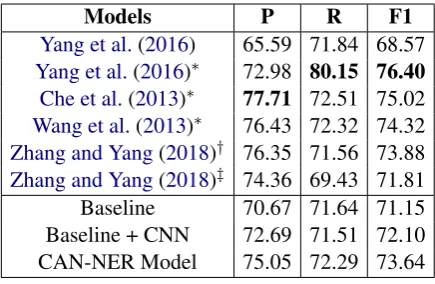
Models P R F1 Yang et al.(2016) 65.59 71.84 68.57
Yang et al.(2016)∗ 72.98 80.15 76.40 Che et al.(2013)∗ 77.71 72.51 75.02
Wang et al.(2013)∗ 76.43 72.32 74.32
Zhang and Yang(2018)† 76.35 71.56 73.88
Zhang and Yang(2018)‡ 74.36 69.43 71.81
Baseline 70.67 71.64 71.15
Baseline + CNN 72.69 71.51 72.10
[image:6.595.309.523.60.228.2]CAN-NER Model 75.05 72.29 73.64
Table 4: Results on OntoNotes
Adding our convolutional attention leads a fur-ther improvement and achieves state-of-the-art F1-score of 94.94%, which further demonstrates the effectiveness of our proposed model.
3.2.3 OntoNotes Dataset
Table 4 shows comparisons on the OntoNotes 4 dataset. The first block in the table lists the per-formance of previous methods for Chinese NER.
Yang et al. (2016) propose a model combining neural and discrete feature, e.g., POS tagging fea-tures, CWS features and orthographic feafea-tures, improving the F1-score from 68.57% to 76.40%. Leveraging bilingual data, Che et al. (2013) and
Wang et al.(2013) achieves F1-scores of 74.32% and 73.88% respectively.Zhang and Yang(2018)‡ is a recent model that uses a character-based model with bichar and softword.
The second block of Table 4shows the results of our baselines and proposed model. Consis-tently with observations on the Weibo and Resume datasets, our Convolutional Attention layer leads to a substantial increment on F1-score. Our pro-posed model achieves a competitive F1-score of 73.64% among character-based model without us-ing external data (e.g.,Zhang and Yang(2018)‡).
3.2.4 MSRA Dataset
Table 5 shows experiment results on the MSRA 2006 dataset. Chen et al. (2006), Zhang et al.
(2006), andZhou et al.(2013) leverage rich hand-crafted features andLu et al.(2016) exploit multi-prototype embedding features. Dong et al.(2016) introduce radical features into LSTM-CRF. Cao et al. (2018) make use of Adversarial Trans-fer Learning and global self-attention to improve model performance. Yang et al.(2018a) propose a character-based CNN-BiLSTM-CRF model to incorporate stroke embeddings and generate
n-Models P R F1 Chen et al.(2006) 91.22 81.71 86.20
Zhang et al.(2006)∗ 92.20 90.18 91.18
Zhou et al.(2013) 91.86 88.75 90.28
Lu et al.(2016) - - 87.94
Dong et al.(2016) 91.28 90.62 90.95
Cao et al.(2018) 91.30 89.58 90.64
Yang et al.(2018a) 92.04 91.31 91.67
Zhang and Yang(2018)† 93.57 92.79 93.18
Baseline 92.54 88.20 90.32
Baseline + CNN 92.57 92.11 92.34
CAN-NER Model 93.53 92.42 92.97
Table 5: Results on MSRA dataset
gram features. Zhang and Yang (2018) introduce a lattice structure to incorporate lexicon informa-tion into the neural network, which actually in-cludes word embedding information. Although this model achieves state-of-the-art F1-score at 93.18%, it leverages external lexicon data and thus the result is dependent on the quality of the lexi-con. At the bottom section of the table, we can see that Baseline + CNN already outperforms most previous methods. Compared with Zhang and Yang (2018), our char-based method achieves a competitive F1-score of 92.97% without any addi-tional lexicon data and word embedding informa-tion. Moreover, CAN-NER model achieves state-of-the-art result among the character-based mod-els.
3.3 Discussion
This section discusses the model effectiveness and the experimental results.
3.3.1 Effectiveness of Convolutional Attention and Global Self-Attention
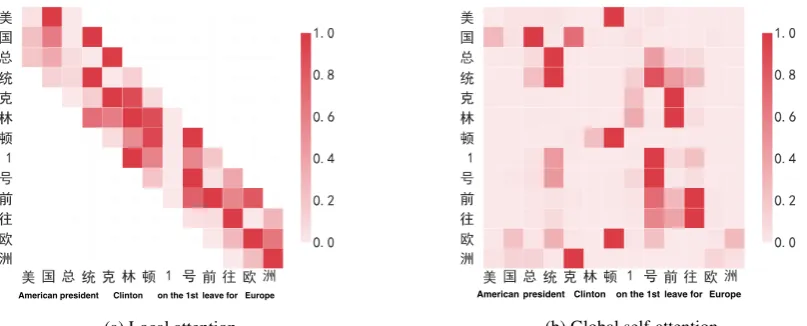
[image:6.595.72.290.61.203.2]American president Clinton on the 1st leave for Europe
(a) Local attention.
American president Clinton on the 1st leave for Europe
[image:7.595.99.503.80.243.2](b) Global self-attention.
Figure 3: Attention visualization. The left-side image shows the normalized Convolutional Attention weights in each window in a sentence. The right-side indicates the global self-attention weights for the whole sentence. In both pictures, the x-axis represents context, while the y-axis represents the input query in the attention mechanism.
its related character “国”, which means they have a higher probability of forming the Chinese word “美国 (American)”. Also for characters “克”, “林”, and “顿”, they tend to have a strong connec-tion because “克林顿” means “Clinton”. Charac-ters “欧” and “洲” also have strong connections, as seen in Figure 3a, because “欧洲” represents “Europe” in Chinese. Therefore, both experiment results and visualization verifies that the Convo-lutional Attention is effective in obtaining phrase-level information between adjacent characters.
In Figure 3b, we visualize the global self-attention matrix. From the picture, we can find that global self-attention can capture the sentence context information from the long-distance rela-tionship of words to overcome the limitation of Recurrent Neural Networks. For the word “克林
顿 (Clinton)”, the global self-attention learns the dependencies with “前往 (leave for)” and “1号 (on the 1st)”. Distinguished by the red color, “克
林顿 (Clinton)” has a stronger connection with “前往 (leave for)” than with “1号 (on the 1st)”, which matches the expectation that the predicate in a sentence provides more information to the subject than adverbs of time.
3.3.2 Results Analysis
Our proposed model outperforms previous work on th eWeibo and Chinese Resume datasets and reaches competitive results on both MSRA and OntoNotes 4 datasets without using any exter-nal resources. The experiments results demon-strate the effectiveness of our proposed model,
es-pecially among char-based models. The perfor-mance improvement after adding Convolutional Attention Layer and Global Attention Layer ver-ifies that our model can capture the relationship between character and its local context, as well as the relationship between word and global context. However, although we can obtain comparable or better results to other models that utilize no ex-ternal resources, we find that our model perfor-mance on the OntoNotes 4 dataset still has room for improvement (2.76% F1-score gap to the best model that leverages additional data). This may be explained by specific discrete features and exter-nal resources (e.g., other labeled data or lexicons) having a more positive influence on this specific dataset, while CAN-NER cannot learn enough in-formation from only the training set. However, we were not able to identify the precise contributors to the gap based on the available corresponding resources.
4 Related Work
4.1 Neural Network Models
word-level context information andLample et al.(2016) further introduced a hierarchy structure by incor-porating BiLSTM-based character embeddings. Multiple recent works integrating word-level in-formation and character-level inin-formation have been found to achieve improved performance (dos Santos et al.,2015;Chiu and Nichols, 2016; Ma and Hovy,2016;Lample et al.,2016;Chen et al.,
2019). Moreover, external knowledge has also been exploited for NER, as has character-level knowledge, both pre-trained (Peters et al., 2017) and co-trained (Liu et al.,2018). More recently, large-scale pre-trained language representations with deep language models have been proposed to help improve the performance of downstream NLP tasks. E.g., ELMo (Peters et al.,2018) and BERT (Devlin et al.,2018).
4.2 Attention Mechanism
Also, Attention Mechanisms have shown very good performance on a variety of tasks includ-ing machine translation, machine comprehension, and related NLP tasks (Vaswani et al.,2017;Seo et al.,2016;Tan et al.,2018a). In language under-standing,Shen et al. (2018) exploit self-attention to learn long range dependencies.Rei et al.(2016) proposed a model employing an attention mech-anism to combine the character-based represen-tation with the word embedding instead of sim-ply concatenating them. This method allows the model to dynamically decide which source of in-formation to use for each word, and therefore out-performing the concatenation method used in pre-vious work. More recently,Tan et al.(2018b) and
Cao et al.(2018) employ self-attention to directly capture the global dependencies of the inputs for NER tasks and demonstrate the effectiveness of self-attention in Chinese NER.
4.3 Chinese NER
Multiple previous efforts have tried to address the Chinese language challenge of not having explicit word boundaries. Traditional models depended on hand-crafted features and CRFs-based mod-els (He and Wang, 2008; Mao et al., 2008) and character-based LSTM-CRF models have been ap-plied to Chinese NER to utilize both character- and radical-level representations (Dong et al., 2016).
Peng and Dredze (2015) applied character posi-tional embeddings and proposed a jointly trained model for embeddings and NER. To better in-tegrate word boundary information into Chinese
NER model, Peng and Dredze (2016) co-trained NER and word segmentation to improve perfor-mance in both tasks. He and Sun (2017b) uni-fied cross-domain learning and semi-supervised learning to obtain information from out-of-domain corpora and in-domain unannotated text. In-stead of performing word segmentation first, Re-cently, Zhang and Yang (2018) proposed con-structing a word-character lattice by matching words in texts with a lexicon to avoid segmen-tation errors. Cao et al. (2018) use an adver-sarial network to jointly train Chinese NER task and Chinese Word Segmentation tasks to extract task-shared word boundary information. Also,
Yang et al.(2018c) leverage character-level BiL-STM to extract higher-level features from crowd-annotations.
5 Conclusion
In this paper, we propose CAN-NER, a Convolu-tional Attention Network model to improve Chi-nese NER performance and preclude word em-bedding and additional lexicon dependencies; thus making the model more efficient and robust. In our model, we implement local-attention CNN and Bi-GRU with the global self-attention structure to capture word-level features and context informa-tion with char-level features. Extensive experi-ments show that our model outperforms the state-of-art systems on the different domain datasets.
Acknowledgements
We’d like to thank our colleague B¨orje Karlsson for his contribution and support in this work, as well as thank our colleagues Haoyan Liu, Zijia Lin, and the anonymous reviewers for their valu-able feedback.
References
Pengfei Cao, Yubo Chen, Kang Liu, Jun Zhao, and Shengping Liu. 2018. Adversarial transfer learn-ing for chinese named entity recognition with self-attention mechanism. In Proceedings of the 2018 Conference on Empirical Methods in Natural Lan-guage Processing, pages 182–192.
Aitao Chen, Fuchun Peng, Roy Shan, and Gordon Sun. 2006. Chinese named entity recognition with con-ditional probabilistic models. InProceedings of the Fifth SIGHAN Workshop on Chinese Language Pro-cessing, pages 173–176.
Hui Chen, Zijia Lin, Guiguang Ding, Jianguang Lou, Yusen Zhang, and B¨orje F. Karlsson. 2019. GRN: Gated relation network to enhance convolutional neural network for named entity recognition. In Pro-ceedings of AAAI 2019.
Yubo Chen, Liheng Xu, Kang Liu, Daojian Zeng, and Jun Zhao. 2015. Event extraction via dy-namic multi-pooling convolutional neural networks. In Proceedings of the 53rd Annual Meeting of the Association for Computational Linguistics and the 7th International Joint Conference on Natural Lan-guage Processing, volume 1, pages 167–176.
Jason Chiu and Eric Nichols. 2016. Named entity recognition with bidirectional lstm-cnns. Transac-tions of the Association of Computational Linguis-tics, 4(1):357–370.
Ronan Collobert, Jason Weston, L´eon Bottou, Michael Karlen, Koray Kavukcuoglu, and Pavel Kuksa. 2011. Natural language processing (almost) from scratch. Journal of Machine Learning Research, 12(Aug):2493–2537.
Jacob Devlin, Ming-Wei Chang, Kenton Lee, and Kristina Toutanova. 2018. Bert: Pre-training of deep bidirectional transformers for language understand-ing. arXiv preprint arXiv:1810.04805.
Chuanhai Dong, Jiajun Zhang, Chengqing Zong, Masanori Hattori, and Hui Di. 2016. Character-based lstm-crf with radical-level features for chi-nese named entity recognition. InNatural Language Understanding and Intelligent Applications, pages 239–250. Springer.
Pavlina Fragkou. 2017. Applying named entity recog-nition and co-reference resolution for segmenting english texts. Progress in Artificial Intelligence, 6(4):325–346.
Nitish Gupta, Sameer Singh, and Dan Roth. 2017. En-tity linking via joint encoding of types, descriptions, and context. In Proceedings of the 2017 Confer-ence on Empirical Methods in Natural Language Processing, pages 2681–2690.
Hangfeng He and Xu Sun. 2017a. F-score driven max margin neural network for named entity recognition in chinese social media. InProceedings of the 15th Conference of the European Chapter of the Associa-tion for ComputaAssocia-tional Linguistics, volume 2, pages 713–718.
Hangfeng He and Xu Sun. 2017b. A unified model for cross-domain and semi-supervised named entity recognition in chinese social media. InAAAI Con-ference on Artificial Intelligence, pages 3216–3222.
Jingzhou He and Houfeng Wang. 2008. Chinese named entity recognition and word segmentation based on character. In Proceedings of the Sixth SIGHAN Workshop on Chinese Language Process-ing.
Shen Huang, Xu Sun, and Houfeng Wang. 2017. Ad-dressing domain adaptation for chinese word seg-mentation with global recurrent structure. In Pro-ceedings of the Eighth International Joint Confer-ence on Natural Language Processing, volume 1, pages 184–193.
Zhiheng Huang, Wei Xu, and Kai Yu. 2015. Bidirec-tional lstm-crf models for sequence tagging. arXiv preprint arXiv:1508.01991.
Guillaume Lample, Miguel Ballesteros, Sandeep Sub-ramanian, Kazuya Kawakami, and Chris Dyer. 2016. Neural architectures for named entity recognition. InProceedings of NAACL-HLT, pages 260–270.
Gina-Anne Levow. 2006. The third international chi-nese language processing bakeoff: Word segmen-tation and named entity recognition. In Proceed-ings of the Fifth SIGHAN Workshop on Chinese Lan-guage Processing, pages 108–117.
Shen Li, Zhe Zhao, Renfen Hu, Wensi Li, Tao Liu, and Xiaoyong Du. 2018. Analogical reasoning on chi-nese morphological and semantic relations. In Pro-ceedings of the 56th Annual Meeting of the Associa-tion for ComputaAssocia-tional Linguistics (Volume 2: Short Papers). Association for Computational Linguistics.
Liyuan Liu, Jingbo Shang, Xiang Ren, Frank Xu, Huan Gui, Jian Peng, and Jiawei Han. 2018. Empower sequence labeling with task-aware neural language model.
Yanan Lu, Yue Zhang, and Dong-Hong Ji. 2016. Multi-prototype chinese character embedding. InLREC.
Xuezhe Ma and Eduard Hovy. 2016. End-to-end se-quence labeling via bi-directional lstm-cnns-crf. In
Proceedings of the 54th Annual Meeting of the As-sociation for Computational Linguistics, volume 1, pages 1064–1074.
Xinnian Mao, Yuan Dong, Saike He, Sencheng Bao, and Haila Wang. 2008. Chinese word segmentation and named entity recognition based on conditional random fields. InProceedings of the Sixth SIGHAN Workshop on Chinese Language Processing.
Makoto Miwa and Mohit Bansal. 2016. End-to-end re-lation extraction using lstms on sequences and tree structures. InProceedings of the 54th Annual Meet-ing of the Association for Computational LMeet-inguis- Linguis-tics, volume 1, pages 1105–1116.
Nanyun Peng and Mark Dredze. 2016. Improving named entity recognition for chinese social media with word segmentation representation learning. In
The 54th Annual Meeting of the Association for Computational Linguistics, page 149.
Nanyun Peng and Mark Dredze. 2017. Supplementary results for named entity recognition on chinese so-cial media with an updated dataset. Technical re-port.
Matthew Peters, Waleed Ammar, Chandra Bhagavat-ula, and Russell Power. 2017. Semi-supervised se-quence tagging with bidirectional language models. InProceedings of the 55th Annual Meeting of the As-sociation for Computational Linguistics, volume 1, pages 1756–1765.
Matthew Peters, Mark Neumann, Mohit Iyyer, Matt Gardner, Christopher Clark, Kenton Lee, and Luke Zettlemoyer. 2018. Deep contextualized word repre-sentations. InProceedings of the 2018 Conference of the North American Chapter of the Association for Computational Linguistics: Human Language Technologies, volume 1, pages 2227–2237.
Marek Rei, Gamal Crichton, and Sampo Pyysalo. 2016. Attending to characters in neural sequence label-ing models. In Proceedings of COLING 2016, the 26th International Conference on Computational Linguistics: Technical Papers, pages 309–318.
Cıcero dos Santos, Victor Guimaraes, RJ Niter´oi, and Rio de Janeiro. 2015. Boosting named entity recog-nition with neural character embeddings. In Pro-ceedings of NEWS 2015 The Fifth Named Entities Workshop, page 25.
Minjoon Seo, Aniruddha Kembhavi, Ali Farhadi, and Hannaneh Hajishirzi. 2016. Bidirectional attention flow for machine comprehension. arXiv preprint arXiv:1611.01603.
Tao Shen, Tianyi Zhou, Guodong Long, Jing Jiang, Shirui Pan, and Chengqi Zhang. 2018. Disan: Di-rectional self-attention network for rnn/cnn-free lan-guage understanding. InThirty-Second AAAI Con-ference on Artificial Intelligence.
Zhixing Tan, Mingxuan Wang, Jun Xie, Yidong Chen, and Xiaodong Shi. 2018a. Deep semantic role la-beling with self-attention. InAAAI Conference on Artificial Intelligence.
Zhixing Tan, Mingxuan Wang, Jun Xie, Yidong Chen, and Xiaodong Shi. 2018b. Deep semantic role la-beling with self-attention. InAAAI Conference on Artificial Intelligence.
Ashish Vaswani, Noam Shazeer, Niki Parmar, Jakob Uszkoreit, Llion Jones, Aidan N Gomez, Łukasz Kaiser, and Illia Polosukhin. 2017. Attention is all you need. InAdvances in Neural Information Pro-cessing Systems, pages 5998–6008.
Chunqi Wang and Bo Xu. 2017. Convolutional neu-ral network with word embeddings for chinese word segmentation. InProceedings of the Eighth Interna-tional Joint Conference on Natural Language Pro-cessing, volume 1, pages 163–172.
Mengqiu Wang, Wanxiang Che, and Christopher D Manning. 2013. Effective bilingual constraints for semi-supervised learning of named entity recogniz-ers. InAAAI Conference on Artificial Intelligence.
Ralph Weischedel, Sameer Pradhan, Lance Ramshaw, Martha Palmer, Nianwen Xue, Mitchell Marcus, Ann Taylor, Craig Greenberg, Eduard Hovy, Robert Belvin, et al. 2011. Ontonotes release 4.0.
LDC2011T03, Philadelphia, Penn.: Linguistic Data Consortium.
Fan Yang, Jianhu Zhang, Gongshen Liu, Jie Zhou, Cheng Zhou, and Huanrong Sun. 2018a. Five-stroke based cnn-birnn-crf network for chinese named en-tity recognition. In CCF International Conference on Natural Language Processing and Chinese Com-puting, pages 184–195. Springer.
Jie Yang, Shuailong Liang, and Yue Zhang. 2018b. Design challenges and misconceptions in neural se-quence labeling. In Proceedings of the 27th Inter-national Conference on Computational Linguistics, pages 3879–3889.
Jie Yang, Zhiyang Teng, Meishan Zhang, and Yue Zhang. 2016. Combining discrete and neural fea-tures for sequence labeling. In CICLing.
Jie Yang, Yue Zhang, and Fei Dong. 2017. Neural word segmentation with rich pretraining. In Pro-ceedings of the 55th Annual Meeting of the Associa-tion for ComputaAssocia-tional Linguistics, volume 1, pages 839–849.
YaoSheng Yang, Meishan Zhang, Wenliang Chen, Wei Zhang, Haofen Wang, and Min Zhang. 2018c. Ad-versarial learning for chinese ner from crowd an-notations. In AAAI Conference on Artificial Intel-ligence.
Matthew D Zeiler. 2012. Adadelta: an adaptive learn-ing rate method.arXiv preprint arXiv:1212.5701.
Suxiang Zhang, Ying Qin, Juan Wen, and Xiaojie Wang. 2006. Word segmentation and named entity recognition for sighan bakeoff3. InProceedings of the Fifth SIGHAN Workshop on Chinese Language Processing, pages 158–161.
Yue Zhang and Jie Yang. 2018. Chinese ner using lat-tice lstm. InProceedings of the 56th Annual Meet-ing of the Association for Computational LMeet-inguis- Linguis-tics, volume 1, pages 1554–1564.