Proceedings of NAACL-HLT 2019, pages 3949–3954 3949
Understanding the Behaviour of Neural Abstractive Summarizers using
Contrastive Examples
Krtin Kumar
School of Computer Science McGill University
Jackie Chi Kit Cheung
School of Computer Science McGill University
Abstract
Neural abstractive summarizers generate sum-mary texts using a language model condi-tioned on the input source text, and have recently achieved high ROUGE scores on benchmark summarization datasets. We inves-tigate how they achieve this performance with respect to human-written gold-standard ab-stracts, and whether the systems are able to un-derstand deeper syntactic and semantic struc-tures. We generate a set of contrastive sum-maries which are perturbed, deficient versions of human-written summaries, and test whether existing neural summarizers score them more highly than the human-written summaries. We analyze their performance on different datasets and find that these systems fail to understand the source text, in a majority of the cases.
1 Introduction
Open-domain abstractive summarization is a long-standing goal of the field of automatic summariza-tion. Compared to extractive techniques, abstrac-tion offers the potential to generate much more useful summaries by simplifying and rephrasing the source text (Knight and Marcu, 2002), and furthermore by aggregating information and per-forming operations which are not possible with extractive techniques (Genest and Lapalme,2012;
Carenini and Cheung,2008).
Recently, a number of abstractive summa-rization systems based on neural sequence-to-sequence architectures have been proposed (Rush et al., 2015; Nallapati et al., 2016; See et al.,
2017;Paulus et al.,2018;Chen and Bansal,2018). These systems learn a compressed representation of the source text using an encoder, then generate the output summary using a conditional decoder. Such neural abstractive systems have achieved very good ROUGE scores on different datasets.
Source
A former Iraqi army chief of staff being investigated in denmark for war crimes is believed to be back inIraq, one of his sons said Tuesday.
Contrastive 1
Iraqi general missingindenmark believed to be backfrom Iraq.
Contrastive 2
Iraqi general missing fromIraqbelieved to be back in Iraq.
Table 1: Examples of generated contrastive summaries. Bold indicate switched words
.
Our interest in this paper is to investigate how these abstractive systems achieve such results, and whether they represent progress towards language understanding and generation. ROUGE arguably provides a limited view of the performance of such systems, as they only relate the system summary to a fixed number of gold-standard summaries. We propose a novel method to directly test the abstrac-tive summarizers in terms of how they score po-tential candidate summaries, viewing them as con-ditional language models. This allows us to test whether the summarizers favour output summaries with specific desired qualities, such as generating a summary that is semantically consistent and en-tailed by the source text.
We test how well the neural abstractive sum-marizers distinguish human-written abstracts from contrastive distractors, which are clearly incorrect summaries that are generated using a rule-based procedure. Table 1 shows contrastive examples which are clearly incorrect1. In majority of source texts, we are able to find a contrastive example that scores more highly than the gold-standard sum-mary.
1
Our work demonstrates the difficulty of control-ling expressive neural abstractive systems to pro-duce correct and fluent output. It also underscores the need to revisit fundamental issues in summa-rization evaluation for neural abstractive models, so that a comprehensive evaluation scheme that captures all relevant aspects of summary quality can be developed. Our code for generating con-trastive summaries is available online.2
2 Related Work
Most work in neural abstractive summarization has focused on optimizing ROUGE, whether im-plicitly by maximum likelihood training or explic-itly by reinforcement learning. While this could certainly capture aspects of the content selection problem, we believe that the focus should now shift towards semantic correctness and readability.
Cao et al. (2018) took a step in this direction through their fact-aware neural abstractive sum-marization system. They use fact descriptions of the source as additional features for the summa-rizer, and showed improved faithfulness accord-ing to human judgments. Multi-task learnaccord-ing is another approach used byPasunuru et al. (2017) to reduce semantic errors in the generated sum-maries. They jointly learn summarization and en-tailment generation tasks, using different encoders but a shared decoder.
A number of automatic evaluation metrics have shown high correlation with human judges (Liu and Liu, 2008;Graham, 2015), but these results are either restricted to extractive systems or were performed with respect to human-generated sum-maries. Correlation values are significantly re-duced when performed on abstractive summariza-tion systems and datasets (Toutanova et al.,2016).
3 Generating Contrastive Summaries
In this section, we describe our method for eval-uating summarization systems based on whether they can separate human-written gold summaries from automatically generated contrastive sum-maries. We define a contrastive summary to be similar to a gold summary, except it contains a perturbation. The perturbation results in either a semantic discrepancy, where facts in source and summary do not corroborate, or a readability is-sue, where issues with grammar or fluency renders
2https://github.com/krtin/
ContrastiveSummaries
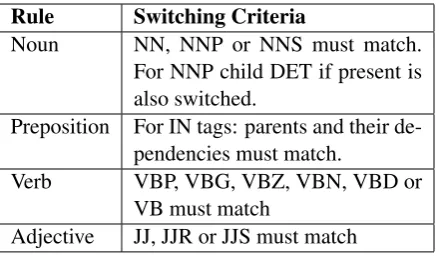
Rule Switching Criteria
Noun NN, NNP or NNS must match.
For NNP child DET if present is also switched.
Preposition For IN tags: parents and their de-pendencies must match.
Verb VBP, VBG, VBZ, VBN, VBD or
VB must match
[image:2.595.308.528.61.189.2]Adjective JJ, JJR or JJS must match
Table 2: Rules for selecting words to switch when gen-erating the contrastive summaries. The tags are as per the Penn Tree-bank (Santorini,1990).
the summary clearly incorrect. Below, we first de-scribe our basic method of introducing these dis-crepancies, then describe a number of restrictions we apply to ensure that the generated contrastive summaries are of high quality.
Perturbation by switching words. Given pairs of source texts and gold summaries, we gener-ate multiple contrastive summaries for each source text by perturbing its associated gold summary. There are many types of possible perturbations, but we focus on two strategies: 1) switching words within a gold summary, and 2) replacing a word in gold summary by a word from the source text. We chose these types of perturbations as they are likely to result in “difficult” contrastive summaries that contain words which are likely to appear in a reasonable summary of the source text, but which are nevertheless incorrect.
In order to select the words to be swapped, we apply four rules, separated by syntactic category, as shown in Table2, using the dependency parse of the texts (Manning et al.,2014). We switch words either within a gold summary, or from the source text and use a single rule at a time for generating a contrastive summary. For example, if the POS tagNNSis matched between a word‘sides’in the source text and the word‘combatants’in the gold summary, then the Noun rule would apply, and the words would be switched to obtain the contrastive summary.
Further restrictions. We place a number of re-strictions on the words switched, to ensure that the generated summary is contrastive compared to the gold summary. We do not allow switching of the same words. We also do not allow words to be switched if they are separated by any of the fol-lowing: ‘or’,‘and’or‘,’, as these are likely to be commutative operators.
Furthermore, we only allow switching of words from the source text if the context of the words to be switched sufficiently differ from each other. We compute unigram overlap around a context win-dow of size 2 on each side, and allow a switch when the overlap proportion is less than 0.65. These settings were determined by manual inspec-tion of the generated summaries, and allowed us to reduce the number of examples where generated summary is not contrastive, without significantly reducing the number of generated summaries.
We will describe the results of a human verifi-cation study in Section5, in which we ask human raters to check the quality of our contrastive sum-maries.
4 Evaluation
We apply our set of contrastive summaries to eval-uate a number of neural abstractive summarizers. For each summarizer under evaluation, we assume access to a conditional language model which de-fines a probability distribution over words condi-tioned on the source. Formally, such a language model is given by Equation1:
P(yi|θ,S, y1...yi−1), (1)
hereS is the source,θare model parameters,yi∈ Vsmrepresents theithword in the summary,Vsm is the vocabulary space of the summary and P is the conditional probability.S ⊆(s1, ..., sn)where si∈Vso,Vsois the vocabulary space of the source andnis the maximum source length. Further, we use Equation2as our scoring function,
p(y) =
m
X
i=1
logP(yi|θ,S, y1...yi−1), (2)
here m is maximum summary length and y rep-resents a gold or contrastive summary. For a given triple of source, gold (g) and contrastive (c) summary, if p(g) > p(c), then we label the triple‘dodged’, since the summarizer successfully dodged the generated contrastive summary. If a
system is able to dodge all contrastive summaries generated from a source and gold summary tuple, then we label the tuple as‘escaped’.
5 Experiments
Datasets. We experimented on two datasets, for two abstractive summarization tasks. The first is a short summarization task, where the sum-mary is one sentence long, for which we use the Gigaword corpus (Graff et al., 2011; Napoles et al., 2012). We use the scripts provided by
Rush et al.(2015) to process the Gigaword corpus, which contains the first sentence of the article and the headline as source and gold summary pairs. The test set contains about 250K source-summary pairs from which we randomly selected 10K pairs and generated 509K contrastive summaries.
The second is a long summarization task, in which the summary consists of multiple sentences. We use the CNN/Dailymail corpus, where the highlights of the articles are used as the gold sum-mary (Hermann et al.,2015). We used the scripts fromNallapati et al.(2016) to get the data and use the non-anonymized version likeSee et al.(2017). We use 11.49K test pairs and were able to generate 563K contrastive summaries.
Models. We analyze and evaluate three state-of-the-art neural abstractive summarization sys-tems: ABS+ (Rush et al.,2015), GTP (See et al.,
2017) and FAS (Chen and Bansal, 2018). The ABS+system uses an attention-based neural lan-guage model as an encoder and a feed-forward neural network for decoding, and is trained on the Gigaword corpus. The GTP system is a seq2seq model with attention on the encoder and a pointer-generator mechanism to choose words from the source in the decoder and, is trained on the CNN/Dailymail corpus. FAS uses reinforce-ment learning algorithm to extract the most impor-tant sentences from the source text, and then sum-marizes each sentence using a similar architecture as GTP on the CNN/Dailymail corpus.
These systems have performed well on small and large text summarization tasks, and have open-source implementation available from the authors. We would have liked to test other relevant systems (Pasunuru et al.,2017;Cao et al.,2018), but were unable to obtain their implementations.
Rule Dodged (%)
CNN Gigaword
GTP FAS ABS+
Gold
Noun 98.8 96.5 49.5
Prep 97.8 96.9 55.4
Verb 99.0 98.5 48.7
Adj 97.8 95.6 55.7
Sour
ce
Noun 94.3 88.5 47.9
Prep 92.0 88.2 50.1
Verb 94.9 91.9 50.2
[image:4.595.89.276.61.212.2]Adj 92.6 87.2 49.7
Table 3: Rule-wise Performance, here Source and Gold are based upon rule perturbations in Section3
contrastive summaries is very large. To restrict the number of contrastive summaries we randomly select approximately 50 generated summaries, while maintaining the rule-wise distribution. The rule-wise distribution was estimated based upon contrastive summaries, generated from a subset of 100 gold standard summaries from CNN/Dailymail corpus.
In order to correctly evaluate the FAS system, for each extracted sentence we generate all sen-tences in the gold summary, and pick the set of summaries with the maximum probability.
Human verification. To ensure that we are gen-erating incorrect contrastive summaries, 200 ran-domly sampled summaries from the Gigaword corpus were evaluated by a human annotator, to verify if a semantic discrepancy or a readability issue was present. We ensured that we sample equally across all the 8 rules, and that we restrict our set of contrastive summaries which the ABS+ system was not able to ‘dodge’. We found that 49.5% had a readability issue while 43.5% had a discrepancy issue, and 93% of the examples had at least one of these issues. This indicates that the vast majority of our contrastive examples are “true negatives”; i.e., a perfect summarization system should score them lower than the gold standard summary.
6 Results
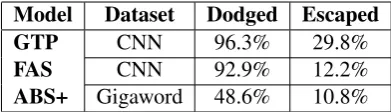
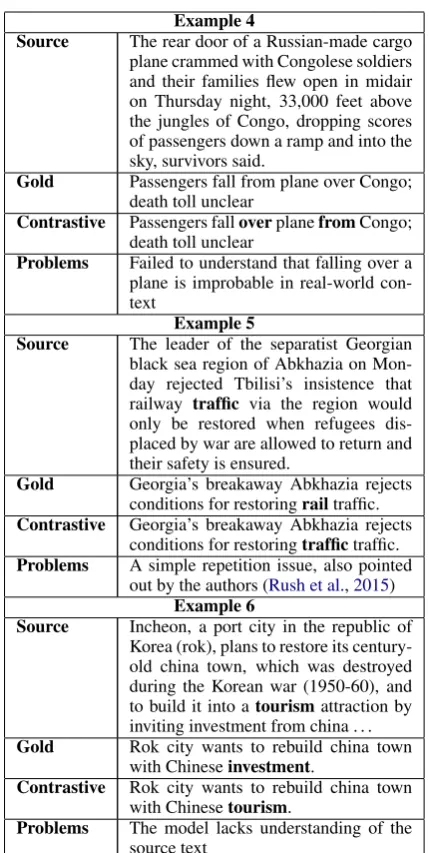
We summarize our results in Table 4, and report rule-wise results in Table 3. We also include ex-amples where the ABS+ system is unsuccessful in dodging the generated contrastive summaries, in Table 5. Since these metrics directly evaluate the posterior distribution of a summarizer, it
al-Model Dataset Dodged Escaped
GTP CNN 96.3% 29.8%
FAS CNN 92.9% 12.2%
[image:4.595.318.514.62.118.2]ABS+ Gigaword 48.6% 10.8%
Table 4: Performance ondodged,escapedmetrics.
1 4 8 12 15 17 21 0
4 8 20 25 30 42
Rank of Gold Summary
Percentage
of
Gold
Summaries
GTP (CNN) ABS+ (Gigaword)
FAS (CNN)
Figure 1: Distribution of Gold Summary Rank
lows us to explicitly recognize problematic exam-ples for a model. We also look at what percent-age of gold summaries lie across different ranks of gold summaries in Figure1. This gives us an insight into distribution of gold summaries, across different ranks. The rank of a gold summary is 1 plus the number of contrastive summaries that scored higher than it.
Dodged and Escaped. On the CNN/Dailymail dataset, we find both the models were able to dodge most of the contrastive summaries, but a large number of summaries had at least a few con-trastive summaries which scored higher than the gold summary, as reflected by theescapedmetric. The FAS model performs worse than GTP model, this might be because the abstraction model only observes one sentence, and thus the probability of observing a word outside the source sentence is higher for the contrastive summaries.
[image:4.595.326.503.159.309.2]towards biases towards particular distributions and can be helpful in further improving these models.
Rank of Gold Summary. As shown in Figure
1, almost all the gold summaries have rank lower than 8 for the GTP model, while a large percent-age of gold summaries have rank greater than 20, for the ABS+ model. The maximum rank in both the cases is of the order 500K, which is the size of contrastive summaries (Section5). We suspect that this might be due to behaviourally extractive nature of GTP model, which allows it to easily dis-tinguish any perturbations in the contrastive sum-maries.
7 Conclusion
We proposed to analyze existing neural abstractive summarizers by testing how they score contrastive summaries, compared to gold-standard ones. For the majority of the gold-standard summaries, we were able to find contrastive examples which score more highly according to current state-of-the-art systems. These examples can be useful not only in evaluating the performance of these systems, but also for improving these systems in the future.
References
Ziqiang Cao, Furu Wei, Wenjie Li, and Sujian Li. 2018. Faithful to the original: Fact aware neural abstrac-tive summarization.
Giuseppe Carenini and Jackie Chi Kit Cheung. 2008. Extractive vs. nlg-based abstractive summarization of evaluative text: The effect of corpus controver-siality. In Proceedings of the Fifth International Natural Language Generation Conference, pages 33–41. Association for Computational Linguistics.
Yen-Chun Chen and Mohit Bansal. 2018. Fast abstrac-tive summarization with reinforce-selected sentence rewriting. InProceedings of ACL.
Albert Gatt and Ehud Reiter. 2009. Simplenlg: A re-alisation engine for practical applications. In Pro-ceedings of the 12th European Workshop on Natural Language Generation, pages 90–93. Association for Computational Linguistics.
Pierre-Etienne Genest and Guy Lapalme. 2012. Fully abstractive approach to guided summarization. In
Proceedings of the 50th Annual Meeting of the Association for Computational Linguistics: Short Papers-Volume 2, pages 354–358. Association for Computational Linguistics.
David Graff, Junbo Kong, Ke Chen, and Kazuaki Maeda. 2011. English gigaword, linguistic data con-sortium.
Yvette Graham. 2015. Re-evaluating automatic sum-marization with BLEU and 192 shades of ROUGE. InProceedings of the 2015 conference on empirical methods in natural language processing, pages 128– 137.
Karl Moritz Hermann, Tomas Kocisky, Edward Grefenstette, Lasse Espeholt, Will Kay, Mustafa Su-leyman, and Phil Blunsom. 2015. Teaching ma-chines to read and comprehend. InAdvances in Neu-ral Information Processing Systems, pages 1693– 1701.
Robin Jia and Percy Liang. 2017. Adversarial exam-ples for evaluating reading comprehension systems. In Proceedings of the 2017 Conference on Empiri-cal Methods in Natural Language Processing, pages 2021–2031.
Kevin Knight and Daniel Marcu. 2002. Summariza-tion beyond sentence extracSummariza-tion: A probabilistic ap-proach to sentence compression. Artificial Intelli-gence, 139(1):91–107.
Feifan Liu and Yang Liu. 2008. Correlation between rouge and human evaluation of extractive meeting summaries. InProceedings of the 46th annual meet-ing of the association for computational lmeet-inguis- linguis-tics on human language technologies: Short papers, pages 201–204. Association for Computational Lin-guistics.
Christopher D. Manning, Mihai Surdeanu, John Bauer, Jenny Finkel, Steven J. Bethard, and David Mc-Closky. 2014. The Stanford CoreNLP natural lan-guage processing toolkit. InAssociation for Compu-tational Linguistics (ACL) System Demonstrations, pages 55–60.
Ramesh Nallapati, Bowen Zhou, Cicero dos Santos, Caglar Gulcehre, and Bing Xiang. 2016. Ab-stractive text summarization using sequence-to-sequence rnns and beyond. InProceedings of The 20th SIGNLL Conference on Computational Natural Language Learning, pages 280–290. Association for Computational Linguistics.
Courtney Napoles, Matthew Gormley, and Benjamin Van Durme. 2012. Annotated gigaword. In Pro-ceedings of the Joint Workshop on Automatic Knowl-edge Base Construction and Web-scale KnowlKnowl-edge Extraction, pages 95–100. Association for Compu-tational Linguistics.
Ramakanth Pasunuru, Han Guo, and Mohit Bansal. 2017. Towards improving abstractive summariza-tion via entailment generasummariza-tion. In Proceedings of the Workshop on New Frontiers in Summarization, pages 27–32. Association for Computational Lin-guistics.
Alexander M. Rush, Sumit Chopra, and Jason Weston. 2015. A neural attention model for abstractive sen-tence summarization. In Proceedings of the 2015 Conference on Empirical Methods in Natural Lan-guage Processing, pages 379–389, Lisbon, Portugal. Association for Computational Linguistics.
Beatrice Santorini. 1990. Part-of-speech tagging guidelines for the penn treebank project (3rd revi-sion).Technical Reports (CIS), page 570.
Abigail See, Peter J. Liu, and Christopher D. Man-ning. 2017. Get to the point: Summarization with pointer-generator networks. In (See et al., 2017), pages 1073–1083.
Kristina Toutanova, Chris Brockett, Ke M. Tran, and Saleema Amershi. 2016. A dataset and evaluation metrics for abstractive compression of sentences and short paragraphs. InProceedings of the 2016 Con-ference on Empirical Methods in Natural Language Processing, pages 340–350, Austin, Texas. Associa-tion for ComputaAssocia-tional Linguistics.
A Appendices
Example 1
Source The Asian economic contagion that contributed overnight to the year’s worst loss on wall street returned home with the opening of trading Wednesday, helping to drag some markets to lev-els they hadn’t seen for months, if not years.
Gold Asian markets fall after big drop on wall street.
Contrastive Asian markets fall after big drop on street wall.
Problems The system failed to understand that wall street has real-world significance
Example 2
Source Panama’s colon duty free area, latin america’s biggest re-export zone, ground to a halt monday as business leaders shut their doors to protest a tax hike.
Gold Business leaders launch strike in Panama’s free zone by James.
Contrastive Business strike launch leaders in Panama’s free zone by James.
Problems Failed to understand that business lead-ers belong to a single entity
Example 3
Source Iran stood firm on its position towards terrorism and the middle east peace pro-cess in talks with an EU mission here . . .
Gold Iran refuses to budge on terrorism, peace process in talks with EU by Lau-rent.
Contrastive Iran refuses to budge on terrorism, peace processbytalks with EUin Lau-rent.
Problems Improper usage and understanding of Prepositions
Example 4
Source The rear door of a Russian-made cargo plane crammed with Congolese soldiers and their families flew open in midair on Thursday night, 33,000 feet above the jungles of Congo, dropping scores of passengers down a ramp and into the sky, survivors said.
Gold Passengers fall from plane over Congo; death toll unclear
Contrastive Passengers falloverplanefromCongo; death toll unclear
Problems Failed to understand that falling over a plane is improbable in real-world con-text
Example 5
Source The leader of the separatist Georgian black sea region of Abkhazia on Mon-day rejected Tbilisi’s insistence that railway traffic via the region would only be restored when refugees dis-placed by war are allowed to return and their safety is ensured.
Gold Georgia’s breakaway Abkhazia rejects conditions for restoringrailtraffic. Contrastive Georgia’s breakaway Abkhazia rejects
conditions for restoringtraffictraffic. Problems A simple repetition issue, also pointed
out by the authors (Rush et al.,2015) Example 6
Source Incheon, a port city in the republic of Korea (rok), plans to restore its century-old china town, which was destroyed during the Korean war (1950-60), and to build it into atourismattraction by inviting investment from china . . . Gold Rok city wants to rebuild china town
with Chineseinvestment.
Contrastive Rok city wants to rebuild china town with Chinesetourism.
[image:6.595.309.524.57.484.2]Problems The model lacks understanding of the source text
Table 5: Examples of contrastive summaries, that ABS+ system was not able to dodge. Bold indicate switched words