Improving Word Alignment with Bridge Languages
Shankar Kumar and Franz Och and Wolfgang Macherey Google Inc.
1600 Amphitheatre Parkway Mountain View, CA 94043, U.S.A.
{shankarkumar,och,wmach}@google.com
Abstract
We describe an approach to improve Statistical Machine Translation (SMT) performance using multi-lingual, parallel, sentence-aligned corpora in several bridge languages. Our approach consists of a sim-ple method for utilizing a bridge language to create a word alignment system and a proce-dure for combining word alignment systems from multiple bridge languages. The final translation is obtained by consensus de-coding that combines hypotheses obtained using all bridge language word alignments. We present experiments showing that mul-tilingual, parallel text in Spanish, French, Russian, and Chinese can be utilized in this framework to improve translation performance on an Arabic-to-English task.
1 Introduction
Word Alignment of parallel texts forms a cru-cial component of phrase-based statistical machine translation systems. High quality word alignments can yield more accurate phrase-pairs which improve quality of a phrase-based SMT system (Och and Ney, 2003; Fraser and Marcu, 2006b).
Much of the recent work in word alignment has focussed on improving the word alignment quality through better modeling (Och and Ney, 2003; Deng and Byrne, 2005; Martin et al., 2005) or alternative approaches to training (Fraser and Marcu, 2006b; Moore, 2005; Ittycheriah and Roukos, 2005). In this paper we explore a complementary approach to
improve word alignments using multi-lingual, par-allel (or multi-parpar-allel) corpora. Two works in the literature are very relevant to our approach. Borin (2000) describes a non-statistical approach where a pivot alignment is used to combine direct translation and indirect translation via a third language. Filali and Bilmes (2005) present a multi-lingual extension to the IBM/HMM models. Our current approach dif-fers from this latter work in that we propose a sim-ple framework to combine word alignments from any underlying statistical alignment model without the need for changing the structure of the model. While both of the above papers focus on improv-ing word alignment quality, we demonstrate that our approach can yield improvements in transla-tion performance. In particular, we aim to improve an Arabic-to-English (Ar-En) system using multi-parallel data from Spanish (Es), French (Fr), Rus-sian (Ru) and Chinese (Zh). The parallel data in these languagesX ∈ {Es, F r, Ru, Zh} is used to generate word alignments between Arabic-X and X-English. These alignments are then combined to obtain multiple word alignments for Arabic-English and the final translation systems.
The motivation for this approach is two-fold. First, we believe that parallel corpora available in several languages provide a better training ma-terial for SMT systems relative to bilingual cor-pora. Such multi-lingual parallel corpora are be-coming widely available; examples include proceed-ings of the United Nations in six languages (UN, 2006), European Parliament (EU, 2005; Koehn, 2003), JRC Acquis corpus (EU, 2007) and religious texts (Resnik et al., 1997). Word alignment systems
trained on different language-pairs (e.g. French-English versus Russian-French-English) make errors which are somewhat orthogonal. In such cases, incorrect alignment links between a sentence-pair can be cor-rected when a translation in a third language is avail-able. Thus it can help resolve errors in word align-ment. We combine word alignments using several bridge languages with the aim of correcting some of the alignment errors. The second advantage of this approach is that the word alignment from each bridge language can be utilized to build a phrase-based SMT system. This provides a diverse collec-tion of translacollec-tion hypotheses for MT system com-bination (Bangalore et al., 2002; Sim et al., 2007; Matusov et al., 2006; Macherey and Och, 2007). Fi-nally, a side benefit of this paper is that it provides a study that compares alignment qualities and BLEU scores for models in different languages trained on parallel text which is held identical across all lan-guages.
We show that parallel corpora in multiple lan-guages can be exploited to improve the translation performance of a phrase-based translation system. This paper gives specific recipes for using a bridge language to construct a word alignment and for com-bining word alignments produced by multiple statis-tical alignment models.
The rest of this paper is organized as follows: Sec-tion 2 gives an overview of our framework for gen-erating word alignments in a single language-pair. In Section 3, we describe how a bridge language may be used for producing word alignments. In Sec-tion 4, we describe a scheme to combine word align-ments from several bridge languages. Section 5 de-scribes our experimental setup and reports the align-ment and translation performance. A final discus-sion is presented in Section 6.
2 Word Alignment Framework
A statistical translation model (Brown et al., 1993; Och and Ney, 2003) describes the relationship be-tween a pair of sentences in the source and target languages (f = f1J,e = eI1) using a translation probabilityP(f|e). Alignment models introduce a hidden alignment variablea=aJ1 to specify a map-ping between source and target words; aj = i
in-dicates that thejth source word is linked to theith
target word. Alignment models assign a probabil-ity P(f,a|e) to the source sentence and alignment conditioned on the target sentence. The transla-tion probability is related to the alignment model as: P(f|e) =P
aPθ(f,a|e), whereθis a set of
param-eters.
Given a sentence-pair (f,e), the most likely (Viterbi) word alignment is found as (Brown et al., 1993): aˆ = argmaxaP(f,a|e). An alternate cri-terion is the Maximum A-Posteriori (MAP) frame-work (Ge, 2004; Matusov et al., 2004). We use a refinement of this technique.
Given any word alignment model, posterior prob-abilities can be computed as (Brown et al., 1993)
P(aj =i|e,f) =
X
a
P(a|f,e)δ(i, aj), (1)
where i ∈ {0,1, ..., I}. The assignment aj = 0
corresponds to the NULL (empty) alignment. These posterior probabilities form a matrix of size(I+1)×
J, where entries along each column sum to one. The MAP alignment for each source positionj∈ {1,2, ..., J}is then computed as
aM AP(j) = argmax i
P(aj =i|e,f). (2)
We note that these posterior probabilities can be computed efficiently for some alignment models such as the HMM (Vogel et al., 1996; Och and Ney, 2003), Models 1 and 2 (Brown et al., 1993).
In the next two sections, we describe how poste-rior probabilities can be used to a) construct align-ment systems from a bridge language, and b) merge several alignment systems.
3 Constructing Word Alignment Using a Bridge Language
We assume here that we have triples of sentences that are translations of each other in languages F, E, and the bridge language G: f = f1J,e = eI1,g =
gK1 . Our goal is to obtain posterior probability es-timates for the sentence-pair in FE:(f,e)using the posterior probability estimates for the sentence pairs in FG:(f,g)and GE:(g,e). The word alignments between the above sentence-pairs are referred to as
aF E,aF G, andaGE respectively; the notationaF E
We first express the posterior probability as a sum over all possible translations g in G and hidden alignmentsaF G.
P(aF Ej =i|e,f)
= X
g
P(aF Ej =i,g|e,f)
= X
g,k
P(aF Ej =i,g, aF Gj =k|e,f)
= X
g,k
n
P(g|e,f)P(aF Gj =k|g,e,f)
×P(aF Ej =i|ajF G=k,g,e,f)o (3)
We now make some assumptions to simplify the above expression. First, there is exactly one trans-lationg in bridge language G corresponding to the sentence-pairf,e. Since aGEaF G
j
= i= aF Ej , we can express
P(aF Ej =i|aF Gj =k,g,f,e) =P(aGEk =i|g,e). Finally, alignments in FG do not depend on E.
Under these assumptions, we arrive at the final ex-pression for the posterior probability FE in terms of posterior probabilities for GF and EG
P(aF Ej =i|e,f) = (4)
K
X
k=0
P(aF Gj =k|g,f)P(aGEk =i|g,e)
The above expression states that the posterior prob-ability matrix for FE can be obtained using asimple matrix multiplication of posterior probability ma-trices for GE and FG. In this multiplication, we prepend a column to the GE matrix corresponding tok= 0. This probabilityP(aGEk =i)whenk= 0
is not assigned by the alignment model; we set it as follows
P(aGEk =i|k= 0) =
(
i= 0
1−
I i∈ {1,2, ..., I}
The parametercontrols the number of empty align-ments; a higher value favors more empty alignments and vice versa. In our experiments, we set= 0.5.
4 Word Alignment Combination Using Posterior Probabilities
We next show how Word Alignment Posterior Prob-abilities can be used for combining multiple word
alignment systems. In our context, we use this pro-cedure to combine word alignments produced using multiple bridge languages.
Suppose we have translations in bridge languages G1, G2, ..., GN, we can generate a posterior
prob-ability matrix for FE using each of the bridge lan-guages. In addition, we can always generate a poste-rior probability matrix for FE with the FE alignment model directly without using any bridge language. TheseN+ 1posterior matrices can be combined as follows. Here, the variableB indicates the bridge language. B ∈ {G0, G1, ..., GN};G0 indicates the
case when no bridge language is used.
P(aF Ej =i|e,f) (5)
=
N
X
l=0
P(B=Gl, aF Ej =i|e,f)
=
N
X
l=0
P(B=Gl)P(ajF E =i|Gl,e,f),
whereP(aF Ej =i|Gl, j,e,f)is the posterior
proba-bility when bridge languageB =Gl. The
probabili-tiesP(B=Gl)sum to one overl∈ {0,1,2, ..., N}
and represent the prior probability of bridge lan-guagel. In our experiments, we use a uniform prior P(B =Gl) = N1+1. Equation 5 provides us a way
to combine word alignment posterior probabilites from multiple bridge languages. In our alignment framework (Section 2), we first interpolate the pos-terior probability matrices (Equation 5) and then ex-tract the MAP word alignment (Equation 2) from the resulting matrix.
5 Experiments
We now present experiments to demonstrate the ad-vantages of using bridge languages. Our experi-ments are performed in the open data track of the NIST Arabic-to-English (A-E) machine translation task1.
5.1 Training and Test Data
Our approach to word alignment (Section 3) requires aligned sentences in multiple languages. For train-ing alignment models, we use the ODS United
Na-1
Set # of Ar words (K) # of sentences
dev1 48.6 2007
dev2 11.4 498
test 37.8 1610
[image:4.612.375.477.57.132.2]blind 36.5 1797
Table 1: Statistics for the test data.
tions parallel data (UN, 2006) which contains par-liamentary documents from 1993 onwards in all six official languages of the UN: Arabic (Ar), Chinese (Zh), English (En), French (Fr), Russian (Ru), and Spanish (Es).
We merge the NIST 2001-2005 Arabic-English evaluation sets into a pool and randomly sam-ple this collection to create two development sets (dev1,dev2) and a test set (test) with 2007, 498, and 1610 sentences respectively. Our blind test (blind) set is the NIST part of the NIST 06 evaluation set consisting of 1797 sentences. The GALE portion of the 06 evaluation set is not used in this paper. We re-port results on the test and blind sets. Some statistics computed on the test data are shown in Table 1.
5.2 Alignment Model Training
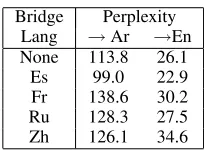
For training Arabic-English alignment models, we use Chinese, French, Russian and Spanish as bridge languages. We train a model for Ar-En and 4 mod-els each for Ar-X and X-En, where X is the bridge language. To obtain aligned sentences in these lan-guage pairs, we train 9 sentence aligners. We then train alignment models for all 9 language-pairs us-ing a recipe consistus-ing of 6 Model-1 iterations and 6 HMM iterations. Finally, Word Alignment Poste-rior Probabilities are generated over the bitext. In Table 2, we report the perplexities of the alignment models for the translation directions where either Arabic or English is predicted. There are 55M Ara-bic tokens and 58M English tokens. We observe that the alignment model using Spanish achieves the lowest perplexity; this value is even lower than the perplexity of the direct Arabic-English model. Per-plexity is related to the hardness of the word align-ment; the results suggest that bridge languages such as Spanish make alignment task easier while others do not. We stress that perplexity is not related to the alignment or the translation performance.
[image:4.612.100.270.59.111.2]Bridge Perplexity Lang →Ar →En None 113.8 26.1 Es 99.0 22.9 Fr 138.6 30.2 Ru 128.3 27.5 Zh 126.1 34.6
Table 2: Perplexities of the alignment models.
5.3 Bridge Language Word Alignments
Each of the 4 bridge languages is utilized for con-structing a word alignment for Arabic-English. Us-ing each bridge language X, we obtain Arabic-English word alignments in both translation direc-tions (AE and EA). The posterior matrix for AE is obtained using AX and XE matrices while the EA matrix is obtained from EX and XA matrices (Equa-tion 4). The AE (EA) matrices from the bridge languages are then interpolated with the AE (EA) matrix obtained from the alignment model trained directly on Arabic-English (Section 4). The MAP word alignment for AE (EA) direction is computed from the AE (EA) matrix. We next outline how these word alignments are utilized in building a phrase-based SMT system.
5.4 Phrase-based SMT system
Our phrase-based SMT system is similar to the alignment template system described in Och and Ney (2004). We first extract an inventory of phrase-pairs up to length 7 from the union of AE and EA word alignments. Various feature functions (Och and Ney, 2004) are then computed over the entries in the phrase table. 5-gram word language models in English are trained on a variety of monolingual corpora (Brants et al., 2007). Minimum Error Rate Training (MERT) (Och, 2003) under BLEU crite-rion is used to estimate 20 feature function weights over the larger development set (dev1).
Bridge Metrics(%)
Language AE EA
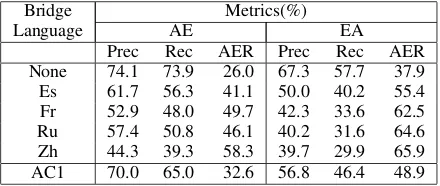
[image:5.612.76.296.60.153.2]Prec Rec AER Prec Rec AER None 74.1 73.9 26.0 67.3 57.7 37.9 Es 61.7 56.3 41.1 50.0 40.2 55.4 Fr 52.9 48.0 49.7 42.3 33.6 62.5 Ru 57.4 50.8 46.1 40.2 31.6 64.6 Zh 44.3 39.3 58.3 39.7 29.9 65.9 AC1 70.0 65.0 32.6 56.8 46.4 48.9
Table 3: Alignment Performance with Bridge Lan-guages
5.5 Alignment Results
We first report alignment performance (Table 3) of the alignment models obtained using the bridge lan-guages. Alignment results are reported in terms of Precision (Prec), Recall (Rec) and Alignment Error Rate (AER). We report these numbers on a 94-sentence test set with translations in all six languages and human word alignments in Arabic-English. Our human word alignments do not dis-tinguish betweenSureandProbablelinks (Och and Ney, 2003).
In these experiments, we first identify the com-mon subset of sentences which have translations in all six languages. Each of the 9 alignment models is then trained on this subset. We report Alignment performance in both translation directions: Arabic-to-English (AE) and English-to-Arabic (EA). The first row (None) gives the results when no bridge language is used.
Among the bridge languages, Spanish gives the best alignment for Arabic-English while Chinese re-sults in the worst. This might be related to how dif-ferent the bridge language is relative to either En-glish or Arabic. The last row (AC1) shows the per-formance of the alignment obtained by combining None/Es/Fr/Ru/Zh alignments. This alignment out-performs all bridge alignments but is weaker than the alignment without any bridge language. Our hypothesis is that a good choice of interpolation weights (Equation 5) would reduce AER of the AC1 combination. However, we did not investigate these choices in this paper. We report alignment error rates here to give the readers an idea of the vastly differ-ent alignmdiffer-ent performance using each of the bridge languages.
5.6 Translation Results
We now report translation performance of our tech-niques. We measure performance using the NIST implementation of case sensitive BLEU-4 on true-cased translations. We observed in experiments not reported here that results are almost identical with/without Minimum Error Rate Training ; we therefore report the results without the training. We note that the blind set is the NIST subset of the 2006 NIST evaluation set. The systems reported here are for the Unlimited Data Track in Arabic-to-English and obtain competitive performance relative to the results reported on the NIST official results page2
We present three sets of experiments. In Table 4, we describe the first set where all 9 alignment mod-els are trained on nearly the same set of sentences (1.9M sentences, 57.5M words in English). This makes the alignment models in all bridge languages comparable. In the first row marked None, we do not use a bridge language. Instead, an Ar-En alignment model is trained directly on the set of sentence pairs. The next four rows give the performance of align-ment models trained using the bridge languages Es, Fr, Ru and Zh respectively. For each language, we use the procedure (Section 3) to obtain the posterior probability matrix for English from Arabic-X and Arabic-X-English matrices. The row AC1 refers to alignment combination using interpolation of poste-rior probabilities described in Section 4. We com-bine posterior probability matrices from the systems in the first four rows: None, Es, Ru and Zh. We exclude the Zh system from the AC1 combination because it is found to degrade the translation perfor-mance by 0.2 points on the test set.
In the final six rows of Table 4, we show the per-formance of a consensus decoding technique that produces a single output hypothesis by combin-ing translation hypotheses from multiple systems; this is an MBR-like candidate selection procedure based on BLEU correlation matrices and is de-scribed in Macherey and Och (2007). We first report performance of the consensus output by combining None systems with/without MERT. Each of the fol-lowing rows provides the results from consensus de-coding for adding an extra system both with/without MERT. Thus, the final row (TC1) combines
transla-2
tions from 12 systems: None, Es, Fr, Ru, Zh, AC1 with/without MERT. All entries marked with an as-terisk are better than the None baseline with 95% statistical significance computed using paired boot-strap resampling (Koehn, 2004).
35 40 45 50 55 60 65 70 37
37.5 38 38.5 39 39.5 40 40.5
None
Es
Fr
Ru
Zh
AC1
100−AER(%)
[image:6.612.96.274.144.282.2]BLEU(%)
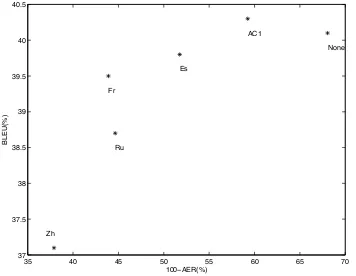
Figure 1: 100-AER (%) vs. BLEU(%) on the blind set for 6 systems from Table 3.
Figure 1 shows the plot between 100-AER% (av-erage of EA/AE directions) and BLEU for the six systems in Table 3. We observe that AER is loosely correlated to BLEU (ρ = 0.81) though the re-lation is weak, as observed earlier by Fraser and Marcu (2006a). Among the bridge languages, Span-ish gives the lowest AER/highest BLEU while Chi-nese results in highest AER/lowest BLEU. We can conclude that Spanish is closest to Arabic/English while Chinese is the farthest. All the bridge lan-guages yield lower BLEU/higher AER relative to the No-Bridge baseline. Therefore, our estimate of the posterior probability (Equation 4) is always worse than the posterior probability obtained using a di-rect model. The alignment combination (AC1) be-haves differently from other bridge systems in that it gives a higher AER and a higher BLEU relative to None baseline. We hypothesize that AC1 is differ-ent from the bridge language systems since it arises from a different process: interpolation with the di-rect model (None).
Both system combination techniques give im-provements relative to None baseline: alignment combination AC1 gives a small gain (0.2 points) while the consensus translation TC1 results in a larger improvement (0.8 points). The last 4 rows of the table show that the performance of the
hy-pothesis consensus steadily increases as systems get added to the None baseline. This shows that while bridge language systems are weaker than the di-rect model, they can provide complementary sources of evidence. To further validate this hypothesis, we compute inter-system BLEU scores between None/es and all the systems in Table 5. We observe that the baseline (None) is very dissimilar from the rest of the systems. We hypothesize that the baseline system has an alignment derived from a real align-ment model while the rest of the bridge systems are derived using matrix multiplication. The low inter-system BLEU scores show that the bridge inter-systems provide diverse hypotheses relative to the baseline and therefore contribute to gains in consensus de-coding.
Bridge Lang # Msents BLEU (%) test blind
None 1.9 52.1 40.1
Es 1.9 51.7 39.8
Fr 1.9 51.2 39.5
Ru 1.9 50.4 38.7
Zh 1.9 48.4 37.1
AC1 1.9 52.1 40.3
Hypothesis Consensus
None 1.9 51.9 39.8
+Es 1.9 52.2 40.0
[image:6.612.342.513.288.441.2]+Fr 1.9 52.4∗ 40.5∗ +Ru 1.9 52.8∗ 40.7∗ +Zh 1.9 52.6∗ 40.6∗ +AC1 = TC1 1.9 53.0∗ 40.9∗
Table 4: Translation Experiments for Set 1; Results are reported on the test and blind set: (NIST portion of 2006 NIST eval set).
Ref None es fr ru zh AC1
None 100.0 60.0 59.8 59.7 59.5 58.7 es 59.6 100.0 79.9 69.3 67.4 70.5
Table 5: Inter-system BLEU scores (%) between None/es and all systems in Table 3.
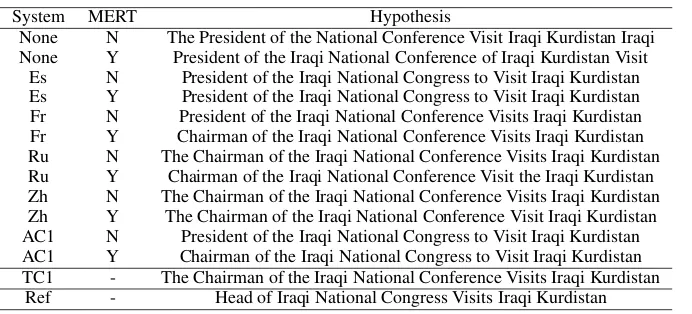
To gain some insight about how the bridge sys-tems help in Table 4, we present an example in Ta-ble 6. The example shows the consensus Transla-tions and the 12 input translaTransla-tions for the consensus decoding. The example suggests that the inputs to the consensus decoding exhibit diversity.
avail-System MERT Hypothesis
None N The President of the National Conference Visit Iraqi Kurdistan Iraqi None Y President of the Iraqi National Conference of Iraqi Kurdistan Visit
Es N President of the Iraqi National Congress to Visit Iraqi Kurdistan Es Y President of the Iraqi National Congress to Visit Iraqi Kurdistan Fr N President of the Iraqi National Conference Visits Iraqi Kurdistan Fr Y Chairman of the Iraqi National Conference Visits Iraqi Kurdistan Ru N The Chairman of the Iraqi National Conference Visits Iraqi Kurdistan Ru Y Chairman of the Iraqi National Conference Visit the Iraqi Kurdistan Zh N The Chairman of the Iraqi National Conference Visits Iraqi Kurdistan Zh Y The Chairman of the Iraqi National Conference Visit Iraqi Kurdistan AC1 N President of the Iraqi National Congress to Visit Iraqi Kurdistan AC1 Y Chairman of the Iraqi National Congress to Visit Iraqi Kurdistan TC1 - The Chairman of the Iraqi National Conference Visits Iraqi Kurdistan
[image:7.612.138.484.67.224.2]Ref - Head of Iraqi National Congress Visits Iraqi Kurdistan
Table 6: An example showing the Consensus Translation (TC1) and the 12 inputs for consensus decoding. The final row shows the reference translation.
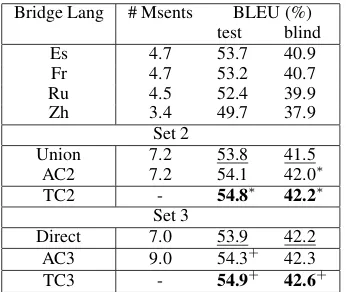
able in Ar, En and X. In Set 2, the first row (Union) is an alignment model trained on all sentence-pairs in Ar-En which are available in at least one bridge language X. AC2 refers to alignment combination using bridge languages Es/Fr/Ru and Union. TC2 refers to the translation combination from 12 sys-tems: Es/Fr/Ru/Zh/Union/AC2 with/without Mini-mum Error Rate training. Finally, the goal in Set 3 (last 3 rows) is to improve the best Arabic-English system that can be built using all available sen-tence pairs from the UN corpus. The first row (Direct) gives the performance of this Ar-En sys-tem; AC3 refers to alignment combination using Es/Fr/Ru and Direct. TC3 merges translations from Es/Fr/Ru/Zh/Direct/AC3. All entries marked with an asterisk (plus) are better than the Union (Direct) baseline with 95% statistical significance computed using paired bootstrap resampling (Koehn, 2004).
The motivation behind Sets 2 and 3 is to train all bridge language systems on as much bitext as possi-ble. As a consequence, these systems give better re-sults than the corresponding systems in Table 4. The Union system outperforms None by 1.7/1.4 BLEU points and provides a better baseline. We show un-der this scenario that system combination techniques AC2 and TC2 can still give smaller improvements (0.3/0.5 and 1.0/0.7 points) relative to this baseline.
As mentioned earlier, our approach requires sentence-aligned corpora. In our experiments, we use a single sentence aligner for each language pair (total of 9 aligners). Since these aligners make inde-pendent decisions on sentence boundaries, we end
up with a smaller pool of sentences (1.9M) that is common across all language pairs. In contrast, a sentence aligner that makes simultaneous decisions in multiple languages would result in a larger set of common sentence pairs (close to 7M sentence pairs). Simard (1999) describes a sentence aligner of this type that improves alignment on a trilingual paral-lel text. Since we do not currently have access to such an aligner, we simulate that situation with Sets 2 and 3: AC2/AC3 do not insist that a sentence-pair be present in all input word alignments. We note that Set 2 is a data scenario that falls between Sets 1 and 3.
Set 3 provides the best baseline for Arabic-English based on the UN data by training on all parallel sentence-pairs. In this situation, sys-tem combination with bridge languages (AC3/TC3) gives reasonable improvements in BLEU on the test set (0.4/1.0 points) but only modest improvements (0.1/0.4 points) on the blind set. However, this does show that the bridge systems continue to provide or-thogonal evidence at different operating points.
6 Discussion
in-Bridge Lang # Msents BLEU (%) test blind
Es 4.7 53.7 40.9
Fr 4.7 53.2 40.7
Ru 4.5 52.4 39.9
Zh 3.4 49.7 37.9
Set 2
Union 7.2 53.8 41.5
AC2 7.2 54.1 42.0∗
TC2 - 54.8∗ 42.2∗
Set 3
Direct 7.0 53.9 42.2
AC3 9.0 54.3+ 42.3
[image:8.612.100.273.59.205.2]TC3 - 54.9+ 42.6+
Table 7: Translation performance for Sets 2 and 3 on test and blind:NIST portion of 2006 NIST eval set.
terpolating posterior probability matrices from dif-ferent sources. In our case, these sources are multi-ple bridge languages. However, this method is more generally applicable for combining posterior matri-ces from different alignment models such as HMM and Model-4. Such an approach contrasts with the log-linear HMM/Model-4 combination proposed by Och and Ney (2003).
There has been recent work by Ayan and Dorr (2006) on combining word alignments from differ-ent alignmdiffer-ent systems; this paper describes a maxi-mum entropy framework for this combination. Their approach operates at the level of the alignment links and uses maximum entropy to decide whether or not to include an alignment link in the final out-put. In contrast, we use posterior probabilities as the interface between different alignment models. An-other difference is that this maxent framework re-quires human word aligned data for training feature weights. We do not require any human word aligned data to train our combiner.
Another advantage of our approach is that it is based on word alignment posterior probability ma-trices that can be generated by any underlying align-ment model. Therefore, this method can be used to combine word alignments generated by fairly dis-similar word alignment systems as long as the sys-tems can produce posterior probabilities.
Bridge languages have been used by NLP re-searchers as a means to induce translation lexicons between distant languages without the need for par-allel corpora (Schafer and Yarowsky, 2002; Mann and Yarowsky, 2001). Our current approach differs
from these efforts in that we use bridge languages to improve word alignment quality between sentence pairs. Furthermore, we do not use linguistic insight to identify bridge languages. In our framework, a good bridge language is one that provides the best translation performance using the posterior matrix multiplication. Our experiments show that Spanish is a better bridge language relative to Chinese for Arabic-to-English translation. We speculate that if our approach was carried out on a data set with hun-dreds of languages, we might be able to automati-cally identify language families.
A downside of our approach is the requirement for exact sentence-aligned parallel data. Except for a few corpora such as UN, European Parliament etc, such a resource is hard to find. One solution is to cre-ate such parallel data by automatic translation and then retaining reliable translations by using confi-dence metrics (Ueffing and Ney, 2005).
Our approach to using bridge languages is ex-tremely simple. Despite its simplicity, the system combination gives improvements in alignment and translation performance. In future work, we will consider several extensions to this framework that lead to more powerful system combination strategies using multiple bridge languages. We recall that the present approach trains bridge systems (e.g. Arabic-to-French, French-to-English) until the alignment stage and then uses these for constructing Arabic-to-English word alignment. An alternate scenario would be to build phrase-based SMT systems for Arabic-to-Spanish and Spanish-to-English, and then obtain Arabic-to-English translation by first trans-lating from Arabic into Spanish and then Spanish into English. Such end-to-end bridge systems may lead to an even more diverse pool of hypotheses that could further improve system combination.
References
N. Ayan and B. Dorr. 2006. A maximum entropy approach to combining word alignments. In
HLT-NAACL, New York, New York.
S. Bangalore, V. Murdock, and G. Riccardi. 2002. Boot-strapping bilingual data using consensus translation for a multilingual instant messaging system. In COL-ING, Taipei, Taiwan.
low road: Using a third language to improve bilingual word alignment. In COLING, pages 97–103, Saar-brucken, Germany.
T. Brants, A. Popat, P. Xu, F. Och, and J. Dean. 2007. Large language models in machine translation. In
EMNLP, Prague, Czech Republic.
P. F. Brown, S. A. Della Pietra, V. J. Della Pietra, and R. L. Mercer. 1993. The mathematics of statistical machine translation: Parameter estimation.
Computa-tional Linguistics, 19(2):263–311.
Y. Deng and W. Byrne. 2005. HMM word and phrase alignment for statistical machine translation. In
EMNLP, Vancouver, Canada.
EU, 2005. European Parliament Proceedings.
http://www.europarl.europa.eu.
EU, 2007. JRC Acquis Corpus. http://langtech.jrc.it/JRC-Acquis.html.
K. Filali and J. Bilmes. 2005. Leveraging multiple lan-guages to improve statistical mt word alignments. In
IEEE Workshop on Automatic Speech Recognition and
Understanding, San Juan, Puerto Rico.
A. Fraser and D. Marcu. 2006a. Measuring word align-ment quality for statistical machine translation. Tech-nical Report ISI-TR-616, ISI/University of Southern California.
A. Fraser and D. Marcu. 2006b. Semi-supervised train-ing for statistical word alignment. InACL, pages 769– 776, Sydney, Australia.
N. Ge. 2004. Improvements in word alignments. In
Presentation given at DARPA/TIDES workshop.
A. Ittycheriah and S. Roukos. 2005. A maximum en-tropy word aligner for arabic-english machine transla-tion. InEMNLP, Vancouver, Canada.
P. Koehn, 2003. European
Parlia-ment Proceedings, Sentence Aligned.
http://people.csail.mit.edu/koehn/publications/europarl/. P. Koehn. 2004. Statistical significance tests for machine
translation evaluation. InEMNLP, Barcelona, Spain.
S. Kumar and W. Byrne. 2004. Minimum Bayes-risk decoding for statistical machine translation. In
HLT-NAACL, pages 169–176, Boston, MA, USA.
W. Macherey and F. Och. 2007. An empirical study on computing consensus translations from multiple ma-chine translation systems. InEMNLP, Prague, Czech Republic.
G. Mann and D. Yarowsky. 2001. Multipath translation lexicon induction via bridge languages. In NAACL, Pittsburgh, PA, USA.
J. Martin, R. Mihalcea, and T. Pedersen. 2005. Word alignment for languages with scarce resources. InACL
Workshop on Building and Using Parallel Texts, pages
65–74, Ann Arbor, MI, USA.
E. Matusov, R. Zens, and H. Ney. 2004. Symmetric word alignments for statistical machine translation. In COL-ING, Geneva, Switzerland.
E. Matusov, N. Ueffing, and H. Ney. 2006. Computing consensus translation from multiple machine transla-tion systems using enhanced hypotheses alignment. In
EACL, Trento, Italy.
R. C. Moore. 2005. A discriminative framework for bilingual word alignment. In EMNLP, Vancouver, Canada.
F. Och and H. Ney. 2003. A systematic comparison of various statistical alignment models. Computational
Linguistics, 29(1):19 – 51.
F. Och and H. Ney. 2004. The alignment template ap-proach to statistical machine translation.
Computa-tional Linguistics, 30(4):417 – 449.
F. Och. 2003. Minimum error rate training in statistical machine translation. InACL, Sapporo, Japan.
P. Resnik, M. Olsen, and M. Diab. 1997. Creating a parallel corpus from the book of 2000 tongues. In
Text Encoding Initiative 10th Anniversary User
Con-ference, Providence, RI, USA.
C. Schafer and D. Yarowsky. 2002. Inducing translation lexicons via diverse similarity measures and bridge languages. InCoNLL, Taipei, Taiwan.
K. C. Sim, W. J. Byrne, M. J. F. Gales, H. Sahbi, and P. C. Woodland. 2007. Consensus network decoding for statistical machine translation system combination. In
IEEE International Conference on Acoustics, Speech,
and Signal Processing, Honolulu, HI, USA.
M. Simard. 1999. Text translation alignment: Three lan-guages are better than two. InEMNLP-VLC, College Park, MD, USA.
N. Ueffing and H. Ney. 2005. Word-level confidence estimation for machine translation using phrase-based translation models. InEMNLP, pages 763 – 770, Van-couver, Canada.
UN, 2006.ODS UN Parallel Corpus. http://ods.un.org/. S. Vogel, H. Ney, and C. Tillmann. 1996. HMM based