A Coarse-Grained Model for Optimal Coupling of ASR and SMT Systems
for Speech Translation
Gaurav Kumar1, Graeme Blackwood2, Jan Trmal1, Daniel Povey1, Sanjeev Khudanpur1 1CLSP & HLTCOE, Johns Hopkins University, Baltimore, MD, USA
2IBM T. J. Watson Research Center, Yorktown Heights, NY, USA
{gkumar6, dpovey1, khudanpur}@jhu.edu,[email protected]
Abstract
Speech translation is conventionally car-ried out by cascading an automatic speech recognition (ASR) and a statistical ma-chine translation (SMT) system. The hy-potheses chosen for translation are based on the ASR system’s acoustic and lan-guage model scores, and typically opti-mized for word error rate, ignoring the in-tended downstream use: automatic trans-lation. In this paper, we present a coarse-to-fine model that uses features from the ASR and SMT systems to optimize this coupling. We demonstrate that several standard features utilized by ASR and SMT systems can be used in such a model at the speech-translation interface, and we provide empirical results on the Fisher Spanish-English speech translation cor-pus.
1 Introduction
Speech translation is the process of translating speech in the source language to text or speech in the target language. This process is typically structured as a three step pipeline. Step one in-volves training an Automatic Speech Recognition (ASR) system to transcribe speech to text in the source language. Step two involves extracting an appropriate form of the ASR output to translate. We will refer to this step as the Speech-Translation interface. In the simplest scenario, the ASR 1-best output can be used as the source text to trans-late. It may be useful to consider alternative ASR hypotheses and these take the form of an N-best list or a word-lattice. An N-best list can be in-cluded easily into the tuning and the decoding pro-cess of a statistical machine translation (SMT) sys-tem (Zhang et al., 2004). Several researchers have proposed solutions to incorporating lattices and
confusion networks in this process (Saleem et al., 2004; Matusov et al., 2005; Bangalore and Ric-cardi, 2000; Dyer et al., 2008a; Bertoldi and Fed-erico, 2005; Quan et al., 2005; Mathias and Byrne, 2006; Bertoldi et al., 2007). Word lattice input to SMT for tuning and decoding increases the com-plexity of the decoding process because of the ex-ponential number of alternatives that are present. Finally, step three involves training and tuning a Statistical Machine Translation (SMT) system and decoding the output extracted through the speech translation interface.
This paper presents a featurized model which performs the job of hypothesis selection from the outputs of the ASR system for the input to the SMT system. Our motivation is as follows:
1. Using downstream information : Hypoth-esis selection for the input to the SMT sys-tem should be done jointly by the ASR and the SMT systems. That is, there may exist hypotheses that a trained SMT system may find easier to translate and produce better translations for than the ones that are deemed best based on the ASR acoustic and language model scores. Incorporation of knowledge from the downstream process (translation) is vital to selecting translation options, and sub-sequently producing better translations. 2. Coarse-to-fine grained decoding : An
in-termediate model which acts as an interface and is a weak (coarse) version of the down-stream process may be able to select better hypotheses. In effect, a weak translation de-coder can be used as the interface to estimate the expected translation quality of an ASR hypothesis. This method of hypothesis se-lection should be able to incorporate features from the ASR and the SMT system.
3. Phrase units vs. word units: When a phrase based SMT system is used for translation,
optimization for hypothesis selection at the Speech-Translation interface should be con-ducted using phrases as the basic unit instead of words.
2 Coarse-to-Fine Speech Translation In this section, we describe the featurized model (coarse-grain MT decoder) for hypothesis selec-tion that uses informaselec-tion from the ASR and SMT systems (impedance matching). We assume the presence of ASR and SMT systems that have been trained separately. In addition to creating almost no disruption in the traditional pipeline approach, this allows us to incorporate local gains from each system. To elaborate, our methods avoid joint op-timization of the ASR and the SMT system with respect to a translation metric (Vidal, 1997; Ney, 1999), which is not feasible for larger datasets. Also, considering the dearth of speech translation training datasets, this method allows independent training of the ASR and SMT systems on data cre-ated only for ASR training and parallel data for SMT. We start by introducing the formal machin-ery that will be used and by presenting a simple example to motivate the model. The complete fea-turized model follows this exposition.
LetΣandΓbe alphabets of words and phrases respectively in the source language. Using these, we can define the following finite state machines:
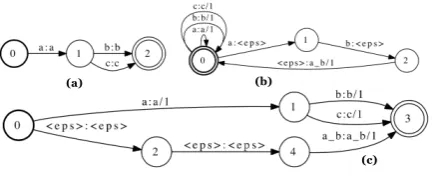
1. Word Lattice (L) : A finite state accep-tor that accepts word-sequences in the source language (L : Σ∗ → Σ∗). This represents the unpruned ASR word lattice output in our model (Figure 1a).
2. Phrase segmentation Transducer (S) : A cyclic finite state transducer that transduces a sequence of words to phrases in the source language (S : Σ∗ → Γ∗). This is built from the source side of the phrase table. Each path represents one source side phrase in the phrase table. Traversing a path is equivalent to consuming the words in a phrase and pro-ducing the phrase as a token (Figure 1b). 3. Weighted word lattice(L˜ASR) : A weighted
version of L(L˜ASR : Σ∗ → Σ∗/R+). We
use the subscript to denote the nature/source of the weights.
4. Phrase acceptor(W˜MT) : A finite state
ac-ceptor that accepts source phrases in the SMT
(a) (b)
[image:2.595.309.528.63.152.2](c)
Figure 1: A toy example for producing a phrase length weighted phrase lattice. (a) An unweighted word lattice. (b) A phrase segmentation trans-ducer which transduces words to phrases and has a weight of one per path. Each path is a source phrase in the phrase table. (c) A phrase lat-tice produced by composing the word latlat-tice and phrase segmentation transducer.
system’s phrase table (W˜MT : Γ → Γ/R).
It is weighted by features derived from the SMT system.
5. Phrase lattice (P) : The result of the com-position of a word lattice (acceptor) with the phrase segmentation transducer (P : Σ∗ →
Γ∗). This represents all possible phrase seg-mentations of all the ASR hypotheses in the word lattice.
P =det(min(L◦S))
We will represent weighted versions ofP as
˜
PASR/MT with subscripts to denote the ori-gin of the weights (Figure 1c).
2.1 A simple model : Maximum Spanning Phrases
We motivate our model with this fairly simple scenario. Suppose that we believe that if our SMT input could be covered by longer source side phrases1, we would produce better translations.
This may be viewed as a tiling problem where the tiles are the source phrases in the phrase table and the goal is to select the ASR hypothesis that re-quires the least number of phrases to cover2. To
achieve this using our existing machinery, we cre-ateS˜, a weighted version ofS(Figure 1 (b)), such
1In phrase based translation, target translations are
pro-duced for each possible span of the input sentence allowed by the phrase table. Translation of a longer source side phrase produces fewer translation options and may be more reliable given sufficient occurrences in the training data.
2It may be useful to incorporate a brevity penalty here,
that
w(δ( ˜S)) = 0 :π1(δ(S))∈Σandπ2(δ(S)) =
1 :π2(δ(S))∈Γandπ1(δ(S)) =
whereδ( ˜S)is an edge inS˜andπ
1andπ2are the in-put and outin-put projections respectively. Using this segmentation transducer and an unweighted word lattice, L (Figure : 1 (a)), we produce a phrase latticeP˜MT. Assuming the weights are in the
log-semiring, the weight of a pathδ( ˜P)∗inP˜MT is
w(δ( ˜P)∗) = X
δ( ˜P)∈δ( ˜P)∗
w(δ( ˜P))
Figure 1(c) shows an example of this phrase lat-tice. Weights in the phrase lattice follow the same definition as the weights in the segmentation trans-ducer. Hence, the weight of a path in the phrase lattice is simply the number of phrases used to cover this path. The shortest path3 in the phrase
lattice P˜MT, corresponds to the hypothesis we
were looking for. This simple example, demon-strates how we may be able to use SMT features (source phrase length in this case) to select hy-potheses from the phrase lattice.
2.2 A general featurized model for hypothesis selection
We now present a general framework in which hypothesis selection can be carried out using knowledge (features) from the ASR and the SMT system. As described earlier, this form of ‘impedance’ matching allows us to select hypothe-ses from an unpruned ASR word lattice for which the SMT system is more likely to find good trans-lations. Incorporating ASR weights also ensures that we take into account what the ASR system considers to be good hypotheses. We start with the previously discussed idea of a phrase lattice, using weights from the ASR system only. That is,
˜
PASR=det(min(˜LASR◦S))
Now, we use the weighted phrase acceptorW˜MT
to bring in the SMT features 4. Composing this
with the weighted phrase lattice, we get
˜
PASR,MT =det(min( ˜PASR◦( ˜WMT)∗) 3To compute the shortest path, we switch from the log to
the tropical semiring (A semiring with ordinary addition as the multiplication operator andmaxas the addition operator).
4Alternatively, we may have introduced the weights in the
segmentation transducer itself. This separate machine is in-troduced for efficient training of this model.
where( ˜WMT)∗ is the Kleene closure of( ˜WMT).
We assume that the edge weights are in the log-semiring. Hence, after these two compositions, the edge weights inP˜ASR,MT can be represented as
w(δ( ˜PASR,MT)) =X
j
βjfj,ASR+
X
k
γkfk,MT
=X
i
λifi
whereδ( ˜PASR,MT)is an edge inP˜ASR,MT,β, γare
feature weights,fASRandfMT are features from
the ASR and SMT system respectively. This form represents a log-linear model (our features are al-ready assumed to be in log-space). wherefiis any
feature andλiis the corresponding feature weight.
We may now extract the one-best,N-best or lattice input for the SMT system fromP˜ASR,MT.
2.2.1 A discussion about related techniques
1. Decoding (Translation) : Our model closely resembles a featurized finite-state transducer based translation model. If we replace the output alphabet of the acceptor( ˜WMT)∗with
the target side phrases, we will actually get output in the target language. Even though this model does not explicity include reorder-ing, the coarse-grained decoder has access to information that can enable better deci-sions about which hypotheses are better for the downstream process (translation). 2. Lattice Decoding : (Dyer et al., 2008b)
sug-gests passing the entire word lattice to the SMT system. However, even if these lattices are not pruned, a beam based decoder might not consider hypotheses that our model may produce through coarse-grained decoding. 3. Language model re-scoring : One may use a
bigger source language model to re-score the ASR lattice (or an N-best list). This how-ever, does not consider any SMT features in re-scoring. With our model, we can simply use this as an additional feature.
2.2.2 Training
quality given any metric that provides sentence level scores. Each time our model produces a hy-pothesis, its score can be looked up from the pre-translatedN-best list. Also, whenever the weights are updated, the only structures that need to be re-built areW˜∗
MT andP˜ASR,MT 5.
2.2.3 Features
We use the following features in our implementa-tion of this model. However, any relevant ASR and SMT feature may be readily added to this model.
1. ASR scores: We incorporate the ASR acous-tic (AM) and language (LM) model scores as one combined feature.
fASR =LM+α∗AM
Here, LM, AM are negative log-probabilities and α is the acoustic scaling parameter chosen to minimize ASR word error rate.
2. Source phrase count: As described in sec-tion 2.1, this feature may be used to cap-ture the intuition that using a fewer number of phrases to cover the input sentence may produce better translations.
3. Length normalized phrase unigram prob-ability : We may use a phrase LM feature by incorporating phrasen-gram probabilities (normalized) by length.
funi(fj) =
Pfreq(fj) k freq(fk)
len(fj)
wherefjis a source side phrase in the phrase
table.
4. Phrase translation entropy : For each source side phrasepj, we may have multiple
translations (ei) in the phrase table with
dif-ferent translation probabilities (p(ei|fj)). A
simple entropy measure can be used as a fea-ture to estimate the confidence that the SMT system has in translatingfj.
ftr(pj) =Htr(E|pj)
=−X
i
ptr(ei|fj) logptr(ei|fj)
5This requires the use of one ASR feature, addressed in
the “Features” section
5. Lexical translation entropy: Similarly, we can use an entropy measure based on the lex-ical translation probability as a feature.
flex(pj) =Hlex(E|pj)
=−X
i
plex(ei|fj) logplex(ei|fj)
3 Results
We use the Fisher and Callhome Spanish-English Speech Translation Corpus (Post et al., 2013) for our experiments. This Fisher dataset consists of 819 transcribed and translated telephone conver-sations. The corpus is split into a training, dev and two test sets (dev-2 and test). We use the dev set for training the feature weights of the proposed model.
We use the Kaldi speech recognition tools (Povey et al., 2011) to build our Spanish ASR systems. Our state-of-the-art ASR system is the p-norm DNN system of (Zhang et al., 2014). The word-error-rates on the dev and test sets of the Fisher dataset (dev, dev-2, test) are29.80%,29.79%and
25.30%respectively.
For the SMT system, we use the phrase based translation system of Moses (Koehn et al., 2007) with sparse features. The system is trained and tuned on the train and dev partitions of the Fisher dataset respectively. The BLEU scores of the MT output for the the dev-2 and the test partitions are
65.38%and62.91%respectively. While decoding the ASR output, we tune on the 1-best ASR output for the dev partition. With this modified system, the BLEU scores for the ASR 1-best output of the dev2 and the test partitions are40.06%and40.4%
respectively. We use this system as the baseline for our experiments (Table 1).
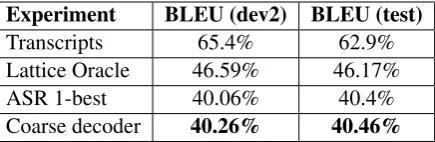
We note that if we were to use the lattice oracle6
from our ASR system as input to the SMT system, we get a BLEU score of 46.59% for the dev2 par-tition of the Fisher dataset. This indicates that the best gain (+BLEU) that an oracle lattice reranker could get is only 6.53%.
To tune the weights of the coarse decoder, we decode 500-best ASR outputs for the tuning set with the SMT system. This maps each ASR hy-pothesis to a target language translation. An OOV feature was added to handle words that were not seen by the SMT system. The tuning process was then carried out so as to maximize the BLEU with
Experiment BLEU (dev2) BLEU (test)
[image:5.595.75.293.63.134.2]Transcripts 65.4% 62.9% Lattice Oracle 46.59% 46.17% ASR 1-best 40.06% 40.4% Coarse decoder 40.26% 40.46%
Table 1: Performance when using the coarse de-coder interface compared to the the decoding the human transcripts, the ASR 1-best or the lattice oracle (the path in the ASR lattice with the least WER : not available during test time.)
respect to the reference translation of the ASR hy-pothesis selected by the coarse grained decoder. We used ZMERT (Zaidan, 2009) for tuning which was configured to expect a 300-best list from the decoder at every iteration using the Fisher dev set. 15 iterations of tuning were carried out for each experiment. We then use the tuned weight vec-tor to decode the Fisher-dev2 and the Fisher-test set using our coarse grained decoder. We extract the one-best output and use it as input to the pre-trained SMT system (description in the preceding section). Table 1 reports the results achieved the featurized coarse grained decoder.
4 Conclusions
We present a coarse-to-fine featurized model which acts as the interface between ASR and SMT systems. By utilizing information from the up-stream (ASR) and the downup-stream (SMT) sys-tems, this model makes more informed decisions about which hypotheses from the ASR word lat-tice may result in better translation results. More-over, the model takes the form of a coarse finite state transducer based translation decoder which imitates the downstream system. This enables it to estimate translation quality even before the com-plete SMT system is used for decoding. Finally, the proposed model is featurized and may accept any weight from the ASR and SMT system that are deemed useful for optimizing translation quality.
The Spanish Fisher corpus is one of a few con-versational speech translation datasets available, and we start with a strong baseline system. We therefore persevere with the experimental setup described above, even though the maximum (ora-cle) improvement by any rescoring method is only 6.5% BLEU, as noted above. This partially ex-plains the small gains reported here, and suggests that this method should be evaluated further on
an-other corpus, e.g. the Egyptian Arabic translation dataset, with greater headroom for improvement.
Acknowledgments
This work was partially supported by NSF award No
¯ IIS 0963898 and DARPA contracts No
References
Srinivas Bangalore and Giuseppe Riccardi. 2000. Finite-state models for lexical reordering in spoken language translation. In Proceedings of the Sixth International Conference on Spoken Language Pro-cessing, pages 422–425.
N. Bertoldi and Marcello Federico. 2005. A new de-coder for spoken language translation based on con-fusion networks. InProceedings of the IEEE Work-shop on Automatic Speech Recognition and Under-standing, pages 86–91.
N. Bertoldi, R. Zens, and Marcello Federico. 2007. Speech translation by confusion network decoding. In Proceedings of the IEEE International Confer-ence in Acoustics, Speech and Signal Processing, volume IV, pages 1297–1300.
Christopher Dyer, Smaranda Muresan, and Philip Resnik. 2008a. Generalizing word lattice transla-tion. InProceedings of ACL-08: HLT, pages 1012– 1020, Columbus, Ohio, June. Association for Com-putational Linguistics.
Christopher Dyer, Smaranda Muresan, and Philip Resnik. 2008b. Generalizing word lattice transla-tion. 2008/02//.
Philipp Koehn, Hieu Hoang, Alexandra Birch, Chris Callison-Burch, Marcello Federico, Nicola Bertoldi, Brooke Cowan, Wade Shen, Christine Moran, Richard Zens, Chris Dyer, Ondˇrej Bojar, Alexandra Constantin, and Evan Herbst. 2007. Moses: Open source toolkit for statistical machine translation. In
Proceedings of the 45th Annual Meeting of the ACL on Interactive Poster and Demonstration Sessions, ACL ’07, pages 177–180, Stroudsburg, PA, USA. Association for Computational Linguistics.
L. Mathias and W. Byrne. 2006. Statistical phrase-based speech translation. In Proceedings of the IEEE International Conference in Acoustics, Speech and Signal Processing, volume I, pages 561–564. Evgeny Matusov, Stephan Kanthak, and Hermann Ney.
2005. On the integration of speech recognition and statistical machine translation. InProceedings of the 9th European Conference on Speech Communica-tion and Technology, pages 3177–3180.
Hermann Ney. 1999. Speech translation: coupling of recognition and translation. In Proceedings of the IEEE International Conference in Acoustics, Speech and Signal Processing, volume 1, pages 517–520, March.
Matt Post, Gaurav Kumar, Adam Lopez, Damianos Karakos, Chris Callison-Burch, and Sanjeev Khu-danpur. 2013. General lattice decoding for im-proved speech-to-text translation with the Fisher and Callhome Spanish-English speech translation cor-pus. Proceedings of the International Workshop on Spoken Language Translation.
Daniel Povey, Arnab Ghoshal, Gilles Boulianne, Lukas Burget, Ondrej Glembek, Nagendra Goel, Mirko Hannemann, Petr Motlicek, Yanmin Qian, Petr Schwarz, Jan Silovsky, Georg Stemmer, and Karel Vesely. 2011. The Kaldi speech recognition toolkit. In IEEE 2011 Workshop on Automatic Speech Recognition and Understanding, December. Vu H Quan, Marcello Federico, and Mauro Cettolo. 2005. Integrated n-best re-ranking for spoken lan-guage translation. In Proceedings of the 9th Eu-ropean Conference on Speech Communication and Technology, pages 3181–3184.
Shirin Saleem, Szu-Chen Jou, Stephan Vogel, and Tanja Schultz. 2004. Using word lattice information for a tighter coupling in speech translation systems. In Proceedings of the International Conference on Spoken Language Processing, pages 41–44. Enrique Vidal. 1997. Finite-state speech-to-speech
translation. In Proceedings of the IEEE Interna-tional Conference in Acoustics, Speech and Signal Processing, volume 1, pages 111–114, April. Omar F. Zaidan. 2009. Z-MERT: A fully configurable
open source tool for minimum error rate training of machine translation systems. The Prague Bulletin of Mathematical Linguistics, 91:79–88.
Ruiqiang Zhang, Genichiro Kikui, Hirofumi Ya-mamoto, Taro Watanabe, Frank Soong, and Wai Kit Lo. 2004. A unified approach in speech-to-speech translation: integrating features of speech recogni-tion and machine translarecogni-tion. In Proceedings of the 20th international conference on Computational Linguistics.