Monotone Submodularity in Opinion Summaries
Jayanth Jayanth IIT Bombay
jayanthjaiswal10 @cse.iitb.ac.in
Jayaprakash Sundararaj IIT Bombay
osjayaprakash @gmail.com
Pushpak Bhattacharyya IIT Bombay
pb
@cse.iitb.ac.in
Abstract
Opinion summarization is the task of pro-ducing the summary of a text, such that the summary also preserves the sentiment of the text. Opinion Summarization is thus a trade-off between summarization and sen-timent analysis. The demand of com-pression may drop sentiment bearing sen-tences, and the demand of sentiment de-tection may bring in redundant sentences. We harness the power of submodularity to strike a balance between two conflict-ing requirements. We investigate an in-cipient class of submodular functions for the problem, and a partial enumeration based greedy algorithm that has perfor-mance guarantee of 63%. Our functions generate summaries such that there is good correlation between document sentiment and summary sentiment along with good ROUGE score, which outperforms the-state-of-the-art algorithms.
1 Introduction
Sentiment Analysis is often addressed as a classi-fication task, which aims at determining the sen-timent of a word, sentence, paragraph or a docu-ment as a whole into positive, negative or neutral classes (Pang et al., 2002). Summarization, on the other hand is the task of aggregating and represent-ing information content from a srepresent-ingle document or multiple documents in a brief and fluent manner. Due to the explosive growth of data, fine grained sentiment analysis as well as summarization on the whole chunk of data can be a very time-consuming task. Sentiment Analysis also requires filtering of text portions as either objective (factual informa-tion) or subjective (expressing some sentiment or opinion) during pre-processing and then, classify-ing the subjective extracts as positive or negative.
Subjective extracts can also be provided to users as a summary of the sentiment-oriented content of the reviews in search engines. In this paper, we address the problem of generic extractive sum-marization of reviews, a task commonly known as Opinion Summarization (Liu, 2012). The goals of opinion summarization are:
1. Present a short summary that conveys the essence as well as the sentiment of the review 2. Provide a short subjective extract to NLP
pipeline for faster execution (e.g. sentiment
analysis, review clusteringetc.).
In this paper, we use movie reviews for opinion summarization task as they often have the follow-ing parts:
1. Plot - Description of the story, which is fac-tual in nature
2. Critique - Opinion about the movie, which is sentiment bearing
Clearly, opinion summary to be generated will have a trade-off between the two opposing parts - subjective critique and objective plot. Our goal is to strike a balance through linear combination of suitable submodular functions in our paper. Joint models of relevance and subjectivity have a great benefit in that they have a large degree of freedom as far as controlling redundancy goes. In con-trast, conventional two-stage approach Pang and Lee (2004), which first generate candidate sub-jective sentences using min-cut and then selects top subjective sentences within budget to generate a summary, have less computational complexity than joint models. However, two-stage approaches are suboptimal for text summarization. For ex-ample, when we select subjective sentences first, the sentiment as well information content may be-come redundant for a particular aspect. On the
other hand, when we extract sentences first, an im-portant subjective sentence may fail to be selected, simply because it is long. The two stage conflict in the sense that the demand of compression may drop sentiment bearing sentences, and the demand of sentiment detection may bring in redundant sen-tences. We then, use partial enumeration based greedy algorithm (Khuller et al., 1999), which
gives performance guarantee of (1−e−1)≈0.632
(Sviridenko, 2004). The performance guarantee reported is better than simple greedy algorithm, used by Lin and Bilmes (2010) as their proof is erroneous (Morita et al., 2013). Further, the same greedy algorithm, which was used again in Lin and Bilmes (2011) gives only performance guarantee
of 1
2(1−e1)≈0.316 (Khuller et al., 1999).
The rest of the paper is as follows - in the next section, we look at previous work and establish further motivation for our work. Following that, we build the theory and formulate suitable objec-tives for opinion summarization task. In the final section, we present results based on implementa-tion and testing of the funcimplementa-tions. Experimental re-sults show that the functions outperform the-state-of-the-art methods.
2 Previous Work
Automatically generating opinion summaries from large review text corpora has long been stud-ied in both information retrieval and natural lan-guage processing.
In (Pang and Lee, 2004), a mincut-based algo-rithm was proposed to classify each sentence as being subjective or objective. The purpose of this work was to remove objective sentences from re-views to improve document level sentiment classi-fication. Interestingly, the cut functions are sym-metrical and submodular, and the problem of find-ing min-cut is equivalent to minimizfind-ing a symmet-ric submodular function.
Lerman et al. (2009) proposed three different models - sentiment match (SM), sentiment match + aspect coverage (SMAC) and sentiment-aspect match (SAM) to perform summarization of re-views of a product. The first model is called sen-timent match (SM), which extracts sentences so that the average sentiment of the summary is as close as possible to the average sentiment rating
of reviews of the entity i.e. low MISMATCH
but with high sentiment INTENSITY. The sec-ond model, called sentiment match + aspect
cov-erage (SMAC), builds a summary that trades-off between DIVERSITY, maximally covering impor-tant aspects and MISMATCH, matching the over-all sentiment of the entity along with high INTEN-SITY. The third model, called sentiment-aspect match (SAM), not only attempts to cover impor-tant aspects, but cover them with appropriate sen-timent using KL-Divergence function. Here, IN-TENSITY and DIVERSITY in the first two mod-els are linear monotone submodular functions,
while KL-Divergence function i.e. relative
en-tropy in last model, unlike enen-tropy is not mono-tone submodular.
In (Nishikawa et al., 2010b), a more sophis-ticated summarization technique was proposed, which generates a traditional text summary by se-lecting and ordering sentences taken from multi-ple reviews, considering both informativeness and readability of the final summary. The readability score in this paper would have been linear mono-tone submodular function, if the negative polarity was not penalizing. In (Nishikawa et al., 2010a), the authors further studied this problem using an integer linear programming formulation.
On the other hand, Lin et al .(2011) treated the task of generic summarization as monotone sub-modular function maximization. Further, they ar-gued that monotone non-decreasing submodular functions are an ideal class of functions to inves-tigate for document summarization. They also show, in fact, that many well-established meth-ods for summarization (Carbonell and Goldstein, 1998; Filatova, 2004; Riedhammer et al., 2010) correspond to submodular function optimization, a property not explicitly mentioned in these publi-cations. Since many authors either in summariza-tion or opinion summarizasummariza-tion have used funcsummariza-tions similar to submodular functions as objective, we can take this fact as testament to the value of sub-modular functions for opinion summarization.
3 Theoretical Background
3.1 Introduction to Submodular Functions
A submodular function is a set function (f : 2V →
R) having a natural diminishing returns property.
Diminishing returns property holds if the differ-ence in the value of the function that a single ele-ment makes when added to an input set decreases
as the size of the input set increasesi.e. for every
A, B ⊆V withA ⊆ B and everyx ∈ V\B, we
A submodular function f is monotone if for every
A⊆B, we have thatf(A)≤f(B).
The extractive summarization task can be
mod-eled as optimization problem i.e. finding a set
S ⊆ V (S is set of sentences in summary, V is
set of sentences in Document) which maximizes a
submodular functionf(S)subject to budget
con-straints. In the following section, we will justify the use of submodular function for opinion sum-marization. Another advantage of choosing mono-tone submodular function is that there exists a polynomial-time greedy algorithm for constrained monotone submodular objective. The greedy al-gorithm guarantees that the summary solution ob-tained is almost as good as (63%) the best possi-ble summary solution according to the objective (Sviridenko, 2004; Wolsey, 1982).
3.2 Submodularity in Opinion Summarization
Opinion Summarization should be modeled as a monotone submodular optimization problem, since opinion summary also holds following prop-erties:
1. Monotonicity - As more sentences are added to opinion summary, subjectivity increases along with information content as opinion-ated words are being added.
2. Diminishing Return - If multiple sentences of varying intensity are added to opinion sum-mary, the effect of a lower intensity polarity bearing sentence is diluted in the presence of a higher intensity one.
To show that opinion summarization inherently follow the diminishing return property, consider
the following sentences1with positive polarity:
A: “Even the acting in From Hell is solid, with the dreamy Depp turning in a typically strong perfor-mance and deftly handling a British accent.”
B: “Worth mentioning are the supporting roles by Ians Holm and Richardsonlog.”
(A∪B) : “Even the acting in From Hell is solid, with the dreamy Depp turning in a typically strong performance and deftly handling a British accent. Worth mentioning are the supporting roles by Ians Holm and Richardsonlog.” Compare A and its
su-perset, A ∪B as candidate summaries. Sentence
A and B convey positive sentiment, but sentence 1http://www.imdb.com/reviews/295/29590.html
B has less intensity compared to sentence A. After
reading the text (A∪B), it is clear that the effect of
sentence B has diminished in front of sentence A, though both are of same polarity. B can be thus, removed from the candidate summary as it does a diminishing addition in presence of sentence A to the positive sentiment over the "acting" aspect of the entity "movie". The diminishing return not only holds for same polarity but also, for opposite
polarity. Consider another example2:
A: “The movie is predictive with foreseeable end-ing.”
B: “Still it’s very well-done that no movie in this entire year has a scene that evokes pure joy as this does.”
(A ∪ B) : “The movie is predictive with foresee-able ending. Still it’s very well-done that no movie in this entire year has a scene that evokes pure joy as this does.” Compare B and its superset, A∪
B as candidate summaries. Sentence A has neg-ative sentiment whereas sentence B conveys posi-tive sentiment with more intensity. When we read
the text (A∪B), it is clear that the effect of
sen-tence A has diminished in front of sensen-tence B in text , as usually polarity of higher intensity dom-inates over the polarity of lower intensity. Now,
consider a general example3,
“Laurence plays Neo’s mentor Morpheus and he does an excellent job of it. His lines flow with con-fidence and style that makes his acting unique and interesting. The movie has lot of special effects and action-packed scenes with part of the appeal has philosophical and religious underpinnings.”
If the budget for summary had been only two subjective sentences, then picking up first two would have redundantly captured only single
as-pect (i.e. acting) and the redundancy of the
con-cept (acting) also causes a diminishing return of the second sentence because of the difference in sentiment intensity. However, picking the last sentence with either one of the first two would
have not just covered both the aspects (i.e. acting
and visual effects) but since, the sentences are not overlapping in aspects, there would not have been any diminishing return of sentiment on shared as-pect (acting). Thus, it can be verified that opinion polarity also holds submodular property of dimin-ishing return, if they are on the same aspect of a distinct entity.
4 Formulation
Let V represent the set of the sentences in a doc-ument. The task of extractive opinion
summariza-tion is to select a subsetS ∈ V to represent the
entirety (ground set V ) . Obviously, we should have|S| ≤ |V|as it is a summary and should be small. Therefore, constraints on S can naturally be modeled as knapsack constraints:
X
i∈S
ci ≤b (1)
where ci is the non-negative cost of selecting
unit i (e.g., the number of words in the sentence)
and b is our budget. If we use a set function
F : 2V → R to measure the quality of the
sum-mary set S, the summarization problem can then be formalized as the following combinatorial opti-mization problem:
S∗ ∈argmaxS⊂VF(S)s.t.
X
i∈S
ci ≤b (2)
where F (S) , total utility of summary is given as a linear combination of L(S), relevance and A(S), subjective coverage of aspects.
F(S) =αL(S) +βA(S) (3) This formulation clearly brings out the trade-off between the subjective and the objective part. The intuition behind the combination of sentiment and aspect coverage in same function A(S) is that opin-ion polarity holds submodular property of dimin-ishing return only if the set of sentences talk about common aspect of the same entity as discussed in previous section. L(S) , relevance is modeled same as in (Lin and Bilmes, 2011) as it captures the summary property, while our novel function, A(S) has been modeled differently through a suit-able submodular function such that it captures the subjectivity property.
L(S) =X i∈V
min{ci(S), γci(V)} (4)
ci(S) =X j∈S
wi,j (5)
Here,wi,j >0measures the similarity between
ithandjthsentences andci(S)measures the
sim-ilarity of summary with the document.
Since, A(S), subjective coverage of aspects has to be modeled as monotone submodular function, it has been formulated as :
1. A1:Modular Function
A1(S) is simple linear function, which is sum
of weighted subjective scores for each sen-tence. No budgeting constraints are added to this formulation.
A1(S) = X
i
X
j∈(Pi∩S)
sj ∗wi (6)
HerePi;i= 1...Kis a partition of the ground
setV (i.e.,∪iPi = V), which contains
sen-tences pertaining to different distinct aspects.
wi are the weights of the partitions, based on
the corresponding aspects. sj is the
subjec-tive score of the sentence j in summary. The
subjective scoresj is calculated using
senti-wordnet as sum of the positive score∈ [0,1]
and negative score∈[0,1](Esuli and
Sebas-tiani, 2006).
sj =
X
word∈j
(pos(word) +neg(word))
(7)
2. A2:Budget-additive Function
A2(S)is an extension toA1(S), where
max-imum subjectivity score is restricted with
budget based on aspect. Here, λ ∈ [0,1]
is threshold coefficient for budget additive function to avoid redundancy of high senti-ment on same aspect. When aspect i is
satu-rated by S (min(Pj∈(Pi∩S)sj, λ) =λ), any
new sentence j cannot further improve cov-erage over i and thus, other aspects, which are not yet saturated will have a better chance of being covered. This formulation ensures that produced summary is diverse enough and conveys sentiment about different aspects by budgeting.
A2(S) =X i
min( X j∈(Pi∩S)
sj, λi)∗wi (8)
3. A3 : Polarity Partitioned Budget-additive Function
sentences with less intensity,A2 more likely
to reward more positive sentences because of intensity. In this formulation budgeting ap-plied not only on aspect but polarity scores too. This ensures that both positive and neg-ative polarity sentences are part of summary.
A3(S) = X
i
min( X
j∈(Pi∩S∩Ppos)
sj, λi)∗wi
+min( X j∈(Pi∩S∩Pneg)
sj, λi)∗wi
(9)
Ppos and Pneg are the partition of the
sen-tences in the ground set V, based on their
sign of polarity score. The polarity scorepolj
for partitioning sentences intoPpos andPneg
is calculated as difference of the positive and negative score.
polj =
X
word∈j
(pos(word)−neg(word))
(10)
Polarity based partitions bring out contrast view on a particular aspect, which is simi-lar to contrast view opinion summarization to give the reader a direct comparative view of different strong opinions.
4. A4:Facility Location Function
In this formulation, we model the facil-ity location objective function (Krause and Golovin, 2014) for opinion summarization as choosing possible sentences (facilities) out of document (set of locations) to serve
as-pects (customers) giving service of valuesj.
If each aspect (customer) chooses the sen-tences (facility) with the highest value, the to-tal value provided to all aspects (customers) is modeled by this set function.
A4(S) = X
i
maxj∈(Pi∩S)sj∗wi (11)
So A4 rewards only a sentence which has
maximum subjectivity score in each aspect.
5. A5:Polarity Partitioned Facility Location Function
A5 is similar toA4, but for each aspect, A5
rewards two sentences with positive and neg-ative polarity but with maximum subjectivity scores in those polarity partitions.
A5(S) = X
i
maxj∈(Pi∩S∩Ppos)sj ∗wi
+X i
maxj∈(Pi∩S∩Pneg)sj ∗wi
(12)
Each of the above functions are monotone
sub-modular as the parameterssj andwiare positive.
Since the first function is linear, it is both submod-ular and supermodsubmod-ular, thus modsubmod-ular. Budget ad-ditive and facility location functions (Krause and Golovin, 2014) are special types of monotone sub-modular functions. Since, monotone subsub-modular- submodular-ity is preserved under non-negative linear combi-nations, polarity based partitioned function, whose sub-parts are monotone submodular is also mono-tone submodular.
5 Experiment
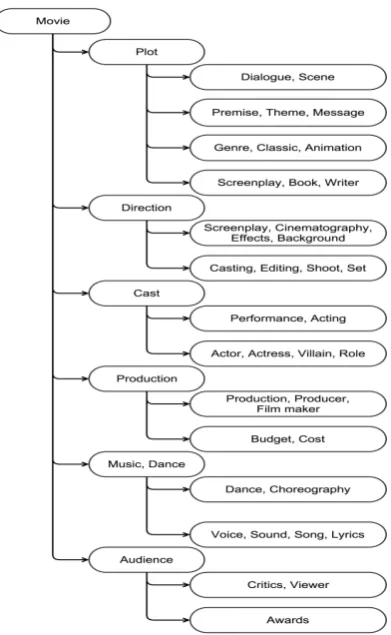
We have created Movie ontology tree manually (figure 1). Further the ontology is enriched by adding clue words to all aspects using wordnet sense propagation algorithm (Esuli and Sebastiani, 2006) for three iterations. The algorithm does a hard clustering of the sentences by assigning the sentence aspect, which has maximum number of clue words in that sentence. Clue words for ‘Plot’
aspect are story, script, storyline, chief,
commu-nicative, explain, narrate, narration, narrative, narrator, report, reporter, scheme, schemer, script, scriptural, storyteller, tell, write up..,.
For the experiments, we have used the polar-ity dataset from Pang et al. (2004). The dataset contains 1000 positive and 1000 negative movie reviews with size varying between 700 to 1000 words. As summary generation is time
consum-ing task (DUC4 only used 25 summaries to
eval-uate the performance of systems), we picked 100 positive and 100 negative reviews randomly from the dataset and their abstract summaries are gener-ated manually with 200 words limit as budget for 4Document Understanding Conferences,
Figure 1: Movie Ontology Tree
evaluation. These 200 summaries are used as gold standard for estimating ROUGE scores of system generated summaries.
In the experiment, the partial enumeration based greedy algorithm (Khuller et al., 1999) is used for summary generation of 200 test documents within budget of 200 words. The algorithm has two parts. In the first part, the algorithm compares function values of all feasible solutions (sets) of
cardinal-ity one or two. LetSumm1 be a feasible set of
cardinality one or two that has the largest value of
the objective function F(S). In the second part,
the algorithm enumerates all feasible sets of cardi-nality three. The algorithm, then completes each such set greedily and keeps the current solution feasible with respect to the knapsack constraint.
LetSumm2be the solution obtained in the second
part that has the largest value of objective function over all choices of the starting set for the greedy
algorithm. Finally, the algorithm outputsSumm1
ifF(Summ1) > F(Summ2)else Summ2
oth-erwise. The algorithm does O(n2) function
cal-culations in first part, while O(n5) in second part.
This algorithm gives a performance guarantee of
(1−e−1) for solving monotone submodular
objec-tive with knapsack constraint (Khuller et al., 1999; Sviridenko, 2004). As far as we know, the algo-rithm has not been implemented for such prob-lems because of complexity constraints (Lin and Bilmes, 2011).
Algorithm 1 Overall Algorithm - Summary Ex-traction
B⇐200
forSentence s∈DocumentVdo
Assign sentence s to one of aspects in movie ontology. end for
Summ1⇐argmax { F(S), such that S⊆V, |S| < 3, and
cost(S)≤B }
Summ2⇐ ∅
for allS⊆V, |S|=3, and cost(S)≤Bdo
U⇐V\S
while U6=∅do maxReturn⇐0.0 newSentence⇐ ∅ forSentence s∈U do
S∗⇐S∪ {s}
F(S∗)⇐αL(S∗) + (1−α)A(S∗) return⇐F(S∗)−F(S)
len(s)
ifreturn≥maxReturnthen
maxReturn⇐return newSentence⇐s
end if end for
if cost(S∪ {newSentence})≤B then
S⇐S∪ {newSentence} end if
U⇐U\{newSentence} end while
ifF(S)≥F(Summ2)then
Summ2⇐S
end if end for
ifF(Summ1)≥F(Summ2) then
Summary⇐Summ1
else
Summary⇐Summ2
end if
In the algorithm, the sentences are clustered in different partitions, corresponding to different as-pects in the ontology tree using the clue words. In the experiment, hard clustering of the sentences in aspect-based partitions is considered but soft-clustering of the sentences will also work with this approach, which has been left out to avoid further parameter tuning for soft clustering assigments. The weights of the partitions as well as the thresh-old parameters for the A(S) are currently kept pro-portional to the inverse of the depth of that aspect in the ontology-tree as sentiment expressed on the concepts at higher level in the ontology tree should have more weightage.
∀Aspects i,
The linear combination parameterβis set as1−
αto bring out the trade-off between relevance and
subjective coverage of aspects andαis varied from
0 to 1 with step size 0.05 to find optimalα. γ in
L(S) is set to 0.5. The parameter learning, esp. α
and its impact have been already studied in (Lin and Bilmes, 2011) and thus, is not addressed in the paper. We have used the same approach of grid
search to find the optimal value ofα.
6 Results
We use ROUGE (Lin, 2004) for evaluating the content of summaries. We have used the 200 test documents that are manually summarized as gold standard data for ROUGE evaluation. For figuring out the sentiment correlation between manual and system generated summaries, we trained Naive Bayes sentiment classifier (Pang et al., 2002) on training data using bag of words approach with features as unigrams and bigrams and then, us-ing minimum Pearson’s chi-square score of 3 for feature extraction (Pecina and Schlesinger, 2006) before calculating the sentiment. The measure of sentiment preservation is calculated as Pear-son correlation between the sentiment score of the document and the corresponding summary ment, both calculated by the Naive Bayes senti-ment classifier while the measure of coverage of information content is given by ROUGE-1 and ROUGE-2 f-scores. Mathematically,
Correlation(X, Y) = Covariance(X, Y)
std.dev(X)∗std.dev(Y)
(13) Here, random variable X is the sentiment score of the document sample and random variable Y is the sentiment score of the correspond-ing summary sample. For 200 documents, it
will be[(X1, Y1),(X2, Y2), ...,(X200, Y200)]
sam-ple points for the above correlation function. Following five baselines are used for compari-son:
1. Baseline-1/TOP : Sentences selected con-secutively from the start of the review within the budget.
2. Baseline-2/TOP-SUBJ : Sentences ranked based on their subjectivity and then, selected with in the budget.
3. Baseline-3/LER-SM: (Lerman et al., 2009) Sentences which have sentiment close to doc-ument sentiment are chosen as Summary. We
have used same NaiveBayes classifier (Pang et al., 2002) trained on imdb corpus to predict the sentiment of a sentence and document.
minS⊂V
X
j∈S
(|senti(V)−senti(j)|) (14)
4. Baseline-4/TEXTRANK : TextRank sum-marizer is based on Graph based unsuper-vised algorithm. Graph is constructed by cre-ating a vertex for each sentence in the docu-ment and edges between vertices based on the number of words two sentences (of vertices) have in common and then, ranking them by applying PageRank to the resulting graph. Summary is generated with sentences hav-ing more vertex score (Mihalcea and Tarau, 2004).
5. Baseline-5/MINCUT : Mincut algorithm (Pang and Lee, 2004) classifies the sentences as subjective and objective sentences, by finding minimum s-t cuts in graph of sen-tences using maximum flow algorithm. In the graph, each sentence is a vertex and the edge between the vertex to the source or sink is taken as probability of the sentence being subjective or objective (individual scores). To ensure the graph connectivity, edges are drawn between every pair of sentence ver-tices, with edge weights taken proportional to the degree of proximity (association scores). After maximum flow algorithm, the cut in which source vertex lies is classified as sub-jective and vice-versa. We pick top subsub-jective sentences within the budget as summary. Among the five baselines, TOP and TOP-SUBJ are simplistic. Though both TEXTRANK and MINCUT were not originally proposed for ion summarization but a number of papers in opin-ion summarizatopin-ion have built over these two meth-ods and also, used them as baselines and thus, comparing with the "well-known" baselines will give the readers from the sentiment analysis field an intuitive idea of the performance of our sys-tem. MINCUT, however was reproposed specif-ically for subjective summarization by Pang and Lee (2004) and we use that formulation for com-parison.
Table 1 compares the five functions with the above baselines based on optimal values of
System ROUGE1 ROUGE2 S. Corr.
TOP 0.43001 0.16591 0.86144
TOP-SUBJ 0.41807 0.14362 0.82953
LER-SM 0.42608 0.14533 0.96545
TEXTRANK 0.41987 0.14644 0.88967
MINCUT 0.39368 0.11047 0.84017
Submod-A1 0.43223 0.15702 0.95306
Submod-A2 0.43594 0.15977 0.97538
Submod-A3 0.43247 0.15436 0.93155
Submod-A4 0.43602 0.15760 0.98566
[image:8.595.311.522.64.221.2]Submod-A5 0.42976 0.15551 0.95415
Table 1: ROUGE F-score and sentiment
correla-tion for optimal values ofαwith baselines 1-5
proposed functions not only outperform the base-lines in terms of ROUGE scores for optimal pa-rameters but also, give better correlation with the document sentiment. This can be quantitively ver-ified by test of significance, unpaired one-tailed t-test without assuming equal variance between
the baselines and the systems. The p-values are
0.0203 and 0.0066 respectively for ROUGE-1 F Score and Sentiment Correlation, justifying that the performance improvement by our system over
the baselines is statistically significant at p <
0.05. The main reason being that the functions
with optimal values of trade-off parameterαstrike
out a balance between relevance and subjectivity. Clearly, the facility location based monotone sub-modular functions are the best choice as objective for opinion summarization task as they select sen-tences with maximum subjectivity (facilities giv-ing best service).
Our system is able to access the information of aspect and polarity of each sentence, while some baselines do not. So, the improvement over the baselines may be attributed to those additional in-formation rather than the optimality of the par-tial enumeration greedy algorithm over submodu-lar functions. So, we therefore, introduced the fol-lowing baseline to question this misdoubt on the experiment:
6. Baseline-6/LIN:
In this baseline, the greedy algorithm (Lin and Bilmes, 2010) is used for summary generation, us-ing the same functions and information in the for-mulation. This algorithm fills the empty summary set greedily by adding a single sentence in each
System ROUGE1 ROUGE2 S. Corr.
LIN-A1 0.43112 0.15795 0.89850
LIN-A2 0.42704 0.15382 0.90212
LIN-A3 0.42612 0.15297 0.93155
LIN-A4 0.42688 0.15245 0.93905
LIN-A5 0.43359 0.15922 0.91019
Submod-A1 0.43223 0.15702 0.95306
Submod-A2 0.43594 0.15977 0.97538
Submod-A3 0.43247 0.15436 0.93155
Submod-A4 0.43602 0.15760 0.98566
[image:8.595.77.289.65.219.2]Submod-A5 0.42976 0.15551 0.95415
Table 2: ROUGE F-score and sentiment
correla-tion for optimal values ofαwith baseline 6
0.78 0.8 0.82 0.84 0.86 0.88 0.9 0.92 0.94 0.96 0.98 1
0 0.1 0.2 0.3 0.4 0.5 0.6 0.7 0.8 0.9
Sentiment Correlation (Document and Summary)
Alpha Alpha vs Sentiment Correlation
A1 A2 A3 A4 A5
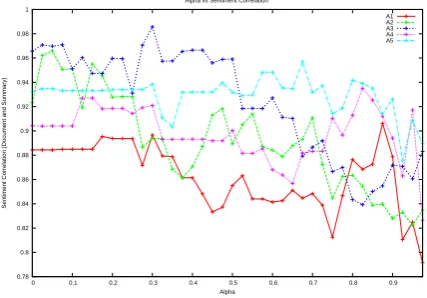
Figure 2: Sentiment Correlationvsα
iteration, which gives maximum return over cost
ratio (F(Slen∗)−(sF)(S)), ensuring that current solution
is feasible with respect to the knapsack constraint
(cost(S∪ {newSentence})≤B). This algorithm
has a complexity of O(n2) but gives only
perfor-mance guarantee of1
2(1−e1)≈0.316 (Khuller et
al., 1999).
Table 2 compares the same five functions in our system with (Lin and Bilmes, 2010) system based
on optimal values of tradeoff α. From the table,
it can be inferred that our system also outperforms this baseline both in terms of ROUGE scores and sentiment correlation, which can be quantitively verified by test of significance, unpaired one-tailed t-test without assuming equal variance between
the baselines and the systems. The p-values are
0.02517 and 0.003965 respectively for ROUGE-1 F Score and Sentiment Correlation, justifying that the performance improvement by our system over
LIN system is statistically significant atp <0.05.
[image:8.595.308.522.275.424.2]0.405 0.41 0.415 0.42 0.425 0.43 0.435 0.44
0 0.1 0.2 0.3 0.4 0.5 0.6 0.7 0.8 0.9
ROUGE-1
Alpha Alpha vs ROUGE-1 F-Score
[image:9.595.320.512.64.154.2]A1 A2 A3 A4 A5
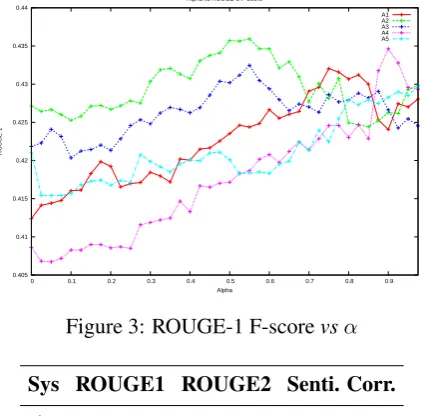
Figure 3: ROUGE-1 F-scorevsα
Sys ROUGE1 ROUGE2 Senti. Corr.
A1 0.43223 0.15702 0.84827
A2 0.43594 0.15977 0.88601
A3 0.43247 0.15436 0.87038
A4 0.43602 0.15760 0.87818
A5 0.42976 0.15551 0.90147
Table 3: Maximum ROUGE F-score and their cor-responding sentiment correlation
ment correlation and ROUGE-1 F score for the formulated submodular functions with respect to
the trade-off parameter,αrespectively. Looking at
the graph 2, we can observe that more weightage to relevance over subjective coverage of aspects decreases the sentiment correlation, which was ex-pected because the summary generated misses out on subjective sentiment due to trade-off. Simi-larly, by looking at the graph 3, we also observe that more weightage to relevance over subjective coverage of aspects increases the ROUGE score as expected. The erratic behaviour in figure 3 can be explained by arguing that subjective words are also important for summary and thus, giving less weightage to them over relevance, ROUGE score will increase but not properly.
The table 3 presents the value of sentiment correlation corresponding to maximum ROUGE
score (forα≈1). Clearly,A4 andA2 have
maxi-mum ROUGE scores as they neglect polarities and instead, reward on aspect based partitions, thus in-creasing coverage. The table 4 presents the value of ROUGE score corresponding to maximum
sen-timent correlation (forα≈0). Clearly,A4also has
maximum sentiment correlation as it rewards max-imum subjectivity, irrespective of polarities and
Sys Senti. Corr. ROUGE1 ROUGE2
A1 0.95306 0.42572 0.14939
A2 0.97538 0.41764 0.14836
A3 0.93155 0.42415 0.14782
A4 0.98566 0.42492 0.14942
A5 0.95415 0.42572 0.14266
Table 4: Maximum sentiment correlation and cor-responding ROUGE F-Score
the corresponding ROUGE-2 F-score is also high-est among all functions. Tables 1 and 2 contain the ROUGE F-score and sentiment correlation for
optimal values ofα, found after grid search while
tables 3 and 4 contain the peak values in the fig-ures 2 and 3. For example, table 3 contains the peak value of ROUGE-1 F score from figure 3 and the corresponding value of Sentiment Correlation
from figure 2, at the sameα.
7 Conclusion
In this paper, we show that conflict between sub-jectivity and relevance naturally arises in opinion summarization. To address this problem, we intro-duce new monotone submodular functions that are well suited to document summarization (Lin and Bilmes, 2010; Lin and Bilmes, 2011; Morita et al., 2013) by modeling two important properties of opinion summary - relevance and subjective cover-age of aspects. We then, design different possible combinations of objective functions to model the task. To solve the algorithm effectively, we use the partial enumeration based algorithm, which
is though computationally expensive (O(n5)
[image:9.595.75.287.68.276.2]References
Jaime Carbonell and Jade Goldstein. 1998. The use of mmr, diversity-based reranking for reordering
doc-uments and producing summaries. InSIGIR, pages
335–336.
Andrea Esuli and Fabrizio Sebastiani. 2006. Senti-wordnet: A publicly available lexical resource for
opinion mining. InProceedings of LREC, volume 6,
pages 417–422.
Elena Filatova. 2004. Event-based extractive
summa-rization. InProceedings of ACL Workshop on
Sum-marization, pages 104–111.
Samir Khuller, Anna Moss, and Joseph Seffi Naor. 1999. The budgeted maximum coverage problem. Information Processing Letters, 70(1):39–45. Hyun Duk Kim, Kavita Ganesan, Parikshit Sondhi, and
ChengXiang Zhai. 2011. Comprehensive review of opinion summarization.
Andreas Krause and Daniel Golovin. 2014. Submod-ular function maximization. InTractability: Practi-cal Approaches to Hard Problems (to appear). Cam-bridge University Press, February.
Kevin Lerman, Sasha Blair-Goldensohn, and Ryan Mc-Donald. 2009. Sentiment summarization:
evalu-ating and learning user preferences. In
Proceed-ings of the 12th Conference of the European Chap-ter of the Association for Computational Linguistics, pages 514–522.
Hui Lin and Jeff Bilmes. 2010. Multi-document sum-marization via budgeted maximization of
submod-ular functions. InHuman Language Technologies:
The 2010 Annual Conference of the North American Chapter of the Association for Computational Lin-guistics, pages 912–920.
Hui Lin and Jeff Bilmes. 2011. A class of
submodu-lar functions for document summarization. In
Pro-ceedings of the 49th Annual Meeting of the Associ-ation for ComputAssoci-ational Linguistics: Human Lan-guage Technologies-Volume 1, pages 510–520. Chin-Yew Lin. 2004. Rouge: A package for automatic
evaluation of summaries. In Text Summarization
Branches Out: Proceedings of the ACL-04 Work-shop, pages 74–81.
Bing Liu. 2012. Sentiment analysis and opinion min-ing. Synthesis Lectures on Human Language Tech-nologies, 5(1):1–167.
Ryan McDonald. 2007. A study of global inference algorithms in multi-document summarization. In Advances in Information Retrieval, pages 557–564. Springer.
Rada Mihalcea and Paul Tarau. 2004. Textrank:
Bringing order into texts. In Proceedings of
EMNLP, volume 4, page 275.
Hajime Morita, Hiroya Takamura, Ryohei Sasano, and Manabu Okumura. 2013. Subtree extractive
sum-marization via submodular maximization. In
Pro-ceedings of 51st Annual Meeting of the Association for Computational Linguistics (to appear).
Hitoshi Nishikawa, Takaaki Hasegawa, Yoshihiro Mat-suo, and Genichiro Kikui. 2010a. Opinion summa-rization with integer linear programming
formula-tion for sentence extracformula-tion and ordering. In
Pro-ceedings of the 23rd International Conference on Computational Linguistics: Posters, pages 910–918. Hitoshi Nishikawa, Takaaki Hasegawa, Yoshihiro Mat-suo, and Genichiro Kikui. 2010b. Optimizing in-formativeness and readability for sentiment
summa-rization. In Proceedings of the ACL 2010
Confer-ence Short Papers, pages 325–330.
Bo Pang and Lillian Lee. 2004. A sentimental educa-tion: Sentiment analysis using subjectivity
summa-rization based on minimum cuts. InProceedings of
the 42nd annual meeting on Association for Compu-tational Linguistics, page 271.
Bo Pang, Lillian Lee, and Shivakumar Vaithyanathan. 2002. Thumbs up?: sentiment classification using
machine learning techniques. InProceedings of the
ACL-02 conference on Empirical methods in natural language processing-Volume 10, pages 79–86. As-sociation for Computational Linguistics.
Pavel Pecina and Pavel Schlesinger. 2006. Combin-ing association measures for collocation extraction. In Proceedings of the COLING/ACL on Main con-ference poster sessions, pages 651–658. Association for Computational Linguistics.
Korbinian Riedhammer, Benoit Favre, and Dilek Hakkani-Tür. 2010. Long story short–global unsu-pervised models for keyphrase based meeting
sum-marization. Speech Communication, 52(10):801–
815.
Maxim Sviridenko. 2004. A note on maximizing a submodular set function subject to a knapsack con-straint. Operations Research Letters, 32(1):41–43. Laurence A Wolsey. 1982. An analysis of the greedy