Learning a Deep Hybrid Model for Semi-Supervised Text Classification
Alexander G. Ororbia II, C. Lee Giles, David Reitter College of Information Sciences and Technology The Pennsylvania State University, University Park, PA
{ago109, giles, reitter}@psu.edu
Abstract
We present a novel fine-tuning algorithm in a deep hybrid architecture for semi-supervised text classification. During each increment of the online learning pro-cess, the fine-tuning algorithm serves as a top-down mechanism for pseudo-jointly modifying model parameters following a bottom-up generative learning pass. The resulting model, trained under what we call theBottom-Up-Top-Downlearning al-gorithm, is shown to outperform a vari-ety of competitive models and baselines trained across a wide range of splits be-tween supervised and unsupervised train-ing data.
1 Introduction
Recent breakthroughs in learning expressive neu-ral architectures have addressed challenging prob-lems in domains such as computer vision, speech recognition, and natural language processing. This success is owed to the representational power af-forded by deeper architectures supported by long-standing theoretical arguments (Hastad, 1987). These architectures efficiently model complex, highly varying functions via multiple layers of non-linearities, which would otherwise require very “wide” shallow models that need large quan-tities of samples (Bengio, 2012). However, many of these deeper models have relied on mini-batch training on large-scale, labeled data-sets, either us-ing unsupervised pre-trainus-ing (Bengio et al., 2007) or improved architectural components (such as ac-tivation functions) (Schmidhuber, 2015).
In an online learning problem, samples are pre-sented to the learning architecture at a given rate (usually with one-time access to these data points), and, as in the case of a web crawling agent, most of these are unlabeled. Given this, batch training
and supervised learning frameworks are no longer applicable. While incremental approaches such as co-training have been employed to help these models learn in a more update-able fashion (Blum and Mitchell, 1998; Gollapalli et al., 2013), neural architectures can naturally be trained in an online manner through the use of stochastic gradient de-scent (SGD).
Semi-supervised online learning does not only address practical applications, but it also reflects some challenges of human category acquisition (Tomasello, 2001). Consider the case of a child learning to discriminate between object categories and mapping them to words, given only a small amount of explicitly labeled data (the mother pointing to the object), and a large portion of un-supervised learning, where the child comprehends an adult’s speech or experiences positive feedback for his or her own utterances regardless of their correctness. The original argument in this respect applied to grammar (e.g., Chomsky, 1980; Pullum & Scholz, 2002). While neural networks are not necessarily models of actual cognitive processes, semi-supervised models can show learnability and illustrate possible constraints inherent to the learn-ing process.
The contribution of this paper is the develop-ment of the Bottom-Up-Top-Down learning al-gorithm for training a Stacked Boltzmann Ex-perts Network (SBEN) (Ororbia II et al., 2015) hybrid architecture. This procedure combines our proposed top-down fine-tuning procedure for jointly modifying the parameters of a SBEN with a modified form of the model’s original layer-wise bottom-up learning pass (Ororbia II et al., 2015). We investigate the performance of the constructed deep model when applied to semi-supervised text classification problems and find that our hybrid ar-chitecture outperforms all baselines.
2 Related Work
Recent successes in the domain of connection-ist learning stem from the expressive power af-forded by models, such as the Deep Belief Net-work (DBN) (Hinton et al., 2006; Bengio et al., 2007) or Stacked Denoising Autoencoder (Vincent et al., 2010), that greedily learn layers of stacked non-linear feature detectors, equivalent to levels of abstraction of the original representation. In a va-riety of language-based problems, deep architec-tures have outperformed popular shallow models and classifiers (Salakhutdinov and Hinton, 2009; Liu, 2010; Socher et al., 2011; Glorot et al., 2011b; Lu and Li, 2013; Lu et al., 2014). How-ever, these architectures often operate in a multi-stage learning process, where a generative archi-tecture is pre-trained and then used to initialize pa-rameters of a second architecture that can be dis-criminatively fine-tuned (using back-propagation of errors ordrop-out: Hinton et al., 2012). Sev-eral ideas have been proposed to help deep mod-els deal with potentially uncooperative input dis-tributions or encourage learning of discriminative information earlier in the process, many leverag-ing auxiliary models in various ways (Bengio et al., 2007; Zhang et al., 2014; Lee et al., 2014). A few methods for adapting deep architecture con-struction to an incremental learning setting have also been proposed (Calandra et al., 2012; Zhou et al., 2012). Recently, it was shown in (Oror-bia II et al., 2015) that deep hybrid architectures, or multi-level models that integrate discriminative and generative learning objectives, offer a strong viable alternative to multi-stage learners and are readily usable for categorization tasks.
For text-based classification, a dominating model is the support vector machine (SVM) (Cortes and Vapnik, 1995) with many useful in-novations to yet further improve its discrimina-tive performance (Subramanya and Bilmes, 2008). When used in tandem with prior human knowl-edge to hand-craft good features, this simple ar-chitecture has proven effective in solving practical text-based tasks, such as academic document clas-sification (Caragea et al., 2014). However, while model construction may be fast (especially when using a linear kernel), this process is costly in that it requires a great deal of human labor to an-notate the training corpus. Our approach, which builds on that of (Ororbia II et al., 2015), provides a means for improving classification performance
when labeled data is in scarce supply, learning structure and regularity within the text to reduce classification error incrementally.
3 A Deep Hybrid Model for Semi-Supervised Learning
To directly handle the problem of discriminative learning when labeled data is scarce, (Ororbia II et al., 2015) proposed deep hybrid architectures that could effectively leverage small amounts of labeled and large amounts of unlabeled data. In particular, the best-performing architecture was the Stacked Boltzmann Experts Network (SBEN), which is a variant of the DBN. In its construction and training, the SBEN design borrows many re-cent insights from efficiently learning good DBN models (Hinton et al., 2006) and is essentially a stack of building block models where each layer of model parameters is greedily modified while freezing the parameters of all others. In con-trast to the DBN, which stacks restricted Boltz-mann machines (RBM’s) and is often used to ini-tialize a deep multi-layer perceptron (MLP), the SBEN model is constructed by composing hybrid restricted Boltzmann machines and can be directly applied to the discriminative task in a single learn-ing phase.
The hybrid restricted Boltzmann machine (HRBM) (Schmah et al., 2008; Larochelle and Bengio, 2008; Larochelle et al., 2012) building block of the SBEN is itself an extension of the RBM meant to ultimately perform classification. The HRBM graphical model is defined via pa-rameters Θ = (W,U,b,c,d) (where W is the input-to-hidden weight matrix, U the hidden-to-class weight matrix,bis the visible bias vector,cis the hidden unit bias vector, anddis the class unit bias vector), and is a model of the joint distribu-tion of a binary feature vectorx = (x1,· · · , xD)
and its labely ∈ {1,· · ·, C}that makes use of a latent variable seth = (h1,· · · , hH). The model
assigns a probability to the triplet (y,x,h) using:
p(y,x,h) = e−E(y,x,h)
Z , (1)
p(y,x) = Z1 X h
e−E(y,x,h) (2)
E(y,x,h) =−hTWx−bTx−cTh−dTey−hTUey.
(3) where ey = (1i=y)Ci=1 is the one-hot vector en-coding of y. It is often not possible to compute
p(y,x,h) or the marginal p(y,x) due to the in-tractable normalization constant. However, ex-ploiting the model’s lack of intra-layer connec-tions, block Gibbs sampling may be used to draw samples of the HRBM’s latent variable layer given the current state of the visible layer and vice versa. This yields the following equations:
p(h|y,x) =Y
j
p(hj|y,x),
p(hj = 1|y,x) =σ(cj+Ujy+
X
i
Wjixi)
(4)
p(x|h) =Y
i
p(xi|h),
p(xi = 1|h) =σ(bi+
X
j
Wjihj)
(5)
p(y|h) = edy+
P jUjyhj P
y?edy?+ P
jUjy?hj (6)
where σ(v) = 1/(1 +e−v). Classification may
be performed directly with the HRBM by using its free energy functionF(y,x)to compute the con-ditional distribution
p(y|x) = P e−F(y,x)
y?∈{1,···,C}e−F(y?,x) (7) where the free energy is formally defined as
−F(y,x) = (dy+
X
j
ψ(cj+Ujy+
X
Wjixi))
(8) andψ is the softplus activation function ψ(v) = log(1 +ev).
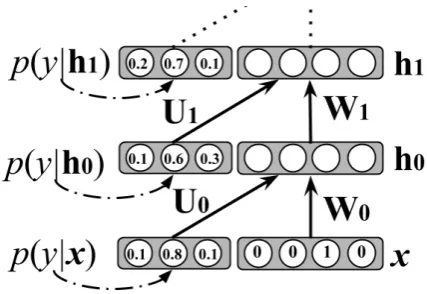
[image:3.595.310.524.60.207.2]To construct anN-layer SBEN (orN-SBEN), as was shown in (Ororbia II et al., 2015), one may learn a stack of HRBMs in one of two ways: (1) in a strict greedy, layer-wise manner, where lay-ers are each trained in isolation on all of the data samples one at a time from the bottom-up; or (2) in a more relaxed disjoint fashion, where all layers are trained together on all of the data but still in a
Figure 1: Architecture of the SBEN model. The model in feedforward mode can be viewed as a directed model, however, during training, connec-tions are bi-directional.
layer-wise bottom-up pass. To properly compute intermediate data representations during training and prediction in the SBEN, one must combine Equations 4 and 7. (The specific procedure for do-ing this can be found in the computeLayerwiseS-tatistics sub-routine in Algorithm 1.) This gives rise to the full SBEN architecture, which is de-picted in Figure 1.
3.1 Ensembling of Layer-Wise Experts
The SBEN may be viewed as a natural vertical en-semble of layer-wise “experts”, where each layer maps latent representations to predictions, which differs from standard methods such as boosting (Schapire, 1990). Traditional feedforward neural models propagate data through the final network to obtain an output predictionyt from a
penulti-mate layer for a givenxt. In contrast, this hybrid
model is capable of a producing a labelyn t at each
levelnforxt.
To vertically aggregate layer-wise expert out-puts, we compute a simple mean predictor,
p(y|x)ensemble, as follows:
p(y|x)ensemble= N1 N
X
n=1
p(y|x)n (9)
3.2 The Bottom-Up-Top-Down Learning Algorithm
With the SBEN architecture defined, we next present its simple two-step training algorithm, or the Bottom-Up-Top-Downprocedure (BUTD), which combines a greedy, bottom-up pass with a subsequent top-down fine-tuning step. At every iteration of training, the model makes use of a sin-gle labeled sample (taken from an available, small labeled data subset) and an example from either a large unlabeled pool or a data-stream. We describe each of the two phases in Sections 3.2.1 and 3.2.2.
3.2.1 Bottom-Up Layer-wise Learning (BU)
The first phase of N-SBEN learning consists of a bottom-up pass where each layerwise HRBM can be trained using a compound objective func-tion. Data samples are propagated up the model to the layer targeted for layer-wise training using the feedforward schema described above. Each HRBM layer of the SBEN is greedily trained us-ing the frozen latent representations of the one be-low, which are generated by using the lower level expert’s input and prediction. The loss function for each layer balances a discriminative objective
Ldisc, a supervised generative objectiveLgen, and
an unsupervised generative objectiveLunsup, fully
defined as follows:
Lsemi(Dtrain,Dunlab) =γLdisc(Dtrain)
+αLgen(Dtrain)
+βLunsup(Dunlab)
(10)
Unlike generative pre-training of neural architec-tures (Bengio et al., 2007), the additional free pa-rameters γ, α, and β offer explicit control over the extent to which the final parameters discovered are influenced by generative learning (Larochelle et al., 2012; Ororbia II et al., 2015). More im-portantly, the generative objectives may be viewed as providing data-dependent regularization on the discriminative learning gradient of each layer.
The objectives themselves are defined as:
Ldisc(Dtrain) =− |DXtrain|
t=1
logp(y|xt), (11)
Lgen(Dtrain) =− |DXtrain|
t=1
logp(yt,xt), and (12)
Lunsup(Dunlab) =− |DXunlab|
t=1
logp(xt) (13)
where Dtrain = {(xt, y)} is the labeled training
data-set and Dunlab = {(ut)} is the unlabeled
training data-set. The gradient for Ldisc may be
computed directly, which follows the general form
∂logp(yt|x)
∂θ =−Eh|yt,xt "
∂
∂θ(E(yt,xt,h))
#
+Ey,h|,x "
∂
∂θ(E(y,x,h))
#
(14) and can be calculated directly (see Larochelle et al., 2012 , for details) or through a form of Drop-ping, such as Drop-Out orDrop-Connect (Tom-czak, 2013). The generative gradients themselves follow the form
∂logp(yt,x)
∂θ =−Eh|yt,xt "
∂
∂θ (E(yt,xt,h))
#
+Ey,x,h "
∂
∂θ(E(y,x,h))
#
(15) and, despite being intractable for any sample
(xt, yt), may be approximated via the contrastive
divergence procedure (Hinton, 2002). The in-tractable second expectation is replaced with a point estimate using a single Gibbs sampling step. To calculate the generative gradient for an unla-beled sampleu, a pseudo-label must be obtained by using a layer-wise HRBM’s current estimate of
p(y|u), which can be viewed as a form of self-training or Entropy Regularization (Lee, 2013). The online procedure for computing the genera-tive gradient (either labeled or unlabeled example) for a single HRBM can be found in Ororbia et al., (2015).
Algorithm 1Top-down fine-tuning of anN-SBEN (ensemble back-propagation). Note that “·” indicates a Hadamard product,ξis an error signal vector, the prime superscript indicates a derivative (i.e.,σ0means
derivative function of the sigmoid), andbzis the symbol for linear pre-activation values.
Input:(xt, yt)∈ D, learning rateλand model parametersΘ ={Θ1,Θ2, ...,ΘN}
functionFINETUNEMODEL((xt, yt),λ,Θ)
Ω← ∅,xn←xt,yn← ∅ .Initialize list of layer-wise model statistics & variables
//Conduct feed-forward pass to collect layer-wise statistics
forΘn∈Θdo
(hn,bzn, ynh,xn)← COMPUTELAYERWISESTATISTICS(xn,Θn)
Ωn←(hn,bzn, yhn,xn),xn←hn,yn←yhn
//Conduct error back-propagation pass to adjust layer-wise parameters
ξl← ∅
forl←N, l−−, while l≥1do
(hl,bzl, yhl,xl)←Ω[l] .Grab relevant statistics for layerlof model
ifi=N then
(5disc, ξl)←COMPUTEDISCIMINATIVEGRADIENT(yt,xl,∅,hn,bz,Θl)
else
ξl←ξl·σ0(bzl)
(5disc, ξl)←COMPUTEDISCIMINATIVEGRADIENT(yt,xl, ξl,hn,bz,Θl)
Θn←Θn−λ(5disc)
functionCOMPUTELAYERWISESTATISTICS(xt,Θn)
yh
t ←p(yt|xt,Θn) .Equation 7 under the layerwise model
bz←c+Wxt+Ueyt .Can re-usebzto perform next step
ht∼p(h|yth,xt,Θn) .Equation 4 under the layerwise model
return(ht,bz, yht,xt)
functionCOMPUTEDISCIMINATIVEGRADIENT(yt,xl, ξl,hn,bz,Θl)
o←p(y|hn,Θl),ξ←softmax0(o)· −(yt/o)
5U ←ξhTn,5d←ξ,ξ ←Uξ,ξ←ξ·σ0(bz)
ifξl6=∅then
ξ ←ξ·ξl
5W ←ξxTl ,5c←ξ,5b ←0,5U ← 5U + (ξeTyt),ξ ←WTξ
return(5 ←(5W,5U,5b,5c,5d), ξ)
Dunsup, and 2) by setting γ = 1 with α freely
varying (which recovers the model of Ororbia et al., 2015). In both scenarios,β is allowed to vary as a user-defined hyper-parameter. The second set-ting of γ allows for training the SBEN directly with only the bottom-up phase defined in this tion. However, if the first setting is used, a sec-ond phase may be used to incorporate a top-down fine-tuning phase. A bottom-up pass simply en-tails computing this compound gradient for each layer of the model for 1 or 2 samples per training iteration. Notice that the first scenario reduces the number of hyper-parameters to explore in model selection, requiring only an appropriate value for
βto be found.
3.2.2 Top-Down Fine-tuning (TD)
Algorithm 2TheBottom-Up-Top-Downtraining procedure for learning anN-SBEN.
Input:(xt, yt)∈ Dtrain,(ut)∈ Dunlab, ratesλ&β,p¯, & parametersΘ ={Θ1,Θ2, ...,ΘN}
functionBOTTOMUPTOPDOWN((yt,xt,ut,λ,β,Θ)
APPLYBOTTOMUPPASS(yt,xt,ut,λ,γ = 0,α= 1,β,Θ) .See (Ororbia II et al., 2015)
//Up to two calls can be made to the top-down tuning routine
FINETUNEMODEL(xt, yt,λ,Θ) .See Algorithm 1 for details
vt←pensemble(y|x,Θn) .Calculate pseudo-label probability using Equation 9
ifmax[vt]>p¯then
vt← TOONEHOT(vt) .Convert to 1-hot vector using argmax of model conditionals
FINETUNEMODEL(ut,vt,λ,Θ)
features being constructed in the bottom-up learn-ing step. Furthermore, errors from experts above are propagated down to lower layers, which were initially frozen during the greedy, bottom-up train-ing phase.
Fine-tuning in the context of training an SBEN is different from using a pre-trained MLP that is subsequently fine-tuned with back-propagation. First, since the SBEN is a more complex architec-ture than an MLP, pre-initializing an MLP would be insufficient given that one would be tossing po-tentially useful information stored in the SBEN’s class filters (and corresponding class bias vectors) of each layer-wise expert (i.e.,U andd). Second, merely using the SBEN as an intermediate model ignores the fact the SBEN can already perform classification directly. To avoid losing such infor-mation and to fully exploit the model’s predictive ability, we adapt the back-propagation algorithm for training MLP’s to operate on the SBEN, which we shall call ensemble back-propagation since the fine-tuning method propagates error deriva-tives down the network from many points of entry. Ensemble back-propagation is described in Algo-rithm 1.
With this second online training step, the
Bottom-Up-Top-Down(BUTD) training algorithm for fully training an SBEN proceeds with a sin-gle bottom-up modification step followed by a single top-down joint fine-tuning step using the
ensemble back-propagation procedure defined in Algorithm 1 for each training time step. A full top-down phase can consist of up to two calls to the ensemble back-propagation procedure. One is used to jointly modify the SBEN’s parame-ters with respect to the sample taken fromDtrain.
A second one is potentially needed to tune pa-rameters with respect to the sample drawn from
Dunlab. For the unlabeled sample, if the
high-est class probability assigned by the SBEN
(us-ing Equation 9) is greater than a pre-set threshold (i.e.,max[pensemble(y|u)]>p¯), a pseudo-label is
created for that sample by converting the model’s mean vector to a 1-hot encoding. The probability thresholdp¯for the potential second call to the en-semble back-propagationroutine allows us to in-corporate a tunable form of pseudo-labeling (Lee, 2013) into theBottom-Up-Top-Downlearning al-gorithm.
The high-level view of theBUTDlearning algo-rithm is depicted in Algoalgo-rithm 2.
4 Experimental Results
We investigate the viability of our deep hybrid ar-chitecture for semi-supervised text categorization. Model performance was evaluated on the WebKB data-set1and a small-scale version of the 20News-Group data-set2.
The original WebKB collection contains pages from a variety of universities (Cornell, Texas, Washington, and Wisconsin as well as miscella-neous pages from others). The 4-class classifica-tion problem we defined using this data-set was to determine if a web-page could be identified as one belonging to a Student, Faculty, Course, or a Project, yielding a subset of usable 4,199 sam-ples. We applied simple pre-processing to the text, namely stop-word removal and stemming, chose to leverage only the k most frequently occurring terms (this varied across the two experiments), and binarized the document low-level representation (only 1 page vector was discarded due to pres-ence of 0 terms). The 20NewsGroup data-set, on the other hand, contained 16242 total samples and was already pre-processed, containing 100 terms, binary-occurrence low-level representation, with
1The exact data-set we used can be found and downloaded at http://www.cs.cmu.edu/afs/cs/project/theo-20/www/data/
tags for the four top-most highest level domains or meta-topics in the newsgroups array.
For both data-sets, we evaluated model gen-eralization performance using a stratified 5-fold cross-validation (CV) scheme. For each possible train/test split, we automatically partitioned the training fold into separate labeled, unlabeled, and validation subsets using stratified random sam-pling without replacement. Generalization perfor-mance was evaluated by estimating classification error, average precision, average recall, and av-erage F-Measure, where F-Measure was chosen to be the harmonic mean of precision and recall,
F1 = 2(precision·recall)/(precision + recall).
4.1 Model Designs
We evaluated the BUTD version of our model, the 3-SBEN,BUTD, as described in Algorithm 2. For simplicity, the number of latent variables at each level of the SBEN was held equal to the di-mensionality of the data (i.e., a complete repre-sentation). We compared this model trained with
BUTDagainst a version utilizing only the bottom-up phase (3-SBEN,BU) as in Ororbia et al. (2015). Both SBEN models contained 3 layers of latent variables.
We compared against an array of baseline clas-sifiers. We used our implementation of an incre-mental version of Maximum Entropy, or MaxEnt-ST (which, as explained in Sarikaya et al., 2014, is equivalent to a softmax classifier). Further-more, we used our implementation of the Pega-sos algorithm (SVM-ST) (Shalev-Shwartz et al., 2011) which was extended to follow a proper multi-class scheme (Crammer and Singer, 2002). This is the online formulation of the SVM, trained via sub-gradient descent on the primal objective followed by a projection step (for simplicity, we opted to using a linear-kernel). Additionally, we implemented a semi-supervised Bernoulli Naive Bayes classifier (NB-EM) trained via Expectation-Maximization as in (Nigam et al., 1999). We also compared our model against the HRBM (Larochelle and Bengio, 2008) (effectively a sin-gle layer SBEN), which serves as a powerful, non-linear shallow classifier in of itself, as well as a 3-layer sparse deep Rectifier Network (Glorot et al., 2011a), or Rect, composed of leaky rectifier units.
All shallow classifiers (except NB-EM and the HRBM) were extended to the semi-supervised
set-Number of Labeled Samples
Mean CV Error
32 84 168 504 840 1512 2520
0.10
0.15
0.20
0.25
0.30
[image:7.595.306.522.83.282.2]Model Types SVM−ST SBEN−BU SBEN−BUTD
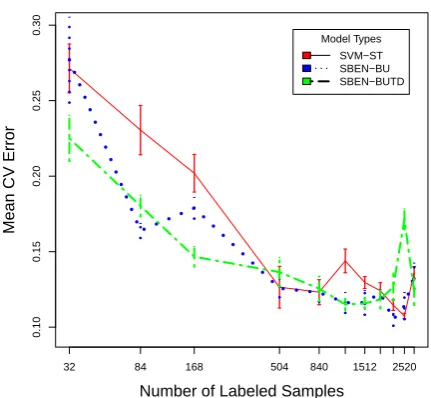
Figure 2: Mean CV generalization performance as a function of labeled sample subset size (using 200 features).
ting by leveraging a simple self-training scheme in order to learn from unlabeled data samples. The self-training scheme entailed using a classifier’s estimate of p(y|u) for an unlabeled sample and, if max[p(y|u)] > p¯, we created a 1-hot proxy encoding using the argmax of model’s predictor, wherep¯is a threshold meta-parameter. Since we found this simple pseudo-labeling approach, sim-ilar in spirit to (Lee, 2013), to improve the results for all classifiers, and thus we report all results uti-lizing this scheme.3 All classes of models (SBEN,
HRBM,Rect,SVM-ST, MaxEnt-ST,NB-ST) were subject to the same model selection procedure de-scribed in the next section.
4.2 Model Selection
Model selection was conducted using a paral-lelized multi-setting scheme, where a configura-tion file for each model was specified, describing a set of hyper-parameter combinations to explore (this is akin to a course-grained grid search, where the points of model evaluation are set manually a priori). For the SBEN’s, we varied the learning rate ([0.01,0.25]) andβcoefficient ([0.1,1.0]) and
Table 1: WEBKB categorization results on 1% of the training data labeled (8 examples per class), rest unlabeled (i.e., 5-fold means with standard error of the mean, 250 features).
Error Precision Recall F1-Score NB-EM 0.369±0.039 0.684±0.022 0.680±0.028 0.625±0.043 MaxEnt-ST 0.402±0.026 0.623±0.025 0.593±0.015 0.583±0.020 SVM-ST 0.342±0.020 0.663±0.010 0.665±0.014 0.644±0.015 HRBM 0.252±0.023 0.740±0.019 0.765±0.016 0.741±0.021 3-Rect 0.328±0.020 0.673±0.017 0.680±0.021 0.654±0.023 3-SBEN,BU 0.239±0.015 0.754±0.014 0.780±0.016 0.754±0.015 3-SBEN,BUTD 0.210±0.011 0.786±0.009 0.784±0.014 0.777±0.012
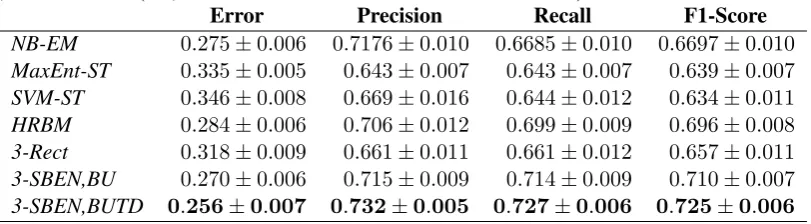
Table 2: 20NewsGroup data-set categorization results on 1% of the training data labeled (8 examples per class), rest unlabeled (i.e., 5-fold means with standard error of the mean).
Error Precision Recall F1-Score NB-EM 0.275±0.006 0.7176±0.010 0.6685±0.010 0.6697±0.010 MaxEnt-ST 0.335±0.005 0.643±0.007 0.643±0.007 0.639±0.007 SVM-ST 0.346±0.008 0.669±0.016 0.644±0.012 0.634±0.011 HRBM 0.284±0.006 0.706±0.012 0.699±0.009 0.696±0.008 3-Rect 0.318±0.009 0.661±0.011 0.661±0.012 0.657±0.011 3-SBEN,BU 0.270±0.006 0.715±0.009 0.714±0.009 0.710±0.007 3-SBEN,BUTD 0.256±0.007 0.732±0.005 0.727±0.006 0.725±0.006
experimented with stochastic and mean-field ver-sions of the models4(we found that mean-field did slightly better for this experiment and thus report the performance of this model in this paper). The HRBM’s meta-parameters were tuned using a sim-ilar set-up to (Larochelle et al., 2012) with learn-ing rate varied in ([0.01,0.25]), α in ([0.1,0.5]), and β in ({0.01,0.1}). For the SVM-ST algo-rithm, we tuned its slack variableλ, searching in the interval[0.0001,0.5], forMaxEnt-STits learn-ing rate in [0.0001,0.1], and for p¯of all models (shallow and deep) that used pseudo-labeling we searched the interval [0.1,1.0]. All models of all configurations were trained for a 10,000 iteration sweep incrementally on the data and the model state with lowest validation error for that partic-ular run was used. The SBEN, HRBM, and Rect
models were also set to use a momentum term of
0.9 (linearly increased from 0.1 in the first 1000 training iterations) and theRect model made use of a smallL1 regularization penalty to encourage additional hidden sparsity. For a data-set like the 20NewsGroup, which contained a number of unla-beled samples greater than training iterations, we view our schema as simulating access to a
data-4Mean-field simply means no sampling steps were taken after computing probability vectors, or “means” in any stage of the computation.
stream, since all models had access to any given unlabeled example only once during a training run.
4.3 Model Performance
[image:8.595.97.503.250.362.2]pseudo-Table 3: Top-most words that the SBEN (BUTD) model associates with the 4 NewsGroup meta-topics.
Meta-Topic Associated Terms
comp.* windows, graphics, card, driver, scsi, dos, files, display rec.* players, hockey, season, nhl, team, league, baseball, games sci.* orbit, shuttle, space, earth, mission, nasa, moon, doctor talk.* jews, christian, religion, jesus, bible, war, israel, president
labeling steps (as in the top-down phase), there is greater risk of reinforcing incorrect predictions in the pseudo-joint 5 tuning of layerwise expert pa-rameters. For text collections where most of the data is labeled and unlabeled data is minimal, only a simple bottom-up pass is needed to learn a good hybrid model of the data.
The next set of experiments was conducted with only 1% of the training sets labeled. We observe (Tables 1 and 2) that our deep hybrid architec-ture trained viaBUTDoutperforms all other mod-els with respect to all performance metrics. While the SBEN trained with simply an online bottom-up performs significantly better than the SVM model, we note a further reduction of error using our pro-posed BUTD training procedure. The additional top-down phase serves as a mechanism for uni-fying the layer-wise experts, where error signals for both labeled and pseudo-labeled examples in-crease agreement among all model layer experts.
For the 20NewsGroup data-set, we conducted a simple experiment to uncover some of the knowl-edge acquired by our model with respect to the tar-get categorization task. We applied the mechanism from (Larochelle et al., 2012) to extract the vari-ables that are most strongly associated with each of the clamped target variables in the lowest layer of a BUTD-trained SBEN. The top-scored terms associated with each class variable are shown in Table 3, using the 10 hidden nodes most highly triggered by the clamped class node, in a model trained on all of the 20NewsGroup data using a model configuration determined from CV results for the 20NewsGroup data-set reported in the pa-per. Since the SBEN is a composition of layer-wise experts each capable of classification, we note that this procedure could be applied to each level to uncover which unobserved variables are most strongly associated with each class target. We speculate that this could serve the basis for
un-5We use the phrase “pseudo-joint” to differentiate a model that has all its parameters trained jointly from our own, where only the top-down phase ofBUTDintroduces any form of joint parameter modification.
covering the model’s underlying learnt hierarchy of the data and be potentially used for knowledge extraction, a subject for future work in analyzing black box neural models such as our own.
5 Conclusions
We presented the Bottom-Up-Top-Down proce-dure for training the Stacked Boltzmann Experts Network, a hybrid architecture that balances both discriminative and generative learning goals, in the context of semi-supervised text categorization. It combines a greedy, layer-wise bottom-up ap-proach with a top-down fine-tuning method for pseudo-joint modification of parameters.
Models were evaluated using two text corpora: WebKB and 20NewsGroup. We compared re-sults against several baseline models and found that our hybrid architecture outperformed the oth-ers in all settings investigated. We found that the SBEN, especially when trained with the full
Bottom-Up-Top-Down learning procedure could in some cases improve classification error by as much39%over the Pegasos SVM, and nearly17%
over the HRBM, especially when data is in very limited supply. While we were able to demon-strate the viability of our hybrid model when using only simple surface statistics of text, future work shall include application of our models to more semantic-oriented representations, such as those leveraged in building log-linear language models (Mikolov et al., 2013).
Acknowledgments
References
Yoshua Bengio, Pascal Lamblin, Dan Popovici, Hugo Larochelle, et al. 2007. Greedy layer-wise training of deep networks. Advances in neural information processing systems, 19:153.
Yoshua Bengio. 2012. Deep learning of representa-tions for unsupervised and transfer learning. Jour-nal of Machine Learning Research–Workshop and Conference Proceedings, 27:17–37.
Avrim Blum and Tom Mitchell. 1998. Combin-ing labeled and unlabeled data with co-trainCombin-ing. In Proceedings of the Eleventh Annual Conference on Computational Learning Theory, pages 92–100. ACM.
Roberto Calandra, Tapani Raiko, Marc Peter Deisen-roth, and Federico Montesino Pouzols. 2012. Learning Deep Belief Networks from Non-stationary Streams. In Artificial Neural Networks and Machine Learning - ICANN 2012, number 7553 in Lecture Notes in Computer Science, pages 379–386. Springer Berlin Heidelberg.
Cornelia Caragea, Jian Wu, Kyle Williams, Sujatha Das, Madian Khabsa, Pradeep Teregowda, and C. Lee Giles. 2014. Automatic identification of research articles from crawled documents. In Pro-ceedings of the Workshop: Web-Scale Classifica-tion: Classifying Big Data from the Web, New York, NY.
Noam Chomsky. 1980. Rules and representations. Be-havioral and brain sciences, 3(01):1–15.
Corinna Cortes and Vladimir Vapnik. 1995. Support-vector networks. 20(3):273–297.
Koby Crammer and Yoram Singer. 2002. On the algo-rithmic implementation of multiclass kernel-based vector machines. The Journal of Machine Learning Research, 2:265–292.
Xavier Glorot, Antoine Bordes, and Yoshua Bengio. 2011a. Deep sparse rectifier networks. In Proc. 14th International Conference on Artificial Intelli-gence and Statistics, volume 15, pages 315–323. Xavier Glorot, Antoine Bordes, and Yoshua Bengio.
2011b. Domain Adaptation for Large-scale Senti-ment Classification: A Deep Learning Approach. In
Proceedings of the 28th International Conference on Machine Learning (ICML-11), pages 513–520. Sujatha Das Gollapalli, Cornelia Caragea, Prasenjit
Mitra, and C. Lee Giles. 2013. Researcher Home-page Classification Using Unlabeled Data. In Pro-ceedings of the 22Nd International Conference on World Wide Web, WWW ’13, pages 471–482. In-ternational World Wide Web Conferences Steering Committee.
Johan Hastad. 1987. Computational limitations of small-depth circuits. MIT press.
Geoffrey E. Hinton, Simon Osindero, and Yee-Whye Teh. 2006. A Fast Learning Algorithm for Deep Belief Nets. Neural computation, 18(7):1527–1554.
Geoffrey E. Hinton, Nitish Srivastava, Alex Krizhevsky, Ilya Sutskever, and Ruslan R. Salakhut-dinov. 2012. Improving neural networks by preventing co-adaptation of feature detectors. arXiv preprint arXiv:1207.0580.
Geoffrey E. Hinton. 2002. Training Products of Ex-perts by Minimizing Contrastive Divergence. Neu-ral Computation, 14(8):1771–1800.
Hugo Larochelle and Yoshua Bengio. 2008. Classi-fication using Discriminative Restricted Boltzmann Machines. InProceedings of the 25th International Conference on Machine Learning, pages 536–543, Helsinki, Finland.
Hugo Larochelle, Michael Mandel, Razvan Pascanu, and Yoshua Bengio. 2012. Learning Algorithms for the Classification Restricted Boltzmann Ma-chine. The Journal of Machine Learning Research, 13:643–669.
Chen-Yu Lee, Saining Xie, Patrick Gallagher, Zhengyou Zhang, and Zhuowen Tu. 2014. Deeply-Supervised Nets. arXiv:1409.5185 [cs, stat].
Dong-Hyun Lee. 2013. Pseudo-label: The Simple and Efficient Semi-supervised Learning Method for Deep Neural Networks. InWorkshop on Challenges in Representation Learning, ICML, Atlanta, GA.
Tao Liu. 2010. A Novel Text Classification Approach Based on Deep Belief Network. InProceedings of the 17th International Conference on Neural Infor-mation Processing: Theory and Algorithms - Volume Part I, ICONIP’10, pages 314–321. Springer-Verlag.
Zhengdong Lu and Hang Li. 2013. A Deep Architec-ture for Matching Short Texts. In C. J. C. Burges, L. Bottou, M. Welling, Z. Ghahramani, and K. Q. Weinberger, editors, Advances in Neural Informa-tion Processing Systems 26, pages 1367–1375. Cur-ran Associates, Inc.
Shixiang Lu, Zhenbiao Chen, and Bo Xu. 2014. Learning new semi-supervised deep auto-encoder features for statistical machine translation. In Pro-ceedings of the 52nd Annual Meeting of the Associa-tion for ComputaAssocia-tional Linguistics, volume 1, pages 122–132, Baltimore, MD.
Kamal Nigam, John Lafferty, and Andrew McCallum. 1999. Using maximum entropy for text classifica-tion. InIJCAI-99 workshop on Machine Learning for Information Filtering, volume 1, pages 61–67. Alexander G. Ororbia II, David Reitter, Jian Wu, and
C. Lee Giles. 2015. Online learning of deep hybrid architectures for semi-supervised categorization. In
ECML PKDD, Porto, Portugal. Springer.
Geoffrey K Pullum and Barbara C Scholz. 2002. Em-pirical assessment of stimulus poverty arguments.
The linguistic review, 18(1-2):9–50.
Ruslan Salakhutdinov and Geoffrey Hinton. 2009. Se-mantic hashing. International Journal of Approxi-mate Reasoning, 50(7):969–978, July.
R. Sarikaya, G.E. Hinton, and A. Deoras. 2014. Application of Deep Belief Networks for Natu-ral Language Understanding. IEEE/ACM Transac-tions on Audio, Speech, and Language Processing, 22(4):778–784.
Robert E. Schapire. 1990. The Strength of Weak Learnability. Machine learning, 5(2):197–227. Tanya Schmah, Geoffrey E. Hinton, Steven L. Small,
Stephen Strother, and Richard S. Zemel. 2008. Generative versus Discriminative Training of RBMs for classification of fMRI images. In Advances in neural information processing systems, pages 1409– 1416.
J¨urgen Schmidhuber. 2015. Deep learning in neural networks: An overview. Neural Networks, 61:85– 117.
Shai Shalev-Shwartz, Yoram Singer, Nathan Srebro, and Andrew Cotter. 2011. Pegasos: Primal Esti-mated Sub-gradient Solver for SVM. Mathematical programming, 127(1):3–30.
Richard Socher, Jeffrey Pennington, Eric H. Huang, Andrew Y. Ng, and Christopher D. Manning. 2011. Semi-supervised recursive autoencoders for predict-ing sentiment distributions. In Proceedings of the Conference on Empirical Methods in Natural Lan-guage Processing, pages 151–161. Association for Computational Linguistics.
Amarnag Subramanya and Jeff Bilmes. 2008. Soft-supervised learning for text classification. In Em-pirical Methods in Natural Language Processing, pages 1090–1099.
Michael Tomasello. 2001. Perceiving intentions and learning words in the second year of life. In Melissa Bowerman and Stephen Levinson, editors,
Language acquisition and conceptual development, pages 132–158.
Jakub M. Tomczak. 2013. Prediction of Breast Cancer Recurrence using Classification Restricted Boltzmann Machine with Dropping. arXiv preprint arXiv:1308.6324.
Pascal Vincent, Hugo Larochelle, Isabelle Lajoie, Yoshua Bengio, and Pierre-Antoine Manzagol. 2010. Stacked Denoising Autoencoders: Learning Useful Representations in a Deep Network with a Local Denoising Criterion. The Journal of Machine Learning Research, 11:3371–3408.
Junbo Zhang, Guangjian Tian, Yadong Mu, and Wei Fan. 2014. Supervised Deep Learning with Aux-iliary Networks. In Proceedings of the 20th ACM SIGKDD International Conference on Knowledge Discovery and Data Mining, KDD ’14, pages 353– 361, New York City, New York. ACM.