Proceedings of the 2018 Conference on Empirical Methods in Natural Language Processing (System Demonstrations), pages 120–126 120
Magnitude: A Fast, Efficient Universal Vector Embedding Utility Package
Ajay Patel Plasticity Inc. San Francisco, CA [email protected]
Alexander Sands Plasticity Inc. San Francisco, CA [email protected]
Chris Callison-Burch Computer and Information
Science Department University of Pennsylvania
Marianna Apidianaki LIMSI, CNRS Universit´e Paris-Saclay
91403 Orsay, France [email protected]
Abstract
Vector space embedding models like word2vec, GloVe, fastText, and ELMo are extremely popular representations in natural language processing (NLP) applications. We present Magnitude, a fast, lightweight tool for utilizing and processing embeddings. Magnitude is an open source Python package with a compact vector storage file format that allows for efficient manipulation of huge numbers of embeddings. Magnitude performs common operations up to 60 to 6,000 times faster than Gensim. Magnitude introduces several novel features for improved robustness like out-of-vocabulary lookups.
1 Introduction
Magnitude is an open source Python package de-veloped by Ajay Patel and Alexander Sands (Patel and Sands,2018). It provides a full set of features and a new vector storage file format that make it possible to use vector embeddings in a fast, ef-ficient, and simple manner. It is intended to be a simpler and faster alternative to current utilities for word vectors like Gensim (Reh˚uˇrek and Sojkaˇ ,
2010).
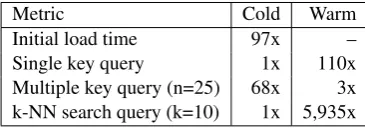
Magnitude’s file format (“.magnitude”) is an ef-ficient universal vector embedding format. The Magnitude library implements on-demand lazy loading for faster file loading, caching for bet-ter performance of repeated queries, and fast pro-cessing of bulk key queries. Table1 gives speed benchmark comparisons between Magnitude and Gensim for various operations on the Google News pre-trained word2vec model (Mikolov et al.,
2013). Loading the binary files containing the word vectors takes Gensim 70 seconds, versus 0.72 seconds to load the corresponding Magnitude
Metric Cold Warm
[image:1.595.324.507.261.325.2]Initial load time 97x – Single key query 1x 110x Multiple key query (n=25) 68x 3x k-NN search query (k=10) 1x 5,935x
Table 1: Speed comparison of Magnitude versus Gen-sim for common operations. The ‘cold’ column repre-sents the first time the operation is called. The ‘warm’ column indicates a subsequent call with the same keys.
file, a 97x speed-up. Gensim uses 5GB of RAM versus 18KB for Magnitude.
Magnitude implements functions for looking up vector representations for misspelled or out-of-vocabulary words, quantization of vector models, exact and approximate similarity search, concate-nating multiple vector models together, and ma-nipulating models that are larger than a computer’s main memory. Magnitude’s ease of use and simple interface combined with its speed, efficiency, and novel features make it an excellent tool for cases ranging from applications used in production envi-ronments to academic research to students in nat-ural language processing courses.
2 Motivation
Magnitude offers solutions to a number of prob-lems with current utilities.
Memory: A production web server will run multiple processes for serving requests. Running Gensim, in the same configuration, will consume
>4GB of RAM usage per process.
Code duplication: Many developers duplicate effort by writing commonly used routines that are not provided in current utilities. Namely, routines for concatenating embeddings, bulk key lookup, out-of-vocabulary search, and building indexes for approximate k-nearest neighbors.
The Magnitude library uses several well-engineered libraries to achieve its performance im-provements. It uses SQLite1 as its underlying data store, and takes advantage of database in-dexes for fast key lookups and memory mapping. It uses NumPy2to achieve significant performance speedups over native Python code using compu-tations that follow the Single Instruction, Multi-ple Data (SIMD) paradigm. It uses spatial in-dexes to perform fast exact similarity search and Annoy3 to perform approximate k-nearest neigh-bors in the vector space. To perform feature hashing, it uses xxHash4, an extremely fast non-cryptographic hash algorithm, working at speeds close to RAM limits. Magnitude’s file format uses LZ4 compression5for compact storage.
3 Design Principles
Several design principles guided the development of the Magnitude library:
• The API should be intuitive and beginner friendly. It should have sensible defaults in-stead of requiring configuration choices by the user. The option to configure every set-ting should still be provided to power users.
• The out of the box configuration should be fast and memory efficient for iterative devel-opment. It should be suitable for deployment in a production environment. Using the same configuration in development and production reduces bugs and makes deployment easier.
• The library should use lazy loading whenever possible to remain fast, responsive, and mem-ory efficient during development.
1
https://www.sqlite.org/ 2http://www.numpy.org/
3https://github.com/spotify/annoy 4
https://xxhash.org/ 5http://www.lz4.org/
• The library should aggressively index, cache, and use memory maps to be fast, responsive, and memory efficient for production.
• The library should be able to process data that is too large to fit into a computer’s main memory.
• The library should be thread-safe and employ memory mapping to reduce duplicated mem-ory resources when multiprocessing.
• The interface should act as a generic key-vector store and remain agnostic to underly-ing models (like word2vec, GloVe, fastText, and ELMo) and remain useable for other do-mains that use vector embeddings like com-puter vision (Babenko and Lempitsky,2016).
Gensim offers several speed ups of its opera-tions, but these are largely only accessible through advanced configuration. For example, by re-exporting a “.bin”, “.txt”, or “.vec” file into its own native format that can be memory-mapped. Magnitude makes this easier by providing a de-fault configuration and file format that requires no extra configuration to make development and pro-duction workloads run efficiently out of the box.
4 Getting Started with Magnitude
The system consists of a Python 2.7 and Python 3.x compatible package (accessible through the PyPI index6 or GitHub7) with utilities for using the “.magnitude” format and converting to it from other popular embedding formats.
4.1 Installation
Installation for Python 2.7 can be performed using thepipcommand:
pip install pymagnitude
Installation for Python 3.x can be performed using thepip3command:
pip 3 install pymagnitude
4.2 Basic Usage
Here is how to construct the Magnitude object, query for vectors, and compare them:
from pymagnitude import ∗
vectors = Magnitude(" w2v . magnitude ") k = vectors . query (" king ")
q = vectors . query (" queen ")
vectors . similarity (k ,q) # 0.6510958
Magnitude queries return almost instantly and are memory efficient. It uses lazy loading di-rectly from disk, instead of having to load the en-tire model into memory. Additionally, Magnitude supports nearest neighbors operations, finding all words that are closer to a key than another key, and analogy solving (optionally withLevy and Gold-berg(2014)’s 3CosMul function):
vectors . most similar (k , topn =5) #[( ‘ king ’, 1.0) , (‘ kings ’, 0.71) , # (‘ queen ’, 0.65) , (‘ monarch ’, 0.64) , # (‘ crown prince ’, 0.62)]
vectors . most similar (q , topn =5) #[( ‘ queen ’, 1.0) , (‘ queens ’, 0.74) , #(‘ princess ’, 0.71) , (‘ king ’, 0.65) , # (’ monarch ’, 0.64)]
vectors . closer than (" queen ", " king ") #[‘ queens ’, ‘ princess ’]
vectors . most similar (
positive = [" woman ", " king "], negative = [" man "]
) # queen
vectors . m o s t s i m i l a r c o s m u l (
positive = [" woman ", " king "], negative = [" man "]
) # queen
In addition to querying single words, Magnitude also makes it easy to query for multiple words in a single sentence and multiple sentences:
vectors . query (" play ")
# Returns : a vector for the word vectors . query ([" play ", " music "]) # Returns : an array with two vectors vectors . query ([
[" play ", " music "],
[" turn ", " on ", " the ", " lights "], ]) # Returns : 2D array with vectors
4.3 Advanced Features
OOVs: Magnitude implements a novel method for handling out-of-vocabulary (OOV) words. OOVs frequently occur in real world data since pre-trained models are often missing slang, col-loquialisms, new product names, or misspellings. For example, while uber exists in Google News word2vec, uberxanduberxldo not. These prod-ucts were not available when Google News cor-pus was built. Strategies for representing these words include generating random unit-length vec-tors for each unknown word or mapping all un-known words to a token like “UNK” and repre-senting them with the same vector. These
solu-tions are not ideal as the embeddings will not cap-ture semantic information about the actual word. Using Magnitude, these OOV words can be simply queried and will be positioned in the vector space close to other OOV words based on their string similarity:
" uber " in vectors # True " uberx " in vectors # False " uberxl " in vectors # False vectors . query (" uberx ")
# Returns : [ 0.0507 , −0.0708 , ...] vectors . query (" uberxl ")
# Returns : [ 0.0473 , −0.08237 , ...] vectors . similarity (" uberx ", " uberxl ")
# Returns : 0.955
A consequence of generating OOV vectors is that misspellings and typos are also sensibly handled: " missispi " in vectors # False
" discrimnatory " in vectors # False " hiiiiiiiiii " in vectors # False vectors . similarity (
" missispi ",
" mississippi "
) # Returns : 0.359 vectors . similarity (
" discrimnatory ",
" discriminatory "
) # Returns : 0.830 vectors . similarity (
" hiiiiiiiiii ",
" hi "
) # Returns : 0.706
The OOV handling is detailed in Section5.
Concatenation of Multiple Models: Magni-tude makes it easy to concatenate multiple types of vector embeddings to create combined models. w2v = Magnitude(" w2v .300 d. magnitude ") gv = Magnitude(" glove .50 d. magnitude ") vectors = Magnitude(w2v , gv ) # concat vectors . query (" cat ")
# Returns : 350 d NumPy array
# ’cat ’ from w2v and ’cat ’ from gv vectors . query ((" cat ", " cats ")) # Returns : 350 d NumPy array
# ’cat ’ from w2v and ’cats ’ from gv
Adding Features for Part-of-Speech Tags and Syntax Dependencies to Vectors: Magnitude can directly turn a set of keys (like a POS tag set) into vectors. Given an approximate upper bound on the number of keys and a namespace, it uses the hashing trick (Weinberger et al.,2009) to cre-ate an appropricre-ate length dimension for the keys.
p o s v e c s = FeaturizerMagnitude( 100 , namespace = " POS ")
p o s v e c s . dim # 4
# number of dims automatically # determined by Magnitude from 100 p o s v e c s . query (" NN ")
d e p v e c s = FeaturizerMagnitude( 100 , namespace = " Dep ")
d e p v e c s . dim # 4
Metric Speed
Exact k-NN 0.9155s
[image:4.595.71.291.255.367.2]Approx. k-NN (k=10, effort = 1.0) 0.1873s Approx. k-NN (k=10, effort = 0.1) 0.0199s
Table 2: Approximate nearest neighbors significantly speeds up similarity searches compared to exact search. Reducing the amount of allowed effort further speeds the approximate k-NN search.
This can be used with Magnitude’s concatena-tion feature to combine the vectors for words with the vectors for POS tags or dependency tags. Homonyms show why this may be useful:
vectors = Magnitude( vecs , pos vecs , d e p v e c s )
vectors . query ([
(" Buffalo ", " JJ ", " amod "), (" buffalo ", " NNS ", " nsubj "), (" Buffalo ", " JJ ", " amod "), (" buffalo ", " NNS ", " nsubj "), (" buffalo ", " VBP ", " rcmod "), (" buffalo ", " VB ", " ROOT "), (" Buffalo ", " JJ ", " amod "), (" buffalo ", " NNS ", " dobj ") ]) # array of 8 x (300 + 4 + 4)
Approximate k-NN We support approximate similarity search with the most similar approx
function. This finds the approximate nearest neighbors more quickly than the exact nearest neighbors search performed by themost similar
function. The method accepts an effort
argu-ment which accepts the range[0.0,1.0]. A lower
effort will reduce accuracy, but increase speed.
A highereffortdoes the reverse. This trade-off
works by searching more- or less-indexed trees. Our approximate k-NN is powered by Annoy, an open source library released by Spotify. Table2
compares the speed of various configurations for similarity search.
5 Details of OOV Handling
Facebook’s fastText (Bojanowski et al., 2016) provides similar OOV functionality to Magni-tude’s. Magnitude allows for OOV lookups for any embedding model, including older models like word2vec and GloVe (Mikolov et al., 2013; Pen-nington et al.,2014), which did not provide OOV support. Magnitude’s OOV method can be used with existing embeddings because it does not re-quire any changes to be made at training time like fastText’s method does. For ELMo vectors, Mag-nitude will use ELMo’s OOV method.
Constructing vectors from character n-grams: We generate a vector for an OOV wordwbased on the character n-gram sequences in the word. First, we pad the word with a character at the beginning of the word and at the end of the word. Next, we generate the set of all character-ngrams inw (de-noted with the fuction CGRAMw) between length
3 and 6, following Bojanowski et al. (2016), al-though these parameters are tunable arguments in the Magnitude converter. We use the set of char-acter n-grams C to construct a vector OOVd(w)
withddimensions to represent the wordw. Each unique character n-gram c from the word con-tributes to the vector through a pseudorandom vectorgenerator function PRVG. Finally, the vec-tor is normalized.
C =CGRAMw(3,6)
oovd(w) =
X
c∈C
PRVGH(c)(−1.0,1.0, d)
OOVd(w) =
oovd(w)
|oovd(w)|
PRVG’s random number generator is seeded by the value “seed”, which generates uniformly ran-dom vectors of dimension size d, with values in the range of -1 to 1. The hashing function H pro-duces a 32 bit hash of its input using xxHash. H : {0,1}∗ → {0,1}32. Since the PRVG’s seed
is only conditioned upon the wordw, the output is deterministic across different machines.
This character n-gram-based method will gener-ate highly similar vectors for a pair of OOVs with similar spellings, like uberx and uberxl. How-ever, they will not be embedded close to similar in-vocabulary words likeuber.
Interpolation with in-vocabulary words To handle matching OOVs to in-vocabulary words, we first define a function MATCHk(a, b, w).
MATCHk(a, b, w)returns the normalized mean of
in-vocabulary words:
oovd(w) = [0.3∗OOVd(w)
+ 0.7∗MATCH3(3,6, w)]
Morphology-aware matching For English, we have implemented a nuanced string similarity met-ric that is prefix- and suffix-aware. While uberifi-cation has a high string similarity to verification and has a lower string similarity to uber, good OOV vectors should weight stems more heavily than suffixes. Details of our morphology-aware matching are omitted for space.
Other matching nuances We employ other techniques when computing the string similarity metric, such as shrinking repeated character se-quences of three or more to two (hiiiiiiii → hii), ranking strings of a similar length higher, and ranking strings that share the same first or last character higher for shorter words.
6 File Format
To provide efficiency at runtime, Magnitude uses a custom “.magnitude” file format instead of “.bin”, “.txt”, “.vec”, or “.hdf5” that word2vec, GloVe, fastText, and ELMo use (Mikolov et al., 2013;
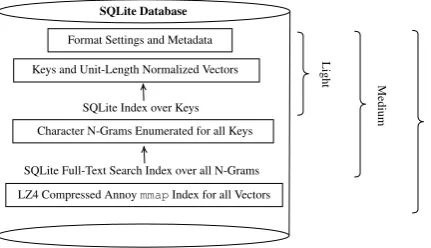
Pennington et al.,2014;Joulin et al.,2016;Peters et al., 2018). The “.magnitude” file is a SQLite database file. There are 3 variants of the file for-mat: Light, Medium, Heavy. Heavy models have the largest file size but support all of the Magni-tude library’s features. Medium models support all features except approximate similarity search. Light models do not support approximate similar-ity searches or interpolated OOV lookups, but they still support basic OOV lookups. See Figure1for more information about the structure and layout of the “.magnitude” format.
Keys and Unit-Length Normalized Vectors
SQLite Index over Keys
Character N-Grams Enumerated for all Keys
SQLite Full-Text Search Index over all N-Grams
LZ4 Compressed AnnoymmapIndex for all Vectors
SQLite Database
Light
Medium
Hea
vy
[image:5.595.75.291.592.716.2]Format Settings and Metadata
Figure 1: Structure of the “.magnitude” file format and its Light, Medium, and Heavy variants.
Converter The software includes a command-line converter utility for converting word2vec (“.bin”, “.txt”), GloVe (“.txt”), fastText (“.vec”), or ELMo (“.hdf5”) files to Magnitude files. They can be converted with the command:
python −m pymagnitude . converter −i " ./ vecs .( bin|txt|vec|hdf5 )"
−o " ./ vecs . magnitude "
The input format will automatically be determined by the extension and the contents of the input file. When the vectors are converted, they will also be unit-length normalized. This conversion process only needs to be completed once per model. Af-ter converting, the Magnitude file format is static and it will not be modified or written to in order to make concurrent read access safe.
By default, the converter builds a Medium “.magnitude” file. Passing the-sflag will turn off
encoding of subword information, and result in a Light flavored file. Passing the-aflag will turn on
building the Annoy approximate similarity index, and result in a Heavy flavored file. Refer to the documentation8 for more information about con-version configuration options.
Quantization The converter utility accepts a-p <PRECISION>flag to specify the decimal precision
to retain. Since underlying values are stored as integers instead of floats, this is essentially quan-tization9for smaller model footprints. Lower dec-imal precision will create smaller files, because SQLite can store integers with either 1, 2, 3, 4, 6, or 8 bytes.10 Regardless of the precision selected, the library will create numpy.float32
vectors. The datatype can be changed by pass-ingdtype=numpy.float16to theMagnitude
con-structor.
7 Conclusion
Magnitude is a new open source Python library and file format for vector embeddings. It makes it easy to integrate embeddings into applications and provides a single interface and configuration that is suitable for both development and produc-tion workloads. The library and file format also
8
https://github.com/plasticityai/ magnitude#file-format-and-converter
9
https://www.tensorflow.org/ performance/quantization
enable novel features like OOV handling that al-low models to be more robust to noisy data. The simple interface, ease of use, and speed of the li-brary, compared to other utilities like Gensim, will enable use by beginners to NLP and individuals in educational environments, such as university NLP and AI courses.
Pre-trained word embeddings have been widely adopted in NLP. Researchers in computer vision have started using pre-trained vector embedding models like Deep1B (Babenko and Lempitsky,
2016) for images. The Magnitude library intends to stay agnostic to various domains, instead pro-viding a generic key-vector store and interface that is useful for all domains and for research that crosses the boundaries between NLP and vi-sion (Hewitt et al.,2018).
8 Software and Data
We release the Magnitude package under the permissive MIT open source license. The full source code and pre-converted “.magnitude” mod-els are on GitHub. The full documentation for all classes, methods, and configurations of the li-brary can be found athttps://github.com/ plasticityai/magnitude, along with ex-ample usage and tutorials.
We have pre-converted several popular em-bedding models (Google News word2vec, Stanford GloVe, Facebook fastText, AI2 ELMo) to “.magnitude” in all its variants (Light, Medium, and Heavy). You can download them from https://github. com/plasticityai/magnitude#pre-
converted-magnitude-formats-of-popular-embeddings-models.
Acknowledgments
We would like to thank Erik Bernhardsson for the useful feedback on integrating Annoy index-ing into Magnitude and thank the numerous con-tributors who have opened issues, reported bugs, or suggested technical enhancements for Magni-tude on GitHub.
This material is funded in part by DARPA under grant number HR0011-15-C-0115 (the LORELEI program) and by NSF SBIR Award #IIP-1820240. The U.S. Government is authorized to reproduce and distribute reprints for Governmental purposes. The views and conclusions contained in this pub-lication are those of the authors and should not
be interpreted as representing official policies or endorsements of DARPA, the NSF, and the U.S. Government. This work has also been supported by the French National Research Agency under project ANR-16-CE33-0013.
References
Artem Babenko and Victor Lempitsky. 2016. Effi-cient Indexing of Billion-Scale Datasets of Deep De-scriptors. In Proceedings of the IEEE Conference
on Computer Vision and Pattern Recognition, pages
2055–2063, Las Vegas, NV.
Piotr Bojanowski, Edouard Grave, Armand Joulin, and Tomas Mikolov. 2016. Enriching word vectors with subword information. CoRR, abs/1607.04606.
John Hewitt, Daphne Ippolito, Brendan Callahan, Reno Kriz, Derry Tanti Wijaya, and Chris Callison-Burch. 2018. Learning Translations via Images with a Mas-sively Multilingual Image Dataset. InProceedings
of ACL, pages 2566–2576, Melbourne, Australia.
Armand Joulin, Edouard Grave, Piotr Bojanowski, and Tomas Mikolov. 2016. Bag of Tricks for Efficient Text Classification. CoRR, abs/1607.01759.
Omer Levy and Yoav Goldberg. 2014. Linguistic reg-ularities in sparse and explicit word representations.
InProceedings of CoNLL, pages 171–180, Ann
Ar-bor, Michigan.
Tomas Mikolov, Kai Chen, Greg Corrado, and Jeffrey Dean. 2013. Efficient Estimation of Word Represen-tations in Vector Space. CoRR, abs/1301.3781.
Ajay Patel and Alex Sands. 2018. plasticityai/magni-tude: Release 0.1.22. https://doi.org/10. 5281/zenodo.1255637.
Jeffrey Pennington, Richard Socher, and Christopher Manning. 2014. Glove: Global vectors for word representation. In Proceedings of EMNLP, pages 1532–1543, Doha, Qatar.
Matthew E. Peters, Mark Neumann, Mohit Iyyer, Matt Gardner, Christopher Clark, Kenton Lee, and Luke Zettlemoyer. 2018. Deep contextualized word rep-resentations. CoRR, abs/1802.05365.
Radim ˇReh˚uˇrek and Petr Sojka. 2010. Software Frame-work for Topic Modelling with Large Corpora. In
Proceedings of the Workshop on New Challenges for
NLP Frameworks, pages 45–50, Valletta, Malta.
Kilian Weinberger, Anirban Dasgupta, John Langford, Alex Smola, and Josh Attenberg. 2009. Feature Hashing for Large Scale Multitask Learning. In
Proceedings of ICML, pages 1113–1120, New York,
A Benchmark Comparisons
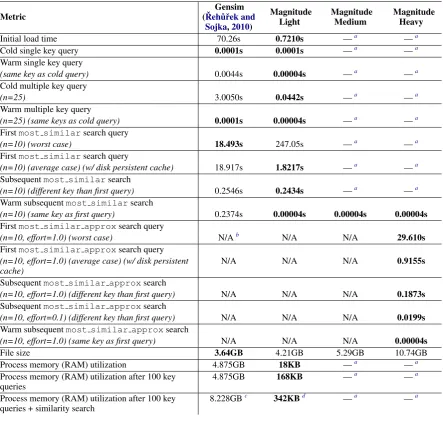
All benchmarks11 were performed on the Google News pre-trained word vectors, “GoogleNews-vectors-negative300.bin” (Mikolov et al., 2013) for Gensim and on the “GoogleNews-vectors-negative300.magnitude”12 for Magnitude, with a MacBook Pro (Retina, 15-inch, Mid 2014) 2.2GHz quad-core Intel Core i7 @ 16GB RAM on a SSD over an average of trials where feasible. We are ex-plicitly not using Gensim’s memory-mapped native format as it requires extra configuration from the developer and is not provided out of the box from Gensim’s data repository13.
Metric
Gensim (Reh ˚uˇrek andˇ
Sojka,2010)
Magnitude Light
Magnitude Medium
Magnitude Heavy
Initial load time 70.26s 0.7210s —a —a
Cold single key query 0.0001s 0.0001s —a —a
Warm single key query
(same key as cold query) 0.0044s 0.00004s —a —a
Cold multiple key query
(n=25) 3.0050s 0.0442s —a —a
Warm multiple key query
(n=25) (same keys as cold query) 0.0001s 0.00004s —a —a
Firstmost similarsearch query
(n=10) (worst case) 18.493s 247.05s —a —a
Firstmost similarsearch query
(n=10) (average case) (w/ disk persistent cache) 18.917s 1.8217s —a —a
Subsequentmost similarsearch
(n=10) (different key than first query) 0.2546s 0.2434s —a —a
Warm subsequentmost similarsearch
(n=10) (same key as first query) 0.2374s 0.00004s 0.00004s 0.00004s
Firstmost similar approxsearch query
(n=10, effort=1.0) (worst case) N/Ab N/A N/A 29.610s
Firstmost similar approxsearch query
(n=10, effort=1.0) (average case) (w/ disk persistent cache)
N/A N/A N/A 0.9155s
Subsequentmost similar approxsearch
(n=10, effort=1.0) (different key than first query) N/A N/A N/A 0.1873s
Subsequentmost similar approxsearch
(n=10, effort=0.1) (different key than first query) N/A N/A N/A 0.0199s
Warm subsequentmost similar approxsearch
(n=10, effort=1.0) (same key as first query) N/A N/A N/A 0.00004s
File size 3.64GB 4.21GB 5.29GB 10.74GB
Process memory (RAM) utilization 4.875GB 18KB —a —a
Process memory (RAM) utilization after 100 key queries
4.875GB 168KB —a —a
Process memory (RAM) utilization after 100 key queries + similarity search
8.228GBc 342KBd —a —a
a
Denotes the same value as the previous column.
b
Gensim does support approximate similarity search, but not out of the box as the index must be built manually with
gensim.similarities.indexfirst which is a slow operation.
cGensim has an option to not duplicate unit-normalized vectors in memory, but still requires up to 8GB of memory
alloca-tion while processing, before dropping down to half the memory. Moreover, this opalloca-tion is not on by default.
d
[image:7.595.72.516.174.595.2]Magnitude usesmmapto read from the disk, so the OS will still allocate pages of memory, when memory is available, in its file cache, but it can be shared between processes and is not managed within each process for extremely large files which is a performance win.
Table 3: Benchmark comparisons between Gensim, Magnitude Light, Magnitude Medium, and Magnitude Heavy.
11https://github.com/plasticityai/magnitude/blob/master/tests/benchmark.py 12
http://magnitude.plasticity.ai/word2vec+approx/GoogleNews-vectors-negative300. magnitude