22
Retrieve and Re-rank: A Simple and Effective IR Approach to Simple
Question Answering over Knowledge Graphs
Vishal Gupta
IIIT Hyderabad, India vishal.gupta@ research.iiit.ac.in
Manoj Chinnakotla
Microsoft, Bellevue, USA manojc@
microsoft.com
Manish Shrivastava
IIIT Hyderabad, India m.shrivastava@
iiit.ac.in
Abstract
SimpleQuestions is a commonly used bench-mark for single-factoid question answering (QA) over Knowledge Graphs (KG). Existing QA systems rely on various components to solve different sub-tasks of the problem (such as entity detection, entity linking, relation pre-diction and evidence integration). In this work, we propose a different approach to the prob-lem and present an information retrieval style solution for it. We adopt a two-phase ap-proach: candidate generation and candidate re-ranking to answer questions. We propose a Triplet-Siamese-Hybrid CNN (TSHCNN) to re-rank candidate answers. Our approach achieves an accuracy of 80% which sets a new state-of-the-art on the SimpleQuestions dataset.
1 Introduction and Related Work
Knowledge Bases (KB) like Freebase (Google, 2017) and DBpedia1 contain a vast wealth of in-formation. A KB has information in the form of tuples, i.e. a combination of subject, predicate and object (s, p, o). SimpleQuestions (Bordes et al., 2015) is a common benchmark used for single fac-toid QA over KB.
Question answering (QA), both on KB
(Lukovnikov et al., 2017;Yin et al., 2016;Fader et al., 2014) and in open domain (Chen et al., 2017; Hermann et al., 2015) is a well studied problem. Learning to rank approaches have also been applied successfully in QA (Agarwal et al., 2012;Bordes et al.,2014).
In this paper, we introduce an information re-trieval (IR) style approach to the QA task and propose a Triplet-Siamese-Hybrid Convolutional Neural Network (TSHCNN) that jointly learns to rank candidate answers.
1http://dbpedia.org/
Many earlier works (Ture and Jojic, 2017;Yu et al., 2017;Yin et al.,2016) that tackle Simple-Questions divide the task into multiple sub-tasks (such as entity detection, entity linking, relation prediction and evidence integration), whereas our model tackles all sub-tasks jointly. Lukovnikov (2017) is more similar to our approach wherein they train a neural network in an end-to-end man-ner. However, we differ in the fact that we generate candidate answers jointly (matching both subject and predicate using a single query) as well as the fact that we combine both the subject and predi-cate as well as the question before obtaining the similarity score. At no stage in our approach, do we differentiate between the subject and the pred-icate. Thus our approach can also be applied in other QA scenarios with or without KBs.
Compared to existing approaches (Yin et al., 2016; Yu et al., 2017; Golub and He, 2016), our model does not employ Bi-LSTMs, attention mechanisms or separate segmentation models and achieves state-of-the-art results. We also intro-duce a custom negative sampling technique that improves results significantly. We conclude with an evaluation of our method and show an abla-tion study as well as qualitative analysis of our ap-proach.
2 Our System: IRQA
Our system which consists of two components is as follows: (1) the candidate generation method for finding the set of relevant candidate answers and (2) a candidate re-ranking model, for getting the top answer from the list of candidate answers.
2.1 Candidate Generation
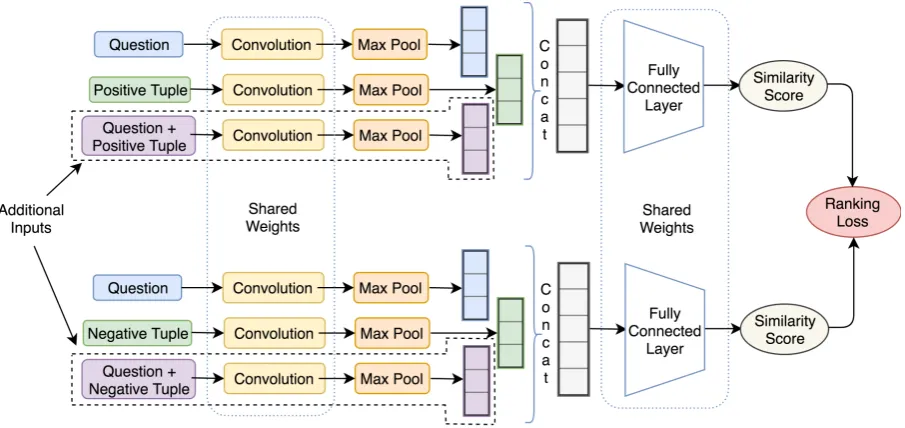
Figure 1: TSHCNN Architecture
SimpleQuestions contains 10.8 million tuples. As such, it is important to reduce the search space to make it feasible to apply semantic-based neu-ral approaches. Thus, we propose a candidate re-trieval system to narrow down our search space and focus on re-ranking only the most relevant candidates.
Solr2is an inverted index search system. We use Solr to index all our freebase tuples (FB2M) and query for the top-k relevant candidates providing a question as the input query. We adopt BM25 as the scoring metric to rank results. Our results demon-strate the effectiveness of the proposed method.
2.2 Candidate Re-ranking
We use Convolutional Neural Networks (CNN) to learn the semantic representation for input text (Kim,2014;Hu et al., 2015;Zhang et al.,2015). CNNs learn globally word order invariant fea-tures and at the same time pick the order in short phrases. Thus, CNNs are ideal for a QA task since different users may paraphrase the same question in different ways. Siamese networks have shown promising results in distance-based learning meth-ods (Bromley et al., 1993; Chopra et al., 2005; Das et al., 2016) and they possess the capability to learn a similarity metric between questions and answers.
Our candidate re-ranking module is motivated by the success of neural models in various im-age and text tasks (Vo and Hays,2016;Das et al.,
2http://lucene.apache.org/solr/
2016). Our network as shown in figure 1, is a Triplet-Siamese Hybrid Convolutional neural net-work (TSHCNN).Vo and Hays (2016) show that classification-siamese hybrid and triplet networks work well on image similarity tasks. TSHCNN can jointly extract and exchange information from the question and tuple inputs. We attribute it to the fact that we concatenate the pooled outputs of the question and tuple before input to the fully con-nected network.
All convolution layers are siamese and share weights in TSHCNN. The fully connected layers also share weights. This weight sharing guaran-tees that the question and its relevant answer are nearer to each other in the semantics space and ir-relevant answers to it are far away. It also reduces the required number of parameters to be learned.
We provide additional inputs to our network which is the concatenation of both the input ques-tion and tuple. This addiques-tional input is motivated by the need to learn features for both the question and tuple.
2.2.1 Loss Function
We use the distance based logistic triplet loss (Vo and Hays, 2016), whichVo and Hays (2016) re-port exhibits better performance in image similar-ity tasks. Considering Spos/Sneg as the score
obtained by the question+positive tuple / ques-tion+negative tuple, respectively andLas the lo-gistic triplet loss, we have:
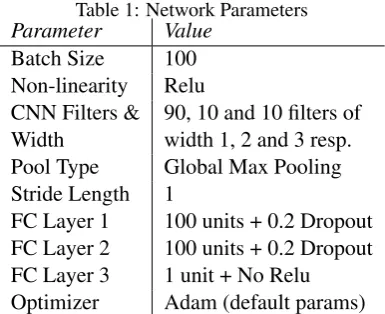
Table 1: Network Parameters
Parameter Value
Batch Size 100
Non-linearity Relu CNN Filters & Width
90, 10 and 10 filters of width 1, 2 and 3 resp. Pool Type Global Max Pooling Stride Length 1
[image:3.595.85.276.286.527.2]FC Layer 1 100 units + 0.2 Dropout FC Layer 2 100 units + 0.2 Dropout FC Layer 3 1 unit + No Relu Optimizer Adam (default params)
Table 2: End-to-End Answer Accuracy for English Questions
Model Acc.
Memory NNBordes et al.(2015) 62.7
Attn. LSTMGolub and He(2016) 70.9
GRULukovnikov et al.(2017) 71.2
BiLSTM & BiGRU
Mohammed et al.(2017) 74.9
CNN & Attn. CNN &
BiLSTM-CRFYin et al.(2016) 76.4
HR-BiLSTM & CNN &
BiLSTM-CRFYu et al.(2017) 77.0
BiLSTM-CRF & BiLSTM
Petrochuk and Zettlemoyer(2018) 78.1
[image:3.595.69.298.575.614.2]Candidate Generation (Ours) 68.4 Solr & TSHCNN (Ours) 80.0
Table 3: Candidate generation results: Recall of top-k answer candidates.
K 1 2 5 10 50 100 200
[image:3.595.129.237.681.758.2]68.4 75.7 82.3 85.6 91.4 92.9 94.3
Table 4: Candidate Re-ranking: Ablation Study. CQT: Additional inputs, concatenate question and tuple , SCNS: Solr Candidates as Negative Samples
CQT SCNS Accuracy
no no 49.1
yes no 68.2
no yes 69.6
yes yes 80.0
3 Experiments
We show experiments on the SimpleQuestions (Bordes et al., 2015) dataset which comprises 75.9k/10.8k/21.7k training/validation/test ques-tions. Each question is associated with an an-swer, i.e. a tuple (subject, predicate, object) from a Freebase subset (FB2M or FB5M). The subject is given as a MID (a unique ID referring to entities in Freebase), and we obtain its corresponding entity name by processing the Freebase data dumps. We were unable to obtain entity name mappings for some MIDs, and removed these from our final set. Our resulting set contained 74,509/10,639/21,300 training/validation/test questions. As with previ-ous work, we show results over the 2M-subset of Freebase (FB2M).
We use pre-trained word embeddings3 pro-vided by Fasttext (Bojanowski et al., 2016) and randomly initialized embeddings between [-0.25, 0.25] for words without embeddings.
3.1 Generating negative samples
In our experiments, we observe that the negative sample generation method has a significant influ-ence on the results. We develop a custom negative sample generation method that generates negative samples similar to the actual answer and helps fur-ther increase the discriminatory ability of our net-work.
We generate 10 negative samples for each train-ing sample. We use the approach inBordes et al. (2014) to generate 5 of these 10 negative sam-ples. These candidates are samples picked at ran-dom and then corrupted following Bordes et al. (2014). Essentially, Given (q, t) ∈ D, Bordes et al.(2014) create a corrupted triple´twith the fol-lowing method: pick another random triple´tfrom K, and then, replace with 66% chance each mem-ber oft(left entity, predicate and right entity) by the corresponding element int´.
Further, we obtain 5 more negative samples by querying the Solr index for top-5 candidates (excluding the answer candidate) providing each question in the training set as the input query. This second policy is unique as we generate negative samples closer to the actual answer thereby pro-viding fine-grained negative samples to our net-work as compared toBordes et al.(2014) who gen-erate only randomly corrupted negative samples.
Table 5: Qualitative Analysis. CA: Correct Answer, PA: Predicted Answer
Examples
Example 1: CA (have wheels will travel, book written work subjects, family) Question: what is the have wheels will travel book about?
Predicted Answer: (have wheels will travel, book written work subjects, adolescence)
Example 2: CA (traditional music, music genre artists, the henrys) Question: which quartet is known for traditional music?
Predicted Answer: (traditional music, music genre albums, music and friends)
3.2 Evaluation
We report results using the standard evaluation cri-teria (Bordes et al., 2015), in terms of path-level accuracy, which is the percentage of questions for which the top-ranked candidate fact is correct. A prediction is correct if the system retrieves the cor-rect subject and predicate. Network parameters and decisions are presented in Table 1. We use top-200 candidates as input to the re-ranking step.
4 Results
In Table 3, we report candidate generation re-sults. As expected, recall increases as we in-crease k. This initial candidate generation step surpasses (Table2) the original Bordes (2015) pa-per and comes close to other complex neural ap-proaches (Golub and He,2016;Lukovnikov et al., 2017). This is surprising since this initial step is an inverted-index based approach which retrieves the most relevant candidates based on term matching. In Table2, we present end-to-end results4of ex-isting approaches as well as our model. There is a significant improvement of 17% in our accuracy after candidate re-ranking. We attribute it to our TSHCNN model. To obtain insights into these im-provements, we do an ablation study (Table4) of the various components in TSHCNN and describe them in more detail further.
SCNS: Using Solr Candidates as Negative
Sam-ples. The scores obtained using our custom
nega-tive sample generation method (described in sec-tion 3.1), were 17.3% and 41.8% higher as com-pared to using only 10 negative samples generated as perBordes et al.(2014), with and without ad-ditional inputs respectively. This is a significant improvement in scores, and we attribute it to the reason that negative candidates similar to the
ac-4(Ture and Jojic, 2017) reported a 86.8% accuracy but
(Petrochuk and Zettlemoyer,2018) and (Mohammed et al., 2017) have not been able to replicate their results.
tual answer increase the discriminatory ability of the network and lead to the robust training of our network.
CQT: Additional inputs, concatenate question
and tuple. Compared to our model without
addi-tional inputs, we obtain an improvement of 14.9% and 38.9% in our scores when we provide addi-tional inputs in the form of concatenated ques-tion and tuple, with and without our custom neg-ative sampling approach respectively. One possi-ble explanation for this increase is that this aug-mented network has 50% more features that help it in learning better intermediate representations. To verify this, we add more filters to our convolu-tion layer such that the total features equalled that when additional input is provided. However, the improvement in results was only marginal. An-other explanation for this improvement would be that the max pooling layer picks out the dominant features from this additional input, and these fea-tures improve the distinguishing ability of our net-work.
Combining both these techniques, we gain an impressive 62.9% in scores as compared to our model without neither of these techniques. Over-all, we achieve an accuracy of 80%, a new state-of-the-art despite having a simple model.
In Table5, some example outputs of our model are shown. Example 1 shows that the predicted answer is correct (subject and predicate match) but does not match the answer that comes with the question. Example 2 shows we can correctly predict the subject but cannot obtain the correct predicate owing to the high similarity between the correct answer predicate and the predicted answer predicate.
5 Conclusion
shows impressive results on the SimpleQuestions benchmark. It outperforms many other approaches that use Bi-LSTMs, attention mechanisms or sep-arate segmentation models. We also introduce a negative sample generation method which signif-icantly improves results. Such negative samples obtained through Solr increase the discriminatory ability of our network. Our experiments highlight the effectiveness of using simple IR models for the SimpleQuestions benchmark.
References
Arvind Agarwal, Hema Raghavan, Karthik Sub-bian, Prem Melville, Richard D. Lawrence, David Gondek, and James Z Fan. 2012. Learning to rank for robust question answering. InCIKM.
Piotr Bojanowski, Edouard Grave, Armand Joulin, and Tomas Mikolov. 2016. Enriching word vec-tors with subword information. arXiv preprint arXiv:1607.04606.
Antoine Bordes, Nicolas Usunier, Sumit Chopra, and Jason Weston. 2015. Large-scale Simple Question Answering with Memory Networks.
Antoine Bordes, Jason Weston, and Nicolas Usunier. 2014. Open Question Answering with Weakly Su-pervised Embedding Models. In Lecture Notes in Computer Science (including subseries Lecture Notes in Artificial Intelligence and Lecture Notes in Bioinformatics), volume 8724 LNAI, pages 165– 180.
Jane Bromley, Isabelle Guyon, Yann LeCun, Eduard S¨ackinger, and Roopak Shah. 1993. Signature ver-ification using a ”siamese” time delay neural net-work. InProceedings of the 6th International Con-ference on Neural Information Processing Systems, NIPS’93, pages 737–744, San Francisco, CA, USA. Morgan Kaufmann Publishers Inc.
Danqi Chen, Adam Fisch, Jason Weston, and Antoine Bordes. 2017. Reading wikipedia to answer open-domain questions. InProceedings of the 55th An-nual Meeting of the Association for Computational Linguistics (Volume 1: Long Papers), pages 1870– 1879. Association for Computational Linguistics.
Sumit Chopra, Raia Hadsell, and Yann LeCun. 2005. Learning a similarity metric discriminatively, with application to face verification. In Proceed-ings of the 2005 IEEE Computer Society Confer-ence on Computer Vision and Pattern Recognition (CVPR’05) - Volume 1 - Volume 01, CVPR ’05, pages 539–546, Washington, DC, USA. IEEE Com-puter Society.
Arpita Das, Harish Yenala, Manoj Kumar Chinnakotla, and Manish Shrivastava. 2016. Together we stand: Siamese networks for similar question retrieval. In
Proceedings of the 54th Annual Meeting of the As-sociation for Computational Linguistics, ACL 2016, August 7-12, 2016, Berlin, Germany, Volume 1: Long Papers.
Anthony Fader, Luke Zettlemoyer, and Oren Etzioni. 2014. Open question answering over curated and extracted knowledge bases. InProceedings of the 20th ACM SIGKDD International Conference on Knowledge Discovery and Data Mining, KDD ’14, pages 1156–1165, New York, NY, USA. ACM.
David Golub and Xiaodong He. 2016. Character-Level Question Answering with Attention.
Google. 2017. Freebase data dumps. https: //developers.google.com/freebase/ data.
Karl Moritz Hermann, Tom´aˇs Koˇcisk´y, Edward Grefenstette, Lasse Espeholt, Will Kay, Mustafa Su-leyman, and Phil Blunsom. 2015. Teaching ma-chines to read and comprehend. InProceedings of the 28th International Conference on Neural Infor-mation Processing Systems - Volume 1, NIPS’15, pages 1693–1701, Cambridge, MA, USA. MIT Press.
Baotian Hu, Zhengdong Lu, Hang Li, and Qingcai Chen. 2015. Convolutional Neural Network Archi-tectures for Matching Natural Language Sentences.
NIPS, page 2009.
Yoon Kim. 2014. Convolutional Neural Networks for Sentence Classification. pages 1746–1751.
Denis Lukovnikov, Asja Fischer, Jens Lehmann, and S¨oren Auer. 2017. Neural Network-based Question Answering over Knowledge Graphs on Word and Character Level. Proceedings of the 26th Interna-tional Conference on World Wide Web - WWW ’17, pages 1211–1220.
Salman Mohammed, Peng Shi, and Jimmy Lin. 2017. Strong Baselines for Simple Question Answering over Knowledge Graphs with and without Neural Networks.
Michael Petrochuk and Luke Zettlemoyer. 2018. Sim-pleQuestions Nearly Solved: A New Upperbound and Baseline Approach.
Ferhan Ture and Oliver Jojic. 2017. No Need to Pay Attention: Simple Recurrent Neural Networks Work! (for Answering ”Simple” Questions). Em-pirical Methods in Natural Language Processing (EMNLP), pages 2866–2872.
Wenpeng Yin, Mo Yu, Bing Xiang, Bowen Zhou, and Hinrich Sch¨utze. 2016. Simple question answering by attentive convolutional neural network. In Pro-ceedings of COLING 2016, the 26th International Conference on Computational Linguistics: Techni-cal Papers, pages 1746–1756. The COLING 2016 Organizing Committee.
Mo Yu, Wenpeng Yin, Kazi Saidul Hasan, Cicero dos Santos, Bing Xiang, and Bowen Zhou. 2017. Im-proved Neural Relation Detection for Knowledge Base Question Answering. In Proceedings of the 55th Annual Meeting of the Association for Compu-tational Linguistics (Volume 1: Long Papers), pages 571–581, Stroudsburg, PA, USA. Association for Computational Linguistics.