A Skeleton-Based Model for Promoting Coherence Among Sentences
in Narrative Story Generation
Jingjing Xu1, Xuancheng Ren1, Yi Zhang1, Qi Zeng1, Xiaoyan Cai2, Xu Sun1
1MOE Key Lab of Computational Linguistics, School of EECS, Peking University
2School of Automation, Northwestern Polytechnical University
{jingjingxu,renxc,zhangyi16,pkuzengqi,xusun}@pku.edu.cn
Abstract
Narrative story generation is a challenging problem because it demands the generated sentences with tight semantic connections, which has not been well studied by most exist-ing generative models. To address this prob-lem, we propose a skeleton-based model to promote the coherence of generated stories. Different from traditional models that generate a complete sentence at a stroke, the proposed model first generates the most critical phrases, called skeleton, and then expands the skeleton to a complete and fluent sentence. The skele-ton is not manually defined, but learned by a reinforcement learning method. Compared to the state-of-the-art models, our skeleton-based model can generate significantly more coher-ent text according to human evaluation and au-tomatic evaluation. The G-score is improved by 20.1% in human evaluation.1
1 Introduction
We focus on the problem of narrative story gen-eration, a special kind of story generation (Li et al., 2013). It requires systems to generate a narrative story based on a short description of a scene or an event, as shown in Table 1. In gen-eral, a narrative story is described with several inter-related scenes. Different from traditional text generation tasks, this task is more challeng-ing because it demands the generated sentences with tight semantic connections. Currently, most state-of-the-art approaches (Jain et al., 2017;Liu et al., 2017; Fan et al., 2018; Ma et al., 2018a;
Xu et al., 2018b) are largely based on Sequence-to-Sequence (Seq2Seq) models (Sutskever et al.,
2014), which generate a sentence at a stroke in a left-to-right manner.
However, we find it hard for these approaches to model the semantic dependency among sentences,
1The code is available at https://github.com/
lancopku/Skeleton-Based-Generation-Model
Task Description
Input: A short description of a scene or an event. Output: A relevant narrative story following the input.
Examples
Input:Fans came together to celebrate the opening of a new studio for an artist.
Output: The artist provided champagne in flutes for everyone. Friends toasted and cheered the artist as she opened her new studio.
Input: Last week I attended a wedding for the first time.
Output:There were a lot of families there. They were all taking pictures together. Everyone was very happy. The bride and groom got to ride in a limo that they rented.
Table 1: An illustration of narrative story generation.
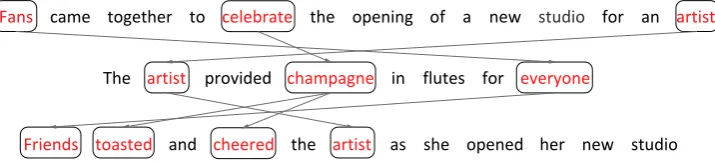
which causes low-quality generated stories where the scenes are irrelevant. In fact, as shown in Figure 1, we observe that the connection among sentences is mainly reflected through key phrases, such as predicates, subjects, objects and so on. In this work, we regard the phrases that express the key meanings of a sentence as a skeleton. The other words (e.g., modifiers) not only are redun-dant for understanding semantic dependency, but also make the dependency sparse. Therefore, gen-erating all information at a stroke makes it difficult to learn the dependency of sentences. In contrast, the sentences written by humans are closely tied and the whole story is more coherent and fluent. It is mainly attributed to the way of human writing where we often first come up with a skeleton and then reorganize them into a fluent sentence.
skeleton-The artist provided champagne in flutes for everyone
Friends toasted and cheered the artist as she opened her new studio
[image:2.595.119.477.63.144.2]Fans came together to celebrate the opening of a new studio for an artist
Figure 1: The semantic dependency among sentences in a narrative story. It can be seen that the connection among sentences is mainly reflected through key phrases (shown in red). In this work, we regard such key phrases as a skeleton.
based generative module and a skeleton extraction module.
The generative module consists of an input-to-skeleton component and a skeleton-to-sentence component. The input-to-skeleton component learns to associate inputs and skeletons, and the skeleton-to-sentence component learns to expand a skeleton to a sentence. In our model, a good skeleton that can capture key semantic informa-tion is a critical supervisory signal.
The skeleton extraction module is used to gen-erate sentence skeletons. In real-world datasets, the human-annotated skeleton is usually unavail-able. In addition, it is difficult to define the uni-fied rules of extracting skeletons, because different sentences have different focuses. To address this problem, we build a skeleton extraction module to automatically explore sentence skeletons. Consid-ering the discrete choice of skeleton words causes the loss function to be non-differentiable, we use a reinforcement learning method to build the con-nection between the skeleton extraction module and the generative module.
Our contributions are listed as follows:
• A skeleton-based model is proposed to pro-mote the coherence of generated stories.
• The proposed model contains a skeleton-based generative module and a skeleton ex-traction module. Two modules are connected by a reinforcement learning method to auto-matically explore sentence skeletons.
• The experimental results on automatic eval-uation and human evaleval-uation show that our model can generate significantly more coher-ent text compared to the state-of-the-art mod-els.
2 Related Work
Strictly speaking, the story generation task re-quires systems to generate a story from scratch
without any external materials. However, for sim-plification, many existing story generation models rely on their given materials, such as short text de-scriptions (Harrison et al.,2017;Jain et al.,2017), visual images (Charles et al.,2001;Huang et al.,
2016), and so on. Different from these studies, we get rid of external materials and consider the complete story generation task (McIntyre and La-pata, 2009). For this task, the widely used mod-els are based on Seq2Seq modmod-els. However, al-though they can generate a fluent sentence (Xu et al.,2018a), these models still perform badly on generating inter-related sentences, which are nec-essary for a coherent story.
To address this problem, there are several mod-els that build the mid-level sentence semantic representation to simplify the dependency among sentences. Clark et al.(2018) extract the entities in sentences, and combine the entity context and text context together when generating a target sen-tence. Cao et al. (2018) encode the words with specific pre-defined dependency labels to a mid-level sentence representation. Martin et al.(2018) use additional knowledge bases to get a general-ized sentence representation.Ma et al.(2018b) use the bag-of-words which occur in all references as a representation of the correct translation. Luo et al.(2018) propose to use two auto-encoders to learn the semantic representation of utterance in dialogue. However, although these models reduce the dependency sparsity to some extent, the unified rules are non-flexible and tend to generate over-simplified representations, resulting in the loss of key information.
Skeleton Reward Skeleton Reward Gold Input
Output Input
Test
[image:3.595.91.268.58.243.2]Train
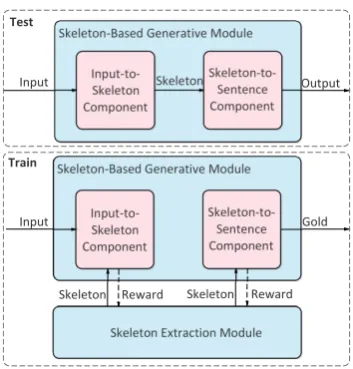
Figure 2: An illustration of the proposed model. Top: Testing. Bottom: Training. The “input” means the existing text, including the source input and the al-ready generated text. The “skeleton” means the skele-ton of the output. The skeleton extraction module first extracts skeletons from gold outputs. The pairs of input-skeleton and skeleton-gold are used to train the input-to-skeleton component and the skeleton-to-sentence component. In return, the generative module can be used to evaluate the quality of extracted skele-tons. Therefore, we use the feedback of the generative module to reward extracted skeletons. By cooperation, the two modules can promote each other until conver-gence.
simplifying sentence representations.
3 Skeleton-Based Model
An overview of our proposed skeleton-based model is presented in Section 3.1. The details of the skeleton-based generative module and the skeleton extraction module are shown in Sec-tion3.2and Section3.3. The reinforcement learn-ing method is explained in Section3.4.
3.1 Overview
As shown in Figure 2, our model consists of two parts, a skeleton-based generative moduleGφand a skeleton extraction moduleEγ. The generative module consists of an input-to-skeleton compo-nent and a skeleton-to-sentence compocompo-nent.
The generative module generates a story sen-tence by sensen-tence. When decoding a sensen-tence, the input-to-skeleton component first generates a skeleton based on the existing text, including the source input and the already generated text, and then the skeleton-to-sentence component expands and reorganizes the skeleton into a complete sen-tence. We keep running this process until the
gen-erative module generates an ending symbol. In the training process, we first use a weakly supervised method to assign the skeleton extrac-tion module with initial extracextrac-tion ability. Then, we use extracted skeletons to train the input-to-skeleton component and the input-to-skeleton-to-sentence component. In return, the generative module can be used to evaluate the quality of extracted skele-tons. Therefore, we use the feedback of the gen-erative module to reward extracted skeletons. The reward refines the skeleton extraction module. The improved skeleton extraction module further en-hances the generative module. By cooperation, the two modules can promote each other until conver-gence.
3.2 Skeleton-Based Generative Module
The skeleton-based generative module Gφ con-sists of two parts: an input-to-skeleton component
Qαand a skeleton-to-sentence componentDθ.
3.2.1 Input-to-Skeleton Component
The input-to-skeleton componentQα builds on a Seq2Seq structure with a hierarchical encoder (Li et al.,2015) and an attention-based decoder ( Bah-danau et al., 2014). It is responsible for learn-ing the dependency between inputs and skele-tons. In the encoding process, we first obtain sen-tence representations via a word-level Long Short Term Memory (LSTM) network (Hochreiter and Schmidhuber, 1997), and then generate a com-pressed vector h via a sentence-level LSTM net-work. Finally, given the compressed vectorh, the attention-based decoder is responsible for imagin-ing a skeleton.
Given the training pair of inputc and skeleton
s = {s1,· · · , si,· · · , sT}, the cross-entropy loss is computed as
Lα =− T
X
i=1
PQ(si|c, α) (1)
whereα refers to the parameters of the input-to-skeleton component. The input-to-skeleton sis extracted by the skeleton extraction module. The extracting details will be introduced in Section3.3.
3.2.2 Skeleton-to-Sentence Component
which is then used to generate a detailed and pol-ished sentence via the decoder.
Given the training pair of skeleton sand target sentence y = {y1,· · ·, yi,· · ·, yM}, the cross-entropy loss is computed as
Lθ=− M
X
i=1
PD(yi|s, θ) (2)
whereθ refers to the parameters of the skeleton-to-sentence component.
3.3 Skeleton Extraction Module
Given a sentencex, the skeleton extraction mod-ule Eγ is responsible for extracting its skeleton that only preserves the key information. Spe-cially, we use the Seq2Seq model with the atten-tion mechanism as the implementaatten-tion. Both the encoder and the decoder are based on LSTM struc-tures.
Since the extracted skeletons are treated as su-pervisory signals for the generative module, the extraction ability needs to be initialized. To pre-train the skeleton extraction module, we propose a weakly supervised method. We reformulate skele-ton extraction as a sentence compression problem and use a sentence compression dataset to train this module. In sentence compression, the com-pressed sentence is required to be grammatical and convey the most important information. From the aspect of keeping important information, the sen-tence compression dataset can be used to help the training of the skeleton extraction module. How-ever, since the style of the sentence compression dataset is very different from that of the narrative story dataset, it is difficult for the pre-trained mod-ule to give narrative text accurate compression re-sults. Therefore, the supervisory signals are noisy and need to be further improved.
Given the training pair of the origi-nal text x and the compressed version
s = {s1,· · ·, si,· · · , sT}, we use the following cross-entropy loss to pre-trainEγ:
Lγ =− T
X
i=1
PE(si|x, γ) (3)
whereγ is the parameters of the skeleton extrac-tion module.
3.4 Reinforcement Learning Method
We propose a reinforcement learning method to build the connection between the skeleton
ex-Algorithm 1The reinforcement learning method
for training the generative module Gφ and the skeleton extraction moduleEγ.
1: Initialize the generative moduleGφand the skeleton ex-traction moduleEγwith random weightsφ,γ
2: Pre-trainEγusing MLE based on Eq.3 3: foreach iterationj= 1,2, ..., Jdo 4: Generate a skeletonsjbased onEγ
5: Givensj, trainGφbased on Eq.1and Eq.2. 6: Compute the rewardRcbased on Eq.5 7: Compute the gradient ofEγbased on Eq.4 8: Update the model parameterγ
9: end for
traction module and the skeleton-based generative module for exploring better skeletons. The de-tailed training process is shown in Algorithm1.
Due to the discrete choice of words in skeletons, the loss is no longer differentiable over the skele-ton extraction module. Therefore, we use policy gradient (Sutton et al.,1999) to train the skeleton extraction module.
First, we calculate a reward Rc based on the feedback of the generative module. The details of calculation process will be introduced in Sec-tion 3.4.1. Then, we optimize the parameters through policy gradient by maximizing the ex-pected reward to train the skeleton extraction mod-ule. According to the policy gradient theorem, the gradient for the skeleton extraction module is
∇J(γ) =E[Rc· ∇log(PE(s|x), γ)] (4)
wherexis the original sentence,sis the skeleton generated by a sampling mechanism.
3.4.1 Reward
To design an appropriate rewarding function, there is a critical question that needs to be considered: what will good/bad skeletons bring to the genera-tive module.
We first define what is a good (or bad) skele-ton. A good skeleton is expected to contain all key information and ignore other information. In con-trast, the skeletons that contain too much detailed information or lack necessary information are con-sidered as bad skeletons and should be punished. For ease of analysis, we classify possible scenarios into three categories: good skeletons, incomplete skeletons, and redundant skeletons.
of this example will be higher compared with other skeleton-sentence pairs.
If a skeleton contains too much redundant infor-mation, the input-skeleton relation will be sparse. Therefore, the cross-entropy loss of this example will be higher compared with other input-skeleton pairs.
For a good skeleton that contains an appropri-ate amount of information, it will benefit the two components and will get balanced losses from the two components.
Therefore, to encourage good skeletons and punish bad skeletons, we use the multiplication of the cross-entropy loss in the input-to-skeleton component and that in the skeleton-to-sentence component as the reward:
Rc= [K−(R1×R2) 1
2] (5)
where K is the upper bound of the reward, R1
and R2 are cross-entropy losses in the
input-to-skeleton component and the input-to-skeleton-to-sentence component, respectively. Only if two components both output lower cross-entropy losses, the ex-tracted skeleton can be rewarded.
4 Experiment
In this section, we evaluate our model on a narra-tive story generation dataset. We first introduce the dataset, the training details, the baselines, and the evaluation metrics. Then, we compare our model with the state-of-the-art models. Finally, we show the experimental results and provide the detailed analysis.
4.1 Dataset
We use the recently introduced visual storytelling dataset (Huang et al., 2016) in our experiments. This dataset contains the pairs of photo sequences and the associated coherent narrative of events through time written by humans. We only use the text data for our experiments. In our version of narrative story generation, the model should gen-erate a coherent story based on a given sentence. We build a new dataset for this task by splitting the data into two parts. In each story, we take the first sentence as the input text, and the following sentences as the target text. The processed dataset contains 40153, 4990, and 5054 stories for train-ing, validation, and testtrain-ing, respectively. The max-imum number of sentences in each story is 6. In
total, the number of training sentences is over 20K and the number of training words is over 2M.
To pre-train the skeleton extraction module, we use a sentence compression dataset (Filippova and Altun, 2013). In this dataset, every compression is a subsequence of tokens from the input. The dataset contains 16999, 1000, and 1998 pairs for training, validation, and testing, respectively.
4.2 Baselines
We compare our proposed model with the follow-ing the state-of-the-art models.
Entity-Enhanced Seq2Seq Model
(EE-Seq2Seq)(Clark et al., 2018). It regards entities
as important context needed for coherent stories. When decoding a sentence, it combines entity context and text context together to reduce dependency sparsity.
Dependency-Tree Enhanced Seq2Seq Model
(DE-Seq2Seq)(Cao et al.,2018). It defines some
manual rules based on dependency parsing labels to find a simplified sentence representation. Fol-lowing this work, we treat the extracted words based on the predefined rules as the skeleton.
Generalized-Template Enhanced Seq2Seq
Model (GE-Seq2Seq) (Martin et al., 2018). It
takes advantages of existing knowledge bases to get a generalized sentence representation. Follow-ing this work, we treat the generalized sentence representation as the skeleton.
4.3 Training Details
For narrative story generation, we set the num-ber of generated sentences to 6 with the maximum length of 40 words for each generated sentence. Based on the performance on the validation set, we set the hidden size to 128, embedding size to 50, vocabulary size to 20K, and batch size to 10 for the proposed model and the state-of-the-art mod-els. We use the Adagrad (Duchi et al.,2011) opti-mizer with the initial learning rate 0.6. All of the gradients are clipped when the norm exceeds 2. Both the generative module and skeleton extrac-tive module are pre-trained for 30 and 40 epochs before reinforcement learning. The K in Equa-tion5is set to 1. Due to the lack of annotated enti-ties and dependency parsing labels, we use a pop-ular natural language processing toolkit, Spacy2, to extract entities and dependency parsing labels in the EE-Seq2Seq and DE-Seq2Seq models.
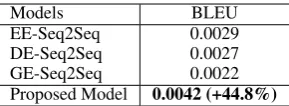
Models BLEU
EE-Seq2Seq 0.0029
DE-Seq2Seq 0.0027
GE-Seq2Seq 0.0022
[image:6.595.108.253.61.114.2]Proposed Model 0.0042 (+44.8%)
Table 2: Automatic evaluations of the proposed model and the state-of-the-art models.
4.4 Evaluation Metrics
We conduct two kinds of evaluations in this work, automatic evaluation and human evaluation. The details of evaluation metrics are shown as follows.
4.4.1 Automatic Evaluation
Following the previous work (Li et al.,2016; Mar-tin et al., 2018), we use the BLEU score to mea-sure the quality of generated text. BLEU (Papineni et al., 2002) is originally designed to automati-cally judge the machine translation quality. The key point is to compare the similarity between the results created by the machine and the references provided by the human. Currently, it is widely used in many generation tasks, such as dialogue generation, story generation, summarization, and so on. For precise results, we remove all stop words, like “the”, “a”, before computing BLEU scores.
4.4.2 Human Evaluation
Although the quantitative evaluation generally in-dicates the quality of generated stories, it can not accurately evaluate the generated text. Therefore, we also perform a human evaluation on the test set. We randomly choose 100 items for human evalu-ation. Each item contains the stories generated by different models given the same source sentence. The items are distributed to the annotators who have no knowledge about which model the story is from. It is important to note that all the anno-tators have linguistic background. They are asked to score the generated stories in terms of fluency and coherence. Fluency represents whether each sentence in the generated story is correct in gram-mar. Coherence evaluates whether the generated story is coherent. The score ranges from 1 to 10 (1 is very bad and 10 is very good). To evaluate the overall performance, we use the geometric mean of fluency and coherence as an evaluation metric.
4.5 Experimental Results
Table 2 shows the results of automatic evalua-tion. The proposed model performs the best
ac-Models Fluency Coherence G-Score
EE-Seq2Seq 6.28 5.14 5.68
DE-Seq2Seq 8.48 3.54 5.48
GE-Seq2Seq 9.48 3.58 5.82
Proposed Model 8.69 5.62 6.99 (+20.1%)
Table 3: Human evaluations of the proposed model and the state-of-the-art models.
cording to BLEU. In particular, the differences between the existing state-of-the-art models are within 0.07, while the proposed model supersedes the best of them by 0.13.
As we previously explained, the best evalua-tion for narrative story generaevalua-tion is human eval-uation. The human evaluation results are listed in Table3.3
As for fluency, the proposed model receives the score of 8.69, second to the GE-Seq2Seq model. It is expected that the generalized templates can constrain the search space in generation and the model achieves higher fluency by loss of expres-sive power. In particular, we find that only 0.48%, 1.01%, and 1.20% of the unigrams, bigrams, and trigrams are unique in the stories generated by the GE-Seq2Seq model, while the percentages are 3.16%, 15.33%, and 29.67% in the stories gen-erated by our proposed model. Nonetheless, the proposed model outperforms the other two exist-ing models by a substantial margin. In terms of coherence, the proposed model is better than all the existing models. We need to point out that the GE-Seq2Seq model is scored the lowest in coher-ence, while highest in fluency. It indicates that the GE-Seq2Seq model does not learn the dependency among sentences effectively, which results from the constraint of the templates. It also needs to be noted that the models are all scored below 6 in coherence, meaning that there is still a long way to go before the generated stories satisfy the require-ment of humans. Overall, the proposed model is arguably better than the existing models in that it achieves a balance between coherence and fluency, with a G-score improvement of 20.1%.
Table 4 presents the examples generated by different models. Compared with the existing models, the sentences generated by our proposed model are connected more logically. For the EE-Seq2Seq model, while it connectsparkwithplants
3The inter-annotator agreement is satisfactory considering
[image:6.595.315.515.61.113.2]androckssuccessfully (4th ex.), it insists on telling getting married when it sees [male]or [female] (1st and 2nd ex.). Such examples suggest that some entities (e.g. park) embody semantics more independently, while for others (e.g. male), we have to associate them in the specific context. The rest of the models try to generalize the tar-get sentences. The DE-Seq2Seq model uses the core dependency arguments as the skeleton. How-ever, the results demonstrate the generated sen-tences are quite irrelevant. The sentence may have links such as walked through to came out (1st ex.), but the objects in the generated stories are hardly related. The GE-Seq2Seq model replaces the specific words with more general concepts and generates some good examples, e.g. the second one in the table. However, there can be over-generalizations. For example, as for the third ex-ample, the GE-Seq2Seq model associatesdriving withcar show, causing the incoherent description. In the last example, the generated story completely diverges from the input. These results prove the drawbacks of static rule-based skeletons. The pro-posed model uses a skeleton extraction module to adaptively determine the appropriate granular-ity of skeletons. The skeleton keeps the main se-mantic of a sentence, which can be a whole sen-tence, phrases, or even segments. It makes the model learn the dependency of sentences more ef-fectively so that the generated stories are much more coherent.
4.6 Incremental Analysis
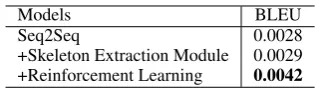
In this section, we conduct a series of experiments to evaluate the contributions of our key compo-nents. The results are listed in Table 5. The Seq2Seq model is scored the lowest according to BLEU. With the skeleton extraction module, the BLEU score is slightly improved, which sug-gests that the model starts to learn the connection of longer segments. Finally, with reinforcement learning, the BLEU score significantly overpasses the Seq2Seq model by 40%.
Table 6 shows the human evaluation results. The slight improvement with the skeleton extrac-tion module in BLEU reflects as the decreases in both fluency and coherence. It suggests the ne-cessity of human evaluation. The decreased re-sults can be explained by the fact that the style of the dataset for pre-training the skeleton extraction module is very different from the narrative story
Input 1: [Female] and her friend had a night out on the town.
EE-Seq2Seq:They were very happy to see us. [Male] and [female] were getting married today.
DE-Seq2Seq: We walked through the streets of the city and found a place to sit. The whole family came out to support their families.
GE-Seq2Seq: My friends and I went to a bar last night. [Female] was so happy to be there.
Proposed Model:They went to the bar. They had a great time.
Input 2:[Male] and [male] are talented artists.
EE-Seq2Seq:They were very happy to see us. [Male] and [female] were getting married today.
DE-Seq2Seq:The kids get to play with the kids. We had a great time.
GE-Seq2Seq:The art was very subjective. The artist had a keen eye.
Proposed Model:They are discussing the importance of the lecture.
Input 3:The bride was driving to the wedding.
EE-Seq2Seq:The family was so happy to be there. They were very happy to see us.
DE-Seq2Seq:The view from the top was amazing. There were a lot of people there.
GE-Seq2Seq:I went to the car show last weekend. People are getting ready to go.
Proposed Model: The groom and groomsmen watched the bride. They kissed and shared their pictures.
Input 4:The park was filled with beauty.
EE-Seq2Seq: The plants were so beautiful. The rocks were very pretty.
DE-Seq2Seq:The family was so happy to be there.
GE-Seq2Seq:There were a lot of people there. We had a great time.
[image:7.595.335.493.478.523.2]Proposed Model:The trees were very sparse. There were also some flowers.
Table 4: Examples generated by the proposed model and the state-of-the-art models.
Models BLEU
Seq2Seq 0.0028
+Skeleton Extraction Module 0.0029 +Reinforcement Learning 0.0042
Table 5: Automatic evaluations of key components.
dataset. While it may help extract some useful skeletons, it is likely that many of them are not suitable for learning the dependency of sentences. Finally, when the skeleton extraction module is trained on the target domain using reinforcement learning, the human evaluation is improved signif-icantly by 14% on G-score.
nec-Models Fluency Coherence G-Score
Seq2Seq 7.54 4.98 6.13
[image:8.595.74.290.63.105.2]+Skeleton Extraction Module 7.26 4.32 5.60 +Reinforcement Learning 8.69 5.62 6.99
Table 6: Human evaluations of the key components.
1)There was a small power stationon the side of the building.
2)The ladywearing the pink shirtdecided to stop play-ing the videoand chatted with other guests.
3)At the end of the night,guests taking picturesbefore saying goodbye to each other.
4) Afterwards, we celebrated with some drinks and watched the rest of the parade.
5)A few miles away was alakethatwereallyenjoyed watching.
6)Some of the guestspartied harderthan others.
7)The bride was driving to the wedding.
Table 7: Analysis of the skeleton extraction module. Given a whole sentence as input, the words in red are the extracted skeleton.
essary, it choose to keep all words. It proves that the skeleton extraction module is effective and is expert in only removing detailed information that is not needed.
Furthermore, it is not quite surprising to see that on our dataset, the Seq2Seq model beats the existing state-of-the-art models (DE-Seq2Seq and GE-Seq2Seq) in human evaluation and automatic evaluation. It is mainly attributed to the over-simplification of sentences. For narrative sen-tences, the key information is usually expressed in a complicated way. It can be a segment, a phrase, or a whole sentence. The simple rules lead to the excessive loss of key information while our pro-posed model can adaptively determine the appro-priate granularity.
4.7 Error Analysis
Although the proposed model outperforms the state-of-the-art models, it needs to be noted that the highest coherence score, 5.62, is a moderate result in human evaluation, indicating that there is still a long way to go before the generated stories reach the human level. Therefore, in this subsec-tion, we give a detailed error analysis to explore what factors affect the performance.
First, we classify the generated stories with scores below 6 that are considered less coherent. We conclude 4 types of errors from these outputs and the distribution of error types are shown in Figure3. It is expected that the irrelevant scenes make up most of the errors. In addition, there are several examples that are hard to be understood
62.8 % Irrelevant Scenes
25.8 %
Chaotic Syntax 5.7 %
Chaotic timeline 5.7 %
[image:8.595.309.534.216.326.2]Repeated Scenes
Figure 3: The distribution of error types.
2 4 6 8 10 Length of Input 2
3 4 5 6 7 8 9 10
Average Coherence
Proposed Model GE-Seq2Seq DE-Seq2Seq EE-Seq2Seq
0.4 0.6 0.8 Unseen Ratio of Input 2
3 4 5 6 7 8 9 10
Average Coherence
Proposed Model GE-Seq2Seq DE-Seq2Seq EE-Seq2Seq
Figure 4: An illustration of how the performance is af-fected by the length of input (left) and the unseen ratio of input (right).
due to chaotic syntax. For the type of chaotic time-line, the model neglects the time order of scenes and the generated stories goes backward in time. The repeated scenes mean that the generated sto-ries just describe the input again. The above errors show that there are many dimensions in coherence, including scene-specific relevance, temporal con-nection, and non-recurrence. Modeling such di-mensions is still a hard problem.
Furthermore, we explore how the performance is affected by the length of input and the unseen ratio of input. The results are shown in Figure4. “Unseen ratio” is the percentage of the phrases that are not seen in the training data. We use the gap between1and the BLEU score with the train-ing data as the reference to compute it. When the input is short and the model often sees the input, the generated story tends to have high coherence. However, when the length of input increases and the model is not familiar with the input, the co-herence goes down. Since our model extracts the key semantics better, the dependency of sentences can be easier to learned, which brings the smaller decrease in coherence.
5 Conclusion and Future Work
Different from traditional models, the proposed model first generates a skeleton that contains the key information of a sentence, and then expands the skeleton to a complete sentence. Experimental results show that our model significantly improves the quality of generated stories, especially in co-herence. However, even with the best human eval-uation results, the error analysis shows that there are still many challenges in narrative story genera-tion, which we would like to explore in the future.
Acknowledgements
This work was supported in part by National Natu-ral Science Foundation of China (No. 61673028). We thank all the reviewers for providing the con-structive suggestions. Xu Sun is the corresponding author of this paper.
References
Dzmitry Bahdanau, Kyunghyun Cho, and Yoshua Bengio. 2014. Neural machine translation by jointly learning to align and translate. CoRR, abs/1409.0473.
Ziqiang Cao, Furu Wei, Wenjie Li, and Sujian Li. 2018. Faithful to the original: Fact aware neural abstrac-tive summarization. In Proceedings of the Thirty-Second AAAI Conference on Artificial Intelligence, New Orleans, Louisiana, USA, February 2-7, 2018.
Fred Charles, Steven J Mead, and Marc Cavazza. 2001. Character-driven story generation in interactive sto-rytelling. InVirtual Systems and Multimedia, 2001. Proceedings. Seventh International Conference on, pages 609–615. IEEE.
Elizabeth Clark, Yangfeng Ji, and Noah A. Smith. 2018. Neural text generation in stories using entity representations as context. In NAACL HLT 2018, The 2018 Conference of the North American Chap-ter of the Association for Computational Linguistics: Human Language Technologies.
John C. Duchi, Elad Hazan, and Yoram Singer. 2011. Adaptive subgradient methods for online learning and stochastic optimization. Journal of Machine Learning Research, 12:2121–2159.
Angela Fan, Mike Lewis, and Yann Dauphin. 2018. Hierarchical neural story generation. CoRR, abs/1805.04833.
Katja Filippova and Yasemin Altun. 2013. Overcom-ing the lack of parallel data in sentence compres-sion. In Proceedings of the 2013 Conference on Empirical Methods in Natural Language Process-ing, EMNLP 2013, 18-21 October 2013, Grand Hy-att SeHy-attle, SeHy-attle, Washington, USA, A meeting of SIGDAT, a Special Interest Group of the ACL, pages 1481–1491.
Brent Harrison, Christopher Purdy, and Mark O Riedl. 2017. Toward automated story generation with markov chain monte carlo methods and deep neu-ral networks. InProceedings of the 2017 Workshop on Intelligent Narrative Technologies.
Sepp Hochreiter and J¨urgen Schmidhuber. 1997. Long short-term memory. Neural computation, 9(8):1735–1780.
Ting-Hao K. Huang, Francis Ferraro, Nasrin
Mostafazadeh, Ishan Misra, Jacob Devlin, Aish-warya Agrawal, Ross Girshick, Xiaodong He, Pushmeet Kohli, Dhruv Batra, et al. 2016. Visual storytelling. In 15th Annual Conference of the North American Chapter of the Association for Computational Linguistics (NAACL 2016).
Parag Jain, Priyanka Agrawal, Abhijit Mishra, Mo-hak Sukhwani, Anirban Laha, and Karthik
Sankara-narayanan. 2017. Story generation from
se-quence of independent short descriptions. CoRR, abs/1707.05501.
Boyang Li, Stephen Lee-Urban, George Johnston, and Mark Riedl. 2013. Story generation with crowd-sourced plot graphs. InProceedings of the Twenty-Seventh AAAI Conference on Artificial Intelligence, July 14-18, 2013, Bellevue, Washington, USA.
Jiwei Li, Minh-Thang Luong, and Dan Jurafsky. 2015. A hierarchical neural autoencoder for paragraphs and documents. InProceedings of the 53rd Annual Meeting of the Association for Computational Lin-guistics and the 7th International Joint Conference on Natural Language Processing of the Asian Fed-eration of Natural Language Processing, ACL 2015, July 26-31, 2015, Beijing, China, Volume 1: Long Papers, pages 1106–1115.
Jiwei Li, Will Monroe, Alan Ritter, Dan Jurafsky, Michel Galley, and Jianfeng Gao. 2016. Deep rein-forcement learning for dialogue generation. In Pro-ceedings of the 2016 Conference on Empirical Meth-ods in Natural Language Processing, EMNLP 2016, Austin, Texas, USA, November 1-4, 2016, pages 1192–1202.
Tianyu Liu, Kexiang Wang, Lei Sha, Baobao Chang, and Zhifang Sui. 2017. Table-to-text genera-tion by structure-aware seq2seq learning. CoRR, abs/1711.09724.
Liangchen Luo, Jingjing Xu, Junyang Lin, Qi Zeng,
and Xu Sun. 2018. An auto-encoder matching
model for learning utterance-level semantic depen-dency in dialogue generation. InEMNLP, 2018.
Shuming Ma, Xu Sun, Junyang Lin, and Houfeng Wang. 2018a. Autoencoder as assistant supervisor: Improving text representation for chinese social me-dia text summarization. CoRR, abs/1805.04869.
Lara J. Martin, Prithviraj Ammanabrolu, Xinyu Wang, William Hancock, Shruti Singh, Brent Harrison, and Mark O. Riedl. 2018. Event representations for au-tomated story generation with deep neural nets. In Proceedings of the Thirty-Second AAAI Conference on Artificial Intelligence, New Orleans, Louisiana, USA, February 2-7, 2018.
Neil Duncan McIntyre and Mirella Lapata. 2009. Learning to tell tales: A data-driven approach to story generation. InACL 2009, Proceedings of the 47th Annual Meeting of the Association for Compu-tational Linguistics and the 4th International Joint Conference on Natural Language Processing of the AFNLP, 2-7 August 2009, Singapore, pages 217– 225.
Kishore Papineni, Salim Roukos, Todd Ward, and Wei-Jing Zhu. 2002. Bleu: a method for automatic eval-uation of machine translation. InProceedings of the 40th Annual Meeting of the Association for Compu-tational Linguistics, July 6-12, 2002, Philadelphia, PA, USA., pages 311–318.
Ilya Sutskever, Oriol Vinyals, and Quoc V. Le. 2014. Sequence to sequence learning with neural net-works. InAdvances in Neural Information Process-ing Systems 27: Annual Conference on Neural In-formation Processing Systems 2014, December 8-13 2014, Montreal, Quebec, Canada, pages 3104– 3112.
Richard S. Sutton, David A. McAllester, Satinder P. Singh, and Yishay Mansour. 1999. Policy gradi-ent methods for reinforcemgradi-ent learning with func-tion approximafunc-tion. In Advances in Neural Infor-mation Processing Systems 12, [NIPS Conference, Denver, Colorado, USA, November 29 - December 4, 1999], pages 1057–1063.
Jingjing Xu, Xuancheng Ren, Junyang Lin, and Xu Sun. 2018a. Diversity-promoting gan: A cross-entropy based generative adversarial network for di-versified text generation. InEMNLP, 2018.