Proceedings of the 2019 Conference on Empirical Methods in Natural Language Processing and the 9th International Joint Conference on Natural Language Processing, pages 1707–1717,
1707
Movie Plot Analysis via Turning Point Identification
Pinelopi Papalampidi Frank Keller Mirella Lapata
Institute for Language, Cognition and Computation School of Informatics, University of Edinburgh
10 Crichton Street, Edinburgh EH8 9AB
[email protected], {keller,mlap}@inf.ed.ac.uk
Abstract
According to screenwriting theory, turning points (e.g., change of plans, major setback, climax) are crucial narrative moments within a screenplay: they define the plot structure, determine its progression and thematic units (e.g., setup, complications, aftermath). We propose the task of turning point identification in movies as a means of analyzing their narra-tive structure. We argue that turning points and the segmentation they provide can facilitate processing long, complex narratives, such as screenplays, for summarization and question
answering. We introduce a dataset
consist-ing of screenplays and plot synopses annotated with turning points and present an end-to-end neural network model that identifies turning points in plot synopses and projects them onto scenes in screenplays. Our model outperforms strong baselines based on state-of-the-art sen-tence representations and the expected posi-tion of turning points.
1 Introduction
Computational literary analysis works at the inter-section of natural language processing and literary studies, aiming to evaluate various theories of sto-rytelling (e.g., by examining a collection of works within a single genre, by an author, or topic) and to develop tools which aid in searching, visualizing, or summarizing literary content.
Within natural language processing, computa-tional literary analysis has mostly targeted works of fiction such as novels, plays, and screenplays. Examples include analyzing characters, their rela-tionships, and emotional trajectories (Chaturvedi et al.,2017;Iyyer et al.,2016;Elsner,2012), iden-tifying enemies and allies (Nalisnick and Baird,
2013), villains or heroes (Bamman et al., 2014,
2013), measuring the memorability of quotes
(Danescu-Niculescu-Mizil et al., 2012), charac-terizing gender representation in dialogue ( Agar-wal et al., 2015; Ramakrishna et al., 2015; Sap et al.,2017), identifying perpetrators in crime
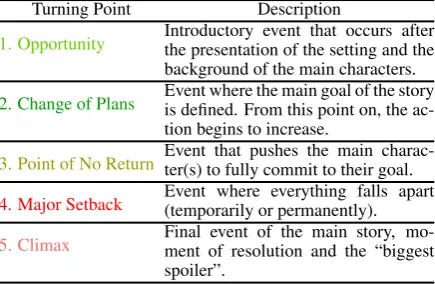
se-Turning Point Description
1. Opportunity Introductory event that occurs afterthe presentation of the setting and the
background of the main characters.
2. Change of Plans Event where the main goal of the storyis defined. From this point on, the
ac-tion begins to increase.
3. Point of No Return Event that pushes the main charac-ter(s) to fully commit to their goal.
4. Major Setback Event where everything falls apart(temporarily or permanently).
5. Climax Final event of the main story, mo-ment of resolution and the “biggest
[image:1.595.308.526.205.347.2]spoiler”.
Table 1: Turning points and their definitions.
ries (Frermann et al.,2018), summarizing screen-plays (Gorinski and Lapata, 2018), and answer-ing questions about long and complex narratives (Koˇcisk`y et al.,2018).
In this paper we are interested in the automatic analysis of narrative structure in screenplays. Nar-rative structure, also referred to as a storyline or plotline, describes the framework of how one tells a story and has its origins to Aristotle who de-fined the basic triangle-shaped plot structure rep-resenting the beginning (protasis), middle (epita-sis), and end (catastrophe) of a story (Pavis,1998). The German novelist and playwright Gustav Frey-tag modified Aristotle’s structure by transforming the triangle into a pyramid (Freytag, 1896). In his scheme, there are five acts (introduction, rising
movement, climax, return, andcatastrophe).
Sev-eral variations of Freytag’s pyramid are used today in film analysis and screenwriting (Cutting,2016). In this work, we adopt a variant commonly em-ployed by screenwriters as a practical guide for producing successful screenplays (Hague, 2017). According to this scheme, there are six stages (acts) in a film, namely the setup, the new situ-ation,progress, complications and higher stakes, the final push, andthe aftermath, separated by five
turning points(TPs). TPs are narrative moments
Recently divorced Meg Altman and her 11-year-old daughter Sarah have just purchased a four-story brownstone on New York City. The house's previous owner installed an isolated room used to protect the house's occupants
from intruders. On the night the two move into the home, it is broken by
Junior, the previous owner's grandson; Burnham, an employee of the residence's security company; and Raoul; a ski mask-wearing gunman.
The three are after $3 million in bearer bonds, which are locked inside a floor safe in the panic room... As they begin the robbery, Meg wakes up and happens to see the intruders on the video monitors in the panic room.
Before the three can reach them, Meg and Sarah run into the panic room and close the door behind them, only to find that the burglars have disabled the telephone.
Intending to force them of the room, Burnham introduces propane gas into the room's air vents....Meg then taps into the main telephone line and gets through to her ex-husband Stephen, before the burglars cut them off.... Stephen arrives at the home and is taken hostage by Burnham and
Raoul—who severely beats him. To make matters worse, Sarah, who has
diabetes, suffers a seizure.
Her glucagon syringe is in a refrigerator outside the panic room. After using an unconscious Stephen to trick Meg into momentarily leaving the panic room, Burnham enters it, finding Sarah motionless on the floor... After Burnham gives Sarah the injection, Sarah thanks him. Having earlier received a call from Stephen, two policemen arrive,
which prompts Raoul to threaten Sarah's life. Sensing the potential
danger to her daughter, Meg lies to the officers and they leave.
Meanwhile, Burnham opens the safe and removes the $22 million in bearer bonds inside. As the robbers attempt to leave, using Sarah as a hostage,
Meg hits Raoul with a sledgehammer and Burnham flees. After a badly
injured Stephen shoots at Raoul and misses, Raoul disables him and prepares to kill Meg with the sledgehammer, but Burnham, upon hearing Sarah's screams of pain, returns to the house and shoots Raoul dead, stating, "You'll be okay now", to Meg and her daughter before leaving.
[image:2.595.73.293.65.286.2]The police, alerted by Meg's suspicious behavior earlier, arrive in force and capture Burnham. Later, Meg and Sarah, having recovered from their harrowing experience, begin searching the newspaper for a new home.
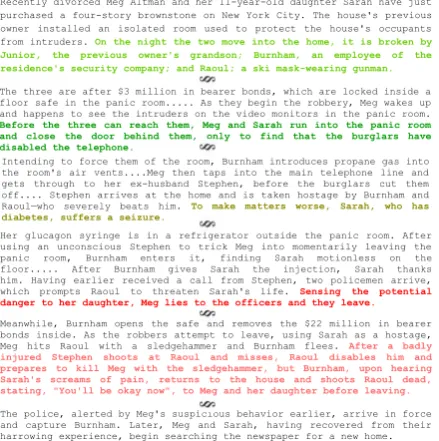
Figure 1: Example of turning point annotations (TP1, TP2,TP3,TP4,TP5, respectively) for the synopsis of the movie “Panic Room”.
(Thompson,1999), and by definition they occur at the junctions of acts. Aside from changing nar-rative direction, TPs define the movie’s structure, tighten the pace, and prevent the narrative from drifting. The five TPs and their definitions are given in Table1.
We propose the task of turning point identifica-tion in movies as a means of analyzing their nar-rative structure. TP identification provides a se-quence of key events in the story and segments the screenplay into thematic units. Common ap-proaches to summarization and QA of long or multiple documents (Chen et al.,2017;Yang et al.,
2018;Kratzwald and Feuerriegel,2018;Elgohary et al., 2018) include a retrieval system as the first step, which selects a subset of relevant pas-sages for further processing. However, Koˇcisk`y et al.(2018) demonstrate that these approaches do not perform equally well for extended narratives, since individual passages are very similar and the same entities are referred to throughout the story. We argue that this challenge can be addressed by TP identification, which finds the most important events and segments the narrative into thematic units. Downstream processing for summarization or question answering can then focus on those seg-ments that are relevant to the task.
Problematically for modeling purposes, TPs are latent in screenplays, there are no scriptwriting conventions (like character cues or scene head-ings) to denote where TPs occur, and their exact
manifestation varies across movies (depending on genre and length), although there are some rules of thumb indicating where to expect a TP (e.g., the Opportunity occurs after the first 10% of a screen-play, Change of Plans is approximately 25% in). To enable automatic TP identification, we develop a new dataset which consists of screenplays, plot synopses, and turning point annotations. To save annotation time and render the labeling task fea-sible, we collect TP annotations at the plot syn-opsis level (synopses are a few paragraphs long compared to screenplays which are on average 120 pages long). An example is given in Figure1. We then project the TP annotations via distant su-pervision onto screenplays and propose an end-to-end neural network model which identifies TPs in full length screenplays.
Our contributions can be summarized as fol-lows: (a) we introduce TP identification as a new task for the computational analysis of screen plays that can benefit applications such as QA and summarization; (b) we create and make pub-licly available theTuRnIngPOint Dataset
(TRI-POD)1 which contains 99 movies (3,329
synop-sis sentences and 13,403 screenplay scenes) an-notated with TPs; and (c) we present an end-to-end neural network model that identifies turning points in plot synopses and projects them onto scenes in screenplays, outperforming strong base-lines based on state-of-the-art sentence represen-tations and the expected position of TPs.
2 Related Work
Recent years have seen increased interest in the automatic analysis of long and complex narra-tives. Specifically, Machine Reading Comprehen-sion (MRC) and Question Answering (QA) tasks are transitioning from investigating single short and clean articles or queries (Rajpurkar et al.,
2016;Nguyen et al.,2016;Trischler et al.,2016) to large scale datasets that consist of complex sto-ries (Tapaswi et al.,2016;Frermann et al.,2018;
Koˇcisk`y et al.,2018;Joshi et al.,2017) or require reasoning across multiple documents (Welbl et al.,
2018;Wang et al., 2018; Dua et al., 2019; Yang et al., 2018). Tapaswi et al. (2016) introduce a multi-modal dataset consisting of questions over 140 movies, whileFrermann et al.(2018) attempt to answer a single question, namely who is the per-petrator in 39 episodes of the well-known crime series CSI, again based on multi-modal
tion. Finally, Koˇcisk`y et al. (2018) recently in-troduced a dataset consisting of question-answer pairs over 1,572 movie screenplays and books.
Previous approaches have focused on fine-grained story analysis, such as inducing charac-ter types (Bamman et al., 2013, 2014) or under-standing relationships between characters (Iyyer et al.,2016;Chaturvedi et al.,2017). Various ap-proaches have also attempted to analyze the goal
and structure of narratives. Black and Wilensky
(1979) evaluate the functionality of story
gram-mars in story understanding,Elson and McKeown
(2009) develop a platform for representing and
reasoning over narratives, andChambers and
Ju-rafsky(2009) learn fine-grained chains of events.
In the context of movie summarization,
Gorin-ski and Lapata (2018) automatically generate an overview of the movie’s genre, mood, and artis-tic style based on screenplay analysis. Gorinski and Lapata(2015) summarize full length screen-plays by extracting an optimal chain of scenes via a graph-based approach centered around the
characters of the movie. A similar approach
has also been adopted by Vicol et al. (2018),
who introduce the MovieGraphs dataset consist-ing of 51 movies and describe video clips with character-centered graphs. Other work creates an-imated story-boards using the action descriptions of screenplays (Ye and Baldwin, 2008), extracts social networks from screenplays (Agarwal et al.,
2014a), or creates xkcd movie narrative charts (Agarwal et al.,2014b).
Our work also aims to analyze the narrative structure of movies, but we adopt a high-level ap-proach. We advocate TP identification as a pre-cursor to more fine-grained analysis that unveils character attributes and their relationships. Our approach identifies key narrative events and seg-ments the screenplay accordingly; we argue that this type of preprocessing is useful for applica-tions which might perform question answering and summarization over screenplays. Although our experiments focus solely on the textual modal-ity, turning point analysis is also relevant for mul-timodal tasks such as trailer generation and video summarization.
3 The TRIPOD Dataset
The TRIPOD dataset contains 99 screenplays, ac-companied with cast information (according to IMDb), and Wikipedia plot synopses annotated with turning points. The movies were selected from the Scriptbase dataset (Gorinski and Lapata,
Train Test
movies 84 15
turning points 420 75
synopsis sentences 2,821 508
screenplay scenes 11,320 2,083
synopsis vocabulary 7.9k 2.8k
screenplay vocabulary 37.8k 16.8k
per synopsis
tokens 729.8 (165.5) 698.4 (187.4)
sentences 35.4 (8.4) 33.9 (9.9)
sentence tokens 20.6 (9.5) 20.6 (9.3)
per screenplay
tokens 23.0k (6.6) 20.9k (4.5)
sentences 3.0k (0.9) 2.8k (0.6)
scenes 133.0 (61.1) 138.9 (50.7)
per scene
tokens 173.0 (235.0) 150.5 (198.3)
sentences 22.2 (31.5) 19.9 (26.9)
[image:3.595.308.525.63.255.2]sentence tokens 7.8 (6.0) 7.6 (6.4)
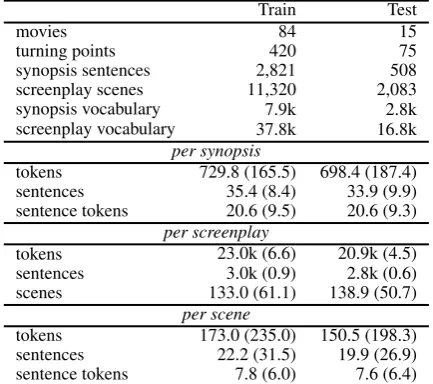
Table 2: Statistics of the TRIPOD dataset; all means are shown with standard deviation in brackets.
2015) based on the following criteria: (a) main-taining a variation across different movie genres (e.g., action, romance, comedy, drama) and narra-tive types (e.g., flashbacks, time shifts); and (b) in-cluding screenplays that are faithful to the released movies and their synopses as much as possible. In Table2, we present various statistics of the dataset. Our motivation for obtaining TP annotations at the synopsis level (coarse-grained), instead of at the screenplay level (fine-grained) was twofold. Firstly, on account of being relatively short, synopses are easier to annotate than full-length screenplays, allowing us to scale the dataset in the future. Secondly, we would expect synopsis-level annotations to be more reliable and the degree of inter-annotator agreement higher; asking annota-tors to identify precisely where a turning point occurs might seem like looking for a needle in a haystack. An example of a synopsis with TP anno-tations is shown in Figure1for the movie “Panic Room”. Each TP is colored differently, and both the chain of key events (colored text) and resulting segmentation ( § ) are illustrated.
In an initial pilot study, the three authors acted as annotators for identifying TPs in movie
syn-opses. They selected exactly one sentence per
in the dataset were then single annotated by the new annotators.
We computed inter-annotator agreement using two different metrics: (a) total agreement (TA), i.e., the percentage of TPs that two annotators agree upon by selecting the exact same sentence; and (b) annotation distance, i.e., the distance d[pi,t pi]between two annotations for a given TP, normalized by synopsis length:
d[pi,t pi] = 1
N|pi−t pi| (1)
whereNis the number of synopsis sentences and
t piand pi are the indices of the sentences labeled
with TP iby two annotators. The mean
annota-tion distanceDis then computed by averaging dis-tancesd[pi,t pi]across all annotated TPs.
The TA between the two annotators in our sec-ond study was 64.00% and the mean annotation distance was 4.30% (StDev 3.43%). The annota-tion distance per TP is presented in Table 5(last line), where it is compared with the automatic TP identification results (to be explained later).
We also asked our annotators to annotate the screenplays (rather than synopses) for a subset of 15 movies. This subset serves as our goldstdard test set. Annotators were given synopses an-notated with TPs and were instructed to indicate for each TP which scenes in the screenplay cor-respond to it. Six of the 15 movies were doubly annotated, so that we could measure agreement. Since annotators were allowed to choose a vari-able number of scenes for each TP, this changes slightly our agreement metrics.
Total Agreement (TA) now is the percentage of TP scenes the annotators agree on:
TA= 1
T·L
T·L
∑
i=1|Si∩Gi|
|Si∪Gi|
(2)
where T, L are the TPs identified per annotator
in a screenplay, and Si andGi are the indices of
the scenes selected for TPiby the two annotators. Partial Agreement (PA) is the percentage of TPs where there is an overlap of at least one scene:
PA= 1
T·L
T·L
∑
i=1[Si∩Gi6=0/] (3)
And annotation distanceD becomes the mean of
the distances2 d[Si,Gi] between two annotators
2We compute the minimum distance between the two sets
of scenes, since non-sequential scenes may be included in the same set. Hence, considering the center of the sets is not always representative of the TP scenes.
normalized byM, the length of the screenplay:
d[Si,Gi] = 1
M(s∈minSi,g∈Gi)
|s−g| (4)
The TA and PA between the two annotators were 35.48% and 56.67%, respectively. The mean an-notation distance was 1.48% (StDev 2.93%). The TA shows that the annotators rarely indicate the same scenes, even if they are asked to annotate an event in the screenplay that is described by a specific synopsis sentence. However, they identify scenes which are in close proximity in the screen-play, as PA and annotation distance reveal. This analysis validates our assumption that annotating the synopses first limits the degree of overall dis-agreement.
4 Turning Point Prediction Models
In this work, we aim to detect text segments which
act as TPs. We first identify which sentences
in plot synopses are TPs (Section 4.1); next, we
identify which scenes in screenplays act as TPs
via projection of goldstandard TP labels
(Sec-tion 4.2); finally, we build an end-to-end system which identifies TPs in screenplays based on pre-dictedTP synopsis labels (Section4.3).
All models we propose in this paper have the
same basic structure; they take text segments i
(sentences or scenes) as input and predict whether these act as TPs or not. Since the sequence, num-ber, and labels of TPs are fixed (see Table1), we treat TP identification as a binary classification problem (where 1 indicates that the text is a TP and 0 otherwise). Each segment is encoded into a multi-dimensional feature spacexiwhich serves
as input to a fully-connected layer with a single neuron representing the probability that iacts as a TP. In the following, we describe several models which vary in the way input segments are encoded.
4.1 Identifying Turning Points in Synopses
Context-Aware Model (CAM) A simple
base-line model would compute the semantic represen-tation of each sentence in the synopsis using a
pre-trained sentence encoder. However, classifying
LSTM
LSTM
LSTM
LSTM
LSTM LSTM
LSTM
LSTM
LSTM
LSTM x1
x2
x3
xN-1
xN
... ...
h1 h1
h2 h2
h3 h3
hN-1 hN-1
hN hN Synopsis
encoder Sentence
representations
Context-aware sentence representations
sentence-context similarity
sentence-context similarity
y3
. . . . .
. . . . .
Context interaction layer
left context
right context
y1
yN sliding
window
sliding window
(a) Topic-Aware Model (TAM)
TP1-Synopsis
encoder TP2-Synopsis encoder
TP3-Synopsis encoder
TP4-Synopsis encoder
TP5-Synopsis encoder
x1. . . xN x1 . . . xN x1. . .xN x1. . .xN x1 . . .xN . . . .
. . .
Context interaction layer
y1 . . . yN
Merging layer
[image:5.595.86.513.67.244.2](b) Multi-view TAM
Figure 2: Model overview for TP identification in synopses. On the left, sentence representationsxiare contextualized via
a synopsis encoder (BiLSTM layer) and after interacting with the left and right windows in the context interaction layer, the final sentence representationyiis computed. On the right, five different synopsis encoders are utilized, one per TP, and these
different views of a synopsis sentencexiare combined in the merging layer.
for sentencexi by concatenating the hidden layers
of the forward−→hi and backward
←−
hi LSTM,
respec-tively: cpi=hi= [
− →
hi;
←−
hi](for a more detailed
de-scription, see the Appendix). Representation cpi
is the input feature vector for our binary classifier. The model is illustrated in Figure2a.
Topic-Aware Model (TAM) TPs by definition
act as boundaries between different thematic units
in a movie. Furthermore, long documents are
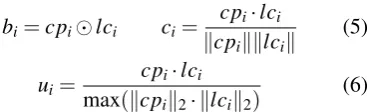
usually comprised of topically coherent text seg-ments, each of which contains a number of text passages such as sentences or paragraphs (Salton et al., 1996). Inspired by text segmentation ap-proaches (Hearst, 1997) which measure the se-mantic similarity between sequential context win-dows in order to determine topic boundaries, we enhance our representations with a context inter-actionlayer. The objective of this layer is to mea-sure the similarity of the current sentence with its preceding and following context, thereby encod-ing whether it functions as a boundary between thematic sections. The enriched model with the context interaction layer is illustrated in Figure2a. After calculating contextualized sentence repre-sentations cpi, we compute the representation of
the leftlciand rightrci contexts of sentencei(see
Figure2a, right-hand side). We select windows of fixed lengthland calculatelciandrciby averaging
the sentence representations within each window. Next, we compute the semantic similarity of the current sentence with each context representation. Specifically, we consider the element-wise prod-uctbi, cosine similarityciand pairwise distanceui
as similarity metrics:
bi=cpilci ci=
cpi·lci
kcpikklcik
(5)
ui=
cpi·lci
max(kcpik2· klcik2)
(6)
The interaction representation of sentencecpiwith
its left context is the concatenation ofcpi, f li, and
the above similarity values (i.e.,bi,ci,ui):
f li= [cpi;lci;bi;ci;ui] (7)
The interaction representation f ri for the right
context rci is computed analogously. We obtain
the final representation of sentenceivia concate-nating f liand f ri:yi= [f li;f ri;cpi].
TP-Specific Information Another variation of
our model is to use TP-specific encoders instead of a single one (see Figure2b). In this case, we employ five different encoders for calculating five different representations for the current synopsis sentencexi, each one with respect to a specific TP.
These representations can be considered multiple views of the same sentence. We calculate the inter-action of each view with the left and right context window, as previously, via the context interaction layer. Finally we compute the sentence represen-tation yi by concatenating its individual
context-enriched TP representations.
Entity-Specific Information We also enrich our
[image:5.595.341.525.342.398.2]Synopsis Encoder Screenplay Encoder
x1 x2 . . . xN s1 . . . sk . . . sM
y1 y2 . . . yN sc1 . . . sck . . . scM
tp1 tp5
TP
selection
. . .
left context
right context
Context
interaction layer
TP-scene interaction layer zk
z1 . . . zM
tp scene
[image:6.595.74.295.60.211.2]. .
Figure 3: TAM overview for TP identification in
screenplays. The synopsis and screenplay encoders
contextualize synopsis sentences xi and screenplay
scenessi, respectively. TPs are selected from
contex-tualized synopsis sentencesyiand a richer
representa-tion sci is computed forsi via the context interaction
layer. The similarity between sentencet piand scenezi
is computed by the TP–scene interaction layer.
2014) and substitute mentions of named entities
whenever these are included in the IMDb cast list. We then obtain entity-specific sentence rep-resentations as follows. Our encoder uses a word embedding layer initialized with pre-trained en-tity embeddings and a BiLSTM for contextual-izing word representations. We add an attention mechanism on top of the LSTM, which assigns a weight to each word representation. We compute the entity-specific representation ei for synopsis
sentence ias the weighted sum of its word
rep-resentations (for more details, see the Appendix). Finally, entity enriched sentence representationsx0i are obtained by concatenating generic vectors xi
with entity-specific onesei:x0i= [xi;ei].
4.2 Identifying Turning Points in Screenplays
Identifying TPs in synopses serves as a testbed for validating some of the assumptions put forward in this work, namely that turning points mark nar-rative progression and can be identified automat-ically based on their lexical makeup. Neverthe-less, we are mainly interested in the real-world scenario where TPs are detected in longer docu-ments such as screenplays. Screenplays are natu-rally segmented into scenes, which often describe a self-contained event that takes place in one lo-cation, and revolves around a few characters. We therefore assume that scenes are suitable textual segments for signaling TPs in screenplays.
Unfortunately, we do not have any goldstandard information about TPs in screenplays. We
pro-TP1 TP2 TP3 TP4 TP5
theory 10.00 25.00 50.00 75.00 94.50
µ 11.39 31.86 50.65 74.15 89.43
σ 6.72 11.26 12.15 8.40 4.74
Table 3: Expected TP position based on screenwriting
theory; mean position µ and standard deviation σ in
goldstandard synopses of our training set.
vide distant supervision by constructing noisy la-bels based on goldstandard TP annotations in syn-opses (see the description below). Given sentences labeled as TPs in a synopsis, we identify scenes in the corresponding screenplay which are semanti-cally similar to them. We formulate this task as a binary classification problem, where a sentence-scene pair is deemed either “relevant” or “irrele-vant” for a given TP.
Distant Supervision Based on the
screenwrit-ing scheme ofHague(2017), TPs are expected to occur in specific parts of a screenplay (e.g., the Climax is likely to occur towards the end). We exploit this knowledge as a form of distant super-vision. We estimate the mean position for each TP using the gold standard annotation of the plot syn-opses in our training set (normalized by the synop-sis length). The results are shown in Table3, to-gether with the TP positions postulated by
screen-writing theory. We observe that our estimates
agree well with the theoretical predictions, but also that some TPs (e.g., TP2 and TP3) are more variable in their position than others (e.g., TP1 and TP5). This leads us to the following hypothesis: each TP is situated within a specific window in a screenplay. Scenes that lie within the window are semantically related to the TP, whereas all other scenes are unrelated. In experiments we calculate a windowµ±σbased on our data (see Table3).
We compute scene representations based on the sequence of sentences that comprise it using a BiLSTM equipped with an attention mechanism (see Section4.1). The final scene representations is the weighted sum of the representations of the scene sentences. Next, the TP–scene interaction layer enriches scene representations with similar-ity values with each marked TP synopsis sentence t pas shown in Equations (5)–(7).
[image:6.595.317.516.63.107.2]sim-ilar fashion over scene representations.
Topic-Aware Model (TAM) TAM enhances our
screenplay encoder with information about topic boundaries. Specifically, we compute the repre-sentations of the leftlci and rightrcicontext
win-dow of theithscene in the screenplay as described in Section4.1. Next, we compute the final repre-sentationzi of scenesci by concatenating the
rep-resentations of the context windowslciandrciand
the current scenesci:zi= [lci;sci;rci]. There is no
need to compute the similarity between scenes and context windows here as we now have goldstan-dard TP representations in the synopsis and em-ploy the TP–scene interaction layer for the compu-tation of the similarity between TPs and enriched scene representationszi. Hence, we directly
calcu-late in this layer a scene-level feature vector that encodes information about the scene, its similar-ity to TP sentences, and whether these function as boundaries between topics in the screenplay.
Entity-Specific information We can also
em-ploy an entity-specific encoder (see Section 4.1) for the representing the synopsis and scene sen-tences. Again, generic and entity-specific repre-sentations are combined via concatenation.
4.3 End-to-end TP Identification
Our ultimate goal is to identify TPs in screen-plays without assuming any goldstandard infor-mation about their position in the synopsis. We address this with an end-to-end model which first predicts the sentences that act as TPs in the synop-sis (e.g., TAM in Section4.1) and then feeds these predictions to a model which identifies the corre-sponding TP scenes (e.g., TAM in Section4.2).
5 Experimental Setup
Training We used the Universal Sentence
En-coder (USE;Cer et al. 2018) as a pre-trained sen-tence encoder for all models and tasks; its perfor-mance was superior to BERT (Devlin et al.,2018) and other related pre-trained encoders (for more details, see the Appendix). Since the binary labels in both prediction tasks are imbalanced, we apply class weights to the loss function of our models. We weight each class by its inverse frequency in the training set (for more implementation details, see the Appendix).
Inference During inference in our first task
(i.e., identification of TPs in synopses), we select one sentence per TP. Specifically, we want to track
TA D
Baseline 31.00 9.65 (4.41)
CAM 33.00 7.44 (8.09)
TAM 36.00 7.11 (7.98)
+ TP views 39.00 6.52(7.72)
+ entities 38.00 6.91 (7.65)
(a) Development set
TA D
Random 2.00 37.79 (25.33)
Theory baseline 22.00 7.47 (6.75)
Distribution baseline 28.00 7.28 (6.23)
TAM 34.67 6.80(5.19)
+ TP views 38.57 7.47 (7.48)
+ entities 41.33 7.30 (7.21)
Human agreement 64.00 4.30 (3.43) (b) Test set
Table 4: Identification of TPs in plot synopses; re-sults are shown in percent (TA: mean Total Agreement;
D: annotation distance; standard deviation in brackets).
TAM TP1 TP2 TP3 TP4 TP5
+ TP views 6.09 9.45 10.72 6.91 4.26
+ entities 7.18 9.35 9.86 5.23 3.48
[image:7.595.321.507.61.244.2]Human agreement 3.33 5.00 10.58 1.07 1.53
Table 5: Mean annotation distanceD(test set); results are shown per TP on the synopsis identification task.
the five sentences with the highest posterior prob-ability of being TPs and sequentially assign them TP labels based on their position. However, it is possible to have a cluster of neighboring sentences with high probability, even though they all belong to the same TP. We therefore constrain the sen-tence selection for each TP within the window of its expected position, as calculated in the distribu-tion baseline (Secdistribu-tion4.2).
For models which predict TPs in screenplays, we obtain a probability distribution over all scenes in a screenplay indicating how relevant each is to the TPs of the corresponding plot synopsis. We find the peak of each distribution and select a neighborhood of scenes around this peak as TP-relevant ones. Based on the goldstandard annota-tion, each TP corresponds to 1.77 relevant scenes on average (StDev 1.23). We therefore consider a neighborhood of three relevant scenes per TP.
6 Results
TP Identification in Synopses Table 4a reports
nei-1st 2nd 3rd 0
5 10 15 20 25 30 35 4045
% cases
[image:8.595.310.523.62.176.2]goldstandard TAM distribution baseline
Figure 4: Rankings (shown as proportions) of synopsis highlights produced by aggregating goldstandard TP annotations, those predicted by the distribution base-line, and our model (TAM + TP views).
ther context-aware nor utilizes topic boundary in-formation against CAM and TAM. We also show two variants of TAM enhanced with TP-specific encoders (+ TP views) and entity-specific informa-tion (+ entities). Model performance is measured using the evaluation metrics of Total Agreement (TA) and annotation distance (D), normalized by synopsis length (equation (1)).
The baseline model presents the lowest per-formance among all variants which suggests that state-of-the-art sentence representations on their own are not suitable for our task. Indeed, when contextualizing the synopsis sentences via a BiL-STM layer we observe an absolute increase of
4.00% in terms of TA. Moreover, the addition
of a context interaction layer (see TAM row in
Table 4a) yields an absolute TA improvement of
4.00% compared to CAM. Combining different TP views further improves by 3.00%, reaching a
TAof 39.00%, and reducingDto 6.52%.
Table 4bshows our results on the test set. We compare TAM, our best performing model against two strong baselines. The first one selects sen-tences that lie on the expected positions of TPs according to screenwriting theory; while the sec-ond one selects sentences that lie on the peaks of the empirical TP distributions in the training set
(Section4.2). As we can see, TAM (+ TP views)
achieves a TA of 38.57% compared to 22.00%
for the distribution baseline. And although entity-specific information does not have much impact on the development set, it yields a 2.76% improve-ment on the test set. A detailed break down of re-sults per TP is given in Table5. Interestingly, our
model resembles human behavior (see rowHuman
agreement): TPs 1, 4, and 5 are easiest to distin-guish, whereas TPs 2 and 3 are hardest and fre-quently placed at different points in the synopsis.
We also conducted a human evaluation
experi-TA PA D
Theory baseline 8.66 10.67 10.45 (9.14)
Distribution baseline 6.67 9.33 10.84 (8.94)
tf*idf similarity 0.74 1.33 53.07 (31.83)
tf*idf + distribution 4.44 6.67 13.33 (11.51)
CAM 11.11 16.00 10.23 (11.23)
+ entities 14.18 17.33 12.77 (12.61)
TAM 10.63 13.33 8.94(9.39)
+ entities 10.63 13.33 10.15 (10.56)
TAM End2end 7.87 9.33 10.16 (10.74)
Human agreement 35.48 56.67 1.48(2.93)
Table 6: Identification of TPs in screenplays; results are shown in percent using five-fold cross validation (TA: mean Total Agreement;PA: Partial Agreement;D: an-notation distanceD; standard deviation in brackets).
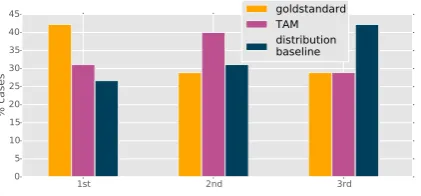
ment on Amazon Mechanical Turk (AMT). AMT workers were presented with a synopsis and “high-lights”, i.e., five sentences corresponding to TPs. We obtained highlights from goldstandard anno-tations, the distribution baseline, and TAM (+ TP views). AMT workers were asked to read the syn-opsis and rank the highlights from best to worst according to the following criteria: (1) the qual-ity of the plotline that they form; (2) whether they include the most important events and plot twists of the movie; and (3) whether they provide some description of the events in the beginning and end
of the movie. In Figure 4 we show,
proportion-ally, how often our participants ranked each model 1st, 2nd, and so on. Perhaps unsurprisingly, gold-standard TPs were considered best (and ranked 1st 42% of the time). TAM is ranked best 30% of the time, followed by the distribution baseline which
was only ranked first 26% of the time.
Over-all, the average ranking positions for the goldstan-dard, TAM, and the baseline are 1.87, 1.98, and
2.16, respectively. Human evaluation therefore
validates that our model outperforms the position-based baselines.
TP Identification in Screenplays Our results
are summarized in Table 6. For this task, we
performed five-fold crossvalidation over our orig-inal goldstandard set to obtain a test-development split (recall we do not have goldstandard anno-tations for training). We report Total Agreement (TA), Partial Agreement (PA), and annotation
dis-tanceD, normalized by screenplay length
(Equa-tions (2)–(4)).
Aside from the theory and distribution-based
baselines, we also experimented3 with a
com-3Common segmentation approaches such as TextTiling
[image:8.595.74.285.64.162.2]scene indices
probability
scene indices
similarity
scene indices
probability
[image:9.595.91.512.72.184.2]Distribution baseline tf*idf similarity TAM
Figure 5: Probability distributions over the scenes of the screenplay for the movie “Juno”; x-axis: scene indices, y-axis: probability that the scene is relevant to a specific TP. Vertical dashed lines are goldstandard TP scenes.
mon IR baseline which considers TP synopsis sen-tences as queries and retrieves a neighborhood of semantically similar scenes from the screenplay using tf*idf similarity. Specifically, we compute the maximum tf*idf similarity for all sentences in-cluded in the respective scene. We empirically ob-served that tf*idf’s behavior can be erratic select-ing scenes in completely different sections of the screenplay, and therefore constrain it by selecting scenes only within the windows determined by the position distributions (µ±σ) for each TP. As far as our own models are concerned, we report results with goldstandard TP labels for CAM and TAM on their own and enriched with entity information. We also built and end-to-end system based on TP predictions from TAM.
As can be seen in Table6, tf*idf approaches per-form worse than position-related baselines. Over-all, similar vocabulary across scenes and mentions of the same entities throughout the screenplay make tf*idf approaches insufficient for our tasks. The best performing model is TAM confirming our hypothesis that TPs are not just isolated key events, but also mark boundaries between the-matic units and, therefore, segmentation-inspired approaches can be beneficial for the task. Results for entities are somewhat mixed; for CAM, the
entity-specific information improves TA and PA
but increases D, while it does not seem to make
much difference for TAM. The performance of the end-to-end TAM model drops slightly com-pared to the same model using goldstandard TP annotations. However, it still remains competitive against the baselines, indicating that tracking TPs in screenplays fully automatically is feasible.
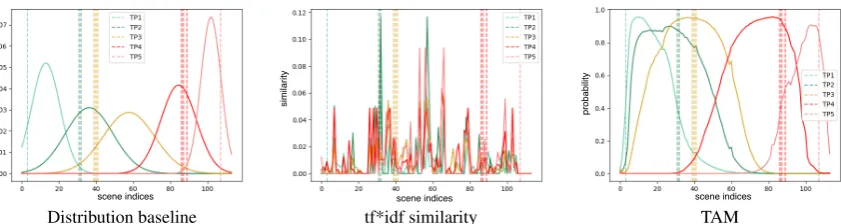
In Figure 5, we visualize the posterior distri-bution of various models over the scenes of the screenplay for the movie “Juno”. The first panel shows the distribution baseline alongside gold-standard TP scenes (vertical lines). We observe
that the distribution baseline provides a good ap-proximation of relevant TP positions (which val-idates its use in the construction of noisy labels, Section4.2), even though it is not always accurate. For example, TPs 1 and 3 lie outside the expected window in “Juno”.
The second panel presents the TP predictions
according to tf*idf similarity. We observe that
scenes located in entirely different parts of the screenplay present high similarity scores with re-spect to a given TP due to vocabulary uniformity and mentions of the same entities throughout the screenplay. In the next panel we present the pre-dictions of TAM. Adding synopsis and screenplay encoders yields smoother distributions increasing the probability of selecting TP scenes inside dis-tinct regions of the screenplay, with sharper peaks and higher confidence.
7 Conclusions
We proposed the task of turning point identifica-tion in screenplays as a means of analyzing their narrative structure. We demonstrated that auto-matically identifying a sequence of key events and segmenting the screenplay into thematic units is feasible via an end-to-end neural network model. In future work, we will investigate the usefulness of TPs for summarization and question answering. We will also scale the TRIPOD dataset and move to a multi-modal setting where TPs are identified directly in video data.
Acknowledgments
References
Apoorv Agarwal, Sriramkumar Balasubramanian,
Jiehan Zheng, and Sarthak Dash. 2014a. Parsing Screenplays for Extracting Social Networks from
Movies. In Proceedings of the 3rd Workshop on
Computational Linguistics for Literature, pages 50– 58, Gothenburg, Sweden.
Apoorv Agarwal, Sarthak Dash, Sriramkumar Balasub-ramanian, and Jiehan Zheng. 2014b. Using Deter-minantal Point Processes for Clustering with Ap-plication to Automatically Generating and Drawing xkcd Movie Narrative Charts. InProceedings of the 2nd Academy of Science and Engineering Interna-tional Conference on Big Data Science and Com-puting, Stanford, California.
Apoorv Agarwal, Jiehan Zheng, Shruti Kamath, Sri-ramkumar Balasubramanian, and Shirin Ann Dey. 2015. Key Female Characters in Film Have More to Talk About Besides Men: Automating the Bechdel
Test. In Proceedings of the 2015 Conference of
the North American Chapter of the Association for Computational Linguistics: Human Language Tech-nologies, pages 830–840, Denver, Colorado.
David Bamman, Brendan OConnor, and Noah A Smith. 2013. Learning latent personas of film char-acters. InProceedings of the 51st Annual Meeting of the Association for Computational Linguistics (Vol-ume 1: Long Papers), volume 1, pages 352–361, Sofia, Bulgaria.
David Bamman, Ted Underwood, and Noah A Smith. 2014. A bayesian mixed effects model of literary character. InProceedings of the 52nd Annual Meet-ing of the Association for Computational LMeet-inguistics (Volume 1: Long Papers), volume 1, pages 370–379.
John B Black and Robert Wilensky. 1979. An
evaluation of story grammars. Cognitive science, 3(3):213–229.
Daniel Cer, Yinfei Yang, Sheng-yi Kong, Nan Hua, Nicole Limtiaco, Rhomni St John, Noah Constant, Mario Guajardo-Cespedes, Steve Yuan, Chris Tar,
et al. 2018. Universal sentence encoder. arXiv
preprint arXiv:1803.11175.
Nathanael Chambers and Dan Jurafsky. 2009.
Un-supervised learning of narrative schemas and their participants. In Proceedings of the Joint Confer-ence of the 47th Annual Meeting of the ACL and the 4th International Joint Conference on Natural Lan-guage Processing of the AFNLP: Volume 2-Volume
2, pages 602–610. Association for Computational
Linguistics.
Snigdha Chaturvedi, Mohit Iyyer, and Hal Daume III. 2017. Unsupervised learning of evolving relation-ships between literary characters. In Thirty-First AAAI Conference on Artificial Intelligence.
Danqi Chen, Adam Fisch, Jason Weston, and
An-toine Bordes. 2017. Reading wikipedia to
an-swer open-domain questions. arXiv preprint
arXiv:1704.00051.
James E Cutting. 2016. Narrative theory and the dy-namics of popular movies. Psychonomic bulletin & review, 23(6):1713–1743.
Cristian Danescu-Niculescu-Mizil, Justin Cheng and-Jon Kleinberg, and Lillian Lee. 2012. You had me at hello: How phrasing affects memorability. In Pro-ceedings of the 50th Annual Meeting of the Associ-ation for ComputAssoci-ational Linguistics: Long Papers– Volume 1, pages 892–901, ??
Jacob Devlin, Ming-Wei Chang, Kenton Lee, and Kristina Toutanova. 2018. Bert: Pre-training of deep bidirectional transformers for language understand-ing.arXiv preprint arXiv:1810.04805.
Dheeru Dua, Yizhong Wang, Pradeep Dasigi, Gabriel Stanovsky, Sameer Singh, and Matt Gardner. 2019.
Drop: A reading comprehension benchmark
re-quiring discrete reasoning over paragraphs. arXiv preprint arXiv:1903.00161.
Ahmed Elgohary, Chen Zhao, and Jordan Boyd-Graber. 2018. A dataset and baselines for sequential open-domain question answering. InProceedings of the 2018 Conference on Empirical Methods in Nat-ural Language Processing, pages 1077–1083.
Mich Elsner. 2012. Character-based kernels for novel-istic plot structure. InProceedings of the 13th Con-ference of the European Chapter of the Association for Computational Linguistics, pages 634–644, Avi-gnon, France.
David Elson and Kathleen McKeown. 2009. Extending and evaluating a platform for story understanding. InProceedings of the AAAI 2009 Spring Symposium on Intelligent Narrative Technologies II, page ??, ??
Lea Frermann, Shay B Cohen, and Mirella Lapata. 2018. Whodunnit? crime drama as a case for natural language understanding. Transactions of the Associ-ation of ComputAssoci-ational Linguistics, 6:1–15.
Gustav Freytag. 1896. Freytag’s technique of the
drama: an exposition of dramatic composition and art. Scholarly Press.
Philip John Gorinski and Mirella Lapata. 2015. Movie script summarization as graph-based scene
extrac-tion. In Proceedings of the 2015 Conference of
the North American Chapter of the Association for Computational Linguistics: Human Language Tech-nologies, pages 1066–1076.
Michael Hague. 2017. Storytelling Made Easy: Per-suade and Transform Your Audiences, Buyers, and Clients – Simply, Quickly, and Profitably. Indie Books International.
Marti A Hearst. 1997. Texttiling: Segmenting text into
multi-paragraph subtopic passages. Computational
linguistics, 23(1):33–64.
Sepp Hochreiter and J¨urgen Schmidhuber. 1997.
Long short-term memory. Neural computation,
9(8):1735–1780.
Mohit Iyyer, Anupam Guha, Snigdha Chaturvedi, Jor-dan Boyd-Graber, and Hal Daum´e III. 2016. Feud-ing families and former friends: Unsupervised learn-ing for dynamic fictional relationships. In Proceed-ings of the 2016 Conference of the North Ameri-can Chapter of the Association for Computational Linguistics: Human Language Technologies, pages 1534–1544.
Mandar Joshi, Eunsol Choi, Daniel S Weld, and Luke Zettlemoyer. 2017. Triviaqa: A large scale distantly supervised challenge dataset for reading comprehen-sion.arXiv preprint arXiv:1705.03551.
Tom´aˇs Koˇcisk`y, Jonathan Schwarz, Phil Blunsom, Chris Dyer, Karl Moritz Hermann, G´aabor Melis,
and Edward Grefenstette. 2018. The narrativeqa
reading comprehension challenge. Transactions
of the Association of Computational Linguistics, 6:317–328.
Bernhard Kratzwald and Stefan Feuerriegel. 2018. Adaptive document retrieval for deep question an-swering. arXiv preprint arXiv:1808.06528.
Christopher Manning, Mihai Surdeanu, John Bauer, Jenny Finkel, Steven Bethard, and David McClosky. 2014. The stanford corenlp natural language
pro-cessing toolkit. In Proceedings of 52nd annual
meeting of the association for computational lin-guistics: system demonstrations, pages 55–60.
Eric T. Nalisnick and Henry S. Baird. 2013. Character-to-character sentiment analysis in shakespeare’s
plays. In Proceedings of the 51st Annual
Meet-ing of the Association for Computational LMeet-inguis- Linguis-tics, pages 479–483, Sofia, Bulgaria.
Tri Nguyen, Mir Rosenberg, Xia Song, Jianfeng Gao, Saurabh Tiwary, Rangan Majumder, and Li Deng.
2016. Ms marco: A human generated machine
reading comprehension dataset. arXiv preprint
arXiv:1611.09268.
Patrice Pavis. 1998. Dictionary of the theatre: Terms, concepts, and analysis. University of Toronto Press.
Pranav Rajpurkar, Jian Zhang, Konstantin Lopyrev, and
Percy Liang. 2016. Squad: 100,000+ questions
for machine comprehension of text. arXiv preprint arXiv:1606.05250.
Anil Ramakrishna, Nikolaos Malandrakis, Elizabeth Staruk, and Shrikanth Narayanan. 2015. A quan-titative analysis of gender differences in movies us-ing psycholus-inguistic normatives. InProceedings of the 2015 Conference on Empirical Methods in Nat-ural Language Processing., pages 1996–2001, Lis-bon, Portugal.
Gerard Salton, Amit Singhal, Chris Buckley, and Man-dar Mitra. 1996. Automatic text decomposition us-ing text segments and text themes. InProceedings of the the seventh ACM conference on Hypertext, pages 53–65, Bethesda, Maryland.
Maarten Sap, Marcella Cindy Prasettio, Ari Holtzman, Hannah Rashkin, and Yejin Choi. 2017. Connota-tion frames of power and agency in modern films. In Proceedings of the 2017 Conference on Empiri-cal Methods in Natural Language Processing, pages 2329–2334, Copenhagen, Denmark.
Makarand Tapaswi, Yukun Zhu, Rainer Stiefelhagen, Antonio Torralba, Raquel Urtasun, and Sanja Fidler. 2016. Movieqa: Understanding stories in movies through question-answering. InProceedings of the IEEE conference on computer vision and pattern recognition, pages 4631–4640.
Kristin Thompson. 1999.Storytelling in the new Holly-wood: Understanding classical narrative technique. Harvard University Press.
Adam Trischler, Tong Wang, Xingdi Yuan, Justin Har-ris, Alessandro Sordoni, Philip Bachman, and Ka-heer Suleman. 2016. Newsqa: A machine compre-hension dataset. arXiv preprint arXiv:1611.09830.
Paul Vicol, Makarand Tapaswi, Lluis Castrejon, and Sanja Fidler. 2018. Moviegraphs: Towards under-standing human-centric situations from videos. In
Proceedings of the IEEE Conference on Computer Vision and Pattern Recognition, pages 8581–8590.
Yizhong Wang, Kai Liu, Jing Liu, Wei He, Yajuan Lyu, Hua Wu, Sujian Li, and Haifeng Wang. 2018. Multi-passage machine reading comprehension with cross-passage answer verification. arXiv preprint arXiv:1805.02220.
Johannes Welbl, Pontus Stenetorp, and Sebastian Riedel. 2018. Constructing datasets for multi-hop
reading comprehension across documents.
Transac-tions of the Association of Computational Linguis-tics, 6:287–302.
Zhilin Yang, Peng Qi, Saizheng Zhang, Yoshua Ben-gio, William W Cohen, Ruslan Salakhutdinov, and Christopher D Manning. 2018. Hotpotqa: A dataset for diverse, explainable multi-hop question answer-ing.arXiv preprint arXiv:1809.09600.
Patrick Ye and Timothy Baldwin. 2008. Towards
Au-tomatic Animated Storyboarding. In Proceedings