Proceedings of the 2019 Conference on Empirical Methods in Natural Language Processing and the 9th International Joint Conference on Natural Language Processing, pages 1920–1930,
1920
A Semi-Supervised Stable Variational Network for Promoting
Replier-Consistency in Dialogue Generation
Jinxin Chang1,2,∗, Ruifang He1,2,3,∗†, Longbiao Wang1,2,†, Xiangyu Zhao1,2, Ting Yang1,2, and Ruifang Wang1,2
1Tianjin Key Laboratory of Cognitive Computing and Application, Tianjin, China. 2College of Intelligence and Computing, Tianjin University, Tianjin, China.
3State Key Laboratory of Cognitive Intelligence, iFLYTEK, P.R. China. {changjinxin,rfhe,longbiao wang}@tju.edu.cn
{zhaoxiangyu009,16622898776,wrf276224255}@163.com
Abstract
Neural sequence-to-sequence models for dia-log systems suffer from the problem of favor-ing uninformative and non replier-specific re-sponses due to lacking of the global and rele-vant information guidance. The existing meth-ods model the generation process by leverag-ing the neural variational network with simple Gaussian. However, the sampled information from latent space usually becomes useless due to the KL divergence vanishing issue, and the highly abstractive global variables easily di-lute the personal features of replier, leading to a non replier-specific response. Therefore, a novel Semi-Supervised Stable Variational
Network (SSVN) is proposed to address these issues. We use a unit hypersperical distribu-tion, namely the von Mises-Fisher (vMF), as the latent space of a semi-supervised model, which can obtain the stable KL performance by setting a fixed variance and hence enhance the global information representation. Mean-while, an unsupervised extractor is introduced to automatically distill the replier-tailored fea-ture which is then injected into a supervised generator to encourage the replier-consistency. Experimental results on two large conversa-tion datasets show that our model outperforms the competitive baseline models significantly, and can generate diverse and replier-specific responses.
1 Introduction
Dialog systems, aiming at generating relevant and fluent responses in the replier-consistent way, have received increasing attention due to its numerous
applications (Grosz, 2016; Chen et al., 2017a).
Recently, Seq2Seq neural networks (Sutskever
et al., 2014) have demonstrated excellent results
on open-domain conversation (Shang et al.,2015;
∗ ∗
Equal contribution.
† †
Corresponding author.
Sordoni et al., 2015; Vinyals and V. Le, 2015;
Yao et al.,2015). However, due to lacking of the
global and relevant information guidance, they in-herently tend to generate trivial and uninforma-tive responses (e.g., “I don’t know”), rather than
meaningful and replier-specific ones (Serban et al.,
2016;Li et al.,2016).
The existing methods based on neural
vari-ational methods with Gaussian (Kingma and
Welling,2014;Kingma et al.,2014), are proposed
to use a latent variable as the global information in
decoder to strengthen the generation (Serban et al.,
2017;Zhao et al.,2017;Chen et al.,2018).
How-ever, they face the problems of (1) latent space
futilityand (2)replier-consistency decay. (1) The model tends to select more gain from a lower Kullback-Leibler (KL) divergence during training, which encourages the approximate pos-terior close to Gaussian prior, rendering the latent space of the former unused. Thus, the latent vari-ables on this space become worthless global guid-ance for decoder. To address this issue, most
pre-vious work (Xie et al., 2017; Yang et al., 2017;
Chen et al.,2017) has suggested a weaker decoder
to match the Gaussian samples, which essentially sacrifice the generative capacity. (2) The speak-ers in a dyadic convspeak-ersation have different lin-guistic characteristics, sentiments and personali-ties. However, the latent variable is learned condi-tioned on the holistic context without any distinc-tion between speakers, especially the replier. This will dilute the personal features of replier and lead to a decrease in replier-consistency. Current
meth-ods (Li et al.,2016;Zhang et al.,2018) normally
recur to artificially scheduled personal information to promote the replier-consistency, but they cannot be migrated to the other datasets.
Inspired by the effectiveness of vMF distribu-tion in solving the KL-vanishing in the
suc-cess of Variational Auto-Encoder (VAE) in
cap-turing latent feature of the real data (Davidson
et al.,2018), we propose aSemi-SupervisedStable
Variational Network (SSVN) framework to
ad-dress the above issues. It consists of an unsuper-vised personal feature extractor (a VAE with vMF) and a supervised information-enhanced generator (a CVAE with vMF). To maintain the consistency of replier features, the extractor only encodes the previous utterances from the replier and produces a personally tailored latent variable. On the top of this, the generator fuses the replier-tailored latent variable and the self vMF distributed global infor-mation to facilitate the diverse and replier-specific responses.
In general, our contributions are as follows:
• A semi-supervised stable variational network
is proposed to solve the latent space futility issue and promote the replier-consistency.
• To the best of our knowledge, our model is
the first to use the vMF distribution in a semi-supervised framework for dialogue genera-tion, which can enhance the global informa-tion by alleviating the KL divergence vanish-ing problem.
• An unsupervised personal feature extractor is
designed to acquire the replier-specific fea-tures automatically.
• The experimental results on two large
con-versation datasets validate the effectiveness of our model.
• It is shown that the different roles of vMF
on extractor and generator. We suprisingly find that the extractor can alleviate the KL-vanishing to some extent.
2 Related Work
2.1 Neural Variational Network
Variational autoencoder (VAE) (Kingma and
Welling,2014;Rezende et al.,2014) is one of the
most popular generative models. The principle
idea is to encode the data x to learn a
probabil-ity distributionz, then sample the latent variables
fromzand inject them into a directed decoder
net-work to reconstructx. The model parameters are
optimized by maximizing a reparameterized vari-ational lower bound. Based on this process, the
conditional VAE (CVAE) (Sohn et al.,2015) can
be conditioned on certain attributes to improve
di-versity. In diaog generation task, Serban et al.
(2017) employs the CVAE to acquire a global
la-tent variable as a holistic representation in a
hier-archical setting. Zhao et al.(2017) regards the
la-tent variable as a global dialog act information and directly feed it to the decoder to control the dia-log act of a response. To maintain the long-term
memory of the previous utterances, Chen et al.
(2018) utilizes the higher-level abstract variable to
retrieve and update memory cells.
2.2 Latent Space Futility
As for the latent space futility issue, also called
KL-vanishing inShen et al.(2018), most previous
work has suggested a weaker decoder to encour-age the simple Gaussian samples to be leverencour-aged,
such as a word drop-out technique in decoder (Xie
et al., 2017; Zhao et al., 2017) or a practice of
replacing RNN decoder with a CNN counterpart
(Yang et al., 2017;Chen et al., 2017;Semeniuta
et al., 2017). These methods are contrary to our
origiral intention due to generation capacity de-scending. Other efforts focus on changing prior
and posterior:Rezende and Mohamed(2015) and
Kingma et al. (2016) utilize a normalizing flow
to transform the sampled variables; Shen et al.
(2018) introduces an AE module to complicate the
quondam distribution. Extending the latter direc-tion yet without increasing the model complexity, we only leverage the vMF distribution instead of the simple Gaussian to strengthen the KL term. Unlike the single vMF-based VAEs implemented
in other cases (Davidson et al.,2018;Guu et al.;
Xu and Durrett,2018), we apply vMF into a
semi-supervised dialog model to generate diverse and replier-specific responses.
2.3 Replier-Consistency Decay
In order to emphasize the replier-consistency, Li
et al.(2016) captures personas’ characteristics of
Twitter users by encapsulating background infor-mation and speaking style into the distributed em-beddings (one per user), which are used to
im-prove consistency for the same person. Zhang
et al.(2018) presents a persona-provided dialogue
Output:
x2+x4: do you want to
download ? http://releases.ub-untu.com/precise/ and use torrent please
y: depends of your comp personal feature
Input:
x1: ubuntu site doesn't work
for me ... i just get ' waiting for www. ubuntu.com ...' in my browser ...
x2: do you want to download ?
x3: yes . any link to some
usable site will be appreciated :-)
x4: http://releases.ubuntu.com/
precise/ and use torrent please
x5: i thought they were going
to recommend 64-bit for desktops , but when I managed to access www.ubu-ntu.com it preferred 32-bit . is 32-bit preferred for desktops ?
y: depends of your comp y x2+x4
Information-Enhanced Generator
Global Context Encoder Utterance Encoder
Utterance Encoder
( , ) vMF
Recognition/Prior Network
Response Decoder
Personal Feature Extractor
Local Context Encoder
Utterance Encoder
( , ) vMF
Recognition/Prior Network
Replier Decoder
x1 x5~
x2+x4
y
1
u
h 2
u
h 3
u
h 4
u
h 5
u h
2
u
h 4
u h
2
r h
u y h
5
c h
r
z
z
r
[image:3.595.96.506.69.225.2]z
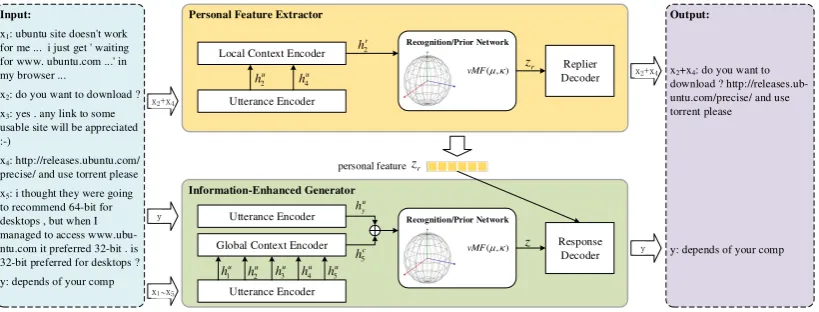
Figure 1: The SSVN framework.
focuses on automatically extracting the individ-ual features of replier from the original conver-sation text, to enhance the replier-consistency of responses, without any corpus restriction.
3 Model
3.1 Task Description
Given a series of dialogue context
ut-terances (x1,x2, ...,xn), where xi =
(wi,1, wi,2, ..., wi,Ni), our task is to generate
a response y = (wy,1, wy,2, ..., wy,Ny) that not
only rely on the global information but also consider the personally special features from the replier. In this paper, we employ the vMF distribution to stimulate the potential of latent space, impelling the extractor to condense a feature-augmented individual information and the generator to generalize a useful global guidance.
The overview of SSVN is illustrated in Figure1.
3.2 von Mises-Fisher
The von Mises-Fisher (vMF) places a distribution over points on the unit hypersphere, parameterized
by a direction vectorµ ∈Rdindicating the mean
direction and a concentration parameterκ∈R≥0.
The PDF of the vMF distribution for the unit
vec-torz∈Rdis defined as:
fd(x;µ, κ) =Cd(κ) exp(κµTx) (1)
Cd(κ) = κ
d/2−1
(2π)d/2I
d/2−1(κ)
(2)
wherekµk= 1, Cdis the normalization constant,
andIρstands for the modified Bessel function of
the first kind at orderρ.
3.3 Personal Feature Extractor
To enhance the replier-consistency, the personal feature extractor, implemented by a VAE with vMF, encodes rustically the context utterances
from replier xr = (xr1,x2r, ...,xrl) (e.g., xr =
(xr1,xr2) = (x2,x4) in Figure 1 into a
ran-dom latent variable zr, based on which the
de-coder reconstructsxr. Due to an intractable
high-dimensional integral problem over the latent
vari-able zr, we set a recognition networkqφe(zr|x
r)
as a variational approximation to the true
poste-riorp(zr|xr), then apply variational inference to
optimize the evidence lower bound (ELBO) as:
LE =−KL(qφe(zr|x
r)
kpθe(zr))
+Eq
φe(zr|xr)logpθe(x
r
|zr)
≤log
Z
zr
pθe(zr)p(x
r|z
r)dzr = logp(xr)
(3)
Utterance & Local Context EncoderConcretely, we employ a hierarchical encoder to encode
xr: the utterance encoder based on bidirectional
RNN (Schuster and Paliwal, 1997)
determiniti-cally reads each utterance xri and output a
size-fixed real-valued hui = [−h→iu,←h−ui], which the local context encoder takes as input to obtain the final
hidden statehrl as the summary ofxr.
Prior/Posterior Distribution Since we assume the latent space follows vMF distribution, the prior
pθe((zr) ∼ vM F(·, κ
e
prior = 0) and the
varia-tional posterior qφe(zr|x
r) ∼ vM F(µe
pos, κepos)
where µe
net-work andκe
posis set to a constant.
˜
µe
pos =fpose (hrl) (4)
µepos = ˜µe
pos/kµepos˜ k (5)
where fpose (·) is a linear transformation, and k·k
stands for 2-norm to ensure the normalization. With the uniform distribution as our prior, the KL divergence can be computed as:
KL(vM F(µepos, κepos)kvM F(·,0)) =
1−d
2
log 2−logId/2−1(κepos)−log Γ
d
2
+κepos Id/2(κ
e pos)
Id/2−1(κepos)
+
d
2−1
logκepos
(6)
Since Eq. 6only depends on fixed constantκe
pos,
not onµepos, this term can resolve the latent space
futility problem by averting the KL-zeroing.
Replier Decoder During reconstruction, the de-coder receives the concatenation of replier’s
con-texthrl and personal latent variablezras the initial
hidden state, then generates tokens sequentially under the following probability distribution:
pθe(x
r|z r) =
l Y
i=1
Ni
Y
j=1
p(wi,j|xr<i, wi,<j) (7)
wherelis the number of turns of the replier’s
con-textxr;Niis the length of thei-th utterance (xri)
inxr;wi,jis thej-th token inxri.
3.4 Information-Enhanced Generator
Similar to the extractor, the information-enhanced generator based on CVAE also employs a
recogni-tion network qφg(z|x,y) to approximate the true
posterior p(z|x,y), correspondingly, its ELBO
can be calculated as:
logp(y|x) = log
Z
z
p(y|x, z)p(z|x)dz
≥ −KL(qφg(z|x,y)kpθg(z|x))
+Eq
φg(z|x,y)logpθg(y|x, z)
(8)
when considering an external personal featurezr,
the ELBO in generator would be rewritten as:
LG=−KL(qφg(z|x,y, zr)kpθg(z|x, zr))
+Eq
φg(z|x,y,zr)logpθg(y|x, z, zr)
≤log
Z
z
p(y|x, z, zr)p(z|x, zr)dz
= logp(y|x, zr)
(9)
Notice that zr only participates in the
genera-tion processpθg(y|x, z, zr), the approximate
pos-teriorqφg(z|x,y, zr) ∼ vM F(µ
g
pos, κgpos)is
con-ditioned on dialog contextxand the
correspond-ing response y, and the prior pθg(z|x, zr) ∼
vM F(µgprior, κgprior)depends onx1.
Utterance & Golbal Context Encoder The hi-erarchical encoder in this part utilizes the shared utterance encoder from extractor to encode
utter-ancesx1,x2, ...,xn,yinto the corresponding
rep-resentationshu
1, hu2, ..., hun, huy orderly. Thereafter,
the utterance vectorshu1, hu2, ..., hun are fed to the
global context encoder to compute the
represen-tation of the whole dialog context hc
n. Based on
these, the approximate posterior and prior can be determined by the following operations:
˜
µgpos =fposg ([hcn, huy]) (10)
µgpos = ˜µgpos/kµgpos˜ k (11)
˜
µgprior=fpriorg (hcn) (12)
µgprior=µgprior˜ /kµgprior˜ k (13)
where fposg (·) andfpriorg (·) are both linear
trans-formations. κgpos andκgprior in both distributions
are the constants with equal values.
Prior/Posterior DistributionWithoutvM F(·,0) as the prior, we require to recalculate the KL term in generator as:
KL(vM F(µgpos, κgpos)kvM F(µgprior, κgprior)) =
(d/2−1) log κ
g pos
κgprior + log
Id/2−1(κgprior)
Id/2−1(κgpos)
−κgpriorµgpriorµgpos−1 Id/2(κ
g pos)
Id/2−1(κgpos)
+κgpos Id/2(κ
g pos)
Id/2−1(κgpos)
(14)
Response Decoder We employ a RNN decoder similar to the one in extractor, extending it to
con-dition on a personal featurezrby concatenatingzr
to the input of the decoder at each time step. The concrete generative process is as follows:
sRt =σ(sRt−1,[ewy,t−1, zr]) (15)
pvocab =sof tmax(V sRt +b) (16)
1The
zrinqφg(z|x,y, zr)andpθg(z|x, zr)is introduced formally
whereσ is the sigmoid function;ewy,i is the word
embedding of thei-th word in responsey;sRt
de-notes the hidden state at the time step t; V and
b are learnable parameters; pvocab stands for the
probability distribution over the vocabulary. Then the objective function of the decoder is given by:
pθg(y|x, z, zr) =
Ny
Y
i=1
pvocab(wy,i) (17)
where pvocab(wy,i) is the probability to generate
the wordwy,i;Ny is the length of the responsey.
3.5 Training Objective
The entire SSVN model integrates two modules in
Figure1, i.e., the unsupervised extractor and the
supervised generator, which can be optimized si-multaneously in one framework. Thus, the overall objective function of SSVN is to maximize:
L=λLG+ (1−λ)LE (18)
where we have a hyperparameterλto control the
balance between response generation (generator) and personality reconstruction (extractor).
3.6 Sampling Techique for vMF
Similar toXu and Durrett(2018), we utilize the
re-jection sampling scheme ofWood(1994) to
sam-ple a valuew∈[−1,1], then derive a random unit
vector tangentυ on the hypersphere at the mean
vectorµ. Based on these, our latent variablezcan
be given byz=wµ+υ√1−w2.
4 Experiments
4.1 Datasets
The proposed model is evaluated on two datasets.
The first corpus is Cornell Movie Dialogs
Cor-pus2 (Danescu-Niculescu-Mizil and Lee, 2011)
that contains more than 80,000 imagined movie
conversations. To normalize the length (turns)
of the dialogs, we divide the original conversa-tions into consecutive 3-10 utterances. Our second
dataset isUbuntu Dialogue Corpus3(Lowe et al.,
2015). It contains about 500,000 multi-turn
dia-logues collected from the Ubuntu Internet Relayed Chat channel, each of which starts with a Ubuntu-related technical problem and follows by the cor-responding responses about solutions.
2
The dataset is available at https://www.cs.cornell.edu/˜ c-ristian/Cornell Movie-Dialogs Corpus.html.
3We use the same train-validation-test split as inChen et al.(2018).
In the above two datasets, the last utterance in a conversation is regarded as the response and the remaining ones are the input context. The detailed
statistical information is shown in Table1.
4.2 Baselines
We compare SSVN with the following models:
S2SA: the standard Seq2Seq model with the
at-tention mechanism (Vinyals and V. Le,2015).
HRED: a hierarchical encoder framework to
model multi-turn dialogs (Serban et al.,2016).
VHRED: a hierarchical encoder-decoder with
latent stochastic variable (Serban et al.,2017).
HVMN: an encoder-decoder network
contain-ing the hierarchical structure and the variational
memory (Chen et al.,2018).
4.3 Experimental Details
Our model is implemented using the Tensorflow
framework (Abadi et al., 2016) with the
follow-ing parameter settfollow-ings: We set word embeddfollow-ings to size of 200 and initialize them randomly. The shared utterance encoder is a 2-layer bidirectional GRU structure with 600 hidden neurons for each layer, while the both context encoders and the both decoders are the unidirectional ones with hidden size of 600. The dimensions of the latent variable
zandzrare both set to 50. We use the Adam
algo-rithm (Kingma and Ba,2014) to update the
param-eters with an initial learning rate of 0.001. In the
training, we employ the early-stop strategy (
Caru-ana et al.,2000) to select the best models using the
variational lower-bound on the validation set.
4.4 Evaluation Metrics
We use both automatic and human evaluations to analyze the model’s performance.
Automatic Evaluation Metrics In our
exper-iment, three embedding-based metrics (Average,
Greedy, Extreme) 4 (Liu et al., 2016) are em-ployed to measure the semantic relevance between generated responses and ground truths. Besides,
we also adoptDistinct-1andDistinct-2(Li et al.,
2016) to evaluate the diversity of responses.
Human EvaluationIn order to assess how well the models can maintain the replier’s consistency, we conduct a human evaluation. Specifically, we randomly sample 300 context from the test set and apply 5 models to generate responses for each con-text. For each response, three annotators are
re-4We use the embeddings trained on Google News Corpus:
Corpus Train Valid Test Avg. Utterances Avg. Words Vocab Coverage
Cornell 91271 871 702 5.04 16.91 10000 98.26%
Ubuntu 448833 19584 18920 4.94 23.67 20000 99.12%
Table 1: Statistical information including number of dialogs in training, validation and test sets, average number of utterances (turns) per dialog, words per utterance, vocabulary size and its proportion in corpus.
Model Cornell Movie Dialogs Corpus Ubuntu Dialogue Corpus
Average Greedy Extreme Distinct-1 Distinct-2 Average Greedy Extreme Distinct-1 Distinct-2
S2SA 0.1979 0.1537 0.1373 19/.0013 37/.0092 0.2156 0.1688 0.1265 1543/.0047 5342/.0260 HRED 0.4964 0.3824 0.3317 27/.0068 56/.0171 0.5415 0.4117 0.3193 1924/.0084 8549/.0409 VHRED 0.5148 0.3954 0.3446 126/.0216 329/.0642 0.5341 0.4027 0.3062 2928/.0151 13468/.0772 HVMN 0.5347 0.3876 0.3462 199/.0399 474/.1107 0.5584 0.4229 0.3220 6334/.0193 25136/.1005
[image:6.595.115.484.62.97.2]SSVN 0.6417 0.4582 0.3732 591/.0535 2535/.2450 0.6089 0.4433 0.3312 9562/.0259 62539/.1955
Table 2: Automatic evaluation results on two dialogue datasets. The Distinct-* contains the number of distinct n-grams and its ratio over all generated responses. The embedding-based metrics results of baselines on Ubuntu are the same asChen et al.(2018).
cruited to give a 4-graded judgement with the
fol-lowing criteria: 1: the response is
ungrammati-cal or semantiungrammati-cally irrelevant; or inconsistent with replier’s features (e.g., linguistic characteristics, sentiments and personalities); or has wrong logic;
2: the response is semantically weak related, but
it is too trivial (e.g., “I don’t know”); 3: the
re-sponse is semantically relevant and informative, but has no obvious consistency about the replier’s
personal features; 4: the response is not only
se-mantically related and informative, but also con-sistent with the individual features of replier.
4.5 Evaluation Results
Automatic Evaluation The metric-based
evalua-tion results are shown in Table2. From the results,
we can observe that:
(1) HRED performs better than S2SA, indicat-ing that the hierarchical structure is benefical.
(2) VHRED outperforms HRED on all met-rics on Cornell, which demonstrates that the latent variables are the useful global guidance informa-tion. Inversely, VHRED has a worse performance than HRED in terms of three embedding-based
metrics on Ubuntu, which is consistent withChen
et al.(2018) due to the domain specific dataset.
(3) On the top of VHRED, HVMN introduces the memory network to enhance the long-term memory, and obtains the best performance among the baseline models.
(4) Compared with all the baselines, our SSVN model achieves the highest scores in terms of all metrics on two datasets, indicating that SSVN can best fit the ground truth semantically and generate more informative responses. Meanwhile, the sign
tests show that the improvements of SSVN are
sta-tistically significant (p-value<0.01).
(5) Noticeably, the models trained on Ubuntu consistently have more distinct n-grams than the same models trained on Cornell, while the dis-tinct ratios do not differ much. The reason is that Ubuntu dataset has more words averagely per ut-terance than Cornell data (as the statistical details
shown in Table1), which forces the models to
pro-duce longer responses.
Human EvaluationThe human evaluation results
on Cornell data are shown in Table4, in which the
score distribution values represent the percentages of responses belonging to each grade, and Fleiss’
kappa (Fleiss and Cohen, 1973) is employed to
evaluate the inter-annotator agreement. From the results, we have the following observations:
(1) The percentage of replier-specific responses
(i.e., the grade ‘4’) of SSVN model is 22.69%,
which is much higher than that of baselines, in-dicating that the personal feature extractor can ef-fectively capture the personal feature of replier.
(2) SSVN model generates much more
informa-tive responses (i.e.,71.56%labeled as ‘3+4’) and
much less generic responses (i.e.,20.28%labeled
as ‘2’) than all the baselines. The results are in line with the above results of metric-based evaluation.
(3) Kappa scores of the models are all higher than 0.4, demonstrating that the annotators come to a fair agreement. Meanwhile, the sign tests also show that the human evaluation improve-ments of SSVN to baselines are significant on
Model Extractor Generator Average Greedy Extreme Distinct-1 Distinct-2
SVN – vMF 0.6108 0.4334 0.3456 403/.0374 1376/.1367
SSVNGau Gau Gau 0.5563 0.4164 0.3406 470/.0703 1859/.3109
SSVNGau−E Gau vMF 0.6164 0.4371 0.3648 472/.0439 2100/.2091
SSVNGau−G vMF Gau 0.5605 0.4195 0.3467 525/.0764 2097/.3403
[image:7.595.104.499.61.124.2]SSVN vMF vMF 0.6417 0.4582 0.3732 591/.0535 2535/.2450
Table 3: Performances of model ablation on Cornell dataset. The ‘Gau’ and ‘vMF’ denote the distributions of the latent spaces of extractor or generator, and ‘–’ means no extractor.
Model score distribution (%) Kappa
1 2 3 4 3+4
S2SA 29.38 45.11 20.47 5.04 25.51 0.41 HRED 26.31 39.38 26.2 8.11 34.31 0.44 VHRED 17.58 36.48 33.55 12.39 45.94 0.46 HVMN 14.03 29.79 39.47 16.71 56.18 0.50
SSVN 8.16 20.28 48.87 22.69 71.56 0.45
Table 4: Human evaluation results on Cornell dataset. The percentages are calculated by combining the judgements from three annotators together. ‘3+4’ stands for the sum of percentages of the grade ‘3’ and ‘4’ (i.e., the ratio of informative responses).
4.6 Discussions
Model Ablation To investigate the effect of dif-ferent parts, we conduct a set of experiments on Cornell by removing the extractor or modifying the distribution of extractor and generator. From
the results listed in Table3, we can observe that:
(1) Removing the extractor (denoted as SVN) makes the distinct ratios and numbers drop dramatically, while the embedding-based met-ric scores are only slightly lower than that of SSVN. This indicates the personal features learned by the extractor not only maintain the replier-consistency, but also improve the diversity of
re-sponses. In addition, SSVNGau−E (replacing the
vMF distribution with a Gaussian in extractor) has a better performance than SVN, but a worse one than SSVN, demonstrating the vMF-Extractor is more effective than Gau-Extractor.
(2) As for the generator, when setting the
Gaus-sian as the latent space (denoted as SSVNGau−G),
the embedding-based performance deteriorates dramatically whereas the distinct numbers de-crease slightly, indicating that the vMF-Generator is more capable of facilitating the generated re-sponses semantically close to the ground truth than Gau-Generator. Notably, the distinct ratios
in SSVNGau−G rise unexpectedly, which will be
investigated in (3).
(3) To figure out this special phenomenon, we
conduct an experiment on SSVNGau composed
by Gau-Extractor and Gau-Generator. We can
see that the SSVNGau−G and SSVNGau obtain
the best distinct ratios among the ablation mod-els, but their distinct numbers are not the high-est. The results indicate that, whatever the latent space of extractor follows, the Gau-Generator al-ways tends to produce informative but very short responses. Meanwhile, their worst embedding-based scores show that the responses generated by Gau-Generator semantically deviate from the ground truth significantly.
The Effect of vMF on KL Besides the metric-based performance, we also evaluate the effective-ness of different settings in sloving the latent space
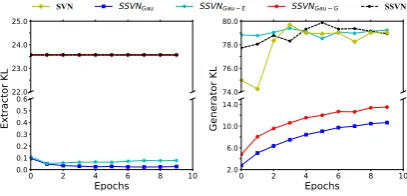
futility problem. Figure 2 visualizes the
evolu-tion of the KL loss in both extractor and generator parts. We can see that:
22.0 23.0 24.0 25.0
Ex
tra
cto
r
K
L
691 SSVNGau SSVNGau − E SSVNGau − G 6691
0 2 4 6 8 10
Epochs 0.0
0.1 0.2 0.3 0.4 0.5
0.6 74.0
76.0 78.0 80.0
Ge
ne
ra
to
r
K
L
0 2 4 6 8 10
Epochs 2.0
[image:7.595.72.291.184.254.2]6.0 10.0 14.0
Figure 2: KL cost of different parts in ablation models as training progress.
(1) In Extractor KL, Gau-Extractors (i.e.,
SSVNGauand SSVNGau−E) have a KL cost close
to 0 at the begining and never recover, while
the vMF-Extractors (i.e., SSVNGau−Gand SSVN)
can keep a constant KL value as evidenced by
Eq.(6). The results indicate that the vMF in
ex-tractor can mitigate KL-vanishing and capture the more meaningful personal features.
(2) Surprisingly, in Generator KL, the KL loss presents an upward trend in Gau-Generators (i.e.,
SSVNGau and SSVNGau−G). The reason is that,
[image:7.595.322.526.430.528.2]is encouraged to exploit the latent variables and the latent space futility problem is alleviated.
(3) Compared with the Gau-Generators in Generator KL, the vMF-Generators (i.e., SVN,
SSVNGau−E and SSVN) have the much higher
KL values, indicating that the vMF is a better se-lection than Gaussian to solve the KL-vanishing problem. Meanwhile, the KL values are relatively stable, which experimentally demonstrates the KL
cost mainly depends on the last term in Eq.(14)
and the variable term has little effect on it. Last but not least, KL cost can explictly be changed by setting different kappa values.
Impact of the Coefficient λRecall that Eq.(18) shows the capacity of SSVN in balancing response generation and personality reconstruction. Here
we analyze the effects of different coefficientλon
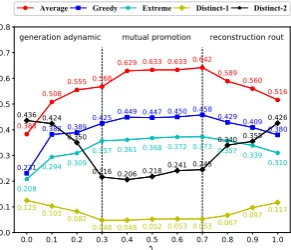
the quality of responses. Figure3shows the
per-formances given varying λ. Notably, the
perfor-mances of embedding-based metrics are changing in a similar trend, as the same case in Distinct-1 and Distinct-2, thus we only consider Average and Distinct-1 as the major analysis items.
0.0 0.1 0.2 0.3 0.4 0.5 0.6 0.7 0.8 0.9 1.0
Ȝ
0.0 0.1 0.2 0.3 0.4 0.5 0.6 0.7 0.8
0.383
0.5080.555 0.568
0.629 0.633 0.633 0.642 0.5890.560
0.516
0.231
0.382 0.3890.425 0.449 0.447 0.450 0.458
0.429 0.4090.380
0.208
0.294 0.3090.357 0.361 0.368 0.372 0.373 0.357 0.3390.310
0.125 0.1030.082
0.048 0.048 0.052 0.053 0.053 0.0670.097 0.117 0.436 0.424
0.350
0.216 0.206 0.2180.241 0.245 0.340 0.355
0.426 generation adynamic mutual promotion reconstruction rout
[image:8.595.107.253.387.512.2]$YHUDJH *UHHG\ ([WUHPH 'LVWLQFW 'LVWLQFW
Figure 3: Influences of differentλon Average, Greedy, Extreme, Distinct-1 and Distinct-2.
As we can see, the evolutions of Average and
Distinct-1 in Figure 3 can be broadly into three
stages: generation adynamic stage, mutual promo-tion stage and reconstrucpromo-tion rout stage.
(1) The first stage shows that as λ increases,
the Average monotonically increases while
diver-sity decreases. This is because the lowerλgives
the model less incentive to optimize the generator, which makes the response decoder incapable of utilizing the higher-quality personal features, re-sulting in the diverse but semantically inappropri-ate responses.
(2) Whenλmoves to the second stage, the
per-formances of the Average and diversity improve simultaneously, implying that the response
gener-ation and personality reconstruction achieve en ex-pected balance.
(3) For the reconstruction rout stage, although the model focuses on response generation, the
larger λ does not bring an improvement of
Av-erage, but instead increases diversity. The result indicates that the unprofitable personal features in thwarted personality reconstruction part, as a ran-dom disturbance, can increase the diversity of the responses, but severely bias the generation of re-sponse decoder semantically.
Observed from the curves of all metrics, the best performance of embedding-based metrics is
achieved atλ = 0.7, while the diversity reaches
the peak in the mutual promotion stage. Thus, we
setλto 0.7 in all previous experiments.
Case StudyBesides the quantitative analysis, we
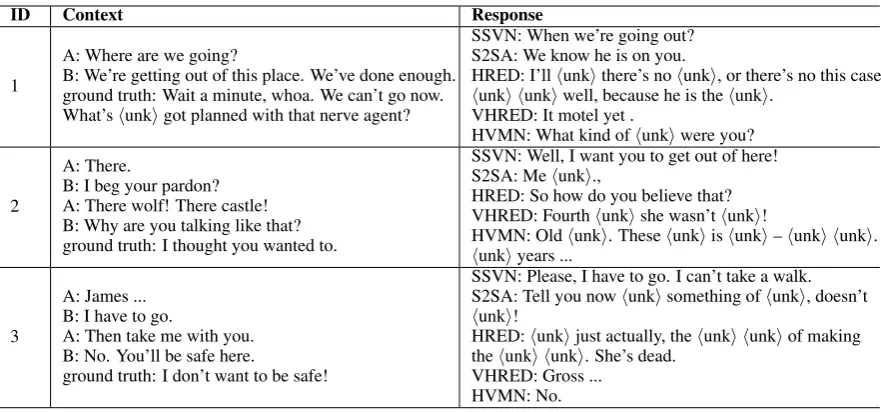
also organize some examples (seen in Table 5)
from different models to analyze the performances of the methods qualitatively. They are chosen ran-domly from the responses produced by the pro-posed model, and showed together with the corre-sponding contexts and the outputs of the baselines. From the case 1, we can observe that the SSVN can extract the personal feature of the replier that the speaker A prefers to acquire further informa-tion from others, which guides the generator to produce an interrogative response to promote the
replier-consistency. Meanwhile, the SSVN can
also extract the firm attitude of the replier in case 2 and the pleading tone of the replier in case 3. By contrast, the baselines favor to produce the bad responses, such as containing more ‘unk’.
Error Analysis To improve the performance of SSVN in the future, we take the worse cases (i.e., the grade ‘1’ and ‘2’) in human judgement as an example to analyze our errors. Specifically, we di-vide the errors with the grade ‘1’ into grammatical error, replier-nonconsistency and logic
contradic-tion, which occupy19.79%,31.49%and48.72%,
respectively. We can find that 1) logic condradic-tion scenes make up most of the errors as SSVN pays little attention to this issue. 2) although con-sidering the personal features from replier, there
still exists31.49%replier-inconsistent cases,
ID Context Response
1
A: Where are we going?
B: We’re getting out of this place. We’ve done enough. ground truth: Wait a minute, whoa. We can’t go now. What’shunkigot planned with that nerve agent?
SSVN: When we’re going out? S2SA: We know he is on you.
HRED: I’llhunkithere’s nohunki, or there’s no this case. hunki hunkiwell, because he is thehunki.
VHRED: It motel yet .
HVMN: What kind ofhunkiwere you?
2
A: There.
B: I beg your pardon? A: There wolf! There castle! B: Why are you talking like that? ground truth: I thought you wanted to.
SSVN: Well, I want you to get out of here! S2SA: Mehunki.,
HRED: So how do you believe that? VHRED: Fourthhunkishe wasn’thunki!
HVMN: Oldhunki. Thesehunkiishunki–hunki hunki. hunkiyears ...
3
A: James ... B: I have to go.
A: Then take me with you. B: No. You’ll be safe here.
ground truth: I don’t want to be safe!
SSVN: Please, I have to go. I can’t take a walk. S2SA: Tell you nowhunkisomething ofhunki, doesn’t hunki!
HRED:hunkijust actually, thehunki hunkiof making thehunki hunki. She’s dead.
[image:9.595.79.520.60.266.2]VHRED: Gross ... HVMN: No.
Table 5: Generated responses of all the models on Cornell Movie Dialogs Corpus.
The above analysis sheds light on our future di-rections: 1) modeling the logic consistency be-tween the context and response; 2) exploring ad-vanced methods for extracting personal features; 3) improving the response diversity.
5 Conclusion and Future Work
In this work, we propose a semi-supervised sta-ble variational network for addressing the latent space futility and replier-consistency decay issues. Different from the traditional variational dialog models, the proposed model selects the vMF as the prior and posterior to resolve the latent space futility issue, and then integrates a unsupervised extractor to obtain the replier-tailored personal
features to ensure the replier-consistency.
Ex-perimental results on two dialog datasets demon-strate the effectiveness of our model, especially on replier-consistency in terms of human evaluation. However, the error analysis shows that there are still challenges in dialogue generation, which we would like to explore in the future.
Acknowledgments
We thank the anonymous reviewers for their valu-able feedback. Our work is supported by National Natural Science Foundation of China (61976154), Tianjin Natural Science Foundation (18JCY-BJC15500), National Natural Science Foundation of China (61771333), Tianjin Municipal Science and Technology Project (18ZXZNGX00330), and the Foundation of State Key Laboratory of Cogni-tive Intelligence, iFLYTEK(CIOS-20190001).
References
Martn Abadi, Ashish Agarwal, Paul Barham, Eu-gene Brevdo, and Xiaoqiang Zheng. 2016. Ten-sorflow: Large-scale machine learning on heteroge-neous distributed systems. arXiv:1603.04467[cs], arXiv:1603.04467.
Rich Caruana, Steve Lawrence, and C. Lee Giles. 2000. Overfitting in neural nets: Backpropagation, conju-gate gradient, and early stopping. In Advances in neural information processing systems 13 (NIPS), pages 402–408.
Hongshen Chen, Xiaorui Liu, Dawei Yin, and Jiliang Tang. 2017a. A survey on dialogue systems: Recent advances and new frontiers. ACM SIGKDD Explo-rations Newsletter, 19(2):25–35.
Hongshen Chen, Zhaochun Ren, Jiliang Tang, Yi-hong Eric Zhao, and Dawei Yin. 2018. Hierarchi-cal variational memory network for dialogue gener-ation. InProceedings of the 2018 World Wide Web Conference (WWW ’18), pages 1653–1662.
Xi Chen, Diederik P. Kingma, Tim Salimans, Yan Duan, Prafulla Dhariwal, John Schulman, Ilya Sutskever, and Pieter Abbeel. 2017. Variational lossy autoencoder. In Proceedings of the Inter-national Conference on Learning Representations (ICLR).
Cristian Danescu-Niculescu-Mizil and Lillian Lee. 2011. Chameleons in imagined conversations: A new approach to understanding coordination of lin-guistic style in dialogs. In Proceedings of the 2nd Workshop on Cognitive Modeling and Computa-tional Linguistics (CMCL ’11), pages 76–87.
Tim R. Davidson, Luca Falorsi, Nicola De Cao, Thomas Kipf, and Jakub M. Tomczak. 2018. Hyperspherical variational auto-encoders.
Joseph L Fleiss and Jacob Cohen. 1973. The equiv-alence of weighted kappa and the intraclass corre-lation coefficient as measures of reliability. Educa-tional and psychological measurement, 33(3):613– 619.
Barbara J. Grosz. 2016. Ai100 report. https://ai100.stanford. edu/2016-report.
Kelvin Guu, Tatsunori B. Hashimoto, Yonatan Oren, and Percy Liang. Generating sentences by edit-ing prototypes. Transactions of the Association for Computational Linguistics (TACL), 6:437–450.
D. P. Kingma, D. J. Rezende, S. Mohamed, and M. Welling. 2014. Semi-supervised learning with deep generative models. In Advances in Neural Information Processing Systems 27 (NIPS), pages 3581–3589.
Diederik Kingma and Jimmy Ba. 2014. Adam: A method for stochastic optimization. InProceedings of the 3rd International Conference for Learning Representations (ICLR).
Diederik P. Kingma, Tim Salimans, Rafal Jozefowicz, and Xi Chen. 2016. Improved variational inference with inverse autoregressive flow. In Advances in Neural Information Processing Systems 29 (NIPS), pages 4743–4751.
Diederik P Kingma and Max Welling. 2014. Auto-encoding variational bayes. InProceedings of the International Conference on Learning Representa-tions (ICLR).
Jiwei Li, Michel Galley, Chris Brockett, Jianfeng Gao, and Bill Dolan. 2016. A diversity-promoting ob-jective function for neural conversation models. In
Proceedings of Annual Conference of the North American Chapter of the Association for Computa-tional Linguistics: Human Language Technologies (NAACL-HLT), pages 110–119.
Chia Wei Liu, Ryan Lowe, Iulian V. Serban, Michael Noseworthy, Laurent Charlin, and Joelle Pineau. 2016. How not to evaluate your dialogue system: An empirical study of unsupervised evaluation met-rics for dialogue response generation. In Proceed-ings of the 2016 Conference on Empirical Methods in Natural Language Processing (EMNLP), pages 2122–2132.
Ryan Lowe, Nissan Pow, Iulian V. Serban, and Joelle Pineau. 2015. The ubuntu dialogue corpus: A large dataset for research in unstructured multi-turn dia-logue systems. InProceedings of the 16th Annual Meeting of the Special Interest Group on Discourse and Dialogue (SIGDIAL), pages 285–294.
Danilo Jimenez Rezende and Shakir Mohamed. 2015. Variational inference with normalizing flows. In
Proceedings of the 32nd International Conference on Machine Learning (ICML), pages 1530–1538.
Danilo Jimenez Rezende, Shakir Mohamed, and Daan Wierstra. 2014. Stochastic backpropagation and ap-proximate inference in deep generative models. In
Proceedings of the 31nd International Conference on Machine Learning (ICML), pages 1278–1286.
Mike Schuster and Kuldip K Paliwal. 1997. Bidirec-tional recurrent neural networks. IEEE Transactions on Signal Processing, 45(11):2673–2681.
Stanislau Semeniuta, Aliaksei Severyn, and Erhardt Barth. 2017. A hybrid convolutional variational au-toencoder for text generation. InProceedings of the 2017 Conference on Empirical Methods in Natural Language Processing (EMNLP), pages 627–637.
Iulian Serban, Alessandro Sordoni, Ryan Joseph Lowe, Laurent Charlin, Joelle Pineau, Aaron C. Courville, and Yoshua Bengio. 2017. A hierarchical la-tent variable encoder-decoder model for generat-ing dialogues. In Proceedings of the Thirty-First AAAI Conference on Artificial Intelligence (AAAI-17), pages 3295–3301.
Iulian Vlad Serban, Alessandro Sordoni, Yoshua Ben-gio, Aaron Courville Courville, and Joelle Pineau. 2016. Building end-to-end dialogue systems using generative hierarchical neural network models. In
Proceedings of the Thirtieth AAAI Conference on Artificial Intelligence (AAAI-16), pages 3776–3784.
Lifeng Shang, Zhengdong Lu, and Hang Li. 2015. Neural responding machine for short-text conver-sation. In Proceedings of the 53rd Annual Meet-ing of the Association for Computational LMeet-inguistics (ACL), pages 1577–1586.
Xiaoyu Shen, Hui Su, Shuzi Niu, and Vera Demberg. 2018. Improving variational encoder-decoders in dialogue generation. In Proceedings of the Thirty-Second AAAI Conference on Artificial Intelligence (AAAI-18), pages 5456–5463.
Kihyuk Sohn, Honglak Lee, and Xinchen Yan. 2015. Learning structured output representation using deep conditional generative models. InAdvances in Neural Information Processing Systems 28 (NIPS), pages 3483–3491.
Alessandro Sordoni, Michel Galley, Michael Auli, Chris Brockett, Yangfeng Ji, Margaret Mitchell, Jian-Yun Nie, Jianfeng Gao, and Bill Dolan. 2015. A neural network approach to context-sensitive gen-eration of conversational responses. In Proceed-ings of the 2015 Conference Annual Conference of the North American Chapter of the Association for Computational Linguistics: Human Language Tech-nologies (NAACL-HLT), pages 196–205.
Ilya Sutskever, Oriol Vinyals, and Quoc V Le. 2014. Sequence to sequence learning with neural net-works. InAdvances in Neural Information Process-ing Systems 27 (NIPS), pages 3104–3112.
Andrew Wood. 1994. Simulation of the von mises fisher distribution. Communications in Statistics Simulation and Computation, 23(1):157–164.
Ziang Xie, Sida I. Wang, Jiwei Li, Daniel Levy, Aim-ing Nie, Dan Jurafsky, and Andrew Y. Ng. 2017. Data noising as smoothing in neural network lan-guage models. InProceedings of the International Conference on Learning Representations (ICLR).
Jiacheng Xu and Greg Durrett. 2018. Spherical latent spaces for stable variational autoencoders. In Pro-ceedings of the 2018 Conference on Empirical Meth-ods in Natural Language Processing (EMNLP), pages 4503–4513.
Zichao Yang, Zhiting Hu, Ruslan Salakhutdinov, and Taylor Berg-Kir. 2017. Improved variational au-toencoders for text modeling using dilated convolu-tions. InProceedings of the 34th International Con-ference on Machine Learning (ICML), pages 3881– 3890.
Kaisheng Yao, Geoffrey Zweig, and Baolin Peng. 2015. Attention with intention for a neural network conversation model. ArXiv, abs/1510.08565.
Saizheng Zhang, Emily Dinanz, Jack Urbanekz, Arthur Szlamz, Douwe Kielaz, and Jason Weston. 2018. Personalizing dialogue agents: I have a dog, do you have pets too? InProceedings of the 56th Annual Meeting of the Association for Computational Lin-guistics (ACL), pages 1–10.