Proceedings of the 2019 Conference on Empirical Methods in Natural Language Processing 4516
Taskmaster-1: Toward a Realistic and Diverse Dialog Dataset
Bill Byrne1∗ Karthik Krishnamoorthi1∗ Chinnadhurai Sankar2∗ Arvind Neelakantan1 Daniel Duckworth1 Semih Yavuz3 Ben Goodrich1
Amit Dubey1 Andy Cedilnik1 Kyu-Young Kim1
1Google LLC, Mountain View, California 2Mila, Universit´e de Montr´eal 3University of California, Santa Barbara
{billb,krishnamoorthi,aneelakantan}@google.com
Abstract
A significant barrier to progress in data-driven approaches to building dialog systems is the lack of high quality, goal-oriented conversa-tional data. To help satisfy this elementary requirement, we introduce the initial release of the Taskmaster-1 dataset which includes 13,215 task-based dialogs comprising six do-mains. Two procedures were used to create this collection, each with unique advantages. The first involves a two-person, spoken “Wiz-ard of Oz” (WOz) approach in which trained agents and crowdsourced workers interact to complete the task while the second is “self-dialog” in which crowdsourced workers write the entire dialog themselves. We do not re-strict the workers to detailed scripts or to a small knowledge base and hence we observe that our dataset contains more realistic and di-verse conversations in comparison to existing datasets. We offer several baseline models in-cluding state of the art neural seq2seq architec-tures with benchmark performance as well as qualitative human evaluations. Dialogs are la-beled with API calls and arguments, a simple and cost effective approach which avoids the requirement of complex annotation schema. The layer of abstraction between the dialog model and the service provider API allows for a given model to interact with multiple ser-vices that provide similar functionally. Finally, the dataset will evoke interest in written vs. spoken language, discourse patterns, error han-dling and other linguistic phenomena related to dialog system research, development and de-sign.1
1 Introduction
Voice-based “personal assistants” such as Apple’s SIRI, Microsoft’s Cortana, Amazon Alexa, and the
∗
Equal Contribution
1Dataset available at https://g.co/dataset/taskmaster-1
Google Assistant have finally entered the main-stream. This development is generally attributed to major breakthroughs in speech recognition and text-to-speech (TTS) technologies aided by recent progress in deep learning (Lecun et al.,2015), ex-ponential gains in compute power (Steinkrau et al., 2005; Jouppi et al., 2017), and the ubiquity of powerful mobile devices. The accuracy of ma-chine learned speech recognizers (Hinton et al., 2012) and speech synthesizers (van den Oord et al., 2016) are good enough to be deployed in real-world products and this progress has been driven by pub-licly available labeled datasets. However, conspic-uously absent from this list is equal progress in machine learned conversational natural language understanding (NLU) and generation (NLG). The NLU and NLG components of dialog systems start-ing from the early research work (Weizenbaum, 1966) to the present commercially available per-sonal assistants largely rely on rule-based systems. The NLU and NLG systems are often carefully programmed for very narrow and specific cases (Google, 2019; Amazon, 2019). General under-standing of natural spoken behaviors across mul-tiple dialog turns, even in single task-oriented sit-uations, is by most accounts still a long way off. In this way, most of these products are very much hand crafted, with inherent constraints on what users can say, how the system responds and the or-der in which the various subtasks can be completed. They are high precision but relatively low cover-age. Not only are such systems unscalable, but they lack the flexibility to engage in truly natural conversation.
system to hold a coherent task-based conversation with a human remains one of computer science’s most complex and intriguing unsolved problems (Weizenbaum, 1966). In contrast to more tradi-tional NLP efforts, interest in statistical approaches to dialog understanding and generation aided by machine learning has grown considerably in the last couple of years (Rojas-Barahona et al.,2017; Bor-des et al.,2017;Henderson et al.,2013). However, the dearth of high quality, goal-oriented dialog data is considered a major hindrance to more significant progress in this area (Bordes et al., 2017;Lowe et al.,2015).
To help solve the data problem we present Taskmaster-1, a dataset consisting of 13,215 di-alogs, including 5,507 spoken and 7,708 written dialogs created with two distinct procedures. Each conversation falls into one of six domains: ordering pizza, creating auto repair appointments, setting up ride service, ordering movie tickets, ordering coffee drinks and making restaurant reservations. For the spoken dialogs, we created a Wizard of Oz (WOz) system (Kelley,1984) to collect two-person, spo-ken conversations. Crowdsourced workers playing the “user” interacted with human operators playing the digital assistant using a web-based interface. In this way, users were led to believe they were inter-acting with an automated system while it was in fact a human, allowing them to express their turns in natural ways but in the context of an automated interface. We refer to this spoken dialog type as “two-person dialogs”. For the written dialogs, we engaged crowdsourced workers to write the full conversation themselves based on scenarios out-lined for each task, thereby playing roles of both the user and assistant. We refer to this written di-alog type as “self-didi-alogs”. In a departure from traditional annotation techniques (Henderson et al., 2013;Rojas-Barahona et al.,2017;Budzianowski et al.,2018), dialogs are labeled with simple API calls and arguments. This technique is much eas-ier for annotators to learn and simpler to apply. As such it is more cost effective and, in addition, the same model can be used for multiple service providers.
Taskmaster-1 has richer and more diverse lan-guage than the current popular benchmark in task-oriented dialog, MultiWOZ (Budzianowski et al., 2018). Table1shows that Taskmaster-1 has more unique words and is more difficult for language models to fit. We also find that Taskmaster-1 is
Statistic Self-dialogs MultiWOZ
# unique words 21,894 19,175 # unique named 8,218 1,338 entities
# utterances 169,469 132,610 # dialogs 7,708 10,438
Avg. utterances 21.99 13.70 per dialog
Avg. tokens 8.62 13.82
per utterance
Perplexity 17.08 15.62
BLEU 6.53 11.02
Table 1: Statistics comparison: Self-dialogs vs Multi-WOZ corpus both containing approximately 10k dia-logues each.
more realistic than MultiWOZ. Specifically, the two-person dialogs in Taskmaster-1 involve more real-word entities than seen in MutliWOZ since we do not restrict conversations to a small knowledge base. Beyond the corpus and the methodologies used to create it, we present several baseline models including state-of-the-art neural seq2seq architec-tures together with perplexity and BLEU scores. We also provide qualitative human performance evaluations for these models and find that auto-matic evaluation metrics correlate well with human judgments. We will publicly release our corpus containing conversations, API call and argument annotations, and also the human judgments.
2 Related work
2.1 Human-machine vs. human-human
dialog
mimic its limitations (Williams and Young,2007). Since the ultimate goal is to be able to handle com-plex human language behaviors, it would seem that human-human conversational data is the bet-ter choice for spoken dialog system development (Budzianowski et al., 2018). However, learning from purely human-human based corpora presents challenges of its own. In particular, human con-versation has a different distribution of understand-ing errors and exhibits turn-takunderstand-ing idiosyncrasies which may not be well suited for interaction with a dialog system (Williams and Young,2007;Serban et al.,2017).
2.2 The Wizard of Oz (WOz) Approach and
MultiWOZ
The WOz framework, first introduced by Kelley (1984) as a methodology for iterative design of nat-ural language interfaces, presents a more effective approach to human-human dialog collection. In this setup, users are led to believe they are interact-ing with an automated assistant but in fact it is a human behind the scenes that controls the system responses. Given the human-level natural language understanding, users quickly realize they can com-fortably and naturally express their intent rather than having to modify behaviors as is normally the case with a fully automated assistant. At the same time, the machine-oriented context of the interac-tion, i.e. the use of TTS and slower turn taking cadence, prevents the conversation from becom-ing fully fledged, overly complex human discourse. This creates an idealized spoken environment, re-vealing how users would openly and candidly ex-press themselves with an automated assistant that provided superior natural language understanding. Perhaps the most relevant work to consider here is the recently released MultiWOZ dataset (Budzianowski et al.,2018), since it is similar in size, content and collection methodologies. Mul-tiWOZ has roughly 10,000 dialogs which feature several domains and topics. The dialogs are an-notated with both dialog states and dialog acts. MultiWOZ is an entirely written corpus and uses crowdsourced workers for both assistant and user roles. In contrast, Taskmaster-1 has roughly 13,000 dialogs spanning six domains and annotated with API arguments. The two-person spoken dialogs in Taskmaster-1 use crowdsourcing for the user role but trained agents for the assistant role. The assis-tant’s speech is played to the user via TTS. The
ASSISTANT: How can I help you?
USER: Hi, could you help me with booking movie tickets for tonight?
ASSISTANT: What movie are you interested in? USER: The Upside.
ASSISTANT: Did you have a theater in mind?
USER: Could you check if the Regal Neshaminy... No, AMC Neshaminy in Neshaminy, PA is playing it?
ASSISTANT: Could you spell that? USER: Sure, n e s h a m i n y.
ASSISTANT: I have a showtime at 7:30 and at 10:30, is that okay?
USER: Yes, could you get two tickets for the 7:30? ASSISTANT: One moment. Okay so that’s 2 tickets for
7:30 at the AMC Neshaminy 24? USER: Yes.
ASSISTANT: It’ll be twenty-four ninety-nine for your tick-ets.
USER: That sounds great.
ASSISTANT: I’ve confirmed your tickets, they’ll arrive via text shortly. Did you need any other information?
USER: No, that was it. Thank you so much for your help.
ASSISTANT: Great, no problem. I hope you have fun. USER: I hope so, too. Thank you so much.
Figure 1: Sample Taskmaster-1 two-person dialog
remaining 7,708 conversations in Taskmaster-1 are self-dialogs, in which crowdsourced workers write the entire conversation themselves. AsKrause et al. (2017);Moghe et al.(2018) show, self dialogs are surprisingly rich in content.
3 The Taskmaster Corpus
3.1 Overview
There are several key attributes that make Taskmaster-1 both unique and effective for data-driven approaches to building dialog systems and for other research.
Spoken and written dialogs: While the spoken sources more closely reflect conversational lan-guage (Chafe and Tannen,1987), written dialogs are significantly cheaper and easier to gather. This allows for a significant increase in the size of the corpus and in speaker diversity.
Goal-oriented dialogs: All dialogs are based on one of six tasks: ordering pizza, creating auto repair appointments, setting up rides for hire, ordering movie tickets, ordering coffee drinks and making restaurant reservations.
MAIN TASK: Users will pretend they are using a voice-powered personal digital assistant to book movie tickets for a film they ALREADY have in mind.
1. In several turns (not just one!), cover the following:
(a) Film name (b) Number of people (c) City
(d) Theater (e) Time
(f) If applicable: 3D vs. IMAX vs. standard.
2. They may also want to know things like:
(a) Run time (b) End time
(c) Director, actors, etc.
3. Make sure to CONFIRM all the relevant ticket details before the end of the dialogue INCLUDING:
(a) Total cost for two tickets (b) Time, location, theater
4. You can assume you have the users account info with the ticket service–so no credit card information is necessary.
5. After confirming the details, end the conversation by confirming that the tickets are being sent to the users mobile device as a text message.
Figure 2: Sample instructions for agents playing “assis-tant” role
MAIN TASK: Pretend you are using your voice-powered digital assistant to book movie tickets.
1. Start by thinking of a particular movie PLAYING NOW in theaters that you’d like to see. (Use the internet to find one if necessary.)
2. Choose a DIFFERENT CITY from where you live, work, or happen to be at the moment.
3. Pretend you’ve decided to see this movie tonight and you’re taking a friend.
4. The assistant will ask about all relevant details BUT you should make sure it covers all your needs.
5. You can assume you already have an account with the ticket service–so no credit card information is necessary.
6. The assistant will end the conversation by confirming that your tickets are being sent to your mobile device as a text message. (And you can respond thanks, goodbye, ok, etc. for a final closing turn, if you like).
Figure 3: Sample instructions for crowdsourced work-ers playing “user” role
Multiple turns:The average number of utterances per dialog is about 23 which ensures context-rich language behaviors.
API-based annotation:The dataset uses a simple annotation schema providing sufficient grounding for the data while making it easy for workers to apply labels consistently.
Size:The total of 13,215 dialogs in this corpus is on par with similar, recently released datasets such as MultiWOZ (Budzianowski et al.,2018).
3.2 Two-person, spoken dataset
In order to replicate a two-participant, automated digital assistant experience, we built a WOz plat-form that pairs agents playing the digital assistant with crowdsourced workers playing the user in task-based conversational scenarios. An example dialog from this dataset is given in Figure1.
3.2.1 WOz platform and data pipeline
While it is beyond the scope of this work to de-scribe the entire system in detail, there are several platform features that help illustrate how the pro-cess works.
Modality: The agents playing the assistant type their input which is in turn played to the user via text-to-speech (TTS) while the crowdsourced work-ers playing the user speak aloud to the assistant us-ing their laptop and microphone. We use WebRTC to establish the audio channel. This setup creates a digital assistant-like communication style.
Conversation and user quality control:Once the task is completed, the agents tag each conversation as either successful or problematic depending on whether the session had technical glitches or user behavioral issues. We are also then able to root out problematic users based on this logging.
Agent quality control: Agents are required to lo-gin to the system which allows us to monitor per-formance including the number and length of each session as well as their averages.
User queuing:When there are more users trying to connect to the system than available agents, a queuing mechanism indicates their place in line and connects them automatically once they move to the front of the queue.
typed input to create a full text version of the di-alog. Finally, these conversations are checked for transcription errors and typos and then annotated, as described in Section3.4.
3.2.2 Agents, workers and training
Both agents and crowdsourced workers are given written instructions prior to the session. Examples of each are given in Figure2 and Figure3. The instructions continue to be displayed on screen to the crowdsourced workers while they interact with the assistant. Instructions are modified at times (for either participant or both) to ensure broader coverage of dialog scenarios that are likely to occur in actual user-assistant interactions. For example, in one case users were asked to change their mind after ordering their first item and in another agents were instructed to tell users that a given item was not available. Finally, in their instructions, crowd-sourced workers playing the user are told they will be engaging in conversation with a digital assistant. However, it is plausible that some suspect human intervention due to the advanced level of natural language understanding from the assistant side.
Agents playing the assistant role were hired from a pool of dialog analysts and given two hours of training on the system interface as well as on how to handle specific scenarios such as uncooperative users and technical glitches. Uncooperative users typically involve those who either ignored agent input or who rushed through the conversation with short phrases. Technical issues involved dropped sessions (e.g. WebRTC connections failed) or cases in which the user could not hear the agent or vice-versa. In addition, weekly meetings were held with the agents to answer questions and gather feed-back on their experiences. Agents typically work four hours per day with dialog types changing ev-ery hour. Crowdsourced workers playing the user are accessed using Amazon Mechanical Turk. Pay-ment for a completed dialog session lasting roughly five to seven minutes was typically in the range of
$1.00to$1.30. Problematic users are detected ei-ther by the agent involved in the specific dialog or by post-session assessment and removed from future requests.
3.3 Self-dialogs (one-person written dataset)
While the two-person approach to data collection creates a realistic scenario for robust, spoken dia-log data collection, this technique is time consum-ing, complex and expensive, requiring considerable
1. Think of a particular movie PLAYING NOW in theaters that you’d like to see. (Use the internet to find one if necessary.)
2. Choose a DIFFERENT CITY from where you live, work, or happen to be at the moment.
3. Pretend you’ve decided to see this movie tonight and you’re taking a friend.
4. Use the internet to look up the details of the city, the theater name, showtimes offered, ticket prices, and any additional options like 3D, etc.
5. MAIN TASK: Pretend you call your personal assistant on the phone who will book the ticket for you. Write the conversation that would happen between you and your assistant in order to buy two tickets.
6. MAKE SURE the assistant asks about all relevant de-tails (see 4) INCLUDING the number of tickets needed. BUT you should choose the order that makes sense to you as far what details to ask (theater, times, etc)
7. You can assume you already have an account with the ticket service–so no credit card information is necessary.
8. The assistant should end the conversation by confirming that your tickets are being sent to your mobile device as a text message. (And you can respond thanks, goodbye, ok, etc. for a final closing turn, if you like).
• YOUR TASK: Write the conversation that results be-tween you and your assistant. It must be at least 10 turns long (for both you and the assistant). Below we have provided 15 turns in case you need more. KEEP IT NEW AND FRESH! DON’T REPEAT DIALOGUES FROM THE PAST!
Figure 4: Sample instructions for written “self-dialogs”
technical implementation as well as administrative procedures to train and manage agents and crowd-sourced workers. In order to extend the Taskmaster dataset at minimal cost, we use an alternative self-dialog approach in which crowdsourced workers write the full dialogs themselves (i.e. interpreting the roles of both user and assistant).
3.3.1 Task scenarios and instructions
USER: Hi I would like to buy 2 tickets for Shazam!
ASSISTANT: What city would you like to see this movie?
USER: Ontario, California
ASSISTANT: Ok, I’ll check that location for you. USER: I would prefer the Edwards Ontario
Mountain Village, since it’s closest to me and my guest.
ASSISTANT: What time is best for you? USER: Either 4 or 6 pm.
ASSISTANT: I’m sorry, but it looks like the 4:10 and the 6:10 pm showings are sold out. USER: That’s too bad. I really wanted to see
that movie.
ASSISTANT: I’m sorry. Is there another movie you would like to see?
USER: How about Captain Marvel at the Ed-wards Ontario Mountain theater. ASSISTANT: Show times are 3:45, 7:10 and 10:10 pm.
Which would you like?
USER: I am interested in the 7:10 showing. ASSISTANT: I’m sorry, it looks like the 7:10 showing
is also sold out. USER: Wow, that’s too bad.
ASSISTANT: I’m sorry. Is there another movie you would like me to look up?
USER: No, I think I’ll pass on the movies tonight since those were the two I really wanted to see.
ASSISTANT: If you want, I can check another theater. USER: No, that’s fine. Thank you for your help. ASSISTANT: You’re welcome.
Figure 5: Sample one-person, written dialog
instructions.
3.3.2 Pros and cons of self-dialogs
The self-dialog technique renders quality data and avoids some of the challenges seen with the two-person approach. To begin, since the same two-person is writing both sides of the conversation, we never see misunderstandings that lead to frustration as is sometimes experienced between interlocutors in the two-person approach. In addition, all the self-dialogs follow a reasonable path even when the user is constructing conversations that include un-derstanding errors or other types of dialog glitches such as when a particular choice is not available. As it turns out, crowdsourced workers are quite effective at recreating various types of interactions, both error-free and those containing various forms of linguistic repair. The sample dialog in Figure5 shows the result of a self-dialog exercise in which workers were told to write a conversation with var-ious ticket availability issues that is ultimately un-successful.
Two more benefits of the self-dialog approach are its efficiency and cost effectiveness. We were
USER: Finally, I need the table to be for three people and 8pm.
ASSISTANT: One moment....OK, I have your table for three (num.guests.accept) at 8pm (time.reservation.accept) reserved.
Figure 6: Indicating transaction status with “accept” or “reject”
able to gather thousands of dialogs in just days without transcription or trained agents, and spent roughly six times less per dialog. Despite these ad-vantages, the self-dialog written technique cannot recreate the disfluencies and other more complex error patterns that occur in the two-person spoken dialogs which are important for model accuracy and coverage.
3.4 Annotation
We chose a highly simplified annotation approach for Taskmaster-1 as compared to traditional, de-tailed strategies which require robust agreement among workers and usually include dialog state and slot information, among other possible labels. Instead we focus solely on API arguments for each type of conversation, meaning just the variables required to execute the transaction. For example, in dialogs about setting up UBER rides, we label the “to” and “from” locations along with the car type (UberX, XL, Pool, etc). For movie tickets, we label the movie name, theater, time, number of tickets, and sometimes screening type (e.g. 3D vs. standard). A complete list of labels is included with the corpus release.
As discussed in Section3.2.2, to encourage di-versity, at times we explicitly ask users to change their mind in the middle of the conversation, and the agents to tell the user that the requested item is not available. This results in conversations hav-ing multiple instances of the same argument type. To handle this ambiguity, in addition to the labels mentioned above, the convention of either “accept or “reject” was added to all labels used to execute the transaction, depending on whether or not that transaction was successful.
In Figure6, both the number of people and the time variables in the assistant utterance would have the “.accept” label indicating the transaction was completed successfully. If the utterance describ-ing a transaction does not include the variables by name, the whole sentence is marked with the di-alog type. For example, a statement such asThe
Statistic Self-dialogs Two Person
# unique words 17,275 13,490 # utterances 110,074 132,407
# dialogs 5000 5000
Avg. utterances 22.01 24.04 per dialog
Avg. tokens 8.62 7.54 per utterance
Perplexity 16.28 6.44
BLEU 4.73 15.16
Joint-Perplexity 16.44 6.04
[image:7.595.76.284.66.238.2]Joint-BLEU 5.80 13.09
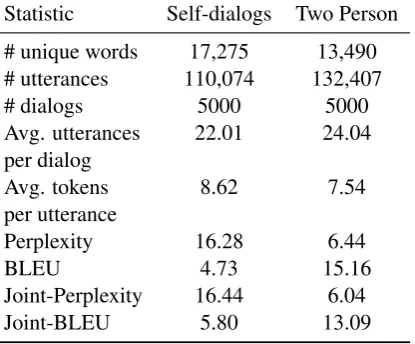
Table 2: Statistics comparison: Self-dialogs vs two person corpus both containing 5k dialogs. Perplex-ity and BLEU are reported for Transformer baseline. Joint-Perplexity and Joint-BLEU are perplexity/BLEU scores from the joint training of self-dialogs and two-person but evaluated with their respective test sets.
reservation.accept.
4 Dataset Analysis
4.1 Self-dialogs vs MultiWOZ
We quantitatively compare our self-dialogs (Sec-tion 3.3) with the MultiWOZ dataset in Table 1. Compared to MultiWOZ, we do not ask the users and assistants to stick to detailed scripts and do not restrict them to have conversations surround-ing a small knowledge base. Table1 shows that our dataset has more unique words, and has al-most twice the number of utterances per dialog than the MultiWOZ corpus. Finally, when trained with the Transformer (Vaswani et al.,2017) model, we observe significantly higher perplexities and lower BLEU scores for our dataset compared to MultiWOZ suggesting that our dataset conversa-tions are difficult to model. Finally, Table1 also shows that our dataset contains close to 10 times more real-world named entities than MultiWOZ and thus, could potentially serve as a realistic base-line when designing goal oriented dialog systems. MultiWOZ has only 1338 unique named entities and only 4510 unique values (including date, time etc.) in their datatset.
4.2 Self-dialogs vs Two-person
In this section, we quantitatively compare 5k con-versations each of self-dialogs (Section3.3) and two-person (Section3.2). From Table2, we find that self-dialogs exhibit higher perplexity ( almost
3 times) compared to the two-person conversa-tions suggesting that self-dialogs are more diverse and contains more non-conventional conversational flows which is inline with the observations in Section-3.3.2. While the number of unique words are higher in the case of self-dialogs, conversations are longer in the two-person conversations. We also report metrics by training a single model on both the datasets together.
4.3 Baseline Experiments: Response Generation
We evaluate various seq2seq architectures (Sutskever et al.,2014) on our self-dialog corpus using both automatic evaluation metrics and human judgments. Following the recent line of work on generative dialog systems (Vinyals and Le,2015), we treat the problem of response generation given the dialog history as a conditional language modeling problem. Specifically we want to learn a conditional probability distribution
Pθ(Ut|U1:t−1)whereUtis the next response given dialog historyU1:t−1. Each utterance Ui itself is comprised of a sequence of wordswi1, wi2. . . wik.
The overall conditional probability is factorized autoregressively as
Pθ(Ut|U1:t−1) =
n Y
i=1
Pθ(wti|wt1:i−1, U1:t−1)
Pθ, in this work, is parameterized by a recurrent, convolution or Transformer-based seq2seq model.
n-gram: We consider 3-gram and 4-gram condi-tional language model baseline with interpolation. We use random grid search for the best coefficients for the interpolated model.
Convolution: We use the fconv architecture (Gehring et al., 2017) and default hyperparam-eters from the fairseq (Ott et al., 2019) frame-work.2 We train the network with ADAM opti-mizer (Kingma and Ba,2015) with learning rate of 0.25 and dropout probability set to 0.2.
LSTM: We consider LSTM models (Hochreiter and Schmidhuber,1997) with and without attention (Bahdanau et al.,2015) and use the tensor2tensor (Vaswani et al., 2018) framework for the LSTM baselines. We use a two-layer LSTM network for both the encoder and the decoder with 128 dimen-sional hidden vectors.
Transformer: As with LSTMs, we use the ten-sor2tensor framework for the Transformer model.
Baseline PPL BLEU Ratings Rank
Models (LIKERT)
GPT-2 (117M) - 0.26 -
-3-gram 38.12 0.20 -
-4-gram 34.49 0.21 -
-LSTM 25.73 4.45 -
-Convolution 21.25 5.09 2.89 3 LSTM-attention 20.05 5.12 3.51 2 Transformer 18.19 6.11 3.22 1
Table 3: Evaluation of various seq2seq architectures (Sutskever et al.,2014) on our self-dialog corpus us-ing both automatic evaluation metrics and human judg-ments. Human evaluation ratings in the 1-5 LIKERT scale (higher the better), and human ranking are aver-aged over 500 x 3 ratings (3 crowdsourced workers per rating).
Our Transformer (Vaswani et al.,2017) model uses 256 dimensions for both input embedding and hid-den state, 2 layers and 4 attention heads. For both LSTMs and Transformer, we train the model with ADAM optimizer (β1 = 0.85, β2 = 0.997) and dropout probability set to 0.2.
GPT-2: Apart from supervised seq2seq mod-els, we also include results from pre-trained GPT-2 (Radford et al.,2019) containing 117M parameters.
We evaluate all the models with perplexity and BLEU scores (Table 3). Additionally, we per-form two kinds of human evaluation - Ranking and Rating (LIKERT scale) for the top-3 performing models - Convolution, LSTM-attention and Trans-former. For the ranking task, we randomly show 500 partial dialogs and generated responses of the top-3 models from the test set to three different crowdsourced workers and ask them to rank the responses based on their relevance to the dialog history. For the rating task, we show the model responses individually to three different crowd-sourced workers and ask them to rate the responses on a 1-5 LIKERT scale based on their appropriate-ness to the dialog history. From Table-4, we see that inter-annotator reliability scores (Krippendorfs Alpha) are higher for the ranking task compared to the rating task. From Table3, we see that Trans-former is the best performing model on automatic evaluation metrics. It is interesting to note that there is a strong correlation between BLEU score and human ranking judgments.
Evalation Inter-Annotator Reliability method (Krippendorfs Alpha)
Rating (1-5 LIKERT) 0.21
[image:8.595.307.453.174.214.2]Ranking 0.29
Table 4: Inter-Annotator Reliability scores of seq2seq model responses computed for 500 self-dialogs from the test set, each annotated by 3 crowdsourced workers.
Model Micro F1 (%)
Transformer 48.73 Transformer + copy 51.79
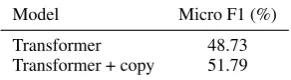
Table 5: API Argument prediction accuracy for Self-dialogs. API arguments are annotated as spans in the utterances.
4.4 Baseline Experiments: Argument
Prediction
Next, we discuss a set of baseline experiments for the task of argument prediction. API arguments are annotated as spans in the dialog (Section3.4). We formulate this problem as mapping text conversa-tion to a sequence of output arguments. Apart from the seq2seq Transformer baseline, we consider an additional model - an enhanced Transformer seq2seq model where the decoder can choose to copy from the input or generate from the vocabu-lary (Merity et al.,2017;Gu et al.,2016). Since all the API arguments are input spans, the copy model having the correct inductive bias achieves the best performance.
5 Conclusion
References
Amazon. 2019.Alexa skills.
Dzmitry Bahdanau, Kyunghyun Cho, and Yoshua Ben-gio. 2015. Neural machine translation by jointly learning to align and translate. ICLR.
Antoine Bordes, Y-Lan Boureau, and Jason Weston. 2017. Learning end-to-end goal-oriented dialog. ICLR.
Paweł Budzianowski, Tsung-Hsien Wen, Bo-Hsiang Tseng, I˜nigo Casanueva, Stefan Ultes, Osman Ra-madan, and Milica Gasic. 2018. Multiwoz - a large-scale multi-domain wizard-of-oz dataset for task-oriented dialogue modelling. EMNLP.
Wallace Chafe and Deborah Tannen. 1987. The rela-tion between written and spoken language. Annual Review of Anthropology.
J. Gehring, M. Auli, D. Grangier, D. Yarats, and Y. N. Dauphin. 2017. Convolutional Sequence to Se-quence Learning.Arxiv.
Google. 2019.Actions on google.
Jiatao Gu, Zhengdong Lu, Hang Li, and Victor O.K. Li. 2016. Incorporating copying mechanism in sequence-to-sequence learning.ACL.
Matthew Henderson, Blaise Thomson, and Steve Young. 2013. Deep neural network approach for the dialog state tracking challenge. SIGDIAL.
Geoffrey Hinton, Li Deng, Dong Yu, George Dahl, Abdel rahman Mohamed, Navdeep Jaitly, Andrew Senior, Vincent Vanhoucke, Patrick Nguyen, Tara Sainath, and Brian Kingsbury. 2012. Deep neural networks for acoustic modeling in speech recogni-tion. Signal Processing Magazine.
Sepp Hochreiter and J¨urgen Schmidhuber. 1997. Long short-term memory.Neural Computation.
Norman P. Jouppi, Cliff Young, Nishant Patil, David Patterson, and Gaurav Agrawal et al. 2017. In-datacenter performance analysis of a tensor process-ing unit. ISCA.
John F Kelley. 1984. An iterative design methodology for user-friendly natural language office information applications. ACM Transactions on Information Sys-tems (TOIS).
Diederik P. Kingma and Jimmy Ba. 2015. Adam: A method for stochastic optimization.ICLR.
Ben Krause, Marco Damonte, Mihai Dobre, Daniel Duma, Joachim Fainberg, Federico Fancellu, Em-manuel Kahembwe, Jianpeng Cheng, and Bonnie Webber. 2017. Edina: Building an open domain so-cialbot with self-dialogues. Arxiv.
Yann Lecun, Yoshua Bengio, and Geoffrey Hinton. 2015. Deep learning. Nature.
Ryan Lowe, Nissan Pow, Iulian V. Serban, and Joelle Pineau. 2015. The ubuntu dialogue corpus: A large dataset for research in unstructured multi-turn dia-logue systems. SIGDIAL.
Stephen Merity, Caiming Xiong, James Bradbury, and Richard Socher. 2017. Pointer sentinel mixture mod-els. ICLR.
Nikita Moghe, Siddhartha Arora, Suman Banerjee, and Mitesh M. Khapra. 2018. Towards exploiting back-ground knowledge for building conversation sys-tems. EMNLP.
Aron van den Oord, Sander Dieleman, Heiga Zen, Karen Simonyan, Oriol Vinyals, Alexander Graves, Nal Kalchbrenner, Andrew Senior, and Koray Kavukcuoglu. 2016. Wavenet: A generative model for raw audio. Arxiv.
Myle Ott, Sergey Edunov, Alexei Baevski, Angela Fan, Sam Gross, Nathan Ng, David Grangier, and Michael Auli. 2019. fairseq: A fast, extensible toolkit for sequence modeling. NAACL Demonstra-tions.
Alec Radford, Jeff Wu, Rewon Child, David Luan, Dario Amodei, and Ilya Sutskever. 2019. Language models are unsupervised multitask learners. Arxiv.
Antoine Raux, Brian Langner, Alan W Black, and Max-ine Eskenazi. 2003. Lets go: Improving spoken di-alog systems for the elderly and non-natives. Eu-rospeech.
Lina Maria Rojas-Barahona, Milica Gasic, Nikola Mrk-sic, Pei-Hao Su, Stefan Ultes, Tsung-Hsien Wen, Steve J. Young, and David Vandyke. 2017. A network-based end-to-end trainable task-oriented di-alogue system.EACL.
Iulian Vlad Serban, Ryan Lowe, Peter Henderson, Lau-rent Charlin, and Joelle Pineau. 2017. A survey of available corpora for building data-driven dialogue systems. nnn.
Dave Steinkrau, Patrice Y. Simard, and Ian Buck. 2005. Using gpus for machine learning algorithms. IC-DAR.
Ilya Sutskever, Oriol Vinyals, and Quoc V. Le. 2014. Sequence to sequence learning with neural networks. NeurIPS.
Ashish Vaswani, Samy Bengio, Eugene Brevdo, Fran-cois Chollet, Aidan N. Gomez, Stephan Gouws, Llion Jones, Łukasz Kaiser, Nal Kalchbrenner, Niki Parmar, Ryan Sepassi, Noam Shazeer, and Jakob Uszkoreit. 2018. Tensor2tensor for neural machine translation.CoRR.
Oriol Vinyals and Quoc V. Le. 2015. A neural conver-sational model. Arxiv.
Joseph Weizenbaum. 1966. Eliza a computer program for the study of natural language communication be-tween man and machine. Computational Linguis-tics.
Jason Williams, Antoine Raux, and Matthew and Hen-derson. 2016. The dialog state tracking challenge series: A review. Dialog and Discourse.