Proceedings of the 2011 Conference on Empirical Methods in Natural Language Processing, pages 1456–1466, Edinburgh, Scotland, UK, July 27–31, 2011. c2011 Association for Computational Linguistics
Structured Relation Discovery using Generative Models
Limin Yao∗ Aria Haghighi+ Sebastian Riedel∗ Andrew McCallum∗
∗ Department of Computer Science, University of Massachusetts at Amherst
+ CSAIL, Massachusetts Institute of Technology
{lmyao,riedel,mccallum}@cs.umass.edu {aria42}@csail.mit.edu
Abstract
We explore unsupervised approaches to rela-tion extracrela-tion between two named entities; for instance, the semanticbornInrelation be-tween a person and location entity. Con-cretely, we propose a series of generative probabilistic models, broadly similar to topic models, each which generates a corpus of ob-served triples of entity mention pairs and the surface syntactic dependency path between them. The output of each model is a cluster-ing of observed relation tuples and their as-sociated textual expressions to underlying se-mantic relation types. Our proposed models exploit entity type constraints within a relation as well as features on the dependency path be-tween entity mentions. We examine effective-ness of our approach via multiple evaluations and demonstrate 12% error reduction in preci-sion over a state-of-the-art weakly supervised baseline.
1 Introduction
Many NLP applications would benefit from large knowledge bases of relational information about entities. For instance, knowing that the entity
Steve Balmer bears the leaderOf relation to the entity Microsoft, would facilitate question answer-ing (Ravichandran and Hovy, 2002), data minanswer-ing, and a host of other end-user applications. Due to these many potential applications, relation extrac-tion has gained much attenextrac-tion in informaextrac-tion ex-traction (Kambhatla, 2004; Culotta and Sorensen, 2004; Mintz et al., 2009; Riedel et al., 2010; Yao et
al., 2010). We propose a series of generative prob-abilistic models, broadly similar to standard topic models, which generate a corpus of observed triples of entity mention pairs and the surface syntactic de-pendency path between them. Our proposed mod-els exploit entity type constraints within a relation as well as features on the dependency path between entity mentions. The output of our approach is a clustering over observed relation paths (e.g. “X was born in Y” and “X is from Y”) such that expressions in the same cluster bear the same semantic relation type between entities.
Past work has shown that standard supervised techniques can yield high-performance relation de-tection when abundant labeled data exists for a fixed inventory of individual relation types (e.g.
ence. Our work is similar to DIRT and USP in that we induce relation types from observed dependency paths, but our approach is a straightforward and principled generative model which can be efficiently learned. As we show empirically, our approach out-performs these related works when trained with the same amount of data and further gains are observed when trained with more data.
We evaluate our approach using ‘intrinsic’ clus-tering evaluation and ‘extrinsic’ evaluation settings.1
The former evaluation is performed using subset of induced clusters against Freebase relations, a large manually-built entity and relational database. We also show some clusters which are not included as Freebase relations, as well as some entity clusters found by our approach. The latter evaluation uses the clustering induced by our models as features for relation extraction in distant supervision framework. Empirical results show that we can find coherent clusters. In relation extraction, we can achieve 12% error reduction in precision over a state-of-the-art weakly supervised baseline and we show that using features from our proposed models can find more facts for a relation without significant accuracy loss.
2 Problem and Experimental Setup
The task of relation extraction is mapping surface textual relations to underlying semantic relations. For instance, the textual expression “X was born in Y” indicates a semantic relationbornInbetween en-tities “X” and “Y”. This relation can be expressed textually in several ways: for instance, “X, a native of Y” or “X grew up in Y”. There are several com-ponents to a coherent relation type, including a tight small number of textual expressions as well as con-straints on the entities involved in the relation. For instance, in thebornInrelation “X” must be a person entity and “Y” a location (typically a city or nation). In this work, we present an unsupervised probabilis-tic generative model for inducing clusters of relation types and recognizing their textual expressions. The set of relation types is not pre-specified but induced from observed unlabeled data. See Table 4 for ex-amples of learned semantic relations.
Our observed data consists of a corpus of docu-ments and each document is represented by a bag
1See Section 4 for a fuller discussion of evaluation.
of relation tuples. Each tuple represents an ob-served syntactic relationship between two Named Entities (NE) and consists of three components: the dependency path between two NE mentions, the source argument NE, and the destination argument NE. A dependency path is a concatenation of depen-dency relations (edges) and words (nodes) along a path in a dependency tree. For instance, the sentence “John Lennnon was born in Liverpool” would yield the relation tuple (Lennon,[↑ −nsubjpass, born,↓
−in], Liverpool). This relation tuple reflects a se-manticbornInrelation between theJohn Lennonand
Liverpoolentities. The dependency path in this ex-ample corresponds to the “X was born in Y” textual expression given earlier. Note that for the above ex-ample, thebornInrelation can only occur between a
personand alocation. The relation tuple is the pri-mary observed random variable in our model and we construct our models (see Section 3) so that clusters consist of textual expressions representing the same underlying relation type.
3 Models
We propose three generative models for modeling tuples of entity mention pairs and the syntactic de-pendency path between them (see Section 2). The first two models, Rel-LDA and Rel-LDA1 are sim-ple extensions of the standard LDA model (Blei et al., 2003). At the document level, our model is iden-tical to standard LDA; a multinomial distribution is drawn over a fixed number of relation types R. Changes lie in the observations. In standard LDA, the atomic observation is a word drawn from a la-tent topic distribution determined by a lala-tent topic indicator variable for that word position. In our ap-proach, a document consists of an exchangeable set of relation tuples. Each relation tuple is drawn from a relation type ‘topic’ distribution selected by a la-tent relation type indicator variable. Relation tuples are generated using a collection of independent fea-tures drawn from the underlying relation type distri-bution. These changes to standard LDA are intended to have the effect that instead of representing seman-tically related words, the ‘topic’ latent variable rep-resents a relation type.
and entities jointly. For each tuple, a set of rela-tion level features and two latent entity type indica-tors are drawn independently from the relation type distribution; a collection of entity mention features for each argument is drawn independently from the entity type distribution selected by the entity type indicator.
Path X, made by Y Source Gamma Knife
Dest Elekta
Trigger make
[image:3.612.340.512.67.235.2]Lex , made by the Swedish medical technology firm POS , VBN IN DT JJ JJ NN NN NER pair MISC-ORG Sync pair partmod-pobj
Table 1: The features of tuple ‘(Gamma Knife, made by, Elekta)’ in sentence “Gamma Knife, made by the Swedish medical technology firm Elekta, focuses low-dosage gamma radiation ...”
3.1 Rel-LDA Model
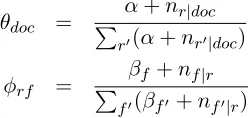
This model is an extension to the standard LDA model. At the document level, a multinomial dis-tribution over relations θdoc is drawn from a prior
Dir(α). To generate a relation tuple, we first draw a
relation ‘topic’r from Multi(θ). Then we generate
each featurefof a tuple independently from a
multi-nomial distribution Multi(φrf) selected byr. In this
model, each tuple has three features, i.e. its three components, shown in the first three rows in Table 1. Figure 1 shows the graphical representation of Rel-LDA. Table 2 lists all the notation used in describing our models.
The learning process of the models is an EM pro-cess. The procedure is similar to that used by the standard topic model. In the variational E-step (in-ference), we sample the relation type indicator for each tuple usingp(r|f):
P(r|f(p, s, d))∝p(r)Qfp(f|r)
∝(αr+nr|d)Qf
βf+nf|r
P
f0(βf0+nf0|r)
|R| Number of relations |D| Number of documents
r A relation
doc A document
p,s,d Dep path, source and dest args f A feature/feature type T Entity type of one argument α Dirichlet prior forθdoc
βx Dirichlet prior forφrx
β Dirichlet prior forφt
θdoc p(r|doc)
φrx p(x|r)
[image:3.612.99.272.184.297.2]φt p(fs|T),p(fd|T)
Table 2: The notation used in our models
|R|
...
N r
f
θ
φrf
α
βf
f
[image:3.612.353.499.273.378.2]
|D|
Figure 1: Rel-LDA model. Shaded circles are observa-tions, and unshaded ones are hidden variables. A docu-ment consists ofN tuples. Each tuple has a set of fea-tures. Each feature of a tuple is generated independently from a hidden relation variabler.
p(r)andp(f|r)are estimated in the M-step:
θdoc =
α+nr|doc
P
r0(α+nr0|doc)
φrf =
βf +nf|r
P
f0(βf0 +nf0|r)
wherenf|rindicates the number of times a featuref
is assigned withr.
3.2 Rel-LDA1
[image:3.612.364.488.495.554.2]for using trigger words is that paths sharing the same set of trigger words should go to one cluster. Adding named entity tag pair can refine the cluster too. For example, a cluster found by Rel-LDA contains “X was born in Y” and “X lives in Y”; but it also con-tains “X, a company in Y”. In this scenario, adding features ‘PER-LOC’ and ‘ORG-LOC’ can push the model to split the clusters into two and put the third case into a new cluster.
Hence we propose Rel-LDA1. It is similar to Rel-LDA, except that each tuple is represented with more features. Besides p, s, and d, we introduce
trigger words, lexical pattern, POS tag pattern, the named entity pair and the syntactic category pair fea-tures for each tuple. Lexical pattern is the word se-quence between the two arguments of a tuple and POS tag pattern is the POS tag sequence of the lexi-cal pattern. See Table 1 as an example.
Following typical EM learning(Charniak and El-sner, 2009), we start with a much simpler genera-tive model, expose the model to fewer features first, and iteratively add more features. First, we train a Rel-LDA model, i.e. the model only generates the dependency path, source and destination arguments. After each interval of 10 iterations, we introduce one additional feature. We add the features in the order of trigger, lexical pattern, POS, NER pair, and syn-tactic pair.
3.3 Type-LDA model
We know that relations can only hold between certain entity types, known as selectional prefer-ences (Ritter et al., 2010; Seaghdha, 2010; Kozareva and Hovy, 2010). Hence we propose Type-LDA model. This model can capture the selectional pref-erences of relations to their arguments. In the mean time, it clusters tuples into relational clusters, and arguments into different entity clusters. The entity clusters could be interesting in many ways, for ex-ample, defining fine-grained entity types and finding new concepts.
We split the features of a tuple into relation level features and entity level features. Relation level fea-tures include the dependency path, trigger, lex and POS features; entity level features include the entity mention itself and its named entity tag.
The generative storyline is as follows. At the doc-ument level, a multinomial distribution over
N
|D|
|R|
r f
fs θ
φrf
φt fd
|R|
φrt2 α
βt2
β βf
T1 T2
|T|
|R|
φrt1
[image:4.612.342.512.76.239.2]βt1
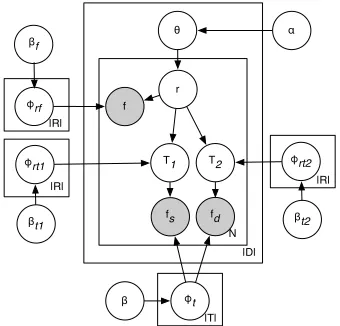
Figure 2: Type-LDA model. Each document consists of N tuples. Each tuple has a set of features, relation level featuresfand entity level features of source argumentfs
and destination argumentfd. Relation level features and
two hidden entity types T1 andT2 are generated from
hidden relation variablerindependently. Source entity features are generated fromT1 and destination features
are generated fromT2.
tionsθdoc is drawn from a Dirichlet prior. A
doc-ument consists ofN relation tuples. Each tuple is
represented by relation level features (f) and entity
level features of source argument (fs) and
destina-tion argument (fd). For each tuple, a relation r is
drawn from Multi(θdoc). The relation level features
and two hidden entity typesT1 andT2 are indepen-dently generated fromr. Featuresfsare generated
fromT1andfdfromT2. Figure 2 shows the graphi-cal representation of this model.
At inference time, we sample r, T1 and T2 for each tuple. For efficient inference, we first initialize the model withoutT1andT2, i.e. all the features are generated directly fromr. Here the model
degener-ates to Rel-LDA1. After some iterations, we intro-duceT1andT2. We sample the relation variable (r) and two mention types variables (T1,T2) iteratively for each tuple. We can sample them together, but this is not very efficient. In addition, we found that it does not improve performance.
4 Experiments
obituary content, lists and so on. Obituary arti-cles often contain syntax that diverges from stan-dard newswire text. This leads to parse errors with WSJ-trained parsers and in turn, makes extraction harder. We also filter out documents that contain lists or tables of items (such as books, movies) be-cause this semi-structured information is not the fo-cus of our current work. After filtering we are left with approximately 428K documents. They are pre-processed in several steps. First we employ Stanford tools to tokenize, sentence-split and Part-Of-Speech tag (Toutanova et al., 2003) a document. Next we recognize named entities (Finkel et al., 2005) by labelling tokens with PERSON, ORGANIZATION, LOCATION, MISC and NONE tags. Consecutive tokens which share the same category are assembled into entity mentions. They serve as source and des-tination arguments of the tuples we seek to model. Finally we parse each sentence of a document using MaltParser (Nivre et al., 2004) and extract depen-dency paths for each pair of named entity mentions in one sentence.
Following DIRT (Lin and Pantel, 2001), we fil-ter out tuples that do not satisfy the following con-straints. First, the path needs to be shorter than 10 edges, since longer paths occur less frequently. Second, the dependency relations in the path should connect two content words, i.e. nouns, verbs, ad-jectives and adverbs. For example, in phrase ‘solve a problem’, ‘obj(solve, problem)’ is kept, while ‘det(problem, a)’ is discarded. Finally, the de-pendency labels on the path must not be: ‘conj’, ‘ccomp’, ‘parataxis’, ‘xcomp’, ‘pcomp’, ‘advcl’, ‘punct’, and ‘infmod’. This selection is based on the observation that most of the times the corresponding dependency relations do not explicitly state a rela-tion between two candidate arguments.
After all entity mentions are generated and paths are extracted, we have nearly 2.5M tuples. After clustering (inference), each of these tuple will be-long to one cluster/relation and is associated with its clusterID.
We experimented with the number of clusters and find that in a range of 50-200 the performance does not vary significantly with different numbers. In our experiments, we cluster the tuples into 100 relation clusters for all three models. For Type-LDA model, we use 50 entity clusters.
We evaluate our models in two ways. The first aims at measuring the clustering quality by mapping clusters to Freebase relations. The second seeks to assess the utility of our predicted clusters as features for relation extraction.
4.1 Relations discovered by different models
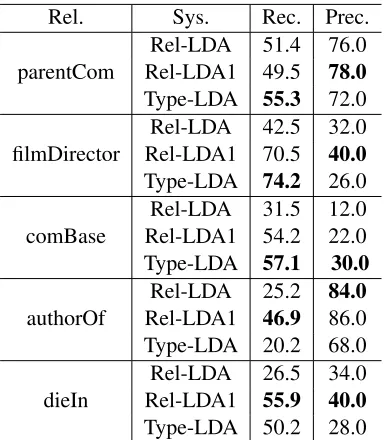
Looking closely at the clusters we predict, we find that some of them can be mapped to Freebase rela-tions. We discover clusters that roughly correspond to theparentCom(parent company relation), filmDi-rector,authorOf,comBase(base of a company rela-tion) anddieInrelations in Freebase. We treat Free-base annotations as ground truth and measure recall. We count each tuple in a cluster as true positive if Freebase states the corresponding relation between its argument pair. We find that precision numbers against Freebase are low, below 10%. However, these numbers are not reliable mainly because many correct instances found by our models are missing in Freebase. One reason why our predictions are missing in Freebase is coreference. For example, we predict parentCom relation between ‘Linksys’ and ‘Cisco’, while Freebase only considers ‘Cisco Systems, Inc.’ as the parent company of ‘Linksys’. It does not corefer ‘Cisco’ to ‘Cisco Systems, Inc.’. Incorporating coreference in our model may fix this problem and is a focus of future work. Instead of measuring precision against Freebase, we ask hu-mans to label 50 instances for each cluster and report precision according to this annotated data. Table 3 shows the scores.
We can see that in most cases Rel-LDA1 and Type-LDA substantially outperform the Rel-LDA model. This is due to the fact that both models can exploit more features to make clustering decisions. For example, in Rel-LDA1 model, the NER pair fea-ture restricts the entity types the two arguments can take.
Rel. Sys. Rec. Prec.
parentCom Rel-LDA1 49.5Rel-LDA 51.4 76.078.0
Type-LDA 55.3 72.0
filmDirector
Rel-LDA 42.5 32.0 Rel-LDA1 70.5 40.0
Type-LDA 74.2 26.0
comBase Rel-LDA1 54.2Rel-LDA 31.5 12.022.0 Type-LDA 57.1 30.0
authorOf
Rel-LDA 25.2 84.0
Rel-LDA1 46.9 86.0 Type-LDA 20.2 68.0
dieIn Rel-LDA1Rel-LDA 26.555.9 40.034.0
[image:6.612.90.283.70.290.2]Type-LDA 50.2 28.0
Table 3: Clustering quality evaluation (%), Rec. is mea-sured against Freebase, Prec. is meamea-sured according to human annotators
For example, when a sentence has the following pat-tern “The winners are A, a part of B; C, a part of D; E, a part of F”, our models may predict parent-Com(A,F), because the parser connects A with F via the pattern ‘a part of’.
Some clusters found by our models cannot be mapped to Freebase relations. Consider the Free-base relation worksFor as one example. This re-lation subsumes all types of employment rere-lation- relation-ships, irrespective of the role the employee plays for the employer. By contrast, our models discover clus-ters such as leaderOf, editorOf that correspond to more specific roles an employee can have. We show some example relations in Table 4. In the table, the 2nd row shows a cluster of employees of news media companies; the 3rd row shows leaders of companies; the last one shows birth and death places of persons. We can see that the last cluster is noisy since we do not handle antonyms in our models. The argu-ments of the clusters have noise too. For example, ‘New York’ occurs as a destination argument in the 2nd cluster. This is because ‘New York’ has high frequency in the corpus and it brings noise to the clustering results. In Table 5 some entity clusters found by Type-LDA are shown. We find different types of companies, such as financial companies and
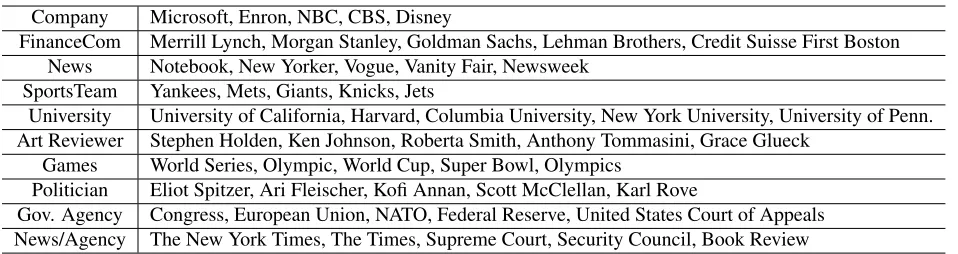
news companies. We also find subclasses ofperson, for example,reviewerandpolitician, because these different entity classes participate in different rela-tions. The last cluster shown in the table is a mix-ture of news companies and government agencies. This may be because this entity cluster is affected by many relations.
4.2 Distant Supervision based Relation Extraction
Our generative models detect clusters of dependency paths and their arguments. Such clusters are inter-esting in their own right, but we claim that they can also be used to help a supervised relation extractor. We validate this hypothesis in the context of relation extraction with distant supervision using predicted clusters as features.
Following previous work (Mintz et al., 2009), we use Freebase as our distant supervision source, and align related entity pairs to the New York Times arti-cles discussed earlier. Our training and test instances are pairs of entities for which both arguments appear in at least one sentence together. Features of each instance are extracted from all sentences in which both entities appear together. The gold label for each instance comes from Freebase. If a pair of entities is not related according to Freebase, we consider it a negative example. Note that this tends to create some amount of noise: some pairs may be related, but their relationships are not yet covered in Free-base.
After filtering out relations with fewer than 10 in-stances we have 65 relations and an additional “O” label for unrelated pairs of entities. We call related instances positive examples and unrelated instances negative examples.
We train supervised classifiers using maximum entropy. The baseline classifier employs features that Mintz et al. (2009) used. To extract features from the generative models we proceed as follows. For each pair of entities, we collect all tuples asso-ciated with it. For each of these tuples we extract its clusterID, and use this ID as a binary feature.
Source New York, Euro RSCG Worldwide, BBDO Worldwide, American, DDB Worldwide Path X, a part of Y; X, a unit of Y; X unit of Y; X, a division of Y; X is a part of Y Dest Omnicom Group, Interpublic Group of Companies, WPP Group, Publicis Groupe Source Supreme Court, Anna Wintour, William Kristol, Bill Keller, Charles McGrath
Path X, an editor of Y; X, a publisher of Y; X, an editor at Y; X, an editor in chief of Y; X is an editor of Y; Dest The Times, The New York Times, Vogue, Vanity Fair, New York
Source Kenneth L. Lay, L. Dennis Kozlowski, Bernard J. Ebbers, Thomas R. Suozzi, Bill Gates Path X, the executive of Y; X, Y’s executive; X, Y executive; X, the chairman of Y; X, Y’s chairman Dest Enron, Microsoft, WorldCom, Citigroup, Nassau County
Source Paul J. Browne, John McArdle, Tom Cocola, Claire Buchan, Steve Schmidt
Path X, a spokesman for Y; X, a spokeswoman for Y; X, Y spokesman; X, Y spokeswoman; X, a commissioner of Y Dest White House, Justice Department, Pentagon, United States, State Department
Source United Nations, Microsoft, Intel, Internet, M. D. Anderson
Path X, based in Y; X, which is based in Y; X, a company in Y; X, a company based in Y; X, a consultant in Y Dest New York, Washington, Manhattan, Chicago, London
Source Army, Shiite, Navy, John, David
[image:7.612.71.573.69.300.2]Path X was born in Y; X die at home in Y; X die in Y; X, son of Y; X die at Y Dest Manhattan, World War II, Brooklyn, Los Angeles, New York
Table 4: The path, source and destination arguments of some relations found by Rel-LDA1.
Company Microsoft, Enron, NBC, CBS, Disney
FinanceCom Merrill Lynch, Morgan Stanley, Goldman Sachs, Lehman Brothers, Credit Suisse First Boston News Notebook, New Yorker, Vogue, Vanity Fair, Newsweek
SportsTeam Yankees, Mets, Giants, Knicks, Jets
University University of California, Harvard, Columbia University, New York University, University of Penn. Art Reviewer Stephen Holden, Ken Johnson, Roberta Smith, Anthony Tommasini, Grace Glueck
Games World Series, Olympic, World Cup, Super Bowl, Olympics
Politician Eliot Spitzer, Ari Fleischer, Kofi Annan, Scott McClellan, Karl Rove
Gov. Agency Congress, European Union, NATO, Federal Reserve, United States Court of Appeals News/Agency The New York Times, The Times, Supreme Court, Security Council, Book Review
Table 5: The entity clusters found by Type-LDA
these against Distant and the DIRT database. For the latter we parse our data using Minipar (Lin, 1998) and extract dependency paths between pairs of named entity mentions. For each path, the top 3 similar paths are extracted from DIRT database. The Minipar path and the similar paths are used as addi-tional features.
For held-out evaluation, we construct the training data from half of the positive examples and half of the negative examples. The remaining examples are used as test data. Note that the number of negative instances is more than 10 times larger than the num-ber of positive instances. At test time, we rank the predictions by the conditional probabilities obtained from the Maximum Entropy classifier. We report precision of top ranked 50 instances for each relation
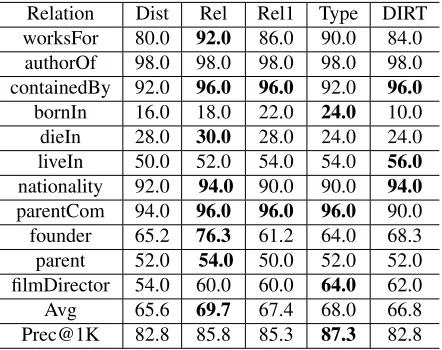
in table 6. From the table we can see that all systems using additional features outperform the Distant sys-tem. In average, our best model achieves 4.1% improvement over the distant supervision baseline, 12% error reduction. The precision ofbornInis low because in most cases we predict bornIninstances asliveIn.
We expect systems using generative model fea-tures to have higher recall than the baseline. This is difficult to measure, but precision in the high re-call area is a signal. We look at top ranked 1000 instances of each system and show the precision in the last row of the table. We can see that our best model Type-LDA outperforms the distant supervi-sion baseline by 4.5%.
[image:7.612.71.550.326.453.2]Relation Dist Rel Rel1 Type DIRT worksFor 80.0 92.0 86.0 90.0 84.0 authorOf 98.0 98.0 98.0 98.0 98.0 containedBy 92.0 96.0 96.0 92.0 96.0
bornIn 16.0 18.0 22.0 24.0 10.0 dieIn 28.0 30.0 28.0 24.0 24.0 liveIn 50.0 52.0 54.0 54.0 56.0
nationality 92.0 94.0 90.0 90.0 94.0
[image:8.612.76.297.71.246.2]parentCom 94.0 96.0 96.0 96.0 90.0 founder 65.2 76.3 61.2 64.0 68.3 parent 52.0 54.0 50.0 52.0 52.0 filmDirector 54.0 60.0 60.0 64.0 62.0 Avg 65.6 69.7 67.4 68.0 66.8 Prec@1K 82.8 85.8 85.3 87.3 82.8
Table 6: Precision (%) of some frequent relations
prove relation extraction? One reason is that gen-erative models can transfer information from known patterns to unseen patterns. For example, given “Sidney Mintz, the great food anthropologist at Johns Hopkins University”, we want to predict the relation between ‘Sidney Mintz’ and ‘Johns Hopkins University’. The distant supervision system incor-rectly predicts the pair as ‘O’ since it has not seen the path ‘X, the anthropologist at Y’ in the training data. By contrast, Rel-LDA can predict this pair cor-rectly asworksForbecause the dependency path of this pair is in a cluster which contains the path ‘X, a professor at Y’.
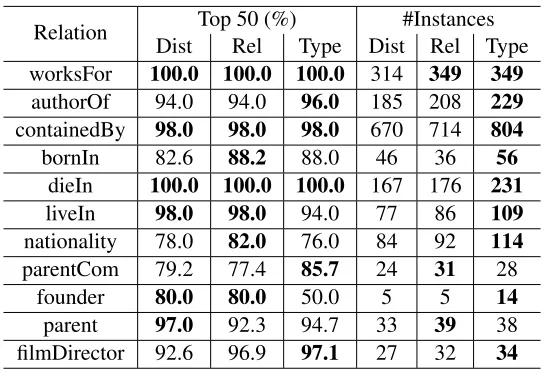
In addition to held-out evaluation we also carry out manual evaluation. To this end, we use all the positive examples and randomly select five times the number of positive examples as negative ex-amples to train a classifier. The remaining nega-tive examples are candidate instances. We rank the predicted instances according to their classification scores. For each relation, we ask human annotators to judge its top ranked 50 instances.
Table 7 lists the manual evaluation results for some frequent relations. We also list how many in-stances are found for each relation. For almost all the relations, systems using generative model fea-tures find more instances. In terms of precision, our models perform comparatively to the baseline, even better for some relations.
We also notice that clustering quality is not con-sistent with distant supervision performance.
Rel-LDA1 can find better clusters than Rel-LDA but it has lower precision in held-out evaluation. Type-LDA underperforms Rel-Type-LDA in average precision but it gets higher precision in a higher recall area, i.e. precision at 1K. One possible reason for the incon-sistency is that the baseline distant supervision sys-tem already employs features that are used in Rel-LDA1. Another reason may be that the clusters do not overlap with Freebase relations very well, see section 4.1.
4.3 Comparing against USP
We also try to compare against USP (Poon and Domingos, 2008). Due to memory requirements of USP, we are only able to run it on a smaller data set consisting of 1,000 NYT documents; this is three times the amount of data Poon and Domingos (2008) used to train USP.2For distant supervision based
re-lation extraction, we only match about 500 Freebase instances to this small data set.
USP provides a parse tree for each sentence and for each mention pair we can extract a path from the tree. Since USP provides clusters of words and phrases, we use the USP clusterID associated with the words on the path as binary features in the clas-sifier.
All models are less accurate when trained on this smaller dataset; we can do as well as USP does, even a little better. USP achieves 8.6% in F1, Rel-LDA 8.7%, Rel-Rel-LDA1 10.3%, Type-Rel-LDA 8.9% and Distant 10.3%. Of course, given larger datasets, the performance of Rel-LDA, Rel-LDA1, and Type-LDA improves considerably. In summary, compar-ing against USP, our approach scales much more easily to large data.
5 Related Work
Many approaches have been explored in relation ex-traction, including bootstrapping, supervised classi-fication, distant supervision, and unsupervised ap-proaches.
Bootstrapping employs a few labeled examples for each relation, iteratively extracts patterns from the labeled seeds, and uses the patterns to extract
2Using the publicly released USP code, training a model
Relation DistTop 50 (%)Rel Type Dist Rel Type#Instances worksFor 100.0 100.0 100.0 314 349 349
authorOf 94.0 94.0 96.0 185 208 229
containedBy 98.0 98.0 98.0 670 714 804
bornIn 82.6 88.2 88.0 46 36 56
dieIn 100.0 100.0 100.0 167 176 231
liveIn 98.0 98.0 94.0 77 86 109
nationality 78.0 82.0 76.0 84 92 114
parentCom 79.2 77.4 85.7 24 31 28
founder 80.0 80.0 50.0 5 5 14
parent 97.0 92.3 94.7 33 39 38
[image:9.612.170.443.69.254.2]filmDirector 92.6 96.9 97.1 27 32 34
Table 7: Manual evaluation, Precision and recall of some frequent relations
more seeds (Brin, 1998). This approach may suffer from low recall since the patterns can be too specific. Supervised learning can discover more general patterns (Kambhatla, 2004; Culotta and Sorensen, 2004). However, this approach requires labeled data, and most work only carry out experiments on small data set.
Distant supervision for relation extraction re-quires no labeled data. The approach takes some existing knowledge base as supervision source, matches its relational instances against the text cor-pus to build the training data, and extracts new in-stances using the trained classifiers (Mintz et al., 2009; Bunescu and Mooney, 2007; Riedel et al., 2010; Yao et al., 2010).
All these approaches can not discover new rela-tions and classify instances which do not belong to any of the predefined relations. Other past work has explored inducing relations using unsupervised ap-proaches.
For example, DIRT (Lin and Pantel, 2001) aims to discover different representations of the same se-mantic relation, i.e. similar dependency paths. They employ the distributional similarity based approach while we use generative models. Both DIRT and our approach take advantage of the arguments of depen-dency paths to find semantic relations. Moreover, our approach can cluster the arguments into differ-ent types.
Unsupervised semantic parsing (USP) (Poon and Domingos, 2008) discovers relations by merging
predicates which have similar meanings; it proceeds to recursively cluster dependency tree fragments (or “parts”) to best explain the observed sentence. It is not focused on capturing any particular kind of re-lation between sentence constituents, but to capture repeated patterns. Our approach differs in that we are focused on capturing a narrow range of binary relations between named entities; some of our mod-els (see Section 3) utilize entity type information to constraint relation type induction. Also, our models are built to be scalable and trained on a very large corpus. In addition, we use a distant supervision framework for evaluation.
Relation duality (Bollegala et al., 2010) employs co-clustering to find clusters of entity pairs and pat-terns. They identify each cluster of entity pairs as a relation by selecting representative patterns for that relation. This approach is related to our models, however, it does not identify any entity clusters.
Generative probabilistic models are widely em-ployed in relation extraction. For example, they are used for in-domain relation discovery while incorpo-rating constraints via posterior regularization (Chen et al., 2011). We are focusing on open domain re-lation discovery. Generative models are also ap-plied to selectional preference discovery (Ritter et al., 2010; Seaghdha, 2010). In this scenario, the authors assume relation labels are given while we automatically discover relations. Generative models are also used in unsupervised coreference (Haghighi and Klein, 2010).
Clustering is also employed in relation extraction. Hasegawa et al. (2004) cluster pairs of named en-tities according to the similarity of context words intervening between them. Their approach is not probabilistic. Researchers also use topic models to perform dimension reduction on features when they cluster relations (Hachey, 2009). However, they do not explicitly model entity types.
Open information extraction aims to discover re-lations independent of specific domains and rela-tions (Banko et al., 2007; Banko and Etzioni, 2008). A self-learner is employed to extract relation in-stances but the systems do not cluster the inin-stances into relations. Yates and Etzioni (2009) present RE-SOLVER for discovering relational synonyms as a post processing step. Our approach integrates entity and relation discovery in a probabilistic model.
6 Conclusion
We have presented an unsupervised probabilistic generative approach to relation extraction between two named entities. Our proposed models exploit entity type constraints within a relation as well as features on the dependency path between entity mentions to cluster equivalent textual expressions. We demonstrate the effectiveness of this approach by comparing induced relation clusters against a large knowledge base. We also show that using clus-ters of our models as features in distant supervised framework yields 12% error reduction in precision over a weakly supervised baseline and outperforms other state-of-the art relation extraction techniques.
Acknowledgments
This work was supported in part by the Center for Intelligent Information Retrieval and the Uni-versity of Massachusetts gratefully acknowledges the support of Defense Advanced Research Projects Agency (DARPA) Machine Reading Program un-der Air Force Research Laboratory (AFRL) prime contract no. FA8750-09-C-0181, ITR#1, and NSF MALLET. Any opinions, findings, and conclusion or recommendations expressed in this material are those of the author(s) and do not necessarily reflect the view of the DARPA, AFRL, or the US govern-ment. Any opinions, findings and conclusions or recommendations expressed in this material are the authors’ and do not necessarily reflect those of the sponsor.
References
Michele Banko and Oren Etzioni. 2008. The tradeoffs between open and traditional relation extraction. In
Proceedings of ACL-08: HLT.
Michele Banko, Michael J Cafarella, Stephen Soderland, Matt Broadhead, and Oren Etzioni. 2007. Open in-formation extraction from the web. InProceedings of IJCAI2007.
David Blei, Andrew Ng, and Michael Jordan. 2003. La-tent Dirichlet allocation. Journal of Machine Learning Research, 3:993–1022, January.
Danushka Bollegala, Yutaka Matsuo, and Mitsuru Ishizuka. 2010. Relational duality: Unsupervised ex-traction of semantic relations between entities on the web. InProceedings of WWW.
Sergey Brin. 1998. Extracting patterns and relations from the world wide web. InProc. of WebDB Work-shop at 6th International Conference on Extending Database Technology.
Razvan C. Bunescu and Raymond J. Mooney. 2007. Learning to extract relations from the web using min-imal supervision. InProceedings of the 45rd Annual Meeting of the Association for Computational Linguis-tics (ACL ’07).
Eugene Charniak and Micha Elsner. 2009. Em works for pronoun anaphora resolution. InProceedings of ACL. Harr Chen, Edward Benson, Tahira Naseem, and Regina
Barzilay. 2011. In-domain relation discovery with meta-constraints via posterior regularization. In Pro-ceedings of ACL.
Aron Culotta and Jeffery Sorensen. 2004. Dependency tree kernels for relation extraction. In 42nd Annual Meeting of the Association for Computational Linguis-tics, Barcelona, Spain.
Jenny Rose Finkel, Trond Grenager, and Christopher Manning. 2005. Incorporating non-local informa-tion into informainforma-tion extracinforma-tion systems by gibbs sam-pling. InProceedings of the 43rd Annual Meeting of the Association for Computational Linguistics (ACL ’05), pages 363–370, June.
Benjamin Hachey. 2009. Towards Generic Relation Ex-traction. Ph.D. thesis, University of Edinburgh. Aria Haghighi and Dan Klein. 2010. Coreference
resolu-tion in a modular, entity-centered model. In Proceed-ings of HLT-NAACL.
Takaaki Hasegawa, Satoshi Sekine, and Ralph Grishman. 2004. Discovering relations among named entities from large corpora. InACL.
Zornitsa Kozareva and Eduard Hovy. 2010. Learning arguments and supertypes of semantic relations using recursive patterns. InProceedings of ACL 10. Dekang Lin and Patrick Pantel. 2001. Dirt - discovery of
inference rules from text. InProceedings of KDD. Dekang Lin. 1998. Dependency-based evaluation of
minipar. InProceedings of the Workshop on the Eval-uation of Parsing Systems.
Mike Mintz, Steven Bills, Rion Snow, and Dan Jurafsky. 2009. Distant supervision for relation extraction with-out labeled data. InACL-IJCNLP.
J. Nivre, J. Hall, and J. Nilsson. 2004. Memory-based dependency parsing. InProceedings of CoNLL, pages 49–56.
Hoifung Poon and Pedro Domingos. 2008. Unsuper-vised semantic parsing. InProceedings of the Confer-ence on Empirical methods in natural language pro-cessing (EMNLP).
Deepak Ravichandran and Eduard Hovy. 2002. Learning surface text patterns for a question answering system. InProceedings of ACL.
Sebastian Riedel, Limin Yao, and Andrew McCallum. 2010. Modeling relations and their mentions without labeled text. InProceedings of the European Confer-ence on Machine Learning and Knowledge Discovery in Databases (ECML PKDD ’10).
Alan Ritter, Mausam, and Oren Etzioni. 2010. A latent dirichlet allocation method for selectional preferences. InProceedings of ACL10.
Dan Roth and Wen tau Yih. 2002. Probabilistic reason-ing for entity and relation recognition. InProceedings of Coling.
Evan Sandhaus, 2008. The New York Times Annotated Corpus. Linguistic Data Consortium, Philadelphia. Diarmuid O Seaghdha. 2010. Latent variable models of
selectional preference. InProceedings of ACL 10. Kristina Toutanova, Dan Klein, Christopher Manning,
and Yoram Singer. 2003. Feature-rich part-of-speech tagging with a cyclic dependency network. In HLT-NAACL, pages 252–259.
Limin Yao, Sebastian Riedel, and Andrew McCallum. 2010. Collective cross-document relation extraction without labelled data. InProceedings of the 2010 Con-ference on Empirical Methods in Natural Language Processing, pages 1013–1023, Cambridge, MA, Oc-tober. Association for Computational Linguistics. Alexander Yates and Oren Etzioni. 2009. Unsupervised
methods for determining object and relation synonyms on the web. Journal of Artificial Intelligence Research, 34:255–296.