Staying Informed: Supervised and Semi-Supervised Multi-view
Topical Analysis of Ideological Perspective
Amr Ahmed
School of Computer Science Carnegie Mellon University
Eric P. Xing
School of Computer Science Carnegie Mellon University
Abstract
With the proliferation of user-generated arti-cles over the web, it becomes imperative to de-velop automated methods that are aware of the ideological-bias implicit in a document col-lection. While there exist methods that can classify the ideological bias of a given docu-ment, little has been done toward understand-ing the nature of this bias on a topical-level. In this paper we address the problem of modeling ideological perspective on a topical level using a factored topic model. We develop efficient inference algorithms using Collapsed Gibbs sampling for posterior inference, and give var-ious evaluations and illustrations of the util-ity of our model on various document collec-tions with promising results. Finally we give a Metropolis-Hasting inference algorithm for a semi-supervised extension with decent results.
1 Introduction
With the avalanche of user-generated articles over the web, it is quite important to develop models that can recognize the ideological bias behind a given document, summarize where this bias is manifested on a topical level, and provide the user with alter-nate views that would help him/her staying informed about different perspectives. In this paper, we fol-low the notion of ideology as defines by Van Dijk in (Dijk, 1998) as “a set of general abstract beliefs commonly shared by a group of people.” In other words, an ideology is a set of ideas that directs one’s goals, expectations, and actions. For instance, free-dom of choice is a general aim that directs the ac-tions of“liberals”, whereasconservation of valuesis the parallel for “conservatives”.
We can attribute the lexical variations of the word content of a document to three factors:
• Writer Ideological Belief. A liberal writer might use words like freedom and choice re-gardless of the topical content of the document. These words define the abstract notion of be-lief held by the writer and its frequency in the document largely depends on the writer’s style.
• Topical Content. This constitutes the main source of the lexical variations in a given docu-ment. For instance, a document about abortion is more likely to have facts related to abortion, health, marriage and relationships.
• Topic-Ideology Interaction. When a liberal thinker writes about abortion, his/her abstract beliefs are materialized into a set of concrete opinions and stances, therefore, we might find words like: pro-choice and feminism. On the contrary, a conservative writer might stress is-sues like pro-life, God and faith.
Given a collection of ideologically-labeled docu-ments, our goal is to develop a computer model that factorsthe document collection into a representation that reflects the aforementioned three sources of lex-ical variations. This representation can then be used for:
• Visualization. By visualizing the abstract no-tion of belief in each ideology, and the way each ideology approaches and views main-stream topics, the user can view and contrast each ideology side-by-side and build the right mental landscape that acts as the basis for his/her future decision making.
• Classification or Ideology Identification. Given a document, we would like to tell the user from which side it was written, and ex-plain the ideological bias in the document at a topical level.
• Staying Informed: Getting alternative views1. Given a document written from
per-spective A, we would like the model to provide the user with other documents that represent al-ternative views about the same topic addressed in the original document.
In this paper, we approach this problem using Topic Models (Blei et al., 2003). We introduce a factored topic model that we call multi-view Latent Dirichlet Allocation or mview-LDA for short. Our model views the word content of each document as the result of the interaction between the document’s idealogical and topical dimensions. The rest of this paper is organized as follows. First, in Section 2, we review related work, and then present our model in Section 3. Then in Section 4, we detail a col-lapsed Gibbs sampling algorithm for posterior infer-ence. Sections 5 and 6 give details about the dataset used in the evaluation and illustrate the capabilities of our model using both qualitative and quantitative measures. Section 7 describes and evaluates the ef-ficacy of a semi-supervised extension, and finally in Section 8 we conclude and list several directions for future research.
2 Related Work
Ideological text is inherently subjective, thus our work is related to the growing area of subjectiv-ity analysis(Wiebe et al., 2004; Riloff et al., 2003). The goal of this area of research is to learn to dis-criminate between subjective and objective text. In contrast,in modeling ideology, we aim toward con-trasting two or more ideological perspectives each of which is subjective in nature. Further more, subjec-tive text can be classified into sentiments which gave rise to a surge of work in automatic opinion min-ing (Wiebe et al., 2004; Yu and Hatzivassiloglou, 2003; Pang et al., 2002; Turney and Littman, 2003; Popescu and Etzioni, 2005) as well as sentiment
1
In this paper, we use the words ideology, view, perspective interchangeably to denote the same concept
analysis and product review mining (Nasukawa and Yi, 2003; Hu and Liu, 2004; Pang and Lee, 2008; Branavan et al., 2008; Titov and McDonald, 2008; Titov and McDonald, 2008; Mei et al., 2007; Ling et al., 2008). The research goal of sentiment anal-ysis and classification is to identify language used to convey positive and negative opinions, which dif-fers from contrasting two ideological perspectives. While ideology can be expressed in the form of a sentiment toward a given topic,like abortion, ideo-logical perspectives are reflected in many ways other than sentiments as we will illustrate later in the pa-per. Perhaps more related to this paper is the work of (Fortuna et al., 2008; Lin et al., 2008) whose goal is to detect bias in news articles via discrimina-tive and generadiscrimina-tive approaches, respecdiscrimina-tively. How-ever, this work still addresses ideology at an abstract level as opposed to our approach of modeling ideol-ogy at a topical level. Finally, independently, (Paul and Girju, 2009) gives a construction similar to ours however for a different task2.
3 Multi-View Topic Models
In this section we introduce multi-view topic mod-els, or LDA for short. Our model, mview-LDA, views each document as the result of the in-teraction between its topical and idealogical dimen-sions. The model seeks to explain lexical variabili-ties in the document by attributing this variabilivariabili-ties to one of those dimensions or to their interactions. Topic models, like LDA, define a generative process for a document collection based on a set of parame-ters. LDA employs a semantic entity known astopic to drive the generation of the document in question. Each topic is represented by a topic-specific word distribution which is modeled as a multinomial dis-tribution over words, denoted by Multi(β). The generative process of LDA proceeds as follows:
1. Draw topic proportionsθd|α∼Dir(α).
2. For each word
(a) Draw a topiczn|θd∼Mult(θd). (b) Draw a wordwn|zn, β∼Multi(βzn).
In step 1 each documentdsamples a topic-mixing vectorθdfrom a Dirichlet prior. The componentθd,k
2
D N
v z
w
V a2 b2
K V
a1 b1
x2
x1
Variable Meaning
w word
v document’s ideology
z topic
x1, x2 word switches, one per word (see text) θ document-specific distribution over topics ξ document’s expected usage of the ideology’s
background topic
Ω ideology’s background-topic
[image:3.612.73.550.57.210.2]β ideology-independent topic distribution φ ideology-specific topic distribution λ topic bias across ideology
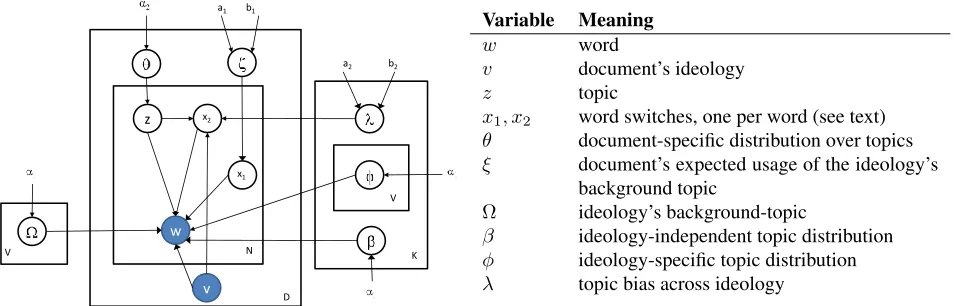
Figure 1: A plate diagram of the graphical model.
of this vector defines how likely topickwill appear in documentd. For each word in the documentwn, a topic indicator zn is sampled from θd, and then the word itself is sampled from a topic-specific word distribution specified by this indicator. Thus LDA can capture and represent lexical variabilities via the components ofθdwhich represents the topical con-tent of the document. In the next section we will ex-plain how our new model mview-LDA can capture other sources of lexical variabilities beyond topical content.
3.1 Multi-View LDA
As we noted earlier, LDA captures lexical variabili-ties due to topical content viaθdand the set of top-icsβ1:K. In mview-LDA each documentdis tagged with the ideological view it represents via the ob-served variablevdwhich takes values in the discrete range: {1,2,· · ·, V}as shown in Fig. 1. For sim-plicity, lets first assume thatV = 2. The topicsβ1:K retain the same meaning: a set of K multinomial distributions each of which represents a given theme or factual topic. In addition, we utilize an ideology-specific topicΩv which is again a multinomial dis-tribution over the same vocabulary. Ωv models the abstract belief shared by all the documents written from viewv. In other words, ifvdenotes the liberal perspective, thenΩvgives high probability to words like progressive, choice, etc. Moreover, we defined a set ofK×V topics that we refer to as ideology-specific topics. For example, topic φv,k represents how ideology v addresses topic k. The generative process of a document dwith ideological view vd
proceeds as follows:
1. Drawξd∼Beta(a1, b1)
2. Draw topic proportionsθd|α∼Dir(α2).
3. For each wordwn
(a) Drawxn,1∼Bernoulli(ξd) (b) If(xn,1= 1)
i. Drawwn|xn,1= 1 ∼ Multi(Ωvd)
(c) If(xn,1= 0)
i. Drawzn|θd∼Mult(θd).
ii. Drawxn,2|vd, zn∼Bernoulli(λzn)
iii. If(xn,2= 1)
A. Drawwn|zn, β∼Multi(βzn).
iv. If(xn,2= 0)
A. Drawwn|vd, zn∼Multi(φvd,zn).
In step 1, we draw a document-specific biased coin,ξd. The bias of this coin determines the pro-portions of words in the document that are gener-ated from its ideology background topicΩvd. As in LDA, we draw the document-specific topic propor-tion θd from a Dirichlet prior. θd thus controls the lexical variabilities due to topical content inside the document.
and depends on the writer’s style to a large degree. If xn,1 turns to be tail,we proceed to the next step
and draw a topic-indicator zn. Now, we have two choices: either to generate this word directly from the ideology-independent portion of the topic βzn,
or to draw the word from the ideology-specific por-tion φvd,zn. The choice here is notdocument
spe-cific, but rather depends on the interaction between the ideology and the specific topic in question. If the ideology associated with the document holds a strong opinion or view with regard to this topic, then we expect that most of the time we will take the second choice, and generate wn from φvd,zn;
and vice versa. This decision is controlled by the Bernoulli variableλzn. Therefore, in step c.ii, we
first generate a coin flip xn,2 fromλzn. Based on
xn,2we either generate the word from the
ideology-independent portion of the topicβzn, and this
con-stitutes how the model accounts for lexical variation due to the topical content of the document, or gen-erate the word from the ideology-specific portion of the topic φvd,zn, and this specifies how the model
accounts for lexical variation due to the interaction between the topical and ideological dimensions of the document.
Finally, it is worth mentioning that the decision to modelλzn3at the topic-ideology level rather than at
the document level, as we have done withξd, stems from our goal to capture ideology-specific behavior on a corpus level rather than capturing document-specific writing style. However, it is worth mention-ing that if one truly seeks to measure the degree of bias associated with a given document,then one can compute the frequency of the eventxn,2 = 0from
posterior samples. In this case,λzn acts as the prior
bias only. Moreover, computing the frequency of the eventxn,2 = 0andzn=kgives the document’s bias toward topickper se.
Finally, it is worth mentioning that all multino-mial topics in the model:β,Ω, φare generated once for the whole collection from a symmetric Dirichlet prior, similarly, all bias variables,λ1:K are sampled from a Beta distribution also once at the beginning of the generative process.
3In an earlier version of the work we modeledλon a per-ideology basis, however, we found that using a single sharedλ
results in more robust results
4 Posterior Inference Via Collapsed Gibbs Sampling
The main tasks can be summarized as follows:
• Learning: Given a collection of documents, find a point estimate of the model parameters (i.e.β,Ω, φ, λ,etc.).
• Inference: Given a new document, and a point estimate of the model parameters, find the pos-terior distribution of the latent variables associ-ated with the document at hand:
(θd,{xn,1},{zn},{xn,2}).
Under a hierarchical Bayesian setting, like the ap-proach we took in this paper, both of these tasks can be handled via posterior inference. Under the gener-ative process, and hyperparmaters choices, outlined in section 3, we seek to compute:
P(d1:D, β1:K,Ω1:V, φ1:V,1:K, λ1:K|α, a, b,w,v),
where d is a shorthand for the hidden variables (θd, ξd,z,x1,x2) in documentd. The above
poste-rior probability is unfortunately intractable,and we approximate it via a collapsed Gibbs sampling pro-cedure (Griffiths and Steyvers, 2004; Gelman et al., 2003) by integrating out, i.e. collapsing, the fol-lowing hidden variables: the topic-mixing vectors
θd and the ideology biasξd for each document, as well as all the multinomial topic distributions: (β,Ω andφ) in addition to the ideology-topic biases given by the set ofλrandom variables.
Therefore, the state of the sampler at each itera-tion contains only the following topic indicators and coin flips for each document:(z,x1,x2). We
topick. Moreover, we follow the standard practice of using the subscript−ito denote the same quan-tity it is added to without the contribution of item
i. For example,Cwk,W K−i is the same as CwkW K with-out the contribution of wordwi. For simplicity, we might drop dependencies on the document whenever the meaning is implicit form the context.
For wordwn in documentd, instead of sampling zn, xn,1, xn,2 independently, we sample them as a
block as follows:
P(xn,1= 1|wn=w, vd=v)∝
(CDX1
d1,−n+a1)×
Cvw,V W−n+α1 P
w0(CvwV W0,−n+α1)
P(xn,1= 0, x2,n= 1, zn=k|wn=w, vd=v)
∝(CDX1
d0,−n+b1)×
CKX2
k1,−n+a2 CKX2
k1,−n+C KX2
k0,−n+a2+b2
× C
KW kw,−n+α1 P
w0(CkwKW0,−n+α1)
× C
DK dk,−n+α2 P
k0(CdkDK0,−n+α2)
P(xn,1= 0, x2,n= 0, zn=k|wn=w, vd=v)
∝(CDX1
d0,−n+b1)×
CKX2
k0,−n+b2 CKX2
k1,−n+C KX2
k0,−n+a2+b2
× C
V KW vkw,−n+α1 P
w0(CvkwV KW0,−n+α1)
× C
DK dk,−n+α2 P
k0(CdkDK0,−n+α2)
The above three equations can be normalized to form a 2 ∗ K + 1 multinomial distribution: one component for generating a word from the ideol-ogy topic, K components for generating the word from the ideology-independent portion of topick= 1,· · · , K, and finally K components for generat-ing the word from the ideology-specific portion of topic k = 1,· · ·, K. Each of these 2 ∗ K + 1 cases corresponds to a unique assignment of the variableszn, xn,1, xn,2. Therefore, our Gibbs
sam-pler just repeatedly draws sample from this2∗K+1 -components multinomial distribution until conver-gence. Upon convergence, we compute point es-timates for all the collapsed variables by a simple marginalization of the appropriate count matrices. During inference, we hold the corpus-level count matrices fixed, and keep sampling from the above
2∗K+1-component multinomial while only chang-ing the document-level count matrices:CDK, CDX1
until convergence. Upon convergence, we compute estimates for ξd and θd by normalizing CDK and CDX1 (or possibly averaging this quantity across
posterior samples). As we mentioned in Section 3, to compute the ideology-bias in addressing a given topic saykin a given document, sayd, we can sim-ply compute the expected value of the eventxn,2 =
0 andzn=kacross posterior samples.
5 Data Sets
We evaluated our model over three datasets: the bit-terlemons croups and a two political blog-data set. Below we give details of each dataset.
5.1 The Bitterlemons dataset
The bitterlemons corpus consists of the articles published on the website
http://bitterlemons.org/. The website is set up to contribute to mutual understanding between Palestinians and Israelis through the open exchange of ideas. Every week, an issue about the Israeli-Palestinian conflict is selected for discussion, and a Palestinian editor and an Israeli editor contribute one article each addressing the issue. In addition, the Israeli and Palestinian editors invite one Israeli and one Palestinian to express their views on the issue. The data was collected and pre-proceed as describes in (Lin et al., 2008). Overall, the dataset contains 297 documents written from the Israeli’s point of view, and 297 documents written from the Palestinian’s point of view. On average each document contains around 740 words. After trimming words appearing less than 5 times, we ended up with a vocabulary size of 4100 words. We split the dataset randomly and used 80% of the documents for training and the rest for testing.
5.2 The Political Blog Datasets
palestinian israeli peace year political process state
end right government
need conflict way security
palestinian israeli Peace political occupation
process end security
conflict way government
people time year
force negotiation bush US president american
sharon administration prime settlement pressure policy washington ariel new middle
unit state american george powell minister colin visit internal policy statement express pro previous package
work transfer european administration receive arafat state leader roadmap
george election month iraq week peace june realistic yasir senior involvement clinton november post
mandate terrorism
US role Israeli View
roadmap phase violence security ceasefire state plan international step implement
authority final quartet issue map effort
roadmap end settlement implementation obligation stop expansion commitment
consolidate fulfill unit illegal present previou assassination
meet forward negative calm process force terrorism unit
road demand provide confidence element interim discussion want union succee point build positive recognize
present timetable
Roadmap process
israel syria syrian negotiate lebanon deal conference concession asad agreement
regional october initiative relationship
track negotiation official leadership position withdrawal time victory
present second stand circumstance represent sense
talk strategy issue participant parti negotiator peace strategic plo hizballah
islamic neighbor territorial radical iran relation think
obviou countri mandate greater conventional intifada
affect jihad time
Arab Involvement
Palestinian View
Israeli Background
topic
Palestinian Background
[image:6.612.80.529.59.335.2]topic
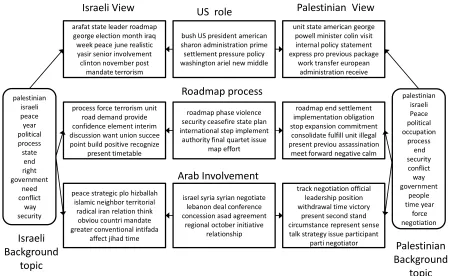
Figure 2: Illustrating the big picture overview over the bitterlemons dataset using few topics. Each box lists the top words in the corresponding multinomial topic distribution. See text for more details
of the liberal view (left-ideology). After trimming short posts of less than 20 words, we ended up with 2040 posts distributed as 1400 from the left-wing and the rest from the right-wing. On average, each post contains around 100 words and the total size of the vocabulary is 14276 words. For this dataset, we followed the train-test split in (Yano et al., 2009). In this split each blog is represented in both train-ing and test sets. Thus this dataset does not measure the model’s ability to generalize to a totally different writing style.
The second dataset refereed to as Blog-2 is sim-ilar to Blog-1 in its topical content and time frame but larger in its blog coverage (Eisenstein and Xing, 2010). Blog-2 spans 6 blogs: three from the left-wing and three from the right-left-wing. The dataset contains 13246 posts. After removing words that appear less then 20 times, the total vocabulary be-comes 13236 with an average of 200 words per post. We used 4 blogs (2 from each view) for training and held two blogs (one from each view) for test-ing. Thus this dataset measures the model’s ability
to generalize to a totally new blog.
6 Experimental Results
In this section we gave various qualitative and quan-titative evaluations of our model over the datasets listed in Section 5. For all experiments, we set
α1 =.01, α2 =.1, a= 1andb= 1. We run Gibbs
sampling during training for 1000 iterations. During inference, we ran Gibbs sampling for 300 iterations, and took 10 samples, with 50-iterations lag, for eval-uations.
6.1 Visualization and Browsing
(the name of these topics were hand-crafted). For each topic, we display the top words in the ideology-independent part of the topic (β), along with top words in each ideology’s view of the topic (φ).
For example, when discussing the roadmap pro-cess, the Palestinian view brings the following is-sues: [the Israeli side should] implement the oblig-atory points in this agreement, stop expansion of settlements, and move forward to the commitments brought by this process. On the other hand, the Is-raeli side brings the following points: [IsIs-raelis] need to build confidence [with Palestinian], address the role of terrorism on the implementation of the pro-cess, and ask for a positive recognition of Israel from the different Palestinian political parties. As we can see, the ideology-specific portion of the topic needn’talways represent asentimentshared by its members toward a given topic, but it might rather includes extra important dimensions that need to be taken into consideration when addressing this topic. Another interesting topic addresses the involve-ment of the neighboring Arab countries in the con-flict. From the Israeli point of view, Israel is worried about the existence of hizballah [in lebanon] and its relationship with radical Iran, and how this might affect the Palestinian-uprising (Intifada) and Jihad. From the other side, the Palestinians think that the Arab neighbors need to be involved in the peace pro-cess and negotiations as some of these countries like Syria and Lebanon are involved in the conflict.
The user can use the above chart as an entry point to retrieve various documents pertinent to a given topic or to a given view over a specific topic. For instance, if the user asks for a representative sam-ple of the Israeli(Palestinian) view with regard to the roadmap process, the system can first retrieve docu-ments tagged with the Israeli(Palestinian) view and having a high topical value in their latent representa-tionθover this topic. Finally, the system then sorts these documents by how much bias they show over this topic. As we discussed in Section 4, this can be done by computing the expected value of the event
xn,2 = 0 andzn = k where k is the topic under consideration.
6.2 Classification
We have also performed a classification task over all the datasets. The Scenario proceeded as follows.
We train a model over the training data with various number of topics. Then given a test document, we predict its ideology using the following equation:
vd = argmaxv∈VP(wd|v); (1)
We use three baselines. The first baseline is an SVM classifier trained on the normalized word frequency of each document. We trained SVM using a regularization parameter in the range
{1,10,20,· · ·,100} and report the best result (i.e. no cross-validation was performed). The other two are supervised LDA models: supervised LDA (sLDA) (Wang et. al., 2009; Blei and McCauliffe, 2007) and discLDA (Lacoste-Julien et al., 2008). discLDA is a conditional model that divides the available number of topics into class-specific top-ics and shared-toptop-ics. Since the code is not publicly available, we followed the same strategy in the orig-inal paper and share 0.1K topics across ideologies and then divide the rest of the topics between ide-ologies4. However, unlike our model, there are no internal relationships between these two sets of top-ics. The decision rule employed by discLDA is very similar to the one we used for mview-LDA in Eq (1). For sLDA, we used the publicly available code by the authors.
As shown in Figure 3, our model performs better than the baselines over the three datasets. We should note from this figure that mview-LDA peaks at a small number of topics, however, each topic is repre-sented by three multinomials. Moreover, it is evident from the figure that the experiment over the blog-2 dataset which measures each model’s ability to generalizes to a totally unseen new blog is a harder task than generalizing to unseen posts form the same blog. However, our model still performs competi-tively with the SVM baseline. We believe that sep-arating each topic into an ideology-independent part and ideology-specific part is the key behind this per-formance, as it is expected that the new blogs would still share much of the ideology-independent parts of the topics and hopefully would use similar (but
4
(a) (b) (c)
Figure 3:Classification accuracy over the Bitterlemons dataset in (a) and over the two blog datasets in (b) and (c). For SVM we give the best result obtained across a wide range of the SVM’s regularization parameter(not the cross-validation result).
no necessarily all) words from the ideology-specific parts of each topic when addressing this topic.
Finally, it should be noted that the bitterlemons dataset is a multi-author dataset and thus the models were tested on some authors that were not seen dur-ing traindur-ing, however, two factors contributed to the good performance by all models over this dataset. The first being the larger size of each document (740 words per document as compared to 200 words per post in blog-2) and the second being the more formal writing style in the bitterlemons dataset.
6.3 An Ablation Study
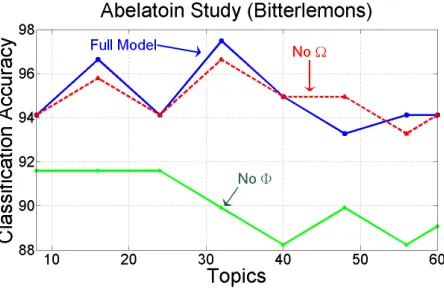
To understand the contribution of each component of our model, we conducted an ablation study over the bitterlemons dataset. In this experiment we turned-off one feature of our model at a time and mea-sured the classification performance. The results are shown in Figure 4. Full, refers to the full model; No-Ωrefers to a model in which the ideology-specific background topicΩ is turned-off; and No-φ refers to a model in which the ideology-specific portions of the topics are turned-off. As evident from the figure,
φis more important to the model thanΩand the dif-ference in performance between the full model and the No-φmodel is rather significant. In fact without
φthe model has little power to discriminate between ideologies beyond the ideology-specific background topicΩ.
6.4 Retrieval: Getting the Other Views
To evaluate the ability of our model in finding al-ternative views toward a given topic, we conducted the following experiment over the Bitterlemons cor-pus. In this corpus each document is associated with a meta-topic that highlights the issues addressed in this document like: “A possible Jordanian role”,
Figure 4:An Ablation study over the bitterlemons dataset.
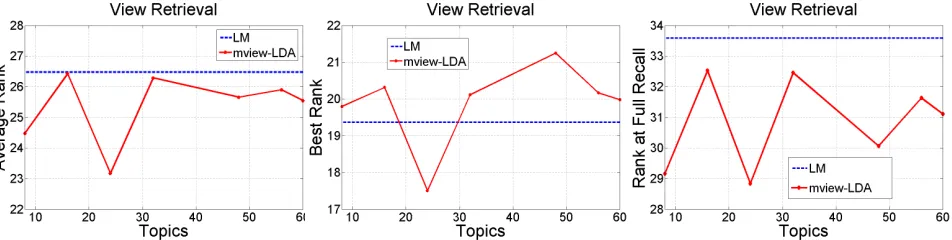
[image:8.612.317.539.205.350.2]Figure 5:Evaluating the performance of the view-Retrieval task. Figure compare performance between mview-LD vs. an SVM+a smoothed language model approach using three measures: average rank, best rank and rank at full recall. (Lower better)
.
the test set by each model as follows:
• mview-LDA: we computed the cosine-distance betweenθdmv−LDA−sharedandθdmv−LDA−shared0
weighted by the probability that d0 is written from a different view than vd. The latter quantity can be computed by normaliz-ing P(v|d0). Moreover, θmv−LDA−d,k shared ∝
P
nI
(xn,1 = 0) and (xn,2= 1) and (zn=k)
, andn ranges over words in document d. In-tuitively, we would like θmv−LDA−d shared to reflect variation due to the topical content, but not ideological view of the document.
• LM: For a document d0, we apply the SVM classifier to getP(v|d0), then we measure sim-ilarity by computing the cosine-distance be-tween the smoothed multinomial-distribution ofdandd0. We combine these two components as in mview-LDA.
Finally we rank documents in the test set in a descending-order and evaluate the resulting rank-ing usrank-ing three measures: the rank at full recall (lowest rank), average rank, and best rank of the ground-truth documents as they appear in the pre-dicted ranking. Figure 5 shows the results across a number of topics. From this figure, it is clear that our model outperforms this baseline over all mea-sures. It should be noted that this is a very hard task since the meta-topics are very fine-grained like: Settlements revisited, The status of the settlements, Is the roadmap still relevant?,The ceasefire and the roadmap: a progress report,etc. We did not attempt to cluster these meta-topics since our goal is just to compare our model against the baseline.
7 A Semi-Supervised Extension
In this section we present and assess the efficacy of a semi-supervised extension of mview-LDA. In this setting, the model is given a set of ideologically-labeled documents and a set of unideologically-labeled docu-ments. One of the key advantages of using a prob-abilistic graphical model is the ability to deal with hidden variables in a principled way. Thus the only change needed in this case is adding a single step in the sampling algorithm to sample the ideologyvof an unlabeled document as follows:
P(vd=v|rest) ∝ P(wd|vd=v,zd,x1,d,x2,d)
Note that the probability of the indicators (x1,d,x2,d,zd) do not depend on the view of the
document and thus got absorbed in the normaliza-tion constant, and thus one only needs to measures the likelihood of generating the words in the doc-ument under the view v. We divide the words into three groups: Ad = {wn|xn,1 = 1} is the
set of words generated from the view-background topic, Bd,k = {wn|zn = k, xn,1 = 0, xn,2 =
1} is the set of words generated from βk, and Cd,k = {wn|zn = k, xn,1 = 0, xn,2 = 0} is the
set of words generated from φk,v. The probabil-ity ofBd,k does not depend on the value of v and thus can be absorbed into the normalization factor. Therefore, we only need to compute the following probability:P(Ad, Cd,1:K|vd=v, rest)=
Y
k
Z
φk,v
P(Cd,k|φk,v, rest)p(φk,v|rest)dφk,v
×
Z
Ω
All the integrals in (2) reduce to the ratio of two log partition functions. For example, the product of integrals containingCd,kreduce to:
Y
k
Q
wΓ
CDKW,X2=0
dkw +C V KW vkw,−d+α1
ΓP
w
CDKW,X2=0
dkw +Cvkw,V KW−d+α1
×
Γ
P
w
CvkwV KW +α1
Q
wΓ
Cvkw,V KW−d+α1
(3)
Unfortunately, the above scheme does not mix well because the value of the integrals in (2) are very low for any view other than the view of the document in the current state of the sampler. This happens because of the tight coupling between vd and the indicators (x1,x2,z). To remedy this
prob-lem we used a Metropolis-Hasting step to sample (vd,x1,x2,z) jointly. We construct a set ofV
pro-posals each of which is indexed by a possible view:
qv(x1,x2,z) = P(x1,x2,z|vd = v,wd). Since
we have a collection of proposal distributions, we select one of them at random at each step. To generate a sample from qv∗(), we run a few
it-erations of a restricted Gibbs scan over the docu-ment d conditioned on fixing vd = v∗ and then take the last sample jointly with v∗ as our pro-posed new state. With probability min(r,1), the new state (v∗,x1∗,x2∗,z∗) is accepted, otherwise the
old state is retained. The acceptance ratio,r, is com-puted as: r = p(wd|v∗,x1∗,x2∗,z∗)
p(wd|v,x1,x2,z) , where the non-*
variables represent the current state of the sampler. It is interesting to note that the above acceptance ra-tio is equivalent to a likelihood rara-tio test. We com-pute the marginal probability P(wd|..) using the
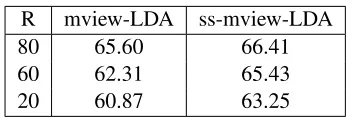
estimated-theta method (Wallach et al., 2009). We evaluated the semi-supervised extension using the blog-2 dataset as follows. We revealR%of the labels in the training set; then we train mview-LDA only over the labeled portion and train the semi-supervised version (ss-mview-LDA) on both the la-beled and unlala-beled documents. Finally we evaluate the classification performance on the test set. We usedR ={20,40,80}. The results are given in Ta-ble 1 which shows a decent improvement over the supervised mview-LDA.
R mview-LDA ss-mview-LDA
80 65.60 66.41
60 62.31 65.43
[image:10.612.339.512.52.111.2]20 60.87 63.25
Table 1: Classification performance of the semi-supervised model. R is the ratio of labeled documents.
8 Discussion and Future Work
In this paper, we addressed the problem of model-ing ideological perspective at a topical level. We developed a factored topic model that we called multiView-LDA or LDA for short. mview-LDA factors a document collection into three set of topics: ideology-specific, topic-specific, and ideology-topic ones. We showed that the resulting representation can be used to give a bird-eyes’ view to where each ideology stands with regard to main-stream topics. Moreover, we illustrated how the la-tent structure induced by the model can by used to perform bias-detection at the document and topic level, and retrieve documents that represent alterna-tive views.
It is important to mention that our model induces a hierarchical structure over the topics, and thus it is interesting to contrast it with hierarchical topic models like hLDA (Blei et al., 2003) and PAM (Li and McCallum, 2006; Mimno et al., 2007). First, these models are unsupervised in nature, while our model is supervised. Second, the semantic of the hierarchical structure in our model is different than the one induced by those models since documents in our model are constrained to use a specific portion of the topic structure while in those models docu-ments can freely sample words from any topic. Fi-nally,in the future we plan to extend our model to perform joint modeling and summarization of ide-alogical discourse.
9 Acknowledgment
References
J. Wiebe, T. Wilson, R.Bruce, M. Bell, and M. Martin. Learning subjective language. Computational Linguis-tics, 30(3), 2004.
H. Yu and V. Hatzivassiloglou. Towards answering opin-ion questopin-ions: Separating facts from opinopin-ions and identifying the polarity of opinion sentences. In Pro-ceedings of EMNLP-2003
B. Pang, L. Lee, and S. Vaithyanathan. 2002. Thumbs up? Sentiment classification using machine learning techniques. In Proceedings of EMNLP-2002.
P. Turney and M. Littman. Measuring praise and criti-cism: Inference of semantic orientation from associa-tion. ACM TOIS, 21(4):315346, 2003
A. Popescu and O. Etzioni. Extracting product fea-tures and opinions from reviews. In Proceedings of HLT/EMNLP-2005, pages 339346, 2005.
T. Nasukawa and J. Yi. Sentiment analysis: Capturing favorability using natural language processing. In Pro-ceedings of K-CAP, 2003.
M. Hu and B. Liu. Mining and summarizing customer reviews. In Proceedings of KDD, 2004.
B. Pang and L. Lee. Opinion mining and sentiment anal-ysis. Foundations and Trends in Information Retrieval, 2(12), 1135, 2008.
S. Branavan, H. Chen, J. Eisenstein and R. Barzilay. Learning Document-Level Semantic Properties from Free-text Annotations, Proceedings of ACL, 2008. I. Titov and R. McDonald. Modeling Online Reviews
with Multi-Grain Topic Models International World Wide Web Conference (WWW), 2008.
I. Titov and R. McDonald. A Joint Model of Text and Aspect Ratings for Sentiment Summarization Associ-ation for ComputAssoci-ational Linguistics (ACL), 2008. Q. Mei, X. Ling, M. Wondra, H. Su, ChengXiang Zhai.
Topic Sentiment Mixture: Modeling Facets and Opin-ions in Weblogs, Proceedings of the 16th International World Wide Web Conference (WWW), pages 171-180, 2007.
X. Ling, Q. Mei, C. Zhai, B. Schatz. Mining Multi-Faceted Overviews of Arbitrary Topics in a Text Col-lection, Proceedings of the 15th ACM SIGKDD In-ternational Conference on Knowledge Discovery and Data Mining (KDD’ 08), pages 497-505, 2008 B. Fortuna , C. Galleguillos, N. Cristianini. Detecting
the bias in media with statistical learning methods. In: Text Mining: Theory and Applications. Taylor and Francis Publisher,2008.
W. Lin, E.P. Xing, and A. Hauptmann. A Joint Topic and Perspective Model for Ideological Discourse Euro-pean Conference on Machine Learning and Principles and Practice of Knowledge Discovery in Databases (ECML/PKDD), 2008.
T. A. Van Dijk. Ideology: A multidisciplinary approach. Sage Publications, 1998.
T. Griffiths, M. Steyvers Finding scientific topics.PNAS, 101:5228-5235, 2004.
A. Gelman, J. Carlin, Hal Stern, and Donald Ru-bin. Bayesian Data Analysis, Chapman-Hall, 2 edi-tion,2003.
D. Blei, A. Ng, and M. Jordan. Latent Dirichlet al-location. Journal of Machine Learning Research, 3:9931022, January 2003.
T. Yano, W. W. Cohen, and N. A. Smith. Predicting Response to Political Blog Posts with Topic Models. NAACL-HLT 2009, Boulder, CO, MayJune 2009 J. Eisenstein and E.P. Xing.The CMU-2008 Political
Blog Corpus. CMU-ML-10-101 Technical Report, 2010.
C. Wang, D. Blei and L. Fei-Fei. Simultaneous image classification and annotation. CVPR, 2010.
D. Blei and J. McAuliffe. Supervised topic models. NIPS, 2007.
S. Lacoste-Julien, F. Sha, and M. Jordan. DiscLDA: Discriminative Learning for Dimensionality Reduc-tion and ClassificaReduc-tion. Neural InformaReduc-tion Process-ing Systems Conference (NIPS08), Vancouver, British Columbia, December 2008.
E. Riloff, J. Wiebe, and T. Wilson. Learning subjective nouns using extraction pattern bootstrapping. In Pro-ceedings of CoNLL-2003.
D. Blei, T. Griffiths, M. Jordan, and J. Tenenbaum. Hier-archical topic models and the nested Chinese restau-rant process. In Neural Information Processing Sys-tems (NIPS)16, 2003.
D. Mimno, W. Li and A. McCallum. Mixtures of Hier-archical Topics with Pachinko Allocation. In Interna-tional Conference of Machine Learning, ICML, 2007. W. Li, and A. McCallum. Pachinko Allocation: DAG-structured Mixture Models of Topic Correlations. In International Conference of Machine Learning, ICML, 2006.
M. Paul and R. Girju. Cross-cultural Analysis of Blogs and Forums with Mixed-Collection Topic Models. EMNLP 2009.