Language Models Based on Semantic Composition
Jeff Mitchell and Mirella Lapata School of Informatics, University of Edinburgh
Edinburgh EH8 9LW, UK
[email protected],[email protected]
Abstract
In this paper we propose a novel statistical language model to capture long-range se-mantic dependencies. Specifically, we ap-ply the concept of semantic composition to the problem of constructing predictive his-tory representations for upcoming words. We also examine the influence of the un-derlying semantic space on the composi-tion task by comparing spatial semantic representations against topic-based ones. The composition models yield reductions in perplexity when combined with a stan-dard n-gram language model over the
n-gram model alone. We also obtain per-plexity reductions when integrating our models with a structured language model.
1 Introduction
Statistical language modeling plays an important role in many areas of natural language process-ing includprocess-ing speech recognition, machine trans-lation, and information retrieval. The prototypi-cal use of language models is to assign proba-bilities to sequences of words. By invoking the chain rule, these probabilities are generally es-timated as the product of conditional probabili-ties P(wi|hi) of a word wi given the history of
preceding wordshi≡wi1−1. In theory, the history
could span any number of words up towi such as
sentences or even a paragraphs. In practice, how-ever, it has proven challenging to deal with the combinatorial growth in the number of possible histories which in turn impacts reliable parame-ter estimation. A simple and effective strategy is to truncate the chain rule to include only the n-1 preceding words (n is often set within the range of 3–5). The simplification reduces the number of free parameters. However, low values ofnimpose an artificially local horizon to the language model,
and compromise its ability to capture long-range dependencies, such as syntactic relationships, se-mantic or thematic constraints.
The literature offers many examples of how to overcome this limitation, essentially by allowing the modulation of probabilities by dependencies which extend to words beyond then-gram horizon. Cache language models (Kuhn and de Mori, 1992) increase the probability of words observed in the history, e.g., by some factor which decays expo-nentially with distance. Trigger models (Rosen-feld, 1996) go a step further by allowing arbi-trary word pairs to be incorporated into the cache. Structured language models (e.g., Roark (2001)) go beyond the representation of history as a lin-ear sequence of words to capture the syntactic con-structions in which these words are embedded.
It is also possible to build representations of history which are semantic rather than syntactic (Bellegarda (2000; Coccaro and Jurafsky (1998; Gildea and Hofmann (1999)). In this approach, es-timates for the probabilities of upcoming words are derived from a comparison of their semantic content with the content of the history so far. The semantic representations, in this case, are vectors derived from the distributional properties of words in a corpus, based on the insight that words which are semantically similar will be found in similar contexts (Harris, 1968; Firth, 1957). Although the the construction of a semantic representation for the history is crucial to this approach, the under-lying vector-based models are primarily designed to represent isolated words rather than word se-quences. Ideally, we would like to compose the meaning of the history out of its constituent parts. This is by no means a new idea. Much work in lin-guistic theory (Partee, 1995; Montague, 1974) has been devoted to compositionality, the process of determining the meaning of complex expressions from simpler ones. Previous work either ignores this issue (e.g., Bellegarda (2000)) or simply
putes the centroid of the vectors representing the history (e.g., Coccaro and Jurafsky (1998)). This is motivated primarily by mathematical convenience rather than by empirical evidence.
In our earlier work (Mitchell and Lapata, 2008) we formulated composition as a function of two vectors and introduced a variety of models based on addition and multiplication. In this paper we apply vector composition to the problem of con-structing predictive history representations for lan-guage modeling. Besides integrating composition with language modeling, a task which is novel to our knowledge, our approach also serves as a valu-able testbed of our earlier framework which we originally evaluated on a small scale verb-subject similarity task. We also investigate how the choice of the underlying semantic representation inter-acts with the choice of composition function by comparing a spatial model that represents words as vectors in a high-dimensional space against a probabilistic model that represents words as topic distributions.
Our results show that the proposed composi-tion models yield reduccomposi-tions in perplexity when combined with a standard n-gram model over the n-gram model alone. We also show that with an appropriate composition function spatial els outperform the more sophisticated topic mod-els. Finally, we obtain further perplexity reduc-tions when our models are integrated with a struc-tured language model, indicating that the two ap-proaches to language modeling are complemen-tary.
2 Background
2.1 Distributional Models of Semantics
The insight that words with similar meanings will tend to be distributed in similar contexts has given rise to a number of approaches that construct semantic representations from corpora. Broadly speaking, these models come in two flavors. Se-mantic space models represent the meaning of words in terms of vectors, with the vector compo-nents being derived from the distributional statis-tics of those words. Essentially, these models pro-vide a simple procedure for constructing spatial representations of word meaning.Topic models, in contrast, impose a probabilistic model onto those distributional statistics, under the assumption that hidden topic variables drive the process that gener-ates words. Both approaches represent the
mean-ings of words in terms of ann-dimensional series of values, but whereas the semantic space model treats those values as defining a vector with spatial properties, the topic model treats them as a proba-bility distribution.
A simple and popular (McDonald, 2000; Bul-linaria and Levy, 2007; Lowe, 2000) way to con-struct a semantic space model is to associate each vector component with a particular context word, and assign it a value based on the strength of its co-occurrence with the target (i.e., the word for which a semantic representation is being con-structed). For example, in Mitchell and Lapata (2008) we used the 2,000 most frequent content words in a corpus as their contexts, and defined co-occurrence in terms of the context word be-ing present in a five word window on either side of the target word. We calculated the ratio of the probability of the context word given the target word to the overall probability of the context word and use these values as their vector components. This procedure has the benefits of simplicity and also of being largely free of any additional the-oretical assumptions over and above the distribu-tional approach to semantics. This is not to say that more sophisticated approaches have not been de-veloped or that they are not useful. Much work has been devoted to enriching semantic space mod-els with syntactic information (e.g., Grefenstette (1994; Pad´o and Lapata (2007)), selectional pref-erences (Erk and Pad´o, 2008) or with identifying optimal ways of defining the vector components (e.g., Bullinaria and Levy (2007)).
nat-ural to treat multi-word structures as a “pseudo-document” and represent them via linear combi-nations of word vectors.
Due to its generality, LSA has proven a valuable analysis tool with a wide range of applications. However, the SVD procedure is somewhat ad-hoc lacking a sound statistical foundation. Probabilis-tic Latent SemanProbabilis-tic Analysis (pLSA, Hofmann (2001)) casts the relationship between documents and words in terms of a generative model based on a set of hidden topics. Documents are represented by distributions over topics and topics are distri-butions over words. Thus the mixture of topics in any document determines its vocabulary. Maxi-mum likelihood estimation of these distributions over a word-document matrix has a comparable effect to SVD in LSA: a set of hidden semantic factors, in this case topics, are extracted and docu-ments and words are represented by these topics.
Latent Dirichlet Allocation (Griffiths et al., 2007; Blei et al., 2003) enhances further the math-ematical foundation of this approach. Whereas pLSA treats each document as a separate, inde-pendent mixture of topics, LDA assumes that the topic distributions of documents are generated by a Dirichlet distribution. Thus, LDA is a probabilis-tic model of the whole document collection. In this model the process of generating a document can be described as follows:
1. draw a multinomial distribution θ from a Dirichlet distribution parametrized byα 2. for each word in a document:
(a) draw a topic zk from the multinomial
distribution characterized byθ
(b) draw a word from a multinomial distri-bution conditioned on the topic zk and
word probabilitiesβ
Under this model, constructing a representation for a multi-word sequence amounts to estimating the topic proportions for that sequence.1
Struc-ture here arises from the mathematical form of the model, as opposed to any linguistic assumptions.
Without anticipating our results too much, we should point out that several features of the LDA model are likely to affect the representation of 1Estimating the posterior distribution P(θ,z|w,α,β) of the hidden variables given an observed collection of docu-mentswis intractable in general; however, a variety of ap-proximate inference algorithms have been proposed in the literature (e.g., Blei et al. (2003; Griffiths et al. (2007)).
multi-word sequences. Firstly, it is a top-down generative model (the topic proportions for a doc-ument are first selected and then this drives the generation of words) as opposed to a bottom-up constructive process (words modulate each other to produce a complex representation of their com-bination). Secondly, the top level Dirichlet distri-bution is likely to lead to documents being dom-inated by a small number of topics, producing sparse vectors. And lastly, the assumption that words are generated independently means the in-teraction between them is not modeled.
2.2 Language Modeling using Semantic Representations
A common approach to embedding semantic rep-resentations within language modeling is to mea-sure the semantic similarity between an upcoming word and its history and use it to modify the prob-abilities from an n-gram model. In this way, the
n-gram’s sensitivity to short-range dependencies is enriched with information about longer-range semantic coherence. Much of previous work has taken this approach (Bellegarda, 2000; Coccaro and Jurafsky, 1998; Wandmacher and Antoine, 2007), whilst relying on LSA to provide seman-tic representations for individual words. Some au-thors (Coccaro and Jurafsky, 1998; Wandmacher and Antoine, 2007) use the geometric notion of a vector centroid to construct representations of history, whereas others (Bellegarda, 2000; Deng and Khundanpur, 2003) use the idea of a “pseudo-document”, which is derived from the algebraic relation between documents and words assumed within LSA. They all deriveP(wi|hi), the
probabil-ity of an upcoming word given its history, from the cosine similarity measure which must be somehow normalized in order to yield well-formed probabil-ity estimates.
The approach of Gildea and Hofmann (1999) overcomes this difficulty by using representations constructed with pLSA, which have a direct prob-abilistic interpretation. As a result, the probabil-ity of an upcoming word given the history can be derived naturally and directly, avoiding the need for ad-hoc transformations. In constructing their representation of history, Gildea and Hofmann (1999) use an online Expectation Maximization process, which derives from the probabilistic basis of pLSA, to update the history with new words.
models sketched above involve representing the history by multiple LSA models of varying granu-larity in an attempt to capture topic, subtopic, and local information (Zhang and Rudnicky, 2002); in-corporating syntactic information by building the semantic space over words and their syntactic an-notations (Kanejiya et al., 2004); and treating the LSA similarity as a feature in a maximum entropy language model (Deng and Khundanpur, 2003). 3 Composition Models
The problem of vector composition has re-ceived relatively little attention within natural lan-guage processing. Attempts to use tensor products (Smolensky, 1990; Clark et al., 2008; Widdows, 2008) as a means of binding one vector to another face major computational difficulties as their di-mensionality grows exponentially with the num-ber of constituents being composed. To overcome this problem, other techniques (Plate, 1995) have been proposed in which the binding of two vectors results in a vector which has the same dimension-ality as its components. Crucially, the success of these methods depends on the assumption that the vector components are randomly distributed. This is problematic for modeling language which has regular structure.
Given the above considerations, in Mitchell and Lapata (2008) we introduce a general framework for studying vector composition, which we formu-late as a function f of two vectorsuandv:
h= f(u,v) (1) wherehdenotes the composition ofuandv. Dif-ferent composition models arise, depending on how f is chosen. Our earlier work (Mitchell and Lapata, 2008) explored two broad classes of mod-els based on additive and multiplicative functions. Additive models are the most common method of vector combination in the literature. They have been applied to a wide variety of tasks includ-ing document coherence (Foltz et al., 1998), es-say grading (Landauer and Dumais, 1997), mod-eling selectional restrictions (Kintsch, 2001), and notably language modeling (Coccaro and Jurafsky, 1998; Wandmacher and Antoine, 2007):
hi=ui+vi (2)
Vector addition (or averaging, which is equivalent under the cosine similarity measure) is a computa-tionally efficient composition model as it does not
increase the dimensionality of the resulting vector. However, the idea of averaging is somewhat coun-terintuitive from a linguistic perspective. Compo-sition of simple elements onto more complex ones must allow the construction of novel meanings which go beyond those of the individual elements (Pinker, 1994).
In Mitchell and Lapata (2008) we argue that composition models based on multiplication ad-dress this problem:
hi=ui·vi (3)
Whereas the addition of vectors ‘lumps their con-tent together’, multiplication picks out the concon-tent relevant to their combination by scaling each com-ponent of one with the strength of the correspond-ing component of the other. This argument is ap-pealing, especially if one is interested in explain-ing how the meanexplain-ing of a verb is modulated by its subject. Here, we also develop a complemen-tary, probabilistic argument for the validity of this model.
Let us assume that semantic vectors are based on components defined as the ratio of the condi-tional probability of a context word given the tar-get word to the overall probability of the context word.
vi= p(contextp(contexti|target)
i) (4)
These vectors represent the distributional proper-ties of a given target word in terms of the strength of its co-occurrence with a set of context words. Dividing through by the overall probability of each context word prevents the vectors being dominated by the most frequent context words, which will of-ten also have the highest conditional probabilities. Let us assume vectors u and v represent tar-get words w1 and w2. Now, when we compose
these vectors using the multiplicative model and the components definition in (4), we obtain:
hi=vi·ui= p(pc(ic|w1) i)
p(ci|w2)
p(ci) (5)
And by Bayes’ theorem:
hi= p(w1p(w1|ci))pp((w2w2)|ci) (6)
Assuming w1 andw2 are independent and apply-ing Bayes’ theorem again,hibecomes:
hi≈ p(pw1w2(w |ci) 1w2) =
p(ci|w1w2)
By comparing to (4), we can see that the expres-sion on the right hand side gives us something akin to the vector components we would expect when our target is the co-occurrence ofw1andw2. Thus,
for the multiplicative model, the combined vec-tor hi can be thought of as an approximation to
a vector representing the distributional properties of the phrasew1w2.
If multiplication results in a vector which is something like the representation of w1 and w2,
then addition produces a vector which is more like the representation ofw1 or w2. Suppose we were unsure whether a word token x was an instance ofw1 or ofw2. It would be reasonable to express
the probabilities of context words around this to-ken in terms of the probabilities for w1 and w2,
assuming complete uncertainty between them:
p(ci|x) =12p(ci|w1) +12p(ci|w2) (8)
Therefore, we could represent x with a vector, based on these probabilities, having the compo-nents:
xi= 12p(pc(i|cw1) i) +
1 2
p(ci|w2)
p(ci) (9)
Which is exactly the vector averaging approach to semantic composition. As more vectors are com-bined, vector addition will lead to greater general-ity rather than greater specificgeneral-ity. The multiplica-tive approach, on the other hand, picks out the components of the constituents that are relevant to the combination, and represents more faithfully the properties of their conjunction.
As an aside, we should point out that our earlier work (Mitchell and Lapata, 2008) introduced sev-eral other models, additive and multiplicative, be-sides the ones discussed here. We selected the ad-ditive model as a baseline and also due to its over-whelming popularity in the language modeling lit-erature. The multiplicative model presented above performed best in our evaluation study (i.e., pre-dictingverb-subjectsimilarity).
4 Language Modeling
Estimating Probabilities In language modeling our aim is to derive probabilities, p(w|h), given the semantic representations of word, w, and its history, h, based on the assumption that probable words should be semantically coherent with the
history. Semantic coherence is commonly mea-sured via the cosine of the angle between two vec-tors:
sim(w,h) =|ww||·hh| (10)
w·h=
∑
i wihi (11)
where w·h is the dot product of w andh. Coc-caro and Jurafsky (1998) utilize this measure in their approach to language modeling. Unfortu-nately, they find it necessary to resort to a number of ad-hoc mechanisms to turn the cosine similari-ties into useful probabilisimilari-ties. The primary problem with the cosine measure is that, although its values lie between 0 and 1, they do not sum to 1, as prob-abilities must. Thus, some form of normalization is required. A further problem concerns the fact that such a measure takes no account of the under-lying frequency ofw, which is crucial for a proba-bilistic model. For example,encephalonandbrain
are roughly synonymous, and may be equally sim-ilar to some context, butbrainmay nonetheless be much more likely, as it is generally more common. An ideal measure would take account of the un-derlying probabilities of the elements involved and produce values that sum to 1. Our approach is to modify the dot product (equation (11)) on which the cosine measure is based. Assuming that our vector components are given by equation (4), the dot product becomes:
w·h=
∑
ip(ci|w) p(ci)
p(ci|h)
p(ci) (12)
which we modify to derive probabilities as fol-lows:
p(w|h) =p(w)
∑
ip(ci|w) p(ci)
p(ci|h)
p(ci) p(ci) (13)
This expression now weights the sum with the in-dependent probabilities of the context words and the word to be predicted. That this is indeed a valid probability can be seen by the fact it is equiva-lent to∑ip(w|ci)p(ci|h). However, in constructing
a representation of the historyh, it is more conve-nient to work with equation (13) as it is based on vector components and can be readily used with the composition models presented in Mitchell and Lapata (2008).
the history up to thenth word of a sentence. To do this, we combine, via some (additive or multiplica-tive) function f, the vector representing that word with the vector representing the history up ton−1 words:
hn= f(wn,hn−1) (14)
h1=w1 (15)
One issue that must be resolved in implement-ing equation (14) is that the history vector should remain correctly normalized. In other words, the productshi·p(ci)must themselves be a valid
dis-tribution over context words. So, after each vec-tor composition the hisvec-tory vecvec-tor is normalized as follows:
hi=
ˆ
hi
∑
j
ˆ
hj·p(ci) (16)
Equations (13)–(16) define a language model that incorporates vector composition. To generate probability estimates, it requires a set of word vec-tors whose components are based on the ratio of probabilities described by equation (4).
Our discussion thus far has assumed a spatial semantic space model similar to that employed in Mitchell and Lapata (2008). However, there is no reason why the vectors should not be constructed by some other means. As mentioned earlier, in the LDA topic model, words are represented as dis-tributions over topics. These disdis-tributions are es-sentially components of a vectorvcorresponding to the target word for which we wish to construct a semantic representation. Analogously to equa-tion (4), we convert these probabilities to ratios of probabilities:
vi= p(topicp(topici|target)
i) (17)
Integrating with Other Language Models The models defined above are based on little more than semantic coherence. As such they will be only weakly predictive, since they largely ignore word order, whichn-gram models primarily exploit. The simplest means to integrate semantic information with a standard language model involves combin-ing two probability estimates as a weighted sum:
p(w|h) =λ1p1(w|h) + (1−λ)p2(w|h) (18)
Linear interpolation is guaranteed to produce valid probabilities, and has been used, for exam-ple, to integrate structured language models with
n-gram models (Roark, 2001). However, it will work best when the models being combined are roughly equally predictive and have complemen-tary strengths and weaknesses. If one model is much weaker than the other, linear interpolation will typically produce a model of intermediate strength (i.e., worse than the better model), with the weaker model contributing a form of smooth-ing at best.
Therefore, based on equation (13), we express our semantic probabilities as the product of the unigram probability, p(w), and a semantic com-ponent,∆, which determines the factor by which this probability should be scaled up or down given the context in which it occurs.
p(w|h) =p(w)·∆(w,h) (19)
∆(w,h) =
∑
ip(ci|w) p(ci)
p(ci|h)
p(ci) p(ci) (20)
Thus, it seems reasonable to integrate then-gram model by replacing the unigram probabilities with then-gram versions.2
ˆ
p(wn) =p(wn|wnn−−12)·∆(wn,h) (21)
To obtain a true probability estimate we normalize ˆ
p(wn) by dividing through the sum of all word
probabilities:
p(wn|wnn−−21,h) =∑pˆ(wn)
wpˆ(w) (22)
In integrating our semantic model with ann-gram model, we allow the latter to handle short range dependencies and have the former handle the longer dependencies outside then-gram window. For this reason, the historyhused by the semantic model in the prediction ofwnonly includes words
up town−3(i.e., only words outside then-gram).
We also integrate our models with a structured language model (Roark, 2001). However, in this case we use linear interpolation (equation (18)) because the models are roughly equally predic-tive and also because linear interpolation is widely used when structured language models are com-bined withn-grams and other information sources. This approach also has the benefit of allowing the
2Equation (21) can also be expressed asp(wn|wn−1
n−2,h)≈
p(wn|wn−1
n−2)p(wn|h)
p(wn) , Which is equivalent to assuming thathis conditionally independent of wn−1
models to be combined without out the need to renormalize the probabilities. In the case of the structured language model, normalizing across the whole vocabulary would be prohibitive.
5 Experimental Setup
In this section we discuss our experimental design for assessing the performance of the models pre-sented above. We give details on our training pro-cedure and parameter estimation, and present the methods used for comparison with our approach.
Method Following previous work (e.g., Belle-garda (2000)) we integrated our compositional language models with a standard n-gram model (see equation (21)). We experimented with addi-tive and multiplicaaddi-tive composition functions, and two semantic representations (LDA and the sim-pler semantic space model), resulting in four com-positional models. In addition, we compared our models against a state of the art structured lan-guage model in order to assess the extent to which the information provided by the semantic repre-sentation is complementary to syntactic structure. Our experiments used Roark’s (2001) grammar-based language model. Similarly to standard lan-guage models, it computes the probability of the next word based upon the previous words of the sentence. This is done by computing a subset of all possible grammatical relations for the prior words and then estimating the probability of the next grammatical structure and the probability of see-ing the next word given each of the prior gram-matical relations. When estimating the probability of the next word, the model conditions on the two prior heads of constituents, thereby using informa-tion about word triples (like a trigram model).
All our models were evaluated by computing perplexity on the test set. Roughly, this quanti-fies the degree of unpredictability in a probabil-ity distribution, such that a fairk-sided dice would have a perplexity ofk. More precisely, perplexity is the reciprocal of the geometric average of the word probabilities and a lower score indicates bet-ter predictions.
Parameter Estimation The compositional lan-guage models were trained on the BLLIP corpus, a collection of texts from the Wall Street Journal (years 1987–89). The training corpus consisted of 38,521,346 words. We used a development corpus of 50,006 words and a test corpus of similar size.
All words were converted to lowercase and num-bers were replaced with the symbolhnumi. A vo-cabulary of 20,000 words was chosen and the re-maining tokens were replaced withhunki.
Following Mitchell and Lapata (2008), we con-structed a simple semantic space based on co-occurrence statistics from the BLLIP training set. We used the 2,000 most frequent word types as contexts and a symmetric five word window. Vec-tor components were defined as in equation (4). Contrary to our earlier work, we did not lemma-tize the corpus before constructing the vectors as in the context of language modeling this was not appropriate. We also trained the LDA model on BLLIP, using Blei et al.’s (2003) implementation.3
We experimented with different numbers of topics on the development set (from 10 to 200) and re-port results on the test set with 100 topics. In our experiments, the hyperparameterαwas initialized to 0.5, and the β word probabilities were initial-ized randomly.
We integrated our compositional models with a trigram model which we also trained on BLLIP. The model was built using the SRILM toolkit (Stolcke, 2002) with backoff and Good-Turing smoothing. Ideally, we would have liked to train Roark’s (2001) parser on the same data as that used for the semantic models. However, this would require a gold standard treebank several times larger than those currently available. Following previous work on structured language modeling (Roark, 2001; Charniak, 2001; Chelba and Jelinek, 1998), we therefore trained the parser on sections 2–21 of the Penn Treebank containing 936,017 words. Note that Roark’s (2001) parser produces prefix probabilities for each word of a sentence which we converted to conditional probabilities by dividing each current probability by the previous one.
6 Results
Table 1 shows perplexity results when the com-positional models are combined with an n-gram model. With regard to the simple semantic space model (SSM) we observe that both additive and multiplicative approaches to constructing history are successful in reducing perplexity over the
n-gram baseline, with the multiplicative model outperforming the additive one. This confirms the 3Available from http://www.cs.princeton.edu/
Model Perplexity
n-gram 78.72
n-gram+AddSSM 76.65 n-gram + MultiplySSM 75.01 n-gram+AddLDA 76.60 n-gram+MultiplyLDA 123.93
parser 173.35
n-gram + parser 75.22
[image:8.595.308.524.59.225.2]n-gram + parser + AddSSM 73.45 n-gram + parser + MultiplySSM 71.32 n-gram + parser + AddLDA 71.58 n-gram + parser + MultiplyLDA 87.93
Table 1: Perplexities forn-gram, composition and structured language models, and their combina-tions; subscriptsSSMandLSArefer to the semantic
space and LDA models, respectively.
hypothesis that for this type of semantic space the multiplicative vector combination function pro-duces representations which have a sounder prob-abilistic basis.
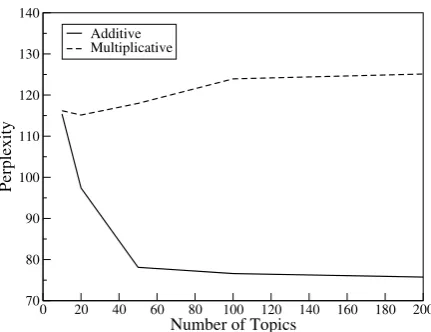
The results for the LDA model are also reported in the table. This model reduces perplexity with an additive composition function, but performs worse than then-gram with a multiplicative function. For comparison, Figure 1 plots the perplexity of the combined LDA and n-gram models against the number of topics. Increasing the number of top-ics produces higher dimensional representations which ought to be richer, more detailed and there-fore more predictive. While this is true for the additive model, a greater number of topics actu-ally increases the perplexity of the multiplicative model, indicating it has become less predictive.
We compared these perplexity reductions against those obtained with a structured lan-guage model. Following Roark (2001), we com-bined the structured language model with a trigram model using linear interpolation (the weights were optimized on the development set). This model (n-gram + parser) performs comparably to our best compositional model (n-gram + MultiplySSM). While both models
in-corporate long range dependencies, the parser is trained on a hand annotated treebank, whereas the compositional model uses raw text, albeit from a larger corpus. Interestingly, when interpolating the trigram with the parserandthe compositional models, we obtain additional perplexity reduc-tions. This suggests that the semantic models are
Figure 1: Perplexity versus Number of Topics for the LDA models using additive and multiplicative composition functions.
encoding useful predictive information about long range dependencies, which is distinct from and po-tentially complementary to the parser’s syntactic information about such dependencies. Note that the semantic space multiplicative model yields the highest perplexity reduction in this suite of exper-iments followed by the LDA additive model. 7 Conclusions
In this paper we advocated the use of vector composition models for language modeling. Us-ing semantic representations of words outside the
n-gram window, we enhanced a trigram model with longer range dependencies. We compared composition models based on addition and multi-plication and examined the influence of the under-lying semantic space on the composition task. Our results indicate that the multiplicative composition function produced the most predictive representa-tions with a simple semantic space. Interestingly, its effect in the LDA setting was detrimental. In-creasing the representational power of the LDA model, by using a greater number of topics, ren-dered the multiplicative model less predictive.
[image:8.595.80.287.61.226.2]vec-tors, with a typical word being strongly associated with only one or two topics. Multiplication of a number of these vectors generally produces a vec-tor in which most of these associations have been obliterated by the sparse components, resulting in a representation with little predictive power.
These shortcomings arise from the mathemati-cal formulation of LDA, which is not directed at modeling the semantic interaction between words. An interesting future direction would be to opti-mize the vector components of the probabilistic model over a suitable training corpus, in order to derive a vector model of semantics adapted specif-ically to the task of composition. We also plan to investigate more sophisticated composition mod-els that take syntactic structure into account. Our results on interpolating the compositional mod-els with a parser indicate that there is substantial mileage to be gained by combining syntactic and semantic dependencies.
Acknowledgements We are grateful to Brian Roark for making his parser available to us. Thanks to Frank Keller and Victor Lavrenko for insightful comments and suggestions. This work was supported by the Economic and So-cial Research Council [grant number PTA-030-2006-00341] and the Engineering and Physi-cal Sciences Research Council [grant number GR/T04540/01].
References
Jerome R. Bellegarda. 2000. Exploiting latent se-mantic information in statistical language modeling. Proceedings of the IEEE, 88(8):1279–1296. Michael W. Berry, Susan T. Dumais, and Gavin W.
O’Brien. 1994. Using linear algebra for intelligent information retrieval. SIAM Review, 37(4):573–595. David M. Blei, Andrew Y. Ng, and Michael I. Jordan. 2003. Latent Dirichlet allocation. Journal of Ma-chine Learning Research, 3:993–1022.
J.A. Bullinaria and J.P. Levy. 2007. Extracting seman-tic representations from word co-occurrence statis-tics: A computational study. Behavior Research Methods, 39:510–526.
Eugene Charniak. 2001. Immediate-head parsing for language models. In Proceedings of 35th Annual Meeting of the Association for Computational Lin-guistics and 8th Conference of the European Chap-ter of the Association for Computational Linguistics, pages 116–123, Toulouse, France.
Ciprian Chelba and Frederick Jelinek. 1998. Exploit-ing syntactic structure for language modelExploit-ing. In Proceedings of the 17th International Conference on Computational Linguistics and 36th Annual Meet-ing of the Association for Computational LMeet-inguis- Linguis-tics, pages 225–231, Montr´eal, Canada.
Stephen Clark, Bob Coecke, and Mehrnoosh Sadrzadeh. 2008. A compositional distribu-tional model of meaning. In Proceedings of the 2nd Symposium on Quantum Interaction, pages 133–140, Oxford, UK. College Publications. Noah Coccaro and Daniel Jurafsky. 1998. Towards
better integration of semantic predictors in satistical language modeling. InProceedings of the 5th Inter-national Conference on Spoken Language Process-ing, pages 2403–2406, Sydney, Australia.
Yonggang Deng and Sanjeev Khundanpur. 2003. La-tent semantic information in maximum entropy lan-guage models for conversational speech recognition. InProceedings of the 2003 Human Language Tech-nology Conference of the North American Chapter of the Association for Computational Linguistics, pages 56–63, Edmonton, AL.
Katrin Erk and Sebastian Pad´o. 2008. A structured vector space model for word meaning in context. In Proceedings of the 2008 Conference on Empiri-cal Methods in Natural Language Processing, pages 897–906, Honolulu, Hawaii.
J. R. Firth. 1957. A synopsis of linguistic theory 1930– 1955. InStudies in Linguistic Analysis, pages 1–32. Philological Society, Oxford.
Peter Foltz, Walter Kintsch, and Thomas Landauer. 1998. The measurement of textual coherence with latent semantic analysis. Discourse Process, 15:285–307.
Daniel Gildea and Thomas Hofmann. 1999. Topic-based language models using EM. InProceedings of the 6th European Conference on Speech Communi-ation and Technology, pages 2167–2170, Budapest, Hungary.
Gregory Grefenstette. 1994. Explorations in Auto-matic Thesaurus Discovery. Kluwer Academic Pub-lishers, Norwell, MA, USA.
Thomas L. Griffiths, Mark Steyvers, and Joshua B. Tenenbaum. 2007. Topics in semantic representa-tion. Psychological Review, 114(2):211–244. Zellig Harris. 1968. Mathematical Structures of
Lan-guage. Wiley, New York.
Thomas Hofmann. 2001. Unsupervised learning by probabilistic latent semantic analysis. Machine Learning, 41(2):177–196.
syntactic-semantic information. In Proceedings of the 20th International Conference on Computational Linguistics, pages 1161–1167, Geneva, Switzerland. Walter Kintsch. 2001. Predication. Cognitive Science,
25(2):173–202.
Roland Kuhn and Renato de Mori. 1992. A cache based natural language model for speech recogni-tion. IEEE Transactions on Pattern Analysis and Machine Intelligence, (14):570–583.
T. K. Landauer and S. T. Dumais. 1997. A solution to Plato’s problem: the latent semantic analysis the-ory of acquisition, induction and representation of knowledge. Psychological Review, 104(2):211–240. Will Lowe. 2000. Topographic Maps of Semantic
Space. Ph.D. thesis, University of Edinburgh. Scott McDonald. 2000. Environmental Determinants
of Lexical Processing Effort. Ph.D. thesis, Univer-sity of Edinburgh.
Jeff Mitchell and Mirella Lapata. 2008. Vector-based models of semantic composition. InProceedings of ACL-08: HLT, pages 236–244, Columbus, OH. R. Montague. 1974. English as a formal language. In
R. Montague, editor,Formal Philosophy. Yale Uni-versity Press, New Haven, CT.
Sebastian Pad´o and Mirella Lapata. 2007. Dependency-based construction of semantic space models. Computational Linguistics, 33(2):161–199. B. Partee. 1995. Lexical semantics and compositional-ity. In Lila Gleitman and Mark Liberman, editors, Invitation to Cognitive Science Part I: Language, pages 311–360. MIT Press, Cambridge, MA. S. Pinker. 1994. The Language Instinct: How the Mind
Creates Language. HarperCollins, New York. Tony A. Plate. 1995. Holographic reduced
represen-tations. IEEE Transactions on Neural Networks, 6(3):623–641.
Brian Roark. 2001. Probabilistic top-down parsing and language modeling. Computational Linguistics, 27(2):249–276.
Roni Rosenfeld. 1996. A maximum entropy approach to adaptive statistical language modeling. Computer Speech and Language, 10:187–228.
Paul Smolensky. 1990. Tensor product variable bind-ing and the representation of symbolic structures in connectionist systems. Artificial Intelligence, 46:159–216.
Andreas Stolcke. 2002. SRILM – an extensible lan-guage modeling toolkit. InProceedings of the Inter-national Conference on Spoken Language Process-ing, pages 901–904, Denver, CO.
Tonio Wandmacher and Jean-Yves Antoine. 2007. Methods to integrate a language model with seman-tic information for a word prediction component. In Proceedings of the 2007 Joint Conference on Empirical Methods in Natural Language Process-ing and Computational Natural Language LearnProcess-ing (EMNLP-CoNLL), pages 506–513, Prague, Czech Republic.
Dominic Widdows. 2008. Semantic vector products: Some initial investigations. In Proceedings of the 2nd Symposium on Quantum Interaction, Oxford, UK. College Publications.