Experiments on the Choice of Features for Learning Verb Classes
Sabine Schulte im Walde
Institut flir Maschinelle Sprachverarbeitung
Universitat Stuttgart
AzenbergstraBe 12, 70174 Stuttgart, Germany
[email protected]—stuttgart.de
Abstract
The choice of verb features is crucial for the learning of verb classes. This pa-per presents clustering expa-periments on 168 German verbs, which explore the relevance of features on three levels of verb description, purely syntactic frame types, prepositional phrase information and selectional preferences. In contrast to previous approaches concentrating on the sparse data problem, we present ev-idence for a linguistically defined limit on the usefulness of features which is driven by the idiosyncratic properties of the verbs and the specific attributes of the desired verb classification.
1 Introduction
The verb is central to the meaning and the struc-ture of a sentence, and lexical verb information represents the core in supporting NLP-tasks such as word sense disambiguation (Dorr and Jones, 1996; Prescher et al., 2000), machine transla-tion (Don, 1997), document classificatransla-tion (Kla-vans and Kan, 1998), and subcategorisation acqui-sition and filtering (Korhonen, 2002). A means to generalise over and predict common properties of verbs is captured by the constitution of verb classes. Levin (1993) has established an extensive manual classification for English verbs; computa-tional approaches adopt the linguistic hypothesis that verb meaning components to a certain extent determine verb behaviour as basis for automati-cally inducing semantic verb classes from corpus-based features (Schulte im Walde, 2000; Merlo and Stevenson, 2001; Joanis, 2002).
Computational approaches on verb classifica-tion which take advantage of corpus-based and knowledge-based verb information offered by available tools and resources such as statistical parsers and semantic ontologies, suffer from se-vere problems to encode and benefit from the information, especially with respect to selec-tional preferences, cf. Schulte im Walde (2000); Joanis (2002). This paper presents clustering ex-periments on German verbs which explore the relevance of features on three levels of verb de-scription, purely syntactic frame types, preposi-tional phrase information and selecpreposi-tional prefer-ences. The clustering results show that the choice and implementation of verb features is crucial for the induction of the verb classes. Intuitively, one might want to add and refine features ad infinitum, but we present evidence for a linguistically defined limit on the usefulness of features which is driven by the idiosyncratic properties of the verbs and the verb classification.
2 German Verb Classes
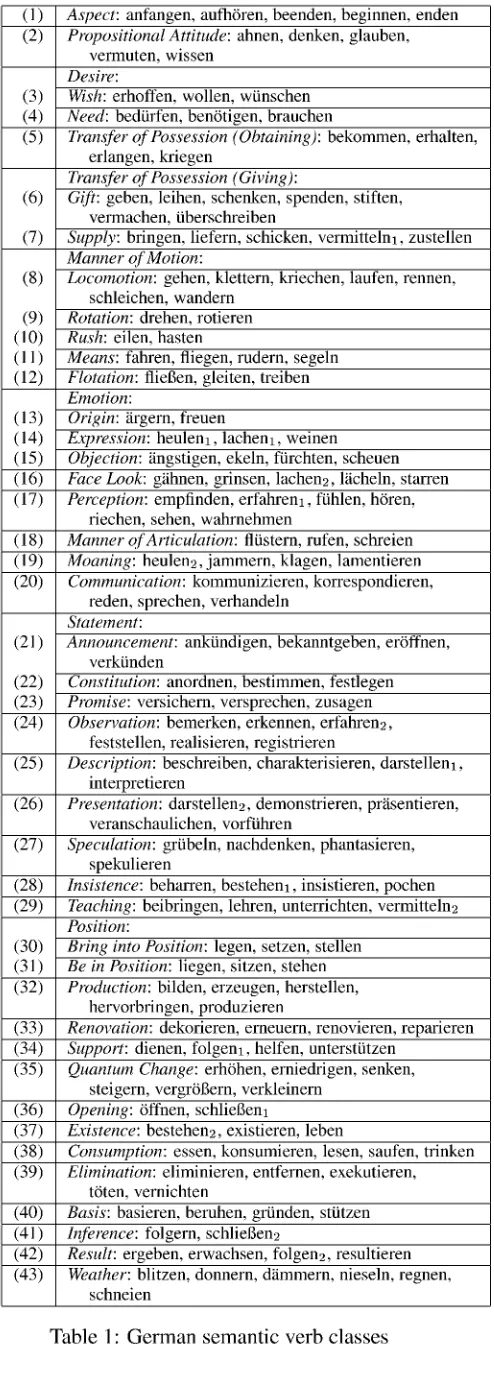
A set of 168 German verbs is manually classified into 43 concise semantic verb classes. The pur-pose of the manual classification is (i) to evaluate the reliability and performance of the clustering experiments on a preliminary set of verbs, and (ii) to explore the potential and limit to apply the clus-tering method to large-scale verb data. The Ger-man classes are closely related to the English pen-dant in (Levin, 1993) and agree with the German verb classification in (Schumacher, 1986) as far as the relevant verbs appear in his semantic 'fields'.
am-(1) Aspect: anfangen, aufhOren, beenden, beginnen, enden (2) Propositional Attitude: ahnen, denken, glauben,
vermuten, wissen
(3) (4)
Desire:
Wish: erhoffen, wollen, wiinschen Need: beckirfen, beniitigen, brauchen
(5) Transfer of Possession (Obtaining): bekommen, erhalten, erlangen, kriegen
(6)
(7)
Transfer of Possession (Giving):
Gift: geben, leihen, schenken, spenden, stiften, vermachen, iiberschreiben
Supply: bringen, liefern, schicken, vermittelni, zustellen
(8)
(9) (10) (11) (12)
Manner of Motion:
Locomotion: gehen, klettern, kriechen, laufen, rennen, schleichen, wandern
Rotation: drehen, rotieren Rush: eilen, hasten
Means: fahren, fliegen, rudern, segeln Flotation: flief3en, gleiten, treiben
(13) (14) (15)
Emotion:
Origin: argern, freuen
Expression: heuleni, lacheni, weinen
Objection: angstigen, ekeln, ftirchten, scheuen (16) Face Look: giihnen, grinsen, lachen2, litcheln, stan-en (17) Perception: empfinden, erfahreni , fiihlen, hOren,
riechen, sehen, wahrnehmen
(18) Manner of Articulation: fltistern, rufen, schreien (19) Moaning: heulen2, jammern, klagen, lamentieren (20) Communication: kommunizieren, korrespondieren,
reden, sprechen, verhandeln
(21)
(22) (23)
Statement:
Announcement: anktindigen, bekanntgeben, erOffnen, verktinden
Constitution: anordnen, bestimmen, festlegen Promise: versichern, versprechen, zusagen (24) Observation: bemerken, erkennen, erfahren2,
feststellen, realisieren, registrieren
(25) Description: beschreiben, charakterisieren, darstellent , interpretieren
(26) Presentation: darstellen2, demonstrieren, prasentieren, veranschaulichen, vorfiihren
(27) Speculation: grtibeln, nachdenken, phantasieren, spekulieren
(28) Insistence: behan-en, besteheni, insistieren, pochen
(29) Teaching: beibringen, lehren, unterrichten, vermitteln2
(30) (31)
Position:
Bring into Position: legen, setzen, stellen Be in Position: liegen, sitzen, stehen (32) Production: bilden, erzeugen, herstellen,
hervorbri ngen, produzieren
(33) Renovation: dekorieren, erneuern, renovieren, reparieren (34) Support: dienen, folgeni, helfen, unterstiitzen
(35) Quantum Change: erhOhen, erniedrigen, senken, steigern, vergraern, verkleinern
(36) Opening: Offnen, schlieBeni
(37) Existence: bestehen2, existieren, leben
(38) Consumption: essen, konsumieren, lesen, saufen, trinken (39) Elimination: eliminieren, entfernen, exekutieren,
Viten, vernichten
(40) Basis: basieren, beruhen, griinden, stfitzen (41) Inference: folgern, schliel3en2
(42) Result: ergeben, erwachsen, folgen2, resultieren
[image:2.595.278.525.84.782.2](43) Weather: blitzen, donnern, dammern, nieseln, regnen, schneien
Table 1: German semantic verb classes biguous and marked by subscripts. The classes
in-clude both high and low frequency verbs,1 in order to exercise the clustering technology in both data-rich and data-poor situations. The class labels are given on two semantic levels; coarse labels such as Manner of Motion are sub-divided into finer bels, such as Locomotion, Rotation. The fine la-bels are relevant for the clustering experiments, as indicated by the numbering in the left column.
The classification is primarily based on seman-tic intuition, not on knowledge about the syn-tactic behaviour. As an extreme example, the Support class (34) contains the verb unterstiitzen, which syntactically requires a direct object, to-gether with the three verbs dienen, folgen, helfen which mainly subcategorise an indirect object.
3 Clustering Methodology
Clustering is a standard procedure in multivariate data analysis. It is designed to uncover an inher-ent natural structure of data objects, and the in-duced equivalence classes provide a means to gen-eralise over the objects. We perform clustering by the k-Means algorithm (Forgy, 1965), an unsuper-vised hard clustering method assigning is data ob-jects to k clusters.2 Initial verb clusters are iter-atively re-organised by assigning each verb to its closest cluster and re-calculating cluster centroids until no further changes take place. The cluster-ing methodology in this work is based on parame-ter investigations in (Schulte im Walde and Brew, 2002): the clustering input is obtained from a hi-erarchical analysis on the German verbs (Ward's amalgamation method), the number of clusters be-ing the number of manual classes; similarity mea-sure is performed by the skew divergence, a variant of the Kullback-Leibler divergence.
The 168 verbs are associated with probabilistic frame descriptions on various levels of verb infor-mation, and assigned to starting clusters by hierar-chical clustering. The k-Means algorithm is then allowed to run until no further changes take place, and the resulting clusters are evaluated and inter-preted against the manual classes.
'The verb frequency range in 35 million words newspaper data is 8-71,604.
4 Clustering Evaluation
Evaluating the result of a cluster analysis against the known gold standard of hand-constructed verb classes requires to assess the similarity between two partitions on the set of n verbs. The evaluation is performed by an adjusted version of the Rand index (Hubert and Arabie, 1985): The Rand index measures the agreement between object pairs in the partitions and is corrected for chance in com-parison to the null model that the partitions are picked at random, given the original number of classes and objects.
The agreement in the two partitions is repre-sented by a contingency table C x M: t,j denotes the number of verbs common to classes C, in the clustering partition C and M3 in the manual clas-sification M; the marginals ti. and t.3 refer to the
number of objects in C, and M3, respectively. The adjusted Rand index Radl is given in Equation (1);
the expected number of common object pairs at-tributable to a particular cell (C,, M) in the con-tingency table is defined by (t2i ) (t )/ (3) . The range of Rad3 is 0 < Rd3 < 1, with only extreme
cases below zero. We choose Rad3 as evaluation
measure compared to e.g. the measures presented in (Schulte im Walde and Brew, 2002), because (a) it does not show a bias towards extreme cluster sizes, and (b) it facilitates the interpretation with its normally used bounds of 0 and 1.
Iti i
E)
CO
()
Ed )(Ei + (tA) ) E3 (ti)
(Z)
(I)5 Verb Description
The German verbs are described on three levels of subcategorisation definition D1 to D3, each re-fining the previous level by additional informa-tion. All information is extracted from a lexi-calised probabilistic grammar which is unsuper-vised trained on 35 million words of a German newspaper corpus, using the EM-algorithm.
D1 provides a coarse syntactic definition of subcategorisation. The verbs are described by a probability distribution over 38 frame types. Pos-sible arguments in the frames are nominative (n),
dative (d) and accusative (a) noun phrases, reflex-ive pronouns (r), prepositional phrases (p), exple-tive es (x), non-finite clauses (i), finite clauses (s-2 for verb second clauses, dass for dasclauses, s-ob for oh-clauses, s-w for indirect wh-questions), and copula constructions (k). For example, sub-categorising a direct (accusative case) object and a non-finite clause next to the obligatory nominative subject is labelled `nai'.
On D2, the verbs are given a syntactico-semantic definition of subcategorisation with prepositional preferences. In addition to the syn-tactic frame information, D2 discriminates be-tween different kinds of pp-arguments. This is done by distributing the probability mass of prepo-sitional phrase frame types over the prepoprepo-sitional phrases, according to their frequencies in the cor-pus. Prepositional phrases are referred to by case and preposition, such as 'mit]) ', ', with D=Dative and A=Accusative. We define 30 differ-ent PPs, according to the most frequdiffer-ent PPs which appear with at least 10 different verbs.
D3 gives a syntactico-semantic definition of subcategorisation with prepositional and selec-tional preferences. The argument slots within a subcategorisation frame type are specified accord-ing to which 'kind' of argument they require. The grammar provides selectional preference informa-tion on a fine-grained level: it specifies argument realisations for a specific verb-frame-slot combi-nation in form of lexical heads. For example, the most prominent nominal argument heads for the verb verfolgen 'to follow' in the accusative NP slot of the transitive frame type 'rm.' (the considered frame slot is underlined) are Ziel 'goal', Strategie 'strategy', Politik 'policy'. Obviously, we would run into a sparse data problem if we tried to in-corporate selectional preferences on the nominal level into the verb descriptions. We need a gen-eralisation of the selectional preference definition, for which we use the noun hierarchy in GennaNet (Kunze, 2000), the German pendant of the seman-tic ontology WordNet (Fellbaum, 1998).
The hierarchy is realised as synsets, sets of syn-onymous nouns, which are organised into multiple inheritance hypernym relationships. A noun may appear in several synsets, according to its number of senses. For each nominal argument in a
frame-slot combination, the joint frequency is split over the different senses of the noun and prop-agated upwards the hierarchy. In case of multi-ple hypernym synsets, the frequency is split, such that the sum of frequencies over the disjoint top synsets equals the total joint frequency. Repeat-ing the frequency assignment and propagation for all nouns appearing in a verb-frame-slot combi-nation, we define a frequency distribution of the verb-frame-slot combination over all GermaNet synsets. To restrict the variety of noun concepts, we consider only the 15 top GermaNet nodes: Lebewesen 'creature', Sache 'thing', Besitz 'prop-erty', Substanz 'substance', Nahrung 'food', Mit-tel 'means', Situation 'situation', Zustand 'state', Struktur 'structure', Physis 'body', Zeit 'time', Ort 'space', Attribut 'attribute', Kognitives Ob-jekt `cognitive object', Kognitiver Prozess 'cogni-tive process'.3 Since the 15 nodes exclude each other and the frequencies sum to the total joint verb-frame frequency, we can define a probabil-ity distribution over the top nodes representing coarse selectional preferences for the respective verb-frame-slot combination. To obtain D3, the verb-frame probability is distributed over those se-lectional preferences .4
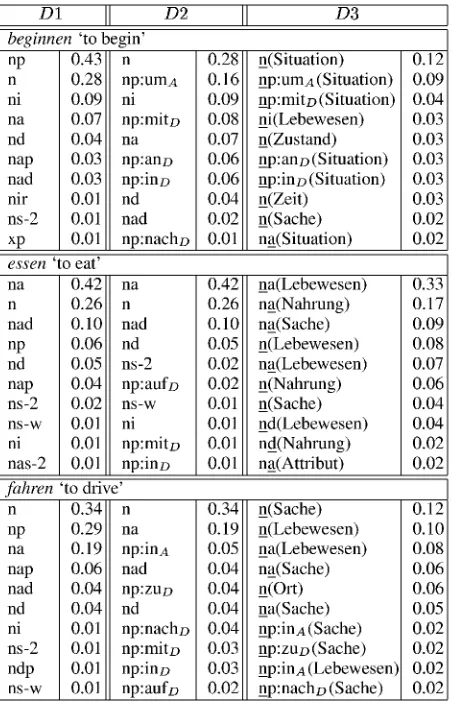
Table 2 presents three verbs from different verb classes and their ten most frequent frame types with respect to the three levels of verb definition, accompanied by the probability values. D1 for be-ginnen `to begin' defines `np' and 'n' as the most probable frame types. Even by splitting the 'rip' probability over the different PP types in D2, a number of prominent PPs are left, the time indi-cating umA and nachD, mitD referring to the be-gun event, anD as date and inD as place indicator. It is obvious that not all PPs are argument PPs, but also adjunct PPs describe a part of the verb behaviour. D3 illustrates that typical selectional preferences for beginner roles are Situation, Zus-tand, Zeit, Sache. D3 has the potential to indicate verb alternation behaviour, e.g. `na(Situation)' refers to the same role for the direct object in a
'Little manual intervention was necessary to define a co-herent set of top level nodes, since GermaNet had not been completed.
4Strictly speaking, we do not have a probability
distribu-tion any longer, since multiple frame slots may be refined. The skew divergence still works well.
transitive frame as 'n(Situation)' in an intransitive frame.
essen `to eat' as an object drop verb shows strong preferences for both an intransitive and transitive usage. As desired, the argument roles are strongly determined by Lebewesen for both 'n' and `na' and Nahrung for `na'.
fahren `to drive' chooses typical manner of mo-tion frames ('n', `na') with the refining PPs being directional (inA, zuD, nachD) or referring to a means of motion (mitD, inD, aufD). The selec-tional preferences represent a correct alternation behaviour: Lebewesen in the object drop case for 'n' and `na', Sache in the inchoative/causative case for 'n' and 'rm.'.
D1 D2 D3
beginnen 'to begin'
np 0.43 n 0.28 n(Situation) 0.12 n 0.28 np:umA 0.16 np:umA (Situation) 0.09 ni 0.09 ni 0.09 np: mitD (Situation) 0.04 na 0.07 np:mitD 0.08 ni(Lebewesen) 0.03 nd 0.04 na 0.07 n(Zustand) 0.03 nap 0.03 np: anD 0.06 lip: anD (Situation) 0.03 nad 0.03 np:inD 0.06 np:inD (Situation) 0.03 nir 0.01 nd 0.04 n(Zeit) 0.03 ns-2 0.01 nad 0.02 n(Sache) 0.02 xp 0.01 np:nachD 0.01 na(Situation) 0.02
essen 'to eat'
na 0.42 na 0.42 na(Lebewesen) 0.33 n 0.26 n 0.26 na(Nahrung) 0.17 nad 0.10 nad 0.10 na(Sache) 0.09 np 0.06 nd 0.05 n(Lebewesen) 0.08 nd 0.05 ns-2 0.02 na(Lebewesen) 0.07 nap 0.04 np:aufD 0.02 n(Nahrung) 0.06 ns-2 0.02 ns-w 0.01 n(Sache) 0.04 ns-w 0.01 ni 0.01 nd(Lebewesen) 0.04 ni 0.01 np: mitD 0.01 nd(Nahrung) 0.02 nas-2 0.01 np: in D 0.01 na(Attribut) 0.02
fahren 'to drive'
[image:4.595.281.507.295.646.2]n 0.34 n 0.34 n(Sache) 0.12 np 0.29 na 0.19 n(Lebewesen) 0.10 na 0.19 np:inA 0.05 na(Lebewesen) 0.08 nap 0.06 nad 0.04 na(Sache) 0.06 nad 0.04 np:zuD 0.04 n(Olt) 0.06 nd 0.04 nd 0.04 na(Sache) 0.05 ni 0.01 np:nachD 0.04 np:inA(Sache) 0.02 ns-2 0.01 np:mitD 0.03 np:zuD(Sache) 0.02 ndp 0.01 np:inD 0.03 np:inA(Lebewesen) 0.02 ns-w 0.01 np:aufD 0.02 np: nachD (S ache) 0.02
Table 2: Examples of most probable frame types
6 Feature Variation
find multiple variations. In order to illustrate that the most plausible variations have been considered, we describe and use linguistically intuitive mutations of the verb descriptions.5 • On D l, there is little room to vary the verb information, since the valency encod-ing is close to standard German grammar, cf. Helbig and Buscha (1998).
• On D2, we vary the amount of PP information: (a) Following standard German grammar books we define a more restricted set of prepositional phrases for argument usage, and (b) ignoring any frequency constraint on the PP information increases the kinds of PPs in the relevant frame types up to 140.
• On D3, there is most room for variation:
Role Choice: Instead of using the 15 top level nodes in GermaNet, (a) we use selectional prefer-ences on a more fine-grained level, the word level, and (b) we define a more generalised description of selectional preferences, by merging the fre-quencies of the 15 top level nodes in GermaNet to only 2 (Lebewesen, Objekt) or 3 (Lebewesen, Sache, Abstraktum).
Role Integration: To integrate the selectional preferences into the verb description, either (a) each argument slot in a subcategorisation frame is substituted by selectional roles separately, e.g. the joint frequency of a verb and transitive `na' is distributed over the nominative slot preferences `na(Lebewesen)' , `na(Sache)', etc. and also over the accusative slot preferences `na(Lebewesen)', `na(Sache)', etc. (as in Table 2). In this case, the argument slots of frame types with several arguments are considered independently, but the number of features remains in a reasonable magnitude, 15 per frame slot. Or (b) the subcate-gorisation frames are substituted by the combina-tions of selectional preferences for the argument slots, e.g. the joint probability of a verb and `na' is distributed over cna(Lebewesen:Nahrung)',
na(Lebewesen : S ache) ' , `na(Sache:Nahrung)', etc. This encoding would directly represent the linguistic idea of alternations, but no direct frequencies are available, and the number of features explodes (15 features for an intransitive,
5We do not attempt to optimise the feature set algorithmi-cally, because that would lead to overfitting.
152 for a transitive, 153 for a ditransitive) and leads to differing magnitudes of probabilities. Role Means: We could use a different means for selectional role representation than GermaNet. But since the ontological idea of WordNet has been widely and successfully used and we do not have any comparable source at hand, we have to exclude this variation.
7 Clustering Results
The baseline for the clustering experiments is
Radj — —0.004 and refers to 50 random cluster-ings: The verbs are randomly assigned to a cluster (with a cluster number between 1 and the number of manual classes 43), and the resulting cluster-ing is evaluated. The baseline value is the average value of the 50 repetitions. The upper bound is
Radj = 0.909 and calculated on a hard version of the manual classification, i.e. multiple senses of verbs are reduced to a single class affiliation, which represents the optimum for the hard clus-tering algorithm.
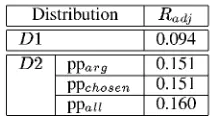
Table 3 presents the clustering results for D1 and D2, with D2 distinguishing the amount of PP information (arg for arguments only, chosen for the manually defined PPs, all for all possible PPs). As stated by Schulte im Walde and Brew (2002), refining the syntactic verb information by prepo-sitional phrases is helpful for the clustering; and the usage is not restricted to argument PPs, but ex-tended by the more variable PP information.
Distribution Radj
D1 0.094
D2 ppa„ 0.151
[image:5.595.391.496.516.577.2]PPchosen 0.151 PPau 0.160
Table 3: Clustering results on D1 and D2
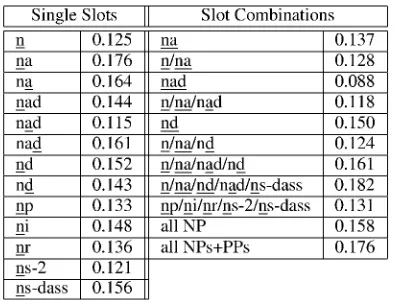
D2. On the other hand, 'Ili' which is not expected to provide variable definitions of selectional pref-erences for the nominative slot, does work bet-ter than 'n'. The right part in Table 4 illustrates the clustering results for example combinations of argument slots refined by selectional preferences, e.g. n/na means that the nominative slot in 'n', and both the nominative and accusative slot in `na' are refined by selectional preferences. The combined information does not necessarily improve the sin-gle slot clustering results, e.g. n/na achieves re-sults below the ones for refining only na or na. The overall best result (including non-illustrated exper-iment results) is achieved by defining selectional preferences on n/na/nd/nad/ns-dass, better than re-fining all NP slots or all NP and all PP slots in the frame types. Summarising, Table 4 illustrates that a linguistic choice of features is worthwhile, but linguistic intuition and algorithmic clustering re-sults do not necessarily align. On selected argu-ment roles, the selectional preference information in D3 once more improves the clustering results compared to D2, but the improvement is not as persuasive as D2 improving D1.
Single Slots Slot Combinations
n 0.125 na 0.137
na 0.176 n/na 0.128
na 0.164 nad 0.088
gad 0.144 n/na/nad 0.118
nad 0.115 nd 0.150
n ad 0.161 n/na/nd 0.124 ad 0.152 n/na/nad/nd 0.161 nd 0.143 n/na/nd/nad/ns-dass 0.182 np 0.133 np/ni/nr/ns-2/ns-dass 0.131 ni 0.148 all NP 0.158 or 0.136 all NPs+PPs 0.176 ns -2 0.121
[image:6.595.55.253.421.571.2]ns-dass 0.156
Table 4: Clustering results on varying D3
With respect to further feature variation, merg-ing the frequencies of the 15 top level nodes in GermaNet to 2 or 3 roles results in noisy distri-butions and destroys the coherence of the cluster analyses. Experiment setups which either include a nominal level of selectional preference informa-tion or an alternainforma-tion-like combinainforma-tion of selec-tional roles were tried, but they suffer from their time demands and result in far worse analyses.
Finally, we present representative parts of the
cluster analysis based on D3, with selectional roles 'n', `na', 'rid', `ns-dass', and com-pares the respective clusters with their pendants under D1 and D2. The manual class numbers as defined in Table 1 are given as subscripts.
(a) beginneni bestehen37 endeni existieren37 laufen8 liegenn sitzenn stehenn
(b) eilenio gleiteni2 kriechen8 rennen8 starren16 (c) fahrenn fliegenn flie13en12 klettern8 segelnii
wandern8
(d) bilden32 erhOhen35 festlegen22 senken35 steigern35 vergrOBern35 verkleinern35
(e) tOten39 unterrichten29
(f) nieseln43 regnen43 schneien43 (g) dammern43
The weather verbs in cluster (f) strongly agree in their syntactic expression on D1 and do not need D2 or D3 refinements for a successful class con-stitution. dammern in cluster (g) is ambiguous between a weather verb and expressing a sense of understanding; this ambiguity is idiosyncrati-cally expressed in D1 frames already, so dammem is never clustered together with the other weather verbs on D1 — 3.
Manner of Motion, Existence, Position and As-pect verbs are similar in their syntactic frame
Cluster (d) contains most verbs of Quantum Change, together with one verb of Production and Constitution each. The semantics of the cluster is therefore rather pure. The verbs in the cluster typi-cally subcategorise a direct object, alternating with a reflexive usage, `nr' and `npr' with mostly aufA and um. The selectional preferences help to dis-tinguish this cluster: the verbs agree in demanding a thing or situation as subject, and various objects such as attribute, cognitive object, state, structure or thing as object. Without selectional preferences (on D1 and D2), the change of quantum verbs are not found together with the same degree of purity. There are verbs as in cluster (e), whose proper-ties are correctly stated as similar on D1 — 3, so a common cluster is justified; but the verbs only have coarse common meaning components, in this case tiiten and unterrichten agree in an action of one person or institution towards another.
Summarising the cluster description, some verbs and verb classes are distinctive on a coarse feature level, some need fine-grained extensions, and some are not distinctive with respect to any combination of features.
8 Discussion and Conclusion
We have presented a clustering methodology for German verbs whose results agree with a manual classification in many respects and should prove useful as automatic basis for a large-scale cluster-ing. Without any doubt the cluster analysis would need manual correction and completion, but rep-resents a plausible basis.
The various verb descriptions illustrate that step-wise refining the features does improve the clustering. But the linguistic feature refinements not necessarily align with expected changes in clustering. This effect could be due to (i) noisy or (ii) sparse data, but (i) the example distribu-tions in Table 2 demonstrate that —even if noisy— our basic verb descriptions appear reliable with respect to their desired linguistic content. In ad-dition, the subcategorisation information on D1 and D2 has been evaluated against manual defi-nitions in a dictionary and proven useful (Schulte im Walde, 2002). And (ii) Table 4 illustrates that even with adding little information (e.g. refining a single argument by 15 selectional roles results
in 186 instead of 171 features) linguistic intuition and clustering results do not necessarily align.
Related work on automatic verb classes con-firms the difficulty of selecting and encoding verb features. Schulte im Walde (2000) clusters 153 English verbs into 30 verb classes as taken from (Levin, 1993), using a hierarchical cluster-ing method. The clustercluster-ing is most successful when utilising syntactic subcategorisation frames enriched with PP information (comparable to our D2); selectional preferences are encoded by role combinations taken from WordNet. Schulte im Walde claims the detailed encoding and there-fore sparse data to make the clustering worse with than without the selectional preference in-formation. Merlo and Stevenson (2001) classify a smaller number of 60 English verbs into three verb classes, by utilising supervised decision trees. The features of the verbs are restricted to those which should capture the basic differences between the verb classes, and the feature values are approached by corpus-based heuristics (e.g. measuring the de-gree of animacy by personal pronoun realisation in the transitive subject slot). An extension of their work by Joanis (2002) uses 802 verbs from 14 classes in (Levin, 1993). He defines an exten-sive feature space with 219 core features (such as part of speech, auxiliary frequency, syntactic cat-egories, animacy as above) and 1,140 selectional preference features taken from WordNet. As in our approach, the selectional preferences do not improve the clustering.
classes, and (ii) idiosyncratic properties which dis-tinguish the verbs from each other. As long as we define the verbs by those properties which repre-sent the common parts of the verb classes, a clus-tering can succeed. But with step-wise refining the verb description by including lexical idiosyncrasy, the emphasis of the common properties vanishes.
The exemplary description of cluster outcomes in the previous section confirms that it is impos-sible to determine an overall appropriate level of feature specification which suffices all kinds of verb classes defined in Table 1. Some verbs and verb classes are distinctive on a coarse feature level, some need fine-grained extensions, some are not distinctive with respect to any combination of features. There is no unique perfect choice and en-coding of the verb features, even more with respect to a potential large-scale extension of verbs and classes. Further work on the verb classes should concern a choice of verb features with respect to the specific properties of the desired verb clas-sification. We could think of either (i) performing several cluster analyses on the same set of verbs, but with different choices of verb features, and then find a way to merge the results to a unique classification, or (ii) not aiming for a fine-grained clustering, but create fewer but larger clusters on coarse features, which classify the verbs on a more general level. Both solutions should facilitate the demarcation of common and idiosyncratic verb features and improve the clustering results.
References
Bonnie J. Dorr and Doug Jones. 1996. Role of Word Sense Disambiguation in Lexical Acquisition: Pre-dicting Semantics from Syntactic Cues. In
Proceed-ings of the 16th International Conference on Com-putational Linguistics, pages 322-327, Copenhagen,
Denmark.
Bonnie J. Don. 1997. Large-Scale Dictionary Con-struction for Foreign Language Tutoring and Inter-lingual Machine Translation. Machine Translation,
12(4 ):271-322.
Christiane Fellbaum, editor. 1998. WordNet — An
Elec-tronic Lexical Database. Language, Speech, and
Communication. MIT Press, Cambridge, MA.
Edward W. Forgy. 1965. Cluster Analysis of Multi-variate Data: Efficiency vs. Interpretability of Clas-sifications. Biometrics, 21:768-780.
Gerhard Helbig and Joachim Buscha. 1998. Deutsche
Grammatik. Langenscheidt — Verlag Enzyklopadie,
18th edition.
Lawrence Hubert and Phipps Arabie. 1985. Compar-ing Partitions. Journal of Classification, 2:193-218.
Eric Joanis. 2002. Automatic Verb Classification using a General Feature Space. Master's thesis, Department of Computer Science, University of Toronto.
Judith L. Klavans and Min-Yen Kan. 1998. The Role of Verbs in Document Analysis. In Proceedings of
the 17th International Conference on Computational Linguistics, pages 680-686, Montreal, Canada.
Anna Korhonen. 2002. Subcategorization Acquisition. Ph.D. thesis, University of Cambridge, Computer Laboratory. Technical Report UCAM-CL-TR-530.
Claudia Kunze. 2000. Extension and Use of Ger-maNet, a Lexical-Semantic Database. In
Proceed-ings of the 2nd International Conference on Lan-guage Resources and Evaluation, pages 999-1002,
Athens, Greece.
Beth Levin. 1993. English Verb Classes and
Alterna-tions. The University of Chicago Press.
Paola Merlo and Suzanne Stevenson. 2001. Auto-matic Verb Classification Based on Statistical Distri-butions of Argument Structure. Computational
Lin-guistics, 27(3):373-408.
Detlef Prescher, Stefan Riezler, and Mats Rooth. 2000. Using a Probabilistic Class-Based Lexicon for Lex-ical Ambiguity Resolution. In Proceedings of the
18th International Conference on Computational Linguistics, pages 649-655, Saarbriicken, Germany.
Sabine Schulte im Walde and Chris Brew. 2002. In-ducing German Semantic Verb Classes from Purely Syntactic Subcategorisation Information. In
Pro-ceedings of the 40th Annual Meeting of the Associa-tion for ComputaAssocia-tional Linguistics, pages 223-230,
Philadelphia, PA.
Sabine Schulte im Walde. 2000. Clustering Verbs Semantically According to their Alternation Be-haviour. In Proceedings of the 18th International
Conference on Computational Linguistics, pages
747-753, Saarbriicken, Germany.
Sabine Schulte im Walde. 2002. Evaluating Verb Subcategorisation Frames learned by a German Sta-tistical Grammar against Manual Definitions in the
Duden Dictionary. In Proceedings of the 10th EURALEX International Congress, pages 187-197,
Copenhagen, Denmark.