Abstract—This paper presents, a two-stage heuristic based procedure for generating part family and machine cell formation in Cellular Manufacturing System. It decreases exceptional elements and voids which in turns decreases intercell flow of parts and increases utilization of machines in the cells. In the first phase; the problem is solved as a bottom-up aggregation procedure for machine grouping. Aggregation is based on the minimization of intercell flow. Later the parts are assigned to the cells according to the proposed heuristic. Upper bound on the cell size is imposed in the first stage which is relaxed gradually in second phase. It ensures the natural cell formation. The solution obtained at the end of first stage is refined in the second phase. Numerical examples were tested for grouping efficiency, grouping efficacy, global efficiency and have been compared with results reported by other researchers. The computational results are encouraging
Index Terms— cellular manufacturing systems, part grouping,
inter-cell movement, operation sequence, void, exceptional element
I. INTRODUCTION
Group Technology (GT) is an approach to manufacturing and engineering management that helps to manage diversity by capitalizing on underlying similarities in products and activities. In the manufacturing context, GT has been defined as a manufacturing philosophy identifying similar parts and grouping them together into families to take advantage of their similarities in manufacturing and design. Grouping the production equipment into machine cells, where each cell specializes in the production of part families, is called as cellular manufacturing. So cellular manufacturing is the application of the GT philosophy in manufacturing. Cellular Manufacturing is concerned with the creation and operation of manufacturing cells which are dedicated to the production of a set of part families. In order to introduce cellular manufacturing, it is necessary to identify parts and machine types to be used in the cellular configuration.
Manuscript received March 22, 2007.
Amit Rai Dixit is with the Institute of Engineering & Rural Technology, Allahabad, India (phone: +91-9415235250; fax: +91-532-2541520; e-mail: amitraidixit@ gmail.com).
P. K. Mishra is with Motilal Nehru National Institute of Technology, Allahabad, India. (e-mail: [email protected]).
The first problem faced in implementing Cellular Manufacturing is cell formation. Cell formation deals with the identification of the family of parts and the group of machines to process these parts. The problem of cell formation is defined as: "If the number, types, and capacities of production machines, the number and types of parts to be manufactured, and the routing plans and machine standards for each part are known, which machines and their associated parts should be grouped together to form cells?" [33]. In some cells the definition of cell formation is expanded to allow choice of processing operations to achieve specific features. Since last three decades, a considerable amount of researches have been directed to ease this type of problem.
Burbidge [3] developed an intuitive method, namely Production Flow Analysis (PFA) which is relatively easy to implement. PFA may be suitable for the small size problem, but it would definitely have difficulties coping with real life cell formation problems when the machine-part incidence matrix becomes more complex because of problem size.
A large number of approaches have been developed to deal with the difficulties of intuitive method. These approaches are usually classified into Part-oriented approaches (based on part characteristics) and Process-oriented approaches (based on production methods). The part-oriented techniques usually employ some classification and coding system, and analyze parts for their similarities in design features and functionalities. However, these do not influence directly the configuration of manufacturing cells [10]. The process-oriented approaches to the cell formation are based on manufacturing data such as production methods, part routing information and process plans. The process-oriented approach is classified into four groups namely: - Descriptive methods, Array-based methods, Similarity coefficient methods and other analytical methods [ 35].
Most of the suggested algorithms/models consider binary machine-part incidence matrix A, with
1
=
ij
a
if part i requires machine j , otherwise 0.
The binary part-machine matrix is incapable of presenting the actual intercell movements of parts. Operation sequences of parts in one of the most important manufacturing factors in the
HEURISTIC BASED APPROACH OF CELL
FORMATION CONSIDERING
OPERATION SEQUENCE
design of cellular manufacturing systems. The operation sequence is defined as an ordering of the machines on which the part is sequentially processed. The sequence of operation has an impact on the flow of material in the system. An intermediate operation of a component to be performed outside its cell requires two inter-cell transfers while the first or last operation requires only one such transfer [10], [19]. Therefore operation sequence matrix has been used in place of binary machine-part matrix. Harhalaskis [19] also considered the same scheme, but there were certain drawbacks in the procedure [14].
1) It requires an a priori specification of the upper bound on the number of machines within a cell and the number of cells. This contradicts the fundamental philosophy of grouping of machines naturally and the task of the analyst is to identify them if they exist [3], [7], [10]. At the design stage, the number of cells should be an outcome of the solution procedure and not an input parameter.
2) Other drawback is the irreversibility of the hierarchal clustering algorithm, i.e. once two machines (or cells) are grouped together at some stage there is no way to retrace the steps even if it leads to suboptimal clustering at the end [7], [19]. Also in the case of ties, selection is made arbitrarily. This precludes formation of better groups at later stage.
In this paper, upper bound on the cell size is imposed initially in the first stage to obtain basic feasible solution. The condition is relaxed in subsequent phase (refinement stage) and the cells are formed naturally. In the case of ties, decision is taken for proper selection based on heuristic.
The paper is organized as follows: Notations and definitions are explained in section 2. The mathematical model is presented in section 3. The proposed algorithm is presented in section 4. The evaluation criteria are given in section 5. Computational results are presented in section 6 to illustrate the proposed algorithm. Conclusion is presented in section 7.
II. NOTATIONS AND DEFINITIONS
i = part type j = machine type k = cell type n = operation type
m = number of machines M= (m1, m2,……,mm).
p = number of parts P= ( p1, p2,…….,pp ).
c = number of cells C= ( c1, c2,…….,cc ).
jk
X
= 1 if machine j is in cell k and 0 otherwise
ik
Y
= 1 if part i is assigned in cell k and 0 otherwise
r
M
= number of machines in cell r
r
N
= number of parts in cell r
d
e
= number of in-cell operations,
o
e
= number of out-of-cell operations,
k
Θ
= total number of operation in the kth cell
k
δ
= total number of non-operation (voids) in the kth cell ξ = Compactness
UB = upper bound on cell size (maximum number of machines in a cell)
m (k)= Number of machines in cell type k.
mpim = machine-part incidence matrix representing the operation sequence.
(mpim)ij = n, if nth operation of part i is performed on
machine j, 0 otherwise.
i ab
ψ = the number of times that part i moves from M
a to
Mb, and Mb is the immediate successor of Ma.
Where
(
)
(
)
∑
∑
+ = = − = m a b ab a p a iab mpim mpim
1 1
ε
ψ
ε≤ m, and value of ε incremented by 1 in each iteration.
III. MATHEMATICAL MODEL
The most fundamental objectives for cell formation are minimization of intercell flows and maximizing machine utilization. It helps to decrease the intercell movement cost. In research, efforts are made to minimise intercell flows and maximize machine utilization with the consideration of operation sequence of parts. The mathematical model is given below:
Normalized Intercell flows:
Min
∑
∑
= = + = w b ab wa ma mb
Z
1
1 () ( )
ψ
(1) Subject to constraint:
UB b m a
m()+ ( )≤
(2)
∑
= = c k jk x 1 1for j = 1,2,……., m. (3)
∑
= = c k ik y 1 1for i= 1,2,……., p. (4)
∑
= ≥ m j jk x 1 1for k=1,2,……., c. (5)
∑
= ≥ p i ik y 1 1for k=1,2,……., c. (6)
IV. HEURISTIC SOLUTION APPROACH
The design of cellular manufacturing is combinatorially complex. There are number of approaches which were proposed by different researcher. Heuristic approaches are used to obtain good solutions within acceptable amount of time. Numerous papers can be found in the literature for cell formation using heuristics[1], [2], [4]-[6], [9], [12], [13], [17]-[19], [23]-[28], [30]-[32], [34], [36], [39].We have applied the two stage heuristic based approach considering operation sequence to solve cell formation.
Phase I. (Initial Cell-formation) A. Machine-Cell Formation Algorithm
Step 1: Assign each machine to a cell (Number of cells = Number of machines).
Step 2: Determine Ψab between the cells from the operation sequence matrix (mpim).
Step 3 : Determine the Normalized Intercell flow between the cells.
Step 4 : Select the minimum normalized Intercell flow value for the given cell-pair satisfying the limit of cell size.
If tie occurs (more than one cell-pair has same value) Decision: Select cell-pair having maximum Intercell movements. (Intercell movement will be minimized)
If TIE still prevails
Decision: Select cell-pair having less number of machines. (Intracell movement will be minimized).
Step 5 : Merge the cell-pair to form new cell.
Step 6 0: Repeat step (2-4) till upper bound condition on cell size is not violated.
Step 7: Stop.
B. Part Allocation Algorithm
Step 1: Part will be assigned to the cell having MAXIMUM number of machines required by the particular part.
If the tie occurs:
(1) If operations are in same sequence in TIE cells:
(a) Part will be assigned to the cell having minimum number of machines (void will be minimum)
(b) If numbers of machines are equal then part will be assigned to the cell having MINIMUM operation sequence. (Inter-cell movement will be minimum) (2) If operations are not in a sequence in one of
the TIE cells:
(a) Part will be assigned to the cell having operations in sequence. (Inter-cell movement will be minimum)
(3) If operations are not in sequence in all the TIE cells:
(a) Part will be assigned to the cell having minimum number of machines (voids
will be minimum)
(b) If number of machines are same then part will be assigned to the cell having MINIMUM operation number (inter-cell movement will be minimum)
Step 2: Stop
Phase II. (Improvement of Result Obtained From Phase I) Step 1: Identify the exceptional elements (EE), bottleneck machines, bottleneck parts and their respective cells from the initial solution obtained from Phase-I.
Step 2: Identify the bottleneck machine which is more involved for EE as compared to their regular operations for the part families within the cell.
Step 3: If these EE are from the same cell (having bottleneck parts)
Shift the machine to the new cell” (EE elements will be reduced and machine utilization will be increased)
Step 4: if TIES occurred:
(Numbers of EE are equal to the numbers of operations within the parent cell of the machine.)
if number of parts in Parent cell > number of parts in cell having bottleneck parts,
“Shift the machine to the new cell” (Voids will be reduced, EE will remain same and within-cell compactness will be increased)
Step 5: Repeat the step (2-4) for all the bottleneck machines. Step 6 : Apply the part allocation algorithm.
Step 7: Stop.
V. EVALUATION CRITERION
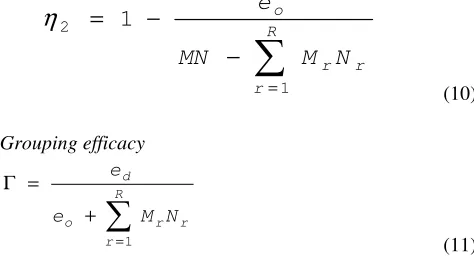
Four performance measures have been used to evaluate the result of proposed algorithm with others. These measures of performance are defined as below:
Grouping efficiency [7] was the first evaluation criteria for final result obtained by different algorithms.
Grouping efficiency ηg = ϖη1 +
(
1 −ϖ)
η2(7) Where ϖ is the weighting factor ranging between 0 and 1, 1
η is the measure of the density of 1’s in the diagonal clusters of the block diagonal matrix and η2 measures the density of 0’s outside the diagonal cluster., that are defined as:
MN
N M
R r
r r
∑
=
= 1
ϖ
(8)
∑
=
= R
r
r r d
N M e
1 1 η
∑
=
−
−
=
R
r
r r o
N
M
MN
e
1 2
1
η
(10) Grouping efficacy
∑
=
+ =
Γ R
r
r r o
d
N M e
e
1 (11) Global Efficiency [19] is the ratio of the number of operations that are performed within cells to the total number of operations in the systems.
Global Efficiency
o d
d o
e e
e
+ = η
(12)
VI. COMPUTATIONAL RESULTS
The algorithm has been implemented in script programming in MATLAB 7.0 and the experiment has been run on a Pentium
IV, with 1.8 GHz and 256 MB RAM. In order to validate the proposed heuristic, a set of problems have been selected from research papers.
A. Example 1
Consider the example of 20 machines, 20 parts. Table 1 shows the incidence matrix. The results after phase-I are same as reported by [19]. The number of exceptional elements was 15. In the reported solution, machine 14 has been assigned to cell 2. Machine 14 was engaged for performing 2nd operation on part 11. So this machine was performing only one operation in the assigned cell. Rest of the time it was engaged with bottleneck parts (6 and 15 of cell 4). This fact is taken into consideration in Phase-II and the machine 14 is shifted to cell 4. As a result number of exceptional elements has been reduced to 14. The number of voids due to machine 14 in cell 2 was 3. After reallocation of machine 14 in cell 4, the number of voids due to machine 14 in cell 4 has reduced to 1. The improved solution is shown in Table 2.
The values of the Grouping efficiency, Grouping Efficacy, and Global Efficiency of the final solution are 0.9125, 0.6465, and 0.8101 respectively. These values are better as compared to the reported solution [19].
Table1. Machine-Part Incidence Matrix (Example 1) Machines
1 2 3 4 5 6 7 8 9 10 11 12 13 14 15 16 17 18 19 20
1 2 3 1 4 5
2 3 2 1
3 1 3 2
4 3 1 4 2
5 1 3 4 2
6 5 1 2 3 4
7 1 2 3
8 5 3 4 2 1
9 4 2 3 5 1
10 3 1 2
11 3 1 2
12 5 3 1 4 2
13 1 2 3 4
14 3 4 1 2
15 1 2 3 4
16 3 2 1 4
17 2 1 3
18 1 4 2 3
19 2 1 4 3
c
om
pone
nt
s
[image:4.612.57.294.58.188.2]20 3 2 4 1
Table 2. Improved part-machine cell matrix after phase-II-Final Solution (Example 1) Machines
1 9 10 12 18 2 3 11 4 6 7 15 5 13 14 16 17 8 19 20
1 2 3 1 4 5
9 4 2 5 1 3
12 5 1 4 2 3
14 3 2 4 1
17 2 1 3
20 3 2 4 1
2 3 2 1
4 4 3 1 2
11 3 1 2
19 2 1 3 4
5 1 3 4 2
8 4 5 3 1 2
13 1 2 3 4
16 3 2 1 4
6 1 5 2 3 4
7 1 2 3
15 1 2 3 4
3 1 3 2
10 3 1 2
c
om
pone
nt
s
B. Example 2
A large matrix used is considered in this example. Table 3 shows the incidence matrix. The improved solution after phase-II is shown in Table 4. The number of exceptional elements in the reported solution is 35. The number of exceptional elements by the proposed solution methodology has been reduced to 32 in the final solution. This solution is
better as compared to the solution reported in reference paper [14].
[image:5.612.92.524.145.450.2]The values of the Grouping efficiency, Grouping Efficacy, and Global Efficiency of the final solution are 0.9450, 0.6516 and 0.7594 respectively. These values are better as compared to the reported solution [14].
Table 3. Machine-Part incidence matrix (Example 2)
Machines
1 2 3 4 5 6 7 8 9 10 11 12 13 14 15 16 17 18 19 20 21 22 23 24 25
1 5 3 1 4 2 6
2 2 3 4 1
3 2 3 1
4 1 2
5 3 2 1
6 3 2 1
7 3 2 5 4 1
8 1 3 2
9 3 4 1 2
10 2 1 3
11 2 3 1
12 1 4 3 2 5
13 3 2 1
14 4 1 2 3
15 4 3 5 1 2
16 1 3 2 4
17 1 3 2
18 3 2 1
19 1 3 2
20 1
21 1 3 2
22 3 4 2 1
23 2 3 1
24 1 2
25 1 3 2
26 2 3 4 1
27 1 3 2
28 2 1 3
29 3 2 1
30 4 2 3 1
31 2 1 3
32 2 1 3 4
33 1 3 2
34 2 1 3
35 2 4 1 3
36 2 3 4 1
37 3 2 1
38 2 3 1
39 1
C
o
mp
o
n
e
n
ts
40 1 3 1
I. CONCLUSION
A heuristic algorithm for generating machine cell and part family has been developed for cellular manufacturing system. This algorithm generates a feasible solution by taking operation sequence of parts into account. The algorithm comprises of two phases. The first phase forms a configuration of independent cells using bottom-up aggregation procedure and parts are allocated according to proposed heuristic. The second phase, named as improvement stage, addresses for minimization of voids
and exceptional elements. The under-utilized machines are identified and an attempt is made to reallocate the machines in other cells so that the voids and exceptional elements are removed from the solution matrix.
Table 4. Improved part-machine cell matrix after phase-II-Final Solution (Example 2)
REFERENCES
[1] Adenso-Diaz B., Lozano S. and Eguia I., 2005. Part-machine
grouping using weighted similarity coefficients. Computers and Industrial Engineering, 48, 553-570.
[2] Baykasoglu, A., Gindy, N.N.Z., Cobb, R.C., 2001. Capability based
formulation and solution of multiple objective cell formation problems using simulated annealing. Integrated Manufacturing Systems 12, 258–274.
[3] Burbidge, J.L., 1971, Production flow analysis. Production Engineer, 50, 4/5, 139-.
[4] Burke, L.I., and Kamal, S., 1992, Fuzzy art and cellular
manufacturing. In Artificial Neural Networks in Engineering. 779-184.
[5] Cao, D., Chen, M., 2004. Using penalty function and Tabu search to
solve cell formation problems with fixed cell cost. Computers and Operations Research 31, 21–37.
[6] Carpenter, G.A., and Grossberg, S., 1987, A massive architecture for a self organizing neural pattern recognition. Computer vision, Graphics Image Processing., 54-115.
[7] Chandrasekharan, M.P. and Rajagopalan, R., 1986, An ideal seed non-hierarchical clustering algorithm for cellular manufacturing. International Journal of Production Research, 24, 2, 451-464.
[8] Chandrasekharan, M.P. and Rajagopalan, R., 1987, ZODIAC-an
algorithm for concurrent formation of part-families and
machine-cells. International Journal of Production Research, 25, 835-850.
[9] Chen C.L., Contruvo N.A. and Baek W., 1995, A simulated annealing
solution to the cell formation problem. International Journal of Production Research, 33, 9, 2601-2614.
[10] Choobineh, F., 1988, A framework for the design of cellular manufacturing systems. International Journal of Production Research, 26, 1161-1172.
[11] Co, H.C. and Araar, A., 1988, Configuring cellular manufacturing systems. International Journal of Production Research, 26,
[12] Dixit, A. R., and Mishra, P. K., 2004, Machine-cell Formation Using Genetic Algorithm, National Conference on Advance Manufacturing and Robotics held at Central Mechanical Engineering Research Institute, West Bangal, India.
[13] Dobando D., Lozano S., Bueno J.M. and Larraneta J., 2002, Cell formation using a Fuzzy Min-Max neural network. International Journal of Production Research, 40, 1, 93-107.
[14] G. Jayakrishnan Nair, T.T. Narender 1998, CASE: A clustering algorithm for cell formation wit sequence data. International Journal of Production Research, 36, , 157-179.
[15] Ghosh, S., Mahanati, A., Nagi, R., and Nau, D., 1993, ,
Manufacturing cell formation by state-space search. Technical Report No. TR 93-75, Institute of Systemss Research, University of Maryland, College Park.
[16] Gupta, T. and Seifoddini, H., 1990, Production data based similarity coefficient for machine-component grouping decision in the design of a cellular manufacturing system. International Journal of Production Research, 28, 7, 247-1269.
[17] Gupta, Y. P., Gupta, M.C., Kumar, A., and Sundaram, C., 1995. Minimising total intercell and Intracell moves cellular manufacturing system: a genetic algorithm approach. International Journal of Computer Integrated Manufacturing. 8. 92-101.
[18] Gupta, Y. P., Gupta, M.C., Kumar, A., and Sundaram, C., 1996. A genetic algorithm based approach to cell composition and layout design problem. International Journal of Production Research, 34, 447-482.
[19] Harhalakis G., Nagi R., & Proth J.M., 1990 An Efficient heuristic in manufacturing cell formation for group technology applications. International Journal of Production Research, 26, 1161-1172. [20] Harhalakis G., Nagi R., & Proth J.M., 1994. Manufacturing cell
formation under random product demand. International Journal of Production Research, 32, 47-64.
[21] Harhalakis, G., Nagi, R. and Xie, X.L, 1990, Manufacturing cell Design using simulated annealing: an industrial application. Journal of Intelligent Manufacturing,1- 8.
[22] Kumar, C.S., and Chandrasekharan, M.P., 1990, Grouping efficacy: a
Machines
1 2 17 24 25 3 11 20 12 23 5 16 19 6 15 21 22 4 7 10 18 8 9 13 14
2 2 3 4 1
12 1 3 2 5 4
36 2 3 1 4
3 2 3 1
9 2 3 4 1
13 3 2 1
14 4 2 3 1
33 2 1 3
4 1 2
6 3 1 2
20 1
26 3 1 4 2
34 3 2 1
37 2 1 3
39 1
8 1 3 2
15 4 3 1 2 5
23 2 3 1
24 1 2
31 1 2 3
18 2 1 3
25 1 3 2
27 1 3 2
29 3 2 1
35 2 4 1 3
40 1 3 1
1 4 6 5 3 1 2
5 2 3 1
7 4 3 2 5 1
16 2 1 3 4
17 1 3 2
30 3 4 2 1
10 3 2 1
11 1 2 3
19 2 1 3
21 2 1 3
22 1 3 4 2
28 3 2 1
38 1 2 3
C
o
mp
o
n
e
n
ts
in group technology. International Journal of Production Research, 28, 233-243.
[23] Lozano S., Canca D, Gurrreo F., and Garcia J.M., 2001, Machne Grouping using sequence-based similarity coffecients and neural network, Robotics and Computer Integrated Manufacturing, Vol 17, 399-404.
[24] Muruganandam A., Prabharan G., Asokan P. and Baskaran V., 2005,
A memetic algorithm approach to the cell formation problem, International Journal of Advance Manufacturing Technology, 25, 988-997.
[25] Onwubolu, G.C., Mutingi, M., 2001. A genetic algorithm approach to
cellular manufacturing systems. Computers and Industrial
Engineering 39, 125–144.
[26] Peker A. and Kara Y., 2004, Parameter setting of te Fuzzy ART neural network to part-machine cell formation problem. International Journal of Production Research, 42, 6, 1257-1278.
[27] Sofianopoulou S., 1997, Application of Simulated Annealing to a linear model for the formulation of machine cells in Group technology, International Journal of Production Research, 35, 2, 501-511.
[28] Solimanpur, M., Vrat, P., Shankar, R., 2004. A multi-objective genetic algorithm approach to the design of cellular manufacturing systems. International Journal of Production Research 42, 1419–1441
[29] Steudel, H.J. and Ballakur, A., 1987, A dynamic programming based
heuristic for machine grouping in manufacturing cell formation. Computers and Industrial Engineering, 12, 3, 215-222.
[30] Su, C.-T., Hsu, C.-M., 1998. Multi-objective machine-part cell formation through parallel simulated annealing. International Journal of Production Research 36, 2185–2207.
[31] Venugopal, V. and Narendran, T. T., 1992 a, A genetic algorithm approach to the machine-component grouping problem with multiple objectives. Computers and Industrial Engineering, 22, 469-480. [32] Venugopal, V. and Narendran, T. T. 1992 b, Cell formation in
manufacturing systems through a simulated annealing: An experimental evolution. European Journal of Operational Research, 63, 409-422.
[33] Wu, N. and Salvendy, 1993 G. A modified network approach for the
design of cellular manufacturing systems. International Journal of Production Research, 31, 1409-1421
[34] Xambre, A.R., Vilarinho, P.M., 2003. A simulated annealing
approach for manufacturing cell formation with multiple identical machines. European Journal of Operational Research 151, 434–446. [35] Yasuda, K. and Yin, Y., 2001, A dissimilarity for solving the cell
formation problem in cellular manufacturing. Computers and Industrial Engineering, 39, 1-17.
[36] Yasuda, K. Hu, L. and Yin, Y., 2005, A grouping genetic algorithm
for the multi-objective cell formation problem. International Journal of Production Research, 43, 4, 829-853.
[37] Yasuda, K., 1990, Basic Program for cell formation using ROC algorithm. Journal of Faculty of Commerce, Chukyo University, Japan, 37, 17-62
[38] Zhao, C., Zhiming, W., 2000. A genetic algorithm for manufacturing
cell formation with multiple routes and multiple objectives. International Journal of Production Research 38, 385–395.