Proceedings of the 2019 Conference on Empirical Methods in Natural Language Processing and the 9th International Joint Conference on Natural Language Processing, pages 1167–1172,
1167
Robust Text Classifier on Test-Time Budgets
Md Rizwan Parvez
University of California Los Angeles
Kai-Wei Chang
University of California Los Angeles
Tolga Bolukbasi
Boston University
Venkatesh Saligrama
Boston University
Abstract
We design a generic framework for learning a robust text classification model that achieves high accuracy under different selection bud-gets (a.k.a selection rates) at test-time. We take a different approach from existing methods and learn to dynamically filter a large fraction of unimportant words by a low-complexity se-lector such that any high-complexity classifier only needs to process a small fraction of text, relevant for the target task. To this end, we propose a data aggregation method for training the classifier, allowing it to achieve competi-tive performance on fractured sentences. On four benchmark text classification tasks, we demonstrate that the framework gains consis-tent speedup with little degradation in accu-racy on various selection budgets.
1 Introduction
Recent advances in deep neural networks (DNNs) have achieved high accuracy on many text classifi-cation tasks. These approaches process the entire text and encode words and phrases in order to per-form target tasks. While these models realize high accuracy, the computational time scales linearly with the size of the documents, which can be slow for a long document. In this context, various ap-proaches based on modifying the RNN or LSTM architecture have been proposed to speed up the process (Seo et al., 2018;Yu et al.,2017). How-ever, the processing in these models is still fun-damentally sequential and needs to operate on the whole document which limits the computational gain. In contrast to previous approaches, we pro-pose a novel framework for efficient text classifi-cation on long documents that mitigates sequential processing. The framework consists of aselector
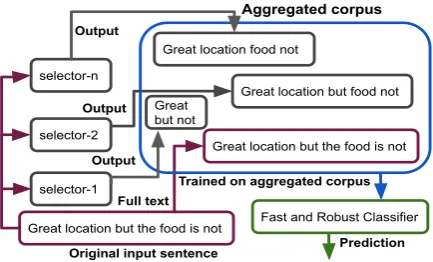
and a classifier. Given a selection budget as in-put, theselectorperforms a coarse one-shot selec-tion deleting unimportant words and pass the
re-selector-n
selector-2
selector-1
Great location but the food is not
Great location but the food is not Great
but not
Great location but food not Great location food not
Original input sentence Full text Output
Aggregated corpus Output
Output
Fast and Robust Classifier
[image:1.595.309.526.221.352.2]Prediction Trained on aggregated corpus
Figure 1: Our proposed framework. Given a selection rate, a
selectoris designed to select relevant words and pass them to theclassifier. To make the classifier robust against fractured sentences, we aggregate outputs from differentselectorsand train theclassifieron the aggregated corpus.
mainder to theclassifier. Theclassifierthen takes the sentence fragments as an input and performs the target task. Figure 1 illustrates the proce-dure. This framework is general and agnostic to the architecture of the downstreamclassifier(e.g., RNN, CNN, Transformer).
However, three challenges arise. First, to build a computationally inexpensive system, the selec-tormust have negligible overhead. We adopt two effective yet simple architectures to design selec-tors based on word embeddings and bag-of-words. Second, training multiple distinct models for dif-ferent budgets is unfeasible in practice, especially when model size is large. Hence, our goal is to learn a singleclassifierthat can adapt to the out-put of anyselectoroperating at any budget. Con-sequently, thisclassifier must be robust so that it can achieve consistent performance with different budgets. Third, the input to the classifier in our framework is a sequence of fractured sentences which is incompatible with a standard classifier
combinatorially numerous. Another approach is to randomly blank out text (a.k.a. blanking-noise), leads to marginalized feature distortion (Maaten et al.,2013) but this also leads to poor accuracy as DNNs leverage word combinations, sentence structure, which this approach does not account for. To mitigate this problem, we propose a data aggregation framework that augments the train-ing corpus with outputs from selectors at differ-ent budget levels. By training theclassifieron the aggregated structured blank-out text, the classi-fierlearns to fuse fragmented sentences into a fea-ture representation that mirrors the representation obtained on full sentences and thus realizes high-accuracy. We evaluate our approach through com-prehensive experiments on real-world datasets.1
2 Related Work
Several approaches have been proposed to speed up the DNN in test time (Wu et al., 2017; Choi et al.,2017). LSTM-jump (Yu et al.,2017) learns to completely skip words deemed to be irrele-vant and skim-RNN (Seo et al.,2018) uses a low-complexity LSTM to skim words rather than skip-ping. Another version of jump, LSTM-shuttle (Fu and Ma, 2018) first skips a number of words, then goes backward to recover lost in-formation by reading some words skipped before. All these approaches require to modify the archi-tecture of the underlying classifier and cannot eas-ily extend to another architecture. In contrast, we adopt existingclassifierarchitectures (e.g., LSTM, BCN (McCann et al.,2017)) and propose a meta-learning algorithm to train the model. Our frame-work is generic and aclassifiercan be viewed as a black-box. Similar to us,Lei et al.(2016) propose a selector-classifier framework to find text snip-pets as justification for text classification but their
selectorandclassifierhave similar complexity and require similar processing times; therefore, it is not suitable for computation gain. Various feature selection approaches (Chandrashekar and Sahin,
2014) have been discussed in literature. For ex-ample, removing predefined stop-words (see Ap-pendix A), attention based models (Bahdanau et al.,2015;Luong et al.,2015), feature subspace selection methods (e.g., PCA), and applying the L1 regularization (e.g., Lasso (Tibshirani,1996) or
1Our source code is available at:
https://github.com/uclanlp/
Fast-and-Robust-Text-Classification
Group Lasso (Faruqui et al.,2015), BLasso (Gao et al., 2007)). However, these approaches either cannot obtain sparse features or cannot straight-forwardly be applied to speed up a DNN classi-fier. Different from ours,Viola and Jones(2001);
Trapeznikov and Saligrama(2013);Karayev et al.
(2013); Xu et al. (2013); Kusner et al. (2014);
Bengio et al. (2016); Leroux et al. (2017); Zhu et al.(2019); Nan and Saligrama (2017); Boluk-basi et al.(2017) focus on gating various compo-nents of existing networks. Finally, aggregating data or models has been studied under different contexts (e.g., in context of reinforcement learn-ing (Ross et al.,2011), Bagging models (Breiman,
1996), etc.) while we aggregate the data output fromselectorsinstead of models.
3 Classification on a Test-Time Budget
Our goal is to build a robustclassifieralong with a suite of selectors to achieve good performance with consistent speedup under different selection budgets at test-time. Formally, aclassifier C(ˆx)
takes a word sequence xˆ and predicts the corre-sponding output labely, and aselectorSb(x)with
selection budget b takes an input word sequence
x = {w1, w2, . . . , wN} and generates a binary
sequence Sb(x) = {zw1, zw2, . . . , zwN} where
zwk ∈ {0,1}represents if the corresponding word
wkis selected or not. We denote the sub-sequence
of words generated after filtering by theselectoras
I x, Sb(x)={wk:zwk = 1,∀wk∈x}. We aim to train aclassifierCand theselectorSbsuch that I x, Sb(x)
is sufficient to make accurate
predic-tion on the output label (i.e., CI x, Sb(x)
≈
C(x)). The selection budget (a.k.a selection rate)b
is controlled by the hyper-parameters of the selec-tor. Higher budget often leads to higher accuracy and longer test time.
3.1 Learning aSelector
We propose two simple but efficient selectors.
Word Embedding (WE) selector. We consider a parsimonious word-selector using word embed-dings (e.g., GloVe (Pennington et al., 2014)) as features to predict important words. We assume the informative words can be identified indepen-dently and model the probability that a wordwkis
selected byP(zwk = 1|wk) = σ(θ
T
Sw~k), where θSis the model parameters of theselectorSb,w~k
anno-tations about which words are important, we train theselectorSbalong with aclassifierCin an
end-to-end manner followingLei et al.(2016), and an L1-regularizer is added to control the sparsity (i.e., selection budget) ofSb(x).
Bag-of-Words selector. We also consider using an L1-regularized linear model (Zou and Hastie,
2005;Ng, 2004; Yuan et al., 2010) with bag-of-words features to identify important bag-of-words. In the bag-of-words model, for each documentx, we construct a feature vector~x∈ {0,1}|V|, where|V|
is the size of the vocabulary. Each element of the feature vector~xw represents if a specific wordw
appearing in the documentx. Given a training set X, the linear model optimizes the L1-regularized task loss. For example, in case of a binary classi-fication task (output labely∈ {1,−1}),
J(xt, yt) = log 1 + exp(−ytθTx~t)
θ∗= arg minθ X
(xt,yt)∈X
J(xt, yt) + 1 bkθk1,
whereθ ∈ R|V| is a weight vector to be learned,
θwcorresponds to wordw∈ V, andbis a
hyper-parameter controlling the sparsity of θ∗ (i.e., se-lection budget). The lower the budget b is, the sparser the selection is. Based on the optimalθ∗, we construct a selectorthat picks word w if the correspondingθ∗w is non-zero. Formally, the bag-of-wordsselectoroutputsSb(x) = {δ(θw 6= 0) : w∈x},whereδis an indicator function.
3.2 The Data Aggregation Framework
In order to learn to fuse fragmented sentences into a robust feature representation, we propose to train the classifier on the aggregated corpus of struc-tured blank-out texts.
Given a set of training data X =
{(x1, y1), ..,(xt, yt), ..,(xm, ym)}, we assume we
have a set of selectors S = {Sb} with different
budget levels trained by the framework discussed in Section3.1. To generate an aggregated corpus, we first apply eachselectorSb∈ S on the training
set, and generate corresponding blank-out corpus I(X, Sb) =
I xt, Sb(xt)
,∀xt∈ X . Then, we
create a new corpus by aggregating the blank-out corpora:T =S
Sb∈SI(X, Sb).
2 Finally, we train
theclassifierCT on the aggregated corpusT. As
CT is trained on documents with distortions, it
2Note that, the union operation is used just to aggregate the train instances which does not hinder the model training (e.g., discrete variables).
Algorithm 1:Data Aggregated Training Schema Input:Training corpusX, a set ofselectors
with different budget levelsS ={Sb}, classifierclassC
Output: A robustclassifierCT
1 Initialize the aggregated corpus:T ← X 2 forSb ∈ Sdo
3 Sb ←Train a selectorSb ∈Swith budget
levelbonX
4 Generate a blank-out datasetI(X, Sb) 5 Aggregate data:T ← T ∪ I(X, Sb)
6 CT ←Train aclassifierConT 7 returnCT
learns to make predictions with different budget levels. The training procedure is summarized in Algorithm 1. In the following, we discuss two extensions of our data aggregation framework.
First, the blank-out data can be generated from different classes of selectors with different fea-tures or architecfea-tures. Second, the blank-out and selection can be done in phrase or sentence level. Specifically, if phrase boundaries are provided, a phrase-level aggregation can avoid aselectorfrom breaking compound nouns or meaningful phrases (e.g., “Los Angeles”, “not bad“). Similarly, for multi-sentenced documents, we can enforce the
selector to pick a whole sentence if any word in the sentence is selected.
4 Experiments
To evaluate the proposed approach, we consider four benchmark datasets: SST-2 (Socher et al.,
2013),IMDB(Maas et al.,2011),AGNews(Zhang et al.,2015), and Yelp(Conneau et al., 2016) and two widely used architectures for classification:
LSTM, and BCN (McCann et al., 2017). The statistics of the datasets are summarized in Table
2. We evaluate the computation gain of models in terms of overall test-time, and the performance in terms of accuracy. We followSeo et al.(2018) to estimate the test-time of models on CPU3 and
exclude the time for data loading.
In our approach, we train aclassifierwith both WE and bag-of-words selectors with 6 selection budgets4 {50%, 60%, . . . , 100%} by the
word-3
Machine specification is in Appendix C.
4For the very large Yelp dataset, 3 selection budgets
Model SST-2 IMDB AGNews Yelp
acc. selection(%) time speedup acc. selection(%) time speedup acc. selection(%) time speedup acc. selection(%) time speedup
Baseline 85.7 100 9 1x 91.0 100 1546 1x 92.3 100 59 1x 66.5 100 3487 1x Bag-of-Words 78.8 75 5.34 1.7x 91.5 91 1258 1.2x 92.9 97 48 1.2x 59.7 55 2325 1.6x
Our framework 82.6 65 4.6 2x 92.0 91 1297 1.2x 93.1 91 46 1.3x 64.8 55 2179 1.6x
[image:4.595.74.527.202.326.2]85.3 0 9 1x 92.1 0 1618 1x 93.2 0 57 1x 66.3 0 3448 1x
Table 1: Accuracy and speedup on the test datasets. Test-times are measured in seconds. The speedup rate is calculated as the running time of a model divided by the running time of the corresponding baseline. For our framework, top row denotes the best speedup and the bottom row denotes the best test accuracy achieved. Overall best accuracies and best speedups are boldfaced. Our framework achieves accuracies better than baseline with a speedup of1.2xand1.3xon IMDB, and AGNews respectively. With same or higher speedup, our accuracies are much better than Bag-of-Words.
(a) IMDB (b) AGNews (c) SST-2
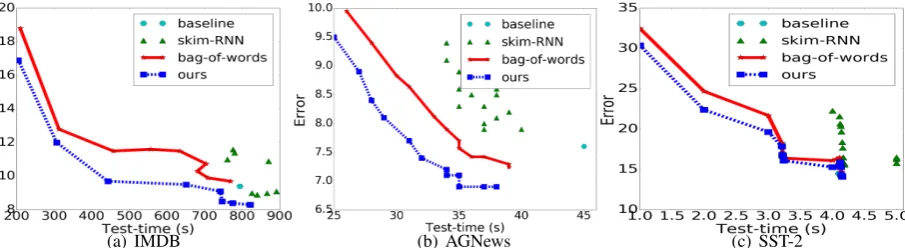
Figure 2: Performance under different test-times on IMDB, AGNews, and SST-2. All the approaches use the same LSTM model as the back-end. Bag-of-Words model and our framework have the same bag-of-wordsselectorcascaded with this LSTM
classifiertrained on the original training corpus and aggregated corpus, respectively. Our model (blue dashed line) significantly outperform others for any test-time budget. Also its performance is robust, while results of skim-RNN is inconsistent with different budget levels.
Dataset #class Vocabulary Size (Train/Valid/Test) Avg. Len
SST 2 13,750 6,920/872/1,821 19
IMDB 2 61,046 21,143/3,857/25,000 240
AGNews 4 60,088 101,851/18,149/7,600 43
Yelp 5 1,001,485 600k/50k/50k 149
Table 2:Dataset statistics.
level data aggregation framework. We evaluate the computation gain of the proposed method through a comparative study of its performance under dif-ferent test-times by varying the selection budgets5 in comparison to the following approaches: (1)
Baseline: the original classifier (i.e., no selec-tor, no data aggregation) (2)skim-RNN: we train a skim-RNN model and vary the amount of text to skim (i.e., test-time) by tuning θ parameter as inSeo et al. (2018). (3) Bag-of-Words: filtering words by the bag-of-words selector and feeding the fragments of sentences to the original clas-sifier (i.e., no data aggregation). This approach serves as a good baseline and has been considered in the context of linear models (e.g., Chang and Lin(2008)). For a fair comparison, we implement all approaches upon the same framework using
5In Appendix B, we discuss how to vary these budgets.
AllenNLP library6, including a re-implementation of the existing state-of-art speedup framework skim-RNN (Seo et al., 2018)7. As skim-RNN is designed specifically for accelerating the LSTM model, we only compare with skim-RNN using LSTM classifier. Each corresponding model is selected by tuning parameters on validation data. The model is then frozen and evaluated on test-data for different selection budgets.
Figure2demonstrates the trade-off between the performance, and the test-time for each setting. Overall, we expect the error to decrease with a larger test-time budget. From Figure2, on all of the IMDB, AGNews, and SST-2 datasets, LSTM
classifiertrained with our proposed data aggrega-tion not only achieves the lowest error curve but also the results are robust and consistent. That is our approach achieves higher performance across different test-time budgets and its performance is a predictable monotonic function of the test-time budget. However, the performance of skim-RNN exhibits inconsistency for different budgets. As a matter of fact, for multiple budgets, none of the skim-RNN, and LSTM-jump address the
prob-6
https://allennlp.org/
World News ..plantsearched. Kansai Electric Power’snuclearpowerplantin Fukui ..was searched by policeSaturday .. Business Telecom Austria taps the Bulgarianmarket.TelecomAustria, Austriaslargesttelecoms operator, obtained .. Sci/Tech .. Reuters -Software securitycompaniesandhandset makers, including Finland’sNokia(NOK1V.HE),are..
Table 3:Examples of the WEselectoroutput on AGNews. Bold words are selected.
lem of different word distribution between train-ing and testtrain-ing. Therefore, similar to skim-RNN, we anticipate that the behavior of LSTM-jump will be inconsistent as well8. Additionally, since LSTM-jump has already been shown to be out-performed by skim-RNN, we do not further com-pare with it. Next, we show that our frame-work is generic and can incorporate with other differentclassifiers, such as BCN (see Table 1).9 When phrase boundary information is available, our model can further achieve 86.7 in accuracy with 1.7xspeedup for BCN on SST-2 dataset by using phrase-level data aggregation. Finally, one more advantage of the proposed framework is that the output of theselector is interpretable. In Ta-ble 3, we present that our framework correctly selects words such as “Nokia”, “telecom”, and phrases such as “searched by police”, “software security” and filters out words like “Aug.”, “users” and “products”.
Note that nevertheless we focus on efficient in-ference, empirically our method is no more com-plex than the baseline during training. Despite the number of training instances increases, and so does the training time for each epoch, the number of epochs we require for obtaining a good model is usually smaller. For example, on the Yelp corpus, we only need 3 epochs to train a BCNclassifieron the aggregated corpus generated by using 3 differ-entselectors, while training on the original corpus requires 10 epochs.
5 Conclusion
We present a framework to learn a robustclassifier
under test-time constraints. We demonstrate that the proposedselectors effectively select important words forclassifierto process and the data aggre-gation strategy improves the model performance.
8As an example, from Table 6 inYu et al.(2017), the per-formance of LSTM-jump drops from 0.881 to 0.854 although it takes longer test-time (102s) than the baseline (81.7s).
9
Because of the inherent accuracy/inference-time trade-off, it is difficult to depict model comparisons. For this rea-son, in Figure 2, we plot the trade-off curve to demonstrate the best speedup achieved by our model for achieving near state-of-art performance. On the other hand, test results are tabulated in Table 1 to focus attention primarily on accuracy.
As future work we will apply the framework for other text reading tasks. Another promising di-rection is to explore the benefits of text classifi-cation model in an edge-device setting. This prob-lem naturally arises with local devices (e.g., smart watches or mobile phones), which do not have suf-ficient memory or computational power to execute a complex classifier, and instances must be sent to the cloud. This setting is particularly suited to ours since we could choose to send only the im-portant words to the cloud. In contrast, skim-RNN and LSTM-jump, which process the text sequen-tially, have to either send the entire text to the server or require multiple rounds of communica-tion between the server and local devices resulting in high network latency.
6 Acknowledgments
We thank the anonymous reviewers for their in-sightful feedback. We also thank UCLA-NLP group for discussion and comments. This work was supported in part by National Science Foun-dation grants IIS-1760523 and CCF-1527618.
References
Dzmitry Bahdanau, Kyunghyun Cho, and Yoshua Ben-gio. 2015. Neural machine translation by jointly learning to align and translate. ICLR.
Emmanuel Bengio, Pierre-Luc Bacon, Joelle Pineau, and Doina Precup. 2016. Conditional computation in neural networks for faster models.ICLR.
Tolga Bolukbasi, Joseph Wang, Ofer Dekel, and Venkatesh Saligrama. 2017. Adaptive neural net-works for efficient inference. InICML.
Leo Breiman. 1996. Bagging predictors. Machine
learning, 24(2):123–140.
Girish Chandrashekar and Ferat Sahin. 2014. A survey on feature selection methods. Computers & Electri-cal Engineering, 40(1):16–28.
Yin-Wen Chang and Chih-Jen Lin. 2008. Feature rank-ing usrank-ing linear SVM. InCausation and Prediction Challenge, pages 53–64.
Alexis Conneau, Holger Schwenk, Lo¨ıc Barrault, and Yann Lecun. 2016. Very deep convolutional
net-works for natural language processing. arXiv
preprint arXiv:1606.01781.
Manaal Faruqui, Yulia Tsvetkov, Dani Yogatama, Chris Dyer, and Noah A Smith. 2015. Sparse overcom-plete word vector representations. InACL-ICJNLP.
Tsu-Jui Fu and Wei-Yun Ma. 2018. Speed
read-ing: Learning to read forbackward via shuttle. In
EMNLP.
Jianfeng Gao, Galen Andrew, Mark Johnson, and Kristina Toutanova. 2007. A comparative study of parameter estimation methods for statistical natural language processing. InACL.
Sergey Karayev, Mario Fritz, and Trevor Darrell. 2013. Dynamic feature selection for classification on a budget. InICML.
Matt J Kusner, Wenlin Chen, Quan Zhou, Zhixiang Ed-die Xu, Kilian Q Weinberger, and Yixin Chen. 2014. Feature-Cost Sensitive Learning with Submodular Trees of Classifiers. InAAAI.
Tao Lei, Regina Barzilay, and Tommi S. Jaakkola. 2016. Rationalizing neural predictions. InEMNLP.
Sam Leroux, Steven Bohez, Elias De Coninck, Tim Verbelen, Bert Vankeirsbilck, Pieter Simoens, and Bart Dhoedt. 2017. The cascading neural network: building the internet of smart things. KAIS.
Minh-Thang Luong, Hieu Pham, and Christopher D Manning. 2015. Effective approaches to attention-based neural machine translation. EMNLP.
Andrew L. Maas, Raymond E. Daly, Peter T. Pham, Dan Huang, Andrew Y. Ng, and Christopher Potts. 2011. Learning word vectors for sentiment analysis. InACL.
Laurens Maaten, Minmin Chen, Stephen Tyree, and Kilian Weinberger. 2013. Learning with marginal-ized corrupted features. InICML.
Bryan McCann, James Bradbury, Caiming Xiong, and Richard Socher. 2017. Learned in translation: Con-textualized word vectors. InNeurIPS.
Feng Nan and Venkatesh Saligrama. 2017.
Adap-tive classification for prediction under a budget. In
NeurIPS.
Andrew Y Ng. 2004. Feature selection, l 1 vs. l 2 reg-ularization, and rotational invariance. InICML.
Jeffrey Pennington, Richard Socher, and Christo-pher D. Manning. 2014. Glove: Global vectors for word representation. InEMNLP.
St´ephane Ross, Geoffrey J. Gordon, and J. Andrew Bagnell. 2011. No-regret reductions for imitation learning and structured prediction. AISTATS.
Min Joon Seo, Sewon Min, Ali Farhadi, and Hannaneh Hajishirzi. 2018. Neural speed reading via skim-rnn.ICLR.
Richard Socher, Alex Perelygin, Jean Wu, Jason Chuang, Christopher D Manning, Andrew Ng, and Christopher Potts. 2013. Recursive deep models for semantic compositionality over a sentiment tree-bank. InEMNLP.
Robert Tibshirani. 1996. Regression shrinkage and se-lection via the lasso. Journal of the Royal Statistical Society. Series B (Methodological), pages 267–288.
Kirill Trapeznikov and Venkatesh Saligrama. 2013. Supervised sequential classification under budget constraints. InAISTATS.
Paul Viola and Michael Jones. 2001. Robust real-time object detection.IJCV.
Felix Wu, Ni Lao, John Blitzer, Guandao Yang, and Kilian Q. Weinberger. 2017. Fast reading compre-hension with convnets.CoRR.
Zhixiang Xu, Matt Kusner, Minmin Chen, and Kilian Q Weinberger. 2013. Cost-Sensitive Tree of Classi-fiers. InICML.
Adams Wei Yu, Hongrae Lee, and Quoc Le. 2017. Learning to skim text. InACL.
Guo-Xun Yuan, Kai-Wei Chang, Cho-Jui Hsieh, and Chih-Jen Lin. 2010. A comparison of optimization methods and software for large-scale l1-regularized linear classification.JMLR.
Xiang Zhang, Junbo Zhao, and Yann LeCun. 2015. Character-level convolutional networks for text clas-sification. InNeurIPS, pages 649–657.
P. Zhu, A. Acar, F. Nan, P. Jain, and V. Saligrama. 2019. Cost-aware inference for iot devices. InAISTATS.