Automatic Acquisition of the Argument-Predicate Relations
from a Frame-Annotated Corpus
Ekaterina Ovchinnikova University of Osnabr¨uck
Theodore Alexandrov University of Bremen
theodore@ math.uni-bremen.de
Tonio Wandmacher University of Osnabr¨uck
Abstract
This paper presents an approach to au-tomatic acquisition of the argument-predicate relations from a semantically annotated corpus. We use SALSA, a German newspaper corpus manually an-notated with role-semantic information based on frame semantics. Since the rel-atively small size of SALSA does not al-low to estimate the semantic relatedness in the extracted argument-predicate pairs, we use a larger corpus for ranking. Two experiments have been performed in or-der to evaluate the proposed approach. In the first experiment we compare au-tomatically extracted argument-predicate relations with the gold standard formed from associations provided by human sub-jects. In the second experiment we cal-culate correlation between automatic relat-edness measure and human ranking of the extracted relations.
1 Introduction
There are many debates in lexical semantics about what kind of world knowledge actually belongs to the meaning of a lexeme. Nowadays, it is widely accepted that predicates impose selectional restrictions on their arguments. For example, since we know that the predicate to be hungry mainly takes expressions describing animate beings as ar-guments, we can correctly resolve the anaphora in the following sentence: We gave the bananas
to the monkeys because they were hungry. There
exists also multiple linguistic evidence showing that the semantics of arguments can help to pre-dict implicit predicates. For example, the sentence
John finished the cigarette usually means John fin-ished smoking the cigarette because the meaning
of the noun cigarette is strongly associated with the smoking activity.
It has been claimed that information about pred-icates associated with nouns can be helpful for a variety of tasks in natural language processing (NLP), see for example (Pustejovsky et al., 1993; Voorhees, 1994). However, at present there exists no corresponding lexical semantic resource. Sev-eral approaches have been presented that aim at creating a knowledge base containing noun-verb relations. There are two main research paradigms for developing such knowledge bases. The first paradigm assumes manual development of the re-source (Pustejovsky et al., 2006), while the sec-ond one relies on automatic acquisition methods, see for example (Cimiano and Wenderoth, 2007). In this paper we propose a procedure for auto-matic acquisition of argument-predicate relations from a semantically annotated corpus. In line with (Lapata and Lascarides, 2003) our approach is based on the assumption that predicates are omit-ted in a discourse when they are highly predictable from the semantics of their arguments. We exploit SALSA (Burchardt et al., 2006), a German news-paper corpus manually annotated with FrameNet frames based on frame semantics. Using a man-ually annotated corpus for relation extraction has one particular advantage compared to extraction from plain text: the type of an argument-predicate relation is already annotated; there is no need to determine it by automatic means which are usu-ally error-prone. However, the relatively small size of SALSA does not allow to make relevant predictions about the degree of semantic related-ness in the extracted argument-predicate pairs, see section 4. We therefore employ a considerably larger unannotated corpus for weighting. The re-sults are evaluated quantitatively against human judgments obtained experimentally. The proposed evaluation procedure is similar to that presented in (Cimiano and Wenderoth, 2007). First, we create a gold standard for 30 words from the argument list and evaluate our approach with respect to this
gold standard. Second, we provide results from an evaluation in which test subjects are asked to rate automatically extracted relations using a four-point scale.
The paper is structured as follows: Section 2 describes some linguistic phenomena requiring in-ferences of an implicit predicate from the seman-tics of an explicitly given argument. In section 3 we give a short overview of the related work. Sec-tions 4 discusses the SALSA corpus. Section 5 in-troduces our approach. Finally, section 6 describes an experimental evaluation of the presented ap-proach and section 7 concludes the paper.
2 Implicit Predicates
In this section we discuss some linguistic phenom-ena requiring inferences of an implicit predicate from the semantics of an explicitly given argument for their resolution. One of the most studied phe-nomena that Pustejovsky (1991) has called logical metonymy is illustrated by the examples (1a) and (1b) below. In the case of logical metonymy an im-plicit predicate is inferable from particular verb-noun and adjective-verb-noun pairs in a systematic way. The verb anfangen ’to start’ and the adjective
kom-pliziert ’complicated’ in the mentioned examples
semantically select for an event, while the nouns (Buch ’book’ and Frage ’question’ respectively) have a different semantic type. However, the set of the most probable implicit predicates is pre-dictable from the semantics of the nouns. Thus, (1a) plausibly means Als ich angefangen habe,
dieses Buch zu lesen/schreiben... ’When I have
started to read/write this book...’ and (2a) plau-sibly means eine Frage die kompliziert zu
beant-worten ist ’a question which is complicated to
an-swer’.
Example 1
(a) Als ich mit diesem Buch angefangen habe... ’When I have started this book...’
(b) eine komplizierte Frage ’a complicated question’ (c) Studentenfutter
’student food’
(d) Nachrichtenagentur Xinhua ¨uber
Beziehun-gen beider Seiten der Taiwan-Strasse
’News agency Xinhua about relations of both sides of the Taiwan Strait’
(e) Hans ist beredt ’Hans is eloquent’
As we can see from Example 1, besides logi-cal metonymy there are other linguistic phenom-ena requiring knowledge about predicates associ-ated with an argument for their resolution. Exam-ple (1c) contains a noun compound which can be interpreted on basis of the meaning of the noun
Futter ’food’. In general, noun compounds can be
interpreted in many different ways depending on the semantics of the constituencies: morning
cof-fee is a cofcof-fee which is drunk in the morning, brick house is a house which is made of bricks etc. In
case of (1c) the relation via the predicate essen ’to eat’ taking Studenten ’students’ as a subject and
Futter ’food’ as an object seems to be the most
plausible one.
The phrase (1d) is a title of a newspaper ar-ticle. As in the previous examples, a predicate is left out in (1d). The meaning of the prepo-sition ¨uber ’about’ can help to narrow down the set of possible predicates, but still allows an in-adequately large range of interpretations. How-ever, the semantics of the noun
Nachrichtenagen-tur ’news agency’ supports such interpretations as berichten ’to report’ or informieren ’to inform’.
Most of the literature discusses predicates infer-able from nouns. However, other parts of speech can support similar inferences. In example (1e) a predicate is predictable on the basis of the mean-ing of the adjective beredt ’eloquent’. The sen-tence (1e) most plausibly means that Hans speaks eloquently.
Example 1 shows that knowledge about pred-icates associated with explicitly given arguments can help to deal with several linguistic phenom-ena. The cases when a predictable predicate is left out are not rare in natural language. For example, for logical metonymy a corpus study has shown that the constructions like begin V NP occur rarely if the verb V corresponds to a highly plausible in-terpretation of begin NP (Briscoe et al., 1990).
3 Related Work
The most influential account of logical metonymy is provided by Pustejovsky’s theory of the Gen-erative Lexicon, GL (Pustejovsky, 1991). Ac-cording to Pustejovsky the meaning of a noun in-cludes a qualia structure representing “the essen-tial attributes of an object as defined by the lexi-cal item”. Thus, the lexilexi-cal meaning of the noun
book includes read and write as qualia roles. In
are manually developing the Brandeis Semantic Ontology which is a large generative lexicon on-tology and dictionary. There also exist several ap-proaches to automatic acquisition of qualia struc-tures from text corpora which aim at supporting the time-consuming manual work. For example, Pustejovsky et al. (1993) use generalized syntac-tic patterns for extracting qualia structures from a partially parsed corpus. Cimiano and Wenderoth (2007) suggest a pattern-based method for auto-matic extraction of qualia structures from the Web. The results of the human judgment experiment re-ported in (Cimiano and Wenderoth, 2007) suggest that the automatic acquisition of qualia structures is a difficult task. Human test subjects have shown a very low agreement (11,8% average agreement) in providing qualia structures for given nouns.
Another line of research on inferring implicit predicates concerns using information about col-locations derived from corpora. For example, Lapata and Lascarides (2003) resolve logical metonymy on the basis of the distribution of para-phrases like finish the cigarette – finish
smok-ing the cigarette and easy problem – problem which is easy to solve in a corpus. This approach
shows promising results, but it is limited to logi-cal metonymy. Similarly, Nastase et al. (2006) use grammatical collocations for defining semantic re-lations between constituents in noun compounds.
In our study we aim at extracting intuitively plausible argument-predicate relations from a se-mantically annotated corpus. Using an annotated corpus we avoid problems of defining types of these relations by automatic means which are usu-ally error-prone. We represent argument-predicate relations in terms of FrameNet frames which al-low for a fine-grained and grounded representation supporting paraphrasing, see next sections. Our approach is not restricted to nouns. We also con-cern relations where argument positions are filled by adjectives, adverbs or even verbs.
4 The SALSA Corpus
For relation extraction we have chosen the SALSA corpus (Burchardt et al., 2006) developed at Saar-land University. SALSA is a German corpus manually annotated with role-semantic informa-tion, based on the syntactically annotated TIGER newspaper corpus (Brants et al., 2002). The 2006 SALSA release which we have used con-tains about 20 000 annotated predicate instances.
The corpus is annotated with the set of FrameNet frames.
The FrameNet, FN (Ruppenhofer et al., 2006), lexical resource is based on frame semantics (Fill-more, 1976), see http://framenet.icsi.berkeley.edu. The lexical meaning of predicates in FN is ex-pressed in terms of frames (approx. 800 frames) which are supposed to describe prototypical sit-uations spoken about in natural language. Every frame contains a set of roles (or frame elements, FEs) corresponding to the participants of the de-scribed situation. Predicates with similar seman-tics are assigned to the same frame, e.g. to give and to hand over refer to the GIVINGframe. Con-sider a FN annotation for the sentence (2a) below. In this annotationDONOR,RECIPIENTandTHEME
are roles in the frame GIVINGand John, Mary and
a book are fillers of these roles. The FN
anno-tation generalizes across near meaning-preserving transformations, see (2b).
Example 2
(a) [John]DONOR [gave]GIVING [Mary]RECIPIENT[a book]THEME.
(b) [John]DONOR [gave]GIVING [a
book]THEME[to Mary]RECIPIENT.
In FN information about syntactic realization patterns of frame elements as well as information about frequency of occurrences of these patterns in corpora is provided. For example, the roleDONOR
in the frame GIVINGis most frequently filled by a
noun phrase in the subject position or by a prepo-sitional phrase with the preposition by as the head in the complement position.
The FN project originally aimed at developing a frame-semantic lexicon for English. Later on FN frames turned out to be to a large extent language independent (Burchardt et al., 2006). In most of the cases German predicates could be successfully described by the FN frames. However, some of the frames required adaptation to the German data, e.g. new FEs were introduced. Since FN does not cover all possible word senses, new frames needed to be added for some of the predicates.
is relatively large for a manually annotated cor-pus. As it was shown in (Bullinaria and Levy, 2007), co-occurrence-based approaches need very large training corpora in order to reliably compute semantic relatedness. The SALSA corpus, com-prising less than 1 million tokens, is too small for this purpose. Moreover, a considerable number of predicates in SALSA appeared to be unannotated. Some of the high frequency pairs, as for exam-ple Bombe, explodieren ’bomb, to explode’, occur in SALSA only once, just as occasional pairs like
Deutsche, entdecken ’German, to discover’. We
have tried to overcome the size problems by using a larger unannotated corpus for recomputing the rating of our resulting relations, see next section.
5 Automatic Acquisition of the Argument-Predicate Relations
In line with (Lapata and Lascarides, 2003), our ap-proach to extraction of argument-predicate (AP) relations is based on two assumptions:
A1: If predicates are highly predictable from the
semantics of their arguments then they can be omitted in a discourse;
A2: If a predicate frequently takes a word as an
argument then it is highly predictable from the se-mantics of this word.
In the proposed experimental setting argument-predicate relations are defined in terms of the FrameNet frames. Thus, we aim at extracting from SALSA tuples of the formhArgument,ROLE,
FRAME, Predicatei such that the Argument plau-sibly fills the ROLEin the FRAME evoked by the
Predicate. As already mentioned in section 3, our approach is not restricted to nouns. We also treat arguments expressed by other content parts of speech. The proposed relation extraction pro-cedure consists in
• finding for every content word which occurs in the corpus a set of predicates taking this word as an argument with a high probability;
• defining a relation between the word and ev-ery predicate from this set by finding which roles the noun fills in frames evoked by the predicate;
• estimating the degree of the semantic relat-edness in the extracted argument-predicate pairs.
For example, analyzing the following sentence
[F¨unf Oppositionelle]SUSPECT sind in
Ebe-biyin [von der Polizei]AUTHORITIES
[festgenom-men]ARRESTworden.
’Five members of the opposition have been arrested by the police in Ebebiyin.’
we aim at extracting the following tuples:
Argument Role Frame Predicate Oppositionell SUSPECT ARREST festnehmen Polizei AUTHORITIES ARREST festnehmen
Relation Extraction
In SALSA, every sentence is annotated with a set of frames in such a way that for every frame its FEs refer to some syntactic constituents in the sen-tence. In order to extract argument-predicate rela-tions from SALSA we need 1) to find a content head for every constituent corresponding to a FE; 2) to resolve possibly existing anaphora. Since SALSA is syntactically annotated, the first task proved to be relatively easy.1 On the contrary, anaphora resolution is well-known to be one of most challenging NLP tasks. In our study, we do not focus on it, and we treat only pronominal anaphora using the following straightforward res-olution algorithm: given a pronoun the first noun which agrees in number and gender with the pro-noun is supposed to be its antecedent. In order to evaluate this resolution procedure we have in-spected 100 anaphoric cases. In approximately three fourths of the cases the anaphora were re-solved correctly. Therefore, we have assigned a confidence rate of 0,75 to the FE fillers resulting from a resolved anaphora. In non-anaphoric cases a confidence rate of 1 was assigned.
For every extracted tuple of the form
hArgument, ROLE, FRAME, Predicatei we have summed up the corresponding confidence rates. Finally, we have obtained around 30 000 tuples with confidence rates ranging from 0,75 to 88. It is not surprising that most of the argu-ments appeared to be nouns, while most of the predicates are expressed by verbs. Since SALSA has been annotated manually, there are almost no mistakes in defining types of the semantic
relations between arguments and predicates.2 For several pairs, the semantic relation between an argument and a predicate is ambiguous. Consider the tuples extracted for the word pair Buch,
schreiben ’book, to write’ which are given below.
While the first tuple corresponds to phrases like
ein Buch schreiben ’to write a book’, the second
one abstracts from the expressions like in einem
Buch schreiben ’to write in a book’.
Argument Role Frame Predicate Buch TEXT TEXT CREATION schreiben Buch MEDIUM STATEMENT schreiben
Additionally, ambiguity can arise because of the annotation disagreements in SALSA. For exam-ple, the pair (Haft, sitzen) ’imprisonment’, ’to sit’ in Table 1 was annotated in SALSA both with the BEING LOCATEDand with the POSTUREframes.
As mentioned in section 4, a considerable num-ber of predicates in SALSA is not annotated se-mantically. In order to find out how many relevant AP-relations get lost if we consider only seman-tically annotated predicates, we have additionally extracted AP-pairs on the basis of the syntactic an-notation only. The anaphora resolution procedure as described above was again applied to the syn-tactic argument heads. We have obtained around 56 500 pairs with confidence rates ranging from 0,75 to 71,50.3
As one could expect, being a newspaper corpus SALSA appeared to be thematically unbalanced. The most frequent argument-predicate relations occurring in SALSA reflect common topics dis-cussed in newspapers: economics (e.g. (Prozent,
steigen), ’percent’, ’to increase’), criminality (e.g.
(Haft, verurteilen) ’imprisonment’, ’to sentence’), catastrophes (e.g. (Mensch, t¨oten) ’human’, ’to kill’) etc.
Ranking
As mentioned in section 4, the size of SALSA does not allow to make relevant predictions about the distribution of frames and role fillers. Only 2% of the relations occur in SALSA more then 3 times. In order to overcome this problem we have developed a measure of semantic relatedness between the extracted arguments and predicates
2Mistakes can arise only because of the annotation errors and errors in the anaphora resolution procedure.
3The comparison of the results obtained by the extraction procedure based on the semantic annotation with the results of the procedure based on the syntactic annotation only is provided in the next section.
which takes into account their co-occurrence in a larger and more representative corpus. For com-puting semantic relatedness we have used a lem-matized newspaper corpus (S¨uddeutsche Zeitung, SZ) of 145 million words. Given a tupletwith a confidence rateccontaining an argumentaand a predicatep, the relatedness measure rm of twas computed as follows:
rm(t) =lsa(a, p) +c/max(c),
where the lsa(a, p) is based on Latent Semantic Analysis, LSA (Deerwester et al., 1990). LSA is a vector-based technique that has been shown to give reliable estimates on semantic relatedness. It makes use of distributional similarities of words in text and constructs a semantic space (or word space) in which every word of a given vocabulary is represented as a vector. Such vectors can then be compared to one another by the usual vector similarity measures (e.g. cosine). We calculated the LSA word space using the Infomap toolkit10 v. 0.8.6 (http://infomap-nlp.sourceforge.net). The co-occurrence matrix (window size: 5 words) comprised 80 000×3 000 terms and was reduced by SVD to 300 dimensions. For the vector com-parisons the cosine measure was applied. To those words which did not occur in the analyzed SZ cor-pus (approx. 3500 words) a lsa measure of 0 was assigned. To provide a comparable contribution to rm, the confidence ratescextracted from SALSA are divided by the maximal confidence rate. The
rm function is a linear interpolation of the lsa and
the normalized c measure. As mentioned above, the c measure is a discriminative factor for only 2% of the relations. For the remaining 98% the normalized c values are small (0,003 or 0,002 or 0,001). Therefore, calculating the rm measure we mainly rely on lsa, while normalized c actually plays a role only for the relations frequently oc-curring in SALSA. Table 1 contains the 5 most se-mantically related predicates for an example argu-ment.
6 Evaluation
Table 1: Examples of the extracted argument-predicate relations
Argument Role Frame Predicate rm
Haft FINDING VERDICT verurteilen ’to sentence’ 0,939 ’imprisonment’ LOCATION BEING LOCATED sitzen ’to sit’ 0,237 LOCATION POSTURE sitzen ’to sit’ 0,226 MESSAGE REQUEST fordern ’to demand’ 0,153 BAD OUTCOME RUN RISK-FNSALSA drohen ’to threaten’ 0,144
Gold Standard
Similar to (Cimiano and Wenderoth, 2007) we provide a gold standard for 30 test arguments oc-curring in the SALSA corpus. The test argu-ments were selected randomly from the set of those arguments that have more than one pred-icate associated with them such that a value of argument-predicate relatedness exceeds the aver-age one. These words were nearly uniformly dis-tributed among 20 participants of the experiment, who were all non-linguists. We also ensured that each word was treated by three different subjects. For every word we asked our subjects to write be-tween 5 and 10 short phrases that contain a pred-icate taking the given word as an argument, e.g.
book – to read a book. The participants were asked
to provide phrases instead of single predicates, be-cause we wanted to control the syntactic and se-mantic position of the arguments. The participants received an instruction informally describing the notion of predicate and what kind of phrases they are supposed to come up with. Besides the task description they were shown examples containing appropriate and inappropriate phrases. Some of the examples are given below.
Example 3
(a) Aktie ’stock’ : Kauf der Aktien ’buying of stocks’, Aktien kaufen ’to buy stocks’, Aktien an
der B¨orse ’stocks on the bourse’ (is inappropriate
because the word “bourse” describes a place and not an event)
(b) beredt ’eloquent’: beredt sprechen ’to
speak eloquently’, ein beredter Sprecher ’an elo-quent speaker’ (is inappropriate because the word “speaker” describes a person and not an event)
The test was conducted via e-mail. In or-der to compare the human associations with the extracted AP-relations, we have manually anno-tated the obtained phrases with SALSA frames. The agreement for the described task for every cue word was calculated as the averaged pairwise agreement between the AP-relations delivered by
the three subjects,S1,S2andS3, as follows:
Agr= ||SS11∪∩SS22||+||SS22∩∪SS33||+||SS22∩∪SS33||
3 .
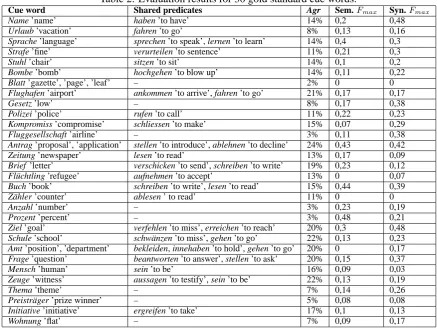
Agreement results for every cue word are re-ported in table 2. Second column of the table contains gold standard predicates which were pro-vided by all 3 participants treating the same word.4 Averaging over all words, we got a mean agree-ment of 13%. Though this value seems to be low, it is consistent with a mean agreement of 11,8% for a similar task reported in (Cimiano and deroth, 2007), see section 3. Cimiano and Wen-deroth (2007) show that the lowest agreement is yielded for more abstract words, while the agree-ment for very concrete words is reasonable. We could not make a similar observation, see table 2.
Comparison with the Gold Standard
In the first experiment we checked whether pred-icates which people associate with the test argu-ments can be automatically extracted by our pro-cedure. For this aim we compared the gold stan-dard with all automatically extracted argument-predicate relations5containing some of the 30 cue words as follows. These relations were ranked ac-cording to the relatedness measure described in previous section. In line with (Cimiano and Wen-deroth, 2007) we exploited an approach common in information retrieval for estimating the qual-ity of correspondence of a ranked output to a gold standard, see (Baeza-Yates and Ribeiro-Neto, 1999).
Given somenautomatically extracted relations with the highest ranking we calculated a precision-recall curve expressing precision and precision-recall of our procedure compared to the gold standard. The pre-cision characterizes the procedure exactness, i.e. how many redundant relations are retrieved. The
4The overall gold standard consists of 33 tuples. 5
recall measures the completeness, i.e. how many relations of the gold standard are extracted auto-matically. For each point of the curve (which is a pair(p, r)of values of precisionpand recallr) we calculated theF-measure asF = 2pr/(p+r) which is the harmonic mean between recall and precision. The precision-recall curve is a set of precision values for the prespecified recall levels varying from 0 to 1 with a step 0,1. Then, to pro-duce only one value evaluating the quality of the ranked output compared to the gold standard, for each precision-recall curve we calculated Fmax, the maximal value of the F-measure achieved for the points of this curve. Fmax expresses the best trade-off between precision and recall for the given ranked output. Finally, among all possible n (numbers of the considered relations with the highest ranking) we selected that one which pro-vides the maximalFmaxvalue.
The resulting maximalFmaxvalues are 0,47 for the procedure extracting AP-relations on the basis of the semantic annotation and 0,41 for the pro-cedure using the syntactic annotation only. We compared these results with the baseline results of maximalFmax values produced for the output with random ranking. The calculation of the base-line was repeated 100 times, each time a new ran-dom ranking was generated. The lowest baseline results are 0,08/0,06 (semantic/syntactic annota-tion), the highest are 0,18/0,14 and the medians are 0,1/0,07. One can see that the results produced using the relatedness measure (0,47/0,41) greatly exceed the baseline. Based on this comparison we conclude that the ranking done using the related-ness measure brings a significant advantage. The values of precision and recall for the reported max-imalFmaxvalues are 0,5/0,33 (semantic/syntactic annotation) and 0,45/0,54 respectively. This re-sults show that half of the AP-relations from the gold standard appeared to be in the list of the top-ranked tuples extracted by the “semantic” proce-dure, while the size of this list (n = 28) was al-most equal to the size of the gold standard (33). The differences in performance between the “se-mantic” and “syntactic” procedures could be ex-plained by the fact that the “syntactic” procedure finds in the corpus more related predicates for ev-ery argument than the “semantic” one. Neverthe-less, the “semantic” procedure shows better per-formance.
Next we investigated the results for each
argu-ment used in the gold standard separately in the same way as described above. For each argument the Fmax measure has been computed. Because of the low agreement between the subjects ques-tioned for the gold standard (see above), in these calculations we considered all predicates reported by our subjects. The calculatedFmax values are reported in table 2 which shows a correlation be-tweenFmax values calculated for the “semantic” and “syntactic” procedures. However, there is no correlation with human agreement. This issue needs a further investigation, see section 7.
Human Judgments of the Relatedness
Following (Cimiano and Wenderoth, 2007), in or-der to check whether the calculated relatedness is reasonable according to human intuition, we have performed another experiment. For each of the 30 words selected for the gold standard we selected the 5 top ranked predicates. Since for some of the cue arguments only 3 predicates were found in the corpus, the final test set contains only 138 argument-predicate tuples. From these tuples we generated short grammatically correct phrases structurally similar to those in example 3. These phrases were uniformly distributed among 10 sub-jects so that every phrase was evaluated by one subject. The participants were asked to rate the phrases with respect to their naturalness using a scale from 0 to 3, whereby 0 means ’unnatural’, 1 ’possible’, 2 ’natural’ and 3 ’totally natural and self-evident’.
Table 2: Evaluation results for 30 gold standard cue words.
Cue word Shared predicates Agr Sem.Fmax Syn.Fmax
Name ’name’ haben ’to have’ 14% 0,2 0,48
Urlaub ’vacation’ fahren ’to go’ 8% 0,13 0,16
Sprache ’language’ sprechen ’to speak’, lernen ’to learn’ 14% 0,4 0,3 Strafe ’fine’ verurteilen ’to sentence’ 11% 0,21 0,3
Stuhl ’chair’ sitzen ’to sit’ 14% 0,1 0,2
Bombe ’bomb’ hochgehen ’to blow up’ 14% 0,11 0,22
Blatt ’gazette’, ’page’, ’leaf’ – 2% 0 0
Flughafen ’airport’ ankommen ’to arrive’, fahren ’to go’ 21% 0,17 0,17
Gesetz ’low’ – 8% 0,17 0,38
Polizei ’police’ rufen ’to call’ 11% 0,22 0,23
Kompromiss ’compromise’ schliessen ’to make’ 15% 0,07 0,29
Fluggesellschaft ’airline’ – 3% 0,11 0,38
Antrag ’proposal’, ’application’ stellen ’to introduce’, ablehnen ’to decline’ 24% 0,43 0,42 Zeitung ’newspaper’ lesen ’to read’ 13% 0,17 0,09 Brief ’letter’ verschicken ’to send’, schreiben ’to write’ 19% 0,23 0,12 Fl¨uchtling ’refugee’ aufnehmen ’to accept’ 13% 0 0,07 Buch ’book’ schreiben ’to write’, lesen ’to read’ 15% 0,44 0,39
Z¨ahler ’counter’ ablesen ’ to read’ 11% 0 0
Anzahl ’number’ – 3% 0,23 0,19
Prozent ’percent’ – 3% 0,48 0,21
Ziel ’goal’ verfehlen ’to miss’, erreichen ’to reach’ 20% 0,3 0,48 Schule ’school’ schw¨anzen ’to miss’, gehen ’to go’ 22% 0,13 0,23 Amt ’position’, ’department’ bekleiden, innehaben ’to hold’, gehen ’to go’ 20% 0 0,17 Frage ’question’ beantworten ’to answer’, stellen ’to ask’ 20% 0,15 0,37
Mensch ’human’ sein ’to be’ 16% 0,09 0,03
Zeuge ’witness’ aussagen ’to testify’, sein ’to be’ 22% 0,13 0,19
Thema ’theme’ – 7% 0,14 0,26
Preistr¨ager ’prize winner’ – 5% 0,08 0,08
Initiative ’initiative’ ergreifen ’to take’ 17% 0,1 0,13
Wohnung ’flat’ – 7% 0,09 0,17
7 Conclusion and Discussion
In this paper we presented an approach to auto-matic extraction of argument-predicate relations from a frame-annotated corpus.6 In our approach we aimed to combine the advantages offered by annotated and unannotated lexical resources. Be-sides extracting AP-pairs the proposed method al-lows us to define types of semantic relations in terms of FrameNet frames. The proposed proce-dure is not restricted to arguments expressed by nouns and treats also other content parts of speech. The main goal of this paper was to show that though manually annotated corpora usually have a relatively small size, they can be successfully exploited for the relation extraction. An obvious limitation of the presented approach is that it is bounded to manual annotations which are hard to obtain. However, since semantic annotations are useful for many different goals in linguistics and NLP, the number of reliable annotated cor-pora constantly grows.7 Moreover, recently
sev-6The complete list of the extracted AP-relations as well as the results of the experiment will be available online at http://www.ikw.uni-osnabrueck.de/∼eovchinn/APrels/.
7At present FrameNet annotated corpora are
eral tools have been developed which perform role annotation automatically, for example see (Erk and Pado, 2006). Therefore we believe that ap-proaches using semantic annotation are valid and promising. In the future we plan to experiment with large role-annotated corpora for English such as PropBank (approx. 300 000 words, (Palmer et al., 2005)) and the FrameNet-annotated corpus provided by the FN project (more than 135 000 annotated sentences, (Ruppenhofer et al., 2006)). Since these corpora do not contain syntactic anno-tation, for extracting argument-predicate relations we will need to parse annotated sentences.
There are several ways to improve the proposed procedure. First, an implementation of a more advanced anaphora resolution algorithm treating pronominal as well as nominal anaphora should significantly raise the precision/recall characteris-tics. Second, splitting German compounds occur-ring in the corpus should provide additional ev-idence. We have treated such words as Kunde ’client’ and Privatkunde ’private client’ as differ-ent lexemes, while they are strongly related
mantically and information about predicates co-occurring with the second word could probably be used for describing the semantics of the first one. Concerning relatedness measure, additional corpus-based measures such as Web-based mea-sures (Cimiano and Wenderoth, 2007) or meamea-sures based on syntactic relations (Pustejovsky et al., 1993) could appear to be useful for improving the ranking of the extracted relations.
The presented procedure was evaluated quanti-tatively against human judgments obtained experi-mentally. The participants of the experiment were asked to provide short phrases containing given cue words and predicates associated with these words as well as to rate phrases generated from the automatically extracted AP-relations. Concerning the first experiment, the low human agreement has shown that the proposed association task appeared to be difficult for the subjects. Nevertheless, the described learning procedure proved to extract in-tuitively reasonable relations.
The evaluation strategy presented in this pa-per on relies on the underlying assumptions (A1 and A2 in section 5) and is compatible with the other approaches to relation extraction, cf. (Cimi-ano and Wenderoth, 2007). However, it is plau-sible that human responses in the context of pro-viding associated predicates for target words will differ from the responses in the experimental set-tings where subjects are asked to infer implicit predicates, e.g. to extend phrases containing im-plicit predicates. In the future we plan to im-plement a procedure making use of the extracted AP-relations which would automatically extend phrases containing implicit predicates. Then we intend to compare output results of the procedure with the human responses. Additionally, a study of a possible correspondence between human agree-ment on associated predicates and a semantic type of an argument (e.g. concrete/abstract, natural kind/artifact) should be performed on more test ar-guments.
Potential Applications
As already mentioned in the literature, see for ex-ample (Lapata and Lascarides, 2003), knowledge about implicit predicates could be potentially use-ful for a variety of NLP tasks such as language generation, information extraction, question an-swering or machine translation. Many applica-tions of semantic relaapplica-tions in NLP are connected
to paraphrasing or query expansion, see for ex-ample (Voorhees, 1994). Suppose that a search engine or a question answering system receives the query schnelle Bombe ’quick bomb’. Prob-ably, in this case the user is interested in find-ing information about bombs that explode quickly rather then about bombs in general. Knowledge about predicates associated with the noun Bombe ’bomb’ could be used for predicting a set of prob-able implicit predicates. For generation of the se-mantically and syntactically correct paraphrases it is sometimes not enough to guess the most prob-able argument-predicate pairs. Information about types of an argument-predicate relation could be helpful, i.e. which semantic and syntactic posi-tion does the argument fill in the argument struc-ture of the predicate. For example, compare
eine Bombe explodiert schnell ’a bomb explodes
quickly’ for schnelle Bombe with ein Buch schnell
lesen/schreiben ’to read/write a book quickly’ for schnelles Buch ’quick book’. In the first case the
argument Bombe fills the subject position, while in the second case Buch fills the object posi-tion. Since FrameNet contains information about syntactic realization patterns for frame elements, representation of argument-predicate relations in terms of frames directly supports generation of se-mantically and syntactically correct paraphrases.
The described procedure could also support manual development of a lexical resource, provid-ing evidence from corpora as well as the distribu-tional information.
References
Ricardo Baeza-Yates and Berthier Ribeiro-Neto. 1999.
Modern Information Retrieval. Addison Wesley, Harlow, 1. aufl. edition.
Sabine Brants, Stefanie Dipper, Silvia Hansen, Wolf-gang Lezius, and George Smith. 2002. The TIGER treebank. In Proceedings of the Workshop on
Tree-banks and Linguistic Theories.
Ted Briscoe, Ann Copestake, and Bran Boguraev. 1990. Enjoy the paper: Lexical semantics via lex-icology. In Proceedings of the 13th International
Conference on Computational Linguistics, pages
42–47.
John Bullinaria and Joseph Levy. 2007. Extracting semantic representations from word co-occurrence statistics: A computational study. Behavior Re-search Methods, 39(3):510–526.
2006. The SALSA corpus: A German corpus re-source for lexical semantics. In Proceedings of
LREC 2006, pages 969–974.
Philipp Cimiano and Johanna Wenderoth. 2007. Auto-matic Acquisition of Ranked Qualia Structures from the Web. In Proceedings of the Annual Meeting
of the Association for Computational Linguistics,
pages 888–895.
Scott Deerwester, Susan T. Dumais, George W. Furnas, Thomas K. Landauer, and Richard Harshman. 1990. Indexing by Latent Semantic Analysis. American
Society of Information Science, 41(6):391–407.
Katrin Erk and Sebastian Pado. 2006. Shalmaneser -a flexible toolbox for sem-antic role -assignment. In
Proceedings of LREC 2006, Genoa, Italy.
Charles J. Fillmore. 1976. Frame semantics and the nature of language. In Annals of the New York
Academy of Sciences: Conference on the Origin and Development of Language and Speech, volume 280,
pages 20–32.
Mirella Lapata and Alex Lascarides. 2003. A Prob-abilistic Account of Logical Metonymy.
Computa-tional Linguistics, 29(2):261–316.
Vivi Nastase, Jelber Sayyad-Shirabad, Marina Sokolova, and Stan Szpakowicz. 2006. Learning noun-modifier semantic relations with corpus-based and wordnet-based features. In Proceedings of the
AAAI 2006.
Martha Palmer, Dan Gildea, and Paul Kingsbury. 2005. The Proposition Bank: A Corpus Annotated with Semantic Roles. Computational Linguistics, 31(1):71–106.
James Pustejovsky, Peter Anick, and Sabine Bergler. 1993. Lexical semantic techniques for corpus anal-ysis. Computational Linguistics, 19(2):331–358.
James Pustejovsky, Catherine Havasi, Roser Saur, Patrick Hanks, Anna Rumshisky, Jessica Littman, Jos Castao, and Marc Verhagen. 2006. Towards a generative lexical resource: The Brandeis Semantic Ontology. In Proceedings of the Fifth Language
Re-source and Evaluation Conference.
James Pustejovsky. 1991. The Generative Lexicon.
Computational Linguistics, 17(4):409–441.
Josef Ruppenhofer, Michael Ellsworth, Miriam R. L. Petruck, Christopher R. Johnson, and Jan Schef-fczyk. 2006. FrameNet II: Extended Theory and Practice. International Computer Science Institute.
Ellen M. Voorhees. 1994. Query expansion using lexical-semantic relations. In Proceedings of the