Semi-supervised Speech Act Recognition in Emails and Forums
Minwoo Jeong†∗ Chin-Yew Lin‡ Gary Geunbae Lee†
†Pohang University of Science & Technology, Pohang, Korea ‡Microsoft Research Asia, Beijing, China
†{stardust,gblee}@postech.ac.kr ‡[email protected]
Abstract
In this paper, we present a semi-supervised method for automatic speech act recogni-tion in email and forums. The major chal-lenge of this task is due to lack of labeled data in these two genres. Our method leverages labeled data in the Switchboard-DAMSL and the Meeting Recorder Dia-log Act database and applies simple do-main adaptation techniques over a large amount of unlabeled email and forum data to address this problem. Our method uses automatically extracted features such as phrases and dependency trees, called sub-tree features, for semi-supervised learn-ing. Empirical results demonstrate that our model is effective in email and forum speech act recognition.
1 Introduction
Email and online forums are important social me-dia. For example, thousands of emails and posts are created daily in online communities, e.g., Usenet newsgroups or the TripAdvisor travel fo-rum1, in which users interact with each other us-ing emails/posts in complicated ways in discus-sion threads. To uncover the rich interactions in these email exchanges and forum discussions, we propose to apply speech act recognition to email and forum threads.
Despite extensive studies of speech act tion in many areas, developing speech act recogni-tion for online forms of conversarecogni-tion is very chal-lenging. A major challenge is that emails and forums usually have no labeled data for training statistical speech act recognizers. Fortunately, la-beled speech act data are available in other do-mains (i.e., telephone and meeting conversations
∗This work was conducted during the author’s internship at Microsoft Research Asia.
1http://tripadvisor.com/
in this paper) and large unlabeled data sets can be collected from the Web. Thus, we focus on the problem of how to accurately recognize speech acts in emails and forums by making maximum use of data from existing resources.
Recently, there are increasing interests in speech act recognition of online text-based con-versations. Analysis of speech acts for online chat and instant messages and have been studied in computer-mediated communication (CMC) and distance learning (Twitchell et al., 2004; Nastri et al., 2006; Ros´e et al., 2008). In natural language processing, Cohen et al. (2004) and Feng et al. (2006) used speech acts to capture the intentional focus of emails and discussion boards. However, they assume that enough labeled data are available for developing speech act recognition models.
A main contribution of this paper is that we ad-dress the problem of learning speech act recog-nition in a semi-supervised way. To our knowl-edge, this is the first use of semi-supervised speech act recognition in emails and online forums. To do this, we make use of labeled data from spo-ken conversations (Jurafsky et al., 1997; Dhillon et al., 2004). A second contribution is that our model learns subtree features that constitute dis-criminative patterns: for example, variable length
n-grams and partial dependency structures. There-fore, our model can capture both local features such as n-grams and non-local dependencies. In this paper, we extend subtree pattern mining to the semi-supervised learning problem.
This paper is structured as follows. Section 2 reviews prior work on speech act recognition and Section 3 presents the problem statement and our data sets. Section 4 describes a supervised method of learning subtree features that shows the effec-tiveness of subtree features on labeled data sets. Section 5 proposes semi-supervised learning tech-niques for speech act recognition and Section 6 demonstrates our method applied to email and
line forum thread data. Section 7 concludes this paper with future work.
2 Related Work
Speech act theory is fundamental to many stud-ies in discourse analysis and pragmatics (Austin, 1962; Searle, 1969). A speech act is an illo-cutionary act of conversation and reflects shal-low discourse structures of language. Recent re-search on spoken dialog processing has investi-gated computational speech act models of human-human and human-human-computer conversations (Stol-cke et al., 2000) and applications of these mod-els to CMC and distance learning (Twitchell et al., 2004; Nastri et al., 2006; Ros´e et al., 2008).
Our work in this paper is closely related to prior work on email and forum speech act recognition. Cohen et al. (2004) proposed the notion of ‘email speech act’ for classifying the intent of an email sender. They defined verb and noun categories for email speech acts and used supervised learn-ing to recognize them. Feng et al. (2006) pre-sented a method of detecting conversation focus based on the speech acts of messages in discus-sion boards. Extending Feng et al. (2006)’s work, Ravi and Kim (2007) applied speech act classifi-cation to detect unanswered questions. However, none of these studies have focused on the semi-supervised speech act recognition problem and ex-amined their methods across different genres.
The speech processing community frequently employs two large-scale corpora for speech act annotation: Switchboard-DAMSL (SWBD) and Meeting Recorder Dialog Act (MRDA).SWBDis an annotation scheme and collection of labeled di-alog act2data for telephone conversations (Juraf-sky et al., 1997). The main purpose ofSWBDis to acquire stochastic discourse grammars for train-ing better language models for automatic speech recognition. More recently, anMRDAcorpus has been adapted from SWBD but its tag set for la-beling meetings has been modified to better reflect the types of interaction in multi-party face-to-face meetings (Dhillon et al., 2004). These two corpora have been extensively studied, e.g., (Stolcke et al., 2000; Ang et al., 2005; Galley et al., 2004). We also use these for our experiments.
2A dialog act is the meaning of an utterance at the level
of illocutionary force (Austin, 1962), and broadly covers the speech act and adjacency pair (Stolcke et al., 2000). In this paper, we use only the term ‘speech act’ for clarity.
This paper focuses on the problem of semi-supervised speech act recognition. The goal of semi-supervised learning techniques is to use aux-iliary data to improve a model’s capability to rec-ognize speech acts. The approach in Tur et al. (2005) presented semi-supervised learning to em-ploy auxiliary unlabeled data in call classification, and is closely related to our work. However, our approach uses the most discriminative subtree fea-tures, which is particularly attractive for reducing the model’s size. Our problem setting is closely re-lated to the domain adaptation problem (Ando and Zhang, 2005), i.e., we seek to obtain a model that analyzes target domains (emails and forums) by adapting a method that analyzes source domains (SWBD and MRDA). Recently, this type of do-main adaptation has become an important topic in natural language processing.
3 Problem Definition
3.1 Problem Statement
We define speech act recognition to be the task that, given a sentence, maps it to one of the speech act types. Figure 1 shows two examples of our email and forum speech act recognition. E1∼6 are all sentences in an email message. F1∼3, F4∼5, and F6 are three posts in a forum thread. A sen-tence interacts alone or with others, for example, F6 agrees with the previous post (F4∼5). To gain insight into our work, it is useful to consider that E2, 3 and F1, 4, 6 are summaries of two dis-courses. In particular, F1 denotes a question and F4 and F6 are corresponding answers. More re-cently, using speech acts has become an appealing approach in summarizing the discussions (Galley et al., 2004; McKeown et al., 2007).
E1: I am planning my schedule at CHI 2003 (http://www.chi2003.org/) S E2:- will there be anything happening at the conference related to this W3C User interest group? QY E3:I do not see anything on the program yet, but I suspect we could at least have an informal SIG S E4: - a chance to meet others and bring someone like me up to speed on what is happening. S E5: There will be many competing activities, so the sooner we can set this up the more likely I can attend. S
E6: Keith S
F1:If given a choice, should I choose Huangpu area, or should I choose Pudong area? QR F2: Both location are separated by a Huangpu river, not sure which area is more convenient for sight seeing? QW
F3: Thanks in advance for reply! P
[image:3.595.84.512.58.185.2]F4:Stay on the Puxi side of the Huangpu river and visit the Pudong side by the incredible tourist tunnel. AC F5: If you stay on the Pudong side add half an hour to visit the majority of the tourist attractions. S F6:I definitely agree with previous post. AA
[image:3.595.94.263.267.446.2]Figure 1: Examples of speech act recognition in emails and online forums. Tags are defined in Table 1.
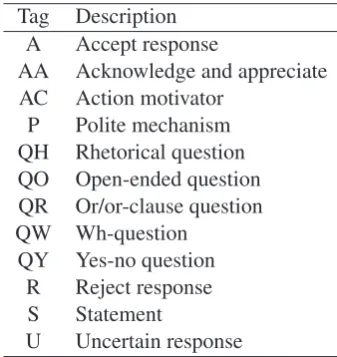
Table 1: Tags used to describe components of speech acts
Tag Description A Accept response
AA Acknowledge and appreciate AC Action motivator
P Polite mechanism QH Rhetorical question QO Open-ended question QR Or/or-clause question QW Wh-question
QY Yes-no question R Reject response S Statement
U Uncertain response
The goal of semi-supervised speech act recogni-tion is to learn a classifier using both labeled and unlabeled data. We formally define our problem as follows. Letx={xj}be aforest, i.e., a set of trees that represents a natural language structure, for example, a sequence of words and a depen-dency parse tree. We will describe this in more detail in Section 4. Lety be aspeech act. Then, we defineDL = {xi, yi}ni=1 as the set of labeled training data, andDU = {xi}li=n+1 as the set of unlabeled training data wherel=n+mandmis the number of unlabeled data instances. Our goal is to find a learning method to minimize the clas-sification errors inDLandDU.
3.2 Data Preparation
In this paper, we separate labeled (DL) and un-labeled data (DU). First we use SWBD3 and MRDA4 as our labeled data. We automatically
3LDC Catalog No. LDC97S62
4http://www.icsi.berkeley.edu/∼ees/dadb/
map original annotations inSWBDandMRDAto one of the 12 speech acts.5 Inter-annotator agree-mentκin both data sets is∼ 0.8(Jurafsky et al., 1997; Dhillon et al., 2004). For evaluation pur-poses, we divide labeled data into three sets: train-ing, development, and evaluation sets (Table 2). Of the 1,155 available conversations in theSWBD corpus, we use 855 for training, 100 for devel-opment, and 200 for evaluation. Among the 75 available meetings in the MRDA corpus, we ex-clude two meetings of different natures (btr001 and btr002). Of the remaining meetings, we use 59 for training, 6 for development, and 8 for eval-uation. Then we merge multi-segments utterances that belong to the same speaker and then divide all data sets into sentences.
As stated earlier, our unlabeled data consists of email (EMAIL) and online forum (FORUM) data. For the EMAIL set, we selected 22,391 emails from Enron data6 (discussion threads, all documents, and calendar folders). For the FO-RUMset, we crawled 11,602 threads and 55,743 posts from the TripAdvisor travel forum site (Bei-jing, Shanghai, and Hongkong forums). As our evaluation sets, we used 40 email threads of the BC3 corpus7forEMAILand 100 threads selected from the same travel forum site forFORUM. Ev-ery sentences was automatically segmented by the MSRA sentence boundary detector (Table 2). An-notation was performed by two human annotators, and inter-annotator agreements wereκ= 0.79for EMAILandκ= 0.73forFORUM.
Overall performance of automatic evaluation measures usually depends on the distribution of tags. In both labeled and unlabeled sets, the most
5Our mapping tables are available at
http://home.postech.ac.kr/∼stardust/acl09/.
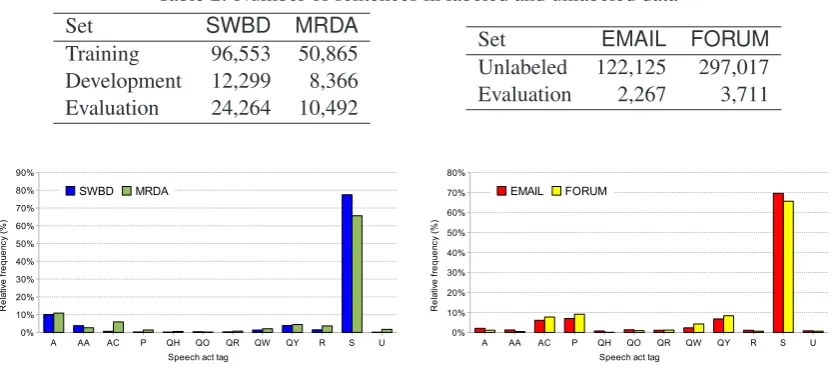
Table 2: Number of sentences in labeled and unlabeled data Set SWBD MRDA
Training 96,553 50,865 Development 12,299 8,366 Evaluation 24,264 10,492
[image:4.595.316.518.317.383.2]Set EMAIL FORUM Unlabeled 122,125 297,017 Evaluation 2,267 3,711
Figure 2: Distribution of speech acts in the evaluation sets. Tags are defined in Table 1.
frequent tag is the statement (S) tag (Figure 2). Distributions of tags are similar in training and de-velopment sets ofSWBDandMRDA.
4 Speech Act Recognition
Previous work in speech act recognition used a large set of lexical features, e.g., bag-of-words, bigrams and trigrams (Stolcke et al., 2000; Co-hen et al., 2004; Ang et al., 2005; Ravi and Kim, 2007). However, these methods create a large number of lexical features that might not be nec-essary for speech act identification. For example, a Wh-question “What site should we use to book a Beijing-Chonqing flight?” can be predicted by two discriminative features, “(<s>, WRB) → QW” and “(?, </s>) → QW” where <s> and </s>
are sentence start and end symbols, and WRB is a part-of-speech tag that denotes a Wh-adverb. In addition, useful features could be of various lengths, i.e. not fixed length n-grams, and non-adjacent. One key idea of this paper is a novel use of subtree features to model these for speech act recognition.
4.1 Exploiting Subtree Features
To exploit subtree features in our model, we use a subtree pattern mining method proposed by Kudo and Matsumoto (2004). We briefly intro-duce this algorithm here. In Section 3.1, we de-finedx= {xj}as the forest that is a set of trees. More precisely,xjis a labeled ordered tree where each node has its own label and is ordered left-to-right. Several types of labeled ordered trees
Figure 3: Representations of tree: (a) bag-of-words, (b)n-gram, (c) word pair, and (d) depen-dency tree. A node denotes a word and a directed edge indicates a parent-and-child relationship.
are possible (Figure 3). Note that S-expression can be used instead for computation, for example
(a(b(c(d)))) for the n-gram (Figure 3(b)). Moreover, we employ a combination of multiple trees as the input of the subtree pattern mining al-gorithm.
We extract subtree features from the forest set
{xi}. A subtree t is a tree if t ⊆ x. For exam-ple,(a),(a(b)), and(b(c(d)))are subtrees of Figure 3(b). We define the subtree feature as a weak learner:
f(y, t,x), (
+y t⊆x,
−y otherwise, (1)
where we assume a binary case y ∈ Y =
the dependency subtrees which should have 3 or more nodes. Second, our method is of interest for semi-supervised learning problems. To learn subtree features, Kudo and Matsumoto (2004) as-sumed supervised data {(xi, yi)}. Here, we scribe the supervised learning method and will de-scribe our semi-supervised method in Section 5.
4.2 Supervised Boosting Learning
Given training examples, we construct a ensem-ble learnerF(x) = Pkλkf(yk, tk,x), whereλk is a coefficient for linear combination. A final classifier h(x) can be derived from the ensemble learner, i.e.,h(x) ,sgn(F(x)). As an optimiza-tion framework (Mason et al., 2000), the objective of boosting learning is to findFsuch that the cost of functional
C(F) =X i∈D
αiC[yiF(xi)] (2) is minimized for some non-negative and monoton-ically decreasing cost functionC : R → R and the weight αi ∈ R+. In this paper, we use the AdaBoost algorithm (Schapire and Singer, 1999); thus the cost function is defined asC(z) =e−z.
Constructing an ensemble learner requires that the user choose a base learner, f(y, t,x), to maximize the inner product −h∇C(F), fi (Ma-son et al., 2000). Finding f(y, t,x) to maxi-mize−h∇C(F), fi is equivalent to searching for
f(y, t,x) to minimize 2Pi:f(y,t,xi)6=yiwi − 1, where wi for i ∈ DL, is the empirical data dis-tributionw(k)i at stepk. It is defined as:
wi(k)=αi·e−yiF(xi). (3) From Eq. 3, a proper base learner (i.e., subtree) can be found by maximizing weighted gain, where
gain(t, y) = X i∈DL
yiwif(y, t,xi). (4) Thus, subtree mining is formulated as the prob-lem of finding (ˆt,yˆ) = arg max
(t,y)∈X ×Ygain(t, y). We
need to search with respect to a non-monotonic score function (Eq. 4), thus we use the monotonic bound, gain(t, y)≤µ(t), where
µ(t) = max
2Xwi
{i|yi=+1,t⊆xi}
−Xn
i=1
yif(y, t,xi),
2Xwi
{i|yi=−1,t⊆xi}
+ n
X
i=1
yif(y, t,xi)
. (5)
Table 3: Result of supervised learning experiment; columns are micro-averagedF1score with
macro-averaged F1 score in parentheses. MAXENT:
maximum entropy model; BOW: bag-of-words
model; NGRAM: n-gram model; +POSTAG,
+DEPTREE, +SPEAKER indicate that the
com-ponents were added individually onto NGRAM.
‘?’ indicates results significantly better than the
NGRAMmodel (p <0.001).
Model SWBD MRDA
MAXENT 92.76 (63.54) 82.48 (57.19)
BOW 91.32 (54.47) 82.17 (55.42)
NGRAM 92.60 (58.43) 83.30 (57.53)
+POSTAG 92.69 (60.07) 83.60 (58.46)
+DEPTREE 92.67 (61.75) ?83.57 (57.45)
+SPEAKER ?92.86 (63.13) 83.40 (58.20)
ALL ?92.87 (63.77) 83.49 (59.04)
The subtree set is efficiently enumerated using a branch-and-bound procedure based onµ(t)(Kudo and Matsumoto, 2004).
After finding an optimal base leaner,f(ˆy,ˆt,x), we need to set the coefficientλkto form a new en-semble, F(xi) ← F(xi) +λkf(ˆt,y,ˆ xi). In Ad-aBoost, we choose
λk= 12log
µ
1 +gain(ˆt,yˆ) 1−gain(ˆt,yˆ)
¶
. (6)
AfterK iterations, the boosting algorithm returns the ensemble learnerF(x)which consists of a set of appropriate base learnersf(y, t,x).
4.3 Evaluation on Labeled Data
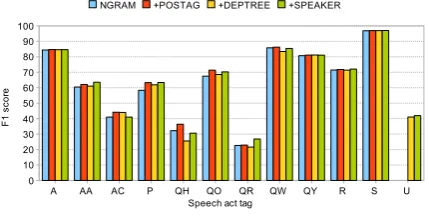
Figure 4: Comparison of different trees (SWBD)
We show that use of subtree features is ef-fective to solve the supervised speech act recog-nition problem. We also compared our model with the state-of-the-art maximum entropy classi-fier (MAXENT). We used bag-of-words, bigram and trigram features for MAXENT, which mod-eled 702k (SWBD) and 460k (MRDA) parameters (i.e., patterns), and produced micro-averaged F1 scores of 92.76 (macro-averagedF1 = 63.54) for SWBD and 82.48 (macro-averaged F1 = 57.19) forMRDA. In contrast, our method generated ap-proximately 4k to 5k patterns on average with sim-ilar or greater F1 scores (Table 3); hence, com-pared to MAXENT, our model requires fewer cal-culations and is just as accurate.
Then-gram model (NGRAM) performed signif-icantly better than the bag-of-words model (Mc-Nemar test; p < 0.001) (Table 3). Unlike MAX -ENT, NGRAMautomatically selects a relevant set of variable length n-gram features (i.e., phrase features). To this set, we separately added two syntax type features, part-of-speech tag n-gram (POSTAG) and dependency parse tree (DEPTREE) automatically parsed by Minipar8, and one dis-course type feature, speaker n-gram (SPEAKER). Although some micro-averagedF1are not statisti-cally significant between the original NGRAMand the models that include POSTAG, DEPTREE or SPEAKER, macro-averagedF1values indicate that minor classes can take advantage of other struc-tures. For example, in the result of SWBD (Fig-ure 4), DEPTREE and SPEAKER models help to predict uncertain responses (U), whereas NGRAM and POSTAGcannot do this.
5 Semi-supervised Learning
Our goal is to eventually make maximum use of existing resources in SWBD and MRDA for
8http://www.cs.ualberta.ca/∼lindek/minipar.htm
email/forum speech act recognition. We call the model trained on the mixed data of these two cor-pora BASELINE. We use ALL features in con-structing the BASELINE for the semi-supervised experiments. While this model gave promising re-sults usingSWBDandMRDA, language used in emails and forums differs from that used in spo-ken conversation. For example, ‘thanx’ is an ex-pression commonly used as a polite mechanism in online communications. To adapt our model to understand this type of difference between spoken and online text-based conversations, we should in-duce new patterns from unlabeled email and fo-rum data. We describe here two methods of semi-supervised learning.
5.1 Method 1: Bootstrapping
First, we bootstrap the BASELINEmodel using au-tomatically predicted unlabeled examples. How-ever, using all of the unlabeled data results in noisy models; therefore filtering or selecting data is very important in practice. To this end, we only select similar examples by criterion,d(xi,xj) < rork nearest neighbors wherexi ∈ DL andxj ∈ DU. In practice,rorkare fixed. In our method, exam-ples are represented by trees; hence we use a “tree edit distance” for calculating d(xi,xj) (Shasha and Zhang, 1990). Selected examples are evalu-ated using BASELINE, and using subtree pattern mining runs on the augmented data (i.e. unla-beled). We call this method BOOTSTRAP.
5.2 Method 2: Semi-supervised Boosting
Our second method is based on a principle of semi-supervised boosting learning (Bennett et al., 2002). Because we have no supervised guidance for DU, our objective functional to find F is de-fined as:
C(F) = X i∈DL
αiC[yiF(xi)] +
X
i∈DU
βiC[|F(xi)|]
(7)
This cost functional is non-differentiable. To solve it, we introduce pseudo-labelsy˜wherey˜=
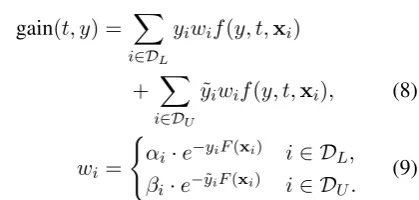
gain function and update rules: gain(t, y) = X
i∈DL
yiwif(y, t,xi)
+ X i∈DU
˜
yiwif(y, t,xi), (8)
wi =
(
αi·e−yiF(xi) i∈ DL,
βi·e−y˜iF(xi) i∈ DU. (9) Intuitively, an unlabeled example that has a high-confidence |F(x)| at the current step, will probably receive more weight at the next step. That is, similar instances become more impor-tant when learning and mining subtrees. This semi-supervised boosting learning iteratively gen-erates pseudo-labels for unlabeled data and finds the value ofFthat minimizes training errors (Ben-nett et al., 2002). Also, the algorithm infers new features from unlabeled data, and these features are iteratively re-evaluated by the current ensem-ble learner. We call this method SEMIBOOST. 6 Experiment
6.1 Setting
We describe specific settings used in our exper-iment. Because we have no development set, we set the maximum number of iterations K at 10,000. At mostK patterns can be extracted, but this seldom happens because duplicated patterns are merged. Typical settings for semi-supervised boosting are αi = 1 and βi = 0.5, that is, we penalize the weights for unlabeled data.
For efficiency, BASELINE model used 10% of theSWBD andMRDAdata, selected at random. We observed that this data set does not degrade the results of semi-supervised speech act recognition. For BOOTSTRAP and SEMIBOOST, we selected k = 100 nearest neighbors of unlabeled exam-ples for each labeled example using tree edit dis-tance, and then used 24,625 (SWBD) and 54,961 (MRDA) sentences for the semi-supervised set-ting.
[image:7.595.81.291.81.181.2]All trees were combined as described in Section 4.3 (ALLmodel). InEMAILandFORUMdata we added different types of discourse features: mes-sage type (e.g., initial or reply posts), authorship (e.g., an identification of 2nd or 3rd posts written by the same author), and relative position of a sen-tence. In Figure 1, for example, F1∼3 is an initial post, and F4∼5 and F6 are reply posts. Moreover, F1, F4, and F6 are the first sentence in each post.
Table 4: Results of speech act recognition on on-line conversations; columns are micro-averaged F1score with macro-averaged scores in
parenthe-ses. ‘?’ indicates that the result is significantly
bet-ter than BASELINE(p <0.001).
Model EMAIL FORUM
BASELINE 78.87 (37.44) 78.93 (35.57)
BOOTSTRAP ?83.11 (44.90) 79.09 (44.38)
SEMIBOOST ?82.80 (44.64) ?81.76 (44.21)
SUPERVISED 90.95 (75.71) 83.67 (40.68)
These features do not occur inSWBDorMRDA because these are utterance-by-utterance conver-sations.
6.2 Result and Discussion
First, we show that our method of semi-supervised learning can improve modeling of the speech act of emails and forums. As our baseline, BASELINE achieved a micro-averaged F1 score of ∼ 79 for both data sets. This implies that SWBD andMRDAdata are useful for our prob-lem. Using unlabeled data, semi-supervised meth-ods BOOTSTRAP and SEMIBOOST perform bet-ter than BASELINE(Table 4; Figure 5). To verify our claim, we evaluated the supervised speech act recognition on EMAIL and FORUM evaluation sets with 5-fold cross validation (SUPERVISED in Table 4). In particular, our semi-supervised speech act recognition is competitive with the supervised model inFORUMdata.
(a)EMAIL (b)FORUM
Figure 5: Result of the semi-supervised learning method
BC3) might have a more fix set of participants. The improvement of less frequent tags is promi-nent, for example 25% for action motivator (AC), 40% for polite mechanism (P), and 15% for rhetor-ical question (QR) error rate reductions were achieved in FORUM data (Figure 5(b)). There-fore, the semi-supervised learning method is more effective with small amounts of labeled data (i.e., less frequent annotations). We believe that despite their relative rarity, these speech acts are more im-portant than the statement (S) in some applica-tions, e.g., summarization.
Next, we give a qualitative analysis for better interpretation of our problem and results. Due to limited space, we focus on FORUMdata, which can potentially be applied to many applications. Of the top ranked patterns extracted by SEMI -BOOST(Figure 6(a)), subtree patterns ofn-gram, part-of-speech, dependency parse trees are most discriminative. The patterns from unlabeled data have relatively lower ranks, but this is not surpris-ing. This indicates that BASELINEmodel provides the base knowledge for semi-supervised speech act recognition. Also, unlabeled data for EMAIL and FORUM help to induce new patterns or ad-just the model’s parameters. As a result, the semi-supervised method is better than the BASELINE when an identical number of patterns is modeled (Figure 6(b)). For this result, we conclude that our method successfully transfers knowledge from a source domain (i.e.,SWBDandMRDA) to a tar-get domain (i.e., EMAIL andFORUM); hence it can be a solution to the domain adaption problem. Finally, we determine the main reasons for error (in SEMIBOOST), to gain insights that may allow development of better models in future work (Fig-ure 6(c)). We sorted speech act tags by their se-mantics and partitioned the confusion matrix into question type (Q*) and statement, which are two
high-level speech acts. Most errors occur in the similar categories, that is, language usage in ques-tion discourse is definitely distinct from that in statement discourse. From this analysis, we be-lieve that more advanced techniques (e.g. two-stage classification and learning with hierarchy-augmented loss) can improve our model.
7 Conclusion
Despite the increasing interest in online text-based conversations, no study to date has investigated semi-supervised speech act recognition in email and forum threads. This paper has addressed the problem of learning to recognize speech acts us-ing labeled and unlabeled data. We have also con-tributed to the development of a novel applica-tion of boosting subtree mining. Empirical results have demonstrated that semi-supervised learning of speech act recognition with subtree features im-proves the performance in email and forum data sets. An attractive future direction is to exploit prior knowledge for semi-supervised speech act recognition. Druck et al. (2008) described gen-eralized expectation criteria in which a discrimi-native model can employ the labeled features and unlabeled instances. Using prior knowledge, we expect that our model will effectively learn useful patterns from unlabeled data.
(a) Example patterns
0 2000 4000 6000
20
25
30
35
40
45
Number of base leaners
Error Rate(%)
BASELINE BOOTSTRAP SEMIBOOST
(b) Learning behavior (c) Confusion matrix
Figure 6: Analysis onFORUMdata
Acknowledgement
We would like to thank to anonymous reviewers for their valuable comments, and Yunbo Cao, Wei Lai, Xinying Song, Jingtian Jing, and Wei Wu for their help in preparing our data.
References
R. Ando and T. Zhang. 2005. A framework for learn-ing predictive structures from multiple tasks and unlabeled data. Journal of Machine Learning Re-search, 6:1817–1853.
J. Ang, Y. Liu, and E. Shriberg. 2005. Automatic dia-log act segmentation and classification in multiparty meetings. InProceedings of ICASSP, pages 1061– 106.
J. Austin. 1962. How to Do Things With Words. Har-vard Univ. Press, Cambridge, MA.
K.P. Bennett, A. Demiriz, and R. Maclin. 2002. Ex-ploiting unlabeled data in ensemble methods. In
Proceedings of ACM SIGKDD, pages 289–296. W.W. Cohen, V.R. Carvalho, and T. Mitchell. 2004.
Learning to classify email into “speech acts”. In
Proceedings of EMNLP, pages 309–316.
R. Dhillon, S. Bhagat, H. Carvey, and E. Shriberg. 2004. Meeting recorder project: Dialog act label-ing guide. Technical report, International Computer Science Institute.
G. Druck, G. Mann, and A. McCallum. 2008. Learn-ing from labeled features usLearn-ing generalized expecta-tion criteria. InProceedings of ACM SIGIR, pages 595–602.
D. Feng, E. Shaw, J. Kim, and E. H. Hovy. 2006. Learning to detect conversation focus of threaded discussions. InProceedings of HLT-NAACL, pages 208–215.
M. Galley, K. McKeown, J. Hirschberg, and E. Shriberg. 2004. Identifying agreement and dis-agreement in conversational speech: use of bayesian networks to model pragmatic dependencies. In Pro-ceedings of ACL.
L. Gillick and S. Cox. 1989. Some statistical issues in the comparison of speech recognition algorithms. In
Proceedings of ICASSP, pages 532–535.
D. Jurafsky, E. Shriberg, and D. Biasca. 1997. Switch-board SWBD-DAMSL labeling project coder’s manual, draft 13. Technical report, Univ. of Col-orado Institute of Cognitive Science.
T. Kudo and Y. Matsumoto. 2004. A boosting algo-rithm for classification of semi-structured text. In
Proceedings of EMNLP, pages 301–308.
S. Levinson. 1983. Pragmatics. Cambridge Univ. Press, Cambridge.
L. Mason, P. Bartlett, J. Baxter, and M. Frean. 2000. Functional gradient techniques for combining hy-potheses. In A.J. Smola, P.L. Bartlett, B. Sch¨olkopf, and D. Schuurmans, editors, Advances in Large Margin Classifiers, pages 221–246. MIT Press, Cambridge, MA.
K. McKeown, L. Shrestha, and O. Rambow. 2007. Us-ing question-answer pairs in extractive summariza-tion of email conversasummariza-tions. InProceedings of CI-CLing, volume 4394 ofLecture Notes in Computer Science, pages 542–550.
J. Nastri, J. Pe na, and J. T. Hancock. 2006. The construction of away messages: A speech act anal-ysis. Journal of Computer-Mediated Communica-tion, 11(4):article 7.
C. Ros´e, Y. Wang, Y. Cui, J. Arguello, K. Stegmann, A. Weinberger, and F. Fischer. 2008. Analyzing collaborative learning processes automatically: Ex-ploiting the advances of computational linguistics in computer-supported collaborative learning. Interna-tional Journal of Computer-Supported Collabora-tive Learning, 3(3):237–271.
R.E. Schapire and Y. Singer. 1999. Improved boosting algorithms using confidence-rated predictions. Ma-chine Learning, 37(3):297–336.
J. Searle. 1969. Speech Acts. Cambridge Univ. Press, Cambridge.
D. Shasha and K. Zhang. 1990. Fast algorithms for the unit cost editing distance between trees. Journal of Algorithms, 11(4):581–621.
R. Soricut and D. Marcu. 2003. Sentence level dis-course parsing using syntactic and lexical informa-tion. In Proceedings of NAACL-HLT, pages 149– 156.
A. Stolcke, K. Ries, N. Coccaro, E. Shriberg, R. Bates, D. Jurafsky, P. Taylor, R. Martin, C. Van Ess-Dykema, and M. Meteer. 2000. Dialogue act modeling for automatic tagging and recognition of conversational speech. Computational Linguistics, 26(3):339–373.
G. Tur, D. Hakkani-T¨ur, and R. E. Schapire. 2005. Combining active and semi-supervised learning for spoken language understanding. Speech Communi-cation, 45(2):171–186.