Macroeconomic Performance and the Design of
Public Pension Programmes*
RICHARD DISNEY
University of Nottingham, and Institute for Fiscal Studies, London
Abstract: I examine the impact of the design of the Irish public pension programme on two dimensions of Ireland’s macroeconomic performance: employment and the average saving rate. Two facets of the programme might affect these outcomes: the lack of generosity of the programme relative to other OECD countries, and the high degree of redistribution embedded in the programme. These characteristics suggest that the programme has little ‘crowding out’ effect on saving rates. For employment rates, the two facets have contradictory effects that ultimately cancel out in their aggregate effect. These findings are illustrated by using a cross-country analysis to simulate a counterfactual where Ireland instead had a pension programme with the average characteristics of OECD countries (i.e., both more generous and less redistributive).
I INTRODUCTION: MACROECONOMIC PERFORMANCE AND LABOUR MARKET INSTITUTIONS
T
he performance of the Irish economy in the last twenty years has precipitated much international interest. Brendan Walsh is one of a small group of economists that attempted to explain this transformation in Irish fortunes after the relatively poor performance of its economy in the 1980s. Many economists, including Brendan, use the insights of trade theory and open economy macroeconomics to explain this phenomenon. However, it is the175
*An earlier version was presented at the Conference on Macroeconomic Perspectivesin Honour of Brendan M. Walsh, held at University College Dublin on 7 October, 2005. My thanks to conference participants and a referee for comments. Email: [email protected]
role of changing labour market institutions, and the impact of these reforms on macroeconomic outcomes, which form the basis of this essay. Brendan Walsh, too, has studied this interaction in the Irish context and his insights have some bearing on the present study (Walsh, 2004). The focus here is on a specific labour market ‘institution’: the mode of pension provision, and how this affects macroeconomic outcomes.1
Several papers by leading macroeconomists have examined the role of labour market institutions, and labour market reforms, in ‘explaining’ differences in economic performance across OECD countries over time, especially differential trends in unemployment/inactivity and employment.2 At the centrepiece of much of the literature is the issue of how the ‘tax wedge’ – the sum of taxes levied on households including contributions to public pension programmes – has potentially adverse effects on employment (Nickell, 2004). Many of the recommendations implicit in this literature found a lucid exposition in the OECD “Jobs Study” (OECD, 1995). This report argued that measures to ‘free up’ the labour market, including lower labour taxes, greater measures to increase labour market flexibility and to give greater emphasis to ‘in-work’ rather than out-of-work benefits, should be encouraged in order to boost employment and reduce inactivity.3 As such, the OECD report and related studies have sometimes been seen as championing the ‘Anglo-Saxon model’ of low labour taxes, and liberalised labour markets (low unionisation and low regulation) against the ‘continental European’ model of high labour taxes, regulation and ‘solidaristic’ negotiation of wages and conditions including generous social welfare programmes and, especially, generous public provision of pensions.
This dichotomy between ‘Anglo-Saxon’ and ‘solidaristic’ labour markets is of course a crude demarcation; a cap which fails to fit for many of the constituent countries. Indeed, one of the interesting features of the recent Irish experience is how it does not appear to fit this stylised demarcation, and nor do its recent policies square completely with the implicit recommendations of the OECD ‘model’. As Honohan and Walsh note in their influential Brookings paper on the ‘Irish Hare’:
1Brendan Walsh has also had an interest and involvement in Irish pension provision, primarily
through being a trustee in a large private pension fund and his influence on pension policy; nevertheless to my knowledge his recent published research has focused on other labour market institutions and policies.
2Representative recent papers include Blau and Kahn (1999); Bertola, Blau and Kahn (2003);
Blanchard and Wolfers (2000); Nickell (1997); Nickell and Layard (1999) and Nickell, Nunziata and Ochel (2005).
3For an analysis and interpretation of the implementation of policies arising from the “Jobs
[The employment] miracle owes something to a more co-operative approach among the social partners – labor, management and government – than has been achieved at any time in the past… Some reduction in disincentives to employment arising from the social welfare and tax systems, and an increased emphasis on active labor market measures, helped the labor market to function more smoothly, but these measures were secondary. (2002, pp. 38-39.)
What is striking about this quote is that it describes an essentially co-operative solution to a below-par economic performance in a predominantly ‘Anglo-Saxon’ environment. That is, countries such as the UK and the US changed their economies in this period by applying a deregulated and market-oriented model of economic transformation with little involvement of ‘social partners’ in the process.4But, despite similar falls in unionism to the UK and US, Ireland did not fully adopt the same solution. True, countries that have operated in a consistently corporatist fashion, with full involvement of social partners, have also had relatively successful economies for long periods during the last fifty years. However, the price of social co-operation in those countries, such as the Scandinavian bloc, has generally been substantial programmes of social welfare expenditure, notably in the fields of provision for retired and disabled people, which have proved extremely hard to finance in periods of economic downturn and also in the context of demographic ageing of the population.
In contrast, the Irish transformation seems to have occurred, according to Honohan and Walsh, by means of social partnership but without the concomitant rise in social welfare expenditures that has been part of the ‘settlement’ between social partners in other countries. This facet of the Irish social welfare programme can be most clearly illustrated by the generosity of its public pension programme relative to other OECD countries. The net replacement ratio of the Irish public pension system, relative to average earnings, is only 36.6 per cent, the lowest of any OECD country, below New Zealand (39.5 per cent), Korea (44.3 per cent) and Mexico (45.1 per cent) (OECD, 2005). Since the Irish programme provides a flat benefit, this average might conceal a good deal of generosity at the bottom end of the income distribution. But even at 50 per cent of average earnings, the pension replacement rate in Ireland is only 63.0 per cent, with only 5 countries (including the more affluent Germany and US) having lower ratios (OECD, ibid).
Not surprisingly, too, given Ireland’s relatively youthful population, effective contribution rates to social welfare programmes in Ireland are among the lowest among OECD countries: Disney (2004) estimates that the pay-as-you-go equilibrium contribution rate in Ireland was 15.2 per cent of the earnings bill in 1995, exceeding only Australia (14.7 per cent) and compared to an average among the 23 countries analysed of 28.0 per cent. (However, as I shall show later in this essay, this low cost of public pension spending in Ireland arises primarily from the lack of programme generosity rather than demographic factors.) Overall, perhaps this unique combination of an ‘Anglo-Saxon’ welfare state with a European-style ‘social partnership’ plays a part in explaining the Irish ‘economic miracle’. Whether such a combination can be sustained as expectations rise and social partners expect rewards for their co-operation remains an important policy question for Ireland in the future.
Given this context, the present paper explores the implications of having a low cost and essentially redistributive public pension programme, such as exists in Ireland, for several dimensions of economic activity – particularly for labour force participation rates across the population and for household saving rates. Using the parameters from a cross-country panel-data analysis (Disney, 2004, 2005), I then attempt to estimate the impact of the design of the public pension programme on macroeconomic performance in Ireland. I do this by simulating an experiment – what would have been the impact on the Irish economy if it were to have adopted a public pension programme that was closer to the OECD ‘average’ including other, more ‘corporatist’ economies, such as Scandinavian countries and the Bismarckian programmes of continental Europe? This ‘experiment’ can either be seen as a pure counter-factual – that is, a by-product of the Irish persisting with an ‘Anglo-Saxon’ or ‘Beveridge’ model of social security. Or else it can be seen as a possible outcome were there to be pressure from social partners to increase deferred compensation (public pensions) as a quid pro quo of greater prosperity and social co-operation. Finally, such reforms are contrasted with actual trends and current reforms in the Irish pension programme, with a possible diagnosis as to where these may lead.
II PUBLIC PENSION PROGRAMMES AND EMPLOYMENT
Much of the variation in the aggregate tax wedge across countries arises from variations in the design of the social security programme. Programme design ranges from the ‘floor-based’ system (normally called a ‘Beveridge’ programme) that relies heavily on targeted benefits and second pillar private funded provision, through to a comprehensive public programme of earnings-replacement in retirement (normally called the ‘Bismarck’ system) with little or no private provision of pensions. ‘Bismarck’ programmes normally levy higher notional contribution rates than ‘Beveridge’ systems.5
Taxes imposed on labour, such as contributions to social welfare programmes, drive a wedge between the cost of labour to the employer and the post-tax wage received by employees. As such, there are various mechanisms by which the tax wedge may reduce aggregate employment. In a static setting, if employees bear the incidence of the ‘tax wedge’, then a higher tax wedge shifts incentives in favour of leisure, non-market activities or the ‘informal’ sector, relative to paid work in the formal sector. The same impact arises from a different direction if employers bear some or all of the incidence of the tax wedge as a result of product or labour market imperfections, such as the activities of trade unions, whereby the demand for labour is reduced. In a dynamic setting of wage bargaining, higher labour taxes may induce workers to bid for a higher target real wage and/or induce employers to resist real wage increases with greater vigour. The result is a higher level of equilibrium unemployment (as in Jackman, Layard and Nickell, 1991).
In practice, the impact of the ‘tax wedge’ on employment is mediated through labour market institutions. In countries with weak labour unions and low out-of-work benefits, the incentives and capacity of workers to withdraw from the labour market are rather low. In contrast, where employer-worker bargains are centrally co-ordinated, the employment effects are also potentially weaker since the employment effects can be ‘internalised’ through contract setting. The ‘tax wedge’ is likely to have the largest effect either where employers are strongly unionised and bargaining is not co-ordinated or where out-of-work benefits are generous, whether in level or duration. So, following a well-established macroeconomic literature, several authorities, such as Alesina and Perotti (1997) and Daveri and Tabellini (2000), argue that the appropriate labour market institutions for minimising the adverse impact of tax levels on employment are either a fully deregulated model or a full corporatist environment involving all social partners. Economies with ‘mixed’
5Note that ‘Bismarck’ programmes have also tended to have redistributive features, such as
models e.g. bilateral negotiation with strong trades unions, are much less successful in averting the impact of higher labour taxes on the level of unemployment. Ireland has benefited in recent years by having a low level of the ‘tax wedge’ relatively to almost all her competitors among OECD countries.6
Whilst there has been some discussion of whether, for example, consumption taxes should be included in the ‘tax wedge’, there has been little or no discussion in the macroeconomic literature as to whether payroll taxes, which largely comprise contributions to the social insurance programme (and which in turn largely comprise contributions towards public pensions), should automatically be included in the ‘tax wedge’. As I have argued at length elsewhere (Disney, 2004), the assumption that contributions to a pay-as-you-go public pension programme are a ‘tax’ is equivalent to assuming that participants in the programme expect to get nothing back from their contributions in the future, even though most social insurance programmes are motivated by concepts such as ‘intergenerational equity (or ‘solidarity’)’ and quasi-actuarial notions of participants earning ‘rights’ or ‘points’ towards future pension entitlements (as in France and Germany). Moreover, there is evidence from surveys that people expect to get something back from their contributions in the future even if it is not exactly what they put in to the programme (Dominitz, Manski and Heinz, 2003). Therefore, in my view, including public pension contributions wholly in the ‘tax wedge’ is erroneous – the question is the extent to which (or under what circumstances) contributions should be treated wholly as a ‘tax’ on labour.
This can be illustrated by the case of Ireland. The Irish public pension programme is highly redistributive (intragenerationally) in the sense that contributions are (broadly) earnings-related whereas pensions are flat benefits, or means tested. For many contributors, therefore, contributions are essentially a pure tax insofar as benefits ultimately received bear little relationship to contributions paid. As suggested previously, we can contrast Ireland, and other broadly ‘Beveridge’ countries with ‘Bismarck’ systems, where pensions are broadly proportional to contributions, and to ‘notional account’ programmes, such as that in Sweden, where individuals have unfunded individual accounts with the government that accrue notional benefits (with a rate of return determined by economic parameters such as
6According to the LSE’s Centre for Economic Performance, total taxes on labour in Ireland,
GDP growth) – for further explanation and discussion, see Disney (2000a). Because of the redistribution inherent in the ‘Beveridge’ system, contributions to such programmes have a higher ‘tax component’ than contributions in a ‘Bismarck’ regime because prospective benefits are more closely tied to individual contributions in the latter. Of course, the absolute contribution rate is likely to be lower in Beveridge regimes than in countries operating according to the Bismarck system of pension provision because benefit payments are more explicitly redistributive.
The other issue in the treatment of pension contributions that has relevance to Ireland is the treatment of contributions to funded versus unfunded pension programmes. In the traditional ‘tax wedge’ literature, contributions to public pension programmes are treated as a ‘tax’ whereas contributions to a mandatory second pillar programme, such as ‘superannuation’ in Australia or funded schemes in the Netherlands and Switzerland, are treated as ‘saving’.7In some countries (such as Australia and New Zealand), no separate public pension contributions are levied on payroll at all. Moreover, there is no differentiation in the literature on the tax wedge between contributions paid to finance current beneficiaries (pure ‘pay-as-you-go’ finance) and contributions paid into a social security Trust Fund over and above current outgoings, even if these contributions are invested in private markets. This has pertinence for the interpretation of the National Pension Reserve Fund in Ireland created in 2002, the value of which currently exceeds 10 billion euros.
To summarise, the existing literature has argued that the adverse effects of the overall ‘tax wedge’ depend on the nature of labour market institutions – especially out-of-work benefits, the extent of unionisation and the degree of centralised bargaining and co-ordination. In the conventional analysis, the low total value of the tax wedge plus declining unionism, low real benefit levels and some degree of ‘social partnership’ – have all contributed to the better-than-average Irish performance in the 1980s and 1990s.
I have suggested here that we should also consider institutional design features when it comes to how we treat contributions to public pension programmes as part of the ‘tax wedge’. The closeness of the link between individual contributions and individual pensions (sometimes called ‘actuarial’
7At the risk of further complication, private ‘defined contribution’ retirement saving programmes
fairness) varies according to different public pension regimes. The closer the link, the lower the ‘tax component’ of the public pension (social security) contribution and the less (ceteris paribus) the adverse impact of this component of the measured ‘tax wedge’ on employment. In Ireland, there is little link between contributions and benefits, since the programme broadly provides flat or means-tested benefits financed by contributions proportional to earnings. So the Irish programme has a low contribution rate (relative to OECD) but a relatively high ‘tax component’ to the public programme. By assumption, however, the second tier provision of retirement benefits through private retirement saving is broadly ‘actuarially fair’, so this conclusion cannot be generalised by the pension programme as a whole encompassing both public and private pensions.
2.1 Measuring the Tax Component of the Public Pension Programme
How can we measure the ‘tax component’ of a public pension programme in practice? There are two dimensions to this tax component. The first is an intergenerational dimension. As Sinn (2000) and Lindbeck and Persson (2003), among many others, have noted, in a dynamically efficient economy the average return on a funded pension programme should exceed the feasible implicit return on a pay-as-you-go (PAYG) financed programme, since the maximum sustainable average long-run return on contributions in the latter is given by the growth of the labour force in effective units (allowing for technological change). The difference between the two is an ‘implicit tax’ from utilising PAYG financing rather than a fully-funded programme. If we assume that a funded programme is invested in an international portfolio, and allow for differences in average returns to contributions to a PAYG-financed system across cohorts, then an approximate measure of this intergenerational ‘implicit tax’ is that it is (negatively) related to the average internal rate of return on a cohort’s contributions to the PAYG programme – the lower the return on those contributions, the higher the implicit tax rate.
impact of public programmes on household saving – which is considered next – since saving is disproportionately undertaken by better-off households, who are, therefore, likely to face lower returns on their contributions to a public programme which embodies highly redistributive design features.
III PUBLIC PENSION PROGRAMMES AND HOUSEHOLD SAVING
The existence of a public pension (social security) programme also has another – macroeconomic impact – on the saving and consumption behaviour of households. There is an extensive literature that argues that contributions to public pension programmes substitute for private retirement saving. In a seminal paper, which has spawned a large literature, Feldstein (1974) estimated a time series model of consumption spending for the United States regressed on income, social security wealth (SSW; both gross and net of contributions) and other household wealth for the US economy 1929-71. From it, he calculated that total private household saving was approximately halved by social security wealth. Feldstein (1980) argued that cross-country differences in saving rates could also be explained by the differing generosity of the social security programme. Many other studies, using time series, cross-country and household data have since argued that contributions to public pension programmes offset private retirement saving, with the ‘offset’ coefficient typically varying between 0 and 1, although it can lie outside these boundaries in both directions.8
Implicit in this literature is an assumption about public pensions that is almost the opposite to that of the literature on the ‘tax wedge’. Here, the ‘default’ assumption is not that contributions to public pension programmes are a pure tax, but rather that they are retirement saving. True, there are some caveats to this interpretation of public pension contributions in the literature and we would not expect one-for-one ‘offset’: some private saving may not be for retirement (e.g., for buffer stock or precautionary motives) and so measured offset coefficients may be lower; second, mandatory saving (i.e., contributions to the public programme) may exceed that which the individual would have done in the absence of the public programme so that lifetime consumption as well as saving may be affected; and third, there are various issues concerning the correct measurement and interpretation of private saving. But the existing literature has generally used only aggregate indicators of the size of the public pension programme (such as contribution rates, the present value of contributions and/or benefits, average replacement
rates, etc.) as indicators when measuring the extent of the offset of private retirement saving arising from the existence of a public pension programme.
In Disney (2005) I argue, consistently with the previous section, that the degree of offset of private retirement saving by the public pension programme also depends on the design of the programme. The greater the ‘tax component’ of the programme, as defined previously, the less the substitutability of public pension contributions for private retirement saving. So, ceteris paribus, the more the public programme has ‘Beveridge’ features (and, therefore, from the previous analysis, the greater the tax component), the less the substitutability of programme contributions for private saving. In contrast, the closer the link between contributions and prospective pension benefits in the programme, the more substitutable are programme contributions for private retirement saving and the greater the measured ‘offset’.
The reasoning behind this conclusion is simple. In a country such as Ireland, public pension contributions earn a low ‘return’ to the average contributor given the flat benefit and broadly proportional contributions to the programme. Although this implies that low earners get an implicit ‘high’ return on their contributions, which might induce them to reduce their private saving, the reverse is true for high earners, who earn a low ‘return’ on their contributions, and for whom the existence of a public pension programme is a poor substitute for private retirement saving. Since, as a matter of fact, most saving is done by middle-to-high income earners, the net effect is that the existence of a public pension programme should do little to reduce aggregate saving in the Irish context.9 The reverse is presumably true for countries where pension benefits are much more closely linked to individual pension contributions.
The only contrary possibility to this view is the ‘induced retirement’ effect of social security (Feldstein, 1974). If the incentives to retire early within the programme are large, the shorter working life might require an increase in the household saving rate. However, since in Ireland there are limited opportunities to retire early or to receive pensions early through the public programme (although there may be such effects through company pension plans, which have greater coverage among highearners), it is unlikely that the induced retirement effect will reverse the proposition that, in a Beveridge-style programme, the ‘offset’ of public pensions for private saving is low.
9For evidence on differential access to consumer durables by income levels in Ireland, which is a
IV EMPIRICAL QUESTIONS
4.1 Measuring the ‘Tax Component’ of the Public Pension Programme in Ireland
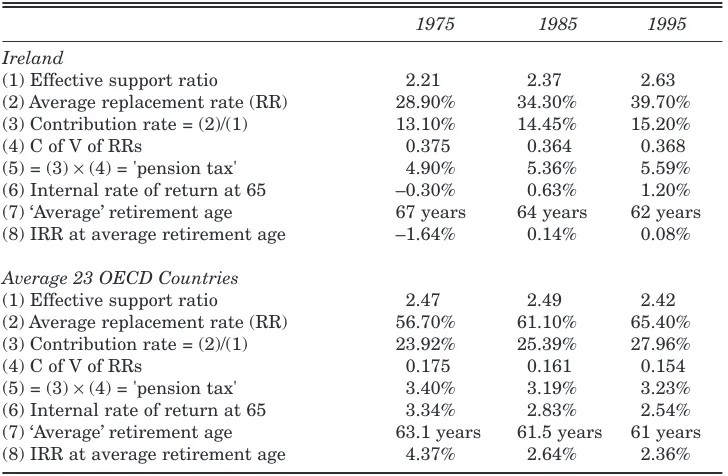
[image:11.499.64.428.224.462.2]In this section, I provide some empirical measures of the ‘tax component’ of the public pension programme in Ireland, comparing the measures to average measures for a sample of 23 OECD countries.10 I supplement these measures with some other important characteristics affecting the size of the public pension programme. These measures are depicted in Table 1.
Table 1: Pension Programme Indicators: Ireland and OECD Averages
1975 1985 1995
Ireland
(1) Effective support ratio 2.21 2.37 2.63
(2) Average replacement rate (RR) 28.90% 34.30% 39.70% (3) Contribution rate = (2)/(1) 13.10% 14.45% 15.20%
(4) C of V of RRs 0.375 0.364 0.368
(5) = (3) ×(4) = 'pension tax' 4.90% 5.36% 5.59% (6) Internal rate of return at 65 –0.30% 0.63% 1.20% (7) ‘Average’ retirement age 67 years 64 years 62 years (8) IRR at average retirement age –1.64% 0.14% 0.08% Average 23 OECD Countries
(1) Effective support ratio 2.47 2.49 2.42
(2) Average replacement rate (RR) 56.70% 61.10% 65.40% (3) Contribution rate = (2)/(1) 23.92% 25.39% 27.96%
(4) C of V of RRs 0.175 0.161 0.154
(5) = (3) ×(4) = 'pension tax' 3.40% 3.19% 3.23% (6) Internal rate of return at 65 3.34% 2.83% 2.54% (7) ‘Average’ retirement age 63.1 years 61.5 years 61 years (8) IRR at average retirement age 4.37% 2.64% 2.36%
The first row in Table 1 is the effective support ratio: the number of workers per pensioner. I calculate this, with some additional assumptions, from ILO labour market data. Note that, despite the youthful nature of the Irish population, and its gradual ageing, the initial support ratio in Ireland is lower than the average for these OECD countries and has indeed been increasing whereas the OECD countries’ average is approximately static. The reason for these disparate trends is simple: Ireland started from a low level of participation in the formal economy and the growth of employment in Ireland
10Broadly, the original EU countries until the recent new Accession states, plus Sweden and
plus the prolonged boom in births have outweighed the growth in the number of pensioners. Although old age demographic dependency in Ireland is now increasing, continued strong employment growth may maintain the support ratio rather more easily in the future than in other OECD countries, such as Scandinavia, Japan and NW Europe, where participation rates are already high.
Row (2) – defined as the average public pension replacement rate on retirement expected by a person aged 55 years – is derived from data in Blöndal and Scarpetta (1998).11 As mentioned previously, average Irish replacement rates are among the lowest in OECD countries, but have been increasing over time (as indeed has the OECD average). Row (3), the average contribution rate, is simply calculated by exploiting the pay-as-you-go requirement that the equilibrium contribution rate is equal to the average replacement rate divided by the support ratio. Note that the contribution rates derived here are not the same as those used by OECD sources and others, which are collected from administrative sources and which are often quite arbitrary (particularly where no separate contribution is levied, or where public pensions are subsidised out of general tax revenues).
Row (4), the coefficient of variation of replacement rates, is also derived from Blöndal and Scarpetta (1998), who provide various public pension replacement rates for different household types, delineated by earnings relative to average earnings and household composition. This provides my first measure of a design feature of each public pension programme – if the programme broadly links the pension paid to an individual in an actuarial manner to that individual’s contributions, the coefficient of variation of replacement rates by household types will be low. In contrast, in a ‘Beveridge’ programme such as that of Ireland, where replacement rates are higher for low earners (and indeed for couples relative to singles), the coefficient of variation will be higher, and this is illustrated in Table 1.
Row (5) simply multiplies the average contribution rate by the coefficient of variation to obtain a numerical measure of the ‘tax component’ of the contribution. This variable, denoted the ‘pension tax’, is a proxy for the extent to which the social security programme embodies intra-(within) generation actuarial fairness across households in the sense that pension benefits are proportional to contributions. Although this normalisation is arbitrary, any normalisation incorporating the average level of contributions and the extent of the departure from (intragenerational) ‘actuarial fairness’ will produce a similar ranking of countries. Note that the calculated ‘pension tax’ in Ireland by this method is somewhat higher than the average for these OECD countries
because, despite lower contribution rates, Ireland departs substantially from actuarially-based pensions in its public programme.
The remaining rows illustrate the other proxy for a measure of the tax component arising from public pension programme design discussed in the previous section – the average internal rate of return (IRR) on contributions to the public programme by cohort. A higher IRR implies a lower ‘implicit tax’ arising from choosing PAYG financing rather than investment in a funded programme. Full details of all these calculations are given in Disney (2004) but it should be noted that the calculation utilises the equilibrium contribution rate needed to finance current pension outgoings in each country’s public pension programme derived in row (3). The calculated IRR does not therefore depend on the average replacement rate, since this determines the equilibrium contribution rate – so a low replacement rate does not of itself generate a low IRR, because contribution rates are also low in such a circumstance. Instead, the IRR in Table 1 depends on such factors as the length of the working life and retirement, on the generosity of treatment of pensioners (and their spouses) and on real earnings growth. Row (6) gives the IRR for the representative individual if he or she retires at age 65 years. Row (7) gives actual average retirement ages for each decade, again derived from Blöndal and Scarpetta (1998). Row (8) recalculates the IRRs for these ‘actual’ retirement dates.
The IRRs in Ireland are low relative to the OECD average (and indeed negative for people expecting to retire in the 1970s). The reasons for this are simple. First, the duration of retirement of the average Irish pensioner was low, especially in the earliest period, relative to the OECD average. As the retirement period has increased relative to the OECD average, the IRRs have increased over time. Second, real earnings growth until the 1980s was relatively low in Ireland compared to other OECD countries. On the other hand, post-retirement benefits are indexed to earnings in Ireland and spouses with incomplete work histories are treated better than in pure ‘actuarial’ regimes. So the IRRs have increased slightly whilst the OECD average has tended to decline over time. But the Irish IRRs are likely to be well below the real return on capital, indicating a high ‘tax component’ to contributions to the Irish public pension programme.
I now ask: what are the implications of all this for the macroeconomic performance of Ireland, relative to the average characteristics of OECD programmes? On employment (Section II), the higher tax component in Ireland might be expected to have an adverse impact since contributions to the programme are essentially a pure tax (mitigated by the low absolute level of the Irish ‘tax wedge’ and the low replacement rate). In contrast, the higher relative tax component of the Irish programme reduces the likelihood that the programme will have an adverse impact on private retirement saving. These findings can be illustrated by an ‘experiment’ in which we simulate the impact on Irish labour force participation rates and household saving rates of redesigning the Irish public pension programme so that it has the features of an ‘average’ OECD public pension programme. This is done in the next sub-section.
4.2 The Irish Public Pension Programme: Simulating Macroeconomic Effects To simulate the effect of Ireland’s public pension programme on macroeconomic variables, I exploit the parameter estimates from a cross-country panel regression model of the impact of programme design on labour force participation (economic activity) rates and household saving rates. Disney (2004) estimated a model of age and gender-specific labour force participation rates regressed on various design features of the public pension programme, on country and time dummies, and controls for labour market institutions and the retirement regime (retirement ‘tests’ and first age of public pension receipt). I showed that the share of the ‘tax wedge’ in GDP and/or the average contribution rate, as conventionally measured from OECD data, have no effect on labour force participation. For several age and gender-specific groups, higher public pension replacement rates had adverse effects on participation. For most age groups among women, the higher the IRR on public pension contributions, the higher the labour force participation. This accords with my argument that a higher IRR reflects a lower ‘tax component’ to public pension contributions. In similar vein, a higher value of ‘pension tax’ (see row (5) of Table 1) typically reduces labour force participation rates. For men, however, there is no evidence of the design of the public pension regime having these predicted effects on labour force participation.
variables, more plausible results are obtained. In particular, a higher IRR on programme contributions is strongly associated with a reduction in household saving, and a higher value of the ‘pension tax’ (indicating a higher ‘tax component’ and therefore less substitutability for private saving) is associated with higher household saving. The reversal of the sign of the results relative to those for labour force participation strongly supports the theory that programmes with a higher ‘tax component’ reduce participation but have no adverse effect on saving, with the opposite finding for more ‘actuarial’ public programmes. Some representative results for both labour force participation and household saving rates are described in Table A1.
[image:15.499.66.427.333.489.2]Coming to specific results of the simulation, I consider first household saving. The overall results suggest that average OECD household saving rates were some 4 percentage points lower in the 1980s and 1990s than the 1970s. A downward trend in the saving rate is also observed in the measured data for Ireland (derived from OECD/IMF sources) but in fact the saving rate predicted by the baseline model (column 5 of Table A1) falls in the 1980s and rises in the 1990s: see Figure 1.
Figure 1: Actual and Predicted Household Saving Rates
I then turn to what happens to the predicted household saving rate when I replace the public pension programme parameters for Ireland by the OECD averages from Table 1 (specifically for average replacement rate, ‘pension tax’, and Internal Rate of Return at 65). The answer is that the Irish saving rate is 0.6 per cent lower in 1975 and slightly higher in the 1980s and 1990s. This relatively small impact should not be too surprising: as argued in the previous section, the high ‘tax component’ of the public pension programme in Ireland mitigates any substitution effect on private retirement saving.
20
15
10
5
0 Saving
Rate %
1975 1985 1995
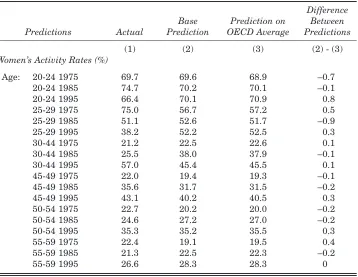
Considering labour force participation (economic activity) rates, as described previously, the empirical evidence suggests that public pension programme design has little impact on male participation rates.12So I focus on female activity rates. Table 2 provides three figures for each year and age group: the actual activity rate from ILO data, the prediction from the baseline model in Disney (2004) for the Irish data, and the predicted values were we to assign to Ireland the average values of the public pension programme parameters for these OECD countries.
Table 2:Activity Rates (Labour Force participation) for Women Aged 20-59 Years in Ireland, Actual and Predictions According to Public Pension Programme
Difference Base Prediction on Between Predictions Actual Prediction OECD Average Predictions
(1) (2) (3) (2) - (3)
Women’s Activity Rates (%)
Age: 20-24 1975 69.7 69.6 68.9 –0.7
20-24 1985 74.7 70.2 70.1 –0.1
20-24 1995 66.4 70.1 70.9 0.8
25-29 1975 75.0 56.7 57.2 0.5
25-29 1985 51.1 52.6 51.7 –0.9
25-29 1995 38.2 52.2 52.5 0.3
30-44 1975 21.2 22.5 22.6 0.1
30-44 1985 25.5 38.0 37.9 –0.1
30-44 1995 57.0 45.4 45.5 0.1
45-49 1975 22.0 19.4 19.3 –0.1
45-49 1985 35.6 31.7 31.5 –0.2
45-49 1995 43.1 40.2 40.5 0.3
50-54 1975 22.7 20.2 20.0 –0.2
50-54 1985 24.6 27.2 27.0 –0.2
50-54 1995 35.3 35.2 35.5 0.3
55-59 1975 22.4 19.1 19.5 0.4
55-59 1985 21.3 22.5 22.3 –0.2
55-59 1995 26.6 28.3 28.3 0
Looking at the difference between the actual measured rates and the base prediction, the model tracks closely the 20-24, 45-49 and 50-54 year age
12This is at first sight surprising for older men. No doubt the existence of a public pension
groups. It underpredicts the decline in economic activity rates among 25-29 year olds and the increase in participation among 30-44 year olds. To a lesser extent, it also predicts faster growth of economic activity rates among 55-59 year old women. Column (3) then simulates these economic activity rates were the Irish pension programme to have the characteristics of the average programme among the OECD countries in the sample. Again, there are not large differences, especially among the older age groups. Again, this is because the simulated OECD programme differs from the Irish programme in two competing directions – it is more generous, which raises the absolute tax wedge, but it is also less targeted, which lowers the ‘tax component’ of the Irish public pension programme. Or, to turn the argument on its head, Ireland has benefited in terms of the growth in economic activity rates in recent years from the low cost of its social welfare programme and the lower value of the OECD-measured ‘tax wedge’. But, in this analysis, the benefit is largely offset by the ‘Beveridge-type’ design of the programme, which has raised the ‘tax component’ of that wedge.
4.3 Pension Reform in Ireland
This essay is not primarily about the direction of Irish pension reform. Indeed one of the results of the analysis in the previous sub-section is that the evolution of the public pension programme may not matter too much for macroeconomic activity, especially for household saving rates. This is an important point, especially where (as in the United States) it is often assumed, wrongly, that a drastic retrenchment of the (essentially Beveridge-style) social security programme would substantially boost private retirement saving (for the relevant calculations, see Disney (2005)). Of course, getting microincentives right, such as the incentives within the retirement regime and the tax treatment of retirement saving, is important for both macroeconomic activity and for the public finances, but this is not a central issue in the present analysis.
retirement benefits maintains the standard of living of pensioners in line with workers, but becomes more costly once the ratio of workers to pensioners declines. In the terminology of this essay, an overly generous public programme allied to a high tax component in the future might raise the possibility of adverse effects on employment and on labour market activity. However, further discussion of these risks lays out the scope of what has been presented here.
V CONCLUSIONS
The focus of this paper has been on an issue that has been of central concern to Brendan Walsh – the link between the labour market and macroeconomic performance, and how this interaction has evolved in Ireland (as in Honohan and Walsh, 2002, and Walsh, 2004). The Irish combination of social partnership and a Beveridge-style welfare state is unusual in OECD experience (perhaps Denmark may come closest in this combination) and is one potential reason for the Irish success story since the 1980s.
In this essay, I have argued that the design of the social welfare system – in particular of the public pension programme – is an element of the story that has not been drawn out fully in either the OECD-led literature or in the Irish ‘story’ told by Brendan and others. The design of the public pension programme in Ireland has potential effects for macroeconomic performance – for household saving rates, for economic activity and for employment. I illustrated how indicators could be constructed, and an empirical test implemented, to show how the design of the public pension (social security) programme might affect economic activity.
rates, especially among older workers, as in Disney (2004), seem rather weaker. Since, as argued here, features that affect private saving rates adversely are most likely to affect employment rates positively, and vice versa, the relative size of these effects, therefore, might suggest that countries focus on the saving offsets rather than adverse employment effects in designing public pension programmes. Beveridge-type programmes that minimise saving offsets, such as Ireland’s programme, might therefore seem more attractive. But this conclusion is only justified if, in social welfare terms, we give equal weight to programme impacts on saving rates and on employment. Finally, even if the design of the Irish public pension programme currently seems to minimise adverse effects on saving and employment rates, there are nevertheless implications for future developments of the programme. Although low cost at present, the earnings-indexation of retirement benefits obviously puts pressure on the public finances as the worker-pensioner support ratio starts to decline. If continued economic success results in labour market tightening and a higher ‘price’ in terms of welfare generosity being exacted for social co-operation, pressures on the public finances and, ultimately, on economic performance could yet arise. In which case, the relatively high ‘tax component’ of the Irish programme, although mitigating the potential adverse impact on private saving rates, may yet slow the Irish hare.
REFERENCES
ALESINA, A. and R. PERROTTI, 1997. “Welfare state and competitiveness”, American Economic Review, Vol. 61, July, pp. 477-94.
BANKS, J., R. DISNEY, A. DUNCAN and J. VAN REENEN, 2005. “The internationalisation of public welfare policy”, Economic Journal, Vol. 115 (March), pp. C62-C82.
BERTOLA, G., F. D. BLAU and L. M. KAHN, 2003. “Labor market institutions and demographic employment patterns”, mimeo, Cornell University, March.
BLANCHARD, O. and J. WOLFERS, 2000. “The role of shocks and institutions in the rise of European unemployment: The aggregate evidence”, Economic Journal, Vol. 110, March, pp. C1-C33.
BLAU, F. D. and L. M. KAHN, 1999. “Institutions and Laws in the Labor Market” in O. Ashenfelter and D. Card (eds.), Handbook of Labor Economics Vol 3, Amsterdam: North Holland.
BLÖNDAL, S. and S. SCARPETTA, S. 1998. “The retirement decisions in OECD countries”, OECD Economics Department Working Paper, No. 202, Paris.
DAVERI, F. and G. TABELLINI, 2000. “Unemployment, growth and taxation in industrial countries”, Economic Policy, Vol. 30, April, pp. 47-101.
DISNEY, R., 2000a. “Crisis in public pension programmes in OECD: What are the reform options?”Economic Journal, Vol. 110, (February), pp. F1-F23.
DISNEY, R., 2000b. “Declining public pensions in an era of demographic ageing: Will private provision fill the gap?”, European Economic Review, Vol. 44, March/April, pp. 957-973.
DISNEY, R., 2004. “Are contributions to public pension programmes a tax on employment?” Economic Policy, Vol. 39, July, 269-311.
DISNEY, R., 2005. “Household saving rates and the design of social security programmes: evidence from a country panel”, Centre for Policy Evaluation, Working Paper 03/05, University of Nottingham.
DISNEY, R. and E. WHITEHOUSE, 1996. “What are occupational pension plan entitlements worth in Britain?” Economica, Vol. 63 (May), pp. 213-238.
DOMINITZ, J., C. MANSKI and J. HEINZ, 2003. “Will social security be there for you? How Americans perceive their benefits”, National Bureau of Economic Research Working Paper w9798, June.
FELDSTEIN, M., 1974. “Social security, induced retirement and aggregate capital accumulation”, Journal of Political Economy, Vol. 82, No. 5, pp. 905-926.
FELDSTEIN, M., 1980. “International differences in social security and saving”, Journal of Public Economics, Vol. 14, pp. 225-244.
HONOHAN, P. and B. WALSH, 2002. “Catching up with the leaders: the Irish hare”, Brookings Papers on Economic Activity, Vol. 1, pp. 1-77.
JACKMAN, R., R. LAYARD and S. NICKELL, 1991. Unemployment, Macroeconomic Performance and the Labour Market, Oxford: Oxford University Press.
LAYTE, R., B. NOLAN and C. WHELAN,, 2001. “Reassessing income and deprivation approaches to the measurement of poverty in the Republic of Ireland”, The Economic and Social Review, Vol. 32, No. 3, pp. 239-261.
LINDBECK, A. and T. PERSSON, 2003. “The gains from pension reform”, Journal of Economic Literature, XLI, March, pp.74-112.
NICKELL, S., 1997. “Unemployment and labor market rigidities: Europe versus North America”, Journal of Economic Perspectives, Vol. 11, Summer, pp. 55-74.
NICKELL, S., 2004. “Employment and taxes”, CEP Discussion paper no. 634, May, London School of Economics.
NICKELL, S. and R. LAYARD, 1999. “Labour market institutions and economic performance” in O. Ashenfelter and D. Card (eds.), Handbook of Labor Economics, Vol. 3, Amsterdam: North Holland.
NICKELL, S., L. NUNZIATA and W. OCHEL, 2005. “Unemployment in the OECD since the 1960s: What do we know?” Economic Journal, Vol. 112, January. OECD, 1995. The OECD Jobs Study: Taxation, Employment and Unemployment, Paris:
OECD.
OECD, 2005. Pensions at a Glance: Public Policies across OECD Countries, Paris: OECD.
SINN, H-W, 2000. “Pension reform and demographic crisis: Why a funded system is needed and why it is not needed”, International Tax and Public Finance, Vol. 7, pp. 389-410.
APPENDIX TABLE A1
Selected Regressions of Determinants of Age-Activity Rates and Household Saving
Dep. Variable: (1) (2) (3) (4) (5)
Coeff. (Std. Err) LFP: LFP: LFP: Household Household
Women Women Men Saving Saving
50-54 55-59 50-54 Rate Rate
Pension tax –1.34*** –0.35 0.20 0.57*** 0.68***
(0.37) (0.30) (0.17) (0.19) (0.17)
Pension RR –0.20*** –0.17*** –0.14*** – –
(0.07) (0.05) (0.03) –
IRR at 65 0.91** 0.89** –0.54** – –1.11***
(0.36) (0.29) (0.17) – (0.20)
IRR – – – –1.09*** –
(0.24)
Support ratio – – – 7.27*** 8.49***
(1.00) (1.01) Retirement test index 5.07*** 4.59*** 2.29*** –0.79 –0.34
(1.97) (1.60) (0.91) (0.92) (1.00) Earliest state pension age 0.19 –0.01 0.53*** –0.20 –0.26
(0.38) (0.30) (0.18) (0.19) (0.18)
Demand shock 0.19 0.10 0.17*** 0.13* 0.08
(0.12) (0.10) (0.06) (0.06) (0.05)
GDP growth (%) – – – – 0.35
(0.23)
Max. LTV ratio – – – – 6.38**
(2.87)
Financial credit as % GDP – – – – 1.63
(1.30)
Union density –0.07 –0.06 0.07 – –
(0.11) (0.09) (0.05) –
Employment protection
index –2.06 –1.31 3.73*** – –
(2.00) (1.63) (0.93) – –
1980s 8.89*** 4.44*** –1.42*** –3.77*** –4.69***
(1.06) (0.87) (0.49) (0.58) (0.56) 1990s 19.00*** 11.76*** –1.01** –3.55*** –4.23***
(1.14) (0.92) (0.53) (0.47) (0.57)
Log L –135.40 –122.40 –86.94 –93.14 –85.43
Wald χ2(28/30/31) 2,360.0 3,141.6 1113.6 1,511.4 1,947.8
(0.000) (0.000) (0.000) (0.000) (0.000)
Notes:Estimated by generalised least squares, weighted by civilian employment; country dummies included; standard errors in parentheses. ***=1 per cent, **=5 per cent, *=10 per cent significance. N=63 (21 countries in 1975, 1985, 1995).