796
Sentence Embedding Alignment for Lifelong Relation Extraction
Hong Wang†, Wenhan Xiong†, Mo Yu‡∗, Xiaoxiao Guo‡∗, Shiyu Chang‡, William Yang Wang†
†University of California, Santa Barbara
‡IBM Research
{hongwang600, xwhan, william}@cs.ucsb.edu, [email protected],{xiaoxiao.guo, shiyu.chang}@ibm.com
Abstract
Conventional approaches to relation extraction usually require a fixed set of pdefined re-lations. Such requirement is hard to meet in many real applications, especially when new data and relations are emerging incessantly and it is computationally expensive to store all data and re-train the whole model every time new data and relations come in. We for-mulate such a challenging problem as lifelong relation extraction and investigate memory-efficient incremental learning methods without catastrophically forgetting knowledge learned from previous tasks. We first investigate a modified version of the stochastic gradient methods with a replay memory, which surpris-ingly outperforms recent state-of-the-art life-long learning methods. We further propose to improve this approach to alleviate the forget-ting problem by anchoring the sentence em-bedding space. Specifically, we utilize an ex-plicit alignment model to mitigate the sentence embedding distortion of the learned model when training on new data and new relations. Experiment results on multiple benchmarks show that our proposed method significantly outperforms the state-of-the-art lifelong learn-ing approaches.
1 Introduction
The task of relation detection/extraction aims to recognize entity pairs’ relationship from given contexts. As an essential component for structured information extraction, it has been widely used in downstream tasks such as automatic knowledge-based completion (Riedel et al., 2013) and ques-tion answering (Yih et al.,2015;Yu et al.,2017).
Existing relation detection methods always as-sume a closed set of relations and perform
once-∗
Co-mentoring
Code and dataset can be found in this repository: https://github.com/hongwang600/Lifelong_ Relation_Detection
of stored samples from previous tasks and new samples from the incoming task. We further test this simple baseline on commonly used continual learning benchmarks and get similar observations. In this work, we thoroughly investigate two ex-isting continual learning algorithms on the pro-posed lifelong relation extraction task. We ob-serve that recent lifelong learning methods only operate on the models’ parameter space or gra-dient space, and do not explicitly constraint the feature or embedding space of neural models. As we train the model on the new task, the embed-ding space might be distorted a lot, and become infeasible for previous tasks. We argue that the embedding space should not be distorted much in order to let the model work consistently on previ-ous tasks. To achieve this, we propose an align-ment model that explicitly anchors the sentence embeddings derived by the neural model. Specif-ically, the alignment model treats the saved data from previous tasks as anchor points and mini-mizes the distortion of the anchor points in the em-bedding space in the lifelong relation extraction. The aligned embedding space is then utilized for relation extraction. Experiment results show that our method outperforms the state-of-the-art signif-icantly in accuracy while remaining efficient.
The main contributions of this work include:
• We introcduce the lifelong relation detection problem and construct lifelong relation detection benchmarks from two datasets with large rela-tion vocabularies: SimpleQuesrela-tions (Bordes et al., 2015) and FewRel (Han et al.,2018).
•We propose a simple memory replay approach and find that current popular methods such as EWC and GEM underperform this method.
• We propose an alignment model which aims to alleviate the catastrophic forgetting problem by slowing down the fast changes in the embedding space for lifelong learning.
2 Problem Definition
Generic definition of lifelong learning problems
In lifelong learning, there is a sequence of K tasks {T(1),T(2), . . . ,T(K)}. Each task T(k) is
a conventional supervised task, with its own la-bel set L(k) and training/validation/testing data
(Ttrain(k), Tvalid(k), Ttest(k)), each of which is a set of la-beled instances{(x(k), y(k))}. Note thatx(k)is the
input data of the context and candidate relations, andy(k)is the ground-truth label. The goal of
life-long learning is to learn a classification modelf. At each stepk,f observes the taskT(k), and
op-timizes the loss function on its training data with a loss function`(f(x), y). At the same time, we require the modelf learned after stepkcould still perform well on the previousk−1tasks. That is, we evaluate the model by using the average accu-racy ofktasks at each step as 1kPk
j=1accf,j.
To makef perform well on the previous tasks, during the lifelong learning process, we usually al-low the learner to maintain and observe a memory
M of samples from the previous tasks. Practi-cally, with the growth of the number of tasks, it is difficult to store all the task data1. Therefore, in lifelong learning research, the learner is usu-ally constrained on the memory size, denoted as a constant B. Thus at each stepk, the learner is allowed to keep training samples from{T(j)|j = 1, . . . , k−1}with size less or equal toB.
Lifelong relation detection In this paper we in-troduce a new problem,lifelong relation detection. Relation detection is an important task that aims to detect whether a relation exists between a pair of entities in a paragraph. In many real-world sce-narios, relation detection naturally forms a life-long learning problem because new relation types emerge as new knowledge is constantly being dis-covered in various domains. For example, in the Wikidata (Vrandeˇci´c and Kr¨otzsch,2014) knowl-edge graph, the numbers of new items and proper-ties are constantly increasing2. So we need to keep collecting data and updating the model over time in order to handle newly added relations.
The problem of lifelong relation detection has the same definition as above with only one dif-ference: during prediction time, we hope to know whether an input paragraph contains any relation observed before. Therefore at time k, given an inputx from task j0<k, instead of predicting an y ∈ L(j0), we predict y(k) ∈ Sk
j=1L(j). That
says, the candidate label set is expanding as the learner observes more tasks, and the difficulty of each previous task is increasing over time as well.
1Even the data can be stored, it is unrealistic to make full
usage of the stored data. For example, random sampling from all previous task data (e.g., for the methods in Section4) will become statistically inefficient.
2https://www.wikidata.org/wiki/
3 Evaluation Benchmarks for Lifelong Learning
3.1 Previous non-NLP Benchmarks
Lifelong MNIST MNIST is a dataset of hand-writing ten digits (LeCun, 1998), where the in-put for each sample is an image, and the label is the digit the image represents. Two variants of the MNIST dataset were proposed for lifelong learning evaluation. One is MNISTPermutations
(Kirkpatrick et al.,2016), where a task is created by rearranging pixels according to a fixed permu-tation. K different permutations are used to gen-erate K tasks. Another variant is MNIST Rota-tions(Lopez-Paz and Ranzato,2017), where each task is created by rotating digits by a fixed angle. K angles are chosen for creatingK tasks. In our experiments, we follow (Lopez-Paz and Ranzato, 2017) to haveK= 20tasks for each benchmark.
Lifelong CIFAR CIFAR (Krizhevsky and Hin-ton,2009) is a dataset used for object recognition, where the input is an image, and the label is the ob-ject the image contains. Lifelong CIFAR100 ( Re-buffi et al.,2017a) is a variant of CIFAR-100 (CI-FAR with 100 classes) by dividing 100 classes into K disjoint subsets. Each task contains samples from100K classes in one subset. Following ( Lopez-Paz and Ranzato,2017), we haveK = 20tasks, where each of them has 5 labels.
3.2 The Proposed Lifelong Relation Detection Benchmarks
Lifelong FewRel FewRel (Han et al., 2018) is a recently proposed dataset for few-shot relation detection. There are 80 relations in this dataset. We choose to create a lifelong benchmark based on FewRel because there are a sufficient number of relation labels. We extract the sentence-relation pairs from FewRel and build our lifelong FewRel benchmark as follows. Each sample contains a sentence with the ground-truth relation it refers, and a set of 10 randomly chosen false relations from all the whole relations set. The model is required to distinguish the right relation from the candidates. We apply K-Means over the averaged word embeddings of the relation names and divide
80relations into10 disjoint clusters. This results in10tasks in this benchmark, and each task con-tains relations from one cluster. Candidate rela-tions will be masked if they do not appear in the history tasks.
Lifelong SimpleQuestions SimpleQuestions is a KB-QA dataset containing single-relation ques-tions (Bordes et al.,2015). (Yu et al.,2017) cre-ated a relation detection dataset from SimpleQues-tions that contains samples of question-relation pairs. For each sample, a candidate set of relations is also provided. Similar to lifelong FewRel, we divide relations into20 disjoint clusters by using K-Means. This results in20 tasks, and each task contains relations from one cluster.
4 Simple Episodic Memory Replay
Algorithm for Lifelong Learning
Catastrophic forgetting is one of the biggest obsta-cles in lifelong learning. The problem is particu-larly severe in neural network models, because the learned knowledge of previous tasks is stored as network weights, while a slight change of weights when learning on the new task could have an un-expected effect on the behavior of the models on the previous tasks (French,1999).
Currently, the memory-based lifelong learning approaches, which maintain a working memory of training examples from previous tasks, are proved to be one of the best solutions to the catastrophic forgetting problem. In this section, we first pro-pose a memory-based lifelong learning approach, namely Episodic Memory Replay (EMR), which uses the working memory by sampling stored sam-ples to replay in each iteration of the new task learning. Surprisingly, such a straightforward ap-proach with a clear motivation was never used in previous research. We first compare EMR with the state-of-the-art memory-based algorithm Gra-dient Episodic Memory (GEM). We also show that the EMR outperforms GEM on many bench-marks, suggesting that it is likely to be among the top-performed lifelong learning algorithms, and it should never be ignored for comparison when de-veloping new lifelong learning algorithms.
4.1 Episodic Memory Replay (EMR)
EMR is a modification over stochastic gradient descent algorithms. It replays randomly sampled data from memory while training on a new task, so the knowledge of previous tasks could be re-tained in the model. After training on each taskk, EMR selects several training examples to store in the memoryM, denoted asMT
Ttrain(k).3
3(Rebuffi et al.,2017b) propose to dynamically change
To handle the scalability, EMR stochastically replays the memory. Specifically, when training on task k with each mini-batch Dtrain(k) ⊂ Ttrain(k), EMR samples from the memoryMto form a sec-ond mini-batchD(replayk) ⊂ M. Then two gradient
steps are taken on the two mini-batches ofD(traink) andD(replayk) . Note that EMR could work with any stochastic gradient optimization algorithm, such as SGD, Adagrad, AdaDelta, and Adam, to opti-mize the modelf with the mixed mini-batches.
We try two variations ofD(replayk) sampling: first,
task-level sampling, which samples from one pre-vious taskjeach time, i.e.,Dreplay(k) ⊂ MT
Ttrain(j). Second,sample-level sampling, which samples all over the memory, i.e.,Dreplay(k) ⊂ M.
The two approaches differ in the task instance sampling probability. The task-level approach as-sumes a uniform distribution over tasks, while the sample-level approach has a marginal distribution on tasks that is proportional to the number of their training data inM.4 When tasks are balanced like MNIST and CIFAR, or when the stored data in the memory for different tasks are balanced, the two approaches become equivalent.
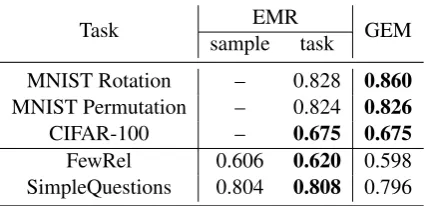
However, the sample-level strategy could some-times make the code implementation more dif-ficult: for some lifelong learning benchmarks such as MNIST Rotation, MNIST Permutation, and CIFAR-100 used in (Lopez-Paz and Ranzato, 2017), the tasks could differ from each other in the input or output distribution, leading to differ-ent computation graphs for differdiffer-ent training ex-amples. From our preliminary study, the task-level approach could always give results as good as those of the sample-level approach on our life-long relation detection benchmarks (see Table1) , so in our experiments in Section6we always use the task-level approach.
4.2 Comparing EMR with State-of-the-art Memory-based Lifelong Algorithm
In this part, we will first thoroughly introduce a state-of-the-art memory-based lifelong learn-ing algorithm called Gradient Episodic Memory (GEM) (Lopez-Paz and Ranzato,2017), and then compare EMR with it in both time complexity and
followup work and this paper all use fixed sets, and we will investigate the usage of dynamic sets in future work.
4The two approaches hence favor different evaluation
metrics – the former fits macro averaging better and the latter fits micro averaging better.
experimental results on several benchmarks.
Gradient Episodic Memory (GEM) The key idea of GEM (Lopez-Paz and Ranzato, 2017) is to constrain the new task learning with previous task data stored in memory. Specifically, it con-strains the gradients during training with the fol-lowing operation. When training on task k, for each mini-batchD(traink) ⊂ Ttrain(k), it first computes the gradient g(traink) on D(traink) , and the average gra-dients on the stored data of each previous task j, denoted asgtask(j). More concretely, we define
gtask(j) = P
i0∇`(f(x(i0j)), y (j)
i0 ) |MT
Ttrain(j)| ,
where j<k, `(·) is the loss function, and
(x(i0j), y (j)
i0 ) ∈ M
T
Ttrain(j), i.e. (x(i0j), y (j)
i0 ) is a
training instance inT(j) that was stored in
mem-ory M. Then the model f is updated along the gradient˜gthat solves the following problem:
ming˜ ||˜g−g(traink)||2
s.t. h˜g, gtask(j)i ≥0, j= 1, . . . , k−1.
˜
gis the closest gradient to the gradient on the cur-rent training mini-batch,gtrain(k) , without decreasing performance on previous tasks much since the an-gle between˜gandg(taskj) is smaller than90◦.
Time Complexity One difference between EMR and GEM is that EMR deals with uncon-strained optimization and does not require the gradient projection, i.e., solving ˜g. But since the model f is deep networks, empirically the time complexity is mainly dominated by the computation of forward and backward passes. We analyze the time complexity as below:
In task k, suppose the mini-batch size is |D|
and the memory replay size ism, our EMR takes
|D|+m forward/backward passes in each train-ing batch. Note thatmis a fixed number and set to be equal to the number of instances stored for each previous task in our experiments. While for GEM, it needs to compute the gradient of all the data stored in the memoryM, thus|D|+|M| for-ward/backward passes are taken. Its complexity is largely dominated by the size|M|(upper bounded by the budget B). When the budget B is large, with the number of previous tasks increases, M
Task EMR GEM sample task
MNIST Rotation – 0.828 0.860
MNIST Permutation – 0.824 0.826
CIFAR-100 – 0.675 0.675
FewRel 0.606 0.620 0.598
[image:5.595.75.288.64.167.2]SimpleQuestions 0.804 0.808 0.796
Table 1: The average accuracy across all the tasks at last time step for EMR and GEM on both non-NLP and our lifelong relation detection benchmarks. For the experiments on MNIST and CIFAR, we follow the set-ting in (Lopez-Paz and Ranzato,2017) (see Appendix
A.2for details). For the experiments on FewRel and SimpleQuestions, we use the same setting in Section
6. We only implement task-level EMR for MNIST and CIFAR because of the relatively easy implementation.
Superior Empirical Results of EMR The EMR algorithm is much simpler compared to the GEM. However, one interesting finding of this paper is that the state-of-the-art GEM is unnecessarily more complex and more inefficient, because EMR, a simple stochastic gradient method with memory replay, outperforms it on several benchmarks.
The results are shown in Table 1. The num-bers are the average accuracy, i.e. k1Pk
j=1accf,j,
at last time step. For both algorithms, the train-ing data is randomly sampled to store in the mem-ory, following (Lopez-Paz and Ranzato,2017). On lifelong relation detection, the EMR outperforms GEM on both of our created benchmarks. To fur-ther show its generalizability, we apply the EMR to previous lifelong MNIST and CIFAR bench-marks and compare to the results in (Lopez-Paz and Ranzato, 2017) with all the hyperparameters set as the same. Still, EMR performs similarly to GEM except for the MNIST Rotation benchmark.5 From the above results, we learned the lesson that previous lifelong learning approaches actu-ally fail to show improvement compared to doing memory replay in a stochastic manner. We hy-pothesise that GEM performs worse when there is positive transfer among tasks, making the gradient projection an inefficient way to use gradients com-puted from memory data. Therefore, in the next section, we start with the basic EMR and focus on more efficient usage of the historical data.
5Even on MNIST Rotation, it has achieved a
competi-tive result, since the conventional training on shuffled data from all the tasks in this benchmark gives∼0.83according to (Lopez-Paz and Ranzato,2017).
5 Embedding Aligned EMR (EA-EMR)
Based on our basic EMR, this section proposes our solution to lifelong relation detection. We improve the basic EMR with two motivations: (1) previ-ous lifelong learning approaches work on the pa-rameter space. However, the number of param-eters in a deep network is usually huge. Also, deep networks are highly non-linear models, and the parameter dimensions have complex interac-tions, making the Euclidean space of parameters not a proper delegate of model behavior (French, 1999). That is, a slight change in parameter space could affect the model prediction unexpectedly. The above two reasons make it hard to maintain deep network behaviors on previous tasks with constraints or Fisher information. Therefore, we propose to alleviate catastrophic forgetting in the hidden space (i.e., the sentence embedding space). (2) for each task, we want to select the most in-formative samples to store in the memory, instead of random sampling like in (Lopez-Paz and Ran-zato,2017). Therefore the budget of memory can be better utilized.
5.1 Embedding Alignment for Lifelong Learning
This section introduces our approach which per-forms lifelong learning in the embedding space, i.e., the Embedding Aligned EMR (EA-EMR).
In EA-EMR, for each taskk, besides storing the original training data (x(k), y(k)) in the memory
M, we also store the embeddings ofx(k). In the future after a new task is trained, the model pa-rameters are changed thus the embeddings for the same(x(k), y(k))would be different. Intuitively, a lifelong learning algorithm should allow such pa-rameter changes but ensure the changes do not dis-tort the previous embedding spaces too much.
that trained on the previousk−1tasks. We want to learn the basic modelf and the transformation asuch that the performance on the new task and stored instances are optimized without distorting the previous embedding spaces much.
min
f(·),a(·) X
(x,y)∈Dtrain(k)
`(a(f(x)), y)+
X
(x,y)∈D(replayk)
`(a(f(x)), y) +ka(f(x))−a(k−1)(f(k−1)(x))k2
We propose to minimize the above objective through two steps. In the first step, we optimize the basic modelf by:
min
f(·)
X
(x,y)∈D(traink)S
Dreplay(k)
`a(k−1)(f(x)), y
This step mainly focuses on learning the new task without performance drop on the stored samples.
In second step, we optimize ato keep the em-bedding space of the current task and restore the previous embedding space of all stored samples:
min
a(·) X
(x,y)∈D(traink)
ka(f(x))−a(k−1)(f(x))k2
+ X
(x,y)∈Dreplay(k)
ka(f(x))−a(k−1)(f(k−1)(x))k2
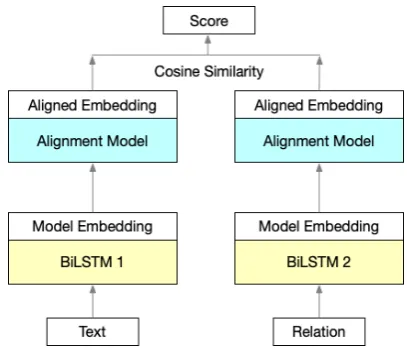
Embedding Alignment on Relation Detection Model We introduce how to add embedding alignment to relation detection models. The ba-sic model we use is a ranking model that is similar to HR-BiLSTM (Yu et al.,2017). Two BiLSTMs (Hochreiter and Schmidhuber, 1997) are used to encode the sentence and relation respectively given their GloVe word embedding (Pennington et al., 2014). Cosine similarity between the sen-tence and relation embedding is computed as the score. Relation with maximum score is predicted by the model for the sentence. Ranking loss is used to train the model6. This base model is our modelf, which is trained on a new taskkat each step and results in an updated model f(k). Our proposed approach (Figure1) inserts an alignment model a to explicitly align to embedding space for stored instances and maintain the embedding space of the current task. Note that the labely(the relation here) also has embedding, so it needs to pass through the alignment modelaas well.
6Though the basic model is simple, it achieves reasonable
[image:6.595.313.517.60.235.2]results on the two datasets when training with all the data, i.e.,0.837on FewRel and0.927on SimpleQuestions.
Figure 1: This figure shows how we add the alignment model (a linear model in our case) on the basic rela-tion detecrela-tion model, where two BiLSTMs are used to encode the text and relation, and cosine similarity be-tween their embeddings are computed as the score.
5.2 Selective Storing Samples in Memory
When the budget of memory is relatively smaller, how to select previous samples will greatly affect the performance. Ideally, in order to make the memory best represents a previous task, we hope to choose diverse samples that best approximate the distribution of task data. However, distribution approximation itself is a hard problem and will be inefficient due to its combinatorial optimiza-tion nature. Therefore, many recent works such as GEM ignore this step and randomly select sam-ples from each task to store in the memory.
Rebuffi et al.(2017b) proposed to select exem-plars that best approximate the mean of the distri-bution. This simplest distribution approximation does not give an improvement in our experiments because of the huge information loss. Therefore, we propose a better approach of sample selection by clustering over the embedding space from the model, and choose one representative from each cluster to store in the memory. More specifically, The embedding after alignment model is used to represent the input because the model makes pre-diction based on that. Then we apply K-Means (the number of clusters equals the budget given to the specific task) to cluster all the samples of the task. For each cluster, we select the sample closest to the centroid to store in the memory.
(a) FewRel (b) SimpleQuestions
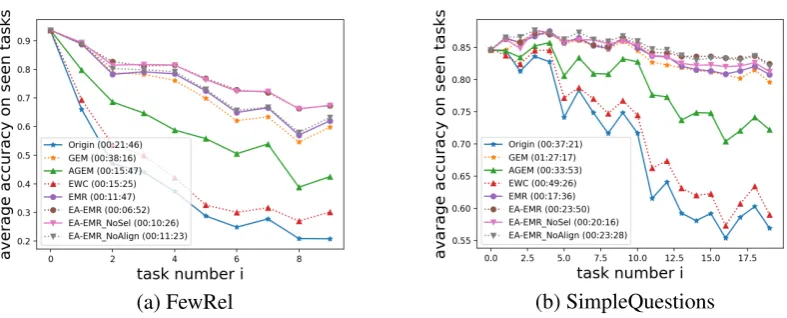
Figure 2: This figure shows the average accuracy of all the observed tasks on the benchmarks of lifelong FewRel and lifelong SimpleQuestions during the lifelong learning process. The average performance of5runs is reported, and theaverage running timeis shown in the brackets.
6 Experiments
6.1 Experimental Setting
We conduct experiments on our lifelong bench-marks: lifelong SimpleQuestions (Bordes et al., 2015) and lifelong FewRel (Han et al., 2018) to compare our proposed methods EMR, EMR without Selection (EMR NoSel), EA-EMR without Alignment (EA-EA-EMR noAlign), and EMR with the following baselines.
• Origin, which simply trains on new tasks based on the previous model.
•EWC(Kirkpatrick et al.,2016), which slows down updates on important parameters by adding L2regularization of parameter changes to the loss. •GEM(Lopez-Paz and Ranzato,2017), which projects the gradient to benefit all the tasks so far by keeping a constraint for each previous task.
•AGEM(Anonymous,2019), which only uses one constraint that the projected gradient should decrease the average loss on previous tasks.
On both FewRel and SimpleQuestions, the epoch to train on each task is set to be3. Learning rate for the basic model is set to be0.001. The hid-den size of LSTM is set to be200. The batch size is set to be 50. For each sample in the memory,
10 candidate relations is randomly chosen from all observed relations to alleviate the problem that new relations are emerging incessantly.
Parameters for our model and baselines are set as follows. For EA-EMR and EA-EMR NoSel, when training the alignment model, the learning rate is set to be 0.0001, and the training epoch is set to be 20 and 10 for FewRel and SimpleQues-tions respectively. For AGEM, 100samples are
Method FewRel SimpleQuestions
Whole Avg Whole Avg
Origin 0.189 0.208 0.632 0.569
Baselines
GEM 0.492 0.598 0.841 0.796
AGEM 0.361 0.425 0.776 0.722
EWC 0.271 0.302 0.672 0.590
Ours
Full EA-EMR 0.566 0.673 0.878 0.824
w/o Selection 0.564 0.674 0.857 0.812 w/o Alignment 0.526 0.632 0.869 0.820 w/o Alignment but keep
0.545 0.655 0.871 0.813 the architecture
[image:7.595.96.490.71.230.2]EMR Only 0.510 0.620 0.852 0.808
Table 2: This table shows the accuracy on the whole testing data (”Whole” column), and average accuracy on all observed tasks (”Avg” column) after the last time step. The average performance of5runs are listed here and the best result on each dataset is marked in bold.
randomly chosen from all the previous tasks to form a constraint. For EWC, we set the balancing parameter α = 100. For GEM and EMR related methods, memory size of each task is set to be50.
6.2 Lifelong Relation Detection Results
Evaluation Metrics We use two metrics to evaluate the performance of the model:
•Average performance on all seen tasks after time stepk, which highlights the catastrophic problem:
ACCavg = 1
k
k
X
i=1
accf,i
•Accuracy on the whole testing data of all tasks:
ACCwhole=accf,Dtest
shuffling sequence of tasks, and the average per-formance is reported. The average accuracy over all observed tasks during the whole lifelong learn-ing process is presented in Figure2, and the accu-racy on the whole testing data during the process is shown in AppendixA.1. We also list the result at last step in Table 2. From the results, we can see that EWC and GEM are better than the Origin baseline on both two datasets, which indicates that they are able to reduce the catastrophic forgetting problem. However, our EA-EMR perform signif-icantly better than these previous state-of-the-arts. The proposed EMR method itself achieves better results than all baselines on both datasets. The ab-lation study shows that both theselectionand the
alignmentmodules help on both tasks.
The Effect of Embedding Alignment To inves-tigate the effect of our embedding alignment ap-proach, we conduct two ablation studies as below: First, we remove both the alignment loss in equa-tion5.1, as well as the alignment modulea, which results in significant drop on most of the cases (the line “w/o Alignment” in Table2). Second, to make sure that our good results do not come from in-troducing a deeper model with the modulea, we propose to only remove the embedding alignment loss, but keep everything else unchanged. That means, we still keep the module aand the train-ing steps, with the only change on replactrain-ing the loss in step2with the one in step1(the line “w/o Alignment but keep the architecture” in Table2). We can see that this decreases the performance a lot. The above results indicate that by explicitly doing embedding alignment, the performance of the model can be improved by alleviating the dis-tortion of previous embedding space.
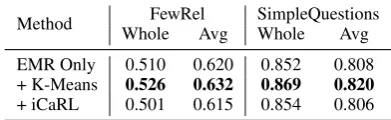
Comparison of Different Sample Selection Strategies Here we compare different selection methods on lifelong FewRel and SimpleQues-tions. EMR Only randomly choose samples. ( Re-buffi et al.,2017b) propose to choose samples that can best approximate the mean of the distribu-tion. We compare their sampling strategy (denoted as iCaRL) with our proposed method (K-Means) which encourages to choose diverse samples by choosing the central sample of the cluster in the embedding space. From the results in Table3, we can see that our method outperforms iCaRL and the random baseline. While iCaRL is not signifi-cantly different from the random baseline.
[image:8.595.316.512.64.124.2]Method FewRel SimpleQuestions Whole Avg Whole Avg EMR Only 0.510 0.620 0.852 0.808 + K-Means 0.526 0.632 0.869 0.820 + iCaRL 0.501 0.615 0.854 0.806 Table 3: Comparison of different methods to select data for EMR. The accuracy on the whole testing data (”Whole” column), and average accuracy on all ob-served tasks (”Avg” column) is reported. We run each method5times, and give their average results.
7 Related Work
Lifelong Learning without Catastrophic For-getting Recent lifelong learning research mainly focuses on overcoming the catastrophic forget-ting phenomenon (French, 1999;McCloskey and Cohen, 1989; McClelland et al., 1995; Rat-cliff, 1990), i.e., knowledge of previous tasks is abruptly forgotten when learning on a new task.
Existing research mainly follow two directions: the first one is memory-based approach ( Lopez-Paz and Ranzato,2017;Anonymous,2019), which saves some previous samples and optimizes a new task with a forgetting cost defined on the saved samples. These methods have shown strength in alleviating catastrophic forgetting, but the compu-tational cost grows rapidly with the number of pre-vious tasks. The second direction is toconsolidate parameters that are important to previous tasks
(Kirkpatrick et al., 2016; Liu et al., 2018; Ritter et al., 2018; Zenke et al., 2017). For example, Elastic Weight Consolidation (EWC) (Kirkpatrick et al.,2016) slows down learning on weights that are important to previous tasks. These methods usually do not need to save any previous data and only train on each task once. But their abilities to overcome catastrophic forgetting are limited.
Remark It is worth noting that the term life-long learning is also widely used in (Chen et al., 2015;Chen,2015;Shu et al.,2016,2017), which mainly focus on how to represent, reserve and ex-tract knowledge of previous tasks. These works belong to a research direction different from life-long learning without catastrophic forgetting.
8 Conclusion
In this paper, we introduce lifelong learning into relation detection, and find that two state-of-the-art lifelong learning algorithms, GEM and EWC, are outperformed by a simple memory replay method EMR on many benchmarks. Based on EMR, we further propose to use embedding align-ment to alleviate the problem of embedding space distortion, which we think is one reason that causes catastrophic forgetting. Also, we propose to choose diverse samples to store in the memory by conducting K-Means in the model embedding space. Experiments verify that our proposed meth-ods significantly outperform other baselines.
Acknowledgement
This research was supported in part by a UCSB Chancellor’s Fellowship, an IBM Faculty Award, and a DARPA Grant D18AP00044 funded under the DARPA YFA program. The authors are solely responsible for the contents of the paper, and the opinions expressed in this publication do not re-flect those of the funding agencies.
References
Anonymous. 2019. Efficient lifelong learning with a-gem. InSubmitted to International Conference on Learning Representations. Under review.
Antoine Bordes, Nicolas Usunier, Sumit Chopra, and Jason Weston. 2015. Large-scale simple ques-tion answering with memory networks. CoRR, abs/1506.02075.
Zhiyuan Chen. 2015. Lifelong machine learning for topic modeling and beyond. InProceedings of the 2015 Conference of the North American Chapter of the Association for Computational Linguistics: Stu-dent Research Workshop, pages 133–139. Associa-tion for ComputaAssocia-tional Linguistics.
Zhiyuan Chen, Nianzu Ma, and Bing Liu. 2015. Life-long learning for sentiment classification. In Pro-ceedings of the 53rd Annual Meeting of the Associ-ation for ComputAssoci-ational Linguistics and the 7th In-ternational Joint Conference on Natural Language
Processing (Volume 2: Short Papers), pages 750– 756. Association for Computational Linguistics.
Chrisantha Fernando, Dylan Banarse, Charles Blun-dell, Yori Zwols, David Ha, Andrei A. Rusu, Alexander Pritzel, and Daan Wierstra. 2017. Path-net: Evolution channels gradient descent in super neural networks.CoRR, abs/1701.08734.
Robert M French. 1999. Catastrophic forgetting in connectionist networks. Trends in cognitive sci-ences, 3(4):128–135.
Xu Han, Hao Zhu, Pengfei Yu, Ziyun Wang, Yuan Yao, Zhiyuan Liu, and Maosong Sun. 2018. Fewrel: A large-scale supervised few-shot relation classifica-tion dataset with state-of-the-art evaluaclassifica-tion. In Pro-ceedings of the 2018 Conference on Empirical Meth-ods in Natural Language Processing, Brussels, Bel-gium, October 31 - November 4, 2018, pages 4803– 4809.
Sepp Hochreiter and J¨urgen Schmidhuber. 1997.
Long short-term memory. Neural Computation, 9(8):1735–1780.
James Kirkpatrick, Razvan Pascanu, Neil C. Rabi-nowitz, Joel Veness, Guillaume Desjardins, An-drei A. Rusu, Kieran Milan, John Quan, Tiago Ra-malho, Agnieszka Grabska-Barwinska, Demis Has-sabis, Claudia Clopath, Dharshan Kumaran, and Raia Hadsell. 2016. Overcoming catastrophic for-getting in neural networks.CoRR, abs/1612.00796.
Alex Krizhevsky and Geoffrey Hinton. 2009. Learning multiple layers of features from tiny images. Tech-nical report, Citeseer.
Yann LeCun. 1998. The mnist database of handwritten digits. http://yann. lecun. com/exdb/mnist/.
Xialei Liu, Marc Masana, Luis Herranz, Joost van de Weijer, Antonio M. L´opez, and Andrew D. Bag-danov. 2018. Rotate your networks: Better weight consolidation and less catastrophic forget-ting.CoRR, abs/1802.02950.
David Lopez-Paz and Marc’Aurelio Ranzato. 2017. Gradient episodic memory for continual learning. InAdvances in Neural Information Processing Sys-tems 30: Annual Conference on Neural Information Processing Systems 2017, 4-9 December 2017, Long Beach, CA, USA, pages 6470–6479.
James L McClelland, Bruce L McNaughton, and Ran-dall C O’reilly. 1995. Why there are complementary learning systems in the hippocampus and neocortex: insights from the successes and failures of connec-tionist models of learning and memory. Psychologi-cal review, 102(3):419–457.
Jeffrey Pennington, Richard Socher, and Christo-pher D. Manning. 2014. Glove: Global vectors for word representation. InEmpirical Methods in Nat-ural Language Processing (EMNLP), pages 1532– 1543.
Roger Ratcliff. 1990. Connectionist models of recog-nition memory: constraints imposed by learning and forgetting functions. Psychological review, 97(2):285–308.
Sylvestre-Alvise Rebuffi, Alexander Kolesnikov, Georg Sperl, and Christoph H. Lampert. 2017a.
icarl: Incremental classifier and representation learning. In 2017 IEEE Conference on Computer Vision and Pattern Recognition, CVPR 2017, Honolulu, HI, USA, July 21-26, 2017, pages 5533–5542.
Sylvestre-Alvise Rebuffi, Alexander Kolesnikov, Georg Sperl, and Christoph H Lampert. 2017b. icarl: Incremental classifier and representation learning. In Computer Vision and Pattern Recog-nition (CVPR), 2017 IEEE Conference on, pages 5533–5542. IEEE.
Sebastian Riedel, Limin Yao, Andrew McCallum, and Benjamin M Marlin. 2013. Relation extraction with matrix factorization and universal schemas. In Pro-ceedings of the 2013 Conference of the North Amer-ican Chapter of the Association for Computational Linguistics: Human Language Technologies, pages 74–84.
Mark Bishop Ring. 1994. Continual learning in rein-forcement environments. Ph.D. thesis, University of Texas at Austin Austin, Texas 78712.
Hippolyt Ritter, Aleksandar Botev, and David Bar-ber. 2018. Online structured laplace approxima-tions for overcoming catastrophic forgetting. CoRR, abs/1805.07810.
Andrei A. Rusu, Neil C. Rabinowitz, Guillaume Des-jardins, Hubert Soyer, James Kirkpatrick, Koray Kavukcuoglu, Razvan Pascanu, and Raia Had-sell. 2016. Progressive neural networks. CoRR, abs/1606.04671.
Lei Shu, Bing Liu, Hu Xu, and Annice Kim. 2016.
Lifelong-rl: Lifelong relaxation labeling for sepa-rating entities and aspects in opinion targets. In Pro-ceedings of the 2016 Conference on Empirical Meth-ods in Natural Language Processing, pages 225– 235. Association for Computational Linguistics.
Lei Shu, Hu Xu, and Bing Liu. 2017. Lifelong learn-ing crf for supervised aspect extraction. In Pro-ceedings of the 55th Annual Meeting of the Associa-tion for ComputaAssocia-tional Linguistics (Volume 2: Short Papers), pages 148–154. Association for Computa-tional Linguistics.
Sebastian Thrun. 1998. Lifelong Learning Algorithms, pages 181–209. Springer US, Boston, MA.
Sebastian Thrun and Lorien Pratt. 2012. Learning to learn. Springer Science & Business Media.
Denny Vrandeˇci´c and Markus Kr¨otzsch. 2014. Wiki-data: a free collaborative knowledgebase. Commu-nications of the ACM, 57(10):78–85.
Tianjun Xiao, Jiaxing Zhang, Kuiyuan Yang, Yuxin Peng, and Zheng Zhang. 2014. Error-driven incre-mental learning in deep convolutional neural net-work for large-scale image classification. In Pro-ceedings of the 22Nd ACM International Conference on Multimedia, MM ’14, pages 177–186, New York, NY, USA. ACM.
Wen-tau Yih, Ming-Wei Chang, Xiaodong He, and Jianfeng Gao. 2015. Semantic parsing via staged query graph generation: Question answering with knowledge base. InProceedings of the 53rd Annual Meeting of the Association for Computational Lin-guistics and the 7th International Joint Conference on Natural Language Processing (Volume 1: Long Papers), pages 1321–1331. Association for Compu-tational Linguistics.
Mo Yu, Wenpeng Yin, Kazi Saidul Hasan, C´ıcero Nogueira dos Santos, Bing Xiang, and Bowen Zhou. 2017. Improved neural relation detection for knowledge base question answering. In Proceedings of the 55th Annual Meeting of the Association for Computational Linguistics, ACL 2017, Vancouver, Canada, July 30 - August 4, Volume 1: Long Papers, pages 571–581.
A Appendix
A.1 Performance on the whole testing data over time
(a) FewRel
[image:11.595.87.264.138.449.2](b) SimpleQuestions
Figure 3: This figure shows the accuracy on the whole testing data on the benchmark of lifelong FewRel and lifelong SimpleQuestions during the lifelong learning process. The average performance of5runs is reported, and theaverage running timeis shown in the brackets.
The performance on the whole testing data over time is shown in Figure3.
A.2 Experiment setting for MNIST and CIFAR
Following the setting in (Lopez-Paz and Ranzato, 2017), the size of memory for each task is set to be