Proceedings of NAACL-HLT 2019, pages 143–155 143
Answer-based Adversarial Training for
Generating Clarification Questions
Sudha Rao∗
Microsoft Research, Redmond
Hal Daum´e III
University of Maryland, College Park Microsoft Research, New York City
Abstract
We present an approach for generating clar-ification questions with the goal of eliciting new information that would make the given textual context more complete. We propose that modeling hypothetical answers (to clarifi-cation questions) as latent variables can guide our approach into generating more useful clar-ification questions. We develop a Generative Adversarial Network (GAN) where the gener-ator is a sequence-to-sequence model and the discriminator is a utility function that models the value of updating the context with the an-swer to the clarification question. We eval-uate on two datasets, using both automatic metrics and human judgments of usefulness, specificity and relevance, showing that our approach outperforms both a retrieval-based model and ablations that exclude the utility model and the adversarial training.
1 Introduction
A goal of natural language processing is to de-velop techniques that enable machines to process naturally occurring language. However, not all language is clear and, as humans, we may not always understand each other (Grice, 1975); in cases of gaps or mismatches in knowledge, we tend to ask questions (Graesser et al., 2008). In this work, we focus on the task of automati-cally generating clarification questions: questions that ask for information that is missing from a given linguistic context. Our clarification ques-tion generaques-tion model builds on the sequence-to-sequence approach that has proven effective for several language generation tasks (Sutskever et al.,
2014; Serban et al., 2016; Yin et al., 2016; Du et al.,2017). Unfortunately, training a sequence-to-sequence model directly on (context, question)
∗
This research performed when the author was still at University of Maryland, College Park.
pairs yields questions that are highly generic1, cor-roborating a common finding in dialog systems (Li et al.,2016b). Our goal is to be able to generate clarification questions that are usefulandspecific. To achieve this, we begin with a recent observa-tion of Rao and Daum´e III(2018), who consider the task of question reranking: a good clarifica-tion quesclarifica-tion is the one whose answer has a high utility, which they define as the likelihood that this question would lead to an answer that will make the context more complete (§2.3). Inspired by this, we construct a model that first generates a question given a context, and then generates a hypotheti-cal answer to that question. Given this (context, question, answer) triple, we train a utility calcula-tor to estimate the usefulness of this question. We then show that this utility calculator can be gen-eralized using ideas for generative adversarial net-works (Goodfellow et al.,2014) for text (Yu et al.,
2017), wherein the utility calculator plays the role of the “discriminator” and the question generator is the “generator” (§2.2), which we train using the MIXERalgorithm (Ranzato et al.,2015). We eval-uate our approach on two datasets: Amazon prod-uct descriptions (Figure 1) and Stack Exchange posts (Figure 2). Our two main contributions are:
1. An adversarial training approach for gener-ating clarification questions that models the utility of updating a context with an answer to the clarification question.2
2. An empirical evaluation using both auto-matic metrics and human judgments to show that our adversarially trained model generates questions that are moreusefulandspecific to the contextthan all the baseline models.
1For instance, under home appliances, frequently asking
“Is it made in China?” or “What are the dimensions?”
2Code and data: https://github.com/
Product T-fal Nonstick Cookware Set, title 18 pieces, Red
Product Easy non-stick 18pc set includes every description piece for your everyday meals.
Exceptionally durable dishwasher safe cookware for easy clean up. Durable non-stick interior. Oven safe up to 350.F/177.C
Question Are they induction compatible?
[image:2.595.306.526.63.185.2]Answer They are aluminium so the answer is NO.
Figure 1: Sample product description from Amazon paired with a clarification question and answer.
2 Training a Clarification Question Generator
Our goal is to build a model that, given a context, can generate an appropriate clarification question. Our dataset consists of (context,question,answer) triples where thecontext is an initial textual con-text,questionis the clarification question that asks about some missing information in the context and answer is the answer to the clarification question (details in §3.1). Representationally, our ques-tion generator is a standard sequence-to-sequence model with attention (§2.1). The learning problem is: how to train the sequence-to-sequence model to generate good clarification questions.
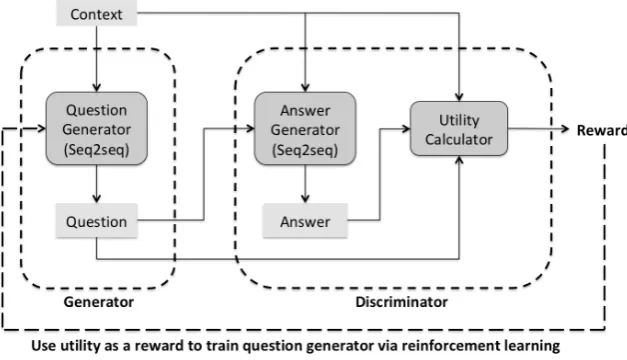
[image:2.595.75.289.64.183.2]An overview of our training setup is shown in
Figure 3. Given a context, our question genera-tor, which is a sequence-to-sequence model, out-puts a question. In order to evaluate the usefulness of this question, we then have a second sequence-to-sequence model called the “answer generator” that generates a hypothetical answer based on the context and the question (§2.5). This (context, generated question and generated answer) triple is fed into a UTILITY calculator, whose initial
goal is to estimate the probability that this (ques-tion, answer) pair is useful in this context (§2.3). This UTILITY is treated as a reward, which is
used to update the question generator using the MIXER (Ranzato et al., 2015) algorithm (§2.2). Finally, we reinterpret the answer-generator-plus-utility-calculator component as a discriminator for differentiating between (context, true question, generated answer) triples and (context, generated question, generated answer) triples , and optimize the generator for this adversarial objective using MIXER(§2.4).
Title Wifi keeps dropping on 5Ghz network
Post Recently my wireless has been iffy at my university. I notice I am connected to a 5Ghz network, while I am connected to a 2.4Ghz everywhere else (where things work fine). Sometimes it reconnects, but I have to run ‘sudo service network-manager restart’. Is it possible a kernel update caused this?
Question what is the make of your wifi card ?
[image:2.595.329.529.448.540.2]Answer intel corporation wireless 7260 ( rev 73 )
Figure 2: Sample post from stackexchange.com paired with a clarification question and answer.
2.1 Sequence-to-sequence Model for Question Generation
We use a standard attention based sequence-to-sequence model (Luong et al.,2015) for our ques-tion generator. Given an input sequence (context)
c = (c1, c2, ..., cN), this model generates an
out-put sequence (question)q = (q1, q2, ..., qT). The
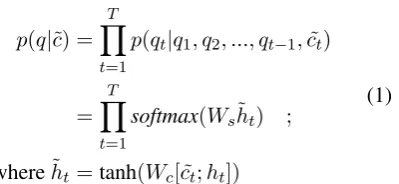
architecture of this model is an encoder-decoder with attention. The encoder is a recurrent neural network (RNN) operating over the input word em-beddings to compute a source context representa-tion˜c. The decoder uses this source representation to generate the target sequence one word at a time:
p(q|˜c) =
T
Y
t=1
p(qt|q1, q2, ..., qt−1,c˜t)
=
T
Y
t=1
softmax(Ws˜ht) ;
where˜ht=tanh(Wc[ ˜ct;ht])
(1)
In Eq 1, h˜t is the attentional hidden state of the
RNN at timetandWs andWcare parameters of
the model.3 The predicted tokenqtis the token in
the vocabulary that is assigned the highest prob-ability using the softmax function. The standard training objective for sequence-to-sequence model is to maximize the log-likelihood of all(c, q)pairs in the training dataDwhich is equivalent to mini-mizing the following loss,
Lmle(D) =− X (c,q)∈D
T
X
t=1
logp(qt|q1, ..., qt−1,c˜t)
(2)
Figure 3: Overview of our GAN-based clarification question generation model (refer preamble of§2)
2.2 Training the Generator to Optimize UTILITY
Training sequence-to-sequence models for the task of clarification question generation (with con-text as input and question as output) using max-imum likelihood objective unfortunately leads to the generation of highly generic questions, such as “What are the dimensions?” when asking ques-tions about home appliances. Recently, Rao and Daum´e III(2018) observed that the usefulness of a question can be better measured as the utility that would be obtained if the context were updated with the answer to the proposed question. Follow-ing this observation, we first use a pretrained an-swer generator (§2.5) to generate an answer given a context and a question. We then use a pretrained UTILITY calculator (§2.3 ) to predict the likeli-hood that the generated answer would increase the utility of the context by adding useful information to it. Finally, we train our question generator to optimize this UTILITYbased reward.
Similar to optimizing metrics like BLEU and
ROUGE, this UTILITY calculator also operates on discrete text outputs, which makes optimiza-tion difficult due to non-differentiability. A suc-cessful recent approach dealing with the non-differentiability while also retaining some advan-tages of maximum likelihood training is the Mixed Incremental Cross-Entropy Reinforce (Ranzato et al., 2015) algorithm (MIXER). In MIXER, the overall lossL is differentiated as in REINFORCE
(Williams,1992):
L(θ) =−Eqs∼pθr(qs) ;
∇θL(θ) =−Eqs∼pθr(qs)∇θlogpθ(qs)
(3)
whereqsis a random output sample according to the modelpθ andθare the parameters of the
net-work. The expected gradient is then approximated using a single sample qs = (qs1, qs2, ..., qTs) from the model distribution (pθ). In REINFORCE, the
policy is initialized randomly, which can cause long convergence times. To solve this, MIXER
starts by optimizing maximum likelihood for the initial∆time steps, and slowly shifts to optimiz-ing the expected reward fromEq 3for the remain-ing(T −∆)time steps.
In our model, for the initial ∆ time steps, we minimize Lmle and for the remaining steps, we
minimize the following UTILITY-based loss:
Lmax-utility=−(r(qp)−r(qb))
T
X
t=1
logp(qt|q1, ..., qt−1,c˜t)
(4)
wherer(qp) is the UTILITY based reward on the
predicted question andr(qb)is a baseline reward introduced to reduce the high variance otherwise observed when using REINFORCE. To estimate
this baseline reward, we take the idea from the self-critical training approachRennie et al.(2017) where the baseline is estimated using the reward obtained by the current model under greedy de-coding during test time. We find that this approach for baseline estimation stabilizes our model better than the approach used in MIXER.
2.3 Estimating UTILITYfrom Data
to estimate the probability that ananswer would be a meaningful addition to a context. They treat this as a binary classification problem where the positive instances are the true (context, question, answer) triples in the dataset whereas the negative instances are contexts paired with a random (ques-tion, answer) from the dataset. FollowingRao and Daum´e III(2018), we model our UTILITY calcula-tor by first embedding the words incand then us-ing an LSTM (long-short term memory) ( Hochre-iter and Schmidhuber,1997) to generate a neural representation c¯of the context by averaging the output of each of the hidden states. Similarly, we obtain neural representationsq¯and¯aofqanda re-spectively using a question and an answer LSTM models. Finally, we use a feed forward neural net-workFUTILITY(¯c,q,¯ ¯a)to predict the usefulness of the question.
2.4 UTILITYGAN for Clarification Question Generation
The UTILITYcalculator trained on true vs random samples from real data (as described in the previ-ous section) can be a weak reward signal for ques-tions generated by a model due to the large dis-crepancy between the true data and the model’s outputs. In order to strengthen the reward signal, we reinterpret the UTILITY calculator (coupled with the answer generator) as a discriminator in an adversarial learning setting. That is, instead of taking the UTILITYcalculator to be a fixed model that outputs the expected quality of a (question, answer) pair, we additionally optimize it to dis-tinguish between true (question, answer) pairs and model-generated ones. This reinterpretation turns our model into a form of a generative adversarial network (GAN) (Goodfellow et al.,2014).
GAN is a training procedure for “generative” models that can be interpreted as a game between a generator and a discriminator. The generator is a modelg ∈ G that produces outputs (in our case, questions). The discriminator is another model
d∈ D that attempts to classify between true out-puts and model-generated outout-puts. The goal of the generator is to generate data such that it can fool the discriminator; the goal of the discriminator is to be able to successfully distinguish between real and generated data. In the process of trying to fool the discriminator, the generator produces data that is as close as possible to the real data distribution.
Generically, the GAN objective is:
LGAN(D,G) = max
d∈Dming∈GEx∼pˆlogd(x)+
Ez∼pzlog(1−d(g(z)))
(5)
wherexis sampled from the true data distribution
ˆ
p, andzis sampled from a prior defined on input noise variablespz.
Although GANs have been successfully used for image tasks, training GANs for text generation is challenging due to the discrete nature of out-puts in text. The discrete outout-puts from the gener-ator make it difficult to pass the gradient update from the discriminator to the generator. Recently,
Yu et al.(2017) proposed a sequence GAN model for text generation to overcome this issue. They treat their generator as an agent and use the dis-criminator as a reward function to update the gen-erative model using reinforcement learning tech-niques. Our GAN-based approach is inspired by this sequence GAN model with two main mod-ifications: a) We use MIXER algorithm as our generator (§2.2) instead of a purely policy gradi-ent approach; and b) We use UTILITY calculator (§2.3) as our discriminator instead of a convolu-tional neural network (CNN).
Theoretically, the discriminator should be trained using (context, true question, true answer) triples as positive instances and (context, gener-ated question, genergener-ated answer) triples as the negative instances. However, we find that train-ing a discriminator ustrain-ing such positive instances makes it very strong since the generator would have to not only generate real looking questions but also generate real looking answers to fool the discriminator. Since our main goal is question generation and since we use answers only as latent variables, we instead use (context, true question, generated answer) as our positive instances where we use the pretrained answer generator to get the generated answerfor the true question. Formally, our objective function is:
LGAN-U(U,M) = max
u∈Um∈Mmin Eq∼pˆlogu(c, q,A(c, q))+
Ec∼pˆlog(1−u(c, m(c),A(c, m(c))))
(6)
whereU is the UTILITY discriminator, Mis the
MIXERgenerator,pˆis our data of (context, ques-tion, answer) triples andAis the answer generator.
2.5 Pretraining
(§2.1) to maximize the log-likelihood of all (con-text, question) pairs in the training data. Parame-ters of this model are updated during adversarial training.
Answer Generator. We pretrain our answer generator using the sequence-to-sequence model (§2.1) to maximize the log-likelihood of all ([con-text+question], answer) pairs in the training data. Parameters of this model are kept fixed during the adversarial training.4
Discriminator. In our UTILITY GAN model (§2.4), the discriminator is trained to differenti-ate between true and generdifferenti-ated questions. How-ever, since we want to guide our UTILITY based discriminator to also differentiate between true (“good”) and random (“bad”) questions, we pre-train our discriminator in the same way we pre-trained our UTILITYcalculator. For positive instances, we use a context and its true question, answer from the training data and for negative instances, we use the same context but randomly sample a question from the training data (and use the answer paired with that random question).
3 Experimental Results
We base our experimental design on the following research questions:
1. Do generation models outperform simpler re-trieval baselines?
2. Does optimizing the UTILITY reward
im-prove over maximum likelihood training? 3. Does using adversarial training improve over
optimizing the pretrained UTILITY?
4. How do the models perform when evaluated for nuances such as specificity & usefulness?
3.1 Datasets
We evaluate our model on two datasets.
Amazon. In this dataset, context is a prod-uct description on amazon.com combined with the product title, question is a clarification question asked to the product and answer is the seller’s (or other users’) reply to the question. To ob-tain these data triples, we combine the Amazon question-answering dataset (McAuley and Yang,
2016) with the Amazon reviews dataset (McAuley et al., 2015). We show results on the Home & Kitchen category of this dataset since it con-tains a large number of questions and is relatively
4We leave the experimentation of updating parameters of
answer generator during adversarial training to future work.
easier for human-based evaluation. It consists of
19,119training,2,435tune and2,305test exam-ples (product descriptions), with 3 to 10 questions (average: 7) per description.
Stack Exchange. In this dataset, context is a post on stackexchange.com combined with the ti-tle,questionis a clarification question asked in the comments section of the post and answer is ei-ther the update made to the post in response to the question or the author’s reply to the question in the comments section. Rao and Daum´e III(2018) cu-rated a dataset of61,681training,7,710tune and
7,709 test such triples from three related subdo-mains on stackexchage.com (askubuntu, unix and superuser). Additionally, for 500 instances each from the tune and the test set, their dataset includes 1 to 6 other questions identified as valid questions by expert human annotators from a pool of candi-date questions.
3.2 Baselines and Ablated Models
We compare three variants (ablations) of our pro-posed approach, together with an information re-trieval baseline:
GAN-Utilityis our full model which is a UTIL
-ITY calculator based GAN training (§2.4) includ-ing the UTILITY discriminator and the MIXER
question generator.5
Max-Utilityis our reinforcement learning base-line where the pretrained question generator model is further trained to optimize the UTILITY
reward (§2.2) without the adversarial training.
MLE is the question generator model pre-trained on context, question pairs using maximum likelihood objective (§2.1).
Lucene6 is our information retrieval baseline similar to the Lucene baseline described in Rao and Daum´e III(2018). Given a context in the test set, we use Lucene, which is a TF-IDF based doc-ument ranker, to retrieve top 10 contexts that are most similar to the given context in the train set. We randomly choose a question from the human written questions paired with these 10 contexts in the train set to construct our Lucene baseline7.
5
Experimental details are inAppendix B.
6https://lucene.apache.org/
7For the Amazon dataset, we ignore questions asked to
3.3 Evaluation Metrics
We evaluate initially with automated evaluation metrics, and then more substantially with crowd-sourced human judgments.
3.3.1 Automatic Metrics
Diversity, which calculates the proportion of unique trigrams in the output to measure the diver-sity as commonly used to evaluate dialogue gener-ation (Li et al.,2016b).
BLEU (Papineni et al., 2002) 8, which evaluates n-gram precision between the output and the ref-erences.
METEOR (Banerjee and Lavie, 2005), which is
similar to BLEU but includes stemmed and syn-onym matches to measure similarity between the output and the references.
3.3.2 Human Judgements
We use Figure-Eight9, a crowdsourcing platform, to collect human judgements. Each judgement10 consists of showing the crowdworker a context and a generated question and asking them to eval-uate the question along following axes:
Relevance: We ask “Is the question on topic?” and let workers choose from: Yes (1) and No (0)
Grammaticality: We ask“Is the question gram-matical?” and let workers choose from: Yes (1) and No (0)
Seeking new information: We ask “Does the question ask for new information currently not included in the description?” and let workers choose from: Yes (1) and No (0)
Specificity: We ask “How specific is the ques-tion?”and let workers choose from:
4: Specific pretty much only to this product (or same product from different manufacturer) 3: Specific to this and other very similar products 2: Generic enough to be applicable to many other
products of this type
1: Generic enough to be applicable to any prod-uct under Home and Kitchen
0: N/A (Not applicable) i.e. Question is not on topic OR is incomprehensible
Usefulness: We ask“How useful is the question to a potential buyer (or a current user) of the prod-uct?”and let workers choose from:
8
https://github.com/moses-smt/ mosesdecoder/blob/master/scripts/ generic/multi-bleu.perl
9
https://www.figure-eight.com
10We paid crowdworkers 5 cents per judgment and
col-lected five judgments per question.
Criteria Agreement
Relevance 0.92
Grammaticality 0.92
Seeking new information 0.84
Usefulness 0.65
[image:6.595.311.492.63.150.2]Specificity 0.72
Table 1: Inter-annotator agreement on the five criteria used in human-based evaluation.
4: Useful enough to be included in the product description
3: Useful to a large number of potential buyers (or current users)
2: Useful to a small number of potential buyers (or current users)
1: Useful only to the person asking the question 0: N/A (Not applicable) i.e. Question is not on
topic OR is incomprehensible OR is not seek-ing new information
3.3.3 Inter-annotator Agreement
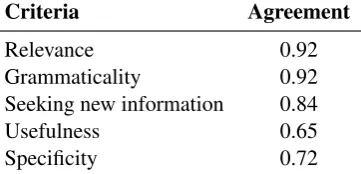
Table 1shows the inter-annotator agreement (re-ported by Figure-Eight as confidence11) on each of the above five criteria. Agreement onRelevance, Grammaticality and Seeking new information is high. This is not surprising given that these crite-ria are not very subjective. On the other hand, the agreement on usefulness and specificity is quite moderate since these judgments can be very sub-jective.
Since the inter-annotator agreement on the use-fulness criteria was particularly low, in order to re-duce the subjectivity involved in the fine grained annotation, we convert the range [0-4] to a more coarse binary range [0-1] by mapping the scores 4 and 3 to1and the scores 2, 1 and 0 to0.
3.4 Automatic Metric Results
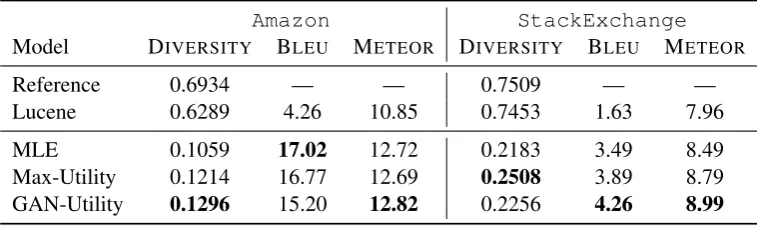
Table 2shows the results on the two datasets when evaluated according to automatic metrics.
In the Amazon dataset, GAN-Utility outper-forms all ablations on DIVERSITY, suggesting that it produces more diverse outputs. Lucene, on the other hand, has the highest DIVERSITY since it
consists of human written questions, which tend to be more diverse because they are much longer compared to model generated questions. This comes at the cost of lower match with the refer-ence as visible in the BLEUand METEORscores.
11https://success.figure-eight.com/
Amazon StackExchange Model DIVERSITY BLEU METEOR DIVERSITY BLEU METEOR
Reference 0.6934 — — 0.7509 — —
Lucene 0.6289 4.26 10.85 0.7453 1.63 7.96
MLE 0.1059 17.02 12.72 0.2183 3.49 8.49
Max-Utility 0.1214 16.77 12.69 0.2508 3.89 8.79
[image:7.595.109.488.63.177.2]GAN-Utility 0.1296 15.20 12.82 0.2256 4.26 8.99
Table 2: DIVERSITYas measured by the proportion of unique trigrams in model outputs. Bigrams and unigrams follow similar trends. BLEUand METEOR scores using up to 10 references for the Amazon dataset and up to six references for the StackExchange dataset. Numbers in bold are the highest among the models. All results for Amazon are on the entire test set whereas for StackExchange they are on the 500 instances of the test set that have multiple references.
In terms of BLEU and METEOR, there is incon-sistency. Although GAN-Utility outperforms all baselines according to METEOR, the fully ablated
MLE model has a higher BLEUscore. This is be-cause BLEUscore looks for exact n-gram matches and since MLE produces more generic outputs, it is much more likely that it will match one of 10 references compared to the specific/diverse out-puts of GAN-Utility, since one of those ten is highly likely to itself be generic.
In the StackExchange dataset GAN-Utility out-performs all ablations on both BLEU and ME
-TEOR. Unlike in the Amazon dataset, MLE does
not outperform GAN-Utility in BLEU. This is because the MLE outputs in this dataset are not as generic as in the amazon dataset due to the highly technical nature of contexts in StackEx-change. As in the Amazon dataset, GAN-Utility outperforms MLE on DIVERSITY. Interestingly, the Max-Utility ablation achieves a higher DIVER
-SITYscore than GAN-Utility. On manual analysis we find that Max-Utility produces longer outputs compared to GAN-Utility but at the cost of being less grammatical.
3.5 Human Judgements Analysis
Table 3shows the numeric results of human-based evaluation performed on the reference and the sys-tem outputs on 300 random samples from the test set of the Amazon dataset.12 All approaches produce relevant and grammatical questions. All models are all equally good at seeking new infor-mation, but are weaker than Lucene, which per-forms better at seeking new information but at the
12We could not ask crowdworkers evaluate the
StackEx-change data due to its highly technical nature.
cost of much lower specificity and lower useful-ness.
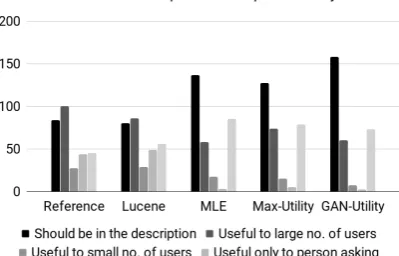
Our full model, GAN-Utility, performs signifi-cantly better at the usefulness criteria showing that the adversarial training approach generates more useful questions. Interestingly, all our models pro-duce questions that are more useful than Lucene and Reference, largely because Lucene and Ref-erence tend to ask questions that are more of-ten useful only to the person asking the question, making them less useful for potential other buyers (seeFigure 4). GAN-Utility also performs signifi-cantly better at generating questions that are more specific to the product (see details in Figure 5), which aligns with the higher DIVERSITY score obtained by GAN-Utility under automatic metric evaluation.
Table 5contains example outputs from different models along with their usefulness and specificity scores. MLE generates questions such as “is it waterproof?” and“what is the wattage?”, which are applicable to many other products. Whereas our GAN-Utility model generates more specific question such as “is this shower curtain mildew resistant?”. Appendix C includes further analy-sis of system outputs on both Amazon and Stack Exchange datasets.
4 Related Work
Model Relevant[0-1] Grammatical[0-1] New Info[0-1] Useful[0-1] Specific[0-4]
Reference 0.96 0.99 0.93 0.72 3.38
Lucene 0.90 0.99 0.95 0.68 2.87
MLE 0.92 0.96 0.85 0.91 3.05
Max-Utility 0.93 0.96 0.88 0.91 3.29
[image:8.595.97.502.66.161.2]GAN-Utility 0.94 0.96 0.87 0.96 3.52
[image:8.595.314.519.235.370.2]Table 3: Results of human judgments on model generated questions on 300 sample Home & Kitchen product descriptions. Numeric range corresponds to the options described in§3.3. The difference between the bold and the non-bold numbers is statistically significant with p<0.05. Reference is excluded in the significance calculation.
Figure 4: Human judgements on the usefulness criteria. Figure 5: Human judgements on the specificity criteria.
in the given text. Outside reading comprehen-sion questions, Liu et al. (2010) use templated questions to help authors write better related work sections whereas we generate questions to fill information gaps. Labutov et al. (2015) use crowdsourcing to generate question tem-plates whereas we learn from naturally occurring questions. Mostafazadeh et al. (2016, 2017) generate natural and engaging questions, given an image (and some initial text). Whereas, we generate questions specifically for identifying missing information. Stoyanchev et al. (2014) generate clarification questions to resolve am-biguity caused by speech recognition failures during dialog, whereas we generate clarification questions to resolve ambiguity caused by missing information. The recent work most relevant to our work is byRao and Daum´e III (2018). They build a model which given a context and a set of candidate clarification questions, ranks them in a way that more useful clarification questions would be higher up in the ranking. In our work, we build on their ideas to propose a model that generates (instead of ranking) clarification questions given a context.
Neural Models and Adversarial Training for Text Generation. Neural network based models have had significant success at a variety of text generation tasks, including machine translation (Bahdanau et al.,2015;Luong et al.,2015), sum-marization (Nallapati et al., 2016), dialog ( Bor-des et al., 2016; Li et al., 2016a; Serban et al.,
2017), textual style transfer (Jhamtani et al.,2017;
[image:8.595.81.281.236.364.2]gra-Title Raining Cats and Dogs Vinyl BathroomShower Curtain
Product This adorable shower curtain measures 70 by 72 Description inches and is sure to make a great gift!
Usefulness[0-4] Specificity[0-4]
Reference does the vinyl smells? 3 4
Lucene other than home sweet home, what other sayings on the curtain? 2 4
MLE is it waterproof ? 4 2
Max-Utility is this shower curtain mildew ? 0 0
GAN-Utility is this shower curtain mildew resistant ? 4 4
Title PURSONIC HF200 PedestalBladeless Fan & HumidifierAll-in-one
Product The first bladeless fan to incoporate a humidifier! This product Description operates solely as a fan, a humidifier or both simultaneously.
Atomizing function via ultrasonic. 5.5L tank lasts up to 12 hours.
Usefulness[0-4] Specificity[0-4]
Reference i can not get the humidifier to work 1 2
Lucene does it come with the vent kit 3 3
MLE what is the wattage of this fan ? 4 2
Max-Utility is this battery operated ? 3 2
[image:9.595.72.526.62.294.2]GAN-Utility does this fan have an automatic shut off ? 4 4
Table 4: Example outputs from each of the systems for two product descriptions along with the usefulness and the specificity score given by human annotators.
dient based generator with a MIXER model and their CNN based discriminator with our UTILITY
calculator. Li et al. (2017) train an adversarial model similar to SeqGAN for generating next ut-terance in a dialog given a context. However, un-like our work, their discriminator is a binary clas-sifier trained only to distinguish between human and machine generated utterances.
5 Conclusion
In this work, we describe a novel approach to the problem of clarification question generation. We use the observation of Rao and Daum´e III
(2018) that the usefulness of a clarification ques-tion can be measured by the value of updating a context with an answer to the question. We use a sequence-to-sequence model to generate a ques-tion given a context and a second sequence-to-sequence model to generate an answer given the context and the question. Given the (context, gen-erated question, gengen-erated answer) triple, we cal-culate the utility of this triple and use it as a re-ward to retrain the question generator using rein-forcement learning based MIXERmodel. Further,
to improve upon the utility calculator, we reinter-pret it as a discriminator in an adversarial setting and train both the utility calculator and the MIXER
model in a minimax fashion. We find that our ad-versarial training approach produces more useful and specific questions compared to both a model
trained using maximum likelihood objective and a model trained using utility reward based reinforce-ment learning.
There are several avenues of future work. Fol-lowingMostafazadeh et al.(2016), we could com-bine text input with image input in the Amazon dataset (McAuley and Yang, 2016) to generate more relevant and useful questions. One signif-icant research challenge in the space of free text generation problems when the set of possible out-puts is large, is that of automatic evaluation (Lowe et al., 2016): in our results we saw some corre-lation between human judgments and automatic metrics, but not enough to trust the automatic met-rics completely. Lastly, we hope to integrate such a question generation model into a real world plat-form like StackExchange or Amazon to under-stand the real utility of such models and to unearth additional research questions.
Acknowledgments
References
Dzmitry Bahdanau, Kyunghyun Cho, and Yoshua Ben-gio. 2015. Neural machine translation by jointly learning to align and translate. InICLR.
Satanjeev Banerjee and Alon Lavie. 2005. Meteor: An automatic metric for mt evaluation with improved correlation with human judgments. InProceedings of the acl workshop on intrinsic and extrinsic evalu-ation measures for machine translevalu-ation and/or sum-marization, pages 65–72.
Antoine Bordes, Y-Lan Boureau, and Jason Weston. 2016. Learning end-to-end goal-oriented dialog.
arXiv preprint arXiv:1605.07683.
Emily L Denton, Soumith Chintala, Arthur Szlam, and Rob Fergus. 2015. Deep generative image models using a Laplacian pyramid of adversarial networks. InAdvances in Neural Information Processing Sys-tems, pages 1486–1494.
Xinya Du, Junru Shao, and Claire Cardie. 2017. Learn-ing to ask: Neural question generation for readLearn-ing comprehension. InProceedings of the 55th Annual Meeting of the Association for Computational Lin-guistics (Volume 1: Long Papers), volume 1, pages 1342–1352.
Nan Duan, Duyu Tang, Peng Chen, and Ming Zhou. 2017. Question generation for question answering. In Proceedings of the 2017 Conference on Empiri-cal Methods in Natural Language Processing, pages 866–874.
Ian Goodfellow, Jean Pouget-Abadie, Mehdi Mirza, Bing Xu, David Warde-Farley, Sherjil Ozair, Aaron Courville, and Yoshua Bengio. 2014. Generative ad-versarial nets. In Advances in Neural Information Processing Systems, pages 2672–2680.
Art Graesser, Vasile Rus, and Zhiqiang Cai. 2008. Question classification schemes. In Proc. of the Workshop on Question Generation.
H Paul Grice. 1975. Logic and conversation. 1975, pages 41–58.
Michael Heilman. 2011. Automatic factual question generation from text. Ph.D. thesis, Carnegie Mellon University.
Sepp Hochreiter and J¨urgen Schmidhuber. 1997. Long short-term memory. Neural computation, 9(8):1735–1780.
Harsh Jhamtani, Varun Gangal, Eduard Hovy, and Eric Nyberg. 2017. Shakespearizing modern language using copy-enriched sequence to sequence models. In Proceedings of the Workshop on Stylistic Varia-tion, pages 10–19.
Igor Labutov, Sumit Basu, and Lucy Vanderwende. 2015. Deep questions without deep understanding. In Proceedings of the 53rd Annual Meeting of the
Association for Computational Linguistics and the 7th International Joint Conference on Natural Lan-guage Processing (Volume 1: Long Papers), vol-ume 1, pages 889–898.
Jiwei Li, Michel Galley, Chris Brockett, Georgios Sp-ithourakis, Jianfeng Gao, and Bill Dolan. 2016a. A persona-based neural conversation model. In Pro-ceedings of the 54th Annual Meeting of the Associa-tion for ComputaAssocia-tional Linguistics (Volume 1: Long Papers), volume 1, pages 994–1003.
Jiwei Li, Will Monroe, Alan Ritter, Dan Jurafsky, Michel Galley, and Jianfeng Gao. 2016b. Deep rein-forcement learning for dialogue generation. In Pro-ceedings of the 2016 Conference on Empirical Meth-ods in Natural Language Processing, pages 1192– 1202.
Jiwei Li, Will Monroe, Tianlin Shi, S˙ebastien Jean, Alan Ritter, and Dan Jurafsky. 2017. Adversarial learning for neural dialogue generation. In Proceed-ings of the 2017 Conference on Empirical Methods in Natural Language Processing, pages 2157–2169.
Zhiyuan Liu, Wenyi Huang, Yabin Zheng, and Maosong Sun. 2010. Automatic keyphrase extrac-tion via topic decomposiextrac-tion. InProceedings of the 2010 conference on empirical methods in natural language processing, pages 366–376. Association for Computational Linguistics.
Ryan Lowe, Iulian V. Serban, Mike Noseworthy, Lau-rent Charlin, and Joelle Pineau. 2016. On the evalu-ation of dialogue systems with next utterance classi-fication. InSIGDIAL.
Thang Luong, Hieu Pham, and Christopher D Man-ning. 2015. Effective approaches to attention-based neural machine translation. In Proceedings of the 2015 Conference on Empirical Methods in Natural Language Processing, pages 1412–1421.
Julian McAuley, Christopher Targett, Qinfeng Shi, and Anton Van Den Hengel. 2015. Image-based recom-mendations on styles and substitutes. In Proceed-ings of the 38th International ACM SIGIR Confer-ence on Research and Development in Information Retrieval, pages 43–52. ACM.
Julian McAuley and Alex Yang. 2016. Addressing complex and subjective product-related queries with customer reviews. In Proceedings of the 25th In-ternational Conference on World Wide Web, pages 625–635. International World Wide Web Confer-ences Steering Committee.
Nasrin Mostafazadeh, Ishan Misra, Jacob Devlin, Mar-garet Mitchell, Xiaodong He, and Lucy Vander-wende. 2016. Generating natural questions about an image. InProceedings of the 54th Annual Meet-ing of the Association for Computational LMeet-inguistics (Volume 1: Long Papers), volume 1, pages 1802– 1813.
Ramesh Nallapati, Bowen Zhou, Cicero dos Santos, Caglar Gulcehre, and Bing Xiang. 2016. Ab-stractive text summarization using sequence-to-sequence rnns and beyond. In Proceedings of The 20th SIGNLL Conference on Computational Natu-ral Language Learning, pages 280–290.
Kishore Papineni, Salim Roukos, Todd Ward, and Wei-Jing Zhu. 2002. Bleu: a method for automatic eval-uation of machine translation. In Proceedings of the 40th annual meeting on association for compu-tational linguistics, pages 311–318. Association for Computational Linguistics.
Jeffrey Pennington, Richard Socher, and Christopher Manning. 2014. Glove: Global vectors for word representation. InProceedings of the 2014 confer-ence on empirical methods in natural language pro-cessing (EMNLP), pages 1532–1543.
Marc’Aurelio Ranzato, Sumit Chopra, Michael Auli, and Wojciech Zaremba. 2015. Sequence level train-ing with recurrent neural networks. arXiv preprint arXiv:1511.06732.
Sudha Rao and Hal Daum´e III. 2018. Learning to ask good questions: Ranking clarification questions us-ing neural expected value of perfect information. In
Proceedings of the 56th Annual Meeting of the As-sociation for Computational Linguistics (Volume 1: Long Papers), volume 1.
Sudha Rao and Joel Tetreault. 2018. Dear Sir or Madam, May I introduce the GYAFC Dataset: Cor-pus, Benchmarks and Metrics for Formality Style Transfer. InHLT-NAACL. The Association for Com-putational Linguistics.
Steven J Rennie, Etienne Marcheret, Youssef Mroueh, Jarret Ross, and Vaibhava Goel. 2017. Self-critical sequence training for image captioning. InCVPR, volume 1, page 3.
Vasile Rus, Paul Piwek, Svetlana Stoyanchev, Brendan Wyse, Mihai Lintean, and Cristian Moldovan. 2011. Question generation shared task and evaluation chal-lenge: Status report. InProceedings of the 13th Eu-ropean Workshop on Natural Language Generation, pages 318–320. Association for Computational Lin-guistics.
Vasile Rus, Brendan Wyse, Paul Piwek, Mihai Lin-tean, Svetlana Stoyanchev, and Cristian Moldovan. 2010. The first question generation shared task eval-uation challenge. In Proceedings of the 6th Inter-national Natural Language Generation Conference, pages 251–257. Association for Computational Lin-guistics.
Iulian Vlad Serban, Alessandro Sordoni, Yoshua Ben-gio, Aaron C Courville, and Joelle Pineau. 2016. Building end-to-end dialogue systems using gener-ative hierarchical neural network models. InAAAI, volume 16, pages 3776–3784.
Iulian Vlad Serban, Alessandro Sordoni, Ryan Lowe, Laurent Charlin, Joelle Pineau, Aaron C Courville, and Yoshua Bengio. 2017. A hierarchical latent variable encoder-decoder model for generating di-alogues. InAAAI, pages 3295–3301.
Svetlana Stoyanchev, Alex Liu, and Julia Hirschberg. 2014. Towards natural clarification questions in di-alogue systems. In AISB symposium on questions, discourse and dialogue, volume 20.
Ilya Sutskever, Oriol Vinyals, and Quoc V Le. 2014. Sequence to sequence learning with neural net-works. InAdvances in Neural Information Process-ing Systems, pages 3104–3112.
Ronald J Williams. 1992. Simple statistical gradient-following algorithms for connectionist reinforce-ment learning. Machine learning, 8(3-4):229–256.
Ronald J Williams and David Zipser. 1989. A learn-ing algorithm for continually runnlearn-ing fully recurrent neural networks. Neural computation, 1(2):270– 280.
Jun Yin, Xin Jiang, Zhengdong Lu, Lifeng Shang, Hang Li, and Xiaoming Li. 2016. Neural generative question answering. InProceedings of the Twenty-Fifth International Joint Conference on Artificial In-telligence, pages 2972–2978. AAAI Press.
Lantao Yu, Weinan Zhang, Jun Wang, and Yong Yu. 2017. SeqGAN: Sequence generative adversarial nets with policy gradient. Inarxiv.
A Sequence-to-sequence model details
In this section, we describe some of the details of the attention based sequence-to-sequence model introduced in Section 2.1 of the main paper. In equation 1,˜htis the attentional hidden state of the
RNN at timetobtained by concatenating the target hidden statehtand the source-side context vector
˜
ct, andWsis a linear transformation that mapsht
to an output vocabulary-sized vector. Each atten-tional hidden stateh˜tdepends on a distinct input
context vector c˜t computed using a global
atten-tion mechanism over the input hidden states as:
˜ ct=
N
X
n=1
anthn (7)
ant =align(hn, ht) (8)
= exp
h
hTtWahn
i.X
n0
exp
h
hTtWahn0
i
The attention weights ant is calculated based on
the alignment score between the source hidden statehnand the current target hidden stateht.
B Experimental Details
In this section, we describe the details of our ex-perimental setup.
We tokenize and lowercase all inputs (context, question and answers). We set the max length of context to be 100, question to be 20 and answer to be 20. We find that increasing the length of con-texts (to 150 or 200) of question/ answer (to 40) yields similar results according to automatic met-rics with increased experimentation time.
Our sequence-to-sequence model (Section 2.1) operates on word embeddings which are pre-trained on in domain data using Glove ( Penning-ton et al.,2014). As frequently used in previous work on neural network modeling, we use an em-beddings of size 200 and a vocabulary with cut off frequency set to 10. During train time, we use teacher forcing (Williams and Zipser,1989). Dur-ing test time, we use beam search decodDur-ing with beam size 5.
We use a hidden layer of size two for both the encoder and decoder recurrent neural network models with size of hidden unit set to 100. We use a dropout of 0.5 and learning ratio of 0.0001. In the MIXERmodel, we start with ∆ = T and
de-crease it by 2 for every epoch (we found decreas-ing∆to 0 is ineffective for our task, hence we stop at 2).
C Analysis of System Outputs
C.1 Amazon Dataset
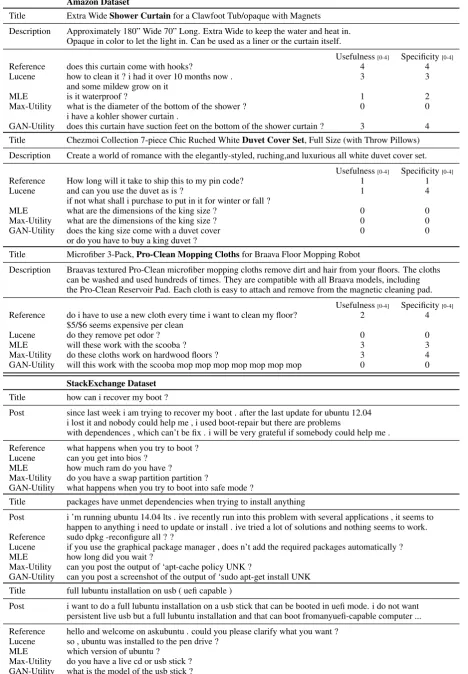
First half of Table 5 shows the system gener-ated questions for three product descriptions in the Amazon dataset.
In the first example, the product is a shower cur-tain. The Reference question is specific and highly useful. Lucene, on the other hand, picks a moder-ately specific (“how to clean it?”) but useful ques-tion. MLE model generates a generic but useful “is it waterproof?”. Max-Utility generates com-paratively a much longer question but in doing so loses out on relevance. This behavior of gener-ating two unrelated sentences is observed quite a few times in both Max-Utility and GAN-Utility models. This suggests that these models, in trying to be very specific, end up losing out on relevance. In the same example, GAN-Utility also generates
a fairly long question which, although awkwardly phrase, is quite specific and useful.
In the second example, the product is a Du-vet Cover Set. Both Reference and Lucene ques-tions here are examples of quesques-tions that are pretty much useful only to the person asking the ques-tion. We find many such questions in both Ref-erence and Lucene outputs which is the main rea-son for the comparatively lower usefulness scores for their outputs. All three of our models generate irrelevant questions since the product description explicitly says that the set is full size.
In the last example, the product is a set of mop-ping clothes. Reference question is quite specific but has low usefulness. Lucene picks an irrel-evant question. MLE and Max-Utility generate highly specific and useful questions. GAN-Utility generates an ungrammatical question by repeating the last word many times. We observe this be-havior quite a few times in the outputs of both Max-Utility and GAN-Utility models suggesting that our sequence-to-sequence models are not very good at maintaining long range dependencies.
C.2 Stack Exchange Dataset
Second half ofTable 5shows the system generated questions for three posts from the Stack Exchange dataset.
The first example is of a post where someone describes their issue of not being able to recover from their boot. Reference and Lucene questions are useful. MLE generates a generic question that is not very useful. Max-Utility generates a use-ful question but has slight ungrammaticality in it. GAN-Utility, on the other hand, generates a spe-cific and an useful question.
In the second example, again Reference and Lucene questions are useful. MLE generates a generic question. Max-Utility and GAN-Utility both generate fairly specific question but contain unknown tokens. The Stack Exchange dataset contains several technical terms leading to a long tail in the vocabulary. Owing to this, we find that both Max-Utility and GAN-Utility models gener-ate many instances of questions with unknown to-kens.
Amazon Dataset
Title Extra WideShower Curtainfor a Clawfoot Tub/opaque with Magnets
Description Approximately 180” Wide 70” Long. Extra Wide to keep the water and heat in. Opaque in color to let the light in. Can be used as a liner or the curtain itself.
Usefulness[0-4] Specificity[0-4]
Reference does this curtain come with hooks? 4 4
Lucene how to clean it ? i had it over 10 months now . 3 3 and some mildew grow on it
MLE is it waterproof ? 1 2
Max-Utility what is the diameter of the bottom of the shower ? 0 0 i have a kohler shower curtain .
GAN-Utility does this curtain have suction feet on the bottom of the shower curtain ? 3 4 Title Chezmoi Collection 7-piece Chic Ruched WhiteDuvet Cover Set, Full Size (with Throw Pillows)
Description Create a world of romance with the elegantly-styled, ruching,and luxurious all white duvet cover set.
Usefulness[0-4] Specificity[0-4]
Reference How long will it take to ship this to my pin code? 1 1
Lucene and can you use the duvet as is ? 1 4
if not what shall i purchase to put in it for winter or fall ?
MLE what are the dimensions of the king size ? 0 0
Max-Utility what are the dimensions of the king size ? 0 0 GAN-Utility does the king size come with a duvet cover 0 0
or do you have to buy a king duvet ?
Title Microfiber 3-Pack,Pro-Clean Mopping Clothsfor Braava Floor Mopping Robot
Description Braavas textured Pro-Clean microfiber mopping cloths remove dirt and hair from your floors. The cloths can be washed and used hundreds of times. They are compatible with all Braava models, including the Pro-Clean Reservoir Pad. Each cloth is easy to attach and remove from the magnetic cleaning pad.
Usefulness[0-4] Specificity[0-4]
Reference do i have to use a new cloth every time i want to clean my floor? 2 4 $5/$6 seems expensive per clean
Lucene do they remove pet odor ? 0 0
MLE will these work with the scooba ? 3 3
Max-Utility do these cloths work on hardwood floors ? 3 4 GAN-Utility will this work with the scooba mop mop mop mop mop mop mop 0 0
StackExchange Dataset
Title how can i recover my boot ?
Post since last week i am trying to recover my boot . after the last update for ubuntu 12.04 i lost it and nobody could help me , i used boot-repair but there are problems
with dependences , which can’t be fix . i will be very grateful if somebody could help me .
Reference what happens when you try to boot ? Lucene can you get into bios ?
MLE how much ram do you have ?
Max-Utility do you have a swap partition partition ?
GAN-Utility what happens when you try to boot into safe mode ?
Title packages have unmet dependencies when trying to install anything
Post i ’m running ubuntu 14.04 lts . ive recently run into this problem with several applications , it seems to happen to anything i need to update or install . ive tried a lot of solutions and nothing seems to work. Reference sudo dpkg -reconfigure all ? ?
Lucene if you use the graphical package manager , does n’t add the required packages automatically ? MLE how long did you wait ?
Max-Utility can you post the output of ‘apt-cache policy UNK ?
GAN-Utility can you post a screenshot of the output of ‘sudo apt-get install UNK Title full lubuntu installation on usb ( uefi capable )
Post i want to do a full lubuntu installation on a usb stick that can be booted in uefi mode. i do not want persistent live usb but a full lubuntu installation and that can boot fromanyuefi-capable computer ...
Reference hello and welcome on askubuntu . could you please clarify what you want ? Lucene so , ubuntu was installed to the pen drive ?
[image:13.595.69.538.69.744.2]MLE which version of ubuntu ? Max-Utility do you have a live cd or usb stick ? GAN-Utility what is the model of the usb stick ?