Proceedings of NAACL-HLT 2019, pages 1756–1767 1756
Fixed That for You: Generating Contrastive Claims with Semantic Edits
Christopher Hidey Department of Computer Science
Columbia University New York, NY 10027
Kathleen McKeown Department of Computer Science
Columbia University New York, NY 10027
Abstract
Understanding contrastive opinions is a key component of argument generation. Central to an argument is the claim, a statement that is in dispute. Generating a counter-argument then requires generating a response in contrast to the main claim of the original argument. To generate contrastive claims, we create a cor-pus of Reddit comment pairs self-labeled by posters using the acronym FTFY (fixed that for you). We then train neural models on these pairs to edit the original claim and pro-duce a new claim with a different view. We demonstrate significant improvement over a sequence-to-sequence baseline in BLEU score and a human evaluation for fluency, coherence, and contrast.
1 Introduction
In the Toulmin model (1958), often used in com-putational argumentation research, the center of the argument is the claim, a statement that is in dispute (Govier, 2010). In recent years, there has been increased interest in argument genera-tion (Bilu and Slonim,2016;Hua and Wang,2018; Le et al., 2018). Given an argument, a system that generates counter-arguments would need to 1) identify the claims to refute, 2) generate a new claim with a different view, and 3) find supporting evidence for the new claim. We focus on this sec-ond task, which requires an understanding of con-trast. A system that can generate claims with dif-ferent views is a step closer to understanding and generating arguments (Apothloz et al.,1993). We build on previous work in automated claim genera-tion (Bilu et al.,2015) which examined generating opposing claims via explicit negation. However, researchers also noted that not every claim has an exact opposite. Consider a claim from Reddit:
Get employers out of the business,pass universal single-payer healthcare. (1)
This is an example of a policy claim - a view on what should be done (Schiappa and Nordin,2013). While negation of this claim is a plausible re-sponse (e.g. asserting there should be no change by stating Do not get employers out of the busi-ness, do not pass universal healthcare), negation limits the diversity of responses that can lead to a productive dialogue. Instead, consider a response that provides an alternative suggestion:
Get employers out of the business,
deregulate and allow cross-state com-petition.
(2)
In Example 1, the speaker believes in an in-creased role for government while in Example2, the speaker believes in a decreased one. As these views are on different sides of the political spec-trum, it is unlikely that a single speaker would utter both claims. In related work, de Marneffe et al.(2008) define two sentences as contradictory when they are extremely unlikely to be true simul-taneously. We thus define a contrastive claim as one that is likely to be contradictory if made by the speaker of the original claim. Our goal, then, is to develop a method for generating contrastive claims when explicit negation is not the best op-tion. Generating claims in this way also has the benefit of providing new content that can be used for retrieving or generating supporting evidence.
allows us to use them as distantly labeled con-trastive word alignments. The word alignments provide semantic information about which words and phrases can be substitutedin contextin a co-herent, meaningful way.
Our contributions1are as follows:
1. Methods and data forcontrastive claim iden-tification to mine comment pairs from Red-dit, resulting in a large, continuously grow-ing dataset of 1,083,520 distant-labeled ex-amples.
2. A crowd-labeled set of 2,625 comments each paired with 5 new contrastive responses gen-erated by additional annotators.
3. Models forgenerating contrastive claims us-ing neural sequence models and constrained decoding.
In the following sections, we describe the task methodology and data collection and process-ing. Next, we present neural models for con-trastive claim generation and evaluate our work and present an error analysis. We then discuss related work in contrast/contradiction, argumenta-tion, and generation before concluding.
2 Task Definition and Motivation
Previous work in claim generation (Bilu et al., 2015) focused on explicit negation to provide op-posing claims. While negation plays an important role in argumentation (Apothloz et al., 1993), re-searchers found that explicit negation may result in incoherent responses (Bilu et al., 2015). Fur-thermore, recent empirical studies have shown that arguments that provide new content (Wachsmuth et al.,2018) tend to be more effective. While new concepts can be introduced in other ways by find-ing semantically relevant content, we may find it desirable to explicitly model contrast in order to control the output of the model as part of a rhetor-ical strategy, e.g. concessions (Musi, 2018). We thus develop a model that generates a contrastive claim given an input claim.
Contrastive claims may differ in more than just viewpoint; they may also contain stylistic differ-ences and paraphrases, among other aspects. We thus propose to model contrastive claims by con-trolling for context and maintaining the same text
1Data and code available at github.com/chridey/fixedthat
between pairs of contrastive claims except for the contrastive word or phrase. Much of the previous work in contrast and contradiction has examined the relationship between words or sentences. In order to understand when words and phrases are contrastive in argumentation, we need to exam-ine them in context. For example, consider the claimHillary Clinton should be president. A rea-sonable contrastive claim might beBernie Sanders should be president.(rather than the explicit nega-tion Hillary Clinton should not be president.) In this context, Hillary Clinton and Bernie Sanders are contrastive entities as they were both running for president. However, for the claimHillary Clin-ton was the most accomplished Secretary of State in recent memory. they would be unrelated. Con-sider also that we could generate the claimHillary Clinton should be senator. This contrastive claim is not coherent given the context. Generating a contrastive claim then requires 1) identifying the correct substitution span and 2) generating a re-sponse with semantically relevant replacements.
While some contrastive claims are not coherent, there are often multiple plausible responses, sim-ilar to tasks such as dialogue generation. For ex-ample, Donald Trump should be presidentis just as appropriate as Bernie Sanders should be pres-ident. We thus treat this as a dialogue generation task where the goal is to generate a plausible re-sponse given an input context.
3 Data
In order to model contrastive claims, we need datasets that reflect this phenomenon.
3.1 Collection
We obtain training data by scraping the social media site Reddit for comments containing the acronym FTFY.2 FTFY is a common acronym meaning “fixed that for you.”3 FTFY responses (hereafter FTFY) are used to respond to another comment by editing part of the “parent comment” (hereafter parent). Most commonly, FTFY is used for three categories of responses: 1) expressing a contrastive claim (e.g. the parent is Bernie Sanders for president and the FTFY is Hillary Clintonshould be president) which may be sarcas-tic (e.g. Ted Cruz for presidentbecomes Zodiac
2
https://en.wiktionary.org/wiki/FTFY
3
killer for president) 2) making a joke (e.g. This Python library reallypiquesmy interestvs. This really*py*quesmy interest), and 3) correcting a typo (e.g. This peaksmy interestvs. piques). In Section3.2, we describe how we identify category 1 (contrastive claims) for modeling.
To obtain historical Reddit data, we mined comments from the site pushshift.io for Decem-ber 2008 through OctoDecem-ber 2017. This results in 2,200,258 pairs from Reddit, where a pair consists of a parent and an FTFY. We find that many of the top occurring subreddits are ones where we would expect strong opinions (/r/politics, /r/worldnews, and /r/gaming).
3.2 Classification
To filter the data to only the type of response that we are interested in, we annotated comment pairs for contrastive claims and other types. We use our definition of contrastive claims based on con-tradiction, where both the parent and FTFY are a claim and they are unlikely to be beliefs held by the same speaker. A joke is a response that does not meaningfully contrast with the parent and commonly takes the form of a pun, rhyme, or oronym. A correction is a response to a typo, which may be a spelling or grammatical error. Any other pair is labeled as “other,” including pairs where the parent is not a claim.
In order to identify contrastive claims, we se-lected a random subset of the Reddit data from prior to September 2017 and annotated 1993 com-ments. Annotators were native speakers of English and the Inter-Annotator Agreement using Kripen-dorff’s alpha was 0.72. Contrast occurs in slightly more than half of the sampled cases (51.4%), with jokes (23.0%) and corrections (21.2%) compris-ing about one quarter each. We then train a bi-nary classifier to predict contrastive claims, thus enabling better quality data for the generation task. To identify the sentence in the parent that the FTFY responds to and derive features for classi-fication, we use an edit distance metric to obtain sentence and word alignments between the parent comment and response. As the words in the par-ent and response are mostly in the same order and most FTFYs contain significant overlap with the parent response, it is possible to find alignments by moving a sliding window over the parent. A sam-ple of 100 comments verifies that this approach yields exact word alignments in 75 comments and
exact sentence alignments in 93.
Given these pairs of comments, we derive lin-guistic and structural features for training a binary classifier. For each pair of comments, we compute features for the words in theentire comment span and features from thealigned phrases span only (as identified by edit distance). From thealigned phrases we compute the character edit distance andcharacter Jaccard similarity(both normalized by the number of characters) to attempt to cap-ture jokes and typos (the similarity should be high if the FTFY is inventing an oronym or correcting a spelling error). From the entire comment, we use thepercentage of characters copied as a low percentage may indicate a poor alignment and the percentage of non-ASCII characters as many of the jokes use emojis or upside-down text. In ad-dition, we use features from GloVe (Pennington et al.,2014) word embeddings4for both theentire commentandaligned phrases. We include the per-centage of words in the embedding vocabularyfor both spans for both the parent and FTFY. The rea-son for this feature is to identify infrequent words which may be typos or jokes. We compute the cosine similarityof the average word embeddings between the parent and FTFY for both spans. Fi-nally, we use average word embeddings for both spans for both parent and FTFY.
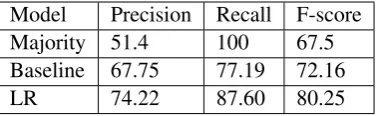
As we want to model the generation of new content, not explicit negation, we removed any pairs where the difference was only “stop words.” The set of stop words includes all the default stop words in Spacy5 combined with expletives and special tokens (we replaced all URLs and user-names). We trained a logistic regression classifier and evaluated using 4-fold cross-validation. We compare to acharacteroverlap baseline where any examples with Jaccard similarity > 0.9 and edit distance<0.15were classified as non-contrastive. The goal of this baseline is to illustrate how much of the contrastive data involves simple or non-existent substitutions. Results are shown in Table 1. Our model obtains an F-score of 80.25 for an 8 point absolute improvement over the baseline.
3.3 Selection
After using the trained model to classify the re-maining data, we have 1,083,797 Reddit pairs. We set aside 10,307 pairs from October 1-20, 2017 for
4
We found the 50-dimensional Wikipedia+Gigaword em-beddings to be sufficient
Model Precision Recall F-score Majority 51.4 100 67.5 Baseline 67.75 77.19 72.16 LR 74.22 87.60 80.25
Table 1: Results of Identifying Contastive Claims
development and October 21-30 for test (6,773), with the remainder used for training. As we are primarily working with sentences, the mean par-ent length was 16.3 and FTFY length was 14.3.
The resulting test FTFYs are naturally occur-ring and so do not suffer from annotation arti-facts. At the same time, they are noisy and may not reflect the desired phenomenon. Thus, we also conducted an experiment on Amazon Me-chanical Turk6 (AMT) to obtain additional gold references, which are further required by metrics such as BLEU (Papineni et al., 2002). We se-lected 2,625 pairs from the 10 most frequent cat-egories7 (see Table 2). These categories form a three-level hierarchy for each subreddit and we use the second-level, e.g. for /r/pokemongo the categories are “Pok´emon”, “Video Games”, and “Gaming” so we use “Video Games.” Before par-ticipating, each annotator was required to pass a qualification test - five questions to gauge their knowledge of that topic. For the movies category, one question we asked was whether for the sen-tenceSteven Spielberg is the greatest director of all time, we could instead useStanley Kubrickor Paul McCartney. If they passed this test, the an-notators were then given the parent comment and “keywords” (the subreddit and three category lev-els) to provide additional context. We obtained fivenew FTFYs for each parent and validated them manually to remove obvious spam or trivial nega-tion (e.g. “not” or “can’t”).
Category Count Category Count Video Games 1062 Basketball 116 Politics 529 Soccer 99 Football 304 Movies 88 Television 194 Hockey 60 World News 130 Baseball 55
Table 2: Comments for Mechanical Turk
6We paid annotators the U.S. federal minimum wage and
the study was approved by an IRB.
7Obtained from the snoopsnoo.com API
4 Methods
Our goal ofgenerating contrastive claims can be broken down into two primary tasks: 1) identify-ing the words in the original comment that should be removed or replaced and 2) generating the ap-propriate substitutions and any necessary context. Initially, we thus experimented with a modular ap-proach by tagging each word in the parent and then using the model predictions to determine if we should copy, delete, or replace a segment with a new word or phrase. We tried the bi-directional LSTM-CNN-CRF model of Ma and Hovy (2016) and used our edit distance word alignments to obtain labels for copying, deleting, or replacing. However, we found this model performed slightly above random predictions, and with error propa-gation, the model is unlikely to produce fluent and accurate output. Instead, we use an end-to-end ap-proach using techniques from machine translation.
4.1 Model
We use neural sequence-to-sequence encoder-decoder models (Sutskever et al., 2014) with at-tention for our experiments. The tokens from the parent are passed as input to a bi-directional GRU (Cho et al.,2014) to obtain a sequence of encoder hidden states hi. Our decoder is also a GRU,
which at timetgenerates a hidden statestfrom the
previous hidden state st−1 along with the input.
When training, the inputxtis computed from the
previous word in the gold training data if we are in “teacher forcing” mode (Williams and Zipser, 1989) and otherwise is the prediction made by the model at the previous time step. When testing, we also use the model predictions. The input word wt may be augmented by additional features, as
discussed in Section4.2. In the baseline scenario xt =e(wt)whereeis an embedding. The hidden
statestis then combined with a context vectorh∗t,
which is a weighted combination of the encoder hidden states using an attention mechanism:
h∗t =X i
αithi
To calculateαt
i, we use the attention of Luong et
[image:4.595.76.287.606.695.2]as Bahdanau attention (Bahdanau et al.,2015) per-formed worse. Attention is then calculated as:
αit= exp(h T i st) P
s0exp(hTs0st)
Finally, we make a prediction of a vocabulary wordwby using features from the context and de-coder hidden state with a projection matrixW and output vocabulary matrixV:
P(w) =softmax(Vtanh(W[st;h∗t] +bw) +bv)
We explored using a copy mechanism (See et al., 2017) for word prediction but found it difficult to prevent the model from copying the entire input.
4.2 Decoder Representation
Decoder Input: We evaluate two representations of the target input: as a sequence of words and as a sequence of edits. The sequence of words approach is the standard encoder-decoder setup. For the example parentHillary Clinton for presi-dent 2020and FTFYBernie Sanders for president we would use the FTFY without modification. Schmaltz et al. (2017) found success modeling er-ror correction using sequence-to-sequence models by representing the target input as a sequence of edits. We apply a similar approach to our prob-lem, generating a target sequence by following the best path in the matrix created by the edit dis-tance algorithm. The new target sequence is the original parent interleaved with “DELETE-N to-kens” that specify how many previous words to delete, followed by the newly generated content. For the same example, Hillary Clinton for pres-ident 2020, the modified target sequence would beHillary Clinton DELETE-2 Bernie Sanders for president 2020 DELETE-1.
Counter: Kikuchi et al. (2016) found that by using an embedding for a length variable they were able to control output length via a learned mechanism. In our work, we compute a counter variable which is initially set to the number of new content words the model should generate. During decoding, the counter is decremented if a word is generated that is not in the source input (I) or in the set of stop words (S) defined in Section 3.2. The model uses an embeddinge(ct)for each
count, which is parameterized by a count embed-ding matrix. The input to the decoder state in this scenario isxt = e(wt, ct). At each time step, the
count is computed by:
c0 =|O\(S∪I)|or desired count
ct+1 = (
ct−1, wt∈/ S∪I andct>0
ct, otherwise
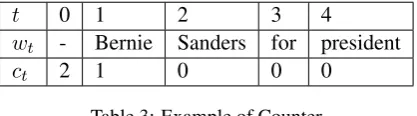
where O is the set of gold output words in training. For the parent comment Hillary Clinton for president 2020and FTFYBernie Sanders for pres-ident, the decoder input is presented, with the time tin the first row of Table3and the inputswtand
ct in the second and third rows, respectively. At
the start of decoding, the model expects to gener-ate two new content words, which in this exam-ple it generates immediately and decrements the counter. When the counter reaches 0, it only gen-erates stop or input words.
t 0 1 2 3 4
wt - Bernie Sanders for president
[image:5.595.313.522.298.356.2]ct 2 1 0 0 0
Table 3: Example of Counter
Unlike the controlled-length scenario, at test time we do not know the number of new content words to generate. However, the count for most FTFYs is between 1 and 5, inclusive, so we can ex-haustively search this range during decoding. We experimented with predicting the count but found it to be inaccurate so we leave this for future work.
Subreddit Information: As the model often needs to disambiguate polysemous words, addi-tional context can be useful. Consider the par-ent commpar-entthis is a strange bug. In a program-ming subreddit, a sarcastic FTFY might bethis is a strange feature.However, in a Pok´emon subred-dit, an FTFY might bethis is a strange dinosaur in an argument over whether Armaldo is a bug or a dinosaur. We thus include additional features to be passed to the encoder at each time step, in the form of an embedding g for each the three cat-egory levels obtained in Section 3.3. These em-beddings are concatenated to the input wordwtat
each timestep, i.e.xt=e(wt, gt1, gt2, g3t).
4.3 Objective Function
We use a negative log likelihood objective func-tion LN LL = −logPt∈1:TP(w
∗
t), where wt∗ is
copied or inserted/deleted. For the example from Section4.2, the target forHillary Clinton for pres-ident 2020would be0 0 1 1 0. This encourages the model to select features that indicate whether the encoder input will be copied to the output. We use a 2-layer multi-layer perceptron and a binary cross-entropy lossLBCE. The joint loss is then:
L=LN LL+λLBCE
4.4 Decoding
We use beam search for generation, as this method has proven effective for many neural language generation tasks. For the settings of the model that require a counter, we expand the beam by countm so that for a beam sizekwe calculatek∗mstates.
Filtering: We optionally include a constrained decoding mode where we filter the output based on the counter; whenct > 1 the end-of-sentence
(EOS) score is set to −∞ and when ct = 0the
score of any wordw∈V \(S∪I)is set to−∞. The counterctis decremented at every time step as
in Section4.2. In other words, when the counter is zero, we only allow the model to copy or gener-ate stop words. When the counter is positive, we prevent the model from ending the sentence before it generates new content words and decrements the counter. The constrained decoding is possible with any combination of settings, with or without the counter embedding.
4.5 Hyper-parameters and Optimization
We used Pytorch (Paszke et al., 2017) for all ex-periments. We used 300-dimensional vectors for the word embedding and GRU layers. The count embedding dimension was set to 5 with m = 5
andk = 10for decoding. The category embed-ding dimensions were set to 5, 10, and 25 for each of the non-subreddit categories. We also setλ= 1
for multi-task learning. We used the Adam op-timizer (Kingma and Ba, 2015) with settings of β1 = 0.9, β2 = 0.999, = 10−8 and a learning
rate of 10−3 decaying by γ = 0.1 every epoch. We used dropout (Srivastava et al., 2014) on the embeddings with a probability of 0.2 and teacher forcing with 0.5. We used a batch size of 100 with 10 epochs, selecting the best model on the devel-opment set based on perplexity. We set the mini-mum frequency of a word in the vocabulary to 4.
5 Results
For training, development, and testing we use the data described in Section 3.3. The test reference data consists of the Reddit FTFYs and the FTFYs generated from AMT. We evaluate our models us-ing automated metrics and human judgments.
Automated metrics should reflect our joint goals of 1) copying necessary context and 2) making ap-propriate substitutions. To address point 1, we use BLEU-4 as a measure of similarity between the gold FTFY and the model output. As the FTFY may contain significant overlap with the parent, BLEU indicates how well the model copies the appropriate context. As BLEU reflects mostly span selection rather than the insertion of new con-tent, we need alternative metrics to address point 2. However, addressing point 2 is more difficult due to the variety of possible substitutions, in-cluding named entities. For example, if the par-ent commpar-ent isjaguars for the win! and the gold FTFY is chiefs for the win! but the model pro-duces cowboys for the win! (or any of 29 other NFL teams), most metrics would judge this re-sponse incorrectly even though it would be an ac-ceptable response. Thus we present results using both automated metrics and human evaluation. As an approximation to address point 2, we attempt to measure when the model is making changes rather than just copying the input. To this end, we present two additional metrics - novelty, a mea-sure of whether novel content (non-stop word) to-kens are generated relative to the parent comment, andpartial match, a measure of whether the novel tokens in the gold FTFY match any of the novel tokens in the generated FTFY. To provide a refer-ence point, we find that the partial match between two different gold FTFYs (Reddit and AMT) was 11.4% and BLEU was 47.28, which shows the dif-ficulty of automatic evaluation. The scores are lower than expected because the Reddit FTFYs are noisy due to the process in Section3.2. This also justifies obtaining the AMT FTFYs.
capabil-Reddit AMT
Model Novelty BLEU-4 % Match BLEU-4 % Match
Constrained
Baseline 79.88 18.81 4.67 40.14 10.06
COUNT 89.69 22.61 4.72 47.55 12.55
COUNT + SUB + COPY 90.45 23.13 4.83 50.05 14.92
EDIT 64.64 16.12 3.37 35.48 7.33
EDIT + COUNT + SUB + COPY 82.96 19.37 4.23 42.69 11.62
Unconstrained
Baseline 3.34 7.31 0.73 25.83 0.68
COUNT 16.19 8.51 1.95 27.68 2.36
COUNT + SUB + COPY 16.26 9.62 1.93 31.23 3.81
EDIT 7.97 35.41 1.57 74.24 1.56
[image:7.595.85.515.61.230.2]EDIT + COUNT + SUB + COPY 39.99 32.59 3.25 67.56 6.25
Table 4: Automatic Evaluation
ities of the models. For each model we com-pute statistical significance with bootstrap resam-pling (Koehn,2004) for the constrained or uncon-strained baseline as appropriate and we find the COUNT and EDIT models to be significantly bet-ter for constrained and unconstrained decoding, respectively (p <0.005).
Under constrained decoding, we see that the “COUNT + SUB + COPY” model performs the best in all metrics, although most of the perfor-mance can be attributed to the count embedding. When we allow the model to determine its own output, we find that “EDIT + COUNT” performs the best. In particular, this model does well at un-derstanding which part of the context to select, and even does better than other unconstrained models at selecting appropriate substitutions. However, when we combine this model with constrained de-coding, the improvement is smaller than for the other settings. We suspect that because the EDIT model often needs to generate a DELETE-N token before a new response, these longer-term depen-dencies are hard to capture with constrained de-coding but easier if included in training.
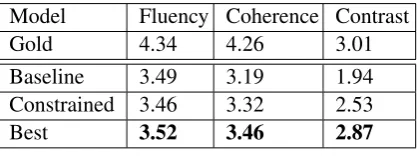
We also conducted a human evaluation of the model output on the same subset of 2,625 exam-ples described in Section 3.3. We performed an additional experiment on AMT where we asked annotators to rate responses on fluency, coherence, and contrast. Fluency is a measure of the qual-ity of the grammar and syntax and the likelihood that a native English speaker would utter that state-ment. Coherence is a measure of whether the response makes sense, is semantically meaning-ful, and would be usable as a response to a claim.
Contrastis a measure of how much the response
contradicts the original comment. We specified that if the response is different but does not pro-vide a contrasting view it should receive a low rat-ing. Previous work (Bilu et al., 2015) used flu-ency, clarity/usability (which we combine into co-herence), and opposition (where we use contrast).
Model Fluency Coherence Contrast
Gold 4.34 4.26 3.01
Baseline 3.49 3.19 1.94 Constrained 3.46 3.32 2.53
Best 3.52 3.46 2.87
Table 5: Human Evaluation
We used a Likert scale where 5 is strongly agree and 1 is strongly disagree. We used the same data and qualification test from Section 3.3 for each category and used three annotators per example. We asked annotators to judge 4 different pairs: 3 model outputs and the gold Reddit8 FTFYs for comparison. We include the baseline, the base-line with constrained decoding, and the best con-strained model (“COUNT + SUB + COPY”) ac-cording to BLEU and partial match. We verified that the annotators understood how to rate con-trast by examining the distribution of responses: the annotators selected option 3 (neither) 15% of the time and preferred to select either extreme, 5 (21%) or 1 (27%). Results are presented in Table 5, showing a clear preference for the best model. Note the degradation in fluency for the constrained baseline, as the model is prevented from generat-ing the EOS token and may repeat tokens up to the
8We did not evaluate the AMT FTFYs as these were
[image:7.595.313.522.365.443.2]Parent:ah yes the wonders of the free market
Model:ah yes the wonders of government in-tervention
Parent: i know that this is an unofficial mod , but xp is the best os for this machine
Model:linux is the best os for this machine
Parent: that ’s why it ’s important to get all your propaganda from infowars and brietbart
Model:propaganda from fox news outlets
Table 6: Model Output
maximum length.
6 Qualitative Analysis
We provide three examples of the model output in Table6with the first and third from the News and Politics category, demonstrating how the model handles different types of input. In the first ex-ample, the contrast is between allowing markets to regulate themselves versus an increased role of government. In the second example, the contra-diction is due to the choice of operating system. In the third (invalid) example, the model responds to a sarcastic claim with another right-wing news organization; this response is not a contradiction since it is plausible the original speaker would also utter this statement.
6.1 Error Analysis
We conduct an error analysis by selecting 100 re-sponses where the model did not partially match any of the 6 gold responses and we found 6 main types of errors. One error is the model identify-ing anincorrect substitution spanwhile the hu-man responses all selected a different span to re-place. We noticed that this occurred 5 times and may require world knowledge to understand which tokens to select. For example, in response to the claimHillary Clinton could have been president if not for robots, the model generatesDonald Trump in place of Hillary Clinton, whereas the gold re-sponses generatehumans / votes / Trump’s tweets in place ofrobots. Another type of error is when the responses are not coherent with the parent and the language model instead determines the token selection based on the most recent context (11 cases). For example, given the claim bb-8 gets a girlfriend and poe still does n’t have a girlf :’)the Reddit FTFY hasboyf instead ofgirlf whereas the model generates ... and poe still does n’t have a
clue what i ’m talking about . We also found ex-amples where the model chose poorly due to un-filtered jokes orerrors in the training data(12 in total). In 15 cases, due to the constrained decod-ing the modelrepeateda word until the maximum length or appended an incoherent phrase. For the most common error, the model made a substitu-tion that was not contrasting as in Table 6 (19 examples). Finally, we found 38 of the samples werevalid responses, but did not match the gold, indicating the difficulty of automatic evaluation. For example, in response to the claimNintendo is the only company that puts customers over profits, the model replacesNintendowithRockstar (both video game companies) while the gold FTFYs had other video game companies.
7 Related Work
Contrast also appears in the study of stance, where the opinion towards a target may vary. The SemEval 2016 Stance Detection for Twitter task (Mohammad et al.,2016) involved predicting if a tweet favors a target entity. The Interpretable Se-mantic Similarity task (Agirre et al.,2016) called to identify semantic relation types (including op-position) between headlines or captions. Target-specific stance prediction in debates is addressed byHasan and Ng(2014) andWalker et al.(2012). Fact checking can be viewed as stance toward an event, resulting in research on social media ( Lend-vai and Reichel, 2016; Mihaylova et al., 2018), politician statements (Vlachos and Riedel,2014), news articles (Pomerleau and Rao, 2017), and Wikipedia (Thorne et al.,2018).
In computational argumentation mining, iden-tifying claims and other argumentative compo-nents is a well-studied task (Stab and Gurevych, 2014).Daxenberger et al.(2017) andSchulz et al. (2018) developed approaches to detect claims across across diverse claim detection datasets. Re-cently, a shared task was developed for argument reasoning comprehension (Habernal et al.,2018). The best system (Choi and Lee,2018) used models pre-trained on NLI data (Bowman et al., 2015b), which contains contradictions. While this work is concerned with identification of argumentative components, we propose to generate new claims.
In the field of argument generation, Wang and Ling (2016) train neural abstractive summarizers for opinions and arguments. Additional work in-volved generating opinions given a product rating (Wang and Zhang,2017).Bilu and Slonim(2016) combine topics and predicates via a template-based classifier. This work involves the genera-tion of claims but in relagenera-tion to a topic. Other researchers generated political counter-arguments supported by external evidence (Hua and Wang, 2018) and generating argumentative dialogue by maximizing mutual information (Le et al.,2018). This research considers end-to-end argument gen-eration, which may not be coherent, whereas we focus specifically on contrastive claims.
8 Conclusion
We presented a new source of over 1 million con-trastive claim pairs that can be mined from social media sites such as Reddit. We provided an anal-ysis and models to filter noisy training data from 49% down to 25%. We created neural models for
generating contrastive claims and obtained signif-icant improvement in automated metrics and hu-man evaluations for Reddit and AMT test data.
Our goal is to incorporate this model into an ar-gumentative dialogue system. In addition to gen-erating claims with a contrasting view, we can also retrieve supporting evidence for the newly-generated claims. Additionally, we plan to exper-iment with using our model to improve claim de-tection (Daxenberger et al.,2017) and stance pre-diction (Bar-Haim et al.,2017). Our model could be used to generate artificial data to enhance clas-sification performance on these tasks.
To improve our model, we plan to experiment with retrieval-based approaches to handle low-frequency terms and named entities, as sequence-to-sequence models are likely to have trouble in this environment. One possibility is to incorpo-rate external knowledge with entity linking over Wikipedia articles to find semantically-relevant substitutions.
Another way to improve the model is by intro-ducing controllable generation. One aspect of trollability is intention; our model produces con-trastive claims without understanding the view of the original claim. Category embeddings partially address this issue (some labels are “Liberal” or “Conservative”), but labels are not available for all views. Going forward, we hope to classify the viewpoint of the original claim and then generate a claim with a desired orientation. Furthermore, we hope to improve on the generation task by identi-fying the types of claims we encounter. For exam-ple, we may want to change the target of the claims in some claims but in others change the polarity.
We also plan to improve the dataset by improv-ing our models for contrastive pair prediction to reduce noise. Finally, we hope that this dataset proves useful for related tasks such as textual entailment (providing examples of contradiction) and argument comprehension (providing counter-examples of arguments) or even unrelated tasks like humor or error correction.
Acknowledgments
References
Eneko Agirre, Aitor Gonzalez-Agirre, Inigo Lopez-Gazpio, Montse Maritxalar, German Rigau, and Lar-raitz Uria. 2016. Semeval-2016 task 2: Interpretable semantic textual similarity. InProceedings of the 10th International Workshop on Semantic
Evalua-tion (SemEval-2016), pages 512–524. Association
for Computational Linguistics.
Khalid Al Khatib, Hinrich Sch¨utze, and Cathleen Kant-ner. 2012. Automatic detection of point of view dif-ferences in wikipedia. InProceedings of COLING 2012, pages 33–50. The COLING 2012 Organizing Committee.
Denis Apothloz, Pierre-Yves Brandt, and Gustavo Quiroz. 1993. The function of negation in argumen-tation. Journal of Pragmatics, 19:23–38.
Dzmitry Bahdanau, Kyunghyun Cho, and Yoshua Ben-gio. 2015. Neural machine translation by jointly learning to align and translate. In3rd International
Conference on Learning Representations.
Roy Bar-Haim, Indrajit Bhattacharya, Francesco Din-uzzo, Amrita Saha, and Noam Slonim. 2017. Stance classification of context-dependent claims. In Pro-ceedings of the 15th Conference of the European Chapter of the Association for Computational
Lin-guistics: Volume 1, Long Papers, pages 251–261,
Valencia, Spain. Association for Computational Lin-guistics.
Yonatan Bilu, Daniel Hershcovich, and Noam Slonim. 2015. Automatic claim negation: Why, how and
when. InProceedings of the 2nd Workshop on
Ar-gumentation Mining, pages 84–93. Association for
Computational Linguistics.
Yonatan Bilu and Noam Slonim. 2016. Claim synthe-sis via predicate recycling. In Proceedings of the 54th Annual Meeting of the Association for
Compu-tational Linguistics (Volume 2: Short Papers), pages
525–530, Berlin, Germany. Association for Compu-tational Linguistics.
Samuel R. Bowman, Gabor Angeli, Christopher Potts, and Christopher D. Manning. 2015a. A large an-notated corpus for learning natural language
infer-ence. In Proceedings of the 2015 Conference on
Empirical Methods in Natural Language Process-ing, pages 632–642. Association for Computational Linguistics.
Samuel R. Bowman, Gabor Angeli, Christopher Potts, and Christopher D. Manning. 2015b. A large an-notated corpus for learning natural language infer-ence. In Proceedings of the 2015 Conference on Empirical Methods in Natural Language Processing
(EMNLP). Association for Computational
Linguis-tics.
Zhigang Chen, Wei Lin, Qian Chen, Xiaoping Chen, Si Wei, Hui Jiang, and Xiaodan Zhu. 2015. Re-visiting word embedding for contrasting meaning.
In Proceedings of the 53rd Annual Meeting of the
Association for Computational Linguistics and the 7th International Joint Conference on Natural
Lan-guage Processing (Volume 1: Long Papers), pages
106–115. Association for Computational Linguis-tics.
Kyunghyun Cho, Bart van Merrienboer, Caglar Gul-cehre, Dzmitry Bahdanau, Fethi Bougares, Holger Schwenk, and Yoshua Bengio. 2014. Learning phrase representations using rnn encoder–decoder for statistical machine translation. InProceedings of the 2014 Conference on Empirical Methods in
Nat-ural Language Processing (EMNLP), pages 1724–
1734, Doha, Qatar. Association for Computational Linguistics.
HongSeok Choi and Hyunju Lee. 2018. Gist at semeval-2018 task 12: A network transferring infer-ence knowledge to argument reasoning comprehen-sion task. InProceedings of The 12th International
Workshop on Semantic Evaluation, pages 773–777.
Association for Computational Linguistics.
Alexis Conneau, Douwe Kiela, Holger Schwenk, Lo¨ıc Barrault, and Antoine Bordes. 2017. Supervised learning of universal sentence representations from natural language inference data. InProceedings of the 2017 Conference on Empirical Methods in
Nat-ural Language Processing, pages 670–680.
Associ-ation for ComputAssoci-ational Linguistics.
Johannes Daxenberger, Steffen Eger, Ivan Habernal, Christian Stab, and Iryna Gurevych. 2017. What is the essence of a claim? cross-domain claim iden-tification. In Proceedings of the 2017 Conference on Empirical Methods in Natural Language
Pro-cessing, pages 2055–2066. Association for
Compu-tational Linguistics.
Trudy Govier. 2010. A Practical Study of Argument. Cengage Learning, Wadsworth.
Ivan Habernal, Henning Wachsmuth, Iryna Gurevych, and Benno Stein. 2018. The argument reasoning comprehension task: Identification and reconstruc-tion of implicit warrants. In Proceedings of the 2018 Conference of the North American Chapter of the Association for Computational Linguistics: Hu-man Language Technologies, Volume 1 (Long
Pa-pers), pages 1930–1940. Association for
Computa-tional Linguistics.
Kazi Saidul Hasan and Vincent Ng. 2014. Why are you taking this stance? identifying and classifying reasons in ideological debates. In Proceedings of the 2014 Conference on Empirical Methods in
Natu-ral Language Processing (EMNLP), pages 751–762.
Association for Computational Linguistics.
Xinyu Hua and Lu Wang. 2018. Neural argument generation augmented with externally retrieved evi-dence. InProceedings of the 56th Annual Meeting of the Association for Computational Linguistics
(Vol-ume 1: Long Papers), pages 1–10, Melbourne,
Yuta Kikuchi, Graham Neubig, Ryohei Sasano, Hi-roya Takamura, and Manabu Okumura. 2016. Con-trolling output length in neural encoder-decoders.
In Proceedings of the 2016 Conference on
Empiri-cal Methods in Natural Language Processing, pages
1328–1338, Austin, Texas. Association for Compu-tational Linguistics.
Diederik Kingma and Jimmy Ba. 2015. Adam: A method for stochastic optimization. In3rd
Interna-tional Conference on Learning Representations.
Julien Kloetzer, Stijn De Saeger, Kentaro Torisawa, Chikara Hashimoto, Jong-Hoon Oh, Motoki Sano, and Kiyonori Ohtake. 2013. Two-stage method for large-scale acquisition of contradiction pattern pairs using entailment. InProceedings of the 2013 Con-ference on Empirical Methods in Natural Language
Processing, pages 693–703. Association for
Com-putational Linguistics.
Philipp Koehn. 2004. Statistical significance tests for machine translation evaluation. In Proceedings of
EMNLP 2004, pages 388–395, Barcelona, Spain.
Association for Computational Linguistics.
Dieu-Thu Le, Cam Tu Nguyen, and Kim Anh Nguyen. 2018. Dave the debater: a retrieval-based and gen-erative argumentative dialogue agent. In
Proceed-ings of the 5th Workshop on Argument Mining, pages
121–130. Association for Computational Linguis-tics.
Piroska Lendvai and Uwe Reichel. 2016. Contradic-tion detecContradic-tion for rumorous claims. InProceedings of the Workshop on Extra-Propositional Aspects of
Meaning in Computational Linguistics (ExProM),
pages 31–40. The COLING 2016 Organizing Com-mittee.
Thang Luong, Hieu Pham, and Christopher D. Man-ning. 2015. Effective approaches to attention-based neural machine translation. InProceedings of the 2015 Conference on Empirical Methods in
Natu-ral Language Processing, pages 1412–1421,
Lis-bon, Portugal. Association for Computational Lin-guistics.
Xuezhe Ma and Eduard Hovy. 2016. End-to-end se-quence labeling via bi-directional lstm-cnns-crf. In
Proceedings of the 54th Annual Meeting of the As-sociation for Computational Linguistics (Volume 1:
Long Papers), pages 1064–1074, Berlin, Germany.
Association for Computational Linguistics.
Marie-Catherine de Marneffe, Anna N. Rafferty, and Christopher D. Manning. 2008. Finding contradic-tions in text. InProceedings of ACL-08: HLT, pages 1039–1047, Columbus, Ohio. Association for Com-putational Linguistics.
Tsvetomila Mihaylova, Preslav Nakov, Llu´ıs M`arquez, Alberto Barr´on-Cede˜no, Mitra Mohtarami, Georgi Karadzhov, and James R. Glass. 2018. Fact check-ing in community forums.CoRR, abs/1803.03178.
Saif Mohammad, Svetlana Kiritchenko, Parinaz Sob-hani, Xiaodan Zhu, and Colin Cherry. 2016. Semeval-2016 task 6: Detecting stance in tweets. In
Proceedings of the 10th International Workshop on
Semantic Evaluation (SemEval-2016), pages 31–41.
Association for Computational Linguistics.
Elena Musi. 2018. How did you change my view? a corpus-based study of concessions argumentative
role.Discourse Studies, 20(2):270–288.
Kim Anh Nguyen, Sabine Schulte im Walde, and Ngoc Thang Vu. 2016. Integrating distributional lexical contrast into word embeddings for antonym-synonym distinction. InProceedings of the 54th An-nual Meeting of the Association for Computational
Linguistics (Volume 2: Short Papers), pages 454–
459. Association for Computational Linguistics.
Kishore Papineni, Salim Roukos, Todd Ward, and Wei-Jing Zhu. 2002. Bleu: a method for automatic eval-uation of machine translation. In Proceedings of 40th Annual Meeting of the Association for
Com-putational Linguistics, pages 311–318, Philadelphia,
Pennsylvania, USA. Association for Computational Linguistics.
Adam Paszke, Sam Gross, Soumith Chintala, Gre-gory Chanan, Edward Yang, Zachary DeVito, Zem-ing Lin, Alban Desmaison, Luca Antiga, and Adam Lerer. 2017. Automatic differentiation in pytorch.
InNIPS-W.
Michael Paul, ChengXiang Zhai, and Roxana Girju. 2010. Summarizing contrastive viewpoints in opin-ionated text. In Proceedings of the 2010 Confer-ence on Empirical Methods in Natural Language
Processing, pages 66–76. Association for
Compu-tational Linguistics.
Jeffrey Pennington, Richard Socher, and Christopher Manning. 2014. Glove: Global vectors for word representation. In Proceedings of the 2014 Con-ference on Empirical Methods in Natural Language
Processing (EMNLP), pages 1532–1543, Doha,
Qatar. Association for Computational Linguistics.
Dean Pomerleau and Delip Rao. 2017.Fake news chal-lenge.
Alan Ritter, Stephen Soderland, Doug Downey, and Oren Etzioni. 2008. It’s a contradiction – no, it’s not: A case study using functional relations. In Pro-ceedings of the 2008 Conference on Empirical
Meth-ods in Natural Language Processing, pages 11–20.
Association for Computational Linguistics.
E. Schiappa and J.P. Nordin. 2013. Argumentation: Keeping Faith with Reason. Pearson Education.
Allen Schmaltz, Yoon Kim, Alexander Rush, and Stu-art Shieber. 2017. Adapting sequence models for sentence correction. In Proceedings of the 2017 Conference on Empirical Methods in Natural
Lan-guage Processing, pages 2807–2813, Copenhagen,
Claudia Schulz, Steffen Eger, Johannes Daxenberger, Tobias Kahse, and Iryna Gurevych. 2018. Multi-task learning for argumentation mining in low-resource settings.CoRR, abs/1804.04083.
Abigail See, Peter J. Liu, and Christopher D. Manning. 2017.Get to the point: Summarization with pointer-generator networks. InProceedings of the 55th An-nual Meeting of the Association for Computational
Linguistics (Volume 1: Long Papers), pages 1073–
1083, Vancouver, Canada. Association for Compu-tational Linguistics.
Nitish Srivastava, Geoffrey Hinton, Alex Krizhevsky, Ilya Sutskever, and Ruslan Salakhutdinov. 2014. Dropout: A simple way to prevent neural networks from overfitting. J. Mach. Learn. Res., 15(1):1929– 1958.
Christian Stab and Iryna Gurevych. 2014. Identify-ing argumentative discourse structures in persuasive essays. InProceedings of the 2014 Conference on Empirical Methods in Natural Language Processing
(EMNLP), pages 46–56, Doha, Qatar. Association
for Computational Linguistics.
Ilya Sutskever, Oriol Vinyals, and Quoc V Le. 2014. Sequence to sequence learning with neural net-works. In Z. Ghahramani, M. Welling, C. Cortes, N. D. Lawrence, and K. Q. Weinberger, editors, Ad-vances in Neural Information Processing Systems 27, pages 3104–3112. Curran Associates, Inc.
Yu Takabatake, Hajime Morita, Daisuke Kawahara, Sadao Kurohashi, Ryuichiro Higashinaka, and Yoshihiro Matsuo. 2015. Classification and ac-quisition of contradictory event pairs using crowd-sourcing. In Proceedings of the The 3rd Work-shop on EVENTS: Definition, Detection,
Corefer-ence, and Representation, pages 99–107.
Associa-tion for ComputaAssocia-tional Linguistics.
James Thorne, Andreas Vlachos, Christos Christodoulopoulos, and Arpit Mittal. 2018. Fever: a large-scale dataset for fact extraction and verification. In Proceedings of the 2018 Conference of the North American Chapter of the Association for Computational Linguistics: Human
Language Technologies, Volume 1 (Long Papers),
pages 809–819. Association for Computational Linguistics.
Stephen Toulmin. 1958. The Uses of Argument. Cam-bridge At the University Press.
Andreas Vlachos and Sebastian Riedel. 2014. Fact checking: Task definition and dataset construction.
InProceedings of the ACL 2014 Workshop on
Lan-guage Technologies and Computational Social Sci-ence, pages 18–22. Association for Computational Linguistics.
Ivan Vuli´c. 2018. Injecting lexical contrast into word vectors by guiding vector space specialisation. In
Proceedings of The Third Workshop on
Representa-tion Learning for NLP, pages 137–143. Association
for Computational Linguistics.
Henning Wachsmuth, Martin Potthast, Khalid Al Khatib, Yamen Ajjour, Jana Puschmann, Jiani Qu, Jonas Dorsch, Viorel Morari, Janek Bevendorff, and Benno Stein. 2017. Building an argument search engine for the web. In Proceedings of
the 4th Workshop on Argument Mining, pages
49–59, Copenhagen, Denmark. Association for Computational Linguistics.
Henning Wachsmuth, Shahbaz Syed, and Benno Stein. 2018. Retrieval of the best counterargument with-out prior topic knowledge. In Proceedings of the 56th Annual Meeting of the Association for
Compu-tational Linguistics (Volume 1: Long Papers), pages
241–251. Association for Computational Linguis-tics.
Marilyn Walker, Pranav Anand, Rob Abbott, and Ricky Grant. 2012. Stance classification using dialogic properties of persuasion. InProceedings of the 2012 Conference of the North American Chapter of the Association for Computational Linguistics: Human
Language Technologies, pages 592–596.
Associa-tion for ComputaAssocia-tional Linguistics.
Lu Wang and Wang Ling. 2016.Neural network-based abstract generation for opinions and arguments. In
Proceedings of the 2016 Conference of the North American Chapter of the Association for
Computa-tional Linguistics: Human Language Technologies,
pages 47–57, San Diego, California. Association for Computational Linguistics.
Zhongqing Wang and Yue Zhang. 2017. Opinion rec-ommendation using a neural model. In Proceed-ings of the 2017 Conference on Empirical Methods
in Natural Language Processing, pages 1627–1638.
Association for Computational Linguistics.
Adina Williams, Nikita Nangia, and Samuel Bowman. 2018. A broad-coverage challenge corpus for sen-tence understanding through inference. In Proceed-ings of the 2018 Conference of the North American Chapter of the Association for Computational Lin-guistics: Human Language Technologies, Volume 1
(Long Papers), pages 1112–1122. Association for
Computational Linguistics.