1962
Improving Natural Language Interaction with Robots Using Advice
Nikhil Mehta
Department of Computer Science Purdue University
West Lafayette, IN 47907 [email protected]
Dan Goldwasser
Department of Computer Science Purdue University
West Lafayette, IN 47907 [email protected]
Abstract
Over the last few years, there has been grow-ing interest in learngrow-ing models for physically grounded language understanding tasks, such as the popular blocks world domain. These works typically view this problem as a single-step process, in which a human operator gives an instruction and an automated agent is eval-uated on its ability to execute it. In this pa-per we take the first step towards increasing the bandwidth of this interaction, and suggest a protocol for including advice, high-level ob-servations about the task, which can help con-strain the agents prediction. We evaluate our approach on the blocks world task, and show that even simple advice can help lead to sig-nificant performance improvements. To help reduce the effort involved in supplying the vice, we also explore model self-generated ad-vice which can still improve results.
1 Introduction
The problem of constructing an artificial agent ca-pable of understanding and executing human in-structions is one of the oldest long-standing AI
challenges (Winograd, 1972). This problem has
numerous applications in various domains (plan-ning, navigation and assembly) and can help ac-commodate seamless interaction with personal as-sistants in many environments. Due to its central role in AI and wide applicability, this problem has seen a surge of interest recently (MacMahon et al.,
2006;Branavan et al., 2009; Chen and Mooney,
2011;Tellex et al., 2011; Matuszek et al., 2012;
Kim and Mooney,2013;Misra et al.,2017).
Recent works (Bisk et al., 2016; Tan and
Bansal, 2018) focus on exploring deep learning methods for grounding spatial language. In this popular setup, human communication with robots is viewed as a single-step process, in which a nat-ural language (NL) instruction is provided, and an outcome is observed.
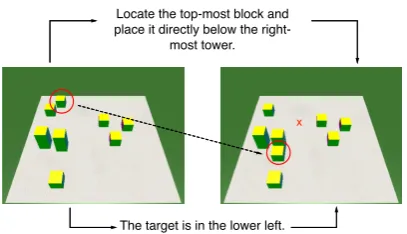
The target is in the lower left. Locate the top-most block and place it directly below the
right-most tower.
[image:1.595.315.519.219.336.2]x
Figure 1: Based on the instruction (upper sentence) the model predicts the coordinates of the block and its tar-get location. The ‘x’ represents an incorrect prediction, corrected by the provided advice (lower sentence).
Our goal in this paper is to explore different
ap-proaches for relaxing thesingle step assumption,
and present initial results which we hope would motivate future work in this direction. Similar to interactive dialog systems (Allen et al.,1995; Ryb-ski et al.,2007;Wen et al.), we view this problem
as aninteractiveprocess, in which the human
op-erator can observe the agents’ response to their in-struction and adjust it by providing advice, a form of online feedback. Specifically, the advice con-sists of a short sentence, simplifying the user’s in-tent. We utilize two types of advice, one restrict-ing the agent’s search space to a general region (restrictive advice), and the other telling the agent the appropriate direction (up, down, left, right) to adjust its current prediction (corrective advice).
Our focus is on the challenging task of
mov-ing blocks on a grid (Winograd, 1972), in which
the agent is given only an instruction and the state of the grid, and must predict the coordinates of where a block must be moved. We follow the
difficult experimental settings suggested by (Bisk
et al., 2016), in which the blocks are unlabeled and can only be referenced by their spatial
prop-erties. Fig. 1 describes our settings and uses the
incor-rect prediction placed the target block in the top half of the board.
To accommodate these settings, we take a two step approach. First, we ground the advice text in the simulated blocks-world environment by traing a neural network. In the second step, we in-tegrate the trained advice network into the
end-to-end neural model proposed byBisk et al. Our
ar-chitecture is described in Fig.2. The experiments
we run show that this end-to-end advice model successfully grounds the meaning of our advice.
We propose four novel interactive advice-based protocols that can be applied on any robot commu-nication architecture, ordered in terms of decreas-ing human effort. As expected, as human effort lessens, performance does worsen, but all
proto-cols outperformBisk et al. (whom our model is
identicalto besides the inclusion of advice). Most notably, we explore the notion of model self-generated advice, which significantly re-duces/eliminates human effort. In this approach, a model is trained to automatically generate re-strictive advice for a given scenario, based on the assumption that it is easier to predict a region con-taining the target coordinates rather than their ex-act location. We validate this assumption by devel-oping a neural architecture to predict the restrictive advice and show it can help improve the overall prediction quality, despite having no human assis-tance.
2 Model
This section describes the architecture we devel-oped for understanding advice, and how to
in-corporate it into the original Bisk et al. model
to make better predictions. We begin by defin-ing the Blocks World task and the types of advice we use. We then introduce a model for ground-ing the advice and a method for incorporatground-ing the pre-trained advice understanding module into the original model. Finally, we discuss an architecture foradvice generation, a method for self-predicting the advice to avoid any human intervention. Fur-ther details of our models and advice generation process are in the Appendix.
2.1 Blocks World Task Definition
Given an input state, consisting of all the block po-sitions on a board, and a NL instruction, the model has to predict the coordinates of the source block to be moved and its target location. We follow the
definition by (Bisk et al.,2016) and due to space constraints refer the reader to that paper.
2.2 Advice
The two types of advice we devise in this paper are designed to assist the prediction agent by pro-viding simpler instructions in addition to the orig-inal input. The first, restrictive advice, informs the agent about the general region of the source / target coordinates, such astop left. These regions are de-termined by dividing the board into equally sized sections (two halves, four quadrants). The sec-ond type of advice, corrective advice, observes the agents' predictions and determines which direction (up, down, left, right) they must be adjusted to get closer to the target. Both of these are representa-tive of information a human could easily provide to a robot in various ways (speech, using assisted devices, etc.), to help correct its predictions. Spe-cific examples are shown below.
Predicted Target Advice
- (-0.5, 0.5, 0.5) In the top left.
(-0.5, 0.5, 0.9) (-0.5, 0.5, 0.5) Move down.
2.3 Advice Grounding
We pre-train a neural network model to accu-rately understand the advice. For both types of
advice, a LSTM-RNN (Hochreiter and
Schmid-huber, 1997) is used to read the advice sentence
s = w1, w2, ..., wn and output the hidden state representations{hn}. Prior to this, a word embed-ding layer is used to project the input words into high-dimension vectors{wi}.
For restrictive advice, the last state from the
LSTMhn is fed along with a random coordinate
into a Fully Connected (FC) layer. The network must output a positive prediction if the random co-ordinate is in the region described by the advice sentence, and negative otherwise.
For corrective advice, the last state from the
LSTMhn is fed along with a random coordinate
into a FC layer, and the network must output a co-ordinate that follows the advice. For example, if
the advice ismove the block down, the predicted
coordinate must be below the random input coor-dinate. If the advice is followed, the network re-ceives 0 loss, otherwise a MSE regression loss.
2.4 End-to-End Training
The pre-trained model from Section 2.3 that
LSTM-RNN
(x, y, z)
Advice
Softmax FC
(a)
LSTM-RNN FC
Advice
LSTM-RNN
Instruction
Offset
Reference
World
(x, y, z)
FC
[image:3.595.73.528.77.162.2](b)
Figure 2: Our advice architectures. (a) Pre-Trained Advice Understanding Model. (b) (Bisk et al.,2016) End-to-End architecture with our pre-trained model. World represents the board state, while offset and reference represent fully connected layers used to identify the offset and reference blocks.
Model Median Mean Median MeanSource Target
M1:Bisk et al. 3.29 3.47 3.60 3.70
M2:Our Replication ofBisk et al. 3.13 3.42 3.29 3.50
M3:Tan and Bansal – 2.21 2.78 3.07
M4:Restrictive Advice w/o Pre-Trained Model 3.88 3.83 3.56 3.43
M5:4 Regions Restrictive Advice 2.23 2.21 2.18 2.19
M6:Corrective Advice 2.76 2.94 2.72 3.06
M7:4 Regions Retry Advice 2.41 3.02 2.42 3.14
M8:2 Regions Model Self-Generated Advice 3.01 3.31 3.08 3.36
M9:Input-Specific Model Self-Generated Advice 2.87 3.12 2.99 3.26
Table 1: Results for our models compared to previous models evaluated as distance from gold prediction normal-ized by block length for source and target coordinate prediction.
LSTM-RNN FC
Instruction
World FC
FC Softmax
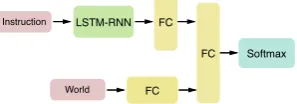
Figure 3: Model for Generating Advice.
the best performing End-to-End RNN architecture
proposed in (Bisk et al., 2016) by adding a FC
layer to the pre-trained LSTM state hn and
sum-ming it with the LSTM hidden state of the
origi-nal model (as shown in Figure2b). We load and
freeze the best performing parameters from our pre-trained model into the relevant portion of this end-to-end architecture, and train it on the origi-nal task of predicting the coordinates of the source / target location, with the addition of advice input.
2.5 Advice Generation
We use a neural network model to self-generate
restrictive advice (as shown in Figure3), passing
the instruction into an embedding layer followed by a LSTM, the board state into a FC layer, con-catenating these into a FC layer, and finally using a softmax to classify the input example into a
re-gion. We train this architecture and then run it on the test set, generate the appropriate advice based on the region the data is classified in, and use that as test advice input for the end-to-end architecture from section2.4.
3 Experiments
Next, we present our experiments over our four different advice protocols, each with decreasing human effort and overall performance. In each protocol, we provide advice to the end-to-end
model from Section2.4, whether it is given by a
human user or model self-generated. Our results, evaluated on each model’s mean and median
pre-diction error, are presented in Table1. We always
compare to the baselineBisk et al. model, which
our model is identical to besides the addition of advice (and we always beat), and the
state-of-the-art best non-ensemble Tan and Bansal
architec-ture. Note thatTan and Bansal use an advanced
[image:3.595.108.257.422.474.2]The pre-trained advice grounding models from
Section2.3 achieve 99.99% accuracy, and are
vi-tal, as shown by the poor performance without
them (M4 vs M5). These grounding models
al-low the end-to-end architecture to generalize to the variability in advice utterances.
3.1 Restrictive Advice
When training the end-to-end model from Sec-tion 2.4, we provide restrictive advice at training time for only half the examples. For every epoch, a different half set of examples (determined ran-domly) receive advice. This mechanism gives the model a chance to learn to interpret each example with and without advice, so that it can handle the interactivity without overfitting to one setup. This setup also gave the best performance.
At test time, the advice is provided only when-ever the predictions fall in the wrong general re-gion, just like a human would. As seen in
Ta-ble 1, this model (M5) significantly outperforms
both baselines (M1, M3). We note that the perfor-mance did not improve much when advice was al-ways provided, showing that this model was able to perform well in its absence and does not rely on it (due to our choice not to provide advice all the time in training). In fact a human would only have to provide restrictive advice for 395/720 examples,
and the model always follows it.1
3.2 Corrective Advice
We train corrective advice identically to restrictive
advice from Section 3.1, except we train in two
separate iterations. This is necessary as the model must learn to adjust its predictions based on the advice, which is why it is first trained to make the normal prediction (first iteration), then trained to adjust the prediction (second iteration).
In the first iteration, we train identically to (Bisk et al.,2016) with no advice, but in the second itera-tion corrective advice is generated based on which direction the predictions must be adjusted to be more accurate. This case is simpler than restrictive advice, since the human operator just has to pro-vide the direction to adjust the predictions, rather than the precise region of the coordinates.
How-ever, the performance does worsen (M5vsM6).
1We note that the performance does not improve from
Bisk et al.if advice is only provided at train time.
3.3 Retry Advice
In Section 2.5, we introduced a model that was
able to self-generate restrictive advice by predict-ing the general region of the block coordinates
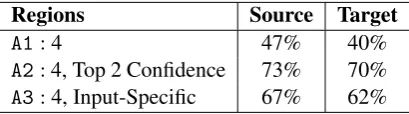
given the NL instruction and blocks world. Table2
shows this model’s accuracy on that task when the board is split into 4 regions. As this is a hard
problem with low accuracy (A1), we instead
gener-ate advice for the top 2 most confident predictions (determined by the softmax scores) (A2).
We now introduce a new multi-stepretryadvice
protocol. In the first step, the model from
Sec-tion2.5 self-generates restrictive advice based on
the most confident predicted region, which it uses as input in the end-to-end model. If the user be-lieves the coordinate prediction based on this ad-vice is wrong, it can tell the model to “retry”, and then the second most likely restrictive advice will be used. Thus, the only human feedback needed now is telling the model to “retry”, rather than ac-curate advice as before. The performance of this (M7) still significantly outperformsBisk et al. and
is close toTan and Bansalon target prediction.
Regions Source Target
A1:4 47% 40%
A2:4, Top 2 Confidence 73% 70%
[image:4.595.314.519.388.445.2]A3:4, Input-Specific 67% 62%
Table 2: Accuracy of model self-generated advice.
3.4 Model Self-Advice Generation
We now aim to avoid any human interaction, by letting the model completely self-generate the ad-vice. Accomplishing it would allow us to im-prove the model’s performance without additional human effort. We experimented with two ap-proaches. In the first, we generate advice as
de-scribed in Section 3.3. However, instead of
hav-ing the user ask the model to “retry”, we treat the top 2 confidence regions as a general region, and provide that as advice input as described in
Sec-tion 3.1. In this case, there is a performance
im-provement over Bisk et al. with no human effort
required (M8in Table1).
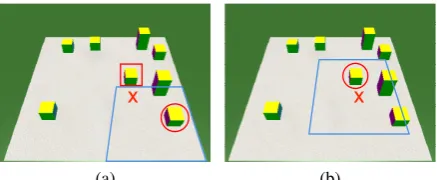
x
(a)
x
(b)
Figure 4: Benefit of Input-Specific Model Self-Generated Advice
(a) TheBisk et al.model would have made a prediction (‘x’) close to the true block (square). However, the ad-vice region (blue) was incorrect (due to the true block being close to the edge of it) and this led to a signifi-cantly worse prediction (circle).
(b) In the input-specific self-generated advice model, the advice region (blue) is centered at the incorrect coordinate prediction (‘x’), leading to the true source block being included and a correct prediction (circle).
the true coordinate lay close to the boundary of one of these regions, often resulting in the model predicting the wrong region when self-generating the advice. This incorrect prediction would lead to significantly worse performance (when compared to the model without advice) when running the
end-to-end model from Section3.1, as the advice
was incorrect (remember that the model always follows our advice, and the true coordinate is not in the advice region due to the mistake). However, if we had instead chosen our regions to be cen-tered at the true coordinate of each input example, it would be less likely that the model would make an incorrect region prediction (since a small error would still lead to the region containing the
cor-rect coordinate). Figure4provides a visual
expla-nation of this.
For this reason, we now introduce input-specific model self-generated advice. In this case, we run theBisk et al. coordinate prediction model in two iterations. In the first iteration, we use the predic-tion to generate advice for a region (of the same size as in the case of 4 quadrants) centered at the predicted coordinate (see Figure4b).2 In the sec-ond iteration, we feed in this generated advice just like Section3.1. This model (M9) achieves perfor-mance slightly worse than retry advice, and sig-nificantly better than Bisk et al., all with no
hu-man effort.3 Table2shows the accuracy increase
2We make sure the advice region doesn’t exceed the board
boundaries.
3Note that we must re-train the model from Section2.3
in predicting the advice now (A3vsA1). It is un-surprising that this approach to self-generating ad-vice performs better, as now the regions are more specific to each coordinate (so there is a higher probability that the true coordinate is actually in the predicted region - see Figure4).
We hypothesize that the performance improve-ments in self-generated advice happen since it is easier to predict the general region used to gen-erate the advice rather than the specific coordi-nates. Previously, we have also shown the benefit of restrictive advice in improving overall coordi-nate prediction, so it is unsurprising that a high accuracy of advice generation leads to better over-all performance. Due to this, we propose that fu-ture robot communication works take advantage of predicting and then using model self-generated ad-vice in their end-to-end training procedure.
4 Summary
This paper takes a first step towards a stronger in-teraction between automated agents and their hu-man operators, for physically grounded language understanding tasks. We focus on the popular blocks task and introduce the notion of advice, Natural Language hints provided by the human operator, correcting the model’s predictions. We show that using four versions of this interactive advice driven protocol on an existing robot com-munication architecture, we can obtain signifi-cant performance improvements. The last method, model self-generated advice, shows the benefit of considering advice even when not designing an in-teractive protocol. Our future work focuses on fur-ther increasing the accuracy of the self-generated advice model, so we can achieve better perfor-mance with no human effort.
Acknowledgements
We thank the anonymous reviewers of this paper for all of their vital feedback.
This work was partially supported by the Defense Advanced Research Projects Agency (DARPA) under the ASED program. Any opin-ions, findings and conclusions or recommenda-tions expressed in this material are those of the au-thor(s) and do not necessarily reflect the views of the DARPA.
[image:5.595.72.291.71.161.2]References
James F Allen, Lenhart K Schubert, George Ferguson, Peter Heeman, Chung Hee Hwang, Tsuneaki Kato, Marc Light, Nathaniel Martin, Bradford Miller, Massimo Poesio, et al. 1995. The trains project: A case study in building a conversational planning agent. Journal of Experimental & Theoretical Arti-ficial Intelligence, 7(1):7–48.
Yonatan Bisk, Deniz Yuret, and Daniel Marcu. 2016. Natural language communication with robots. In Proc. of the Annual Meeting of the North American Association of Computational Linguistics (NAACL).
Satchuthananthavale RK Branavan, Harr Chen, Luke S Zettlemoyer, and Regina Barzilay. 2009. Reinforce-ment learning for mapping instructions to actions. In Proc. of the Annual Meeting of the Association Computational Linguistics (ACL).
David L Chen and Raymond J Mooney. 2011. Learn-ing to interpret natural language navigation instruc-tions from observainstruc-tions. In Proc. of the National Conference on Artificial Intelligence (AAAI).
Sepp Hochreiter and J¨urgen Schmidhuber. 1997. Long short-term memory.
Joohyun Kim and Raymond J Mooney. 2013. Adapt-ing discriminative rerankAdapt-ing to grounded language learning. InProc. of the Annual Meeting of the As-sociation Computational Linguistics (ACL), pages 218–227.
Diederik P Kingma and Jimmy Ba. 2014. Adam: A method for stochastic optimization. arXiv preprint arXiv:1412.6980.
Andrew L Maas, Awni Y Hannun, and Andrew Y Ng. 2013. Rectifier nonlinearities improve neural net-work acoustic models. InProc. of the International Conference on Machine Learning (ICML).
Matt MacMahon, Brian Stankiewicz, and Benjamin Kuipers. 2006. Walk the talk: Connecting language, knowledge, and action in route instructions. InProc. of the National Conference on Artificial Intelligence (AAAI).
Cynthia Matuszek, Nicholas FitzGerald, Luke Zettle-moyer, Liefeng Bo, and Dieter Fox. 2012. A joint model of language and perception for grounded at-tribute learning. InProc. of the International Con-ference on Machine Learning (ICML).
Dipendra K Misra, John Langford, and Yoav Artzi. 2017. Mapping instructions and visual observations to actions with reinforcement learning. InProc. of the Conference on Empirical Methods for Natural Language Processing (EMNLP).
Razvan Pascanu, Tomas Mikolov, and Yoshua Bengio. 2013. On the difficulty of training recurrent neural networks. InProc. of the International Conference on Machine Learning (ICML), pages 1310–1318.
Paul E Rybski, Kevin Yoon, Jeremy Stolarz, and Manuela M Veloso. 2007. Interactive robot task training through dialog and demonstration. In Proc. of the ACM/IEEE international conference on Human-robot interaction, pages 49–56. ACM. Hao Tan and Mohit Bansal. 2018. Source-target
in-ference models for spatial instruction understanding. InProc. of the National Conference on Artificial In-telligence (AAAI).
Stefanie Tellex, Thomas Kollar, Steven Dickerson, Matthew R Walter, Ashis Gopal Banerjee, Seth J Teller, and Nicholas Roy. 2011. Understanding nat-ural language commands for robotic navigation and mobile manipulation. InProc. of the National Con-ference on Artificial Intelligence (AAAI).
TH Wen, D Vandyke, N Mrkˇs´ıc, M Gaˇs´ıc, LM Rojas-Barahona, PH Su, S Ultes, and S Young. A network-based end-to-end trainable task-oriented dialogue system. InProc. of the Annual Meeting of the Euro-pean Chapter of the Association for Computational Linguistics (EACL).