The Interplay of Semantics and Morphology in Word Embeddings
Oded Avraham and Yoav Goldberg Computer Science Department
Bar-Ilan University Ramat-Gan, Israel
{oavraham1,yoav.goldberg}@gmail.com
Abstract
We explore the ability of word embed-dings to capture both semantic and mor-phological similarity, as affected by the different types of linguistic properties (surface form, lemma, morphological tag) used to compose the representation of each word. We train several models, where each uses a different subset of these prop-erties to compose its representations. By evaluating the models on semantic and morphological measures, we reveal some useful insights on the relationship between semantics and morphology.
1 Introduction
Word embedding models learn a space of continu-ous word representations, in which similar words are expected to be close to each other. Tradi-tionally, the term similar refers tosemantic sim-ilarity (e.g. walking should be close to hiking, and happiness to joy), hence the model perfor-mance is usually evaluated using semantic simi-larity datasets. Recently, several works introduced morphology-driven models motivated by the poor performance of traditional models on morpholog-ically complex words. Such words are often rare, and there is not enough evidence to model them correctly. The morphology-driven models allow pooling evidence from different words which have the same base form. These models work by learn-ing per-morpheme representations rather than just per-word ones, and compose the representing vec-tor of each word from those of its morphemes – as derived from a supervised or unsupervised mor-phological analysis – and (optionally) its surface form (e.g.walking=f(vwalk, ving, vwalking)).
The works differ in the way they acquire mor-phological knowledge (from using linguistically
derived morphological analyzers on one end, to approximating morphology using substrings while relying on the concatenative nature of morphol-ogy, on the other) and in the model form (cDSMs (Lazaridou et al., 2013), RNN (Luong et al., 2013), LBL (Botha and Blunsom, 2014), CBOW (Qiu et al., 2014), SkipGram (Soricut and Och, 2015; Bojanowski et al., 2016), GGM (Cotterell et al., 2016)). But essentially, they all show that breaking a word into morphological components (base form, affixes and potentially also the com-plete surface form), learning a vector for each component, and representing a word as a composi-tion of these vectors improves the models semantic performance, especially on rare words.
In this workwe argue that these models capture two distinct aspects of word similarity, semantic (e.g.sim(walking, hiking)>sim(walking, eating)) and morphological (e.g. sim(walking, hiking) > sim(walking, hiked)), and that these two aspects are at odds with each other (shouldsim(walking, hiking) be lower or higher than sim(walking, walked)?). Thebase formcomponent of the com-positional models is mostly responsible for seman-tic aspects of the similarity, while the affixesare mostly responsible for morphological similarity.
This analysis brings about several natural ques-tions: is the combination of semantic and morpho-logical components used in previous work ideal for every purpose? For example, if we exclude the morphological component from the represen-tations, wouldn’t it improve the semantic perfor-mance? What is the contribution of using the surface form? And do the models behave dif-ferently on common and rare words? We ex-plore these questions in order to help the users of morphology-driven models choose the right con-figuration for their needs: semantic or morpholog-ical performance, on common or rare words.
We compare different configurations of morphology-driven models, while controlling for the components composing the representation. We then separately evaluate the semantic and morphological performance of each model, on rare and on common words. We focus on inflec-tional(rather thanderivational) morphology. This is due to the fact that derivations (e.g. affected→
unaffected) often drastically change the meaning of the word, and therefore the benefit of having similar representations for words with the same derivational base is questionable, as discussed by Lazaridou et al (2013) and Luong et al (2013). Inflections (e.g. walked →walking), in contrast, preserve the word lexical meaning, and only change its grammatical categories values.
Our experiments are performed on Modern He-brew, a language with rich inflectional morpho-logical system. We build on a recently intro-duced evaluation dataset for semantic similarity in Modern Hebrew (Avraham and Goldberg, 2016), which we further extend with a collection of rare words. We also create datasets for morphologi-cal similarity, for common and rare words. He-brew’s morphology is not concatenative, so un-like most previous work we do not break the words into base and affixes, but instead rely on a morphological analyzer and represent words using theirlemmas(corresponding to the base form) and their morphological tags (from which the mor-phological forms are derived, corresponding to af-fixes). This allow us to have a finer grained con-trol over the composition, separating inflectional from derivational processes. We also compare to a strong character ngram based model, that mixes the different components and does not allow finer-grained distinctions.
We observe a clear trade-off between the mor-phological and semantic performance – models that excel on one metric perform badly on the other. We present the strengths and weaknesses of the different configurations, to help the users choose the one that best fits their needs. To the best of our knowledge, this work is the first to make a comprehensive comparison between var-ious configurations of morphology-driven mod-els,1 as well as the first to evaluate both
seman-1Among the previous work mentioned above, only few explored configurations other than (base + affixes) or (sur-face + base + affixes). Lazaridou et al (2013) and Luong et al (2013) trained models which represent a word by its base only, and showed that these models performs worse than the
tic and morphological performance of such mod-els. While our experiments focus on Modern He-brew due to the availability of a reliable semantic similarity dataset, we believe our conclusions hold more generally.
2 Models
Our model form is a generalization of the fast-Text model (Bojanowski et al., 2016), which in turn extends the skip-gram model of Mikolov et al (2013). The skip-gram model takes a sequence of words w1, ..., wT and a function s assigning
scores to (word, context) pairs, and maximizes
T
X
t=1 X
wc∈Ct
`(s(wt, wc)) +
X
w0
c∈Nt
`(−s(wt, w0c))
where ` is the log-sigmoid loss function, Ct is a
set of context words, and Nt is a set of negative
examples sampled from the vocabulary.s(wt, wc)
is defined ass(wt, wc) =uw>tvwc (whereuwt and vwc are the embeddings of the focus and the
con-text words).
Bojanowski et al (2016) replace the word rep-resentation vwt with the set of character ngrams
appearing in it: vwc =
P
g∈G(wt)vgwhereG(wt)
is the set of n-grams appearing inwt. The n-grams
are used to approximate the morphemes in the tar-get word.
We generalize Bojanowski et al (2016) by re-placing the set of ngrams G(w) with a set P(w)
of explicit linguistic properties. Each word wt
is then composed as the sum of the vectors of its linguistic properties: vwt =
P
p∈P(wt)vp.
The linguistic properties we consider are the sur-face form of the word (W), it’s lemma (L) and its morphological tag (M)2. The lemma
corre-sponds to the base-form, and the morphologi-cal tag encodes the grammatimorphologi-cal properties of the word, from which its inflectional affixes are de-rived (a similar approach was taken by Cotterell and Sch¨utze (2015)). Moving from a set of n-grams to a set of explicit linguistic properties, al-lows finer control of the kinds of information in compositional ones (base + affixes). However, the poor re-sults for the base-only models were mainly attributed to un-desirable capturing of derivational similarity, e.g. (affected, unaffected). Working with a more linguistically informed morphological analyzer allows us to tease apart inflectional from derivational processes, leading to different results.
the word representation. We train models with dif-ferent subsets of{W, L, M}.
3 Experiments and Results
Our implementation is based on the fastText3
li-brary (Bojanowski et al., 2016), which we modify as described above. We train the models on the Hebrew Wikipedia (∼4M sentences), using a win-dow size of 2 to each side of the focus word, and dimensionality of 200. We use the morphologi-cal disambiguator of Adler (2007) to assign words with their morphological tags, and the inflection dictionary of MILA (Itai and Wintner, 2008) to find their lemmas. For example, for the words
לכתסנ ([we will] look [at]), הלכתסה ([she] looked
[at]) and לכתסה ([he] looked [at]) are assigned
the tagsVB.MF.P.1.FUTURE,VB.F.S.3.PAST and VB.M.S.3.PASTrespectively, and share the lemma
לכתסה. We train the models for the subsets{W}, {L}, {W, L}, {W, M} and {W, L, M}, as well as the original fastText (n-grams) model. Finally, we evaluate each model on several datasets, us-ing both semantic and morphological performance measures.4
Semantic Evaluation Measure The common datasets for semantic similarity5 have some
no-table shortcomings as noted in (Avraham and Goldberg, 2016; Faruqui et al., 2016; Batchkarov et al., 2016; Linzen, 2016). We use the eval-uation method (and corresponding Hebrew sim-ilarity dataset) that we have introduced in a previous work (Avraham and Goldberg, 2016) (AG). The AG method defines an annotation task which is more natural for human judges, result-ing in datasets with improved annotator-agreement scores. Furthermore, the AG’s evaluation metric takes annotator agreement into account, by putting less weight on similarities that have lower annota-tor agreement.
An AG dataset is a collection of target-groups, where each group contains a target word (e.g. singer) and three types of candidate words: pos-itiveswhich are words “similar” to the target (e.g. musician), distractors which are words “related but dissimilar” to the target (e.g.microphone), and randomswhich are not related to the target at all
3https://github.com/facebookresearch/fastText
4Our code is available on https://github.com/ oavraham1/prop2vec, our datasets on https:// github.com/oavraham1/ag-evaluation
5E.g., WordSim353 (Finkelstein et al., 2001), RW (Luong et al., 2013) and SimLex999 (Hill et al., 2015)
(e.glaptop). The human annotators are asked to rank the positive words by their similarity to the target word (distractor and random words are not annotated by humans and are automatically ranked below the positive words). This results in a set of triples of a target word w and two candidate wordsc1, c2, coupled with a value indicating the confidence of ranking sim(w, c1) > sim(w, c2) by the annotators. A model is then scored based on its ability to correctly rank each triple, giv-ing more weight to highly-confident triples. The scores range between 0 (all wrong answers) to 1 (perfect match with human annotators).
We use this method on two datasets: the AG dataset from (Avraham and Goldberg, 2016) ( Se-manticSim, containing 1819 triples), and a new dataset we created in order to evaluate the mod-els on rare words (similar to RW (Luong et al., 2013)). The rare-words dataset ( SemanticSim-Rare) follows the structure ofSemanticSim, but in-cludes only target words that occur less than 100 times in the corpus. It contains a total of 163 triples, all of the type positive vs. random (we find that for rare words, distinguishing similar words from random ones is a hard enough task for the models).
Morphological Evaluation Measure Cotterrel and Sch¨utze (2015) introduced the MorphoDistk
measure, which quantifies the amount of mor-phological difference between a target word and a list of its k most similar words. We modify MorphDistk measure to derive
MorphSimk, a measure that ranges between
0 and 1, where 1 indicates total morpho-logical compatibility. The MorphDist mea-sure is defined as: MorphoDistk(w) =
P
w0∈Kwminmw,mw0 dh(mw, mw0) where Kw is
the set of top-k similarities of w, mw and mw0
are possible morphological tags of w and w0
re-spectively (there may be more than one possi-ble morphological interpretation per word), and dh is the Hamming distance between the
morpho-logical tags. MorphoDist counts the total num-ber of incompatible morphological components. MorphSimk calculates the average rate of
com-patible morphological values. More formally, MorphoSimk(w) = 1− MorphoDistk·|mw|k(w), where |mw| is the number of grammatical components
specified inw’s morphological tag.
1st 2nd 3rd
W הטיבה:gaze:VB.F.S.3.PAST הכייח:smile:VB.F.S.3.PAST תחפייתמ:cry:VB.F.S.3.PRESENT
L יטיבה:gaze:VB.F.S.2.IMPERATIVE ןנובתה:watch:VB.M.S.3.PAST והב:stare:VB.MF.P.3.PAST
WL טיבנ:gaze:VB.MF.P.1.FUTURE הננובתה:watch:VB.F.S.3.PAST ההוב:stare:VB.F.S.3.PRESENT
WM הכייח:smile:VB.F.S.3.PAST הלבחנ:injure:VB.F.S.3.PAST הפשנ:blow:VB.F.S.3.PAST
LM הטיבה:gaze:VB.F.S.3.PAST הננובתה:watch:VB.F.S.3.PAST הזז:move:VB.F.S.3.PAST
[image:4.595.86.514.61.157.2]WLM הטיבה:gaze:VB.F.S.3.PAST הננובתה:watch:VB.F.S.3.PAST העספ:walk:VB.F.S.3.PAST
Table 1: Top-3 similarities for the wordהלכתסה([she] looked [at]).
Each entry is of the form [word:lexical meaning:morphological tag]. Green-colored items share the semantic/inflection of the target word, while red-colored indicate a divergence. In the morphological tags: M/F/MF indicate masculine/feminine/both,
P/S indicate plural/singular, 1/2/3 indicate 1st/2nd/3rd person.
To evaluate the morphological performance on rare words, we run another benchmark ( Mor-phoSimRare) in which we calculate the average MorphoSimscore over the 35 target words of the SemanticSimRaredataset.
Qualitative Results To get an impression of the differences in behavior between the models, we queried each model for the top similarities of sev-eral words (calculated by cosine similarity be-tween words vectors), focusing on rare words. Ta-ble 1 presents the top-3 similarities for the word
הלכתסה([she] looked [at]), which occurs 17 times
in the corpus, under the different models. Unsur-prisingly, the lemma component has a positive ef-fect on semantics, while the tag component im-proves the morphological performance. It also shows a clear trade-off between the two aspects – as models which perform the best on semantics are the worst on morphology. This behavior is rep-resentative of the dozens of words we examined.
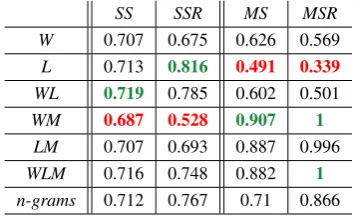
Quantitative Results We compare the different models on the different measures, and also com-pare to the state-of-the-art n-gram based fastText model of Bojanowski et al (2016) that does not require morphological analysis. The results (Ta-ble 2) highlight the following:
1. There is a trade-off between semantic and mor-phological performance – improving one aspect comes at the expense of the other: the lemma com-ponent improves semantics but hurts morphology, while the opposite is true for the tag component. The common practice of using both components together is a kind of compromise: theLM,WLM andn-gramsmodels are not the best nor the worst on any measure.
2. The impacts of the lemma and the tag com-ponents are much larger when dealing with rare
SS SSR MS MSR
W 0.707 0.675 0.626 0.569 L 0.713 0.816 0.491 0.339
WL 0.719 0.785 0.602 0.501
WM 0.687 0.528 0.907 1
LM 0.707 0.693 0.887 0.996 WLM 0.716 0.748 0.882 1
n-grams 0.712 0.767 0.71 0.866 Table 2:Results onSemanticSim (SS),SemanticSimRare (SSR),MorphoSim (MS)andMorphoSimRare (MSR). The
best result for each measure is green, the worst is red.
words: comparing toW,WLis only 1.7% better on SSand 3.8% worse onMS, while it’s 16.3% better and 11.9% worse onSSRandMSR(respectively). Similarly,WM is only 2.8% worse thanW on SS and 44.9% better on MS, while it’s 21.8% worse and 75.7% better onSSRandMSR(respectively). 3. Simply lemmatizing the words is very effec-tive for capturing semantic similarity. This is es-pecially true for the rare words, in which the L model clearly outperform all others. For the com-mon words, we see a small drop compared to in-cluding the surface form as well (WL,WLM). This is attributed to cases in which some of the seman-tics lies within the word’s morphological template, for example: inW model, most similar words for the masculine verb לפנ (fell) are associated with
a soldier (which is a masculine noun): גרהנ (was
killed),עגפנ(was injured), while the similarities of
the feminine formהלפנare associated with a land
ora state (both are feminine nouns): החפוס (was
annexed),השבכנ(was occupied). InLmodel –הלפנ
andלפנshare a single, less accurate representation
[image:4.595.327.506.236.344.2]4 Conclusions
Our key message is that users of morphology-driven models should consider the trade-off be-tween the different components of their repre-sentations. Since the goal of most works on morphology-driven models was to improve se-mantic similarity, the configurations they used (which combine both semantic and morphological components) were probably not the best choices: we show that using the lemma component (either alone or together with the surface form) is better. Indeed, excluding the morphological component will make the morphological similarity drop, but it’s not necessarily a problem for every task. One should include the morphological component in the embeddings only for tasks in which morpho-logical similarity is required and cannot be han-dled by other means. A future work can be to per-form an extrinsic evaluation of the different mod-els in various downstream applications. This may reveal which kinds of tasks benefit from morpho-logical information, and which can be done better by a pure semantic model.
Acknowledgements
The work was supported by the Israeli Science Foundation (grant number 1555/15).
References
Menahem Meni Adler. 2007. Hebrew morphological disambiguation: An unsupervised stochastic word-based approach. Ph.D. thesis, Ben-Gurion Univer-sity of the Negev.
Oded Avraham and Yoav Goldberg. 2016. Improving reliability of word similarity evaluation by redesign-ing annotation task and performance measure. ACL Workshop on Evaluating Vector Space Representa-tions for NLP, page 106.
Miroslav Batchkarov, Thomas Kober, Jeremy Reffin, Julie Weeds, and David Weir. 2016. A critique of word similarity as a method for evaluating distribu-tional semantic models.ACL Workshop on Evaluat-ing Vector Space Representations for NLP, page 7. Piotr Bojanowski, Edouard Grave, Armand Joulin,
and Tomas Mikolov. 2016. Enriching word vec-tors with subword information. arXiv preprint arXiv:1607.04606.
Jan A Botha and Phil Blunsom. 2014. Compositional morphology for word representations and language modelling. InICML, pages 1899–1907.
Ryan Cotterell and Hinrich Sch¨utze. 2015. Morpho-logical word-embeddings. InProc. of NAACL.
Ryan Cotterell, Hinrich Sch¨utze, and Jason Eisner. 2016. Morphological smoothing and extrapolation of word embeddings. InProceedings of the 54th An-nual Meeting of the Association for Computational Linguistics, volume 1, pages 1651–1660.
Manaal Faruqui, Yulia Tsvetkov, Pushpendre Rastogi, and Chris Dyer. 2016. Problems with evaluation of word embeddings using word similarity tasks. ACL Workshop on Evaluating Vector Space Representa-tions for NLP, page 30.
Lev Finkelstein, Evgeniy Gabrilovich, Yossi Matias, Ehud Rivlin, Zach Solan, Gadi Wolfman, and Ey-tan Ruppin. 2001. Placing search in context: The concept revisited. InProceedings of the 10th inter-national conference on World Wide Web, pages 406– 414. ACM.
Felix Hill, Roi Reichart, and Anna Korhonen. 2015. Simlex-999: Evaluating semantic models with (gen-uine) similarity estimation. Computational Linguis-tics, 41(4).
Alon Itai and Shuly Wintner. 2008. Language re-sources for Hebrew. Language Resources and Eval-uation, 42(1):75–98, March.
Angeliki Lazaridou, Marco Marelli, Roberto Zampar-elli, and Marco Baroni. 2013. Compositional-ly derived representations of morphologically complex words in distributional semantics. InACL (1), pages 1517–1526. Citeseer.
Tal Linzen. 2016. Issues in evaluating semantic spaces using word analogies. ACL Workshop on Evaluating Vector Space Representations for NLP, page 13. Thang Luong, Richard Socher, and Christopher D
Manning. 2013. Better word representations with recursive neural networks for morphology. In
CoNLL, pages 104–113.
Tomas Mikolov, Kai Chen, Greg Corrado, and Jef-frey Dean. 2013. Efficient estimation of word representations in vector space. arXiv preprint arXiv:1301.3781.
Siyu Qiu, Qing Cui, Jiang Bian, Bin Gao, and Tie-Yan Liu. 2014. Co-learning of word representations and morpheme representations. InCOLING, pages 141– 150.
Radu Soricut and Franz Och. 2015. Unsupervised morphology induction using word embeddings. In