Cross-lingual tagger evaluation without test data
ˇZeljko Agi´c
IT University of Copenhagen
Barbara Plank
University of Groningen
Anders Søgaard
University of Copenhagen
Abstract
We address the challenge of cross-lingual POS tagger evaluation in absence of man-ually annotated test data. We put forth and evaluate two dictionary-based metrics. On the tasks of accuracy prediction and system ranking, we reveal that these met-rics are reliable enough to approximate test set-based evaluation, and at the same time lean enough to support assessment for truly low-resource languages.
1 Introduction
Cross-lingual learning of NLP models is currently in an evaluation impasse. While we can create reli-able cross-lingual taggers and parsers for hundreds of low-resource languages (Agi´c et al., 2016), we can only evaluate our models for languages where some hand-annotated test data is available. The re-quirement for the uniformity of annotations (Mc-Donald et al., 2013) further strengthens the con-straint. The set of languages with readily available test data is very exclusive. Namely, they are the resource-rich languages from the Universal De-pendencies project (Nivre et al., 2015).1
Recent works have suggested to evaluate cross-lingual approachesby proxy, e.g., by using crowd-sourced tag dictionaries (Li et al., 2012; Agi´c et al., 2015). In these works, though, the validity of assessment by using tag dictionaries is left com-pletely unaddressed.
Contributions. Our work poses the question: How adequate are tag dictionaries for evaluating POS taggers for low-resource languages? Across 25 languages, we compare the POS tagger rank-ings induced by evaluation against dictionaries to
1http://universaldependencies.org/
those induced by evaluation on manually anno-tated gold standards. We select the best out of five competitive taggers for 14 out of 25 languages. We also consider to what extent we can predict true tagging scores. We find that as little as the 100 most frequent tokens with corresponding POS tags suffice to provide reliable estimates of true scores. Finally, we introduce a novel metric that presumes nothing but an English tag dictionary and a small bilingual dictionary for the target language. We also find this metric to be a relatively robust esti-mator for tagging accuracy. It finds the best tagger for 11 out of 20 languages.
Our code and data are freely available.2
2 Metrics
In cross-lingual learning work, it is common to evaluate POS taggers for accuracy by using test data annotated by human experts. For a test setT ofnword-tag pairs(wi, ti)and its taggingTˆ, we define the true accuracyAtrueas:
Atrue(T , Tˆ ) = ∣{(wi,ˆti) ∈
ˆ
T ∣ˆti=ti}n i=1∣
∣Tˆ∣
T = {(wi, ti)},Tˆ= {(wi,ˆti)},1≤i≤n Obviously this metric can only be computed when test data is available, which is not the case for the vast majority of the world’s languages. Note that while we use the termtrueaccuracy, the adequacy of the metric depends on how representative the annotated data is of the underlying distribution.
Drawing from Li et al. (2012)—who compared Wiktionaries to gold dictionaries extracted from the tagger training sets—Agi´c et al. (2015) pro-pose an approximate metric in absence of test data T. They apply it to 10 low-resource languages by
2Wiktionaries included,
https://bitbucket.org/lowlands/release.
using Wiktionaries ranging from only 50 to more than 20k dictionary entries. We take their metric as our starting point.
Soft accuracy. Given a dictionaryDwhose en-tries are word forms with their ambiguous tag-gings(w, Dw = {tw1, ..., twk}), we express the ap-proximate or soft accuracyAsoftas:
Asoft(T ,ˆ D) = ∣{(wi,tˆi)∈Tˆ∣(wi,Dwi)∈D∧ˆti∈Dwi}ni =1∣ ∣{(wi,ˆti)∈Tˆ∣(wi,Dwi)∈D}ni
=1∣
In absence of true tagsti, we ambiguously tag T using the tags fromD, but only for the tokenswi that are covered by the dictionary:(wi, Dwi) ∈ D.
We then count the tagger outputtˆi as correct iff it is warranted by the dictionary:ˆti∈Dwi.
Problems. Crowd-sourced dictionaries can suf-fer from limited coverage and poor quality. We counter the first issue by covering the most fre-quent words. We distinguish between Asoft with
frequency information (+freq), using them most frequent words, or without frequency information (−freq), usingmrandom words.
Tag listsDi can also be deficient: They can be missing certain tags, or contain incorrect tags, or both. For example, the Croatian Wiktionary only notes theNOUNtagging ofigra(en. game), but in
reality the word form also has aVERBtagging (en. to play, third person singular).
We can gauge the quality ofDin presence of a high-quality dictionary G = {(wi, Gi)}∣G ∣i=1 which we can induce from a training set:
precision(D,G) = ∑∣D∣ i=1
∣{Di∩Gi}∣ ∣{t∈Di}∣
recall(D,G) = ∑∣D∣ i=1
∣{Di∩Gi}∣ ∣{t∈Gi}∣
Namely, for each wordwicovered by bothDand
G, we check how many tagsDi andGi intersect, and then use the intersection to estimate dictionary precision and recall.
Translated dictionaries. With low-resource languages, we cannot presume the availability of tag dictionaries. However, we often have high-quality bilingual dictionaries with translations of common words into a resource-rich language such as English. With these in place, we can “translate” the English dictionary into a low-resource language and exploit the resultingDtrans
in the evaluation forAsoft. We implement a very
simple form of dictionary lookup-based transla-tion, whereby all words in the English word-tag dictionary are replaced by target-language words through bilingual dictionaries.
We expect this bilingual dictionary-based soft metric Atrans to suffer from the same coverage
and quality problems as Asoft, and to introduce
additional “translation noise” on top of that. We maintain that both metrics can still be reliable esti-mators of tagging accuracy for truly low-resource languages in absence of annotated test data.
3 Experiments
We perform two sets of experiments:
i) numerical score prediction, where we eval-uate the approximate metricsAsoftandAtrans
as estimators of the true POS tagging accura-ciesAtrue, and
ii) rank prediction, where we test how well do Asoft andAtrans perform in ranking several
POS taggers relative toAtrue.
In numerical score prediction, we evaluate the tag-gers using all three metrics, and establish empiri-cal relations between dictionary quality and size, and the observed scores.
In rank prediction, we rank five POS taggers us-ingAtrue, and then attempt to replicate the
rank-ing usrank-ingAsoftandAtrans. We express the quality
of predicted rankings using precision (P@1) and Kendall’sτb statistic (Knight, 1966).
Data. We train and test our taggers on data from UD version 1.2 (Nivre et al., 2015). We inter-sect this collection with the dictionaries we make available for this experiment: 9 of the Wiktionar-ies come from Li et al. (2012), and we collect 16 new on top of that. Thus, we experiment with a total of 25 languages from the UD. We refer to the 9 languages of Li et al. (2012) as development lan-guages. To make the Wiktionaries and the UD data compatible, we map all POS tags to the tagset by Petrov et al. (2012).
We estimate the frequencies for the+freq vari-ants of the soft metrics by using the multilingual Bible corpus by Christodouloupoulos and Steed-man (2014) and the Watchtower corpus (Agi´c et al., 2016) combined.
We translate the English Wiktionary from Li et al. (2012) by using bilingual dictionaries from Wiktionary to obtainDtransfor 20 languages.3
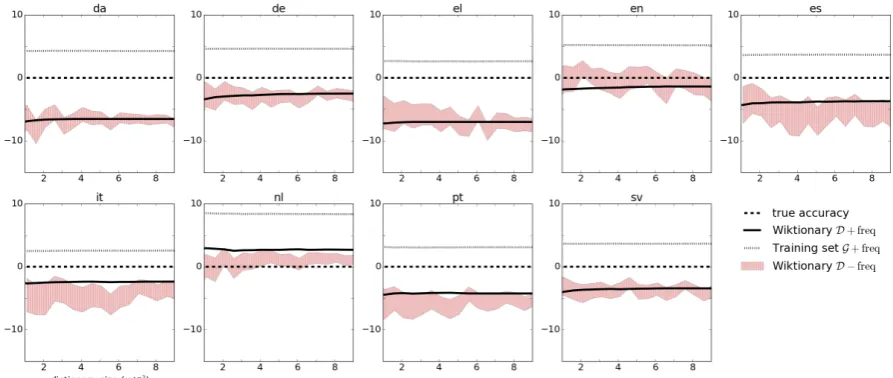
En-Figure 1: Impact of dictionary size and frequency usage (−freq, +freq) on numerical score prediction for nine development languages using the TnT tagger. The shaded regions represent 95% confidence intervals forD −freq. The−freqdictionaries are randomly sampled 100 times for each size step, and the steps range 100–10,000 entries both for−freqand+freq.
Taggers. We experiment with five POS taggers, all run with their default settings:
a) bi-LSTM tagger (Plank et al., 2016), b) CRF++ (Kudo, 2005),
c) MarMoT (Mueller et al., 2013), d) TnT (Brants, 2000), and e) TreeTagger (Schmid, 1994).
3.1 Results
Score prediction. Here, we discuss how well our metricAsoftperforms in guessing the true
tag-ger accuracies by using the Wiktionaries.
Figure 1 reveals that even large Wiktionaries do not make for good accuracy estimators if they do not exploit the frequencies. We see the evidence for that in the very wide confidence intervals in our Wiktionary sampling. In contrast, even the smallest of frequency-aware Wiktionaries prove to be much more reliable. They can contain as little as 100 entries, especially if their tagging quality is high. For example, a bad sample of 6k Span-ish (es) words and tags might underestimateAtrue
by 10 points, while using the 100 most frequent Spanish words get us as close as -4 points even with erroneous tags.
We observe high negative correlations of Wik-tionary F1 scores (Pearson’sρ = −0.58) and test
glish UD training set due to much higher coverage in spite of lower precision: F1 =18.51for the Wiktionary translations
(Dtrans), compared toF1 =13.22for the UD training set
translations (Gtrans) over 20 languages.
set coverages (ρ= −0.60) with the quality of accu-racy estimation, expressed as absolute difference of the two scores∣Atrue−Asoft∣for the data in
Fig-ure 1. In simpler terms: The higher i) the intrin-sic quality of the Wiktionary and ii) its coverage, the better the score estimation. There, the Wik-tionaries are intrinsically evaluated with respect to the training set dictionaries. We also note that the noisy Wiktionaries (D) tend to underestimate Atrue, while the more reliable gold dictionaries
(G) overestimate.
The translation-based metric Atrans
approxi-mates the true scores better thanAsoftfor 7/20
lan-guages, and is more stable across languages as all
Dtransoriginate from English (en). See Table 1 for
the results on all 25 languages.
Rank prediction. In system ranking, we try to select the best tagger for a given language through our metrics. We note the task is rather hard as all the taggers score very close to one another. Still, we manage to find the best tagger for 14/25 lan-guages withAsoft, and for 11/20 withAtrans.
For some languages, even in spite of Wiktionary deficiency, we manage to i) select the best tag-ger and to ii) improve the true score prediction through translation from English. For example, the high quality of Bulgarian (bg) Wiktionary is outweighed by the high coverage of itsDtrans, and
thereAtrans significantly improves the prediction.
[image:3.595.78.525.63.252.2]predic-Wiktionary quality Metrics evaluation
D Dtrans Atrue Asoft Atrans
∣D∣ P R ∣D∣ P R Atrue¯ Asoft¯ P@1 τb Atrans¯ P@1 τb
Bulgarian (bg) 3 93.58 3.54 15 59.33 7.65 97.45±1.14 89.73±0.20 0 -0.2 95.54±0.18 0 -0.2 Czech (cs) 14 98.77 4.82 23 62.35 5.59 97.88±1.00 94.74±0.82 1 0.6 93.47±0.19 0 0.2 * Danish (da) 23 83.89 19.00 15 55.42 12.21 96.07±1.03 88.94±0.51 1 0.6 87.54±0.51 0 0.4 * German (de) 63 94.97 23.19 46 63.20 14.79 95.02±0.42 92.48±0.21 1 0.4 76.77±0.24 1 0.2 * Greek (el) 22 87.99 18.72 21 56.50 10.85 96.97±1.22 89.45±0.47 1 1.0 78.28±0.32 1 0.4
* English (en) 388 69.88 65.97 – – – 95.39±1.07 93.15±0.26 0 -0.4 – – – * Spanish (es) 240 85.00 40.20 31 67.27 17.00 96.22±0.38 91.91±0.65 0 -0.2 79.39±0.36 1 0.4
Basque (eu) 1 90.43 1.49 – – – 95.08±1.33 74.90±1.25 1 0.8 – – –
Farsi (fa) 4 87.87 11.89 1 56.22 1.43 96.35±0.73 90.46±0.45 0 -0.2 94.05±0.54 1 0.6 Finnish (fi) 104 88.41 8.52 45 53.70 6.38 94.72±2.24 79.72±1.26 1 1.0 90.51±0.44 1 0.8
French (fr) 17 88.70 7.49 36 67.55 18.55 96.47±0.62 48.08±1.03 0 0.2 79.30±0.23 0 0.2
Irish (ga) 6 85.73 12.54 – – – 92.77±0.87 91.97±2.88 0 0.2 – – –
Ancient Greek (grc) 5 94.13 2.46 – – – 91.97±2.88 74.62±0.96 1 1.0 – – –
Hebrew (he) 4 83.12 5.04 7 58.37 5.06 95.69±1.15 86.23±0.65 1 0.6 79.84±0.57 1 0.4 Hindi (hi) 2 89.79 4.19 2 61.03 3.81 97.97±0.73 81.25±1.03 0 0.2 80.16±0.50 0 -0.4
Croatian (hr) 21 92.03 12.76 6 55.44 2.43 95.32±1.06 89.81±0.46 0 0.4 94.41±0.76 0 -0.2 Hungarian (hu) 14 84.01 15.29 17 49.78 10.75 92.46±2.35 86.22±2.43 0 -0.2 73.04±1.14 1 0.4 * Italian (it) 494 79.03 65.29 29 63.32 19.62 97.53±0.61 94.58±0.46 1 0.6 85.51±0.23 0 0.2
Latin (la) 30 68.15 7.80 – – – 91.24±2.27 68.24±2.11 1 1.0 – – –
* Dutch (nl) 55 83.67 35.25 29 57.45 16.92 92.38±2.11 92.85±0.74 0 0.2 86.58±0.76 1 0.6
Norwegian (no) 47 89.51 6.94 11 55.32 7.48 97.67±0.55 33.99±0.11 0 0.2 87.33±0.14 0 0.2 Polish (pl) 6 92.97 3.70 22 53.91 8.50 95.55±1.35 87.97±1.17 1 0.8 81.86±0.28 1 0.6 * Portuguese (pt) 42 90.55 18.38 26 62.10 17.98 97.22±0.69 92.39±0.22 1 0.6 82.46±0.27 0 0.2 Romanian (ro) 7 82.29 16.95 15 49.65 16.64 89.59±2.26 83.59±1.50 1 1.0 84.24±0.74 1 1.0 * Swedish (sv) 91 85.84 48.32 29 53.89 16.60 96.22±0.92 92.14±0.77 1 0.4 83.32±0.49 1 0.4 Mean – 86.81 18.38 – 58.09 11.01 95.25±0.89 83.27±5.69 14/25 0.42 86.40±2.89 11/20 0.27
Table 1: Wiktionary size and quality, and metrics evaluation. The dictionary sizes∣D∣are×103 entries.
Wiktionaries are evaluated for precision (P) and recall (R) against the respective UD training set dictio-naries (G). In metrics evaluation, scores are obtained by using the full Wiktionaries, averaged (A¯) over five POS taggers. *: development languages, with Wiktionaries by Li et al. (2012). ±: 95% confidence intervals;bold: best score estimates, i.e., lowest differences to true scores∣Atrue−Asoft∣.
tion and the tagger selection.
Through Kendall’sτbstatistic, we rate the qual-ity of the entire rankings, not just of guessing the best out of five taggers. We find that the true and the estimated rankings are statistically dependent atp<0.05for all languages. We also find that the taggers are easier to rank when the true scores are lower and further apart. For example, the French (fr) and Spanish (es) taggers are hard to rank as they all score very close to one another, while we easily rank the taggers for Greek (el), Basque (eu), Polish (pl), or Romanian (ro). We argue that such ranking behavior favors evaluation for low-resource languages, where insufficient data is very likely to cause even greater disparity between dif-ferent POS taggers.
3.2 Discussion
Sources of POS tags. Our work aims at support-ing cross-lsupport-ingual POS tagger evaluation. Why did
we then evaluate the metrics on outputs of fully su-pervised taggers? In short, because higher tagging scores areharderto estimate.
We experimented with: i) fully supervised tag-gers, ii) actual cross-lingual taggers from Agi´c et al. (2016), for whichA¯true=70.56, and iii)
artifi-cial corruption of gold POS tags.
In artificial data corruption for the development languages, we found that the score prediction error correlates with the true score (ρ = 0.54). For the corruption, we created 20 samples ofAtrue∈ [0,1]
for each language with a 0.05 increment. Further, we evaluated Asoft on the cross-lingual taggers.
There, we singled out the best taggers for 13/21 in-tersecting languages, or for 2 languages more than over fully supervised taggers (11/21). With trans-lated dictionaries, i.e., throughAtrans, we scored
13/20 (also +2 languages).
the additional experiments with different sources of POS tags show that the metrics easily scale down to evaluating cross-lingual taggers for low-resource languages.
Held-out data. Annotating a handful of test sen-tences could serve as an alternative to dictionary-based evaluation. We find that∼55±27 sentences are needed on average to reach the system ranking accuracy ofAtransfor our 20 languages. However,
the option of annotating test data might not be feasible for many low-resource languages, while Wiktionaries are currently readily available for more than 300 languages. We also note that the required sample size is negatively correlated with tagging accuracy (ρ= −0.63): the lower the tagger accuracy, the more sentences we need to reason-ably estimate it.
4 Related work
Li et al. (2012) gauge 9 Wiktionaries against gold dictionaries to strengthen the argument for their weakly-supervised tagger. Agi´c et al. (2015) use 10 Wiktionaries to extend a cross-lingual tagger evaluation to languages without test sets, but they do so indiscriminately. Their Wiktionaries range from only 50 to more than 20k random entries. To the best of our knowledge, research on evaluating POS taggers in absence of manually annotated test data is novel to our work.
We collected 16 new Wiktionaries on top of the 9 provided by Li et al. (2012) for our exper-iment. Recently, larger Wiktionary datasets4have
been made available, enabling further experiments with cross-lingual tagging. The dataset of Sylak-Glassman et al. (2015) covers more than 300 lan-guages, and includes parts of speech and morpho-logical features.
Plank et al. (2015) discuss how various metrics for evaluating syntactic dependency parsing corre-late with human judgments. We suggest that our translation-based metrics might naturally extend to dependency parsing by, e.g., treating an English dependency relation dictionary as a tag dictionary. The strong correlations between labeling (LA) and attachment scores (UAS) in dependency parsing favor our proposal.5
Garrette and Baldridge (2013) build taggers for low-resource languages from just 2 hours of
man-4http://unimorph.org/
5Pearson’sρ=0.82; 0.91(gold POS; predicted POS), UD
data for 20 languages, TurboParser (Martins et al., 2013).
ual annotation. Similarly, we show how to reliably evaluate cross-lingual POS taggers by translating as little as 100 most frequent English Wiktionary entries to the target language.
5 Conclusions
We evaluated how well the quality of POS taggers can be estimatedwithout annotated test data. Our work has obvious applications to developing un-supervised or weakly un-supervised POS taggers for low-resource languages.
We were able to reliably estimate tagging accu-racies by using very small tag dictionaries. Dic-tionaries with as little as 100 entries were in the majority of cases sufficient to predict true accura-cies within 5%. We only require that these 100 en-tries be frequently used. Out of 5 competitive POS taggers, we then single out the best ones using our metric for 14/25 languages.
Finally, we showed that even if the dictionar-ies are “translated” from the English Wiktionary through a small list of bilingual word pairs we can still predict what POS taggers are best for 11/20 languages. In other words, we found that it is suf-ficient to translate a small list of frequent words from English to start reliably evaluating cross-lingual taggers for the true targets.
Acknowledgements
We acknowledge the three anonymous reviewers, and Natalie Schluter, for their valuable comments. ˇZeljko Agi´c and Barbara Plank thank the Nvidia Corporation for supporting their research. An-ders Søgaard is funded by the ERC Starting Grant LOWLANDS No. 313695.
References
ˇZeljko Agi´c, Dirk Hovy, and Anders Søgaard. 2015. If all you have is a bit of the Bible: Learning POS
tag-gers for truly low-resource languages. In
Proceed-ings of the 53rd Annual Meeting of the Association for Computational Linguistics and the 7th Interna-tional Joint Conference on Natural Language Pro-cessing (Volume 2: Short Papers), pages 268–272. Association for Computational Linguistics.
ˇZeljko Agi´c, Anders Johannsen, Barbara Plank, H´ector Mart´ınez Alonso, Natalie Schluter, and Anders Søgaard. 2016. Multilingual projection for parsing
truly low-resource languages. Transactions of the
Thorsten Brants. 2000. TnT: A statistical
part-of-speech tagger. InProceedings of the Sixth Applied
Natural Language Processing Conference, pages 224–231.
Christos Christodouloupoulos and Mark Steedman. 2014. A massively parallel corpus: The Bible in
100 languages. Language Resources and
Evalua-tion, 49(2):375—-395.
Dan Garrette and Jason Baldridge. 2013. Learning a part-of-speech tagger from two hours of annotation. InProceedings of the 2013 Conference of the North American Chapter of the Association for Computa-tional Linguistics: Human Language Technologies, pages 138–147. Association for Computational Lin-guistics.
William R. Knight. 1966. A computer method
for calculating Kendall’s tau with ungrouped data.
Journal of the American Statistical Association, 61(314):436–439.
Taku Kudo. 2005. CRF++: Yet another CRF toolkit.
http://crfpp.sourceforge.net.
Shen Li, Jo˜ao Grac¸a, and Ben Taskar. 2012. Wiki-ly
supervised part-of-speech tagging. InProceedings
of the 2012 Joint Conference on Empirical Methods in Natural Language Processing and Computational Natural Language Learning, pages 1389–1398. As-sociation for Computational Linguistics.
Andre Martins, Miguel Almeida, and A. Noah Smith. 2013. Turning on the turbo: Fast third-order non-projective turbo parsers. InProceedings of the 51st Annual Meeting of the Association for Computa-tional Linguistics (Volume 2: Short Papers), pages 617–622. Association for Computational Linguis-tics.
Ryan McDonald, Joakim Nivre, Yvonne Quirmbach-Brundage, Yoav Goldberg, Dipanjan Das, Kuz-man Ganchev, Keith Hall, Slav Petrov, Hao Zhang, Oscar T¨ackstr¨om, Claudia Bedini, N´uria Bertomeu Castell´o, and Jungmee Lee. 2013. Uni-versal dependency annotation for multilingual
pars-ing. In Proceedings of the 51st Annual Meeting of
the Association for Computational Linguistics (Vol-ume 2: Short Papers), pages 92–97. Association for Computational Linguistics.
Thomas Mueller, Helmut Schmid, and Hinrich Sch¨utze. 2013. Efficient higher-order CRFs for
morphological tagging. InProceedings of the 2013
Conference on Empirical Methods in Natural Lan-guage Processing, pages 322–332. Association for Computational Linguistics.
Joakim Nivre, ˇZeljko Agi´c, Maria Jesus Aranzabe, Masayuki Asahara, Aitziber Atutxa, Miguel Balles-teros, John Bauer, Kepa Bengoetxea, Riyaz Ah-mad Bhat, Cristina Bosco, Sam Bowman, Giuseppe G. A. Celano, Miriam Connor, Marie-Catherine de Marneffe, Arantza Diaz de Ilarraza, Kaja Do-brovoljc, Timothy Dozat, Tomaˇz Erjavec, Rich´ard
Farkas, Jennifer Foster, Daniel Galbraith, Filip Ginter, Iakes Goenaga, Koldo Gojenola, Yoav Goldberg, Berta Gonzales, Bruno Guillaume, Jan Hajiˇc, Dag Haug, Radu Ion, Elena Irimia, An-ders Johannsen, Hiroshi Kanayama, Jenna Kan-erva, Simon Krek, Veronika Laippala, Alessan-dro Lenci, Nikola Ljubeˇsi´c, Teresa Lynn, Christo-pher Manning, C˘at˘alina M˘ar˘anduc, David Mareˇcek, H´ector Mart´ınez Alonso, Jan Maˇsek, Yuji Mat-sumoto, Ryan McDonald, Anna Missil¨a, Verginica Mititelu, Yusuke Miyao, Simonetta Montemagni, Shunsuke Mori, Hanna Nurmi, Petya Osenova, Lilja Øvrelid, Elena Pascual, Marco Passarotti, Cenel-Augusto Perez, Slav Petrov, Jussi Piitulainen, Bar-bara Plank, Martin Popel, Prokopis Prokopidis, Sampo Pyysalo, Loganathan Ramasamy, Rudolf Rosa, Shadi Saleh, Sebastian Schuster, Wolfgang Seeker, Mojgan Seraji, Natalia Silveira, Maria Simi, Radu Simionescu, Katalin Simk´o, Kiril Simov, Aaron Smith, Jan ˇStˇep´anek, Alane Suhr, Zsolt Sz´ant´o, Takaaki Tanaka, Reut Tsarfaty, Sumire Ue-matsu, Larraitz Uria, Viktor Varga, Veronika Vincze, Zdenˇek ˇZabokrtsk´y, Daniel Zeman, and Hanzhi Zhu. 2015. Universal dependencies 1.2.
Slav Petrov, Dipanjan Das, and Ryan McDonald.
2012. A universal part-of-speech tagset. In
Pro-ceedings of the Eighth International Conference on Language Resources and Evaluation (LREC-2012), pages 2089–2096. European Language Resources Association (ELRA).
Barbara Plank, H´ector Mart´ınez Alonso, ˇZeljko Agi´c, Danijela Merkler, and Anders Søgaard. 2015. Do dependency parsing metrics correlate with human
judgments? InProceedings of the Nineteenth
Con-ference on Computational Natural Language
Learn-ing, pages 315–320. Association for Computational
Linguistics.
Barbara Plank, Anders Søgaard, and Yoav Goldberg.
2016. Multilingual part-of-speech tagging with
bidirectional long short-term memory models and
auxiliary loss. In Proceedings of the 54th Annual
Meeting of the Association for Computational Lin-guistics (Volume 2: Short Papers), pages 412–418. Association for Computational Linguistics.
Helmut Schmid. 1994. Probabilistic part-of-speech tagging using decision trees. InProceedings of the International Conference on New Methods in Lan-guage Processing, pages 44–49.
John Sylak-Glassman, Christo Kirov, David Yarowsky, and Roger Que. 2015. A language-independent
fea-ture schema for inflectional morphology. In