Transduction Recursive Auto-Associative Memory:
Learning Bilingual Compositional Distributed Vector Representations of
Inversion Transduction Grammars
Karteek Addanki Dekai Wu
HKUST
Human Language Technology Center Department of Computer Science and Engineering Hong Kong University of Science and Technology
{vskaddanki|dekai}@cs.ust.hk
Abstract
We introduce TRAAM, or Transduction RAAM, a fully bilingual generalization of Pollack’s (1990) monolingual Recur-sive Auto-Associative Memory neural net-work model, in which each distributed vec-tor represents a bilingual constituent—i.e., an instance of a transduction rule, which specifies a relation between two monolin-gual constituents and how their subcon-stituents should be permuted. Bilingual terminals are special cases of bilingual constituents, where a vector represents ei-ther (1) a bilingual token—a token-to-token or “word-to-word” translation rule —or (2) a bilingual segment—a segment-to-segment or “phrase-to-phrase” transla-tion rule. TRAAMs have properties that appear attractive for bilingual grammar in-duction and statistical machine translation applications. Training of TRAAM drives both the autoencoder weights and the vec-tor representations to evolve, such that similar bilingual constituents tend to have more similar vectors.
1 Introduction
We introduce Transduction RAAM—or TRAAM for short—a recurrent neural network model that generalizes the monolingual RAAM model of Pol-lack (1990) to a distributed vector representation of compositionally structured transduction gram-mars (Aho and Ullman, 1972) that is fully bilingual from top to bottom. In RAAM, which stands for Recursive Auto-Associative Memory, using fea-ture vectors to characterize constituents at every level of a parse tree has the advantages that (1) the entire context of all subtrees inside the con-stituent can be efficiently captured in the feature vectors, (2) the learned representations generalize
well because similar feature vectors represent sim-ilar constituents or segments, and (3) representa-tions can be automatically learned so as to max-imize prediction accuracy for various tasks using semi-supervised learning. We argue that different, but analogous, properties are desirable for bilin-gual structured translation models.
Unlike RAAM, where each distributed vector represents a monolingual token or constituent, each distributed vector in TRAAM represents a
bilingualconstituent orbiconstituent—that is, an instance of a transduction rule, which asserts a re-lation between two monolingual constituents, as well as specifying how to permute their subcon-stituents in translation. Bilingual terminals, or biterminals, are special cases of biconstituents where a vector represents either (1) abitoken—a token-to-token or “word-to-word” translation rule —or (2) a bisegment—a segment-to-segment or “phrase-to-phrase” translation rule.
The properties of TRAAMs are attractive for machine translation applications. As with RAAM, TRAAMs can be trained via backpropagation training, which simultaneously evolves both the autoencoder weights and the biconstituent vector representations. As with RAAM, the evolution of the vector representations within the hidden layer performs automatic feature induction, and for many applications can obviate the need for man-ual feature engineering. However, the result is that similar vectors tend to represent similar bicon-stituents, rather than monolingual constituents.
The learned vector representations thus tend to form clusters of similar translation relations in-stead of merely similar strings. That is, TRAAM clusters represent soft nonterminal categories of cross-lingual relations and translation patterns, as opposed to soft nonterminal categories of mono-lingual strings as in RAAM.
Also, TRAAMs inherently make full simulta-neous use of both inputandoutput language
tures, recursively, in an elegant integrated fash-ion. TRAAM does not make restrictive a pri-ori assumptions of conditional independence be-tween input and output language features. When evolving the biconstituent vector representations, generalization occurs over similar inputand out-put structural characteristics simultaneously. In most recurrent neural network applications to ma-chine translation to date, only input side features or only output language features are used. Even in the few previous cases where recurrent neural net-works have employed both input and output lan-guage features for machine translation, the models have typically been factored so that their recursive portion is applied only to either the input or output language, but not both.
As with RAAM, the objective criteria for train-ing can be adjusted to reflect accuracy on nu-merous different kinds of tasks, biasing the di-rection that vector representations evolve toward. But again, TRAAM’s learned vector representa-tions support making predicrepresenta-tions that simultane-ously make use of both input and output struc-tural characteristics. For example, TRAAM has the ability to take into account the structure of both input and output subtree characteristics while making predictions on reordering them. Similarly, for specific cross-lingual tasks such as word align-ment, sense disambiguation, or machine transla-tion, classifiers can simultaneously be trained in conjunction with evolving the vector representa-tions to optimize task-specific accuracy (Chris-man, 1991).
In this paper we use as examples binary bi-parse trees consistent with transduction grammars in a 2-normal form, which by definition are in-version transduction grammars (Wu, 1997) since they are binary rank. This is not a requirement for TRAAM, which in general can be formed for transduction grammars of any rank. Moreover, with distributed vector representations, the notion of nonterminal categories in TRAAM is that of soft membership, unlike in symbolically represented transduction grammars. We start with bracketed training data that contains no bilingual category labels (like training data for Bracketing ITGs or BITGs). Training results in self-organizing clus-ters that have been automatically induced, repre-senting soft nonterminal categories (unlike BITGs, which do not have differentiated nonterminal cat-egories).
2 Related work
TRAAM builds on different aspects of a spec-trum of previous work. A large body of work ex-ists on various different types of self-organizing recurrent neural network approaches to model-ing recursive structure, but mostly in monolin-gual modeling. Even in applications to ma-chine translation or cross-lingual modeling, the typical practice has been to insert neural net-work scoring components while still maintain-ing older SMT modelmaintain-ing assumptions like bags-of-words/phrases, “shake’n’bake” translation that relies heavily on strong monolingual language models, and log-linear models—in contrast to TRAAM’s fully integrated bilingual approach. Here we survey representative work across the spectrum.
2.1 Monolingual related work
Distributed vector representations have long been used for n-gram language modeling; these continuous-valued models exploit the general-ization capabilities of neural networks, although there is no hidden contextual or hierarchical structure as in RAAM. Schwenk (2010) applies one such language model within an SMT system.
In the simple recurrent neural networks (RNNs or SRNs) of Elman (1990), hidden layer represen-tations are fed back to the input to dynamically rep-resent an aggregate of the immediate contextual history. More recently, the probabilistic NNLMs of Bengioet al. (2003) and Bengio et al. (2009) follow in this vein.
To represent hierarchical tree structure using vector representations, one simple family of ap-proaches employs convolutional networks, as in Leeet al.(2009) for example. Collobert and We-ston (2008) use a convolution neural network layer quite effectively to learn vector representations for words which are then used in a host of NLP tasks such as POS tagging, chunking, and semantic role labeling.
feature structures. Socheret al.(2011) used mono-lingual recursive autoencoders for sentiment pre-diction, with or without parse tree information; this was perhaps the first use of a RAAM style ap-proach on a large scale NLP task, albeit mono-lingual. Scheible and Schütze (2013) automat-ically simplified the monolingual tree structures generated by recursive autoencoders, validated the simplified structures via manual evaluation, and showed that sentiment classification accuracy is not affected.
2.2 Bilingual related work
The majority of work on learning bilingual dis-tributed vector representations has not made use of recursive approaches or hidden contextual or com-positional structure, as in the bilingual word em-bedding learning of Klementievet al.(2012) or the bilingual phrase embedding learning of Gaoet al.
(2014). Schwenk (2012) uses a non-recursive neu-ral network to predict phrase translation probabil-ities in conventional phrase-based SMT.
Attempts have been made to generalize the dis-tributed vector representations of monolingual n -gram language models, avoiding any hidden con-textual or hierarchical structure. Working within the framework ofn-gram translation models, Son
et al. (2012) generalize left-to-right monolingual
n-gram models to bilingual n-grams, and study bilingual variants of class-based n-grams. How-ever, their model does not allow tackling the chal-lenge of modeling cross-lingual constituent order, as TRAAM does; instead it relies on the assump-tion that some other preprocessor has already man-aged to accurately re-order the words of the input sentence into exactly the order of words in the out-put sentence.
Similarly, generalizations of monolingual SRNs to the bilingual case have been studied. Zou
et al. (2013) generalize the monolingual recur-rent NNLM model of Bengio et al. (2009) to learn bilingual word embeddings using conven-tional SMT word alignments, and demonstrate that the resulting embeddings outperform the baselines in word semantic similarity. They also add a sin-gle semantic similarity feature induced with bilin-gual embeddings to a phrase-based SMT log-linear model, and report improvements in BLEU. Com-pared to TRAAM, however, they only learn non-compositional features, with distributed vectors only representing biterminals (as opposed to bi-constituents or bilingual subtrees), and so other
mechanisms for combining biterminal scores still need to be used to handle hierarchical structure, as opposed to seamlessly being integrated into the distributed vector representation model. De-vlin et al. (2014) obtain translation accuracy im-provements by extending the probabilistic NNLMs of Bengio et al. (2003), which are used for the output language, by adding input language con-text features. Unlike TRAAM, neither of these approaches symmetrically models the recursive structure of both the input and output language sides.
For convolutional network approaches, Kalch-brenner and Blunsom (2013) use a recurrent prob-abilistic model to generate a representation of the source sentence and then generate the target sen-tence from this representation. This use of in-put language context to bias translation choices is in some sense a neural network analogy to the PSD (phrase sense disambiguation) approach for context-dependent translation probabilities of Carpuat and Wu (2007). Unlike TRAAM, the model does not contain structural constraints, and permutation of phrases must still be done in con-ventional PBSMT “shake’n’bake” style by rely-ing mostly on a language model (in their case, a NNLM).
A few applications of monolingual RAAM-style recursive autoencoders to bilingual tasks have also appeared. For cross-lingual document classifica-tion, Hermann and Blunsom (2014) use two sep-arate monolingual fixed vector composition net-works, one for each language. One provides the training signal for the other, and training is only on the embeddings.
Liet al.(2013) described a use of monolingual recursive autoencoders within maximum entropy ITGs. They replace their earlier model for pre-dicting reordering based on the first and the last tokens in a constituent, by instead using the con-text vector generated using the recursive autoen-coder. Only input language context is used, unlike TRAAM which can use the input and output lan-guage contexts equally.
could be used to optimize the log-linear model weights.
3 Representing transduction grammars with TRAAM
As a recurrent neural network representation of a transduction grammar, TRAAM learns bilingual distributed representations that parallel the struc-tural composition of a transduction grammar. As with transduction grammars, the learned represen-tations are symmetric and model structured rela-tional correlations between the input and output languages. The induced feature vectors in effect represent soft categories of cross-lingual relations and translations. The TRAAM model integrates elegantly with the transduction grammar formal-ism and aims to model the compositional struc-ture of the transduction grammar as opposed to incorporating external alignment information. It is straightforward to formulate TRAAMs for arbi-trary syntax directed transduction grammars; here we shall describe an example of a TRAAM model for an inversion transduction grammar (ITG).
Formally, an ITG is a tuple ⟨N,Σ,∆, R, S⟩, whereN is a finite nonempty set of nonterminal symbols,Σis a finite set of terminal symbols inL0,
∆is a finite set of terminal symbols in L1,Ris a finite nonempty set of inversion transduction rules andS∈Nis a designated start symbol. A normal-form ITG consists of rules in one of the following four forms:
S→A, A→[BC], A→ ⟨BC⟩, A→e/f
where S ∈ N is the start symbol, A, B, C ∈
N are nonterminal symbols and e/f is a biter-minal. A biterminal is a pair of symbol strings:
Σ∗×∆∗, where at least one of the strings have to be nonempty. The square and angled brackets sig-nal straight and inverted order respectively. With straight order, both theL0 and theL1productions are generated left-to-right, but with inverted order, theL1production is generated right-to-left.
In the distributed TRAAM representation of the ITG, we represent each bispan, using a feature vec-torvof dimensiondthat represents a fuzzy encod-ing of all the nonterminals that could generate it. This is in contrast to the ITG model where each nonterminal that generates a bispan has to be enu-merated separately. Feature vectors correspond-ing to larger bispans are compositionally generated from smaller bispans using acompressornetwork
which takes two feature vectors of dimension d, corresponding to the smaller bispans and gener-ates the feature vector of dimensiond ing to the larger bispan. A single bit correspond-ing to straight or inverted order is also fed as an input to the compressor network. The compres-sor network in TRAAM serves a similar role as the syntactic rules in the symbolic ITG, but keeps the encoding fuzzy. Figure 2 shows the straight and inverted syntactic rules and the correspond-ing inputs to the compressor network. Modelcorrespond-ing of unary rules (with start symbol on the left hand side) although similar, is beyond the scope of this paper.
It is easy to demonstrate that TRAAM mod-els are capable of representing any symbolic ITG model. All the nonterminals representing a bispan can be encoded as a bit vector in the feature vector of the bispan. Using the universal approximation theorem of neural networks (Horniket al., 1989), an encoder with a single hidden layer can represent any set of syntactic rules. Similarly, all TRAAM models can be represented using a symbolic ITG by assuming a unique nonterminal label for every feature vector. Therefore, TRAAM and ITGs rep-resent two equivalent classes of models for repre-senting compositional bilingual relations.
It is important to note that although both TRAAM and ITG models might be equivalent, the fuzzy encoding of nonterminals in TRAAM is suit-able for modeling the generalizations in bilingual relations without exploding the search space unlike the symbolic models. This property of TRAAM makes it attractive for bilingual category learning and machine translation applications as long as ap-propriate language bias and objective functions are determined.
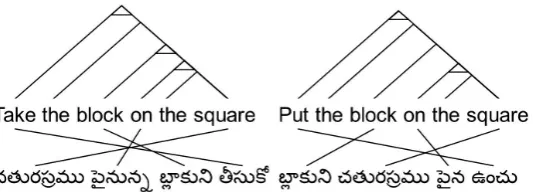
in-Figure 1: Example of English-Telugu biparse trees where inversion depends on output language sense.
Compressor
Compressor Reconstructor
Reconstructor
o1#=#1# c1# c2# c3#
o2#=#(1#
p1#
o1'# c1'# c2'#
p2#
[image:5.595.168.435.63.159.2]o2'# p1'# c3'#
Figure 2: Architecture of TRAAM.
version order and generates a vectorp of dimen-siondcorresponding to the larger bispan generated by combining the two smaller bispans as shown in Figure 2. The vectorpthen serves as the input for the successive combinations of the larger bispan with other bispans.
p=tanh(W1[o;c1;c2] +b1) (1)
whereW1andb1are the weight matrix and the bias vector of the encoder network.
To ensure that the computed vector p captures the fuzzy encodings of its children and the inver-sion order, we use areconstructornetwork which attempts to reconstruct the inversion order and the feature vectors corresponding of its children. We use the error in reconstruction as our objective function and train our model to minimize the re-construction error over all the nodes in the biparse
tree. The reconstructor network in our TRAAM model can be replaced by any other network that enables the computed feature vector representa-tions to be optimized for the given task. In our current implementation, we reconstruct the inver-sion ordero′ and the child vectorsc′1 andc′2using another nonlinear activation function as follows:
[o′;c′1;c′2] =tanh(W2p+b2) (2)
whereW2andb2are the weight matrix and the bias vector of the reconstructor network.
4 Bilingual training
4.1 Initialization
[image:5.595.158.438.202.474.2]corresponding to the leaf nodes (biterminals in the symbolic ITG notation) in the biparse trees are also initialized randomly. These constitute the model parameters and are optimized to minimize our ob-jective function of reconstruction error. The parse trees for providing the structural constraints are generated by a bracketing inversion transduction grammar (BITG) induced in a purely unsupervised fashion, according to the algorithm in Saerset al.
(2009). Due to constraints on the training time, we consider only the Viterbi biparse trees according to the BITG instead of all the biparse trees in the forest.
4.2 Computing feature vectors
We compute the feature vectors at each internal node in the biparse tree, similar to the feedforward pass in a neural network. We topologically sort all the nodes in the biparse tree and set the feature vec-tor of each node in the topologically sorted order as follows:
• If the node is a leaf node, the feature vector is the corresponding bisegment embedding.
• Else, the biconstituent embedding corre-sponding to the internal node is generated us-ing the feature vectors of the children and the inversion order using Equation 1. We also normalize the length of the computed fea-ture vector so as to prevent the network from making the biconstituent embedding arbitrar-ily small in magnitude (Socheret al., 2011).
4.3 Feature vector optimization
We train our current implementation of TRAAM, by optimizing the model parameters to minimize an objective function based on the reconstruction error over all the nodes in the biparse trees. The objective function is defined as a linear combina-tion of the l2 norm of the reconstruccombina-tion error of the children and the cross-entropy loss of recon-structing the inversion order. We define the error at each internal nodenas follows:
En= α2|[c1;c2]−[c′1;c′2]|2−(1−α)
[(1−o)log(1−o′) + (1 +o)log(1 +o′)]
where c1, c2, o correspond to the left child, right child and inversion order,c′1, c′2, o′ are the respec-tive reconstructions andα is the linear weighting factor. The global objective functionJ is the sum
of the error function at all internal nodesnin the bi-parse trees averaged over the total number of sen-tencesT in the corpus. A regularization parameter
λis used on the norm of the model parametersθto avoid overfitting.
J = T1ΣnEn+λ||θ||2 (3)
As the bisegment embeddings are also a part of the model parameters, the optimization objective is similar to a moving target training objective Ro-hwer (1990). We use backpropagation with struc-ture Goller and Kuchler (1996) to compute the gra-dients efficiently. L-BFGS algorithm Liu and No-cedal (1989) is used in order to minimize the loss function.
5 Bilingual representation learning
We expect the TRAAM model to generate clus-ters over cross-lingual relations similar to RAAM models on monolingual data. We test this hypoth-esis by bilingually training our model using a par-allel English-Telugu blocks world dataset. The dataset is kept simple to better understand the na-ture of clusters. Our dataset comprises of com-mands which involves manipulating different col-ored objects over different shapes.
5.1 Example
Figure 1 shows the biparse trees for two English-Telugu sentence pairs. The prepositionon in En-glish translates to ౖనున (pinunna) and ౖన(pina) re-spectively in the first and second sentence pairs be-cause in the first sentenceblockis described by its position on thesquare, whereas in the second sen-tenceblock is the subject and square is the object. Since Telugu is a language with an SOV structure, the verbs ఉంచు(vunchu)and సు (teesuko) occur at the end for both sentences.
cate-Figure 3: Clustering of biconstituents in the Telugu-English data.
gories within a symbolic framework in an un-supervised manner creates extremely challenging combinatorial scaling issues. TRAAM models are a promising approach for tackling this prob-lem, since the vector representations learned us-ing the TRAAM model inherently yield soft syn-tactic category membership properties, despite be-ing trained only with the unlabeled structural con-straints of simple BITG-style data.
5.2 Biconstituent clustering
The soft membership properties of learned dis-tributed vector representations can be explored via cluster analysis. To illustrate, we trained a TRAAM network bilingually using the algorithm in Section 4, and obtained feature vector represen-tations for each unique biconstituent. Clustering the obtained feature vectors reveals emergence of fuzzy nonterminal categories, as shown in Figure 3. It is important to note that each point in the vector space corresponds to a tree-structured bi-constituent as opposed to merely a flat bilingual phrase, as same surface forms with different tree structures will have different vectors.
As the full cluster tree is too unwieldy, Figure 4 zooms in to shows an enlarged version of a por-tion of the clustering, along with the corresponding bracketed bilingual structures. One can observe that the cluster represents the biconstituents that describe the object by its position on another ob-ject. We can deduce this from the fact that only a
single sense ofon/ ౖనున (pinnuna)seems to be occur-ing inallthe biconstituents of the cluster. Manual inspection of other clusters reveals such similari-ties despite noise expected to be introduced by the sparsity of our dataset.
6 Conclusion
We have introduced a fully bilingual generaliza-tion of Pollack’s (1990) monolingual Recursive Auto-Associative Memory neural network model, TRAAM, in which each distributed vector repre-sents a bilingual constituent—i.e., an instance of a transduction rule, which specifies a relation be-tween two monolingual constituents and how their subconstituents should be permuted. Bilingual ter-minals are special cases of bilingual constituents, where a vector represents either (1) a bilingual to-ken—a token-to-token or “word-to-word” transla-tion rule—or (2) a bilingual segment—a segment-to-segment or “phrase-to-phrase” translation rule. TRAAMs can be used for arbitrary rank SDTGs (syntax-directed transduction grammars, a.k.a. synchronous context-free grammars). Although our discussions in this paper have focused on bi-parse trees from SDTGs in a 2-normal form, which by definition are ITGs due to the binary rank, nothing prevents TRAAMs from being applied to higher-rank transduction grammars.
[image:7.595.217.369.81.257.2]sta-Figure 4: Typical zoomed view into the Telugu-English biconstituent clusters from Figure 3.
tistical machine translation—their sensitivity to both input and output language context means that the learned vector representations tend to reflect the similarity of bilingualrather than monolingual constituents, which is what is needed to induce dif-ferentiated bilingual nonterminal categories.
7 Acknowledgments
This material is based upon work supported in part by the Defense Advanced Research Projects Agency (DARPA) under BOLT contract nos. HR0011-12-C-0014 and HR0011-12-C-0016, and GALE contract nos. HR0011-06-C-0022 and HR0011-06-C-0023; by the European Union un-der the FP7 grant agreement no. 287658; and by the Hong Kong Research Grants Council (RGC) research grants GRF620811, GRF621008, and GRF612806. Any opinions, findings and conclu-sions or recommendations expressed in this mate-rial are those of the authors and do not necessarily reflect the views of DARPA, the EU, or RGC.
References
Alfred V. Aho and Jeffrey D. Ullman. The The-ory of Parsing, Translation, and Compiling. Prentice-Halll, Englewood Cliffs, New Jersey, 1972.
Yoshua Bengio, Réjean Ducharme, Pascal Vin-cent, and Christian Jauvin. A neural probabilis-tic language model. Journal of Machine Learn-ing Research, 3:1137–1155, 2003.
Yoshua Bengio, Jérôme Louradour, Ronan Col-lobert, and Jason Weston. Curriculum learning. InProceedings of the 26th annual international conference on machine learning, pages 41–48. ACM, 2009.
Marine Carpuat and Dekai Wu.
Context-dependent phrasal translation lexicons for sta-tistical machine translation. In 11th Machine Translation Summit (MT Summit XI), pages 73– 80, 2007.
Lonnie Chrisman. Learning recursive distributed representations for holistic computation. Con-nection Science, 3(4):345–366, 1991.
Ronan Collobert and Jason Weston. A unified architecture for natural language processing: Deep neural networks with multitask learning. In Proceedings of the 25th International Con-ference on Machine Learning, ICML ’08, pages 160–167, New York, NY, USA, 2008. ACM.
[image:8.595.107.546.106.286.2]52nd Annual Meeting of the Association for Computational Linguistics, 2014.
Jeffrey L Elman. Finding structure in time. Cog-nitive science, 14(2):179–211, 1990.
Jianfeng Gao, Xiaodong He, Wen-tau Yih, and Li Deng. Learning continuous phrase represen-tations for translation modeling. In52nd Annual Meeting of the Association for Computational Linguistics (Short Papers), 2014.
Christoph Goller and Andreas Kuchler. Learn-ing task-dependent distributed representations by backpropagation through structure. In Neu-ral Networks, 1996., IEEE International Con-ference on, volume 1, pages 347–352. IEEE, 1996.
Karl Moritz Hermann and Phil Blunsom. Multi-lingual models for compositional distributed se-mantics. In52nd Annual Meeting of the Asso-ciation for Computational Linguistics, volume abs/1404.4641, 2014.
Kurt Hornik, Maxwell Stinchcombe, and Hal-bert White. Multilayer feedforward networks are universal approximators. Neural networks, 2(5):359–366, 1989.
Nal Kalchbrenner and Phil Blunsom. Recurrent continuous translation models. In EMNLP, pages 1700–1709, 2013.
Alexandre Klementiev, Ivan Titov, and Binod Bhattarai. Inducing crosslingual distributed representations of words. In 24th Interna-tional Conference on ComputaInterna-tional Linguistics (COLING 2012). Citeseer, 2012.
Honglak Lee, Roger Grosse, Rajesh Ranganath, and Andrew Y Ng. Convolutional deep be-lief networks for scalable unsupervised learning of hierarchical representations. InProceedings of the 26th Annual International Conference on Machine Learning, pages 609–616. ACM, 2009.
Peng Li, Yang Liu, and Maosong Sun. Recur-sive autoencoders for itg-based translation. In
EMNLP, pages 567–577, 2013.
Dong C Liu and Jorge Nocedal. On the limited memory bfgs method for large scale optimiza-tion.Mathematical programming, 45(1-3):503– 528, 1989.
Jordan B Pollack. Recursive distributed represen-tations. Artificial Intelligence, 46(1):77–105, 1990.
Richard Rohwer. The“moving targets”training al-gorithm. InNeural Networks, pages 100–109. Springer, 1990.
Markus Saers, Joakim Nivre, and Dekai Wu. Learning stochastic bracketing inversion trans-duction grammars with a cubic time biparsing algorithm. In11th International Conference on Parsing Technologies (IWPT’09), pages 29–32, Paris, France, October 2009.
Christian Scheible and Hinrich Schütze. Cutting recursive autoencoder trees. In1st International Conference on Learning Representations (ICLR 2013), Scottsdale, Arizona, May 2013.
Holger Schwenk. Continuous-space language models for statistical machine translation. In
The Prague Bulletin of Mathematical Linguis-tics, volume 93, pages 137–146, 2010.
Holger Schwenk. Continuous space transla-tion models for phrase-based statistical machine translation. In Proceedings of COLING 2012: Posters, pages 1071––1080. Citeseer, 2012. Richard Socher, Jeffrey Pennington, Eric H
Huang, Andrew Y Ng, and Christopher D Man-ning. Semi-supervised recursive autoencoders for predicting sentiment distributions. In Pro-ceedings of the Conference on Empirical Meth-ods in Natural Language Processing, pages 151–161. Association for Computational Lin-guistics, 2011.
Le Hai Son, Alexandre Allauzen, and François Yvon. Continuous space translation models with neural networks. In Proceedings of the 2012 conference of the north american chapter of the association for computational linguistics: Hu-man language technologies, pages 39–48. As-sociation for Computational Linguistics, 2012.
Andreas Stolcke and Dekai Wu. Tree match-ing with recursive distributed representations. In AAAI 1992 Workshop on Integrating Neu-ral and Symbolic Processes —The Cognitive Di-mension, 1992.
Dekai Wu. Stochastic inversion transduction grammars and bilingual parsing of parallel cor-pora. Computational Linguistics, 23(3):377– 403, 1997.
IEEE International Conference on Acoustic, Speech and Signal Processing (ICASSP), 2014. Will Y Zou, Richard Socher, Daniel M Cer, and Christopher D Manning. Bilingual word embed-dings for phrase-based machine translation. In