An ACG Analysis of the G-TAG Generation Process
∗ Laurence DanlosUniversit´e Paris Diderot (Paris 7) ALPAGE, INRIA Paris–Rocquencourt Institut Universitaire de France, Paris, France
Aleksandre Maskharashvili and Sylvain Pogodalla
INRIA Villers-l`es-Nancy, France Universit´e de Lorraine, CNRS, LORIA, UMR 7503 Vandœuvre-l`es-Nancy, France
[email protected] [email protected]
Abstract
This paper presents an encoding of Generation-TAG (G-TAG) within Abstract Categorial Grammars (ACG). We show how the key notions of G-TAG have a nat-ural interpretation in ACG, allowing us to use itsreversibilityproperty for text gen-eration. It also offers solutions to several limitations of G-TAG.
1 Motivations
G-TAG (Danlos, 1998;Danlos, 2000) is a formal-ism based on the Tree Adjoining Grammar (TAG) formalism (Joshi et al., 1975;Joshi and Schabes, 1997) dedicated to text generation. It focuses on providing several notions to support useful data structures, such as g-derivation trees or lexical databases, to effectively relate a surface form (a derived tree or a string) to a conceptual represen-tation. An actual implementation in ADA was first provided for French (Meunier, 1997), and it has re-cently been implemented in the .NET framework as the EasyText NLG system and is operational at Kantar Media, a French subsidiary company of TNS-Sofres (Danlos et al., 2011).
The G-TAG proposal can be seen as a result of the observation of the mismatch between the derivation tree notion of TAG and the expected se-mantic dependencies (Schabes and Shieber, 1994) from a generation perspective. Several approaches that extend the derivation tree notion of TAG have been proposed to overcome this difficulty. Other approaches showed that the derivation trees still could be used without additional modifications.
Such approaches rely on unification (Kallmeyer
and Romero, 2004;Kallmeyer and Romero, 2007) or a functional approach to TAG (Pogodalla, 2004;
∗This work has been supported by the French agency Agence Nationale de la Recherche (ANR-12-CORD-0004).
Pogodalla, 2009)1 based on Abstract Categorial
Grammars (ACG) (de Groote, 2001). The latter
is intrinsically reversible: the grammars and the algorithms are the same for parsing and for gener-ation.
We propose then to study G-TAG under the ACG perspective. We show that the key notion of g-derivation tree naturally express itself in this framework. The surface form construction from a conceptual representation can then use the gen-eral algorithms of ACG, the very same ones that can be used in parsing to analyze mildly con-text sensitive languages (TAG generated language, LCFRS) (de Groote and Pogodalla, 2004), follow-ing (Kanazawa, 2007)’s proposal here applied to give an ACG account of G-TAG. We do not con-sider here the G-TAG treatment of preferences be-tween the different realizations of the same input. Similarly, we do not consider the generation of pronouns used in G-TAG and we will work on integrating a theory of generation of referring ex-pressions.
2 Sketching G-TAG
G-TAG deals with theHow to say it? task of
gen-eration. The input is a conceptual representation.
A G-TAG grammar includeselementarytrees, as
any TAG grammar. But it also makesg-derivation
trees primary objects, relating them to the elemen-tary trees and considering them as pivot to the con-ceptual representation level.
Conceptual Representation G-TAG
concep-tual representation makes use of notions as
sec-ond order relation, first order relation andthing. Second order relations have two arguments which are relations (either first or second order ones) and typically correspond to discourse relations,
1Synchronous approaches (Nesson and Shieber, 2006) are similar in many respects, as shown in (Storoshenk and Frank, 2012).
whereas first order relations have things as their arguments. While (Danlos, 2000) uses reified for-mulas of a logical conceptual representation lan-guage as G-TAG inputs, it can also be represented as a higher-order logical formula (Meunier, 1997) or as a SDRT-like formula (Danlos et al., 2001). We follow here this presentation. Equation (1) ex-emplifies an input that could be realized as Jean a pass´e l’aspirateur pour ˆetre r´ecompens´e par Marie. Puis il a fait une sieste(John has vacumed in order to be rewarded by Mary. Then he took a nap).
SUCCESSION(GOAL(VACUUMING(Jean),
REWARDING(Marie,Jean)),
NAPPING(Jean)) (1)
G-TAG Lexical Database A lexical entry of G-TAG corresponds to a lemma. For each lexical en-try (i.e. lemma) there is a set of TAG elementary trees which corresponds to it. Among the TAG el-ementary trees that correspond to a given lexical entry, there is the canonical representative, and all the other representatives are represented by adding features to the canonical representative. For exam-ple, if the lexical entry is to love, then the canon-ical representative will be the active form of the verbto love. Then the passive alternation is rep-resented by adding a feature [+passive] toto love. Moreover, all the lexical entries attached to a con-cept (such asSUCCESSION) belong to a same
lexi-cal base. So for a concept, there can be a lexical entry describing verbal realizations of the concept. These realizations can correspond to the active or to the passive forms, etc. There can also be a lex-ical entry which corresponds to nominal realiza-tions, etc.
G-Derivation Trees A TAG derivation tree can be seen as a record of the substitutions and adjunc-tion occurring during a TAG analysis. The same is true for g-derivation tree. However, while TAG derivation trees are considered as a by-product, with inflected anchors, G-TAG derivation trees are first class structures that are combined in order to reflect the conceptual input. To abstract from the surface form and from the derived tree they can relate to, they don’t correspond to inflected forms but bear features that are used in a post-processing step. Complex g-derivation trees are built by going through the dynamic selection process of a lexi-cal item from the set of appropriate candidates for
a given concept. So contrary to TAG derivation trees, they are not fully instantiated trees: their ar-guments are represented by variables whose lexi-calization are not carried out yet.
G-Derived Trees A g-derivation tree defines a unique g-derived tree corresponding to it. This correspondance is maintained all along the real-ization process and a post-processing module out-puts the surface representation (text) from the g-derived tree. In addition to inflecting forms using the feature values it can make some rewriting to propose different versions of the initial text. In this particular sense, g-derived tree corresponds to possibly multiple text outputs generated by the post-processing module.
3 The G-TAG Generation Process
Let us assume the input of Equation1. The G-TAG process starts by lexicalizing relations that have the widest scope in the conceptual representation: typically second order relations, then first order re-lations, and things.2 Back to the example, we first
lexicalize the second order relation SUCCESSION.
Several items are associated with this relation: apr`es (after), avant (before), ensuite (afterwards), auparavant (beforehand), puis (then), etc. Each of them has two arguments, however, some of them produce texts comprising two or more sentences, like ensuite(afterwards); some of them can pro-duce either two sentence texts or one sentence text, while others produce only one sentence. For in-stance,Jean a pass´e l’aspirateur. Ensuite, il a fait une sieste (John has vacuumed. Afterwards, he
took a nap) is a two sentences text whileJohn a
fait une sieste apr`es avoir pass´e l’aspirateur(John took a nap after having vacuumed) is a one sen-tence text. For this reason, items describing the arguments or the result of second order relations have features expressing the following constraints:
(+T,+S)indicates it is a text (two ore more
sen-tences); (+S) indicates it is either a single
sen-tence or a text;(−T,+S)indicates it is a sentence (not a text). Every second order relation has three features: one for output, and two for inputs.3
2Correctness of the process is ensured because the gram-mars don’t contain auxiliary trees that would reverse the pred-ication order. (Danlos, 2000) argues such cases don’t occur in technical texts, the first target of G-TAG. We don’t elaborate on this point since the ACG approach we propose remove this constraint for free.
Dan-Let us assume that the G-TAG g-derivation tree ensuite(+T,+S)belonging to the lexical database
associated with the concept SUCCESSION is first
chosen, resulting in a text rather than a sentence (illustrated by the leftmost g-derivation tree of Fig-ure1. The process then tries to realize its two ar-guments. The first one involves theGOALrelation
that can be realized either by pour (in order to) or by pour que (so that), as exemplified by the right-most g-derivation trees of Figure1. Both have fea-tures(−T,+S)for the inputs (i.e. arguments) and
return a tree labeled at the root by(−T,+S).
ensuite
(+T,+S)
(1st event)
(+S)
(2nd event)
(+S) arg1 arg2
pour
(−T,+S)
(ACTION)
(−T,+S)
(PURPOSE)
(−T,+S) arg1 arg2
pour que
(−T,+S)
(ACTION)
(−T,+S)
(PURPOSE)
[image:3.595.309.524.498.606.2](−T,+S) arg1 arg2
Figure 1: G-derivation trees samples
Despite pour and pour que bearing the same features, the syntactic trees corresponding to pour and pour que are quite different. For pour que
S substitution nodes can be substituted by two
tensed sentences, while pour takes a finite sen-tence and a “sensen-tence” in the infinitive form with-out any nominal subject. Figure2shows the asso-ciated elementary trees. Selecting one or the other during the generation process restricts the possible realizations for the arguments. This is enforced by a feature associated to the elementary tree, namely
the (+reduc-subj) feature as shown in Fig. 3.
Again, we may assume that G-TAG selects pour,
S S (arg1) PP
Prep pour
S
C que
S(arg2) (mood:subj)
S S (arg1) PP
Prep pour
S(arg2) (mood:inf)
Figure 2: Elementary trees of pour que (so that)
andpour(in order to)
which will enforce, because of the associated ele-mentary trees, that the subject of the first and the second arguments are the same. Afterwards, we need to lexicalize these two arguments with a com-mon subjectJean. From a semantic point of view,
the agent ofVACUUMINGhas to be the beneficiary
of REWARDING (the rewardee). VACUUMING can
only be lexicalized as passer-l’aspirateur (run-the-vacuum-cleaner), while there are several
lexical-los, 2000).
ization options for the REWARDING: r´ecompenser
(to reward), donner-r´ecompense (to give-reward), and recevoir-r´ecompense (to receive-reward). Let us notice that donner-r´ecompense does not meet the constraint on a shared subject as it cannot have the rewardee as its subject4. The remaining
options are: recevoir-r´ecompense, whose canon-ical representation has the rewardee as subject; and r´ecompense whose passive construction has the rewardee as subject. s Assuming a choice of r´ecompenser[+passive],5the lexicalizations of the
arguments of the first order relations remain. As
Marie occurs only once and in subject position,
it can only be lexicalized asMarie. On the other
hand, Jean three times: one will be the implicit
subject of the subordinate, then as argument of
VACUUMINGandNAPPING. Therefore it can be
ei-ther lexicalized in both of the cases as Jean, or
Jean and the pronoun il (he). In G-TAG, there
are some post-processing rules that take care of the generation of referring expressions, but not in a really principled way so we do not demonstrate them here. We assume a lexicalization by Jean in
both cases. Figure 3 shows the g-derivation tree
associated with the input of Equation1and Fig.4
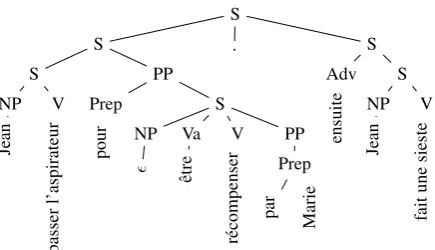
show the unique resulting (non-flected) derived tree. The post-processing modules then outputs:
Jean a pass´e l’aspirateur pour ˆetre r´ecompens´e par Marie. Ensuite, il a fait une sieste. (John vacuumed in order to be rewarded by Mary. Af-terwards, he took a nap.)
ensuite
pour
(+reduc-subj)
passer-l’aspirateur
Jean
recompenser
(+reduc-subj,+passive)
Marie
faire-la-sieste
Jean
arg1
arg1
arg1
arg2
arg1 arg2 arg2
arg1
Figure 3: Fully instantiated g-derivation tree
4 ACG Definition
Abstract Categorial Grammars
(ACGs) (de Groote, 2001) are a type
theo-4It lacks passivation in French and there is no form equiv-alent to: John was given a reward by Mary.
[image:3.595.77.284.516.585.2]S S
S NP
Jean
V
passer
l’aspirateur
PP Prep
pour
S NP
Va
ˆetre
V
r´ecompenser
PP Prep
par Marie
. S
Adv
ensuite
S NP
Jean
V
fait
une
[image:4.595.76.294.62.187.2]sieste
Figure 4: Non-inflected derived tree
retical framework that is able to encode several
grammatical formalisms (de Groote and
Pogo-dalla, 2004). An ACG defines two languages: the abstract one and the object one. The abstract level describe the admissible parse structures and a lexicon maps these structures to the ones we observe at the object level (strings for surface forms, logical formulas for semantic forms). In all cases, the considered languages are sets of
λ-terms that generalize string and tree languages.
Definition. A higher-order linear signature (also called avocabulary) is defined to be a tripleΣ = hA, C, τi, where:
• A is a finite set of atomic types (also noted AΣ),
• Cis a finite set of constants (also notedCσ),
• andτ is a mapping fromC toTAthe set of
types built onA:TA::=A|TA→TA(also
notedTΣ).
Given a higher-order linear signatureΣ,Λ(Σ)is
the set of λ-terms built on Σ, and for t ∈ Λ(Σ)
andα∈TΣsuch thatthas typeα, we notet:Σ α
(theΣsubscript is omitted when obvious from the
context).
Definition. An abstract categorial grammar is a quadrupleG =hΣ,Ξ,L, siwhere:
1. ΣandΞ are two higher-order linear
signa-tures, which are called the abstract vocabu-laryand theobject vocabulary, respectively; 2. L : Σ −→ Ξis a lexicon from the abstract
vocabulary to the object vocabulary. It is a homomorphism that maps types and terms built onΣ to types and terms built on Ξ as
follows:
• if α → β ∈ TΣ then L(α → β) =
L(α)→L(β)
• if x ∈ Λ(Σ) (resp. λx.t ∈ Λ(Σ) and
t u ∈ Λ(Σ)) then L(x) = x (resp.
L(λx.t) = λx.L(t) and L(t u) =
L(t)L(u))
It is then enough to defineL on the atomic
types and on the constants of Σ to define it
on all types and terms, provided that for any constant c : α ofΣwe haveL(c) : L(α).
We notet:=GuifL(t) = uand omit the G
subscript if obvious from the context.
3. s∈ TΣ is a type of the abstract vocabulary,
which is called thedistinguished typeof the grammar.
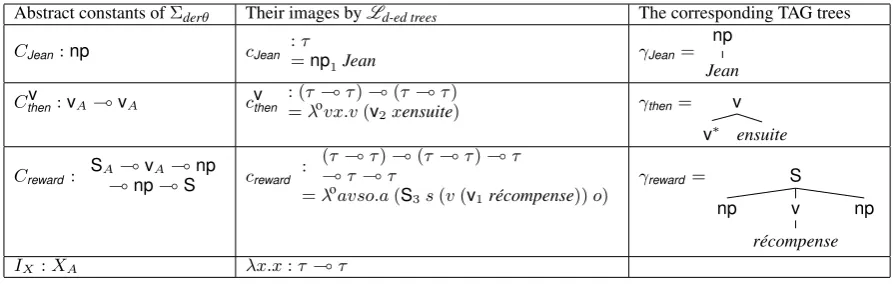
Table 1 provides an ACG example Gd-ed trees
where the abstract typed constants of Σderθ
en-code the combinatorial properties of the associated (through the lexiconLd-ed trees) elementary trees.
Definition. Theabstract languageof an ACGG = hΣ,Ξ,L, siisA(G) ={t∈Λ(Σ)|t:Σ s}
The object languageof the grammar O(G) =
{t∈Λ(Ξ)| ∃u∈ A(G). t=LG(u)}
For instance, the termCreward ISIvCMary CJean :
S ∈ Gd-ed trees, and its image, the derived tree for
Marie r´ecompense Jean(Mary rewards John). It is important to note that, from a purely math-ematical point of view, there is no structural differ-ence between the abstract and the object vocabu-lary: both are higher-order signatures. This allows for combining ACGs in different ways:
• by having a same abstract vocabulary shared
by several ACGs: this can be used to make two object terms (for instance a string and a logical formula) share the same underlying structure.Gd-ed treesandGLogin Fig.5illustrate such a composition.
• by making the abstract vocabulary of one
ACG the object vocabulary of another ACG, allowing for the control of the admissible structures of the former by the latter. Gyield andGd-ed trees in Fig. 5 illustrate such a com-position.
Λ(Σderθ)
Λ(Σtrees) Gd-ed trees
Λ(Σstring)
Gyield
[image:4.595.307.522.609.744.2]Λ(ΣLog) GLog
Crucial to our analysis is that ACG parsing of
a term u amounts to finding an abstract term t
such that t:=u, no matter whether u represents
a string, a tree, or a logical formula. This can be done in polynomial time for ACGs whose abstract constant types are at most of order 2: second order ACGs as (Kanazawa, 2007) shows.6The result
re-lies on a reduction of the parsing problem to Data-log querying where the term to be parsed is stored in a database. Interestingly, this database can
rep-resent a set of terms (Kanazawa, 2011, Section
4.2) and the query reduces to checking whether at least one of them can be retrieved. This allows the query associated with a term representing a logical formula to extend to all the terms that are equiva-lent modulo the associativity and the commutativ-ity of the conjunction.
5 ACG Encoding
5.1 TAG as ACG
Because ACG considers both the abstract lan-guage and the object lanlan-guage, the encoding of TAG into ACG makes (abstract) terms represent-ing derivation trees primary. The encodrepresent-ing uses two ACGs Gd-ed trees = hΣderθ,Σtrees,Ld-ed trees,Si andGyield =hΣtrees,Σstring,Lyield, τi.
We exemplify the encoding7 of a TAG
analyz-ing (2) in Fig.6.8
(2) Marie
Mary r´ecompenserewards ensuitethen JeanJohn
This sentence is usually analyzed in TAG with a derivation tree where the adverb adjoins at the v
node.
The three higher-order signatures are:
Σderθ: Its atomic types include S, v, np, SA,
vA. . . where the X types stand for the
cate-gories X of the nodes where a substitution
can occur while the XA types stand for the
categoriesX of the nodes where an
adjunc-tion can occur. For each elementary tree
γlex. entry it contains a constantClex. entry whose
type is based on the adjunction and substitu-tion sites as Table 1 shows. It additionally
contains constantsIX : XA that are meant
to provide a fake auxiliary tree on adjunction
6It actually extends this result to almost linear object terms where variables with atomic type can be duplicated, as it commonly happens at the semantic level.
7This corresponds to the systematic encoding of (
Pogo-dalla, 2009) of TAG and its semantics into ACG. 8We follow the grammar of (Abeill´e, 2002).
sites where no adjunction actually takes place in a TAG derivation.
Σtrees: Its unique atomic type is τ the type of
trees. Then, for any X of arity n
belong-ing to the ranked alphabet describbelong-ing the ele-mentary trees of the TAG, we have a constant
Xn:
ntimes
z }| {
τ (· · ·(τ (τ
Σstring: Its unique atomic type is σ the type of
strings. The constants are the terminal sym-bols of the TAG (with typeσ), the
concatena-tion+ : σ ( σ ( σ and the empty string
ε:σ.
Table 1illustrates Ld-ed trees.9 Lyield is defined as follows:
• Lyield(τ) =σ;
• for n > 0, Lyield(Xn) = λx1· · ·xn.x1 + · · ·+xn;
• forn= 0,X0 :τ represents a terminal
sym-bol andLyield(X0) =X.
Then, the derivation tree, the derived tree, and the yield of Fig.6are represented by:
γreward
γJean
γMarie
γthen
(a) Derivation tree
S
np
Jean
v
ensuite
v
r´ecompense
np
Marie
(b) Derived tree
Figure 6:Marie r´ecompense ensuite Jean
γ5=Creward IS (Cthenv IS) CMarie CJean Ld-ed trees(γ5)
=S3 (np1 Marie)
(v2(v1r´ecompense)ensuite) (np1Jean)
Lyield(Ld-ed trees(γ5)) =Marie+r´ecompense +ensuite+Jean
5.2 G-TAG as ACG
In order to model G-TAG in ACG, first we need to design the abstract signature Σg-derθ in which we
can have entries for G-TAG. This entries will re-flect the ideology that G-TAG is based on. For instance, in G-TAG discourse level words like en-suitecan take as its arguments texts and sentences and produces text. In order to model this, we
introduce types S and T. Then, we can define
DthenSS: S ( S ( T, which means that DthenSS has
takes two arguments of type S and returns a
re-sult of typeT. As in G-TAG,ensuitecan take two
9WithL
d-ed trees(XA) = τ (τ and for any other type
Abstract constants ofΣderθ Their images byLd-ed trees The corresponding TAG trees
CJean:np cJean :=τnp
1Jean
γJean=
np
Jean
Cthenv :vA(vA cvthen =: (τλo(vx.vτ)(v(2x(τensuite(τ)) γthen= v
ensuite
v∗
Creward: SA((npvA((Snp creward :
(τ(τ)((τ(τ)(τ
(τ(τ
=λoavso.a(S3s(v(v1r´ecompense))o)
γreward = S
np v
r´ecompense
np
[image:6.595.75.522.61.203.2]IX:XA λx.x:τ(τ
Table 1: A TAG as an ACG:Ld-ed treesandLlog.semlexicons
texts as arguments and return text as well, we need to do have another entry for modeling this fact. This makes us to introduce another constantDthenT T:
T(T(T. For the same kind of reason, we
in-troduce following constants:DST
then:S( T(T,
DT Sthen andT ( S ( T. Other relations, like au-paravantis modeled in the same way asensuitein
Σg-derθ.
Apart from ensuite and auparavant, there are
connectives asavant(before) andapr`es(after) that need to be modeled differently from ensuite. In-deed, while ensuiteresults in a text, placing side by side a text and a sentence separated with a pe-riod,avantandapr`esin French combine in a sin-gle sentence a (full) clause and an infinitive clause with an implicit subject: the one of the first clause. It is clear that in order to typeavantandapr`esin theΣg-derθ signature, one should use a type which
schematically looks as . . . ( S. On the other
hand, one needs to give the exact type to them.
Despite that in TAG and G-TAGavantandapr`es
take two sentential arguments (labelled byS), the second argument bears a feature indicating it lacks the subject and that the latter has to be shared with the first sentence. For instance: Jean a fait une sieste apr`es avoir pass´e l’aspirateur (John took a nap after having vacuumed), here the subject ofavoir pass´e l’aspirateur (having vacuumed) is
Jean, which comes from the sentence Jean a fait
une sieste (John took a nap). So, Jean a fait une sieste(John took a nap) can be seen as a sentence whose subject is shared by another sentence as well. In order to model this point, we use
fol-lowing type: Sws ( Sh ( np ( S. Indeed,
theSwsand theShtypes correspond to the type
of sentences missing a subject. Furthermore, we
need to modelpourandpour que, which were
in-troduced in order to lexicalize theGOALrelation in
G-TAG. First, let us have a look atpour que. It can
take as its arguments two complete (from a syntax point of view) sentences and results in a sentence as in: Il travaille pour que vous puissiez manger.
So, Dpour que, which is an entry corresponding to
pour que, can be assigned aS ( S ( Stype.
The syntactic difference between pour que and
pour was highlighted in Section 3: pour takes
as arguments a complete sentence and an infini-tive form of a sentence missing a subject whose subject comes from the first argument. Thus, in this case, similarly to case of avant and apr`es,
pourhas to be modeled as an entry that has type
Sws( Sinf ( np (S, whereSinfstands for
the type of an infinitive form of a clause missing a subject. We also need to deal with encoding differ-ent forms of a verb. For instance, r´ecompenser has an active and a passive form. In G-TAG deriva-tion, both of them can be encountered. In order to model this fact, two different entries are intro-duced: one for the passive form and one for the active form, which is the canonical construction for r´ecompenser. So, we need to have two distinct entriesDpassive
recompense andDrecompenseactive , and both of them
have typeSA ( vA ( np ( np ( S.
More-over, (Danlos, 2000) poses the problem that
G-TAG cannot handle a text where the adverb adjoin at thevnode rather than on theSnode as in:Jean a pass´e l’aspirateur. Il a ensuite fait une sieste
(John vacuumed. Hethentook a nap.) According
to (Danlos, 2000) modelling such text production requires a formalism more powerful than TAG. In the ACG framework, this observations translates into defining an entryDvthen :S( (vA ( S) (
TinΣg-derθwhich is third order and that is, as such,
beyond the TAC into ACG encoding (that only re-quires second-order types).10 This also offers a
particu-general mechanism for providing constants encod-ing adverbial connectives with two arguments as
in discourse grammars such as D-STAG (Danlos,
2011), but contrary to D-LTAG where one of the
arguments is anaphorically given from the preced-ing discourse (Webber, 2004).
G-Derivation Trees to Derivation Trees We translate terms ofΣg-derθ, which correspond to
g-derivation trees, into the TAG g-derivation tree lan-guage defined on Σderθ using the lexicon Lder-der of Table 2. It is interesting to see how to
inter-Lder-der(S) =Lder-der(T) =Lder-der(Sws)
=Lder-der(Sinf) =Lder-der(Sh)
=S
Lder-der(SA) =SA Lder-der(vA) =vA Lder-der(np) =np Lder-der(IS) =IS
[image:7.595.309.530.230.514.2]Lder-der(Iv) =Iv
Table 2: TheLder-der lexicon
pret Dvthen: S ( (vA ( S) ( T into Σderθ.
For this reason, we introduce inΣderθ the
follow-ing constant: s2 : S ( S ( S that allows
for combining two sentences with a period. Now, it is possible to translate Dvthen into Σderθ as
fol-lows: Lder-der(Dvthen) = λoS1S2.s2 S1(S2Cthenv ). It means that Dthenv is interpreted as performing
both the operation of combining two sentences with a period and the adjunction ofensuiteon the
vnode of the second sentence.
Derived Trees as Interpretation of G-Derivation Trees As soon as g-derivation trees as term built on Σg-derθ are interpreted as term
built onΣderθ, we can map them to derived trees.
Thus, by composing the two lexiconsLder-der and Ld-ed treeswe can get directly from G-TAG into de-rived trees
5.3 From G-TAG to Montague Style Semantics Using ACGs
(Pogodalla, 2009) defines a signature ΣLog and a lexicon LLog from Σderθ to ΣLog. The entries in
ΣLog have Montague like semantics. The lexicon
translates a derivation tree into a corresponding formula. We will use the same kind of semantic language for conceptual representations. In other words, our language will produce the formulas
lar case, we could use a second-order—and polynomial— encoding of multi-component TAG into ACG.
that are used in the conceptual representation of G-TAG, while we will stick to the Montague style translations from syntax to semantics.
So, we define a signature Σconrepof conceptual representation that is similar to the one of ( Pogo-dalla, 2009). Σconrep defines two atomic types e andtand constants such as: j,m. . . of typee, the
constantREWARDof type e ( e ( t, the
con-stantCLAIMof typee (t (tand the constant
SEEMof typet(t. Moreover, we have constants
SUCC,GOALof typet(t(t.
We are able to translate Σg-derθ into Σconrep
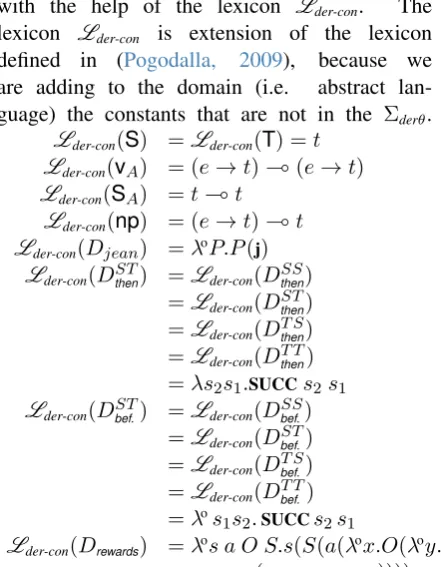
with the help of the lexicon Lder-con. The
lexicon Lder-con is extension of the lexicon
defined in (Pogodalla, 2009), because we
are adding to the domain (i.e. abstract
lan-guage) the constants that are not in the Σderθ.
Lder-con(S) =Lder-con(T) =t Lder-con(vA) = (e→t)((e→t) Lder-con(SA) =t(t
Lder-con(np) = (e→t)(t Lder-con(Djean) =λoP.P(j)
Lder-con(DthenST) =Lder-con(DthenSS)
=Lder-con(DthenST)
=Lder-con(DthenT S)
=Lder-con(DthenT T)
=λs2s1.SUCCs2s1
Lder-con(Dbef.ST) =Lder-con(Dbef.SS)
=Lder-con(Dbef.ST)
=Lder-con(Dbef.T S)
=Lder-con(Dbef.T T)
=λos1s2.SUCCs2s1
Lder-con(Drewards) =λos a O S.s(S(a(λox.O(λoy.
(REWARDx y))))
Note that the interpretation of np is JnpK =
(e → t) ( t, using a non-linear implication (but
almost linear). Typically, the sharing of the sub-ject by the two clauses related bypouroravant de
induces non linearity.
TheSinf,Sh, andSwstypes all are interpreted
asJnpK ( JSK = ((e → t) ( t) ( tas they
denote clauses lacking a subject. Then we trans-late the constantsDpour,Dapr`es, andDavant in
the following way:
Lder-con(Dpour) =
λos1.λos2.λoN.N(λx.(GOAL(s1(λP.P x)) (s2(λP.P x))))
Lder-con(Dapres) =
Lder-con(Davant) =
λos1.λos2.λoN.N(λx.(SUCC(s2(λP.P x)) (s1(λP.P x))))
5.4 The G-TAG Process as a Morphism Composition
We exemplify the whole process using the term
T0 = SUCC(VAC(jean),REWARD(marie,jean))
of type t.11 The terms representing the
g-derivation trees that generate this conceptual rep-resentation are the antecedents of To by Lder-con−1 : Lder-con−1 (T0) = {t1, . . . , t8} that all are of type
T. They are given in Figure7. Each of these re-trieved termst1, . . . , t8 are then mapped to terms
representing TAG derivation trees, i.e. built on
Σderθ via the lexicon Lder-der. They can be can in turn be interpreted as syntactic derived trees via the lexicon Ld-ed trees, and the latter can be interpreted as strings using the lexicon Lyield.
So from T0 we can have eight surface forms:
Lyield(Ld-ed trees(Lder-der(ti))), i ∈ [1,8]. Let us show this process on the example of t512. It
il-lustrates the generation of the example (3).13
(3) Jean
John
a pass´e l’aspirateur.
vacuumed.
Marie
Mary
a r´ecompens´e
rewarded ensuiteafterwards Jean.John.
Lder-der(t5) =s2(CvacISIvCjean)
(CrewardISCthenv CmarieCjean)
Ld-ed trees(Lder-der(t5) =
S3(S2(np1Jean)(v1a pass´e l’aspirateur)) ·
(S3(np1Marie)(v2(v1a r´ecompens´e)ensuite)(np1Jean))
And the surface forms is given by composing the interpretations:
Lyield(Ld-ed trees(Lder-der(t5)) =
Jean+a pass´e+l’aspirateur+.+
Marie+a recompens´e+ensuite+Jean
11The associated conceptual input is a simplified version of the conceptual input of Equation1without theGOALconcept and a replacement of theNAPone by theREWARDINGone.
12t5 is such that
Lder-der(t5) = γ5and the termγ5 was
used as example at Section5.1.
13For sake of simplicity we assume the adverb adjoins on the whole auxiliary+verb phrase rather than only on the aux-iliary as it would be in French.
t1 =DSS
then(DvacISIvDjean)(DrewardISIvDmarieDjean)
t2 =DSS
then(DvacISIvDjean)(DpassiverewardISIvDmarieDjean)
t3 =DSS
bef.(DrewardISIvDmarieDjean)(DvacISIvDjean)
t4 =DSSbef.(DpassiverewardISIvDjeanDmarie)(DvacISIvDjean)
t5 =Dvthen(DvacISIvDjean)(λoa.DrewardISa DmarieDjean)
t6 =Dvthen(DvacISIvDjean)(DpassiverewardISIvDjeanDmarie)
t7 =Dafter(DswsvacISIv)(Dreceive-rew.ISIvDjean)Dmarie
t8 =Dbef.(DswsvacISIv)(Dreceive-rew.ISIvDjean)Dmarie
Figure 7: Antecedents ofT0byLder-con
6 Related Work
We can only quickly mention two related pieces
of work. On the one hand, (Gardent and
Perez-Beltrachini, 2010) also takes advantage of the formal properties underlying the tree language of derivation trees to propose a generation pro-cess using TAG grammars. On the other hand, (Nakatsu and White, 2010) also includes discourse
relations in the grammar withDiscourse
Combi-natory Categorial Grammarand a type-theoretical framework to provide a text (rather than sentence) generation process.
7 Conclusion
This paper shows how G-TAG can be encoded as ACG. It relies on the fact that both G-TAG and the encoding of TAG within ACG make the deriva-tion tree a primary noderiva-tion. Then we can bene-fit from the polynomial reversibility of the ACG framework. It also offers a generalization of the process to all kinds of adjunctions, including the predicative ones. It also offers a new insight on discourse grammars for the adverbial connective encoding (Danlos, 2011). Note that contrary to an important part of G-TAG that offers a way (based on a semantic and a linguistic analysis) to rank the different realizations of a conceptual representa-tion, we do not deal here with such preferences. As syntactic ambiguity treatment is not usually part of the syntactic formalism, we prefer the “re-alization ambiguity” treatment not to be part of the generation formalism. Finally, a crucial perspec-tive is to integrate a theory of generation of re-ferring expressions relying on type-theoretical ap-proaches to dynamics semantics (de Groote, 2006;
References
[Abeill´e2002] Anne Abeill´e. 2002. Une grammaire ´electronique du franc¸ais. Sciences du langage. CNRS ´Editions.
[Danlos et al.2001] Laurence Danlos, Bertrand Gaiffe, and Laurent Roussarie. 2001. Document sructuring `a la SDRT. In Helmut Horacek, Nicolas Nicolov, and Leo Wanner, editors, Proceedings of the ACL 2001 Eighth European Workshop on Natural Lan-guage Generation (EWNLG). http://aclweb. org/anthology/W/W01/W01-0803.pdf.
[Danlos et al.2011] Laurence Danlos, Fr´ed´eric Meu-nier, and Vanessa Combet. 2011. EasyText: an operational NLG system. In ENLG 2011, 13th European Workshop on Natural Language Gener-ation, September. http://hal.inria.fr/ inria-00614760/en/.
[Danlos1998] Laurence Danlos. 1998. G-TAG : Un formalisme lexicalis´e pour la g´en´eration de textes inspir´e de TAG. Traitement Automatique des Langues, 39(2). http://hal.inria.fr/ inria-00098489.
[Danlos2000] Laurence Danlos. 2000. G-TAG: A lex-icalized formalism for text generation inspired by tree adjoining grammar. In Anne Abeill´e and Owen Rambow, editors, Tree Adjoining Grammars: For-malisms, Linguistic Analysis, and Processing, pages 343–370. CSLI Publications.
[Danlos2011] Laurence Danlos. 2011. D-STAG: a formalism for discourse analysis based on SDRT and using synchronous TAG. In Philippe de Groote, Markus Egg, and Laura Kallmeyer, ed-itors, 14th conference on Formal Grammar - FG 2009, volume 5591 of LNCS/LNAI, pages 64–84. Springer. http://dx.doi.org/10.1007/ 978-3-642-20169-1_5.
[de Groote and Lebedeva2010] Philippe de Groote and Ekaterina Lebedeva. 2010. Presupposition ac-commodation as exception handling. In Proceed-ings of the SIGDIAL 2010 Conference, pages 71–74, Tokyo, Japan, September. Association for Computa-tional Linguistics. http://www.aclweb.org/ anthology/W/W10/W10-4313.
[de Groote and Pogodalla2004] Philippe de Groote and Sylvain Pogodalla. 2004. On the expressive power of Abstract Categorial Grammars: Representing context-free formalisms. Journal of Logic, Lan-guage and Information, 13(4):421–438. http: //hal.inria.fr/inria-00112956.
[de Groote2001] Philippe de Groote. 2001. Towards Abstract Categorial Grammars. In Association for Computational Linguistics, 39th Annual Meet-ing and 10th Conference of the European Chap-ter, Proceedings of the Conference, pages 148– 155. http://aclweb.org/anthology/P/ P01/P01-1033.pdf.
[de Groote2006] Philippe de Groote. 2006. To-wards a montagovian account of dynam-ics. In Masayuki Gibson and Jonathan Howell, editors, Proceedings of Semantics and Linguistic Theory (SALT) 16. http: //elanguage.net/journals/index. php/salt/article/view/16.1/1791.
[Gardent and Perez-Beltrachini2010] Claire Gardent and Laura Perez-Beltrachini. 2010. RTG based sur-face realisation for TAG. InProceedings of the 23rd International Conference on Computational Lin-guistics (COLING 2010), pages 367–375, Beijing, China, August. Coling 2010 Organizing Committee.
http://www.aclweb.org/anthology/ C10-1042.
[Joshi and Schabes1997] Aravind K. Joshi and Yves Schabes. 1997. Tree-adjoining grammars. In G. Rozenberg and A. Salomaa, editors, Handbook of formal languages, volume 3, chapter 2. Springer. [Joshi et al.1975] Aravind K. Joshi, Leon S. Levy, and
Masako Takahashi. 1975. Tree adjunct gram-mars. Journal of Computer and System Sciences, 10(1):136–163.
[Kallmeyer and Romero2004] Laura Kallmeyer and Maribel Romero. 2004. LTAG semantics with semantic unification. In Proceedings of TAG+7, pages 155–162.
[Kallmeyer and Romero2007] Laura Kallmeyer and Maribel Romero. 2007. Scope and situation binding for LTAG. Research on Language and Computation, 6(1):3–52. http://dx.doi. org/10.1007/s11168-008-9046-6.
[Kanazawa2007] Makoto Kanazawa. 2007. Pars-ing and generation as datalog queries. In Pro-ceedings of the 45th Annual Meeting of the Association of Computational Linguistics (ACL), pages 176–183. http://www.aclweb.org/ anthology/P/P07/P07-1023.
[Kanazawa2011] Makoto Kanazawa, 2011. Parsing and generation as Datalog query evaluation. Un-der review. http://research.nii.ac.jp/ ˜kanazawa/publications/pagadqe.pdf.
[Meunier1997] Fr´ed´eric Meunier. 1997. Implantation du formalisme de g´en´eration G-TAG. Ph.D. thesis, Universit´e Paris 7 — Denis Diderot.
[Nakatsu and White2010] Crytal Nakatsu and Michael White. 2010. Generating with discourse com-binatory categorial grammar. Linguistic Is-sues in Language Technology, 4(1). http: //elanguage.net/journals/index. php/lilt/article/view/1277/871.
http://cslipublications.stanford. edu/FG/2006/nesson.pdf.
[Pogodalla2004] Sylvain Pogodalla. 2004. Comput-ing Semantic Representation: Towards ACG Ab-stract Terms as Derivation Trees. In Proceedings of TAG+7, pages 64–71. http://hal.inria. fr/inria-00107768.
[Pogodalla2009] Sylvain Pogodalla. 2009. Advances in Abstract Categorial Grammars: Language The-ory and Linguistic Modeling. ESSLLI 2009 Lec-ture Notes, Part II. http://hal.inria.fr/ hal-00749297.
[Schabes and Shieber1994] Yves Schabes and Stu-art M. Shieber. 1994. An alternative conception of tree-adjoining derivation. Computational Lin-guistics, 20(1):91–124. http://aclweb.org/ anthology/J/J94/J94-1004.pdf.
[Storoshenk and Frank2012] Dennis Ryan Storoshenk and Robert Frank. 2012. Deriving syntax-semantics mappings: node linking, type shifting and scope am-biguity. InProceedings of TAG+11, pages 10–18.