Coreference Resolution for Structured Drug Product Labels
Halil Kilicoglu and Dina Demner-Fushman
National Library of Medicine National Institutes of Health
Bethesda, MD, 20894
{kilicogluh,ddemner}@mail.nih.gov
Abstract
FDA drug package inserts provide com-prehensive and authoritative information about drugs. DailyMed database is a repository of structured product labels ex-tracted from these package inserts. Most salient information about drugs remains in free text portions of these labels. Ex-tracting information from these portions can improve the safety and quality of drug prescription. In this paper, we present a study that focuses on resolution of coref-erential information from drug labels con-tained in DailyMed. We generalized and expanded an existing rule-based coref-erence resolution module for this pur-pose. Enhancements include resolution of set/instance anaphora, recognition of ap-positive constructions and wider use of UMLS semantic knowledge. We obtained an improvement of 40% over the baseline with unweighted average F1-measure
us-ing B-CUBED, MUC, and CEAF metrics. The results underscore the importance of set/instance anaphora and appositive con-structions in this type of text and point out the shortcomings in coreference annota-tion in the dataset.
1 Introduction
Almost half of the US population uses at least one prescription drug and over 75% of physician of-fice visits involve drug therapy1. Knowing how
these drugs will affect the patient is very impor-tant, particularly, to over 20% of the patients that are on three or more prescription drugs1. FDA
drug package inserts (drug labels or Structured
1Centers for Disease Control and
Preven-tion: FASTSTATS - Therapeutic Drug Use: http://www.cdc.gov/nchs/fastats/drugs.htm
Product Labels (SPLs)) provide curated informa-tion about the prescripinforma-tion drugs and many over-the-counter drugs. The drug labels for most drugs are publicly available in XML format through Dai-lyMed2. Some information in these labels, such as
the drug identifiers and ingredients, could be eas-ily extracted from the structured fields of the XML documents. However, the salient content about in-dications, side effects and drug-drug interactions, among others, is buried in the free text of the corresponding sections of the labels. Extracting this information with natural language process-ing techniques can facilitate automatic timely up-dates to databases that support Electronic Health Records in alerting physicians to potential drug in-teractions, recommended doses, and contraindica-tions.
Natural language processing methods are in-creasingly used to support various clinical and biomedical applications (Demner-Fushman et al., 2009). Extraction of drug information is playing a prominent role in these applications and research. In addition to earlier research in extraction of med-ications and relations involving medmed-ications from clinical text and the biomedical literature (Rind-flesch et al., 2000; Cimino et al., 2007), in the third i2b2 shared task (Uzuner et al., 2010), 23 organizations have explored extraction of medica-tions, their dosages, routes of administration, fre-quencies, durations, and reasons for administra-tion from clinical text. The best performing sys-tems used rule-based and machine learning tech-niques to achieve over 0.8 F-measure for extrac-tion of medicaextrac-tion names; however, the remain-ing information was harder to extract. Researchers have also tackled extraction of drug-drug interac-tions (Herrero-Zazo et al., 2013), side effects (Xu and Wang, 2014), and indications (Fung et al., 2013) from various biomedical resources.
As for many other information extraction tasks,
2DailyMed: http://dailymed.nlm.nih.gov/dailymed/about.cfm
extracting drug information is often made more difficult by coreference. Coreference is defined as the relation between linguistic expressions that are referring to the same entity (Zheng et al., 2011). Coreference resolution is a fundamental task in NLP and can benefit many downstream applica-tions, such as relation extraction, summarization, and question answering. Difficulty of the task is due to the fact that various levels of linguistic in-formation (lexical, syntactic, semantic, and dis-course contextual features) generally play a role.
Coreference occurs frequently in all types of biomedical text, including the drug package in-serts. Consider the example below:
(1) Since amiodarone is a substrate for CYP3A and CYP2C8, drugs/substances that inhibit these isoenzymes may decrease the metabolism . . . .
In this example, the expression these isoenzymes
refer to CYP3A and CYP2C8. Resolving this coreference instance would allow us to capture the following drug interactions mentioned in the sen-tence: inhibitors of CYP3A POTENTIATE amio-darone andinhibitors of CYP2C8 POTENTIATE amiodarone.
In this paper, we present a study that focuses on identification of coreference links in drug labels, with the view that these relations will facilitate the downstream task of drug interaction recogni-tion. The rule-based system presented is an exten-sion of the previous work reported in Kilicoglu et al. (2013). The main focus of the dataset, based on SPLs, is drug interaction information. Coref-erence is only annotated when it is relevant to ex-tracting such information. In addition to evaluat-ing the system against a baseline, we also manu-ally assessed the system output for precision. Fur-thermore, we also evaluated the system on a sim-ilarly drug-focused corpus annotated for anaphora (DrugNerAR) (Segura-Bedmar et al., 2010). Our results demonstrate that set/instance anaphora res-olution and appositive recognition can play a sig-nificant role in this type of text and highlight some of the major areas of difficulty and potential en-hancements.
2 Related Work
We discuss two areas of research related to this study in this section: processing of drug labels and coreference resolution focusing on biomedi-cal text. Drug labels, despite their availability and
the wealth of information contained within them, remain underutilized. One of the reasons might be the complexity of the text in the labels: in a review of publicly available text sources that could be used to augment a repository of drug indications and adverse effects (ADEs), Smith et al. (2011) concluded that many indication and adverse drug event relationships in the drug labels are too com-plex to be captured in the existing databases of in-teractions and ADEs. Despite the complexity, the labels were used to extract indications for drugs in several studies. Elkin et al. (2011) automatically extracted indications, mapped them to SNOMED-CT and then automatically derived rules in the form (”Drug” HasIndication ”SNOMED CT”). Fung et al. (2013) used MetaMap (Aronson and Lang, 2010) to extract indications and map them to the UMLS (Lindberg et al., 1993), and then manually validated the quality of the mappings. Oprea et al. (2011) used information extracted from the adverse reactions sections of 988 drugs for computer-aided drug repurposing. Duke et al. (2011) have developed a rule-based system that extracted 534,125 ADEs from 5602 SPLs. Zhu et al. (2013) extracted disease terms from five SPL sections (indication, contraindication, ADE, precaution, and warning) and combined the ex-tracted terms with the drug and disease relation-ships in NDF-RT to disambiguate the PharmGKB drug and disease associations. A hybrid NLP sys-tem, AutoMCExtractor, uses conditional random fields and post-processing rules to extract medical conditions from SPLs and build triplets in the form of([drug name]-[medical condition]-[LOINC sec-tion header]) (Li et al., 2013).
extraction pipelines using rule-based corefer-ence systems that rely on syntactic information and predicate argument structures. Nguyen et al. (2012) evaluated contribution of discourse pref-erence, number agreement, and domain-specific semantic information in capturing pronominal and nominal anaphora referring to proteins. An ef-fort similar to ours is that of Segura-Bedmar et al. (2010), who resolve anaphora to support drug-drug interaction extraction. They created a cor-pus of 49 interactions sections extracted from the DrugBank database, having on average 40 sen-tences and 716 tokens. They then manually anno-tated pronominal and nominal anaphora, and de-veloped a rule-based approach that achieve 0.76 F1-measure in anaphora resolution.
3 Methods 3.1 The dataset
We used a dataset extracted from FDA drug pack-age labels by our collaborators at FDA interested in extracting interactions between cardiovascu-lar drugs. The dataset consists of 159 drug la-bels, with an average of 105 sentences and 1787 tokens per label. It is annotated for three en-tity types (Drug, Drug Class, and Substance) and four drug interaction types (Caution, Decrease, In-crease, and Specific). 377 instances of corefer-ence were annotated. Two annotators separately annotated the labels and one of the authors per-formed the adjudication. The relatively low num-ber of coreference instances is due to the fact that coreference was annotated only when it would be relevant to drug interaction recognition task. This parsimonious approach to annotation presents dif-ficulty in automatically evaluating the system, and to mitigate this, we present an assessment of the precision of our end-to-end coreference system, as well. We split the dataset into training and test sets by random sampling. Training data consists of 79 documents and the test set has 80 documents. We used the training data for analysis and as the basis of our enhancements.
3.2 The system
The work described in this paper extends and refines earlier work, described in Kilicoglu et al. (2013), which focused on disease anaphora and ellipsis in the context of consumer health ques-tions. We briefly recap that system here. The sys-tem begins by mapping named entities to UMLS
Metathesaurus concepts (CUIs). Next, it identifies anaphoric expressions in text, which include per-sonal (e.g., it, they) and demonstrative pronouns (e.g.,this,those), as well as sortal anaphora (def-inite (e.g., withthe) and demonstrative (e.g., with
that) noun phrases). The candidate antecedents are then recognized using syntactic (person, gen-der and number agreement, head word matching) and semantic (hypernym and UMLS semantic type matching) constraints. Finally, the co-referent is then selected as thefocusof the question, which is taken as the first disease mention in the question.
The coreference resolution pipeline used in the current work, while enhanced significantly, fol-lows the same basic sequence. The relatively sim-ple approach of earlier work is generally sufficient for consumer health questions; however, we found it insufficient when it comes to drug labels. Aside from the obvious point that the approach was lim-ited to diseases, there are other stylistic differences that have an impact on coreference resolution. In contrast to informal and casual style of consumer health questions, drug labels are curated and pro-vide complex indication and ADE information in a formal style, more akin to biomedical literature. Our analysis of the training data highlighted sev-eral facts regarding coreference in drug labels: (1) the set/instance anaphora (including those involv-ing distributive anaphora such as both, each, ei-ther) instances are prominent, (2) demonstrative pronominal anaphora is non-existent in contrast to consumer health questions, (3) thefocus-based salience scoring is simplistic for longer texts. We describe the system enhancements below.
3.2.1 Generalizing from diseases to drugs and beyond
Pharmaco-logic Substance and Clinical Drug are aggregated into both Drug and Intervention semantic groups, while Therapeutic or Preventive Procedure is as-signed to Procedure group only. Drug hypernyms, such as medication, drug, agent, were derived from the training data.
3.2.2 Set/instance anaphora
Set/instance anaphora instances are prevalent in drug labels. In our dataset, 19% of all anno-tated anaphoric expressions indicate set/instance anaphora (co-referring with 29% of antecedent terms). An example was provided earlier (Ex-ample 1). While recognizing anaphoric expres-sions that indicate set/instance anaphora is not necessarily difficult (i.e., recognizingthese isoen-zymes in the example), linking them to their an-tecedents can be difficult, since it generally in-volves correctly identifying syntactic coordina-tion, a challenging syntactic parsing task (Ogren, 2010). Our identification of these structures re-lies on collapsed Stanford dependency output (de Marneffe et al., 2006) and uses syntactic and se-mantic constraints. We examine all the depen-dency relations extracted from a sentence and only consider those with the typeconj *(e.g.,conj and,
conj or). For increased accuracy, we then check the tokens involved in the dependency (conjuncts) and ensure that there is a coordinating conjunc-tion (e.g.,and,or,,(comma),&(ampersand)) be-tween them. Once such a conjunction is identified, we then examine the semantic compatibility of the conjuncts. In the case of entities, the compatibil-ity involves that at the semantic group level. In the current work, we also began recognizing distribu-tive anaphora, such as either, each as anaphoric expressions. When the recognized anaphoric ex-pression is plural (as inthey,these agentsoreither drug), we allow the coordinated structures previ-ously identified in this fashion as candidate an-tecedents. The current work does not address a more complex kind of set/instance anaphora, in which the instances are not syntactically coordi-nated, such as in Example (2), wheresuch agents
refer to thiazide diuretics, in the preceding sen-tence, as well asPotassium-sparing diureticsand
potassium supplements.
(2) . . . can attenuate potassium loss caused by thiazide diuretics. Potassium-sparing diuretics . . . or potassium supplements can increase . . . . if concomitant use of
such agentsis indicated . . .
3.2.3 Appositive constructions
Coreference involving appositive constructions3
are annotated in some corpora, including the BioNLP shared task coreference dataset (Kim et al., 2012) and DrugNerAR corpus (Segura-Bedmar et al., 2010). An example is given below, in which the indefinite noun phrasea drugand the druglovastatinare appositives.
(3) PLETAL does not, however, appear to cause increased blood levels of drugs metabolized by CYP3A4, as it had no effect on lovastatin,
a drug with metabolism very sensitive to CYP3A4 inhibition.
In our dataset, coreference involving apposi-tive constructions were generally left unannotated. However, it was consistently the case that when one of the items in the construction is annotated as the antecedent for an anaphoric expression, the other item in the construction was also anno-tated as such. Therefore, we identified appositive constructions in text to aid the antecedent selec-tion task. We used dependency relaselec-tions for this task, as well. Identifying appositives is relatively straightforward using syntactic dependency rela-tions. We adapted the following rule from Kil-icoglu and Bergler (2012):
APPOS(Antecedent,Anaphor)∨
APPOS(Anaphor,Antecedent)⇒
COREF(Anaphor,Antecedent)
whereAPPOS∈ {appos,abbrev,prep including,
prep such as}. In our case, this rule becomes
(APPOS(Antecedent1,Antecedent2)∨
APPOS(Antecedent2,Antecedent1))∧
COREF(Anaphor,Antecedent1)⇒
COREF(Anaphor,Antecedent2)
which essentially states that a candidate is taken as an antecedent, only if its appositive has been rec-ognized as an antecedent. Additionally, semantic compatibility between the items is required.
This allows us to identifytheirandClass Ia an-tiarrhythmic drugsas co-referents in the following example, due to the fact that the exemplification indicated by the appositive construction between
Class Ia antiarrythmic drugsanddisopyramideis recognized, the latter previously identified as an antecedent fortheir.
3We use the term “appositive” to cover exemplifications,
(4) Class Ia antiarrhythmic drugs, such as disopyramide, quinidine and procainamide and other Class III drugs (e.g., amiodarone) are not recommended . . . because of their
potential to prolong refractoriness.
3.2.4 Relative pronouns
Similar to appositive constructions, relative pro-nouns are annotated as anaphoric expressions in some corpora (same as those for appositives), but not in our dataset. In the example below, the rela-tive pronounwhichrefers topotassium-containing salt substitutes.
(5) . . . the concomitant use of potassium-sparing diuretics, potassium supplements, and/or potassium-containing salt substitutes, which
should be used cautiously. . .
Since we aim for generality and this type of anaphora can be important for downstream ap-plications, we implemented a rule, again taken from Kilicoglu and Bergler (2012), which simply states that the antecedent of a relative pronominal anaphora is the noun phrase head it modifies.
rel(X,Anaphor)∧rcmod(Antecedent,X)⇒
COREF(Anaphor,Antecedent)
whererelindicates arelativedependency, and rc-mod a relative clause modifier dependency. We extended this in the current work to include the following rules:
(6) (a) LEFT(Antecedent,Anaphor) ∧
NO INT WORD(Antecedent,Anaphor)
⇒COREF(Anaphor,Antecedent)
(b) LEFT(Antecedent,Anaphor) ∧ rc-mod(Antecedent,X)∧LEFT(Anaphor,X)
⇒COREF(Anaphor,Antecedent)
where LEFT indicates that the first argument is to the left of the second and NO INT WORD in-dicates that the arguments have no intervening words between them.
3.3 Drug ingredient/brand name synonymy A specific, non-anaphoric type of coreference, between drug ingredient name and drug’s brand name, is commonly annotated in our dataset. An example is provided below, whereCOREG CRis the brand name forcarvedilol.
(7) The concomitant administration of amio-darone or other CYP2C9 inhibitors such as fluconazole with COREG CR may enhance the -blocking properties ofcarvedilol. . . .
To identify this type of coreference, we use se-mantic information from UMLS Metathesaurus. We stipulate that, to qualify as co-referents, both terms under consideration should map to the same UMLS concept (i.e., that they are considered syn-onyms). If the terms are within the same sentence, we further require that they are appositive. 3.3.1 Demonstrative pronouns
Anaphoric expressions of demonstrative pronoun type generally have discourse-deictic use; in other words, they often refer to events, propositions de-scribed in prior discourse or even to the full sen-tences or paragraphs, rather than concrete objects or entities (Webber, 1988). This fact was implic-itly exploited in consumer health questions, since the coreference resolution focused on diseases only, which are essentially processes. However, in drug labels, discourse-deictic use of demonstra-tives is much more overt. Consider the sentence below, where the demonstrativeThis refers to the event ofincreasing the exposure to lovastatin.
(8) Co-administration of lovastatin and SAMSCA increases the exposure to lovastatin and . . . .
Thisis not a clinically relevant change.
To handle such cases, we blocked entity an-tecedents (such as drugs) for demonstrative pro-nouns and only allowed predicates (verbs, nomi-nalizations) as candidate antecedents.
3.3.2 Pleonasticit
We recognized pleonastic instances of the pronoun
itto disqualify them as anaphoric expressions (for instance, it inIt may be necessary to . . .). Gen-erally, lexical patterns involving sequence of to-kens are used to recognize such instances (e.g., (Segura-Bedmar et al., 2010). We used a simple dependency-based rule that mimics these patterns, given below.
nsubj*(X,it)∧DEP(X,Y)⇒PLEONASTIC(it)
wherensubj*refers tonsubjornsubjpass depen-dencies andDEPis any dependency, whereDEP
/
∈ {infmod,ccomp,xcomp}.
3.3.3 Discourse-based constraints
case in drug labels, especially because often intri-cate interactions between the drug of interest and other medications are discussed. Therefore, we limit the discourse window from which candidate antecedents are identified. Generally, the search space for the antecedents is limited to the current sentence as well as the two preceding sentences (Segura-Bedmar et al., 2010; Nguyen et al., 2012). In our dataset, we found that 98% of antecedents occurred within this discourse window and, thus, use the same search space. We make an exception for the cases in which the anaphoric expression ap-pear in the first sentence of a paragraph and no compatible antecedent is found in the same sen-tence. In this case, the search space is expanded to the entire preceding paragraph.
We also extended the system to include different types of salience scoring methods. For drug labels, we use linear distance between the co-referents (in terms of surface elements) as the salience score; the lower this score, the better candidate the an-tecedent is. Additionally, we implemented syn-tactic tree distance between the co-referents as a potential salience measure, even though this type of salience scoring did not have an effect on our results on drug labels.
Finally, we block candidate antecedents that are in a direct syntactic dependency with the anaphoric expression, except when the anaphor is reflexive (e.g.,itself).
3.4 Evaluation
To evaluate our approach, we used a baseline simi-lar to that reported in Segura-Bedmar et al. (2010), which consists of selecting the closest preceding nominal phrase for the anaphoric expressions an-notated in their corpus. These expressions in-clude pronominal (personal, relative, demonstra-tive, etc.) and nominal (definite, possessive, etc.) anaphora. We compared our system to this baseline using the unweighted average of F1
-measure over B-CUBED (Bagga and Baldwin, 1998), MUC (Vilain et al., 1995), and CEAF (Luo, 2005) metrics, the standard evaluation metrics for coreference resolution. We used the scripts pro-vided by i2b2 shared task organizers for this pur-pose. Since coreference annotation was parsimo-nious in our dataset, we also manually examined a subset of the coreference relations extracted by the system for precision. Additionally, we tested our system on DrugNerAR corpus (Segura-Bedmar et
al., 2010), which similarly focuses on drug inter-actions. We compared our results to theirs, us-ing as evaluation metrics precision, recall, and F1
-measure, the metrics that were used in their evalu-ation.
4 Results and Discussion
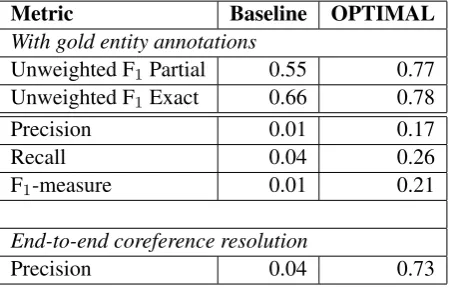
With the drug label dataset, we obtained the best results without relative pronominal anaphora reso-lution and drug ingredient/brand name synonymy strategies (OPTIMAL) and with linear distance as the salience measure. In this setting, using gold entity annotations, we recognized 318 coref-erence chains, 54 of which were annotated in the corpus. The baseline identified 1415 coreference chains, only 10 of which were annotated. The im-provement provided by the system over the base-line is clear; however, the low precision/recall/F1
-measure, given in Table 1, should be taken with caution due to the sparse coreference annotation in the dataset. To get a better sense of how well our system performs, we also performed end-to-end coreference resolution and manually assessed a subset of the system output (22 randomly se-lected drug labels with 249 coreference instances). Of these 249, 181 were deemed correct, yielding a precision of 0.73. The baseline method extracted 1439 instances, 56 of which were deemed cor-rect, yielding a precision of 0.04. The precision of our method is more in line with what has been reported in the literature (Segura-Bedmar et al., 2010; Nguyen et al., 2012). For i2b2-style eval-uation using the unweighted average F1 measure
over B-CUBED, MUC, and CEAF metrics, we considered both exact and partial mention overlap. These results, provided in Table 1, also indicate that the system provides a clear improvement over the baseline.
Metric Baseline OPTIMAL
With gold entity annotations
Unweighted F1Partial 0.55 0.77
Unweighted F1Exact 0.66 0.78
Precision 0.01 0.17
Recall 0.04 0.26
F1-measure 0.01 0.21
End-to-end coreference resolution
[image:6.595.308.533.595.739.2]Precision 0.04 0.73
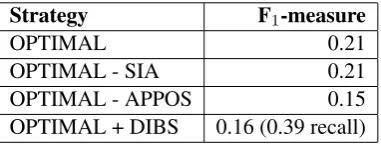
We also assessed the effect of various resolution strategies on results. These results are presented in Table 2.
Strategy F1-measure
OPTIMAL 0.21
OPTIMAL - SIA 0.21
OPTIMAL - APPOS 0.15
OPTIMAL + DIBS 0.16 (0.39 recall)
Table 2: Effect of coreference strategies
Disregarding set/instance anaphora resolution (SIA) does not appear to affect the results by much; however, this is mostly due to the fact that the “instance” mentions are generally exemplifica-tions of a particular drug class which also appear in text. In the absence of set/instance anaphora resolution, the system often defaults to these drug class mentions, which were annotated more often than not, unlike the “instance” mentions. Take the following example:
(9) Use of ZESTRIL with potassium-sparing diuretics (e.g., spironolactone, eplerenone, triamterene or amiloride) . . . may lead to sig-nificant increases . . . if concomitant use of
these agents. . .
Without set-instance anaphora resolution, the sys-tem links these agents to potassium-sparing di-uretics, an annotated relation. With set-instance anaphora resolution, the same expression is linked to individual drug names (spironolactone, etc.) as well as the the drug class, creating a number of false positives, which, in effect, offsets the im-provement provided by this strategy.
On the other hand, recognizing appositive con-structions (APPOS) appears to have a larger im-pact; however, it should be noted that this is mostly because it helps us expand the antecedent mention list in the case of set/instance anaphora. For in-stance, in Example (9), this strategy allows us to establish the link between the anaphora and the drug class (diuretics), since the drug class and in-dividual drug name (spironolactone) are identified earlier as appositive. We can conclude that, in gen-eral, set/instance anaphora benefits from recogni-tion of appositive construcrecogni-tions.
Recognizing drug ingredient/brand name syn-onymy (DIBS) improved the recall and hurt the precision significantly, the overall effect being
negative. Since this non-anaphoric type of coref-erence is strictly semantic in nature and resources from which this type of semantic information can be derived already exist (UMLS, among others), it is perhaps not of utmost importance that a coref-erence resolution system recognizes such corefer-ence.
We additionally processed the DrugNerAR cor-pus with our system. The optimal setting for this corpus was disregarding the drug ingredi-ent/brand name synonymy but using relative pro-noun anaphora resolution, based on the discus-sion in Segura-Bedmar et al. (2010). Somewhat to our surprise, our system did not fare well on this corpus. We extracted 524 chains, 327 of which (out of 669) were annotated in the corpus, yield-ing a precision of 0.71, recall of 0.56, and F1
-measure of 0.63. This is about 20% lower than their reported results. When we used their base-line method (explained earlier), we obtained simi-larly lower scores (precision of 0.18, recall of 0.45, F1-measure of 0.26, about 40% lower than their
reported results). In light of this apparent discrep-ancy, which clearly warrants further investigation, it is perhaps more sensible to focus on “improve-ment over baseline” (reported as 73% in their pa-per and is 140% in our case).
We analyzed some of the annotations more closely to get a better sense of the shortcomings of the system. The majority of errors were due to using linear distance as the salience score. For in-stance, in the following example,theyis linked to
ACE inhibitorsdue to proximity, whereas the true antecedent isthese reactions(itself an anaphor and is presumably linked to another antecedent). It could be possible to recover this link using prin-ciples of Centering Theory (Grosz et al., 1995), which suggests that subjects are more central than objects and adjuncts in an utterance. Following this principle, the subject (these reactions) would be preferred toACE inhibitorsas the antecedent.
(10) In the same patients, these reactions were avoided when ACE inhibitors were temporar-ily withheld, buttheyreappeared upon inad-vertent rechallenge.
anda second diuretic; however, we are unable to identify the link between them and the number dis-agreement between the anaphora and either of the antecedents blocks a potential coreference relation between these items.
(11) If, after five days, an adequate diuretic re-sponse to ALDACTONE has not occurred, a second diuretic that acts more proximally in the renal tubule may be added to the reg-imen. Because of the additive effect of AL-DACTONE when administered concurrently withsuch diuretics. . .
5 Conclusion
We presented a coreference resolution system en-hanced based on insights from a dataset of FDA drug package inserts. Sparse coreference annota-tion in the dataset presented difficulties in evaluat-ing the results; however, based on various eval-uation strategies, the performance improvement due to the enhancements seems evident. Our re-sults show that recognizing coordination and ap-positive constructions are particularly useful and that non-anaphoric cases of coreference can be identified using synonymy in semantic resources, such as UMLS. However, whether this is a task for a coreference resolution system or a concept normalization system is debatable. We exper-imented with using hierarchical domain knowl-edge in UMLS (for example, the knowlknowl-edge that
lisinopril ISA angiotensin converting enzyme in-hibitor) to resolve some cases of sortal anaphora. Even though we did not see an improvement due to using this type of information on our dataset, further work is needed to assess its usefulness. While the enhancements were evaluated on drug labels only, they are not specific to this type of text. Their portability to different text types is limited only by the accuracy of underlying tools, such as parsers, for the text type of interest and the availability of domain knowledge in the form of relevant semantic types, groups, hypernyms for the entity types under consideration. The re-sults also indicate that a more rigorous application of syntactic constraints in the spirit of Centering Theory (Grosz et al., 1995) could be beneficial. Event (or clausal) anaphora and anaphora indicat-ing discourse deixis, while rarely annotated in our dataset, appear to occur fairly often in biomedical text. These types of anaphora are known to be par-ticularly challenging, and we plan to investigate
them in future research, as well.
Acknowledgments
This work was supported by the intramural re-search program at the U.S. National Library of Medicine, National Institutes of Health.
References
Alan R. Aronson and Franc¸ois-Michel Lang. 2010. An overview of MetaMap: historical perspective and re-cent advances.Journal of the American Medical In-formatics Association (JAMIA), 17(3):229–236.
Amit Bagga and Breck Baldwin. 1998. Algorithms for scoring coreference chains. InThe First Interna-tional Conference on Language Resources and Eval-uation Workshop on Linguistics Coreference, pages 563–566.
James J. Cimino, Tiffani J. Bright, and Jianhua Li. 2007. Medication reconciliation using natural lan-guage processing and controlled terminologies. In Klaus A. Kuhn, James R. Warren, and Tze-Yun Leong, editors,MedInfo, volume 129 ofStudies in Health Technology and Informatics, pages 679–683. IOS Press.
Marie-Catherine de Marneffe, Bill MacCartney, and Christopher D. Manning. 2006. Generating typed dependency parses from phrase structure parses. In
Proceedings of the 5th International Conference on Language Resources and Evaluation, pages 449– 454.
Dina Demner-Fushman, Wendy W. Chapman, and Clem J. McDonald. 2009. What can natural lan-guage processing do for clinical decision support?
Journal of Biomedical Informatics, 5(42):760–762.
Jon Duke, Jeff Friedlin, and Patrick Ryan. 2011. A quantitative analysis of adverse events and ”over-warning” in drug labeling. Archives of internal medicine, 10(171):944–946.
Peter L. Elkin, John S. Carter, Manasi Nabar, Mark Tuttle, Michael Lincoln, and Steven H. Brown. 2011. Drug knowledge expressed as computable se-mantic triples. Studies in health technology and in-formatics, (166):38–47.
Kin Wah Fung, Chiang S. Jao, and Dina Demner-Fushman. 2013. Extracting drug indication infor-mation from structured product labels using natural language processing. JAMIA, 20(3):482–488.
Mar´ıa Herrero-Zazo, Isabel Segura-Bedmar, Paloma Mart´ınez, and Thierry Declerck. 2013. The DDI corpus: An annotated corpus with pharmacological substances and drug-drug interactions. Journal of Biomedical Informatics, 46(5):914–920.
Halil Kilicoglu and Sabine Bergler. 2012. Biolog-ical Event Composition. BMC Bioinformatics, 13 (Suppl 11):S7.
Halil Kilicoglu, Marcelo Fiszman, and Dina Demner-Fushman. 2013. Interpreting consumer health ques-tions: The role of anaphora and ellipsis. In Proceed-ings of the 2013 Workshop on Biomedical Natural Language Processing, pages 54–62.
Jin-Dong Kim, Ngan Nguyen, Yue Wang, Jun’ichi Tsu-jii, Toshihisa Takagi, and Akinori Yonezawa. 2012. The Genia Event and Protein Coreference tasks of the BioNLP Shared Task 2011. BMC Bioinformat-ics, 13(Suppl 11):S1.
Qi Li, Louise Deleger, Todd Lingren, Haijun Zhai, Megan Kaiser, Laura Stoutenborough, Anil G. Jegga, Kevin B. Cohen, and Imre Solti. 2013. Min-ing FDA drug labels for medical conditions. BMC medical informatics and decision making, 13(1):53. Donald A. B. Lindberg, Betsy L. Humphreys, and Alexa T. McCray. 1993. The Unified Medical Lan-guage System. Methods of Information in Medicine, 32:281–291.
Xiaoqiang Luo. 2005. On coreference resolution performance metrics. In In Proc. of HLT/EMNLP, pages 25–32.
Alexa T. McCray, Anita Burgun, and Olivier Boden-reider. 2001. Aggregating UMLS semantic types for reducing conceptual complexity. Proceedings of Medinfo, 10(pt 1):216–20.
Makoto Miwa, Paul Thompson, and Sophia Ana-niadou. 2012. Boosting automatic event ex-traction from the literature using domain adapta-tion and coreference resoluadapta-tion. Bioinformatics, 28(13):1759–1765.
Ngan L. T. Nguyen, Jin-Dong Kim, Makoto Miwa, Takuya Matsuzaki, and Junichi Tsujii. 2012. Im-proving protein coreference resolution by simple se-mantic classification. BMC Bioinformatics, 13:304. Philip V. Ogren. 2010. Improving Syntactic Coor-dination Resolution using Language Modeling. In
NAACL (Student Research Workshop), pages 1–6. The Association for Computational Linguistics.
T.I. Oprea, S.K. Nielsen, O. Ursu, J.J. Yang, O. Taboureau, S.L. Mathias, L. Kouskoumvekaki, L.A. Sklar, and C.G. Bologa. 2011. Associat-ing Drugs, Targets and Clinical Outcomes into an Integrated Network Affords a New Platform for Computer-Aided Drug Repurposing. Molecular in-formatics, 2-3(30):100–111.
Thomas C. Rindflesch, Lorrie Tanabe, John N. We-instein, and Lawrence Hunter. 2000. EDGAR: Extraction of drugs, genes, and relations from the biomedical literature. In Proceedings of Pacific Symposium on Biocomputing, pages 514–525. Isabel Segura-Bedmar, Mario Crespo, C´esar de
Pablo-S´anchez, and Paloma Mart´ınez. 2010. Resolving anaphoras for the extraction of drug-drug interac-tions in pharmacological documents. BMC Bioin-formatics, 11 (Suppl 2):S1.
J.C. Smith, J.C. Denny, Q. Chen, H. Nian, A. 3rd Spickard, S.T. Rosenbloom, and R. A. Miller. 2011. Lessons learned from developing a drug evidence base to support pharmacovigilance.Applied clinical informatics, 4(4):596–617.
¨Ozlem Uzuner, Imre Solti, and Eithon Cadag. 2010. Extracting medication information from clinical text. JAMIA, 17(5):514–518.
¨Ozlem Uzuner, Andrea Bodnari, Shuying Shen, Tyler Forbush, John Pestian, and Brett R. South. 2012. Evaluating the state of the art in coreference res-olution for electronic medical records. JAMIA, 19(5):786–791.
Marc B. Vilain, John D. Burger, John S. Aberdeen, Dennis Connolly, and Lynette Hirschman. 1995. A model-theoretic coreference scoring scheme. In
MUC, pages 45–52.
Bonnie L. Webber. 1988. Discourse Deixis: Reference to Discourse Segments. InACL, pages 113–122. Rong Xu and QuanQiu Wang. 2014. Large-scale
com-bining signals from both biomedical literature and the FDA Adverse Event Reporting System (FAERS) to improve post-marketing drug safety signal detec-tion. BMC Bioinformatics, 15:17.
Katsumasa Yoshikawa, Sebastian Riedel, Tsutomu Hi-rao, Masayuki Asahara, and Yuji Matsumoto. 2011. Coreference Based Event-Argument Relation Ex-traction on Biomedical Text. Journal of Biomedical Semantics, 2 (Suppl 5):S6.
Jiaping Zheng, Wendy W. Chapman, Rebecca S. Crow-ley, and Guergana K. Savova. 2011. Corefer-ence resolution: A review of general methodologies and applications in the clinical domain. Journal of Biomedical Informatics, 44(6):1113–1122.