Named Entity Recognition for Dialectal Arabic
Ayah Zirikly
Department of Computer Science The George Washington University
Washington DC, USA
Mona Diab
Department of Computer Science The George Washington University
Washington DC, USA
Abstract
To date, majority of research for Ara-bic Named Entity Recognition (NER) ad-dresses the task for Modern Standard Ara-bic (MSA) and mainly focuses on the newswire genre. Despite some common characteristics between MSA and Dialec-tal Arabic (DA), the significant differences between the two language varieties hinder such MSA specific systems from solving NER for Dialectal Arabic. In this paper, we present an NER system for DA specif-ically focusing on the Egyptian Dialect (EGY). Our system delivers≈ 16% im-provement in F1-score over state-of-the-art features.
1 Introduction
Named Entity Recognition (NER) aims to iden-tify predefined set of named entities types (e.g. Location, Person) in open-domain text (Nadeau and Sekine, 2007). NER has proven to be an es-sential component in many Natural Language Pro-cessing (NLP) and Information Retrieval tasks. In (Thompson and Dozier, 1997), the authors show the significant impact NER imposes on the re-trieval performance, given the fact that names oc-cur with high frequency in text. Moreover, in Question Answering, (Ferrndez et al., 2007) re-port that Questions on average contain ≈ 85%
Named Entities.
Although NER has been well studied in the liter-ature, but the majority of the work primarily fo-cuses on English in the newswire genre, with near-human performance (f-score≈ 93% in MUC-7). Arabic NER has gained significant attention in the NLP community with the increased availability of annotated datasets. However, due to the rich mor-phological and highly inflected nature of Arabic language (Ryding, 2005), Arabic NER faces many
challenges (Abdul-Hamid and Darwish, 2010), that manifest in:
• Lack of capitalization: Unlike English (and other Latin-based languages), proper nouns are not capitalized, which renders the iden-tification of NER more complicated;
• Proper nouns can also represent regular words (e.g. jamilah, gmylp 1” which means ‘beautiful’ and can be a proper noun or an ad-jective;
• Agglutination: Since Arabic exhibits con-catenate morphology, we note the pervasive presence of affixes agglutinating to proper nouns as prefixes and suffixes (Shaalan, 2014). For instance: Determiners appear as prefixes as inAl(AlqAhrp‘Cairo’), likewise with affixival prepositions such aslmeaning ‘for’ (ldm$q -‘to/from Damascus’-), as well as prefixed conjunctions such as wmeaning ‘and’ (wAlqds-‘and Jerusalem’-);
• Absence of Short Vowels (Diacritics): Writ-ten MSA, even in newswire, is undiacritized; resulting in ambiguity that can only be re-solved using contextual information (Bena-jiba et al., 2009). Instances of such phe-nomena: mSr, which is underspecified for short vowels, can refer to miSor ‘Egypt’ or
muSir ‘insistent’; qTr may be ‘Qatar’ if
qaTar, ‘sugar syrup’ if qaTor, ‘diameter’ if
quTor.
Previously proposed Arabic NER systems (Be-najiba et al., 2007) and (Abdallah et al., 2012) were developed exclusively for MSA and primar-ily address the problem in the newswire genre. Nevertheless, with the extensive use of social net-working and web blogs, DA NLP is gaining more
1The second form of the name is written in Buckwalter
encoding http://www.qamus.org/transliteration.htm
attention, yielding a more urgent need for DA NER systems. Furthermore, applying NLP tools, such as NER, that are designed for MSA on DA results in considerably low performance, thus the need to build resources and tools that specifically target DA (Habash et al., 2012).
In addition to the afore mentioned challenges for Arabic NER in general compared to Latin based languages, DA NER faces additional issues:
• Lack of annotated data for supervised NER;
• Lack of standard orthographies or language academics (Habash et al., 2013): Unlike MSA, the same word in DA can be rewritten in so many forms, e.g.mAtEyT$, mtEyt$, mA tEyT$ ‘do not cry’ are all acceptable variants since there is no one standard;
• Lack of comprehensive enough Gazetteers: this is a problem facing all NER systems for all languages addressing NER in social media text, since by definition such media has a ubiquitous presence of highly produc-tive names exemplified by the usage of nick names, hence the PERSON class in social media NER will always have a coverage problem.
In this paper, we propose a DA NER system – using Egyptian Arabic (EGY) as an example di-alect. Our contributions are as follows:
• Provide an annotated dataset for EGY NER;
• To the best of our knowledge, our system is one of the few systems that specifically tar-gets DA.
2 Related Work
Significant amount of work in the area of NER has taken place. In (Nadeau and Sekine, 2007), the authors survey the literature of NER and report on the different set of used features such as contextual and morphological. Although more research has been employed in the area of English NER, Arabic NER has been gaining more attention recently. Similar to other languages, several approaches have been used for Arabic NER: Rule-based methods, Statistical Learning methods, and a hybrid of both.
In (Shaalan and Raza, 2009), the authors present rule-based NER system for MSA that comprises gazetteers, local grammars in the form
system, namely, the head and trailing bigrams (L2), trigrams (L3), and 4-grams (L4) characters. (Shaalan and Oudah, 2014) presents a hybrid approach that targets MSA and produces state-of-the-art results. However, due to the lack of availability of the used rules, it is hard to replicate their results. The rule-based component is identical to their previous proposed rule-based system in (Shaalan and Raza, 2009). The features used are a combination of the rule-based features in addition to morphological, capitalization, POS tag, word length, and dot (has an adjacent dot) features. We reimplement their Machine Learning component and present it as one of our baselines (BAS2). (Abdul-Hamid and Darwish, 2010) produce near state-of-the-art results with the use of generic and language independent features that we use to generate baseline results (BAS1). The proposed system does not rely on any external resources and the system outperforms (Benajiba and Rosso, 2008) performance with an F-score of 81% on ANERCorp vs. the latter’s performance of 72.68% F-score. All the work mentioned has focused on MSA, albeit with variations in genres to the extent exemplified by the ACE data and author generated data. However unlike the work mentioned above, (Darwish and Gao, 2014) proposed an NER system that specifically targets microblogs as a genre, as opposed to newswire data. Their proposed language-independent system relies on set of features that are similar to (Abdul-Hamid and Darwish, 2010). Their dataset contains dialectal data, since it is collected from Twitter. However, the dataset contains English and Arabic; in this work we only target Dialectal Arabic. Their overall performance, on their proposed data, is 65.2% (LOC 76.7%, 55.6% ORG, 55.8% PER).
3 Approach
In this paper, we use a supervised machine learn-ing approach since it has been shown in the litera-ture that supervised typically outperform unsuper-vised approaches for the NER task (Nadeau et al., 2006). We use Conditional Random Field (CRF) sequence labeling as described in (Lafferty et al., 2001). Moreover, (Benajiba and Rosso, 2008) demonstrates that CRF yields better results over other supervised machine learning techniques.
3.1 Baseline
In this paper, we introduce two baselines to com-pare our work against. The first baseline (BAS1) is based on work reported in (Abdul-Hamid and Darwish, 2010). We adopt their approach since it produces near state-of-the-art results. Addition-ally, the features proposed are applicable to DA as they do not rely on the availability of morphologi-cal or syntactimorphologi-cal analyzers. We reimplement their listed features that yield the highest performance and report those results as our BAS1 system. The list of features used are: previous and next word, in addition to the leading and trailing character bi-grams, tribi-grams, and 4-grams.
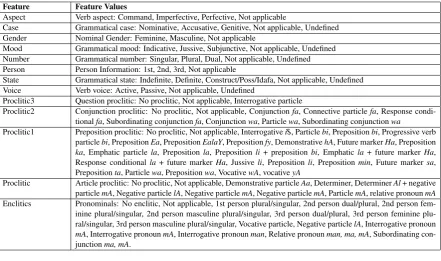
The second baseline (BAS2) adopted is the work proposed in (Shaalan and Oudah, 2014). The authors present state-of-the-art results when evaluated on ANERcorp (Benajiba and Rosso, 2008) using the following features: Rule-based features, Morphological features generated by MADAMIRA (Pasha et al., 2014) presented in Table 1, targeted word POS tag, word length flag which is a binary feature that is true if the word length is≥3, a binary feature to represent whether the word has an adjacent dot, capitalization bi-nary feature which is dependent on the English gloss generated by MADAMIRA, nominal binary feature that is set to true if the POS tag is noun or proper noun, and binary features to represent whether the current, previous, or next word belong to the gazetteers. We omit Rule-based features in our baseline since we do not have access to the ex-act rules used and their rules specifically targeted MSA, hence would not be directly applicable to DA.
3.2 NER Features
In our approach, we propose the following NER features:
• Lexical Features: Similar to BAS1 (Darwish and Gao, 2014) character n-gram features, the head and trailing bigrams (L2), trigrams (L3), and 4-grams (L4) characters;
• Contextual Features(CTX): The surround-ing undiacritized lemmas and words of a con-text window=±1; (LEM-1, LEM0, LEM1) and (W-1,W0,W1)
Feature Feature Values
Aspect Verb aspect: Command, Imperfective, Perfective, Not applicable
Case Grammatical case: Nominative, Accusative, Genitive, Not applicable, Undefined Gender Nominal Gender: Feminine, Masculine, Not applicable
Mood Grammatical mood: Indicative, Jussive, Subjunctive, Not applicable, Undefined Number Grammatical number: Singular, Plural, Dual, Not applicable, Undefined Person Person Information: 1st, 2nd, 3rd, Not applicable
State Grammatical state: Indefinite, Definite, Construct/Poss/Idafa, Not applicable, Undefined Voice Verb voice: Active, Passive, Not applicable, Undefined
Proclitic3 Question proclitic: No proclitic, Not applicable, Interrogative particle
Proclitic2 Conjunction proclitic: No proclitic, Not applicable, Conjunctionfa, Connective particlefa, Response condi-tionalfa, Subordinating conjunctionfa, Conjunctionwa, Particlewa, Subordinating conjunctionwa
Proclitic1 Preposition proclitic: No proclitic, Not applicable, Interrogativei$, Particlebi, Prepositionbi, Progressive verb particlebi, PrepositionEa, PrepositionEalaY, Prepositionfy, DemonstrativehA, Future markerHa, Preposition ka, Emphatic particlela, Prepositionla, Prepositionli+ prepositionbi, Emphaticla+ future markerHa, Response conditionalla+ future markerHa, Jussiveli, Prepositionli, Prepositionmin, Future markersa, Prepositionta, Particlewa, Prepositionwa, VocativewA, vocativeyA
[image:4.595.80.522.61.322.2]Proclitic Article proclitic: No proclitic, Not applicable, Demonstrative particleAa, Determiner, DeterminerAl+ negative particlemA, Negative particlelA, Negative particlemA, Negative particlemA, ParticlemA, relative pronounmA Enclitics Pronominals: No enclitic, Not applicable, 1st person plural/singular, 2nd person dual/plural, 2nd person fem-inine plural/singular, 2nd person masculine plural/singular, 3rd person dual/plural, 3rd person femfem-inine plu-ral/singular, 3rd person masculine pluplu-ral/singular, Vocative particle, Negative particlelA, Interrogative pronoun mA, Interrogative pronounmA, Interrogative pronounman, Relative pronounman, ma, mA, Subordinating con-junctionma, mA.
Table 1: Morphological Features
contains a total of 4893 names between Per-son (PER), Location (LOC), and Organiza-tion (ORG). The second gazetteer is a large Wikipedia gazetteer (WikiGaz) from (Dar-wish and Gao, 2014); 50141 locations, 17092 organizations, 65557 persons. which repre-sents a significantly more extensive and com-prehensive list. We introduce three methods for exploiting GAZ:
– Exact match (EM-GAZ): For more efficient search, we use Aho-Corasick Algorithm that has linear running time in terms of the input length plus the number of matching entries in a gazetteer. When a word sequence matches an entry in the gazetteer, EM-GAZ for the first word will take the value ”B-<NE class>” where <NE class>is one of the previously discussed classes (PER, LOC, ORG), whereas the following words will be assigned I-<NE class>, where <NE class>will be assigned the same value of the matched sequence’s head;
– Partial match(PM-GAZ): This feature is created to handle the case of compound gazetteer entries. If the token is part of the compound name then this feature is set to true. For example, if we have in
the gazetteer the compound name yAsr ErfAt ‘Yasser Arafat’ and the input text is yAsr BarakAt then PM-GAZ for the token yAsr will be set to true. This is particularly useful in the case of PER as it recovers a large list of first names in compounds;
– Levenshtein match (LVM-GAZ): Due to the non-standard spelling of words in dialectal Arabic, we use Levenshtein distance (Levenshtein, 1966) to com-pare the similarity between the input and a gazetteer entry;
• Morphological Features: The morphologi-cal features that we employ in our feature set are generated by MADAMIRA (Pasha et al., 2014):
– Capitalization (CAPS): In order to circumvent the lack of capitalization in Arabic, we check the capitalization of the translated NE which could indicate that a word is an NE (Benajiba et al., 2008). This feature is dependent on the English gloss that is generated by MADAMIRA;
– Part of Speech (POS) tags: We use POS tags generated from MADAMIRA, where the POS tagger has a reported accuracy of 92.4% for DA;
• Distance from specific keywords within a window (KEY): This feature captures certain patterns in person names that are more com-monly used in DA (e.g. using the nickname pattern ofAbw + proper noun instead of an actual name). In this feature, if the distance is set to one, the feature will be true if the previous token equals an entry in a keywords list, otherwise false. Examples of keywords:
Abw‘father of’, yA invocation particle, typ-ically used before names to call a person, terms of address, or honorifics, such as dk-twr/dktwrp‘doctor -masculine and feminine-’, and AstA*/AstA*p ‘Mr/Mrs/Ms/teacher -masculine and feminine-’;
• Brown Clustering (BC): Brown clustering as introduced in (Brown et al., 1992) is a hierarchical clustering approach that maxi-mizes the mutual information of word bi-grams. Word representations, especially Brown Clustering, have been demonstrated to improve the performance of NER system when added as a feature (Turian et al., 2010). In this work, we use Brown Clustering IDs of variable prefixes length (4,7,10,13) as fea-tures resulting in the following set of feafea-tures BC4, BC7, BC10, BC13. For example if
AmrykA‘America’ has the brown cluster ID 11110010 then BC4 = 1111, BC7=1111001, whereas BC10 and BC13 are empty strings. This feature is based on the observation that semantically similar words will be grouped together in the same cluster and will have a common prefix.
4 Experiments & Discussion
4.1 Datasets and Tools
Evaluation Data Due to the very limited re-sources in DA for NER, we manually annotate a portion of the DA data collected and provided by the LDC from web blogs.2 The annotated data was chosen from a set of web blogs that are man-ually identified by LDC as Egyptian dialect and contains nearly 40k tokens. The data was anno-tated by one native Arabic speaker annotator who followed the Linguistics Data Consortium (LDC) guidelines for NE tagging. Our dataset is rela-tively small and contains 285 PER, 153 LOC, and 10 ORG instances.
Brown Clustering Data In our work, we run Brown Clustering on BOLT Phase1 Egyptian Ara-bic Treebank (ARZ)3, where the chosen number of clusters is 500.
Parametric features values We use the follow-ing values for the parametric features:
• CTX features: we set context window =±1
for lemmas and tokens;
• Keyword distance: we set the distance from the token to a keyword to 1 and2, namely, KEY1 and KEY2, respectively;
• LM-GAZ: The threshold of the number of deletion, insertion, or modification≤2;
• BC: the length of the prefixes of the Brown Clusters ID is set to 4,7,10,13;
Tools In this work, we used the following tools: 1. MADAMIRA (Pasha et al., 2014): For tok-enization and other features such as lemmas, gender and Part of Speech (POS) tags, and other morphological features;
2. CRFSuite implementation (Okazaki, 2007).
4.2 Evaluation Metrics
We choose precision (PREC), recall (REC), and harmonic F-measure (F1) metrics to evaluate the performance of our NER system over accuracy. This decision is based on the observation that the baseline accuracy on the token level in NER is not
2GALE Arabic-Dialect/English Parallel Text
LDC2012T09
a fair assessment, since NER accuracy is always high as the majority of the tokens in free text are not named entities.
4.3 Results & Discussion
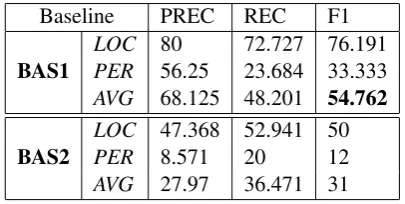
In our NER system, we solely identify PER and LOC NE classes and omit the ORG class. This is due to the small frequency (≤0.05%) of ORG instances in our annotated data, which does not represent a fair training data to the system. The reported results are the average of 5-fold cross validation on the blog post level. Also, it is worth mentioning that we use IOB tagging scheme; Inside I NE, Outside O, and Beginning B of NE. Table 2 depicts the two baselines discussed in 3.1. BAS1 yields a weighted macro-average F-score=54.762% using near state-of-the-art features on our annotated data. On the other hand, BAS2 F-score is 31%. Although BAS2 presents state-of-the-art results, it actually produces lower performance than BAS1. It should be noted that our implementation of BAS2 does not incorpo-rate rule-based features (Shaalan and Oudah, 2014). However, by extrapolation using their performance improvement of ≈ 6% attributed to rule-based features alone, such a relative gain in performance for BAS2 in our setting would still be outperformed by both BAS1 and our current system.
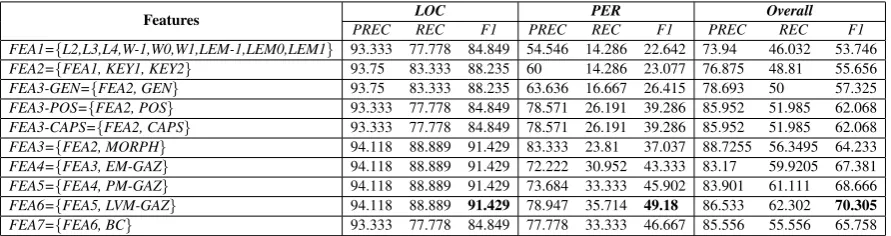
In Table 3, we show our NER system perfor-mance using different permutations of features proposed in Section 3.2. Additionally, in Table 3, we use the weighted macro-average (Overall) in order to assess the system’s overall performance. We use the following abbreviation annotation:
• FEA1: includes n-gram characters and CTX on the word and lemma level features;
• FEA2: includes FEA1 in addition to KEY features with distance 1&2;
• FEA3: includes FEA2 in addition to the mor-phological features (MORPH) and it is sub-categorized as follow: FEA3-GEN takes into account the gender feature only, FEA3-POS takes into account POS tag (FEA2+POS), whereas FEA3-CAPS takes into account the use of CAPS with FEA2;
• FEA4: shows the impact of adding EM-GAZ features (FEA3+EM-GAZ);
• FEA5: shows the impact of adding PM-GAZ features (FEA4+PM-GAZ);
• FEA6: shows the impact of adding LVM-GAZ features (FEA5+LM-LVM-GAZ);
• FEA7: shows the impact of adding Brown Clustering (BC) features on the performance; The best results for precision, recall and F1-score are bolded in Table 3. FEA6 delivers the best NER performance of F1-score=70.305%
Baseline PREC REC F1
BAS1 LOCPER 8056.25 72.727 76.19123.684 33.333
AVG 68.125 48.201 54.762
BAS2 LOCPER 47.368 52.941 508.571 20 12
[image:6.595.315.518.214.316.2]AVG 27.97 36.471 31
Table 2: Baseline NER performance
In comparing FEA1, FEA2 results, we note that KEY features increase the F1-score by 2% ab-solute. This improvement mirrors the fact that
Abw+name, for example, is very commonly used in dialects, where it represents ≈ 46% of PER names. The morphological features (GEN, POS, CAPS), produce the most significant improvement
Features PREC LOCREC F1 PREC PERREC F1 PREC OverallREC F1
FEA1={L2,L3,L4,W-1,W0,W1,LEM-1,LEM0,LEM1} 93.333 77.778 84.849 54.546 14.286 22.642 73.94 46.032 53.746
FEA2={FEA1, KEY1, KEY2} 93.75 83.333 88.235 60 14.286 23.077 76.875 48.81 55.656
FEA3-GEN={FEA2, GEN} 93.75 83.333 88.235 63.636 16.667 26.415 78.693 50 57.325
FEA3-POS={FEA2, POS} 93.333 77.778 84.849 78.571 26.191 39.286 85.952 51.985 62.068
FEA3-CAPS={FEA2, CAPS} 93.333 77.778 84.849 78.571 26.191 39.286 85.952 51.985 62.068
FEA3={FEA2, MORPH} 94.118 88.889 91.429 83.333 23.81 37.037 88.7255 56.3495 64.233
FEA4={FEA3, EM-GAZ} 94.118 88.889 91.429 72.222 30.952 43.333 83.17 59.9205 67.381
FEA5={FEA4, PM-GAZ} 94.118 88.889 91.429 73.684 33.333 45.902 83.901 61.111 68.666
FEA6={FEA5, LVM-GAZ} 94.118 88.889 91.429 78.947 35.714 49.18 86.533 62.302 70.305
[image:7.595.78.524.62.180.2]FEA7={FEA6, BC} 93.333 77.778 84.849 77.778 33.333 46.667 85.556 55.556 65.758
Table 3: Dialectal Arabic NER
the test data. In addition, LOC members, unlike PER, convey tag consistency, where most of the time it will be tagged as NE. For instance, mSr
‘Egypt’ occurred in the data 35 times and in all of which it was assigned a LOC tag, unlikeEAdlthat appears as an adjective ’fair/rightful’ and proper name ’Adel’ in the same dataset. The former rea-son explains why the GAZ helps PER class per-formance but does not affect LOC perper-formance. If we discuss in more detail the MORPH feature set, we notice that CAPS and POS produce identi-cal results in terms of PREC, REC, and F-1 score on each of the NE classes. However, CAPS and POS help in PER class, whereas GEN helps in the LOC class. For example in LOC class, the num-ber of false negatives, when POS is employed, is higher as opposed to GEN.
As mentioned earlier, LVM-GAZ produces the best F-score. However, LVM main contribution is on the PER class which is caused by the nature of Arabic names’ different spelling variations, es-pecially the last name (e.g. with or without Al).
5 Conclusion & Future Work
In this paper we present Dialectal Arabic NER system using state-of-the-art features in addi-tion to proposing new features that improve the performance. We show that our proposed system improves over state-of-the-art features performance. Our contribution is not solely limited to the NER system, but further includes, our manually annotated data.4 In future work, we would like to annotate more data in more variable genre and with more dialects including code switched data.
4Please contact the authors for access to the annotated
data.
6 Acknowledgment
References
Sherief Abdallah, Khaled Shaalan, and Muhammad Shoaib. 2012. Integrating rule-based system with classification for arabic named entity recognition. In Computational Linguistics and Intelligent Text Pro-cessing, pages 311–322. Springer.
Ahmed Abdul-Hamid and Kareem Darwish. 2010. Simplified feature set for arabic named entity recog-nition. InProceedings of the 2010 Named Entities Workshop, NEWS ’10, pages 110–115, Stroudsburg, PA, USA. Association for Computational Linguis-tics.
Yassine Benajiba and Paolo Rosso. 2008. Arabic named entity recognition using conditional random fields. InProc. of Workshop on HLT & NLP within the Arabic World, LREC, volume 8, pages 143–153. Citeseer.
Yassine Benajiba, Paolo Rosso, and Jos´e-Miguel Bened´ı. 2007. Anersys: An arabic named entity recognition system based on maximum entropy. In CICLing, pages 143–153.
Yassine Benajiba, Mona Diab, and Paolo Rosso. 2008. Arabic named entity recognition using optimized feature sets. In Proceedings of the Conference on Empirical Methods in Natural Language Process-ing, pages 284–293. Association for Computational Linguistics.
Yassine Benajiba, Mona Diab, and Paolo Rosso. 2009. Arabic named entity recognition: A feature-driven study. Audio, Speech, and Language Processing, IEEE Transactions on, 17(5):926–934.
Yassine Benajiba, Imed Zitouni, Mona Diab, and Paolo Rosso. 2010. Arabic named entity recognition: Using features extracted from noisy data. In Pro-ceedings of the ACL 2010 Conference Short Papers, ACLShort ’10, pages 281–285, Stroudsburg, PA, USA. Association for Computational Linguistics. Peter F Brown, Peter V Desouza, Robert L Mercer,
Vincent J Della Pietra, and Jenifer C Lai. 1992. Class-based n-gram models of natural language. Computational linguistics, 18(4):467–479.
Kareem Darwish and Wei Gao. 2014. Simple effec-tive microblog named entity recognition: Arabic as an example. In Proceedings of the Ninth Interna-tional Conference on Language Resources and Eval-uation (LREC-2014), Reykjavik, Iceland, May 26-31, 2014., pages 2513–2517.
Ali Elsebai, Farid Meziane, and Fatma Zohra Belkredim. 2009. A rule based persons names arabic extraction system. Communications of the IBIMA, 11(6):53–59.
Sergio Ferrndez, Antonio Toral, scar Ferrndez, An-tonio Ferrndez, and Rafael Muoz. 2007. Ap-plying wikipedias multilingual knowledge to cross-lingual question answering. InIn Zoubida Kedad,
Nadira Lammari, Elisabeth Mtais, Farid Meziane, and Yacine Rezgui, editors, NLDB, volume 4592 of Lecture Notes in Computer Science. Springer. Nizar Habash, Mona T Diab, and Owen Rambow.
2012. Conventional orthography for dialectal ara-bic. InLREC, pages 711–718.
Nizar Habash, Ryan Roth, Owen Rambow, Ramy Es-kander, and Nadi Tomeh. 2013. Morphologi-cal analysis and disambiguation for dialectal arabic. In Human Language Technologies: Conference of the North American Chapter of the Association of Computational Linguistics, Proceedings, June 9-14, 2013, Westin Peachtree Plaza Hotel, Atlanta, Geor-gia, USA, pages 426–432.
John Lafferty, Andrew McCallum, and Fernando CN Pereira. 2001. Conditional random fields: Prob-abilistic models for segmenting and labeling se-quence data.
Vladimir I Levenshtein. 1966. Binary codes capable of correcting deletions, insertions and reversals. In Soviet physics doklady, volume 10, page 707. David Nadeau and Satoshi Sekine. 2007. A
sur-vey of named entity recognition and classification. Lingvisticae Investigationes, 30(1):3–26.
David Nadeau, Peter Turney, and Stan Matwin. 2006. Unsupervised named-entity recognition: Generating gazetteers and resolving ambiguity.
Naoaki Okazaki. 2007. Crfsuite: A fast implementa-tion of condiimplementa-tional random fields (crfs).
Arfath Pasha, Mohamed Al-Badrashiny, Ahmed El Kholy, Ramy Eskander, Mona Diab, Nizar Habash, Manoj Pooleery, Owen Rambow, and Ryan Roth. 2014. Madamira: A fast, comprehensive tool for morphological analysis and disambiguation of ara-bic. In In Proceedings of the 9th International Conference on Language Resources and Evaluation, Reykjavik, Iceland.
Karin C Ryding. 2005.A Reference Grammar of Mod-ern Standard Arabic. Cambridge University Press. Khaled Shaalan and Mai Oudah. 2014. A hybrid
ap-proach to arabic named entity recognition. Journal of Information Science, 40(1):67–87.
Khaled Shaalan and Hafsa Raza. 2009. Nera: Named entity recognition for arabic. Journal of the Ameri-can Society for Information Science and Technology, 60(8):1652–1663.
Khaled Shaalan. 2014. A survey of arabic named entity recognition and classification. Comput. Lin-guist., 40(2):469–510, June.