Domain Adaptation with Active Learning for Coreference Resolution
Shanheng Zhao
Elance 441 Logue Ave
Mountain View, CA 94043, USA
Hwee Tou Ng
Department of Computer Science National University of Singapore 13 Computing Drive, Singapore 117417
Abstract
In the literature, most prior work on coreference resolution centered on the newswire domain. Although a coreference resolution system trained on the newswire domain performs well on newswire texts, there is a huge performance drop when it is applied to the biomedical domain. In this paper, we present an approach integrat-ing domain adaptation with active learnintegrat-ing to adapt coreference resolution from the newswire domain to the biomedical do-main. We explore the effect of domain adaptation, active learning, and target do-main instance weighting for coreference resolution. Experimental results show that domain adaptation with active learn-ing and target domain instance weightlearn-ing achieves performance on MEDLINE ab-stracts similar to a system trained on coref-erence annotation of only target domain training instances, but with a greatly re-duced number of target domain training instances that we need to annotate.
1 Introduction
Coreference resolution is the task of determin-ing whether two or more noun phrases (NPs) in a text refer to the same entity. Successful coref-erence resolution benefits many natural language processing (NLP) tasks, such as information ex-traction and question answering. In the literature, most prior work on coreference resolution recasts the problem as a two-class classification problem. Machine learning-based classifiers are applied to determine whether a candidate anaphor and a po-tential antecedent are coreferential (Soon et al., 2001; Ng and Cardie, 2002; Stoyanov et al., 2009; Zhao and Ng, 2010).
In recent years, with the advances in biologi-cal and life science research, there is a rapidly
in-creasing number of biomedical texts, including re-search papers, patent documents, etc. This results in an increasing demand for applying natural lan-guage processing and information retrieval tech-niques to efficiently exploit information contained in these large amounts of texts. However, corefer-ence resolution, one of the core tasks in NLP, has only a relatively small body of prior research in the biomedical domain (Kim et al., 2011a; Kim et al., 2011b).
A large body of prior research on coreference resolution focuses on texts in the newswire do-main. Standardized data sets, such as MUC (DARPA Message Understanding Conference, (MUC-6, 1995; MUC-7, 1998)) and ACE (NIST Automatic Content Extraction Entity Detection and Tracking task, (NIST, 2002)) data sets are widely used in the study of coreference resolution. Traditionally, in order to apply supervised ma-chine learning approaches to an NLP task in a spe-cific domain, one needs to collect a text corpus in the domain and annotate it to serve as training data. Compared to other NLP tasks, e.g., part-of-speech (POS) tagging or named entity (NE) tag-ging, the annotation for coreference resolution is much more challenging and time-consuming. The reason is that in tasks like POS tagging, an annota-tor only needs to focus on each markable (a word, in the case of POS tagging) and a small window of its neighboring words. In contrast, to annotate a coreferential relation, an annotator needs to first recognize whether a certain text span is a mark-able, and then scan through the text preceding the markable (a potential anaphor) to look for the an-tecedent. It also requires the annotator to under-stand the text in order to annotate coreferential re-lations, which are semantic in nature. If a mark-able is non-anaphoric, the annotator has to scan to the beginning of the text to realize that. Cohen et al. (2010) reported that it took an average of 20 hours to annotate coreferential relations in a single
document with an average length of 6,155 words, while an annotator could annotate 3,000 words per hour in POS tag annotation (Marcus et al., 1993).
The simplest approach to avoid the time-consuming data annotation in a new domain is to train a coreference resolution system on a resource-rich domain and apply it to a different target domain without any additional data anno-tation. Although coreference resolution systems work well on test texts in the same domain as the training texts, there is a huge performance drop when they are tested on a different domain. This motivates the usage of domain adaptation techniques for coreference resolution: adapting a coreference resolution system from one source do-main in which we have a large collection of an-notated data, to a second target domain in which we need good performance. It is almost inevitable that we annotate some data in the target domain to achieve good coreference resolution performance. The question is how to minimize the amount of an-notation needed. In the literature, active learning has been exploited to reduce the amount of anno-tation needed (Lewis and Gale, 1994). In contrast to annotating the entire data set, active learning se-lects only a subset of the data to annotate in an iter-ative process. How to apply active learning and in-tegrate it with domain adaptation remains an open problem for coreference resolution.
In this paper, we explore domain adaptation for coreference resolution from the resource-rich newswire domain to the biomedical domain. Our approach comprises domain adaptation, active learning, and target domain instance weighting to leverage the existing annotated corpora from the newswire domain, so as to reduce the cost of developing a coreference resolution system in the biomedical domain. Our approach achieves comparable coreference resolution performance on MEDLINE abstracts, but with a large reduction in the number of training instances that we need to annotate. To the best of our knowledge, our work is the first to combine domain adaptation and ac-tive learning for coreference resolution.
The rest of this paper is organized as follows. We first review the related work in Section 2. Then we describe the coreference resolution system in Section 3, and the domain adaptation and active learning techniques in Section 4. Experimental re-sults are presented in Section 5. Finally, we ana-lyze the results in Section 6 and conclude in
Sec-tion 7.
2 Related Work
Not only is there a relatively small body of prior research on coreference resolution in the biomed-ical domain, there are also fewer annotated cor-pora in this domain. Casta˜no et al. (2002) were among the first to annotate coreferential relations in the biomedical domain. Their annotation only concerned the pronominal and nominal anaphoric expressions in 46 biomedical abstracts. Gasperin and Briscoe (2007) annotated coreferential rela-tions on 5 full articles in the biomedical domain, but only on noun phrases referring to bio-entities. Yang et al. (2004) annotated full NP coreferential relations on biomedical abstracts of the GENIA corpus. The ongoing project of the CRAFT cor-pus is expected to annotate all coreferential rela-tions on full text of biomedical articles (Cohen et al., 2010).
Unlike the work of (Casta˜no et al., 2002), (Gasperin and Briscoe, 2008), and (Gasperin, 2009) that resolved coreferential relations on cer-tain restricted entities in the biomedical domain, we resolve all NP coreferential relations. Al-though the GENIA corpus contains 1,999 biomed-ical abstracts, Yang et al. (2004) tested only on 200 abstracts under 5-fold cross validation. In contrast, we randomly selected 399 abstracts in the 1,999 MEDLINE abstracts of the GENIA-MEDCo cor-pus as the test set, and as such our evaluation was carried out on a larger scale.
streaming active learning setting whereas ours is pool-based.
Dahlmeier and Ng (2010) evaluated the perfor-mance of three previously proposed domain adap-tation algorithms for semantic role labeling. They evaluated the performance of domain adaptation with different sizes of target domain training data. In each of their experiments with a certain target domain training data size, the target domain train-ing data were added all at once. In contrast, we add the target domain training instances selectively in an iterative process. Different from (Dahlmeier and Ng, 2010), we weight the target domain in-stances to further boost the performance of do-main adaptation. Our work is the first system-atic study of domain adaptation with active learn-ing for coreference resolution. Although Gasperin (2009) tried to apply active learning for anaphora resolution, her results were negative: using ac-tive learning was not better than randomly select-ing instances in her work. Miwa et al. (2012) incorporated a rule-based coreference resolution system for automatic biomedical event extraction, and showed that by adding training data from other domains as supplementary training data and us-ing domain adaptation, one can achieve a higher F-measure in event extraction.
3 Coreference Resolution
The gold standard annotation and the output by a coreference resolution system are called the key and the response, respectively. In both the key and the response, a coreference chain is formed by a set of coreferential markables. A markable is a noun phrase which satisfies the markable defini-tion in an individual corpus. Here is an example:
When the same MTHC lines are ex-posed to TNF-alpha in combination with IFN-gamma, the cells instead become DC.
In the above sentence, the same MTHC lines and the cells are referring to the same entity and hence are coreferential. It is possible that more than two markables are coreferential in a text. The task of coreference resolution is to determine these relations in a given text.
To evaluate the performance of coreference res-olution, we follow the MUC evaluation metric in-troduced by (Vilain et al., 1995). Let Si be an equivalence class generated by the key (i.e., Si
is a coreference chain), and p(Si) be a partition ofSi relative to the response. Recall is the num-ber of correctly identified links over the numnum-ber of
links in the key: Recall =
P
(|Si|−|p(Si)|)
P
(|Si|−1) . Pre-cision, on the other hand, is defined in the oppo-site way by switching the role of key and response. F-measure is a trade-off between recall and preci-sion:F = 2Recall·Recall+·P recisionP recision.
4 Domain Adaptation with Active Learning
4.1 Domain Adaptation
Domain adaptation is applicable when one has a large amount of annotated training data in the source domain and a small amount or none of the annotated training data in the target domain. We evaluate the AUGMENT technique introduced by (Daume III, 2007), as well as the INSTANCE
WEIGHTING(IW) and the INSTANCEPRUNING
(IP) techniques introduced by (Jiang and Zhai, 2007).
4.1.1 AUGMENT
Daume III (2007) introduced a simple domain adaptation technique by feature space augmenta-tion. It maps the feature space of each instance into a feature space of higher dimension. Suppose
x is the feature vector of an instance. DefineΦs and Φt to be the mappings of an instance from the original feature space to an augmented feature space in the source and the target domain, respec-tively:
Φs(x) =hx, x,0i (1)
Φt(x) =hx,0, xi (2)
where0= h0,0, . . . ,0iis a zero vector of length |x|. The mapping can be treated as taking each feature in the original feature space and making three versions of it: a general version, a source-specific version, and a target-source-specific version. The augmented source domain data will contain only the general and the source-specific versions, while the augmented target domain data will contain only the general and the target-specific versions.
4.1.2 INSTANCEWEIGHTINGand INSTANCE
PRUNING
Jiang and Zhai (2007) pointed out that when ap-plying a classifier trained on a source domain to a target domain, the joint probability Pt(x, y) in the target domain may be different from the joint probability Ps(x, y) in the source domain. They proposed a general framework to usePs(x, y) to estimate Pt(x, y). The joint probability P(x, y) can be factored intoP(x, y) =P(y|x)P(x). The adaptation of the first component is labeling adap-tation, while the adaptation of the second compo-nent is instance adaptation. We explore only label-ing adaptation.
To calibrate the conditional probabilityP(y|x) from the source domain to the target domain, ide-ally each source domain training instance(xi, yi) should be given a weight PsPt((yyiss|xsi)
i|xsi). Although Ps(ysi|xsi) can be estimated from the source
do-main training data, the estimation of Pt(ysi|xsi) is much harder. Jiang and Zhai(2007) proposed two methods to estimate Pt(ysi|xsi): INSTANCE
WEIGHTING and INSTANCE PRUNING. Both
methods first train a classifier with a small amount of target domain training data. Then, INSTANCE
WEIGHTING directly estimates Pt(yis|xsi) using the trained classifier. INSTANCEPRUNING, on the other hand, removes the topN source domain in-stances that are predicted wrongly, ranked by the prediction confidence.
4.1.3 Target Domain Instance Weighting Both INSTANCE WEIGHTING and INSTANCE
PRUNING set the weights of the source domain instances. In domain adaptation, there are typi-cally many more source domain training instances than target domain training instances. Target do-main instance weighting can effectively reduce the imbalance. Unlike INSTANCE WEIGHTING and
INSTANCE PRUNING in which each source
do-main instance is weighted individually, we give all target domain instances the same weight. This target domain instance weighting scheme is not only complementary to INSTANCE WEIGHTING
and INSTANCE PRUNING, but is also applicable to AUGMENT.
4.2 Active Learning
Active learning iteratively selects the most infor-mative instances to label, adds them to the train-ing data pool, and trains a new classifier with the enlarged data pool. We follow (Lewis and Gale, 1994) and use the uncertainty sampling strategy in our active learning setting.
Ds←the set of source domain training instances
Dt←the set of target domain training instances
Da← ∅
Γ←coreference resolution system trained onDs T ←number of iterations
for i from 1 to T do for eachdi∈Dtdo
b
di←prediction ofdiusingΓ
pi←prediction confidence ofdbi end for
D′
a←topNinstances with the lowestpi Da←Da+D′a
Dt←Dt−Da′
provide correct labels to the unlabeled instances inD′a
Γ←coreference resolution system trained onDsand
Dausing the chosen domain adaptation technique
[image:4.595.306.533.61.244.2]end for
Figure 1: An algorithm for domain adaptation with active learning
4.3 Domain Adaptation with Active Learning
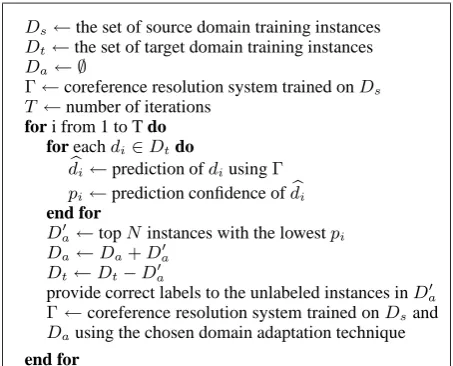
Combining domain adaptation and active learning together, the algorithm we use is shown in Figure 1.
In our domain adaptation setting, there is a pa-rameter λt for target domain instance weighting. Because the number of target domain instances is different in each iteration, the weight should be ad-justed in each iteration. We give all target domain training instances an equal weight ofλt=Ns/Nt, whereNsandNtare the numbers of instances in the source domain and the target domain in the current iteration, respectively. We setN = 10to add 10 instances in each iteration to speed up the active learning process.
To provide the correct labels, the labeling pro-cess shows the text on the screen, highlights the two NPs, and asks the annotator to decide if they are coreferential. In our experiments, this is simu-lated by providing the gold standard coreferential information on this NP pair to the active learning process.
5 Experiments
5.1 The Corpora
three newswire sources: BNEWS, NPAPER, and NWIRE. The GENIA-MEDCo corpus contains 1,999 MEDLINE abstracts1. We randomly split the GENIA corpus into a training set and a test set, containing 1,600 and 399 texts, respectively.
5.2 The Coreference Resolution System
In this study, we use Reconcile, a state-of-the-art coreference resolution system implemented by (Stoyanov et al., 2009). The input to the corefer-ence resolution system is raw text, and we apply a sequence of preprocessing components to process it. Following Reconcile, the individual prepro-cessing steps include: 1) sentence segmentation (using the OpenNLP toolkit2); 2) tokenization (us-ing the OpenNLP toolkit); 3) POS tagg(us-ing (us(us-ing the OpenNLP toolkit); 4) syntactic parsing (using the Berkeley Parser3); and 5) named entity recog-nition (using the Stanford NER4). Markables are extracted as defined in each individual corpus. All possible markable pairs in the training and test set are extracted to form training and test instances, respectively. The learning algorithm we use is maximum entropy modeling, implemented in the DALR package5 (Jiang and Zhai, 2007). The coreference resolution system employs a compre-hensive set of 62 features to represent each train-ing and test instance, includtrain-ing lexical, proximity, grammatical, and semantic features (Stoyanov et al., 2009). We do not introduce additional features motivated from the biomedical domain, but use the same feature set for both the source and target do-mains.
5.3 Preprocessing
For the ACE corpora, all preprocessing compo-nents use the original models (provided by the OpenNLP toolkit, the Berkeley Parser, and the Stanford NER). For the GENIA corpus, since it is from a very different domain, the original models do not perform well. However, the GENIA cor-pus contains multiple layers of annotations. We use these annotations to re-train each of the pre-processing components (except tokenization) us-ing the 1,600 trainus-ing texts of the GENIA
cor-1
http://nlp.i2r.a-star.edu.sg/medco.html 2http://opennlp.sourceforge.net/
3
http://code.google.com/p/berkeleyparser/ 4
http://nlp.stanford.edu/ner/
5http://www.mysmu.edu/faculty/jingjiang/software/
DALR.html
NPAPER NPAPER GENIA GENIA
TRAIN TEST TRAIN TEST
Number of Docs
76 17 1,600 399
Number of Words
Total 68,463 17,350 391,380 95,405
Avg. 900.8 1,020.6 244.6 239.1
Number of Markables
Total 21,492 5,153 99,408 24,397
Avg. 282.8 303.1 62.1 61.1
Number of Instances
Total 3,365,680 871,314 3,335,640 798,844
[image:5.595.308.522.61.196.2]Avg. 44,285.3 51,253.8 2,084.8 2,002.1
Table 1: Statistics of the NPAPER and GENIA data sets
pus6. We do not use any texts from the test set when training these models. Also, we do not use any NLP toolkits from the biomedical domain, but only use general toolkits trained with biomedical training data. These re-trained preprocessing com-ponents are then applied to process the entire GE-NIA corpus, including both the training and test sets.
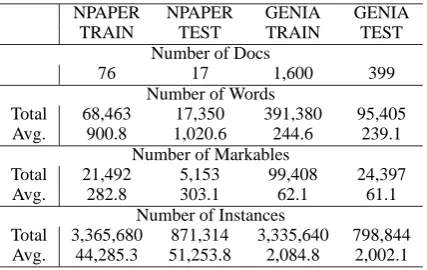
Instead of using the entire ACE corpora, we choose the NPAPER portion of the ACE corpora as the source domain in the experiments, because it is the best performing one among the three por-tions. Under these preprocessing settings, the recall percentages of markable extraction on the training and test set of the NPAPER corpus are 94.5% and 95.5% respectively, while the recall percentages of markable extraction on the training and test set of the GENIA corpus are 87.6% and 86.6% respectively. The statistics of the NPAPER and the GENIA corpora are listed in Table 1.
5.4 Baseline Results
Under our experimental settings, a coreference resolution system that is trained on the NPA-PER training set and tested on the NPANPA-PER test set achieves recall, precision, and F-measure of 59.0%, 70.6%, and 64.3%, respectively. This is comparable to the state-of-the-art performance (Stoyanov et al., 2009). Table 2 compares the per-formance of testing on the GENIA test set, but training with the GENIA training set or the NPA-PER training set. Training with in-domain data achieves an F-measure that is 9.1% higher than training with out-of-domain data. Training with
6It turned out that the re-trained tokenization model gave
Training Set Recall Precision F-measure
GENIA Training Set 37.7 71.9 49.5
NPAPER Training Set 30.3 60.7 40.4
Table 2: MUC F-measures on the GENIA test set
in-domain data is better than training with out-of-domain data for both recall and precision. This confirms the impact of domain difference between the newswire and the biomedical domain.
5.5 Domain Adaptation with Active Learning
In the experiments on domain adaptation with ac-tive learning for coreference resolution, we as-sume that the source domain training data are an-notated. The target domain training data are not annotated but are used as a data pool for instance selection. The algorithm selects the instances in the data pool to annotate and add them to the train-ing data to update the classifier. The target domain test set is strictly separated from this data pool, i.e., none of the target domain test data are used in the instance selection process of active learning.
From Table 1, one can see that both training sets in the NPAPER and the GENIA corpora contain large numbers of training instances. Instead of us-ing the entire trainus-ing sets in the experiments, we use a smaller subset due to several reasons. First, to train a coreference resolution classifier, we do not need so much training data (Soon et al., 2001). Second, a large number of training instances will slow the active learning process. Third, a smaller source domain training corpus suggests a more modest annotation effort even on the source do-main. Lastly, a smaller target domain training cor-pus means that fewer words need to be read by human annotators to label the data.
We randomly choose 10 NPAPER texts as the source domain training set. A coreference resolu-tion system that is trained on these 10 texts and tested on the entire NPAPER test set achieves re-call, precision, and F-measure of 60.3%, 70.6%, and 65.0%, respectively. This is comparable to (actually slightly better than) a system trained on the entire NPAPER training set. As for the GE-NIA training set, we randomly choose 40 texts as the target domain training data. To avoid selec-tion bias, we perform 5 random trials, i.e., choos-ing 5 sets, each containchoos-ing 40 randomly selected GENIA training texts. In the rest of this paper, all performances of using 40 GENIA training texts are the average scores over 5 runs, each of which uses
a different set of 40 texts.
In the previous section, we have presented the domain adaptation techniques, the active learning algorithm, as well as the target domain instance weighting scheme. In the rest of this section, we present the experimental results to show how main adaptation, active learning, and target do-main instance weighting help coreference resolu-tion in a new domain. We use Augment, IW, and IP to denote the three domain adaptation tech-niques: AUGMENT, INSTANCEWEIGHTING, and INSTANCEPRUNING, respectively. For a further
comparison, we explore another baseline method, which is simply a concatenation of the source and target domain data together, called Combine in the rest of this paper. In all the experiments with ac-tive learning, we run 100 iterations, which result in the selection of 1,000 target domain instances.
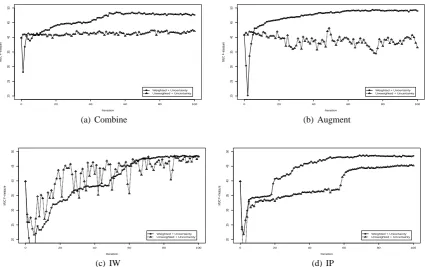
The first experiment is to measure the effective-ness of target domain instance weighting. We fix on the use of uncertainty-based active learning, and compare weighting and without weighting of target domain instances (denoted as Weighted and Unweighted). The learning curves are shown in Figure 2. For Combine, Augment, and IP, it can be seen that Weighted is a clear winner. As for IW, at the beginning of active learning, Unweighted out-performs Weighted, though it is unstable. At the end of 100 iterations, Weighted outperforms Un-weighted.
Since Weighted outperforms Unweighted, we fix on the use of Weighted and explore the effec-tiveness of active learning. For comparison, we try another iterative process that randomly selects 10 instances in each iteration. We found that selection of instances using active learning achieved better performance than random selection in all cases. This is because random selection may select in-stances that the classifier has very high confidence in, which will not help in improving the classifier.
0 20 40 60 80 100
20
25
30
35
40
45
50
Iteration
MUC F−measure
Weighted + Uncertainty Unweighted + Uncertainty
(a) Combine
0 20 40 60 80 100
20
25
30
35
40
45
50
Iteration
MUC F−measure
Weighted + Uncertainty Unweighted + Uncertainty
(b) Augment
0 20 40 60 80 100
20
25
30
35
40
45
50
Iteration
MUC F−measure
Weighted + Uncertainty Unweighted + Uncertainty
(c) IW
0 20 40 60 80 100
20
25
30
35
40
45
50
Iteration
MUC F−measure
Weighted + Uncertainty Unweighted + Uncertainty
[image:7.595.83.509.71.338.2](d) IP
Figure 2: Learning curves of comparing target domain instances weighted vs. unweighted. All systems use uncertainty-based active learning.
Iteration 0 10 20 30 40 60 80 100
Combine+Unweighted 39.8 40.7 40.9 41.1 41.4 40.4 41.6 42.1
Combine+Weighted 39.8 40.9 44.0** 44.8** 45.2** 48.0** 47.7** 47.6**
Augment+Weighted 39.8 44.1**†† 46.0**†† 47.0**†† 47.8**†† 49.1**†† 49.1**†† 49.0**††
IW+Weighted 39.8 24.3 33.1 36.8 38.1 45.0** 48.2**†† 48.3**††
IP+Weighted 39.8 34.4 40.7 43.4** 46.2**†† 48.0** 48.5**†† 48.5**††
Table 3: MUC F-measures of different active learning settings on the GENIA test set. All systems use Uncertainty. Statistical significance is compared against Combine+Unweighted, where * and ** stand forp <0.05andp <0.01, respectively, and compared against Combine+Weighted, where†and††stand forp <0.05andp <0.01, respectively.
6 Analysis
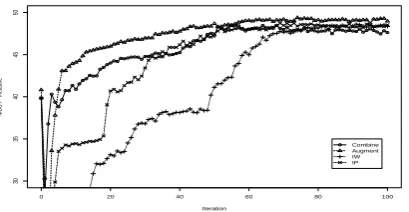
Using only the source domain training data, a coreference resolution system achieves an F-measure of 39.8% on the GENIA test set (the col-umn of “Iteration 0” in Table 3). From Figure 3 and Table 3, we can see that in the first few iter-ations of active learning, domain adaptation does not perform as well as using only the source do-main training data. This is because when there are very limited target domain data, the estima-tion of the target domain is unreliable. Dahlmeier and Ng (2010) reported similar findings though they did not use active learning. With more iter-ations, i.e., more target domain training data, do-main adaptation is clearly superior. Among the three domain adaptation techniques, Augment is
better than IW and IP. It not only achieves a higher F-measure, but also a faster speed to adapt to a new domain in active learning. Also, similar to (Dahlmeier and Ng, 2010), we find that IP is gen-erally better than IW. All systems (except IW) with Weighted performs much better than Com-bine+Unweighted. This shows the effectiveness of target domain instance weighting. The aver-age recall, precision, and F-measure of our best model, Augment+Weighted, after 100 iterations are 37.3%, 71.5%, and 49.0%, respectively. Com-pared to training with only the NPAPER training data, not only the F-measure, but also both the re-call and precision are greatly improved (cf Table 2).
[image:7.595.78.509.389.454.2]dis-0 20 40 60 80 100
30
35
40
45
50
Iteration
MUC F−measure
[image:8.595.75.280.72.178.2]Combine Augment IW IP
Figure 3: Learning curves of different domain adaptation methods. All systems use Weighted and Uncertainty.
tance of the two markables in an instance (mea-sured in sentence) is 3.4 (averaged over the 5 runs), which means an annotator needs to read 4 sentences on average to annotate an instance.
We also investigate the difference of corefer-ence resolution between the newswire domain and the biomedical domain, and the instances that were selected in active learning which represent this difference. One of the reasons that corefer-ence resolution differs in the two domains is that scientific writing in biomedical texts frequently compares entities. For example,
In Cushing’s syndrome, the CR of GR was normal in spite of the fact that the CR of plasma cortisol was disturbed.
The two CRs refer to different entities and hence are not coreferential. However, a system trained on NPAPER predicts them as coreferential. In the newswire domain, comparisons are less likely, especially for named entities. For example, in the newswire domain, London in most cases is coreferential to other Londons. However, in the biomedical domain, DNAs as in DNA of human beings and DNA of monkeys are different enti-ties. A coreference resolution system trained on the newswire domain is unable to capture the dif-ference between these two named entities, hence predicting them as coreferential. This also jus-tifies the need for domain adaptation for corefer-ence resolution. For the above sentcorefer-ence, after ap-plying our method, the adapted coreference res-olution system is able to predict the two CRs as non-coreferential.
Next, we show the effectiveness of our sys-tem using domain adaptation with active learning compared to a system trained with full corefer-ence annotations. Averaged over 5 runs, a system
trained on a single GENIA training text achieves an F-measure of 25.9%, which is significantly lower than that achieved by our method. With more GENIA training texts added, the F-measure increases. After 80 texts are used, the system trained on full annotations finally achieves an F-measure of 49.2%, which is 0.2% higher than Aug-ment+Weighted after 100 iterations. However, af-ter 100 iaf-terations, only 1,000 target domain in-stances are annotated under our framework. Con-sidering that one single text in the GENIA corpus contains an average of over 2,000 instances (cf Ta-ble 1), effectively we annotate only half of a text. Compared to the 80 training texts needed, this is a huge reduction. In order to achieve similar perfor-mance, we only need to annotate 1/160 or 0.63% of the complete set of training instances under our framework of domain adaptation with active learn-ing.
Lastly, although in this paper we reported exper-imental results with the MUC evaluation metric, we also evaluated our approach with other evalu-ation metrics for coreference resolution, e.g., the B-CUBED metric, and obtained similar findings.
7 Conclusion
In this paper, we presented an approach using domain adaptation with active learning to adapt coreference resolution from the newswire domain to the biomedical domain. We explored the ef-fect of domain adaptation, active learning, and target domain instance weighting for coreference resolution. Experimental results showed that do-main adaptation with active learning and the tar-get instance weighting scheme achieved a simi-lar performance on MEDLINE abstracts but with a greatly reduced number of annotated training instances, compared to a system trained on full coreference annotations.
Acknowledgments
This research is supported by the Singapore Na-tional Research Foundation under its InternaNa-tional Research Centre @ Singapore Funding Initiative and administered by the IDM Programme Office.
References
Yee Seng Chan and Hwee Tou Ng. 2007. Domain adaptation with active learning for word sense dis-ambiguation. In Proceedings of the ACL2007.
Nancy Chinchor. 2011. Statistical significance of MUC-6 results. In Proceedings of the Sixth Mes-sage Understanding Conference.
K. Bretonnel Cohen, Arrick Lanfranchi, William Corvey, William A. Baumgartner Jr., Christophe Roeder, Philip V. Ogren, Martha Palmer, and Lawrence Hunter. 2010. Annotation of all coref-erence in biomedical text: Guideline selection and adaptation. In BioTxtM 2010.
Daniel Dahlmeier and Hwee Tou Ng. 2010. Domain adaptation for semantic role labeling in the biomed-ical domain. Bioinformatics, 26(8):1098–1104.
Hal Daume III. 2007. Frustratingly easy domain adap-tation. In Proceedings of the ACL2007.
Caroline Gasperin and Ted Briscoe. 2008. Statistical anaphora resolution in biomedical texts. In Proceed-ings of the COLING2008.
Caroline Gasperin, Nikiforos Karamanis, and Ruth Seal. 2007. Annotation of anaphoric relations in biomedical full-text articles using a domain-relevant scheme. In Proceedings of the DAARC2007.
Caroline Gasperin. 2009. Active learning for anaphora resolution. In Proceedings of the NAACL-HLT2009 Workshop on Active Learning for Natural Language Processing.
Jing Jiang and ChengXiang Zhai. 2007. Instance weighting for domain adaptation in NLP. In Pro-ceedings of the ACL2007.
Jin-Dong Kim, Sampo Pyysalo, Tomoko Ohta, Robert Bossy, Ngan Nguyen, and Jun’ichi Tsujii. 2011a. Overview of BioNLP shared task 2011. In Proceed-ings of BioNLP Shared Task 2011 Workshop.
Youngjun Kim, Ellen Riloff, and Nathan Gilbert. 2011b. The taming of Reconcile as a biomedical coreference resolver. In Proceedings of BioNLP Shared Task 2011 Workshop.
Florian Laws, Florian Heimerl, and Hinrich Sch¨utze. 2012. Active learning for coreference resolution. In Proceedings of the NAACL2012.
David D. Lewis and William A. Gale. 1994. A se-quential algorithm for training text classifiers. In Proceedings of the SIGIR1994.
Mitchell P. Marcus, Beatrice Santorini, and Mary Ann Marcinkiewicz. 1993. Building a large annotated corpus of English: The Penn Treebank. Computa-tional Linguistics, 19(2):313–330.
Timothy A. Miller, Dmitriy Dligach, and Guergana K. Savova. 2012. Active learning for coreference reso-lution. In Proceedings of the BioNLP2012.
Makoto Miwa, Paul Thompson, and Sophia Ana-niadou. 2012. Boosting automatic event ex-traction from the literature using domain adapta-tion and coreference resoluadapta-tion. Bioinformatics, 28(13):1759–1765.
MUC-6. 1995. Coreference task definition (v2.3, 8 Sep 95). In Proceedings of the Sixth Message Un-derstanding Conference (MUC-6).
MUC-7. 1998. Coreference task definition (v3.0, 13 Jul 97). In Proceedings of the Seventh Message Un-derstanding Conference (MUC-7).
Vincent Ng and Claire Cardie. 2002. Improving ma-chine learning approaches to coreference resolution. In Proceedings of the ACL2002.
NIST. 2002. The ACE 2002 evaluation plan. ftp://jaguar.ncsl.nist.gov/ace/doc/ ACE-EvalPlan-2002-v06.pdf.
Piyush Rai, Avishek Saha, Hal Daume, and Suresh Venkatasubramanian. 2010. Domain adapta-tion meets active learning. In Proceedings of the NAACL-HLT2010 Workshop on Active Learning for Natural Language Processing.
Wee Meng Soon, Hwee Tou Ng, and Daniel Chung Yong Lim. 2001. A machine learning ap-proach to coreference resolution of noun phrases. Computational Linguistics, 27(4):521–544.
Veselin Stoyanov, Nathan Gilbert, Claire Cardie, and Ellen Riloff. 2009. Conundrums in noun phrase coreference resolution: Making sense of the state-of-the-art. In Proceedings of the ACL-IJCNLP2009.
Min Tang, Xiaoqiang Luo, and Salim Roukos. 2002. Active learning for statistical natural language pars-ing. In Proceedings of the ACL2002.
Marc Vilain, John Burger, John Aberdeen, Dennis Con-nolly, and Lynette Hirschman. 1995. A model-theoretic coreference scoring scheme. In Proceed-ings of the MUC-6.
Xiaofeng Yang, Guodong Zhou, Jian Su, and Chew Lim Tan. 2004. Improving noun phrase coreference resolution by matching strings. In Pro-ceedings of the IJCNLP2004.
Jian Bo Yang, Qi Mao, Qiao Liang Xiang, Ivor W. Tsang, Kian Ming A. Chai, and Hai Leong Chieu. 2012. Domain adaptation for coreference resolu-tion: An adaptive ensemble approach. In Proceed-ings of the EMNLP2012.
Shanheng Zhao and Hwee Tou Ng. 2010. Maximum metric score training for coreference resolution. In Proceedings of the COLING2010.