Likelihood of external causation in the structure of events
Tanja Samardˇzi´c
CorpusLab, URPP Language and Space University of Zurich
Paola Merlo
Linguistics Department University of Geneva [email protected]
Abstract
This article addresses the causal structure of events described by verbs: whether an event happens spontaneously or it is caused by an external causer. We automat-ically estimate the likelihood of external causation of events based on the distribu-tion of causative and anticausative uses of verbs in the causative alternation. We train a Bayesian model and test it on a monolin-gual and on a bilinmonolin-gual input. The perfor-mance is evaluated against an independent scale of likelihood of external causation based on typological data. The accuracy of a two-way classification is 85% in both monolingual and bilingual setting. On the task of a three-way classification, the score is 61% in the monolingual setting and 69% in the bilingual setting.
1 Introduction
Ubiquitously present in human thinking, causal-ity is encoded in language in various ways. Com-putational approaches to causality are mostly concerned with automatic extraction of causal schemata (Michotte, 1963; Tversky and Kahne-man, 1982; Gilovich et al., 1985) from sponta-neously produced texts based on linguistic encod-ing. A key to success in this endeavour is under-standing how human language encodes causality.
Linguistic expressions of causality, such as causative conjunctions, verbs, morphemes, and constructions, are highly ambiguous, encoding not only the real-world causality, but also the struc-ture of discourse, as well as speakers’ attitudes (Moeschler, 2011; Zufferey, 2012). Causality judgements are hard to elicit in an annotation project. This results in a low inter-annotator agree-ment and makes the evaluation of automatic sys-tems difficult (Bethard, 2007; Grivaz, 2012).
Our study addresses the relationship between world-knowledge about causality and the gram-mar of language, focusing on the causal structure of events expressed by verbs. In current analyses, the meaning of verbs is decomposed into multiple predicates which can be in a temporal and causal relation (Pustejovsky, 1995; Talmy, 2000; Levin and Rappaport Hovav, 2005; Ramchand, 2008).
(1) a. Causative: Adam broke the laptop. b. Anticausative: The laptop broke.
We propose a computational approach to the
causative alternation, illustrated in (1), in which an event (breaking the laptopin (1)) can be disso-ciated from its immediate causer (Adamin (1a)). The causative alternation has been attested in al-most all languages (Schafer, 2009), but it is re-alised with considerable cross-linguistic variation in the sets of alternating verbs and in the grammat-ical encoding (Alexiadou et al., 2006; Alexiadou, 2010).
Since the causative alternation involves most verbs, identifying the properties of verbs which al-low them to alternate is important for developing representations of the meaning of verbs in gen-eral. Analysing the structural components of the meaning of verbs proves important for tasks such as word sense disambiguation (Lapata and Brew, 2004), semantic role labelling (M`arquez et al., 2008), cross-linguistic transfer of semantic anno-tation (Pad´o and Lapata, 2009; Fung et al., 2007; van der Plas et al., 2011). The knowledge about the likelihood of external causation might be help-ful in the task of detecting implicit arguments of verbs and, especially deverbal nouns (Gerber and Chai, 2012; Roth and Frank, 2012). Knowing, for example, that a verb expresses an externally caused event increases the probability of an im-plicit causer if an exim-plicit causer is not detected in a particular instance of the verb. Our study should
contribute to the development of formal and exten-sive representations of grammatically relevant se-mantic properties of verbs, such as Verb Net (Kip-per Schuler, 2005) and PropBank (Palmer et al., 2005).
2 External Causation and the Grammar of Language
The distinction between external and internal cau-sation in events described by verbs is introduced by Levin and Rappaport Hovav (1994) to account for the fact that the alternation is blocked in some verbs such asbloomin (2). In Levin and Rappa-port Hovav’s account, verbs which describe ex-ternally caused events alternate (1), while verbs which describe internally caused events do not (2).
(2) a. The flowers suddenly bloomed. b. * The summer bloomed the flowers.
The main objection to this proposed generali-sation is that it does not account for the cross-linguistic variation. Since the distinction concerns the meaning of verbs, one could expect that the verbs which are translations of each other alter-nate in all languages. This is, however, often not true. There are many verbs that do alternate in some languages, while their counterparts in other languages do not (Alexiadou et al., 2006; Schafer, 2009; Alexiadou, 2010). For example,appearand
arrivedo not alternate in English, but their equiv-alents in Japanese or in the Salish languages do.
To account for the variation in cross-linguistic data Alexiadou (2010) introduces the notion of cause-unspecified events, a category between ex-ternally caused and inex-ternally caused events. In-troducing gradience into the classification allows Alexiadou to propose generalisations which apply across languages: cause-unspecified verbs alter-nate in all languages, while only some languages allow the alternation if the event is either exter-nally or interexter-nally caused. To allow the alterna-tion in the latter cases, languages need a special grammatical mechanism. In English, for example, this mechanism is not available, which is why only cause-unspecified verbs alternate. The alternation is thus blocked in both verbs describing externally caused and internally caused events.
Alexiadou’s account is based not only on the observations about the availability of the alterna-tion, but also about morphological encoding of the alternation across languages. Unlike English,
which does not mark the alternation morphologi-cally (note that the two versions of English verbs in (1-3) are morphologically identical), other lan-guages encode the alternation in different ways, as shown in (3).
(3)
Causative Anticausative Mongolian xajl-uul-ax xajl-ax
’melt’ ’melt’ Russian rasplavit rasplavit-sja
’melt’ ’melt’ Japanese atum-eru atum-aru
’gather’ ’gather’
An analysis of the distribution of morpholog-ical marking across languages leads Haspelmath (1993) to introduce the notion of likelihood into his account of the meaning of the alternating verbs. In a study of 31 verbs in 21 languages from all over the world, Haspelmath notices that certain verbs tend to get the same kind of mark-ing across languages. For each verb, he calcu-lates the ratio between the number of languages which mark the anticausative version and the num-ber of languages which mark the causative version of the verb. He interprets this ratio as a quantita-tive measure of how spontaneous events described by the verbs are. As each verb is assigned a dif-ferent score, ranking the verbs according to the score results in a “scale of increasing likelihood of spontaneous occurrence”. Events with a low anti-causative/causative ratio (e.g. boil,dry,melt) are likely to occur spontaneously, while events with a high ratio (e.g. break,close,split) are likely to be caused by an external causer.
3 The Model
We design a probabilistic model which esti-mates the likelihood of external causation and gen-erates a probability distribution over a given num-ber of event classes for each verb in a given set of verbs. The model formalises the intuition that an externally caused event tends to be expressed by a verb in its causative realisation. In other words, if the likelihood of external causation of the event is encoded in the use of the verb which de-scribes the event, then the causer is expected to ap-pear frequently in the realisations of the verb. The opposite is expected for internally caused events. Cause-unspecified events are expected to appear with and without the causer equally.
To take into account the two questions discussed in the theoretical approaches, namely the number of classes and the role of cross-linguistic data in the classification of events, we design four ver-sions of the model, varying the input data and the number of classes in the output: a) monolingual input and two classes; b) cross-linguistic input and two classes; c) monolingual input and three classes; d) cross-linguistic input and three classes. The current cross-linguistic versions of the model include only two languages, English and German, because we test the models in a minimal cross-linguistic setting. In principle, the approach can be easily extended to include any number of languages.
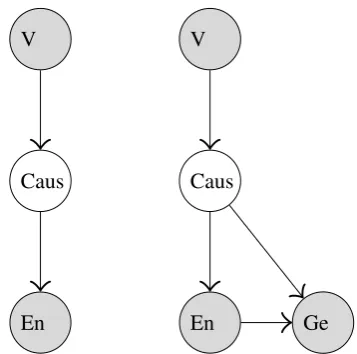
As it can be seen in its graphical representation in Figure 1, the model consists of three variables in the monolingual version and of four variables in the cross-linguistic version.
V
Caus
En
V
Caus
En Ge
Figure 1: Two version of the Bayesian net model for estimating external causation.
The first variable in both versions is the set of verbsV. This can be any given set of verbs.
The second variable is the event class of the verb, for which we use the symbolCaus. The val-ues of this variable depend on the assumed classi-fication. In the two-class version, the values are
causative, representing externally caused events, andanticausative, representing internally caused events. In the three-class version, the variable can take one more value,unspecified, representing cause-unspecified events.
The third (En) and the fourth (Ge) (in the cross-linguistic version) variables are the surface realisa-tions of the verbs in parallel instances. These vari-ables take three values: causativefor active tran-sitive use, anticausative for intransitive use, and
passive for passive use in the languages in ques-tion.
We represent the relations between the variables as a Bayesian network. The variable that rep-resents the event class of verbs (Caus) is unob-served. The values for the other three variables are observed in the data source. Note that the in-put to the model does not contain the information about the event class at any point.
The dependence between En and Ge in the bilingual version of the model represents the fact that the two instances of a verb are translations of each other, but does not represent the direction of translation in the actual data. The form of the instance in one language depends on the form of the parallel instance because they express the same meaning in the same context, regardless of the di-rection of translation.
[image:3.595.90.269.546.723.2]Assuming that the variables are related as in Figure 1, En andGe are conditionally indepen-dent of V given Caus, so we can calculate the probability of the model as in (4) for the monolin-gual version and as in (6) for the cross-linguistic version.
(4) P(v, caus, en) =P(v)·P(caus|v)·P(en|caus)
(5) P(caus|v, en) = P P(v)·P(caus|v)·P(en|caus)
causP(v)·P(caus|v)·P(en|caus)
(6) P(v, caus, en, ge) =
P(v)·P(caus|v)·P(en|caus)·P(ge|caus, en)
(7) P(caus|v, en, ge) =
P(v)·P(caus|v)·P(en|caus)·P(ge|caus,en)
P
causP(v)·P(caus|v)·P(en|caus)·P(ge|caus,en)
We assign to each verb the event class that is most probable given the verb, as in (8).
(8) caus class(verb) =arg maxcausP(caus|v)
All the variables in the model are defined so that the parameters can be estimated on the basis of frequencies of instances of verbs automatically ex-tracted from parsed corpora.
4 Experiments
The accuracy of the predictions of the model is evaluated in experiments.
4.1 Materials and Methods
The verbs for which we estimate the likelihood are the 354 verbs that participate in the causative alter-nation in English, as listed by Levin (1993), and the 26 verbs listed as alternating in a typological study (Haspelmath, 1993).
We estimate the parameters of the model by implementing the expectation-maximisation algo-rithm. The algorithm is initialised by assigning different arbitrary values to the parameters of the model. The classification reported in the paper is obtained after 100 iterations.
We train the classifier using the data automat-ically extracted from an English-German parallel corpus (Europarl (Koehn, 2005)). Both monolin-gual and bilinmonolin-gual input data are extracted from the parallel corpus. All German verbs which are word-aligned with the alternating English verbs listed in the literature are regarded as German equivalents. By extracting cross-linguistic equiv-alents automatically from a parallel corpus, we avoid manual translation into German of the lists of English verbs discussed in the literature. In this way, we eliminate the judgements which would be involved in the process of translation.
The corpus is syntactically parsed (using the MaltParser (Nivre et al., 2007)) and word-aligned
(using GIZA++ (Och and Ney, 2003)). For both the syntactic parses and word alignments, we reuse the data provided by Bouma et al. (2010).
We extract only the instances of verbs where both the object (if there is one) and the sub-ject are realised in the same clause, excluding the instances involving syntactic movements and coreference. Transitive instances are considered causative realisations, intransitive anticausative. We count passive instances separately because they are formally transitive, but they usually do not express the causer.
German equivalents of English alternating verbs are extracted in two steps. First, all verbs occur-ring as transitive, intransitive, and passive were extracted from the German sentences that are sentence-aligned with the English sentences con-taining the instances of alternating verbs. These instances were considered candidate translations. The instances that are the translations of the En-glish instances were then selected on the basis of word alignments. Instances where at least one el-ement (the verb, the head of its object, or the head of its subject) is aligned with at least one element in the English instance were considered aligned.
Only the instances of English verbs that are translated with a corresponding finite verbal form in German are extracted, excluding the cases where English verbs are translated into a corre-sponding non-finite form such as infinitive, nomi-nalization, or participle in German.
4.2 Evaluation
We evaluate the performance of the models against the scale of spontaneous occurrence proposed by Haspelmath (1993), shown in (9). We expect the verbs classified as internally caused by our models to correspond to the verbs with a low morpholog-ical anticausative/causative ratio (those on the left side of the scale). The opposite is expected for externally caused verbs. Cause-unspecified verbs are expected to be in the middle of Haspelmath’s scale.
(9) boil, dry, wake up, sink, learn-teach, melt, stop, turn, dissolve, burn, fill, finish, begin, spread, roll, develop, rise-raise, improve, rock, connect, change, gather, open, break, close, split
is maximised for each version of the model. For example, the threshold which divides the verbs into anticausative and causative in the two-way classification is set after the verbturn.
By evaluating the performance of our models against a typology-based measure, we avoid elic-iting human judgements, which is a known prob-lem in computational approaches to causality. The downside of this approach is that such evaluation is currently possible for a relatively small number of verbs.
5 Results and Discussion
Table 1 shows all the confusion matrices of the classifications performed automatically in com-parison with the classifications based on the typol-ogy rankings.1
In the two-way classification, the two versions of the model, with monolingual and with bilingual input, result in identical classifications. The agree-ment of the models with the typological ranking can be considered very good (85%). The optimal threshold divides the verbs into two asymmetric classes: eight verbs in the internally caused class and eighteen in the externally caused class. The agreement is better for the internally caused class. In the three way-classification, the performance of both versions of the model drops. In this set-ting, the output of the two versions differs: there are two verbs which are classified as externally caused by the monolingual version and as cause-unspecified by the bilingual version, which results in a slightly better performance of the bilingual version. Given the small number of evaluated verbs, however, this tendency cannot be consid-ered significant.
The three-way classification is more difficult than the two-way classification, but the difficulty is not only due to the number of classes, but also to the fact that two of the classes are not well-distinguished in the data. While the class of in-ternally caused events is relatively easily distin-guished (small number of errors in all classifica-tions), the classes of externally caused and cause-unspecified verbs are hard to distinguish. This finding supports the two-way classification argued for in the literature.
The classification performed by the bilingual
1The table contains 26 instead of 31 verbs because corpus
data could not be reliably extracted for some phrasal verbs listed by Haspelmath.
model indicates that the distinction between ex-ternally caused and cause-unspecified verbs might still exist. Compared to the monolingual clas-sification, more verbs are classified as cause-unspecified, and they are grouped in the middle of the typological scale. Since the model takes into account cross-linguistic variation in the realisa-tions of the alternating verbs, the observed differ-ence in the performance could be interpreted as a sign that the distinction between cause-unspecified and externally caused events does emerge in cross-linguistic contexts.
While supporting the two-way classification of events, our experiments do not provide a defi-nite answer to the question of whether there are more than two classes of events. To obtain sig-nificant results, more verbs need to be evaluated. However, the typological data used in our exper-iments (Haspelmath, 1993) are not easily avail-able. This kind of data are currently not included in the typological resources (such as the WALS database (Dryer and Haspelmath, 2013)), but they can, in principle, be collected from other elec-tronic sources of language documentation, which are increasingly available for many different lan-guages.
6 Related Work
The proposed distinction between externally and internally caused events is addressed by McKoon and Macfarland (2000). They study twenty-one verbs defined in the linguistic literature as describ-ing internally caused events and fourteen verbs de-scribing externally caused events. Their corpus study shows that the appearance of these verbs as causative (transitive) and anticausative (intransi-tive) cannot be used as a diagnostic for the kind of meaning that has been attributed to them.
Model 2-class 3-class
Monolingual Bilingual Monolingual Bilingual Typology acaus caus acaus caus acaus caus unspec. acaus caus unspec.
acaus 8 0 8 0 6 0 1 6 0 1
caus 4 14 4 14 0 3 0 0 3 0
unspec. — — — — 4 5 7 4 3 9
[image:6.595.87.516.62.165.2]Agreement 85% 85% 61% 69%
Table 1: Per class and overall agreement between the corpus-based and the typology-based classification of verbs; acaus = internally caused, caus = externally caused, unspec. = cause-unspecified.
Even though the most obvious prediction con-cerning the corpus instances of the two groups of verbs was not confirmed, the corpus data were still found to support the distinction between the two groups. Examining 50 randomly selected in-stances of transitive uses of each of the studied verbs, McKoon and Macfarland (2000) find that, when used in a transitive clause, internally caused change-of-state verbs tend to occur with a limited set of subjects, while externally caused verbs can occur with a wider range of subjects. This differ-ence is statistically significant.
The relation between frequencies of certain uses and the lexical semantics of English verbs has been explored by Merlo and Stevenson (2001) in the context of automatic verb classification. Merlo and Stevenson (2001) show that information col-lected from instances of verbs in a corpus can be used to distinguish between three different classes which all include verbs that alternate between transitive and intransitive use. The classes in ques-tion are manner of moques-tion verbs (10), which alter-nate only in a limited number of languages, exter-nally caused change of state verbs (11), alternating across languages, and performance/creation verbs, which are not lexical causatives (12).
(10) a. The horse raced past the barn.
b. The jockey raced the horse past the barn. (11) a. The butter melted in the pan.
b. The cook melted the butter in the pan. (12) a. The boy played.
b. The boy played soccer.
One of the most useful features for the classi-fication proved to be the causativity feature. It represents the fact that, in the causative alterna-tion, the same lexical items can occur both as sub-jects and as obsub-jects of the same verb. This feature
sets apart the two causative classes from the per-formance class.
In the context of psycholinguistic empirical ap-proaches to encoding causality in verbs, it has been established that assigning a causal relation to a sequence of events can be influenced by the native languages (Wolff et al., 2009a; Wolff and Ventura, 2009b). English speakers, for instance, tend to assign causal relations more than Russian speakers.
In our study, we draw on the fact that the se-mantic properties of verbs are reflected in the way they are used in a corpus, established by the pre-vious studies. We explore this relationship further, relating it to a deeper semantic analysis and to the typological distribution of grammatical features.
7 Conclusion and Future Work
The experiments presented in this article provide empirical evidence that contribute to a better un-derstanding of the relationship between the causal semantics of verbs, their formal morphological and syntactic properties, and the variation in their use. We have shown that the likelihood of external causation of events is encoded in the distribution of the causative and anticausative uses of verbs. Two classes of events, externally caused and inter-nally caused events, can be distinguished automat-ically based on corpus data.
References
Artemis Alexiadou, Elena Anagnostopoulou, and Flo-rian Schfer. 2006. The properties of anticausatives
crosslinguistically. In Mara Frascarelli, editor,
Phases of Interpretation, pages 187–212, Berlin, New York. Mouton de Gruyter.
Artemis Alexiadou. 2010. On the morpho-syntax of (anti-)causative verbs. In Malka Rappaport Hovav, Edit Doron, and Ivy Sichel, editors,Syntax, Lexical Semantics and Event Structure, pages 177–203, Ox-ford. Oxford University Press.
Steven Bethard. 2007. Finding Event, Temporal and
Causal Structure in Text: A Machine Learning Ap-proach. Ph.D. thesis, University of Colorado at Boulder.
Gerlof Bouma, Lilja Øvrelid, and Jonas Kuhn. 2010. Towards a large parallel corpus of cleft
construc-tions. InProceedings of the Seventh conference on
International Language Resources and Evaluation (LREC’10), Valletta, Malta. European Language Re-sources Association.
Matthew S. Dryer and Martin Haspelmath, editors.
2013. WALS Online. Max Planck Institute for
Evo-lutionary Anthropology, Leipzig.
Pascale Fung, Zhaojun Wu, Yongsheng Yang, and Dekai Wu. 2007. Learning bilingual semantic frames: Shallow semantic parsing vs. semantic role
projection. In11th Conference on Theoretical and
Methodological Issues in Machine Translation (TMI 2007), pages 75–84, Skovde, Sweden.
Matthew Gerber and Joyce Y. Chai. 2012. Seman-tic role labeling of implicit arguments for nominal
predicates. Computational Linguistics, 38(4):755–
798.
Thomas Gilovich, Robert Vallone, and Amos Tversky. 1985. The hot hand in basketball: On the
misper-ception of random sequences. Cognitive
Psychol-ogy, 17(3):295–314.
C´ecile Grivaz. 2012. Automatic extraction of causal
knowledge from natural language texts. Ph.D. the-sis, University of Geneva.
Martin Haspelmath. 1993. More on typology of inchoative/causative verb alternations. In Bernard
Comrie and Maria Polinsky, editors, Causatives
and transitivity, volume 23, pages 87–121, Amster-dam/Philadelphia. John Benjamins Publishing Co.
Karin Kipper Schuler. 2005. VerbNet: A
broad-coverage, comprehensive verb lexicon. Ph.D. thesis, University of Pennsylvania.
Philipp Koehn. 2005. Europarl: A parallel corpus for statistical machine translation. In Proceedings of MT Summit 2005, Phuket, Thailand.
Mirella Lapata and Chris Brew. 2004. Verb class
disambiguation using informative priors.
Computa-tional Linguistics, 30(1):45–73.
Beth Levin and Malka Rappaport Hovav. 1994. A pre-liminary analysis of causative verbs in English. Lin-gua, 92:35–77.
Beth Levin and Malka Rappaport Hovav. 2005.
Ar-gument realization. Cambridge University Press, Cambridge.
Beth Levin. 1993. English verb classes and
alterna-tions : a preliminary investigation. The University of Chicago Press, Chicago.
Llu´ıs M`arquez, Xavier Carreras, Kenneth C. Litkowski, and Suzanne Stevenson. 2008. Se-mantic role labeling: An introduction to the special issue.Computational Linguistics, 34(2):145–159. Gail McKoon and Talke Macfarland. 2000. Externally
and internally caused change of state verbs.
Lan-guage, 76(4):833–858.
Paola Merlo and Susanne Stevenson. 2001. Automatic verb classification based on statistical distribution
of argument structure. Computational Linguistics,
27(3):373–408.
Albert Michotte. 1963. The perception of causality.
Basic Books, Oxford, England.
Jacques Moeschler. 2011. Causal, inferential and temporal connectives: Why ‘parce que’ is the only causal connective in French. In S. Hancil, editor,
Marqueurs discursifs et subjectivit´e, pages 97–114, Rouen. Presses Universitaires de Rouen et du Havre. Joakim Nivre, Johan Hall, Jens Nilsson, Chanev Atanas, Gles¸en Eryi˘git, Sandra Kbler, Svetoslav Marinov, and Erwin Marsi. 2007. MaltParser: A language-independent system for data-driven
de-pendency parsing. Natural Language Engineering,
13(2):95–135.
Franz Josef Och and Hermann Ney. 2003. A sys-tematic comparison of various statistical alignment
models. Computational Linguistics, 29(1):19–52.
Sebastian Pad´o and Mirella Lapata. 2009. Cross-lingual annotation projection of semantic roles.
Journal of Artificial Intelligence Research, 36:307– 340.
Martha Palmer, Daniel Gildea, and Paul Kingsbury. 2005. The Proposition Bank: An annotated
cor-pus of semantic roles. Computational Linguistics,
31(1):71–105.
James Pustejovsky. 1995. The generative lexicon.
MIT Press, Cambridge, MA.
Gillian Ramchand. 2008. Verb Meaning and the
Michael Roth and Anette Frank. 2012. Aligning predi-cate argument structures in monolingual comparable
texts: A new corpus for a new task. In*SEM 2012:
The First Joint Conference on Lexical and Compu-tational Semantics – Volume 1: Proceedings of the main conference and the shared task, and Volume 2: Proceedings of the Sixth International Workshop on Semantic Evaluation (SemEval 2012), pages 218– 227, Montr´eal, Canada, 7-8 June. Association for Computational Linguistics.
Florian Schafer. 2009. The causative alternation. In Language and Linguistics Compass, volume 3, pages 641–681. Blackwell Publishing.
Leonard Talmy. 2000. Towards a cognitive semantics.
The MIT Press, Cambridge Mass.
Amos Tversky and Daniel Kahneman. 1982. Causal schemata in judgments under uncertainty. In Daniel Kahneman, Paul Slovic, and Amos Tversky, editors,
Judgement Under Uncertainty: Heuristics and Bi-ases.
Lonneke van der Plas, Paola Merlo, and James Hen-derson. 2011. Scaling up automatic cross-lingual semantic role annotation. InProceedings of the 49th Annual Meeting of the Association for Computa-tional Linguistics: Human Language Technologies, pages 299–304, Portland, Oregon, USA, June. As-sociation for Computational Linguistics.
Phillip Wolff and Tatyana Ventura. 2009b. When Rus-sians learn English: How the semantics of causation
may change. Bilingualism: Language and
Cogni-tion, 12(2):153–176.
Phillip Wolff, Ga-Hyun Jeon, and Yu Li. 2009a. Causal agents in English, Korean and Chinese: The
role of internal and external causation. Language
and Cognition, 1(2):165–194.
Sandrine Zufferey. 2012. ‘Car, parce que, puisque’ revisited: Three empirical studies on French causal