Towards segment-based recognition of argumentation structure
in short texts
Andreas Peldszus
Applied Computational Linguistics University of Potsdam [email protected]
Abstract
Despite recent advances in discourse pars-ing and causality detection, the automatic recognition of argumentation structure of authentic texts is still a very challeng-ing task. To approach this problem, we collected a small corpus of German mi-crotexts in a text generation experiment, resulting in texts that are authentic but of controlled linguistic and rhetoric com-plexity. We show that trained annotators can determine the argumentation struc-ture on these microtexts reliably. We ex-periment with different machine learning approaches for automatic argumentation structure recognition on various levels of granularity of the scheme. Given the com-plex nature of such a discourse under-standing tasks, the first results presented here are promising, but invite for further investigation.
1 Introduction
Automatic argumentation recognition has many possible applications, including improving docu-ment summarization (Teufel and Moens, 2002), retrieval capabilities of legal databases (Palau and Moens, 2011), opinion mining for commercial purposes, or also as a tool for assessing public opinion on political questions.
However, identifying and classifying arguments in naturally-occurring text is a very challenging task for various reasons: argumentative strategies and styles vary across texts genres; classifying ar-guments might require domain knowledge; fur-thermore, argumentation is often not particularly explicit – the argument proper is being infiltrated with the full range of problems of linguistic ex-pression that humans have at their disposal.
Although the amount of available texts featur-ing argumentative behaviour is growfeatur-ing rapidly in
the web, we suggest there is yet one resource miss-ing that could facilitate the development of auto-matic argumentation recognition systems: Short texts with explicit argumentation, little argumenta-tively irrelevant material, less rhetorical gimmicks (or even deception), in clean written language.
For this reason, we conducted a text generation experiment, designed to control the linguistic and rhetoric complexity of written ‘microtexts’. These texts have then been annotated with argumentation structures. We present first results of automatic classification of these arguments on various levels of granularity of the scheme.
The paper is structured as follows: In the next section we describe related work. Section 3 presents the annotation scheme and an agreement study to prove the reliability. Section 4 describes the text generation experiment and the resulting corpus. Section 5 and 6 present the results of our first attempts in automatically recognizing the ar-gumentative structure of those texts. Finally, Sec-tion 7 concludes with a summary and an outlook on future work.
2 Related Work
There exist a few ressources for the study of ar-gumentation, most importantly perhaps the AIF database, the successor of the Araucaria corpus (Reed et al., 2008), that has been used in dif-ferent studies. It contains several annotated En-glish datasets, most interestingly for us one cov-ering online newspaper articles. Unfortunately, the full source text is not part of the download-able database, which is why the linguistic ma-terial surrounding the extracted segments is not easy to retrieve for analysis. Instead of manu-ally annotating, Cabrio and Villata (2012) cre-ated an argumentation resource by extracting ar-gumentations from collaborative debate portals, such as debatepedia.org, where arguments are al-ready classified into pro and con classes by the
users. Unfortunately, those arguments are them-selves small texts and their internal argumenta-tive structure is not marked up. Finally, to the best of our knowledge, the only existing corpus of German newspaper articles, essays or editori-als annotated with argumentation structure is that used by Stede and Sauermann (2008), featuring ten commentaries from the Potsdam Commentary Corpus (Stede, 2004). Although short, these texts are rhetorically already quite complex and often have segments not relevant to the argument.1
In terms of automatic recognition, scientific documents of different fields have been studied in-tensively in the Argumentative Zoning approach or in similar text zoning approaches (Teufel and Moens, 2002; Teufel et al., 2009; Teufel, 2010; Liakata et al., 2012; Guo et al., 2013). Here, sen-tences are classified into different functional or conceptual roles, grouped together with adjacent sentences of the same class to document zones, which induces a flat partitioning of the text. A va-riety of machine learning schemes have been ap-plied here.
Another line of research approaches argumen-tation from the perspective of Rhetorical Struc-ture Theory (RST) (Mann and Thompson, 1988) and works with argumentation-enriched RST trees (Azar, 1999; Green, 2010). However, we do not consider RST to be the best level for representing argumentation, due to its linearization constraints (Peldszus and Stede, 2013a, sec. 3). Nevertheless, noteworthy advances have been made recently in rhetorical parsing (Hernault et al., 2010; Feng and Hirst, 2012). Whether hybrid RST argumenta-tion structures will profit similarly remains to be shown. A more linguistically oriented approach is given with the TextCoop platform (Saint-Dizier, 2012) for analyzing text on the discourse level with emphasis on argumentation.
One step further, Feng and Hirst (2011) concen-trate on types of arguments and use a statistical approach to classify already identified premises and conclusions into five common argumentation schemes (Walton et al., 2008).
3 Annotation Scheme
Our representation of the argumentation structure of a text is based on Freeman’s theory of ar-gumentation structure (Freeman, 1991; Freeman,
1We intend to use this resource, when we move on to
ex-periment with more complex texts.
2011).2 Its central idea is to model argumen-tation as a hypothetical dialectical exchange be-tween the proponent, who presents and defends his claims, and the opponent, who critically ques-tions them in a regimented fashion. Every move in such a dialectical exchange corresponds to a struc-tural element in the argument graph. The nodes of this graph represent the propositions expressed in text segments (round nodes are proponent’s nodes, square ones are opponent’s nodes), the arcs be-tween those nodes represent different supporting (arrow-head links) and attacking moves (circle-head links). The theory distinguishes only a few general supporting and attacking moves. Those could be specified further with a more fine grained set, as provided for example by the theory of ar-gumentation schemes (Walton et al., 2008). Still, we focus on the coarse grained set, since this re-duces the complexity of the already sufficiently challenging task of automatic argument identifica-tion and classifcaidentifica-tion. Our adapidentifica-tion of Freeman’s theory and the resulting annotation scheme is de-scribed in detail and with examples in (Peldszus and Stede, 2013a).
3.1 Reliability of annotation
The reliability of the annotation scheme has been evaluated in two experiments. We will first reca-pitulate the results of a previous study with naive annotators and then present the new results with expert annotators.
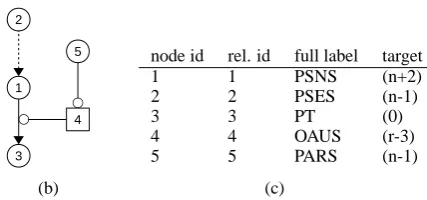
Naive annotators: In (Peldszus and Stede, 2013b), we presented an agreement study with 26 naive and untrained annotators: undergradu-ate students in a “class-room annotation” szenario, where task introduction, guideline reading and the actual annotation is all done in one obligatory 90 min. session and the subjects are likely to have different experience with annotation in gen-eral, background knowledge and motivation. We constructed a set of 23 microtexts (each 5 seg-ments long) covering different linearisations of several combinations of basic argumentation con-structs. An example text and the corresponding argumentation structure graph is shown in Fig-ure 1. On these texts, the annotators achieved moderate agreement3for certain aspects of the
ar-2The theory aims to integrate the ideas of Toulmin (1958)
into the argument diagraming techniques of the informal logic tradition (Beardsley, 1950; Thomas, 1974) in a system-atic and compositional way.
gument graph (e.g. κ=.52 in distinguishing pro-ponent and oppro-ponent segments, or κ=.58 in des-tinguishing supporting and attacking segments), yet only a marginal agreement of κ=.38 on the full labelset describing all aspects of the argument graph. However, we could systematically identify subgroups performing much better than average using clustering techniques: e.g. a subgroup of 6 annotators reached a relatively high IAA agree-ment of κ=.69 for the full labelset and also high agreement with gold data.
Expert annotators: Here, we present the re-sults of an agreement study with three expert an-notators: two of them are the guideline authors, one is a postdoc in computational linguistics. All three are familiar with discourse annotation tasks in general and specifically with this annotation scheme. They annotated the same set of 23 mi-crotexts and achieved a high agreement of κ=.83 on the full labelset describing all aspects of the ar-gument graph. The distinction between supporting and attacking was drawn with very high agreement of κ=.95, the one between proponent and oppo-nent segments even with perfect agreement.
Since argumentation structures can be reliably annotated using this scheme, we decided to create a small corpus of annotated microtexts.
4 Dataset
The corpus used in this study consists of two parts: on the one hand, the 23 microtexts used in the an-notation experiments just described; on the other hand, 92 microtexts that have been collected in a controlled text generation experiment. We will de-scribe this experiment in the following subsection.
4.1 Microtext generation experiment
We asked 23 probands to discuss a controversial issue in a short text of 5 segments. A list of 17 of these issues was given, concerning recent po-litical, moral, or everyday’s life questions. Each proband was allowed to discuss at maximum five of the given questions. Probands were instructed to first think about the pros & cons of the con-troversial question, about possible refutation and counter-refutations of one side to the other. On this basis, probands should decide for one side and write a short persuasive text (corresponding to the standards of the written language), arguing in favour of their chosen position.
The written texts were required to have a length
of five segments. We decided not to bother our probands with an exact definition of a segment, as this would require the writers to reliably iden-tify different complex syntactic constructions. In-stead, we simply characterized it as a clause or a sentence, expressing an argumentative point on its own. We also required all segments to be ar-gumentatively relevant, in the sense that they ei-ther formulate the main claim of the text, sup-port the main claim or another segment, or attack the main claim or another segment. This require-ment was put forward in order to prevent digres-sion and argumentatively irrelevant but common segment types, such as theme or mood setters, as well as background information. Furthermore, we demanded that at least one possible objection to the main claim be considered in the text, leaving open the choice of whether to counter that objec-tion or not. Finally, the text should be written in such a way that it would be understandable with-out having the question as a headline.
In total, 100 microtexts have been collected. The five most frequently chosen issues are:
• Should the fine for leaving dog excrements on sideways be increased?
• Should shopping malls generally be allowed to open on Sundays?
• Should Germany introduce the death penalty?
• Should public health insurance cover treat-ments in complementary and alternative medicine?
• Should only those viewers pay a TV licence fee who actually want to watch programs of-fered by public broadcasters?
4.2 Cleanup and annotation
[Energy-saving light bulbs contain a considerable amount of toxic substances.]1[A customary lamp can for instance contain up to five milligrams of quicksilver.]2[For this rea-son, they should be taken off the market,]3 [unless they are virtually unbreakable.]4 [This, however, is simply not case.]5
(a) (b)
node id rel. id full label target
1 1 PSNS (n+2)
2 2 PSES (n-1)
3 3 PT (0)
4 4 OAUS (r-3)
5 5 PARS (n-1)
[image:4.595.311.525.59.159.2](c)
Figure 1: An example microtext: the (translated) segmented text in (a), the argumentation structure graph in (b), the segment-based labeling representation in (c).
minimal as possible. Another source of problems were segments that do not meet our requirement of argumentative relevance. Some writers did not concentrate on discussing the thesis, but moved on to a different issue. Others started the text with an introductory presentation of background information, without using it in their argument. We removed those segments, again with minimal changes in the remaining segments. Some texts containing several of such segments remained too short after the removal and have been discarded from the dataset.
After cleanup, 92 of the 100 written texts re-mained for annotation of argumentation structure. We found that a few texts did not meet the require-ment of considering at least one objection to the own position. In a few other texts, the objection is not present as a full segment, but rather implicitly mentioned (e.g. in a nominal phrase or participle) and immediatly rejected in the very same segment. Those segments are to be annotated as a support-ing segment accordsupport-ing to the guidelines, since the attacking moves cannot be expressed as a relation between segments in this case.
We will present some statistics of the resulting dataset at the end of the following subsection.
5 Modelling
In this section we first present, how the argu-mentation structure graphs can be interpreted as a segment-wise labelling that is suitable for au-tomatic classification. We then describe the set of extracted features and the classifiers set up for recognition.
5.1 Preparations
In the annotation process, every segment is as-signed one and only one function, i.e. every node in the argumentative graph has maximally one out-going arc. The graph can thus be reinterpreted as a list of segment labels.
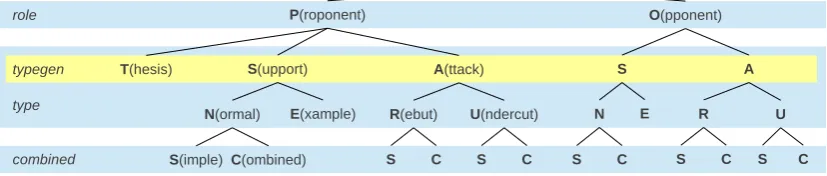
Every segment is labeled on different levels: The ‘role’-level specifies the dialectical role (pro-ponent or op(pro-ponent). The ‘typegen’-level specifies the general type, i.e. whether the segment presents the central claim (thesis) of the text, supports or attacks another segment. The ‘type’-level addi-tionally specifies the kind of support (normal or example) and the kind of attack (rebutter or under-cutter). Whether a segment’s function holds only in combination with that of another segment (com-bined) or not (simple) is represented on the ‘com-bined’-level. The target is finally specified by a position relative identifier: The offset -x. . . 0. . . +x identifies the targeted segment, relative from the position of the current segment. The prefix ‘n’ states that the proposition of the node itself is the target, while the prefix ‘r’ states that the relation coming from the node is the target.4
The labels of each separate level can be merged to form a complex tagset. We interpret the re-sult as a hierarchical tagset as it is presented in Figure 2. The label ‘PSNS(n+2)’ for example stands for a proponent’s segment, giving normal, non-combined support to the next but one seg-ment, while ‘OAUS(r-1)’ represents an opponent’s segment, undercutting the relation established by the immediately previous segment, not combined. Figure 1c illustrates the segment-wise labelling for the example microtext.
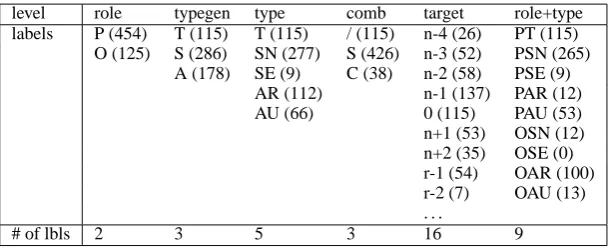
The dataset with its 115 microtexts has 8183 word tokens, 2603 word types and 579 segments in total. The distribution of the basic labels and the complex ‘role+type’ level is presented in Ta-ble 1. The label distribution on the ‘role+type’ level shows that most of the opponent’s attacks are rebutting attacks, directed against the central claim
4
Figure 2: The hierarchy of segment labels.
or its premises directly (OAR>OAU). In contrast, the proponent’s counters of these attack are typi-cally untercutting attacks, directed against the at-tack relation (PAU>PAR). This is due to the au-thor’s typical strategy of first conceding some as-pect in conflict with the main claim and then ren-dering it irrelevant or not applicable without di-rectly challenging it. Note however, that about 40% of the opponents objections have not been countered by the proponent (OA*>PA*).
5.2 Features
All (unsegmented) texts have been automatically split into sentences and been tokenized by the OpenNLP-tools. The mate-pipeline then pro-cessed the tokenized input, yielding lemmati-zation, POS-tags, word-morphology and depen-dency parses (Bohnet, 2010). The annotated gold-standard segmentation in the dataset was then au-tomatically mapped to the automatic sentence-splitting/tokenization, in order to be able to ex-tract exactly those linguistic features present in the gold-segments. Using this linguistic output and several other resources, we extracted the follow-ing features:
Lemma Unigrams: We add a set of binary fea-tures for every lemma found in the present ment, in the preceding and the subsequent seg-ment in order to represent the segseg-ment’s context in a small window.
Lemma Bigrams: We extracted lemma bi-gramms of the present segment.
POS Tags: We add a set of binary features for every POS tag found in the present, preceding and subsequent segment.
Main verb morphology: We added binary fea-tures for tempus and mood of the segment’s main verb, as subjunctive mood might indicate antici-pated objections and tempus might help to identify the main claim.
Dependency triples: The dependency parses were used to extract features representing
depen-dency triples (relation, head, dependent) for each token of the present segment. Two features sets were built, one with lemma representations, the other with POS tag representations of head and de-pendent.
Sentiment: We calculate the sentiment value of the current segment by summing the values of all lemmata marked as positive or negative in Sen-tiWS (Remus et al., 2010).5
Discourse markers: For every lemma in the segment that is listed as potentially signalling a discourse relation (cause, concession, contrast, asymmetriccontrast) in a lexicon of German dis-course markers (Stede, 2002) we add a binary feature representing the occurance of the marker, and one representing the occurance of the relation. Again, discourse marker / relations in the preced-ing and subsequent segment are registered in sep-arate features.
First three lemmata: In order to capture sentence-initial expressions that might indicate ar-gumentative moves, but are not strictly defined as discourse markers, we add binary features repre-senting the occurance of the first three lemmata.
Negation marker presence: We use a list of 76 German negation markers derived in (Warzecha, 2013) containing both closed class negation opera-tors (negation particles, quantifiers and adverbials etc.) and open class negation operators (nouns like “denial” or verbs like “refuse”) to detect negation in the segment.
Segment position: The (relative) position of the segment in the text might be helpful to identify typical linearisation strategies of argumentation.
In total a number of ca. 19.000 features has been extracted. The largest chunks are bigrams and lemma-based dependencies with ca. 6.000 features each. Each set of lemma unigrams (for
5
level role typegen type comb target role+type labels P (454) T (115) T (115) / (115) n-4 (26) PT (115)
O (125) S (286) SN (277) S (426) n-3 (52) PSN (265) A (178) SE (9) C (38) n-2 (58) PSE (9)
AR (112) n-1 (137) PAR (12)
AU (66) 0 (115) PAU (53)
n+1 (53) OSN (12) n+2 (35) OSE (0) r-1 (54) OAR (100) r-2 (7) OAU (13) . . .
# of lbls 2 3 5 3 16 9
Table 1: Label distribution on the basic levels and for illustration on the complex ‘role+type’ level. Labels on remaining complex level combine accoringly: ‘role+type+comb’ with in total 12 different labels and ‘role+type+comb+target’ with 48 different labels found in the dataset.
the present, preceding, and subsequent segment) has around 2.000 features.
5.3 Classifiers
For automatic recognition we compare classifiers that have frequently been used in related work: Naïve Bayes (NB) approaches as in (Teufel and Moens, 2002), Support Vector Machines (SVM) and Conditional Random Fields (CRF) as in (Li-akata et al., 2012) and maximum entropy (Max-Ent) approaches as in (Guo et al., 2013) or (Teufel and Kan, 2011). We used the Weka data mining software, v.3.7.10, (Hall et al., 2009) for all ap-proaches, except MaxEnt and CRF.
Majority: This classifier assignes the most fre-quent class to each item. We use it as a lower bound of performance. The used implementation is Weka’s ZeroR.
One Rule: A simple but effective baseline is the one rule classification approach. It selects and uses the one feature whose values can describe the class majority with the smallest error rate. The used implementation is Weka’s OneR with stan-dard parameters.
Naïve Bayes: We chose to apply a feature se-lected Naïve Bayes classifier to better cope with the large and partially redundant feature set.6 Be-fore training, all features are ranked accoring to their information gain observed on the training set. Features with information gain≯0are excluded.
SVM: For SVMs, we used Weka’s wrapper to LibLinear (Fan et al., 2008) with the Crammer and Singer SVM type and standard wrapper parame-ters.
6
With feature selection, we experienced better scores with the Naïve Bayes classifier, the only exception being the most complex level ‘role+type+comb+target’, where only very few features reached the information gain threshold.
MaxEnt: The maximum entropy classifiers are trained and tested with the MaxEnt toolkit (Zhang, 2004). We used at maximum 50 iterations of L-BFGS parameter estimation without a Gaussian prior.
CRF: For the implementation of CRFs we chose Mallet (McCallum, 2002). We used the SimpleTagger interface with standard parameters. Nonbinary features have been binarized for the MaxEnt and CRF classifiers.
6 Results
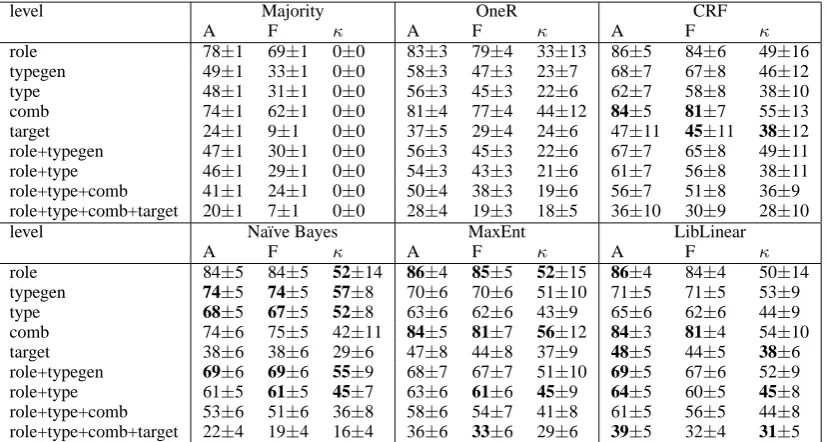
All results presented in this section have been produced in 10 repetitions (with different random seeds) of 10-fold cross validation, i.e. for each score we have 100 fold-specific values of which we can calculate the average and the standard devi-ation. We report A(ccuracy), micro-averaged F(1-score) as a class-frequency weighted measure and Cohen’s κ(Cohen, 1960) as a measure focussing on less frequent classes. All scores are given in percentages.
6.1 Comparing classifiers
A comparison of the different classifiers is shown in Table 2. Due to the skewed label distribution, the majority classifier places the lower bounds already at a quite high level for the ‘role’ and ‘comb’-level. Also note that the agreement be-tween predicted and gold for the majority classi-fier is equivalent to chance agreement and thusκ is 0 on every level, even though there are F-scores near the .70.
[image:6.595.147.455.61.185.2]level Majority OneR CRF
A F κ A F κ A F κ
role 78±1 69±1 0±0 83±3 79±4 33±13 86±5 84±6 49±16
typegen 49±1 33±1 0±0 58±3 47±3 23±7 68±7 67±8 46±12
type 48±1 31±1 0±0 56±3 45±3 22±6 62±7 58±8 38±10
comb 74±1 62±1 0±0 81±4 77±4 44±12 84±5 81±7 55±13 target 24±1 9±1 0±0 37±5 29±4 24±6 47±11 45±11 38±12 role+typegen 47±1 30±1 0±0 56±3 45±3 22±6 67±7 65±8 49±11 role+type 46±1 29±1 0±0 54±3 43±3 21±6 61±7 56±8 38±11 role+type+comb 41±1 24±1 0±0 50±4 38±3 19±6 56±7 51±8 36±9 role+type+comb+target 20±1 7±1 0±0 28±4 19±3 18±5 36±10 30±9 28±10
level Naïve Bayes MaxEnt LibLinear
A F κ A F κ A F κ
role 84±5 84±5 52±14 86±4 85±5 52±15 86±4 84±4 50±14 typegen 74±5 74±5 57±8 70±6 70±6 51±10 71±5 71±5 53±9
type 68±5 67±5 52±8 63±6 62±6 43±9 65±6 62±6 44±9
comb 74±6 75±5 42±11 84±5 81±7 56±12 84±3 81±4 54±10
target 38±6 38±6 29±6 47±8 44±8 37±9 48±5 44±5 38±6
role+typegen 69±6 69±6 55±9 68±7 67±7 51±10 69±5 67±6 52±9
role+type 61±5 61±5 45±7 63±6 61±6 45±9 64±5 60±5 45±8
role+type+comb 53±6 51±6 36±8 58±6 54±7 41±8 61±5 56±5 44±8
[image:7.595.94.508.62.283.2]role+type+comb+target 22±4 19±4 16±4 36±6 33±6 29±6 39±5 32±4 31±5
Table 2: Classifier performance comparison: Percent average and standard deviation in 10 repetitions of 10-fold cross-validation of A(ccuracy), micro averages of F1-scores, and Cohen’sκ.
folds on this rather small dataset.
The Naïve Bayes classifier profits from the fea-ture selection on levels with a small number of labels and gives best results for the ‘type(gen)’ and ‘role+typegen’ levels. On the most complex level with 48 possible labels, however, perfor-mance drops even below the OneR baseline, be-cause features do not reach the information gain threshold. The MaxEnt classifier performs well on the ‘role’ and ‘comb’, as well as on the ‘role+type’ levels. It reaches the highest F-score on the most complex level, although the highest accuracy and agreement on this levels is achieved by the SVM, indicating that the SVM accounted better for the less frequent labels. The SVM generally per-forms well in terms of accuracy and specifically on the most interesting levels for future applications, namely in target identification and the complex ‘role+type’ and ‘role+type+comb+target’ levels. For the CRF classifier, we had hoped that ap-proaching the dataset as a sequence labelling prob-lem would be of advantage. However, applied out of the box as done here, it did not perform as well as the segment-based MaxEnt or SVM classifier.
6.2 Feature ablation on ‘role+type’ level
We performed feature ablation tests with multi-ple classifiers on multimulti-ple levels. For the sake of brevity, we only present the results of the SVM and MaxEnt classifiers here on the ‘role+type’ level. The results are shown in Table 3. Bold
val-ues indicate greatest impact, i.e. strongest loss in the upper leave-one-feature-out half of the table and highest gain in the lower only-one-feature half of the table.
The greatest loss is produced by leaving out the discourse marker features. We assume that this impact can be attributed to the useful abstraction of introducing the signalled discourse relation as a features, since the markers are also present in other features (as lemma unigrams, perhaps first three lemma or even lemma dependencies) that produce minor losses.
For the single feature runs, lemma unigrams produce the best results, followed by discourse markers and other lemma features as bigrams, first three lemma and lemma dependencies. Note that negation markers, segment position and senti-ment perform below or equal to the majority base-line. Whether at least the sentiment feature can prove more useful when we apply a more sophisti-cated calculation of a segment’s sentiment value is something we want to investigate in future work. POS-tag based features are around the OneR base-line in terms of F-score andκ, but less accurate.
Features LibLinear MaxEnt
A F κ A F κ
all 64±5 60±5 45±8 63±6 61±6 45±9
all w/o dependencies lemma 64±5 60±5 46±8 62±6 60±6 44±9 all w/o dependencies pos 65±5 61±5 46±8 63±6 61±7 45±9 all w/o discourse markers 62±5 59±5 43±8 61±7 58±7 42±9 all w/o first three lemma 64±5 60±5 44±8 63±6 60±7 44±9 all w/o lemma unigrams 63±5 60±5 45±8 62±6 60±7 44±9
all w/o lemma bigrams 63±5 60±5 44±8 62±6 60±6 44±9
all w/o main verb morph 64±5 60±5 45±8 62±6 60±6 43±9 all w/o negation marker 64±5 60±6 45±8 63±6 61±7 45±9
all w/o pos 64±5 61±5 45±8 63±6 60±7 44±8
all w/o segment position 64±5 60±5 45±8 63±6 61±6 45±9
all w/o sentiment 64±5 60±5 45±8 62±6 60±6 44±9
only dependencies lemma 56±4 47±4 27±6 56±6 49±7 30±8
only dependencies pos 42±6 41±6 18±8 41±7 40±7 16±9
only discourse markers 56±6 53±6 34±9 53±6 52±7 30±10 only first three lemma 54±6 52±6 33±9 50±6 48±6 26±8 only lemma unigrams 59±5 55±5 37±8 59±6 56±7 38±8
only lemma bigrams 59±4 53±5 34±8 55±7 51±7 30±9
only main verb morph 49±6 39±4 16±7 52±5 41±6 20±6
only negation marker 25±14 19±8 0±4 46±5 29±5 0±0
only pos 45±6 45±6 24±9 46±8 45±7 23±10
only segment position 31±12 25±10 4±7 46±5 29±6 0±0
[image:8.595.137.463.59.316.2]only sentiment 22±14 15±11 -1±3 46±5 29±6 0±0
Table 3: Feature ablation tests on the ‘role+type’ level: Percent average and standard deviation in 10 repetitions of 10-fold cross-validation of A(ccuracy), micro averages of F1-scores, and Cohen’sκ.
as clear for the MaxEnt classifier.
6.3 Class specific results
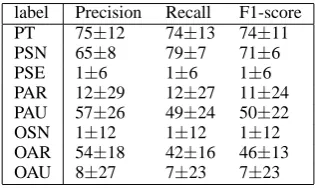
Finally, we present class-specific results of the MaxEnt classifier for the ‘role+type’ level in Ta-ble 4. Frequent categories give good results, but for low-frequency classes there are just not enough instances in the dataset. We hope improve this by extending the corpus by corresponding examples.
label Precision Recall F1-score PT 75±12 74±13 74±11 PSN 65±8 79±7 71±6
PSE 1±6 1±6 1±6
PAR 12±29 12±27 11±24
PAU 57±26 49±24 50±22
OSN 1±12 1±12 1±12
OAR 54±18 42±16 46±13
OAU 8±27 7±23 7±23
Table 4: MaxEnt class-wise results on the ‘role+type’ level: Percent average and stan-dard deviation in 10 repetitions of 10-fold cross-validation of Precision, Recall and F1-score.
7 Summary and outlook
We have presented a small corpus of German microtexts that features authentic argumentations, yet has been collected in a controlled fashion to reduce the amount of distracting or complicated
rhetorical phenomena, focussing instead on the ar-gumentative moves. The corpus has been anno-tated with a scheme that –as we have shown– can be reliably used by trained and experienced anno-tators. To get a first impression of the performance of frequently used modelling approaches on our dataset, we experimented with different classifiers with rather out-of-the-box parameter settings on various levels of granularity of the scheme. Given the complex nature of such a discourse under-standing tasks, the first results presented here are promising, but invite for further investigation.
We aim to generate a significantly larger corpus of argumentative microtexts by a crowd-sourced experiment. For the improvement of models, we consider various strategies: Integrating top down constraints on the argumentation structure, as done in (Guo et al., 2013) for the zoning of scientific documents, is one option. Hierarchical models that apply classifiers along the levels of our la-bel hierarchy are another option. Furthermore, we want to explore sequence labelling models in more detail. Ultimately, the goal will be to apply these methods to authentic news-paper commentaries.
Acknowledgments
[image:8.595.102.260.503.597.2]References
Moshe Azar. 1999. Argumentative text as rhetorical structure: An application of rhetorical structure the-ory. Argumentation, 13:97–114.
Monroe C. Beardsley. 1950. Practical Logic. Prentice-Hall, New York.
Bernd Bohnet. 2010. Very high accuracy and fast de-pendency parsing is not a contradiction. In Proceed-ings of the 23rd International Conference on Com-putational Linguistics, COLING ’10, pages 89–97, Stroudsburg, PA, USA. Association for Computa-tional Linguistics.
Elena Cabrio and Serena Villata. 2012. Natural lan-guage arguments: A combined approach. In Luc De Raedt, Christian Bessiere, Didier Dubois, Patrick Doherty, Paolo Frasconi, Fredrik Heintz, and Peter J. F. Lucas, editors, ECAI, volume 242 of Frontiers in Artificial Intelligence and Applications, pages 205–210. IOS Press.
Jacob Cohen. 1960. A Coefficient of Agreement for Nominal Scales. Educational and Psychological Measurement, 20(1):37–46.
Rong-En Fan, Kai-Wei Chang, Cho-Jui Hsieh, Xiang-Rui Wang, and Chih-Jen Lin. 2008. Liblinear: A li-brary for large linear classification. J. Mach. Learn. Res., 9:1871–1874, June.
Vanessa Wei Feng and Graeme Hirst. 2011. Classi-fying arguments by scheme. In Proceedings of the 49th Annual Meeting of the Association for Com-putational Linguistics: Human Language Technolo-gies - Volume 1, HLT ’11, pages 987–996, Strouds-burg, PA, USA. Association for Computational Lin-guistics.
Vanessa Wei Feng and Graeme Hirst. 2012. Text-level discourse parsing with rich linguistic features. In Proceedings of the 50th Annual Meeting of the Asso-ciation for Computational Linguistics: Long Papers - Volume 1, ACL ’12, pages 60–68, Stroudsburg, PA, USA. Association for Computational Linguistics.
Joseph L. Fleiss. 1971. Measuring nominal scale agreement among many raters. Psychological Bul-letin, 76(5):378–382.
James B. Freeman. 1991. Dialectics and the Macrostructure of Argument. Foris, Berlin.
James B. Freeman. 2011. Argument Structure: Repre-sentation and Theory. Argumentation Library (18). Springer.
Nancy L. Green. 2010. Representation of argumenta-tion in text with rhetorical structure theory. Argu-mentation, 24:181–196.
Yufan Guo, Roi Reichart, and Anna Korhonen. 2013. Improved information structure analysis of scien-tific documents through discourse and lexical con-straints. In Proceedings of the 2013 Conference of
the North American Chapter of the Association for Computational Linguistics: Human Language Tech-nologies, pages 928–937, Atlanta, Georgia, June. Association for Computational Linguistics.
Mark Hall, Eibe Frank, Geoffrey Holmes, Bernhard Pfahringer, Peter Reutemann, and Ian H. Witten. 2009. The weka data mining software: An update. SIGKDD Explor. Newsl., 11(1):10–18, November.
Hugo Hernault, Hemut Prendinger, David duVerle, and Mitsuru Ishizuka. 2010. HILDA: A discourse parser using support vector machine classification. Dialogue and Discourse, 1(3):1–33.
Maria Liakata, Shyamasree Saha, Simon Dob-nik, Colin R. Batchelor, and Dietrich Rebholz-Schuhmann. 2012. Automatic recognition of con-ceptualization zones in scientific articles and two life science applications. Bioinformatics, 28(7):991– 1000.
William Mann and Sandra Thompson. 1988. Rhetori-cal structure theory: Towards a functional theory of text organization. TEXT, 8:243–281.
Andrew Kachites McCallum. 2002. Mal-let: A machine learning for language toolkit. http://mallet.cs.umass.edu.
Raquel Mochales Palau and Marie-Francine Moens. 2011. Argumentation mining. Artificial Intelligence and Law, 19(1):15–22.
Andreas Peldszus and Manfred Stede. 2013a. From argument diagrams to automatic argument mining: A survey. International Journal of Cognitive Infor-matics and Natural Intelligence (IJCINI), 7(1):1–31.
Andreas Peldszus and Manfred Stede. 2013b. Ranking the annotators: An agreement study on argumenta-tion structure. In Proceedings of the 7th Linguistic Annotation Workshop and Interoperability with Dis-course, pages 196–204, Sofia, Bulgaria, August. As-sociation for Computational Linguistics.
Chris Reed, Raquel Mochales Palau, Glenn Rowe, and Marie-Francine Moens. 2008. Language resources for studying argument. In Nicoletta Calzolari (Con-ference Chair), Khalid Choukri, Bente Maegaard, Joseph Mariani, Jan Odijk, Stelios Piperidis, and Daniel Tapias, editors, Proceedings of the Sixth International Conference on Language Resources and Evaluation (LREC’08), Marrakech, Morocco, may. European Language Resources Association (ELRA).
Patrick Saint-Dizier. 2012. Processing natural lan-guage arguments with the TextCoop platform. Jour-nal of Argumentation and Computation, 3(1):49–82.
Manfred Stede and Antje Sauermann. 2008. Lin-earization of arguments in commentary text. In Pro-ceedings of the Workshop on Multidisciplinary Ap-proaches to Discourse. Oslo.
Manfred Stede. 2002. DiMLex: A Lexical Ap-proach to Discourse Markers. In Vittorio Di Tomaso Alessandro Lenci, editor, Exploring the Lexicon - Theory and Computation. Edizioni dell’Orso, Alessandria, Italy.
Manfred Stede. 2004. The Potsdam Commentary Cor-pus. In Proceedings of the ACL Workshop on Dis-course Annotation, pages 96–102, Barcelona.
Simone Teufel and Min-Yen Kan. 2011. Robust ar-gumentative zoning for sensemaking in scholarly documents. In Raffaella Bernadi, Sally Cham-bers, Björn Gottfried, Frédérique Segond, and Ilya Zaihrayeu, editors, Advanced Language Technolo-gies for Digital Libraries, volume 6699 of Lec-ture Notes in Computer Science, pages 154–170. Springer Berlin Heidelberg.
Simone Teufel and Marc Moens. 2002. Summarizing scientific articles: Experiments with relevance and rhetorical status. Comput. Linguist., 28(4):409–445, December.
Simone Teufel, Advaith Siddharthan, and Colin Batch-elor. 2009. Towards discipline-independent ar-gumentative zoning: evidence from chemistry and computational linguistics. In Proceedings of the 2009 Conference on Empirical Methods in Natu-ral Language Processing: Volume 3, EMNLP ’09, pages 1493–1502, Stroudsburg, PA, USA. Associa-tion for ComputaAssocia-tional Linguistics.
Simone Teufel. 2010. The Structure of Scientific Arti-cles: Applications to Citation Indexing and Summa-rization. CSLI Studies in Computational Linguis-tics. CSLI Publications.
Stephen N. Thomas. 1974. Practical Reasoning in Natural Language. Prentice-Hall, New York.
Stephen Toulmin. 1958. The Uses of Argument. Cam-bridge University Press, CamCam-bridge.
Douglas Walton, Chris Reed, and Fabrizio Macagno. 2008. Argumentation Schemes. Cambridge Univer-sity Press.
Saskia Warzecha. 2013. Klassifizierung und Skopus-bestimmung deutscher Negationsoperatoren. Bach-elor thesis, Potsdam University.