Munich Personal RePEc Archive
Does Anti-dumping Enforcement
Generate Threat?
Bagchi, Sagnik and Bhattacharyya, Surajit and Narayanan,
Krishnan
Indian Institute of Technology Bombay
12 February 2014
Does Anti-dumping Enforcement Generate Threat?
Sagnik Bagchi, Surajit Bhattacharyya and K. Narayanan§
Abstract
The last two decades have witnessed that countries across the world are guided by the rules
and regulations of multilateral trading institutions (for example, World Trade organization
[WTO], International Monetary Fund [IMF]) in order to promote free and fair trade through
gradual reduction in trade barriers. The World economy has noticed significant reduction in
tariffs, yet we find a rise in non-tariff barriers (NTBs). However, we still find dumping and
few other trade strategies of the exporting countries as a major hindrance to free and fair
trade. Such behaviour has led to “contingent protection” as a tool of new-protectionism.
Among the contingent protection measures, anti-dumping (AD) has evolved as the most
popular choice of strategy for the trading nations. The AD policy invokes a threat to the
exporter and thereby can change its strategic behaviour. We describe the phenomenon of
dumping through a price-leadership model and thereby compute the optimal level of
anti-dumping duty that can offset dumping. Using a sequential game, we conclude that the
credible threat of an AD duty restricts dumping and thereby leads to a win-win situation for
both the foreign and domestic firms.
JEL: C02, C72, D43, F13, L40
Keywords: Price-leadership, Dumping, Anti-dumping duty, Sequential game
This paper has been published in Foreign Trade Review, February (2014), Vol. 49 (1):
31-44.
§
2
1. Introduction
The post-war period has witnessed significant growth of international trade which was mainly
guided by the multifarious statues of the multilateral trading institutions (for example, The
General Agreement on Tariffs and Trade [GATT], IMF, WTO, etc.). The major objectives of
these organizations were to promote free and fair trade. One of such means was by gradually
bringing down the tariff rates, abolishing quota and other trade restrictions. Initially, the
emerging economies (e.g., India, Argentina, Brazil and South Africa, among a few others)
were not in favour of accepting the new trade policies framed by these institutions. These
economies were sceptical because exposing the domestic economy to international
competition can create distortions in the form of material injury to the firms in the respective
home country.1 In response to the divergence in trade policies of developed and developing
countries, WTO [GATT (1948) and in subsequent rounds of deliberations] provided a
platform for the harmonization of the same and thereby promoting world trade. One such
policy measure was providing protection through „contingent protection‟.
Contingent protection comprises of AD measures, Countervailing and Safeguard measures.
AD duty is used by the importing country to offset the price advantage exploited by the
foreign firms on their low priced exports. An AD initiation has two components: (i) a
dumping component based on price discrimination (i.e., export price below the normal value)
and (ii) the „material injury‟.2 Under the WTO rules [Uruguay Round (1994)], AD duty can
only be applied if these two conditions are satisfied simultaneously. Countervailing measures
on the other hand, help the domestic firms in offsetting the advantages that the foreign firms
possess in terms of an export subsidy given by their respective home countries. Lastly, the
safeguard measures allow a grace period to those importing countries whose domestic
industries have lost comparative advantage due to the competition faced from huge imports.
The intricate process of the safeguard and countervailing measures make them quite
conservative in nature among the trading countries. On the contrary, AD procedures are
flexible and gets over within a period of 18 months; moreover, it is case specific which is
unlike the typical tariff policy. It is argued that AD has a unique combination of economic
and political applicability (Prusa, 2001). On the other hand, Finger (1993), demonstrates that
1
Material Injury to any industry means the actual or potential decline in sales, profit, output, market share, productivity, return on investment, etc. See, Article 3 of the AD agreement of GATT (1994) for details.
2
3
anti-dumping as practised today comprises largely of bad economics and power politics.3
(See, Bekker, 2006, for similar arguments). AD law justifies the trade restriction it creates.
Moreover, this law allows meagre firms to initiate AD cases, bring imports under scrutiny
and thereby protect themselves from competition. Otherwise, the low priced exports can be
countered with orthodox trade protectionist measures.
The main theme of the paper is to explore whether the (credible) threat of an AD enforcement
by the import competing domestic firm would alter the decision of foreign exporting firm
with regard to selling below the „normal value‟.
1.2 Anti-dumping Its Popularity and Concerns
Market distortions in the form of dumping signal price changes that over time lead to various
market adjustments. If these disturbances are temporary, then there would be few
adjustments. One such temporal adjustment is imposition of an anti-dumping duty. The
emergence of new protectionism in the form of anti-dumping across the developing nations
seems to be mostly concerned with safeguarding the domestic industries against these market
distortions. Sometimes, nations use AD initiations as a threat to counter attack low priced
exports or to protect their own sick industries.
The dawn of the 21st century marked the centennial year (2004) of the anti-dumping measures
and also by this time it had become the (trade) policy choice for both developing and
developed nations. Particularly, in the last two decades „new‟ AD users (comprising India,
Argentina, Brazil, Mexico and South Africa, among a few others) have outpaced the „traditional‟ AD users (U.S., Canada, Australia, New Zealand and the European Community) in terms of AD filings. In the immediate aftermath of the Uruguay Round, these „new‟ AD
users had initiated AD complaints at an unprecedented rate. Compared to 1980s when only a
handful of nations had anti-dumping codes, over 40 nations had joined the AD club in the
1990s.
The significant spurt in AD activities across the world over the period 1980-2011 has led to
the dilemma of whether anti-dumping is actually a form of protection from genuine harmful
3
4
practices or is it just a modified form of a protectionist measure?4 Recent available data
reveal that AD initiations constitute around 89 per cent of the total contingent protection
measures all over the world and are significantly greater when average tariff rates across the
[image:5.595.144.411.157.311.2]globe have been declining (Figure 1).
Figure 1: Distribution of Various Contingent Protections, 1995 – 2011 Data Source: WTO Reports on Anti-dumping, Safeguard and Countervailing Initiations
Since the Uruguay Round till date, the WTO data specify India as the top users of AD. The
first AD initiation of India was in 1992 against the U.S., Japan and Brazil for the product
PVC resin. In particular during the period 1995-2011, India has filed 16 per cent of all global
anti-dumping cases, quite disproportionate to its share in global imports (2.04% in 2010-11).5
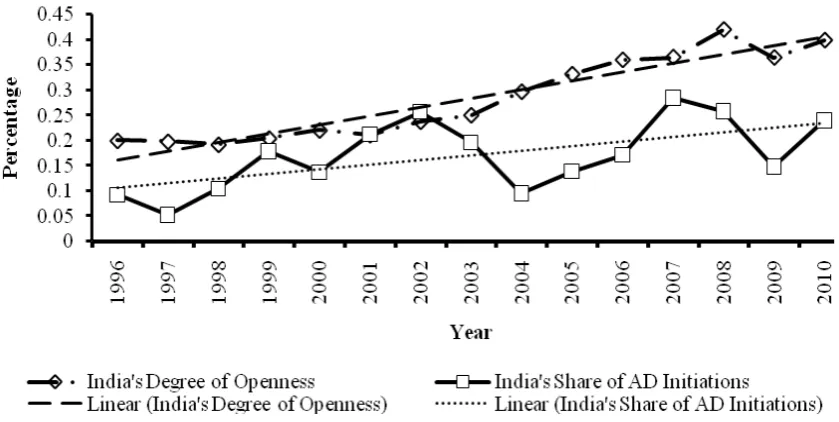
As the economy progressively opened up under the statutes of multilateral trading institutions, India‟s share in global AD activities has also increased.
4
Prior to the 1980s there were less than 100 AD cases across the world; whereas, in the period between 1995 and 2011 there were more than 250 cases on an average every year.
5Authors‟ calculatio
5
Figure 2: Anti-dumping Initiations and Degree of Openness in India
Data Source: WTO Reports on AD Initiations; WTO Statistics Database and The World Development Indicators (World Bank).
Note: India‟s Share in AD Initiations is defined as a ratio of India‟s AD Initiations to World AD Initiations. Degree of openness is calculated as a ratio of trade to GDP (in current year prices).
Most of the products which face AD initiations and measures are products of chemical and
allied industries, plastic and rubber articles, textiles, base metals, machinery and mechanical
appliances. These industries alone initiated around 91 per cent of AD cases during the period
1995-2011. Out of these initiations, around 61 per cent have been converted into measures.
With so many initiations across India and other nations, there is a concern among scholars of
whether anti-dumping has moved away from the original intentions that created it (i.e.,
protection from predatory dumping). We do not answer such questions in this paper.
However, we believe that credible threat of AD enforcement would alter trade practices of
the foreign (exporting) firm with respect to selling below the „normal value‟ and move
towards free and fair trade.
The itinerary of rest of the paper is as follows. Section 2 focuses on the main theme of the
paper. With the backdrop of a price leadership model, we argue whether threat of an AD duty
on the foreign firm, can effectively eliminate exports below the „normal value‟. Alongside, we
6
2. The Model
In this section we argue that the threat of an optimal ad-valorem AD duty would alter the
pricing decision of the foreign firm. For similar arguments see, (Reitzes, 1993; Tivig and
Walz, 2000). With this proposition, we take into account the sustained „material injury‟ to the
domestic firm and thereby calculate the optimal duty required to offset dumping.
We consider a duopoly model involving the domestic firm and a foreign firm, both producing „like product‟.6
The technologically superior foreign firm is the price leader. The foreign firm
(Firm 1) exports q1amount of output to the home country. It enjoys a cost advantage in
production of q1and can sell in the home (export) market below its „normal value‟. On the
other hand, Firm 2 (the domestic firm) produces q2amount of output and is assumed to be the
single producer of the product in its home country.
In the home market, both the firms face a linear market demand functionQabp a,b0.7
Suppose that the cost functions for firm 1 and 2 are:
1
( )
1 1 1;
0
c q
q
F
and2 2
2( 2) 2
2
q
c q F
1
FandF2denote fixed costs for firm 1 and 2, respectively. Total market output is Q q1 q2.
The profit-maximization problem for the domestic firm (Firm 2) in autarky is:
2 2
2
2 )
( ) (
max Q Q F
b Q a F Q C Q Q p
Q
Hence, the domestic firm‟s monopoly equilibrium price-output combination will be:
2
M a
Q
b
, ( 1) ( 2)
M a b
p
b b
The maximum profit of the domestic firm is:
2
auturky 2
2 ( 2) a
F b b
However, in the post-trade scenario, the domestic firm can no longer charge the monopoly
price as it faces competition from the foreign firm. As a result, the domestic firms lobby to
6
Identical Products that are alike in all respects or in the absence of such a product, another product which although not alike in all respects, has characteristics closely resembling those of the product under consideration. For details see, Article 2.6 of the AD agreement of GATT (1994).
7
7
their government authorities for protection. One such policy choice by the domestic
government is AD initiation. Considering the plausible actions of both the foreign and
domestic firm, we compute and compare the optimal price, output and profit conditions under
each of the following strategy combinations.
Case I: Exports Below Normal Value with No AD Initiation
With trade, the domestic firm would accept the price „p‟ (as parameter) set by the foreign firm, and choose its output level.8
The post-trade profit maximization problem for the domestic firm can be written as:
The follower (Firm 2) would choose an output level where price is equal to its marginal cost.
With p as the (parametric) prevailing price in the domestic market, the foreign firm would
be serving the residual demand.
The profit maximization problem of the foreign firm is:
1 1 1 1 1
1 1 max
1
F q q b
q b
a
q
The trade equilibrium price-output combinations for the two firms are:
* * *
1 2
( 1) ( 1)
;
2 2( 1)
a b a b
q q p
b
The profit of the two concerned firms will be:
2 2
* *
1 1 2 2 2
{ ( 1)} { ( 1)}
;
4( 1) 8( 1)
a b a b
F F
b b
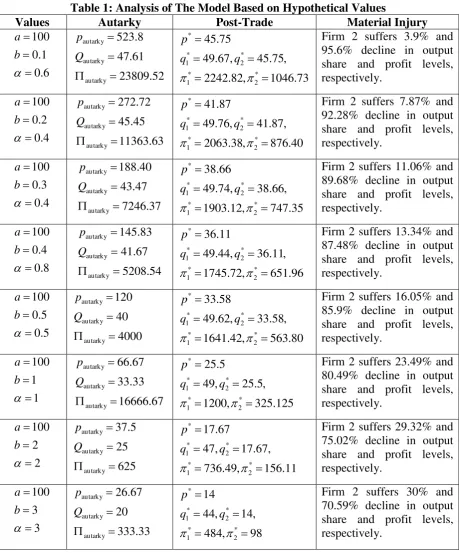
In order to highlight the sustained „material injury‟ and argue in favour of the AD policy we
compare the pre-trade optimal price, output and profit level with the corresponding trade
equilibrium price, output and profit values for the domestic firm. See, Table 1 in which we
consider some hypothetical values for a, b and .
8„
p‟ being the export price whichis below „normal value‟.
2 2 2 2 2
2 max
2
F q pq
8
Table 1: Analysis of The Model Based on Hypothetical Values
Values Autarky Post-Trade Material Injury
6 . 0 1 . 0 100 b a 52 . 23809 61 . 47 8 . 523 autarky autarky autarky Q p 73 . 1046 , 82 . 2242 , 75 . 45 , 67 . 49 75 . 45 * 2 * 1 * 2 * 1 * q q
p Firm 2 suffers 3.9% and
95.6% decline in output share and profit levels, respectively. 4 . 0 2 . 0 100 b a 63 . 11363 45 . 45 72 . 272 autarky autarky autarky Q p 40 . 876 , 38 . 2063 , 87 . 41 , 76 . 49 87 . 41 * 2 * 1 * 2 * 1 * q q
p Firm 2 suffers 7.87% and
92.28% decline in output share and profit levels, respectively. 4 . 0 3 . 0 100 b a 37 . 7246 47 . 43 40 . 188 autarky autarky autarky Q p 35 . 747 , 12 . 1903 , 66 . 38 , 74 . 49 66 . 38 * 2 * 1 * 2 * 1 * q q
p Firm 2 suffers 11.06% and
89.68% decline in output share and profit levels, respectively. 8 . 0 4 . 0 100 b a 54 . 5208 67 . 41 83 . 145 autarky autarky autarky Q p 96 . 651 , 72 . 1745 , 11 . 36 , 44 . 49 11 . 36 * 2 * 1 * 2 * 1 * q q
p Firm 2 suffers 13.34% and
87.48% decline in output share and profit levels, respectively. 5 . 0 5 . 0 100 b a 4000 40 120 autarky autarky autarky Q p 80 . 563 , 42 . 1641 , 58 . 33 , 62 . 49 58 . 33 * 2 * 1 * 2 * 1 * q q
p Firm 2 suffers 16.05% and
85.9% decline in output share and profit levels, respectively. 1 1 100 b a 67 . 16666 33 . 33 67 . 66 autarky autarky autarky Q p 125 . 325 , 1200 , 5 . 25 , 49 5 . 25 * 2 * 1 * 2 * 1 * q q
p Firm 2 suffers 23.49% and
80.49% decline in output share and profit levels, respectively. 2 2 100 b a 625 25 5 . 37 autarky autarky autarky Q p 11 . 156 , 49 . 736 , 67 . 17 , 47 67 . 17 * 2 * 1 * 2 * 1 * q q
p Firm 2 suffers 29.32% and
75.02% decline in output share and profit levels, respectively. 3 3 100 b a 33 . 333 20 67 . 26 autarky autarky autarky Q p 98 , 484 , 14 , 44 14 * 2 * 1 * 2 * 1 * q q
p Firm 2 suffers 30% and
70.59% decline in output share and profit levels, respectively.
Had the domestic firm, accepted the prevailing export price, it would not have been able to
sustain the losses, as it can nowhere reach the price level that the foreign firm charge. We
9
Also, it is found that unlike orthodox protectionist measures, the rate of an AD duty can be
varied depending upon the magnitude of „material injury‟. Further, one can say from fig. 3
that beyond the profit maximizing price of firm 1 (the foreign firm), imposition of an AD
duty would cause the export price to increase. This will lead to a decline in profits of foreign
[image:10.595.86.501.171.363.2]firm.
Figure 3: Profit Curve of the Foreign Firm
Case II: Exports Below Normal Value with Affirmative AD Case
We consider an ad-valorem anti-dumping duty on equilibrium price below the „normal
value‟
*p . Domestic firm would now accept the price p p*tq1 where t0 is the rate of
AD duty. Such an AD duty will raise the export price to the level of „normal value‟ and ensure dumping margin to be zero.9 Accordingly, the domestic (importing) firm would
choose its output level (q2).
The profit maximization problem of the domestic firm now becomes:
2 2 2 2 2
~ 2
~ ~ ~ ~ max
2
F q q p
q
Since the foreign firm would operate in the domestic market based upon the residual demand,
the profit maximization problem for the foreign firm would be
9Dumping margin is defined as the difference between „normal value‟
minus export price.
1
1 1 1 1 1
( 1)
max
1 1
q
a bt t
q q q F
b b
10
Trade equilibrium price-output combination with the AD duty prevailing in the home market
for the two firms would be:
) 1 ( 2 ) 1 ( ~*
1
t bt b a
q and
) ~ ( ) 1 ( 2 ) 1 ( ) 1 ( 2 ) 1 ( ~* * 2 p t bt b a t b b a q
Compared to Case I, a commitment to an anti-dumping policy increases domestic output,
decreases foreign exports, and increases the market price.
Case III: Exports Above Normal Value with Counterfeit AD Case
When exports are made above „normal value‟, the prevailing price in the home market would
bepˆ p*
and
tq1. As the domestic firm does not get to know initially whether theimports are above or below the „normal value‟ before filing an AD investigation, the AD case is likely to be a counterfeit one. Under such circumstances both the firms would bear an
unnecessary cost of fighting out the AD case. In order to capture such unnecessary costs, we
modify the initial cost functions to the followings:
1 1 1
1(q) q F
c and 2
2 2 2 2 2 )
(q q F
c
where, Fi Fi
i,i1,2 and
i includes the monetary and non-monetary cost of acounterfeit AD case.10
The profit maximization problem for the domestic firm is:
2 2 2 2 2 ˆ 2 ˆ ˆ ˆ ˆ max 2 F q q p
q
As earlier, again the follower would choose an output level where pˆ qˆ2.
The profit maximization problem of the foreign firm would be:
1 1 1 1
1
ˆ 1 ˆ ˆ
ˆ 1 ˆ max 1 F q q b q b a
q
Then the trade equilibrium price-output combination for the two firms would be:11
10
Examples of non-monetary cost are loss of goodwill, frequent visits to case hearings, time cost, among others.
Also known as „harassment effect‟.
11
11 and 2 ) 1 )( ( ˆ* 1
a b
q ( ˆ )
) 1 ( 2 ) 1 )( (
ˆ* *
2 p b b a q
Compared to Case I and II, the foreign firm would not export above „normal value‟, as its
trade equilibrium output falls. Thus, in order to encourage exports above „normal value‟ in
the home market, the home country must have the ad-valorem duty:
) 1 )( ( * b a t .
In other words, *
t acts as a credible threat12 for the foreign firm and restrict them only to
export above „normal value‟. In the post-trade scenario the domestic firm enjoys a larger
market share when the prevailing price in the home market (i.e., export price) is above the
„normal value‟. Thus, we have ˆ ~ *2.
* 2 *
2 q q
q
On the contrary, when exports are made below the „normal value‟, the domestic firm enjoys
an increment in profit with an ad valorem AD duty levied. Given the non-monetary cost
associated with a counterfeit AD case, the domestic firm would not like to engage itself in
such a situation. Nonetheless, when the foreign firm exports above „normal value‟, and there
is no counterfeit AD case filed by the domestic firm, both firms(s) enjoy a higher profit share.
In order to substantiate the general validity of the model, we perform the entire exercise with
different cost specifications, such as:
0 , ; )
( 1 1
2 1 1
1 q q q F
c and
( ) 2 2; , 0
2 2 2
2 q q q F
c
With these new cost functions, the results do not change qualitatively. However, the new
optimal ad-valorem AD duty is: .
)] )( 1 ( [ )] 1 ( 1 [ *
new
b a b t
Thus, a credible threat of an AD duty can potentially alter the pricing strategy of the
exporting firm from „below‟ to „above‟ normal value and create a win-win situation for both
the firms.
12 *
12
2.1 Game Theoretic Exercise
We continue with the assumption that the foreign firm has technological superiority (and therefore, cost advantage) in producing the „like product‟. As a result, the foreign firm has a choice to sell below the „normal value‟.13 In retaliation, the domestic (importing) firm can
either initiate an anti-dumping investigation or can opt to set its price as that of leader.
When the foreign firm exports below the „normal value‟, it enjoys a higher pay-off given the
domestic firm does not retaliate but simply opt to set the same price as that of exporter.
However, the domestic firm would not prefer to set such a price as it would be extremely
difficult to reduce its selling price anywhere close to it. There is a good reason to believe that
the foreign firm would have to compromise with a relatively lower pay-off when the
domestic firm selects the strategy of initiating an AD case. Under such a circumstance, it is
highly probable that an AD initiation by the domestic firm would get converted into an AD
measure. Moreover, as the foreign (exporting) firm sells below the „normal value‟ it may
have to sustain short term losses apart from incurring a significant cost of fighting out the AD
case.
On the other hand, when the foreign firm decides to sell above the „normal value‟, the
domestic firm has a higher likelihood to set its price somewhere close to the price charged by
the foreign firm (leader). The domestic firm knows that not only there is a high cost of being
engaged in an counterfeit AD case; also the domestic firm can now better compete with the
price charged by the foreign firm.14 In other words, when the exporting firm decides to sell
above the „normal value‟, it would be wise for the import competing domestic firm to set its
price around the price charged by the exporting firm over an AD initiation. Given the
common knowledge and costs associated with AD investigation for both the players, it is
rational for the exporting firm to sell above the „normal value‟.
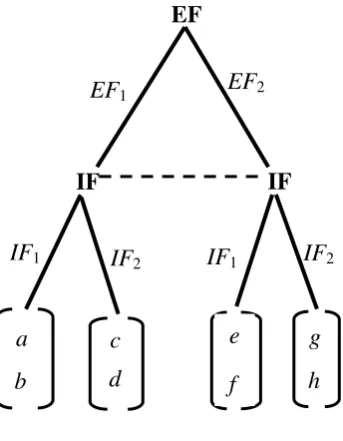
We consider a sequential form game. The foreign firm makes the choice first and then the
domestic firm retaliates. As the domestic (importing) firm does not get to realize initially
whether the imports are above or below the „normal value‟ before filing an AD investigation,
13
The underlying assumption here is that exports made belowthe normal value causes „material injury‟ to the
domestic firm(s).
14
13
we therefore, assign a singleton information set containing two decision nodes for the
[image:14.595.213.385.102.323.2]domestic firm.
Figure 3: Extensive Form Game
where EF1: Price below Normal Value; EF2: Price above Normal Value; and
IF1: Initiate AD; IF2: Accept Leader’s Price.
We impose the following restrictions on the pay-offs:
Exporting firm: a < c and e < g
Importing firm: b >d and f < h
When the exports are made below the „normal value‟ and subsequently the domestic
(importing) firm initiates an AD procedure (IF1), the foreign (exporting) firm would earn a
lower profit than what it would earn if the domestic firm accepts the price set by the foreign
firm (IF2); i.e., a < c. This is because the foreign firm has high probability to face an AD
measure (which may be very costly) when selling below the „normal value‟. On the same note, an AD initiation by the domestic (importing) firm would yield it a higher pay-off (i.e., b
> d) as there is a high probability of recovering the sustained „material injury‟ through the
AD measure.
When the foreign (exporting) firm sells above the „normal value‟ (EF2), an AD initiation by
the importing firm would yield a lower pay-off for both the firms (i.e., e < g and f < h). Despite selling above the „normal value‟ if the domestic (importing) firm initiates an anti-dumping case against its foreign counterpart, it will not only involve monetary cost of
h c
IF IF
d a
b
IF2
IF1
IF2
IF1
EF2
EF1
EF
e
f
14
fighting out the AD case but also a significant time cost as well as the opportunity cost of
losing that particular export market till the case is resolved. Moreover, the foreign firm will
be relatively better off if the domestic firm decides to operate upon the price set by the
foreign (exporting) firm. Further one can say that given the optimal rate of AD duty, the
foreign firm would like to export above „normal value‟. When exports are made above the „normal value‟, the domestic firm would prefer to accept the prevailing price than to initiate an AD case.15 Filing a counterfeit AD case would imply unnecessary cost to the domestic
(importing) firm. Also, the domestic firm can now compete with prevailing export price.
When the foreign firm decides to sell below the „normal value‟, it earns a lesser pay-off
compared to what it would earn if it sold above the „normal value‟ (i.e., a < e). This is
because of the possible retaliation by the domestic firm in terms of initiating an AD case
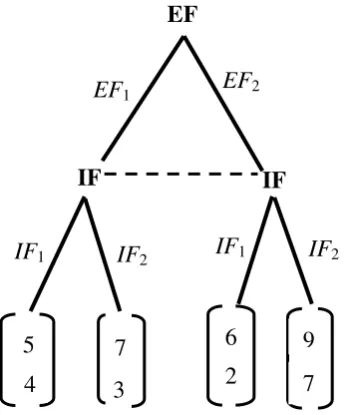
against the foreign firm and therefore, imposing an AD duty on exports. As an illustration we
[image:15.595.201.380.374.582.2]represent the restrictions on the basis of some hypothetical values in fig. 4.
Figure 4: The Pay-off Structure of Domestic and Foreign Firm
When the exports are made below the „normal value‟ (EF1), then it is more paying for the
domestic firm to initiate AD (IF1) as the pay-off is higher. On the other hand, when exports
are made above the „normal value‟ (EF2), the domestic firm would accept the prevailing price
(IF2) as the pay-off is relatively higher. Therefore, the strategy combination (EF2- IF2) is the
unique Nash equilibrium.
15
We assume here that exports above normal value do not necessarily cause any „material injury‟ to the
domestic firm.
3 7
EF2
EF1
IF IF
EF
IF2
IF1
IF1 IF2
5
4
6
2
9
15
No matter what the domestic firm plays, selling above the „normal value‟ is clearly a
preferred strategy for the foreign firm. As a result, the exporting firm would not sell below the „normal value‟ and the importing firm would find IF2 to be its dominant strategy. Thus,
the credible threat of an anti-dumping enforcement alters the strategy choice of the exporting
firm and allows for the conduct of free and fair trade.
3. Summing Up
How would a domestic (importing) firm respond to the case of dumping? This paper analyzed the magnitude of sustained „material injury‟ and a possible retaliation strategy by the firm(s) in terms of a price-leadership model. The level of AD duty varies with „material injury‟ and
ensures export price to rise. A strategically chosen AD duty by the government of an
importing country over the profit-maximizing price of the foreign (exporting) firm will
decrease its profit.
The domestic firm faces a trade-off in choosing alternative strategies (i.e., anti-dumping
initiations vis-à-vis a price war). The (credible) threat of the ad-valorem anti-dumping duty
avoids exports below „normal value‟ by the foreign firm. An anti-dumping duty acts as an
ex-ante threat to the exporters and thus changes the equilibrium outcome. The threat of an
anti-dumping enforcement might not be a permanent one but it would manage to alter the original
intentions of the exporting firm (i.e. predatory pricing).
For instance, data on AD initiations reveal that around 62 per cent of AD initiations get
converted to AD measures for the new users. It may be argued that owing to a high success
rate, unfair trade practices pertaining to selling below the „normal value‟ have been reduced
and thus a decline in AD activities in recent times. Nonetheless, we still find that
anti-dumping initiations are used much more than any other protectionist measures in lieu of
declining orthodox trade protectionist measures (e.g., tariff barrier or a binding constraint of
16
References
Bekker, D. (2006). “The Strategic Use of Anti-dumping in International Trade”, South Africa Journal of Economics, Vol. 74(3), pp. 501-21.
Finger, M. J. (1993). Reform. In J. M. Finger (Eds.), Antidumping: How It Works And Who Gets Hurt (pp. 57-79). The University of Michigan Press: Ann Arbor.
Prusa, J. T. (2001). “On the Spread and Impact of Anti-dumping”, The Canadian Journal of Economics, Vol. 34(3), pp. 591-611.
Reitzes, D. J. (1993). “Antidumping Policy”, International Economic Review, Vol. 34(4), pp. 745-63.