Korea University System in the HOO 2012 Shared Task
Jieun Lee† and Jung-Tae Lee‡ and Hae-Chang Rim†
†
Dept. of Computer & Radio Communications Engineering, Korea University, Seoul, Korea ‡
Research Institute of Computer Information & Communication, Korea University, Seoul, Korea
{jelee,jtlee,rim}@nlp.korea.ac.kr
Abstract
In this paper, we describe the Korea Univer-sity system that participated in the HOO 2012 Shared Task on the correction of preposition and determiner errors in non-native speaker texts. We focus our work on training the sys-tem on a large collection of error-tagged texts provided by the HOO 2012 Shared Task or-ganizers and incrementally applying several methods to achieve better performance.
1 Introduction
In the literature, there have been efforts aimed at de-veloping grammar correction systems designed es-pecially for non-native English speakers. A typi-cal approach is to train statistitypi-cal models on well-formed texts written by native English speakers and apply the learned models to non-native speaker texts to correct textual errors based on given context. This approach, however, fails to model the types of errors that non-native speakers usually make. Recent stud-ies demonstrate that it is possible to improve the per-formance of error correction systems by training the models on error-annotated non-native speaker texts (Han et al., 2010; Dahlmeier and Ng, 2011; Gamon, 2010). Most recently, a large collection of training data consisting of preposition and determiner errors made by non-native English speakers has been re-leased in the HOO (Helping Our Own) 2012 Shared Task, which aims at promoting the research and de-velopment of automated tools for assisting authors in writing (Dale et al., 2012).
In this paper, we introduce our error correction system that participated in the HOO 2012 Shared
Task, where the goal is to correct errors in the use of prepositions and determiners by non-native speakers of English. We mainly focus our efforts on training the system using the non-native speaker texts pro-vided in the HOO 2012 Shared Task. We also share our experience in handling some issues that emerged while exclusively using the non-native speaker texts for training our system. In the following sections, we will describe the system in detail.
2 System Architecture
The goal of our system is to detect and correct prepo-sition and determiner errors in a given text. Our sys-tem consists of two types of classifiers, namelyedit and insertion classifiers. Inputs for the two types of classifiers are noun phrases (NP), verb phrases (VP), and prepositional phrases (PP); we initially pre-process the text given for training/testing by us-ing the Illinois Chunker1 and the Stanford Part-of-Speech Tagger (Toutanova et al., 2003). For learn-ing the classifiers, we use maximum entropy models, which have been successfully applied to many tasks in natural language processing. We particularly use Le Zhang’s Maximum Entropy Modeling Toolkit2 for implementation.
2.1 Edit Classifiers
The role of an edit classifier is to check the source preposition/determiner word originally chosen by the author in a given text. If the source word is incorrect, the classifier replaces it with a bet-ter choice. For every preposition/debet-terminer word,
1
Available at http://cogcomp.cs.illinois.edu
2
Available at http://homepages.inf.ed.ac.uk/lzhang10/
we train a classifier using examples that are ob-served in training data. The choice for preposi-tions is limited to eleven preposipreposi-tions (about, at, as, by, for, from, in, of, on , to, with) that most frequently occur in the training data, and the can-didates for determiner choice arethe and a/an. In summary, we train a total of thirteen edit classifiers, one for each source preposition or determiner. For each edit classifier, the set of candidate outputs con-sists of the source preposition/determiner word it-self, other confusable preposition/determiner words, and no preposition/determiner in case the source word should be deleted. Note that the number of confusable words for each source preposition is de-cided flexibly, depending on examples observed in the training data; a similar approach has been pro-posed earlier by Rozovskaya and Roth (2010a). For a particular source preposition/determiner word in the test data, the system decides whether to correct it or not based on the output of the classifier for that source word.
2.2 Insertion Classifier
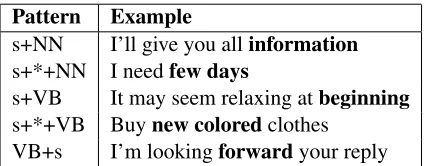
Although the edit classifiers described above are capable of deciding whether a source preposi-tion/determiner word that appears in the test data should be replaced or removed, a large proportion of common mistakes for non-native English writers consists of missing prepositions/determiners (i.e., leaving them out by mistake). To deal with those types of errors, we train a special classifier for inser-tions. A training or testing event for this particular classifier is any whitespace before or after a word in a noun or verb phrase that is a potential loca-tion for a preposiloca-tion or determiner. Table 1 shows the five simple heuristic patterns based on part-of-speech tags that the system uses in order to locate potential sites for prepositions/determiners. Note thatsis a whitespace to be examined, an asterisk (*) means wildcard, andNNincludes the tags that start with NN, such as NNS, NNP, and NNPS.VBis also treated in the same manner asNN. The set of can-didate outputs consists of the eleven prepositions, the two determiners, andno preposition/determiner class. Once a candidate position for insertion is de-tected in the test data, the system decides whether to make an insertion or not based on the output of the insertion classifier.
Pattern Example
s+NN I’ll give you allinformation s+*+NN I needfew days
s+VB It may seem relaxing atbeginning s+*+VB Buynew coloredclothes
[image:2.612.320.533.62.145.2]VB+s I’m lookingforwardyour reply
Table 1: Patterns of candidates for insertion
2.3 Features
Both edit and insertion classifiers can be trained us-ing three types of features described below.
• LEX/POS/HEADThis feature set refers to the contextual features from a window ofntokens to the right and left that are practically used in error correction studies (Rozovskaya and Roth, 2010b; Han et al., 2010; Gamon, 2010). Such features include lexical features, part-of-speech tags, and head words of the preceding and the following chunks of the source word. In this work, we setnto be 3.
• HANThis represents the set of features specifi-cally used in the work of Han et al. (2010); they demonstrate that a model trained on non-native speaker texts can outperform one trained solely on well-formed texts.
• L13 L1 refers to the first language of the au-thor. There have been some efforts to leverage L1 information for improving error correction performance. For example, Rozovskaya and Roth (2011) propose an algorithm for adapting a learned model to the L1 of the author. There have been many studies leveraging writers’ L1. In this work, we propose to directly utilize L1 information of the authors as features. We also leverage additional features by combining L1 and individual head words that govern or are governed by VP or NP.
3 Additional Methods for Improvement
The training data provided in the HOO 2012 Shared Task consists of exam scripts drawn from the pub-licly available FCE dataset (Yannakoudakis et al.,
3
a/an the NULL 6028 114 203
Table 2: Training data distribution fora/anclassifier
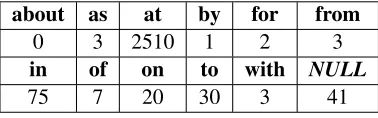
about as at by for from 0 3 2510 1 2 3 in of on to with NULL 75 7 20 30 3 41
Table 3: Training data distribution foratclassifier
2011) with textual errors annotated in HOO data format. From this data, we extract examples for training our classifiers. For example, let w be a source word that we specifically want our classifier to learn. Every use of wthat appears in the train-ing data may be an example that the classifier can learn from. However, it is revealed that for allw, there are always many more examples where w is used correctly than examples wherewis replaced or removed. Table 2 and Table 3 respectively show the class distributions of all examples for source words a/anandatthat are observable from the whole train-ing data for traintrain-inga/an- andat-specific classifiers. We can see that various classes among the training data are unevenly represented. When training data is highly skewed as shown in the two tables, construct-ing a useful classifier becomes a challengconstruct-ing task. We observed from our preliminary experiments that classifiers learned on highly unbalanced data hardly tend to correct the incorrect choices made by non-native speakers. Therefore, we investigate two sim-ple ways to alleviate this problem.
3.1 Filtering Examples Less Likely to be Incorrect
As mentioned above, there are many more exam-ples where the source preposition/determiner is used without any error. One straightforward way to ad-just the training data distribution is to reduce the number of examples where the source word is less likely to be replaced or removed by using language model probabilities. If a language model learned on a very large collection of well-formed texts returns a very high language model probability for a source word surrounded by its context, it may be
reason-Class Initial After After Distribution Filtering Adding
about 0 0 528
as 3 3 275
at 2510 2367 2367
by 1 1 207
for 2 2 1159
from 3 3 550
in 75 75 1521
of 7 7 1454
on 20 20 541
to 30 30 2309
with 3 3 727
NULL 41 41 41
Table 4: Refined data distribution foratclassifier
able to assume that the source word is used correctly. Therefore we build a language model trained on the English Gigaword corpus by utilizing trigrams. Be-fore providing examples to the classifiers for train-ing or testtrain-ing, we filter out those that have very high language model probabilities above a pre-defined threshold value.
3.2 Adding Artificial Errors
Our second approach is to introduce more artificial examples to the training data, so that the class dis-tribution of all training examples becomes more bal-anced. For example, if we aim at adding more train-ing examples for a/an classifier, we would extract correct phrases such as “thedifferent actor” from the training data and artificially convert it into “a differ-ent actor” so that an example ofa/anbeing corrected totheis also provided toa/anclassifier for training. When adding aritificial examples into the training data, we avoid the number of examples belonging to each class exceeding the number of cases where the source word is not replaced or removed. Table 4 demonstrates the results of both the filtering and adding approaches for training thea/anclassifier.
4 Experiments
4.1 Runs
[image:3.612.92.281.130.189.2]Runs Models Features Filtering Adding Threshold
Run0 LM n/a n/a
Run1 ME LEX/POS/HEAD X X
Run2 ME HAN X X
Run3 ME LEX/POS/HEAD -2 X
Run4 ME LEX/POS/HEAD -2 O
Run5 ME LEX/POS/HEAD, L1 -2 O Run6 ME LEX/POS/HEAD, L1, age -2 O Run7 ME Insertion: POS/HEAD X X
Other: LEX/POS/HEAD
[image:4.612.150.466.62.227.2]Run8 ME LEX/POS/HEAD -3 X
Table 5: The explanation of each runs
• Run0This is a baseline run that represents the language model approach proposed by Gamon (2010). We train our language model on Giga-word corpus, utilizing trigrams with interpola-tion and Kneser-Ney discount smoothing.
• Run1, 2 Run1 and 2 represent our system us-ing the LEX/POS/HEAD feature sets and HAN feature sets respectively. Neither additional method described in Section 3 is applied.
• Run3, 8 These runs represent our system us-ing LEX/POS/HEAD features (Run1), where examples that are less likely to be incorrect are filtered out by consulting our language model. The threshold value is set to −2 and −3 for Runs 3 and 8 respectively.
• Run4This particular run is one where we intro-duce additional errors in order to make the class distribution of the training data for the classi-fiers more balanced. This step is incrementally applied in the setting of Run3.
• Run5, 6Run5 and 6 are when we consider L1 information and age respectively as additional features for training the classifiers. The basic setup is same as Run4.
• Run7 This run represents our system with its insertion classifier trained using POS and HEAD features only. No LEX features are used.
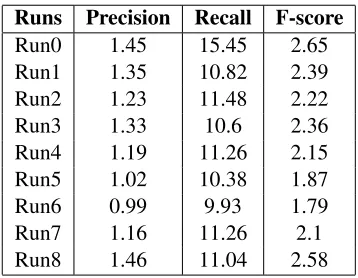
[image:4.612.336.515.268.407.2]Runs Precision Recall F-score Run0 1.45 15.45 2.65 Run1 1.35 10.82 2.39 Run2 1.23 11.48 2.22 Run3 1.33 10.6 2.36 Run4 1.19 11.26 2.15 Run5 1.02 10.38 1.87 Run6 0.99 9.93 1.79 Run7 1.16 11.26 2.1 Run8 1.46 11.04 2.58
Table 6: Correction before test data revisions
5 Results
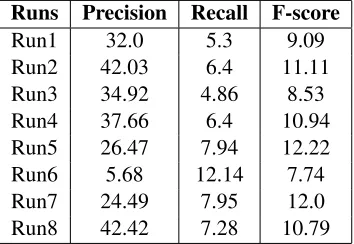
Table 6 shows the correction scores of the individual runs that we originally submitted. Unfortunately, we should confess that we made a vital mistake while generating the runs from 1-8; the modules imple-mented for learning the insertion classifier had some bugs that we could not notice during the submission time. Because of this, our system was unable to han-dle MD and MT type errors properly. This is the reason why the performance figures of our runs are very low. For reference, we include Tables 7-10 that illustrate the performance of our individual runs that we calculated by ourselves using the test data and the evaluation tool provided by the organizers.
Runs Precision Recall F-score Run1 42.67 7.06 12.12 Run2 49.28 7.51 13.03 Run3 47.62 6.62 11.63 Run4 45.45 7.73 13.21 Run5 33.82 10.15 15.62 Run6 8.68 18.54 11.82 Run7 33.33 10.82 16.33 Run8 50.0 7.28 12.72
Table 7: Recognition before test data revisions (system revised)
[image:5.612.339.516.63.186.2]Runs Precision Recall F-score Run1 32.0 5.3 9.09 Run2 42.03 6.4 11.11 Run3 34.92 4.86 8.53 Run4 37.66 6.4 10.94 Run5 26.47 7.94 12.22 Run6 5.68 12.14 7.74 Run7 24.49 7.95 12.0 Run8 42.42 7.28 10.79
Table 8: Correction before test data revisions (system re-vised)
help. Moreover, we can also see that L1 informa-tion helps when directly used for training features.
6 Conclusion
This was our first attempt to participate in a shared task that involves the automatic correction of gram-matical errors made by non-native speakers of En-glish. In this work, we tried to focus on investigating simple ways to improve the error correction system learned on non-native speaker texts. While we had made some critical mistakes on the submitted runs, we were able to observe that our method can poten-tially improve error correction systems.
Acknowledgments
We would like to thank Hyoung-Gyu Lee for his technical assistance.
References
Daniel Dahlmeier and Hwee Tou Ng. 2011. Gram-matical error correction with alternating structure
[image:5.612.99.276.233.355.2]op-Runs Precision Recall F-score Run1 49.33 7.82 13.50 Run2 52.17 7.61 13.28 Run3 52.38 6.98 12.31 Run4 51.95 8.46 14.55 Run5 37.5 10.78 16.75 Run6 9.29 19.03 12.5 Run7 36.73 11.42 17.42 Run8 51.52 7.18 12.62
Table 9: Recognition after test data revisions (system re-vised)
Runs Precision Recall F-score Run1 34.67 5.5 9.49 Run2 42.02 6.13 10.7 Run3 36.51 4.86 8.58 Run4 38.96 6.34 10.91 Run5 29.42 8.45 13.13 Run6 6.40 13.11 8.61 Run7 25.85 8.03 12.26 Run8 42.42 5.92 10.39
Table 10: Correction after test data revisions (system re-vised)
timization. InProceedings of the 49th Annual Meet-ing of the Association for Computational LMeet-inguistics: Human Language Technologies - Volume 1, ACL-HLT ’11, pages 915–923, Portland, Oregon.
Robert Dale, Ilya Anisimoff, and George Narroway. 2012. Hoo 2012: A report on the preposition and determiner error correction shared task. In Proceed-ings of the 7th Workshop on Innovative Use of NLP for Building Educational Applications, HOO ’12, Mon-treal, Canada.
Michael Gamon. 2010. Using mostly native data to correct errors in learners’ writing: a meta-classifier approach. In Human Language Technologies: Pro-ceedings of the 2010 Annual Conference of the North American Chapter of the Association for Computa-tional Linguistics, NAACL-HLT ’10, pages 163–171, Los Angeles, California.
Na-Rae Han, Joel Tetreault, Soo-Hwa Lee, and Jin-Young Ha. 2010. Using an error-annotated learner corpus to develop an esl/efl error correction system. In Proceedings of the 7th International Conference on Language Resources and Evaluation, LREC ’10, pages 763–770, Malta.
[image:5.612.337.514.233.354.2]InProceedings of the 2010 Conference on Empirical Methods in Natural Language Processing, EMNLP ’10, pages 961–970, Cambridge, Massachusetts. Alla Rozovskaya and Dan Roth. 2010b. Training
paradigms for correcting errors in grammar and usage. InHuman Language Technologies: Proceedings of the 2010 Annual Conference of the North American Chap-ter of the Association for Computational Linguistics, NAACL-HLT ’10, pages 154–162, Los Angeles, Cali-fornia.
Alla Rozovskaya and Dan Roth. 2011. Algorithm se-lection and model adaptation for esl correction tasks. InProceedings of the 49th Annual Meeting of the As-sociation for Computational Linguistics: Human Lan-guage Technologies - Volume 1, ACL-HLT ’11, pages 924–933, Portland, Oregon.
Kristina Toutanova, Dan Klein, Christopher D. Manning, and Yoram Singer. 2003. Feature-rich part-of-speech tagging with a cyclic dependency network. In Pro-ceedings of the 2003 Conference of the North Ameri-can Chapter of the Association for Computational Lin-guistics on Human Language Technology - Volume 1, NAACL ’03, pages 173–180, Edmonton, Canada. Helen Yannakoudakis, Ted Briscoe, and Ben Medlock.