Multi-modal Sensing and Analysis of Poster Conversations
toward Smart Posterboard
Tatsuya Kawahara
Kyoto University, Academic Center for Computing and Media Studies Sakyo-ku, Kyoto 606-8501, Japan
http://www.ar.media.kyoto-u.ac.jp/crest/
Abstract
Conversations in poster sessions in academic events, referred to as poster conversations, pose interesting and challenging topics on multi-modal analysis of multi-party dialogue. This article gives an overview of our project on multi-modal sensing, analysis and “under-standing” of poster conversations. We fo-cus on the audience’s feedback behaviors such as non-lexical backchannels (reactive tokens) and noddings as well as joint eye-gaze events by the presenter and the audience. We inves-tigate whether we can predict when and who will ask what kind of questions, and also inter-est level of the audience. Based on these anal-yses, we design a smart posterboard which can sense human behaviors and annotate interac-tions and interest level during poster sessions.
1 Introduction
As a variety of spoken dialogue systems have been developed and deployed in the real world, the fron-tier of spoken dialogue research, with engineering applications in scope, has been extended from the conventional human-machine speech interface. One direction is a multi-modal interface, which includes not only graphics but also humanoid robots. An-other new direction is a multi-party dialogue sys-tem that can talk with multiple persons as an as-sistant agent (D.Bohus and E.Horvitz, 2009) or a companion robot (S.Fujie et al., 2009). While these are extensions of the human-machine speech in-terface, several projects have focused on human-human interactions such as meetings (S.Renals et
al., 2007) and free conversations (K.Otsuka et al., 2008; C.Oertel et al., 2011), toward ambient systems supervising the human communications.
We have been conducting a project which focuses on conversations in poster sessions, hereafter re-ferred to as poster conversations. Poster sessions have become a norm in many academic conventions and open laboratories because of the flexible and in-teractive characteristics. Poster conversations have a mixture characteristics of lectures and meetings; typically a presenter explains his/her work to a small audience using a poster, and the audience gives feed-back in real time by nodding and verbal feed- backchan-nels, and occasionally makes questions and com-ments. Conversations are interactive and also multi-modal because people are standing and moving un-like in meetings. Another good point of poster con-versations is that we can easily make a setting for data collection, which is controlled in terms of fa-miliarity with topics or other participants and yet is “natural and real”.
The goal of the project is signal-level sensing and high-level “understanding” of human interac-tions, including speaker diarization and annotation of comprehension and interest level of the audience. These will realize a new indexing scheme of speech archives. For example, after a long session of poster presentation, we often want to get a short review of the question-answers and what looked difficult for audience to follow. The research will also provide a model of intelligent conversational agents that can make autonomous presentation.
As opposed to the conventional content-based in-dexing approach which focuses on the presenter’s
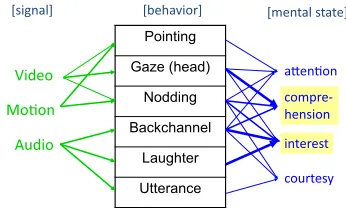
Figure 1: Overview of multi-modal interaction analysis
speech by conducting speech recognition and nat-ural language analysis, we adopt an interaction-oriented approach which looks into the audience’s reaction. Specifically we focus on non-linguistic in-formation such as backchannel, nodding and eye-gaze information, because we assume the audience better understands the key points of the presentation than the current machines. An overview of the pro-posed scheme is depicted in Figure 1.
Therefore, we set up an infrastructure for multi-modal sensing and analysis of multi-party interac-tions. Its process overview is shown in Figure 2. From the audio channel, we detect utterances as well as laughters and backchannels. We also de-tect eye-gaze, nodding, and pointing information. Special devices such as a motion-capturing system and eye-tracking recorders are used to make a “gold-standard” corpus, but only video cameras and distant microphones will be used in the practical system.
Our goal is then annotation of comprehension and interest level of the audience by combining these in-formation sources. This annotation will be useful in speech archives because people would be inter-ested in listening to the points other people were interested in. Since this is apparently difficult to be well-defined, however, we set up several mile-stones that can be formulated in objective manners and presumably related with the above-mentioned goal. They are introduced in this article after de-scription of the sensing environment and the col-lected corpus in Section 2. In Section 3, annota-tion of interest level is addressed through detecannota-tion of laughters and non-lexical kinds of backchannels, referred to as reactive tokens. In Section 4 and 5, eye-gaze and nodding information is incorporated to predict when and who in the audience will ask questions, and also what kind of questions. With
Figure 2: Flow of multi-modal sensing and analysis
these analyses, we expect that we can get clues to high-level “understanding” of the conversations, for example, whether the presentation is understood or liked by the audience.
2 Multi-modal Corpus of Poster Conversations
2.1 Recording Environment
We have designed a special environment (“IMADE Room”) to record audio, video, human mo-tion, and eye-gaze information in poster conversa-tions (T.Kawahara et al., 2008). An array of micro-phones (8 to 19) has been designed to be mounted on top of the posterboard, while each participant used a wireless head-set microphone for recording voice for the “gold-standard” corpus annotation. A set of cameras (6 or 8) has also been designed to cover all participants and the poster, while a motion captur-ing system was used for the “gold-standard” annota-tion. Each participant was equipped with a dozen of motion-capturing markers as well as an eye-tracking recorder and an accelerometer, but all devices are attached with a cap or stored in a compact belt bag, so they can be naturally engaged in the conversation. An outlook of session recording is given in Figure 3.
2.2 Corpus Collection and Annotation
[image:2.612.72.299.57.157.2]Figure 3: Outlook of poster session recording
academic research, and there was an audience of two persons (labeled as “B” and “C”), standing in front of the poster and listening to the presentation. They were not familiar with the presenter and had not heard the presentation before. The duration of each session was 20-30 minutes.
All speech data, collected via the head-set mi-crophones, were segmented into IPUs (Inter-Pausal Unit) with time and speaker labels, and transcribed according to the guideline of the Corpus of Sponta-neous Japanese (CSJ) (K.Maekawa, 2003). We also manually annotated fillers, verbal backchannels and laughters.
Eye-gaze information is derived from the eye-tracking recorder and the motion capturing system by matching the gaze vector against the position of the other participants and the poster. Noddings are automatically detected with the accelerometer at-tached with the cap.
3 Detection of Interesting Level with Reactive Tokens of Audience
We hypothesize that the audience signals their in-terest level with their feedback behaviors. Specif-ically, we focus on the audience’s reactive tokens and laughters. By reactive tokens (Aizuchi in Japanese), we mean the listener’s verbal short re-sponse, which expresses his/her state of the mind during the conversation. The prototypical lexical en-tries of backchannels include “hai” in Japanese and “yeah” or “okay” in English, but many of them are
non-lexical and used only for reactive tokens, such as “hu:n”, “he:” in Japanese and “wow”, “uh-huh” in English. We focus on the latter kind of reactive tokens, which are not used for simple acknowledg-ment.
We also investigate detection of laughters and its relationship with interesting level. The detection method and performance were reported in (K.Sumi et al., 2009).
3.1 Relationship between Prosodic Patterns of Reactive Tokens and Interest Level
In this subsection, we hypothesize that the audience expresses their interest with specific syllabic and prosodic patterns. Generally, prosodic features play an important role in conveying para-linguistic and non-verbal information. In previous works (F.Yang et al., 2008; A.Gravano et al., 2007), it was re-ported that prosodic features are useful in identi-fying backchannels. Ward (N.Ward, 2004) made an analysis of pragmatic functions conveyed by the prosodic features in English non-lexical tokens.
In this study, we designed an experiment to iden-tify the syllabic and prosodic patterns closely related with interest level. For this investigation, we select three syllabic patterns of “hu:N”, “he:” and “a:”, which are presumably related with interest level and also most frequently observed in the corpus, except lexical tokens.
We computed following prosodic features for each reactive token: duration, F0 (maximum and range) and power (maximum). The prosodic tures are normalized for every person; for each fea-ture, we compute the mean, and this mean is sub-tracted from the feature values.
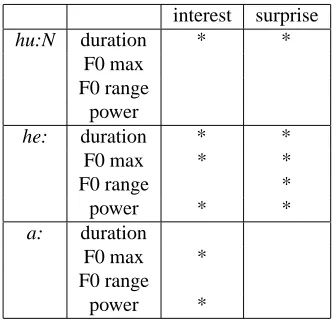
Table 1: Significant combinations of syllabic and prosodic patterns of reactive tokens
interest surprise hu:N duration * *
F0 max F0 range
power
he: duration * *
F0 max * *
F0 range *
power * *
a: duration F0 max * F0 range
power *
other two items are related to surprise level1. Ta-ble 1 lists the results (marked by ”*”) that have a sta-tistically significant (p < 0.05) difference between top-ten and bottom-ten samples. It is observed that prolonged “hu:N” means interest and surprise while “a:” with higher pitch or larger power means inter-est. On the other hand, “he:” can be emphasized in all prosodic features to express interest and surprise. The tokens with larger power and/or a longer du-ration is apparently easier to detect than indistinct tokens, and they are more related with interest level. It is expected that this rather simple prosodic infor-mation is useful for indexing poster conversations.
3.2 Third-party Evaluation of Hot Spots
In this subsection, we define those segments which induced (or elicited) laughters or non-lexical reac-tive tokens as hot spots, 2 and investigate whether these hot spots are really funny or interesting to the third-party viewers of the poster session.
We had four subjects, who had not attended the presentation nor listened the recorded audio content. They were asked to listen to each of the segmented hot spots in the original time sequence, and to make evaluations on the questionnaire, as below.
1We used different Japanese wording for interest and for
sur-prise to enhance the reliability of the evaluation; we adopt the result if the two matches.
2
Wrede et al.(B.Wrede and E.Shriberg, 2003; D.Gatica-Perez et al., 2005) defined “hot spots” as the regions where two or more participants are highly involved in a meeting. Our def-inition is different from it.
Q1: Do you understand the reason why the reactive token/laughter occurred?
Q2: Do you find this segment interesting/funny? Q3: Do you think this segment is necessary or
use-ful for listening to the content?
The percentage of “yes” on Question 1 was 89% for laughters and 95% for reactive tokens, confirm-ing that a large majority of the hot spots are appro-priate.
The answers to Questions 2 and 3 are more sub-jective, but suggest the usefulness of the hot spots. It turned out that only a half of the spots associated with laughters are funny for the subjects (Q2), and they found 35% of the spots not funny. The result suggests that feeling funny largely depends on the person. And we should note that there are not many funny parts in poster sessions by nature.
On the other hand, more than 90% of the spots associated with reactive tokens are interesting (Q2), and useful or necessary (Q3) for the subjects. The result supports the effectiveness of the hot spots ex-tracted based on the reaction of the audience.
4 Prediction of Turn-taking with Eye-gaze and Backchannel Information
Table 2: Duration (sec.) of eye-gaze and its relationship with turn-taking
turn held by turn taken by presenter A B C A gazed at B 0.220 0.589 0.299 A gazed at C 0.387 0.391 0.791
B gazed at A 0.161 0.205 0.078 C gazed at A 0.308 0.215 0.355
We also presume that turn-taking by the audience is related with their interest level because they want to know more and better when they are more at-tracted to the presentation.
It is widely-known that eye-gaze information plays a significant role in turn-taking (A.Kendon, 1967; B.Xiao et al., 2011; K.Jokinen et al., 2011; D.Bohus and E.Horvitz, 2009). The existence of posters, however, requires different modeling in poster conversations as the eye-gaze of the partici-pants are focused on the posters in most of the time. This is true to other kinds of interactions using some materials such as maps and computers. Moreover, we investigate the use of backchannel information by the audience during the presenter’s utterances.
4.1 Relationship between Eye-gaze and Turn-taking
We identify the object of the eye-gaze of all partic-ipants at the end of the presenter’s utterances. The target object can be either the poster or other partic-ipants. Then, we measure the duration of the eye-gaze within the segment of 2.5 seconds before the end of the presenter’s utterances because the major-ity of the IPUs are less than 2.5 seconds. It is listed in Table 2 in relation with the turn-taking events. We can see the presenter gazed at the person right before yielding the turn to him/her significantly longer than other cases. However, there is no significant differ-ence in the duration of the eye-gaze by the audidiffer-ence according to the turn-taking events.
4.2 Relationship between Joint Eye-gaze Events and Turn-taking
Next, we define joint eye-gaze events by the presen-ter and the audience as shown in Table 3. In this table, we use notation of “audience”, but actually these events are defined for each person in the
audi-Table 3: Definition of joint eye-gaze events by presenter and audience
who presenter
gazes at audience poster
(I) (P)
audience presenter (i) Ii Pi
poster (p) Ip Pp
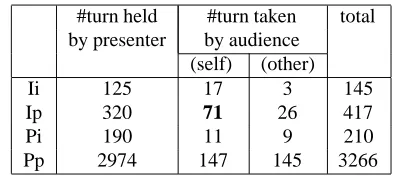
Table 4: Statistics of joint eye-gaze events by presenter and audience in relation with turn-taking
#turn held #turn taken total by presenter by audience
(self) (other)
Ii 125 17 3 145
Ip 320 71 26 417
Pi 190 11 9 210
Pp 2974 147 145 3266
ence. Thus, “Ii” means the mutual gaze by the pre-senter and a particular person in the audience, and “Pp” means the joint attention to the poster object.
Statistics of these events at the end of the presen-ter’s utterances are summarized in Table 4. Here, the counts of the events are summed over the two persons in the audience. They are classified accord-ing to the turn-takaccord-ing events, and turn-takaccord-ing by the audience is classified into two cases: the person in-volved in the eye-gaze event actually took the turn (self), and the other person took the turn (other). The mutual gaze (“Ii”) is expected to be related with turn-taking, but its frequency is not so high. The frequency of “Pi” is not high, either. The most po-tentially useful event is “Ip”, in which the presenter gazes at the person in the audience before giving the turn. This is consistent with the observation in the previous subsection.
4.3 Relationship between Backchannels and Turn-taking
As shown in Section 3, verbal backchannels suggest the listener’s interest level. Nodding is regarded as a non-verbal backchannel, and it is more frequently observed in poster conversations than in simple spo-ken dialogues.
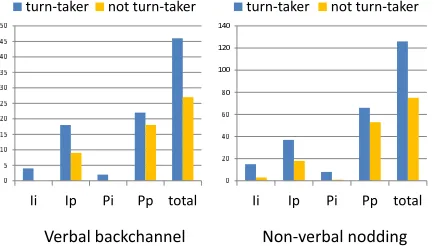
[image:5.612.326.523.189.278.2]Figure 4: Statistics of backchannels and their relationship with turn-taking
events. It is observed that the person in the audi-ence who takes the turn (=turn-taker) made more backchannels both in verbal and non-verbal man-ners, and the tendency is more apparent in the par-ticular eye-gaze events of “Ii” and “Ip” which are closely related with the turn-taking events.
4.4 Prediction of Turn-taking by Audience
Based on the analyses in the previous subsections, we conduct an experiment to predict turn-taking by the audience. The prediction task is divided into two sub-tasks: detection of speaker change and identifi-cation of the next speaker. In the first sub-task, we predict whether the turn is given from the presen-ter to someone in the audience, and if that happens, then we predict who in the audience takes the turn in the second sub-task. Note that these predictions are done at every end-point of the presenter’s utter-ance (IPU) using the information prior to the speaker change or the utterance by the new speaker.
For the first sub-task of speaker change predic-tion, prosodic features are adopted as a baseline. Specifically, we compute F0 (mean, max, min, and range) and power (mean and max) of the presenter’s utterance prior to the prediction point. Backchan-nel features are defined by taking occurrence counts prior to the prediction point for each type (verbal backchannel and non-verbal nodding). Eye-gaze features are defined in terms of eye-gaze objects and joint eye-gaze events, as described in previous subsections, and are parameterized with occurrence counts and duration. These parameterizations, how-ever, show no significant difference nor synergetic
Table 5: Prediction result of speaker change
feature recall precision F-measure prosody 0.667 0.178 0.280 backchannel (BC) 0.459 0.113 0.179 eye-gaze (gaze) 0.461 0.216 0.290 prosody+BC 0.668 0.165 0.263 prosody+gaze 0.706 0.209 0.319 prosody+BC+gaze 0.678 0.189 0.294
effect in terms of prediction performance.
SVM is adopted to predict whether speaker change happens or not by using these features. The result is summarized in Table 5. Here, we compute recall, precision and F-measure for speaker change, or turn-taking by the audience. This case accounts for only 11.9% and its prediction is very challeng-ing, while we can easily get an accuracy of over 90% for prediction of turn-holding by the presenter. We are particularly concerned on the recall of speaker change, considering the nature of the task and appli-cation scenarios.
Among the individual features, the prosodic tures obtain the best recall while the eye-gaze fea-tures achieve the best precision and F-measure. Combination of these two is effective in improving both recall and precision. On the other hand, the backchannel features get the lowest performance, and its combination with the other features is not ef-fective, resulting in degradation of the performance.
Next, we conduct the second sub-task of speaker prediction. Predicting the next speaker in a multi-party conversation (before he/she actually speaks) is also challenging, and has not been addressed in the previous work (K.Jokinen et al., 2011). For this sub-task, the prosodic features of the current speaker are not usable because it does not have information sug-gesting who the turn will be yielded to. Therefore, we adopt the backchannel features and eye-gaze fea-tures. Note that these features are computed for in-dividual persons in the audience, instead of taking the maximum or selecting among them.
[image:6.612.314.539.80.169.2]Table 6: Prediction result of the next speaker
feature accuracy eye-gaze (gaze) 66.4% backchannel (BC) 52.6% gaze+BC 69.7%
5 Relationship between Feedback Behaviors and Question Type
Next, we investigate the relationship between feed-back behaviors of the audience and the kind of ques-tions they ask after they take a turn. In this work, questions are classified into confirming questions and substantive questions. The confirming questions are asked to make sure of the understanding of the current explanation, thus they can be answered sim-ply by “Yes” or “No”.3 The substantive questions, on the other hand, are asking about what was not explained by the presenter, thus they cannot be an-swered by “Yes” or “No” only; an additional expla-nation is needed.
This annotation together with the preceding ex-planation segment is not so straightforward when the conversation got into the QA phase after the presen-ter went through an entire pospresen-ter presentation. Thus, we exclude the QA phase and focus on the questions asked during the explanation phase. In this section, we analyze the behaviors during the explanation seg-ment that precedes the question by merging all con-secutive IPUs of the presenter. This is a reasonable assumption once turn-taking is predicted in the pre-vious section. These are major differences from the analysis of the previous section.
5.1 Relationship between Backchannels and Question Type
The occurrence frequencies of verbal backchannels and non-verbal noddings, normalized by the dura-tion of the explanadura-tion segment (seconds), are listed according to the question type in Tables 7 and 8. In these tables, statistics of the person who actu-ally asked questions are compared with those of the person who did not. We can observe the turn-taker made significantly more verbal backchannels when asking substantive questions. On the other hand,
3
This does not mean the presenter actually answered simply by “Yes” or “No”.
Table 7: Frequencies (per sec.) of verbal backchannels and their relationship with question type
confirming substantive turn-taker 0.034 0.063
[image:7.612.335.520.169.208.2]non-turn-taker 0.041 0.038
Table 8: Frequencies (per sec.) of non-verbal noddings and their relationship with question type
[image:7.612.358.495.256.319.2]confirming substantive turn-taker 0.111 0.127 non-turn-taker 0.109 0.132
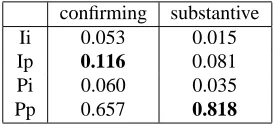
Table 9: Duration (ratio) of joint eye-gaze events and their relationship with question type
confirming substantive Ii 0.053 0.015
Ip 0.116 0.081
Pi 0.060 0.035 Pp 0.657 0.818
there is no significant difference in the frequency of non-verbal noddings among the audience and among the question types.
5.2 Relationship between Eye-gaze Events and Question Type
We also investigate the relationship between eye-gaze events and the question type. Among several parameterizations introduced in the previous sec-tion, we observe a significant tendency in the du-ration of the joint eye-gaze events, which is normal-ized by the duration of the presenter’s explanation segment. It is summarized in Table 9. We can see the increase of “Ip” (and decrease of “Pp” accord-ingly) in confirming questions. By combining with the analysis in the previous section, we can reason the majority of turn-taking signaled by the presen-ter’s gazing is attributed to confirmation.
6 Smart Posterboard
Figure 5: Outlook of smart posterboard
to the posterboard, which is actually a 65-inch LCD display. An outlook of the posterboard is given in Figure 5.
It is equipped with a 19-channel microphone array on the top, and attached with six cameras and two Kinect sensors. Speech separation and enhancement has been realized with Blind Spatial Subtraction Ar-ray (BSSA), which consists of the delay-and-sum (DS) beamformer and a noise estimator based on in-dependent component analysis (ICA) (Y.Takahashi et al., 2009). In this step, the audio input is separated to the presenter and the audience, but discrimination among the audience is not done. Visual information should be combined to annotate persons in the au-dience. Voice activity detection (VAD) is conducted on each of the two channels to make speaker diariza-tion. Localization of the persons in the audience and estimation of their head direction, which approxi-mates their eye-gaze, are conducted using the video information captured by the six cameras.
Although high-level annotations addressed in the previous sections have not been yet implemented in the current system, the above-mentioned processing realizes a browser of poster sessions which visual-izes the interaction.
The Kinect sensors are used for a portable and on-line version, in which speech enhancement, speaker localization and head direction estimation are per-formed in real time.
We made a demonstration of the system in IEEE-ICASSP 2012 as shown in Figure 5, and plan further improvements and trials in the future.
7 Conclusions
This article has given an overview of our multi-modal data collection and analysis of poster conver-sations. Poster conversations provide us with a num-ber of interesting topics in spoken dialogue research as they are essentially multi-modal and multi-party. By focusing on the audience’s feedback behaviors and joint eye-gaze events, it is suggested that we can annotate interest level of the audience and hot spots in the session.
Nowadays, presentation using a poster is one of the common and important activities in academic and business communities. As large LCD displays become ubiquitous, its style will be more interac-tive. Accordingly, sensing and archiving functions introduced in the smart posterboard will be useful.
Acknowledgments
The work presented in this article was conducted jointly with Hisao Setoguchi, Zhi-Qiang Chang, Takanori Tsuchiya, Takuma Iwatate, and Katsuya Takanashi. The smart posterboard system has been developed by a number of researchers in Kyoto Uni-versity and Nara Institute of Science and Technol-ogy (NAIST).
This work was supported by JST CREST and JSPS Grant-in-Aid for Scientific Research.
References
A.Gravano, S.Benus, J.Hirschberg, S.Mitchell, and I.Vovsha. 2007. Classification of discourse functions of affirmative words in spoken dialogue. In Proc. IN-TERSPEECH, pages 1613–1616.
A.Kendon. 1967. Some functions of gaze direction in social interaction. Acta Psychologica, 26:22–63. B.Wrede and E.Shriberg. 2003. Spotting “hot spots” in
meetings: Human judgments and prosodic cues. In Proc. EUROSPEECH, pages 2805–2808.
B.Xiao, V.Rozgic, A.Katsamanis, B.R.Baucom, P.G.Georgiou, and S.Narayanan. 2011. Acous-tic and visual cues of turn-taking dynamics in dyadic interactions. In Proc. INTERSPEECH, pages 2441–2444.
D.Bohus and E.Horvitz. 2009. Models for multiparty engagement in open-world dialog. In Proc. SIGdial. D.Gatica-Perez, I.McCowan, D.Zhang, and S.Bengio.
2005. Detecting group interest-level in meetings. In Proc. IEEE-ICASSP, volume 1, pages 489–492. F.Yang, G.Tur, and E.Shriberg. 2008. Exploiting dialog
act tagging and prosodic information for action item identification. In Proc. IEEE-ICASSP, pages 4941– 4944.
K.Jokinen, K.Harada, M.Nishida, and S.Yamamoto. 2011. Turn-alignment using eye-gaze and speech in conversational interaction. In Proc. INTERSPEECH, pages 2018–2021.
K.Laskowski, J.Edlund, and M.Heldner. 2011. A single-port non-parametric model of turn-taking in multi-party conversation. In Proc. IEEE-ICASSP, pages 5600–5603.
K.Maekawa. 2003. Corpus of Spontaneous Japanese: Its design and evaluation. In Proc. ISCA & IEEE Work-shop on Spontaneous Speech Processing and Recogni-tion, pages 7–12.
K.Otsuka, S.Araki, K.Ishizuka, M.Fujimoto, M.Heinrich, and J.Yamato. 2008. A realtime multimodal system for analyzing group meetings by combining face pose tracking and speaker diarization. In Proc. ICMI, pages 257–262.
K.Sumi, T.Kawahara, J.Ogata, and M.Goto. 2009. Acoustic event detection for spotting hot spots in pod-casts. In Proc. INTERSPEECH, pages 1143–1146. N.Ward. 2004. Pragmatic functions of prosodic features
in non-lexical utterances. In Speech Prosody, pages 325–328.
S.Fujie, Y.Matsuyama, H.Taniyama, and T.Kobayashi. 2009. Conversation robot participating in and activat-ing a group communication. In Proc. INTERSPEECH, pages 264–267.
S.Renals, T.Hain, and H.Bourlard. 2007. Recognition and understanding of meetings: The AMI and AMIDA projects. In Proc. IEEE Workshop Automatic Speech Recognition & Understanding.
T.Kawahara, H.Setoguchi, K.Takanashi, K.Ishizuka, and S.Araki. 2008. Multi-modal recording, analysis and indexing of poster sessions. In Proc. INTERSPEECH, pages 1622–1625.