An Exploration of Discourse-Based Sentence Spaces for Compositional
Distributional Semantics
Tamara Polajnar, Laura Rimell, and Stephen Clark
Computer Laboratory University of Cambridge
Cambridge, UK
{tamara.polajnar,laura.rimell,stephen.clark}@cl.cam.ac.uk
Abstract
This paper investigates whether the wider context in which a sentence is located can contribute to a distributional repre-sentation of sentence meaning. We com-pare a vector space for sentences in which the features are words occurring within the sentence, with two new vector spaces that only make use of surrounding con-text. Experiments on simple subject-verb-object similarity tasks show that all sen-tence spaces produce results that are com-parable with previous work. However, qualitative analysis and user experiments indicate that extra-sentential contexts cap-ture more diverse, yet topically coherent information.
1 Introduction
Distributional word representations (Turney and Pantel, 2010) have proven useful for a wide va-riety of tasks, including lexical similarity, senti-ment analysis, and machine translation. By far the most typical method of building distributional word vectors is based on co-occurrences in a small context window around the word. In contrast, there has been little investigation of different dis-tributional representations for sentences, though the current hypothesis is that the wider discourse in which the sentence is situated may provide rele-vant information (Baroni et al., 2014; Clark, 2013, 2015). If word representations could be composed into sentence vectors that reflect typical discourse contexts, this might be of great use in sentence-level tasks such as sentence similarity, automatic summarisation, and textual entailment.
Previous work in compositional distributional semantics largely defines the sentence vector space to be the same as the noun space (Kartsaklis et al., 2012; Socher et al., 2011b, 2012), and pro-duces sentence vectors in that space by a sequence
of operations on word representations. How-ever, embedding a sentence into a vector space whose dimensions are based on lexical semantics may fail to capture important aspects of senten-tial meaning. We believe there are two reasons behind the rather surprising lack of attention to sentence spaces. The first is doubt as to whether the distributional hypothesis applies to sentences, i.e. whether sentence meaning is contextual. The second is a question of data sparsity in obtaining contextual sentence representations.
In this paper we explore the idea that contex-tual sentence representations are viable, and that the surrounding discourse, in the form of adjacent sentences, provides useful information for mod-elling sentence meaning. We introduce two sen-tence spaces based on extra-sentential context, one consisting of a variety of context words and the other only of the surrounding verbs, and compare them with an intra-sentential contextual sentence space similar to that proposed in Grefenstette et al. (2013).
We situate our work within the Categorial framework (Coecke et al., 2010; Baroni et al., 2014; Clark, 2013, 2015) where nouns and sen-tences are considered atomic types, represented as vectors, and other words as functions, repre-sented as tensors. This framework provides a nat-ural setting in which the sentence space can dif-fer from the spaces of sentence constituents, since argument-taking words such as verbs are maps from argument space into sentence space. Fol-lowing Grefenstette and Sadrzadeh (2011a,b) and Kartsaklis et al. (2012) we focus on simplified sen-tences consisting of a subject, transitive verb, and object (SVO). We train transitive verb tensors us-ing a sus-ingle-step multilinear regression algorithm. We evaluate our composed representations on two standard SVO sentence similarity tasks. The results show that the discourse-based sentence spaces perform competitively, both with the
sentential contextual space and with previous work on SVO composition, although not beating the state of the art on these tasks. We then pro-vide a qualitative analysis of the topics resulting from Singular Value Decomposition in each sen-tence space, showing that both intra- and extra-sentential spaces contain highly coherent topics, but that the extra-sentential spaces are able to group together SVO triples with greater lexical di-versity. We evaluate topic coherence with a novel SVO triple intrusion task.
2 Background and Related Work
The majority of previous work producing vector representations for sentences uses the same space for sentences as for words. Within the Categorial framework, several previous experiments (Grefen-stette and Sadrzadeh, 2011a,b; Kartsaklis et al., 2012; Kartsaklis and Sadrzadeh, 2014) have de-fined the sentence space to be the same as the noun space. The noun space is based on co-occurrences with frequent words in the corpus in a small win-dow, which may not be the ideal space to represent sentences, which have distinct semantics involv-ing propositional meaninvolv-ing and links to surround-ing discourse (see Section 2.1 for more detail).
Neural language modelling approaches such as Socher et al. (2011a, 2013) recursively build sen-tence representations from constituent word vec-tors, which themselves are embeddings based on local context, such that the phrase space after each composition step remains the same, including the space for sentences at the root of a derivation. In these models the features are less interpretable, but since the original word embeddings are based on local co-occurrences, sentences are effectively be-ing represented in a lexical semantic space.
Grefenstette et al. (2013) use a dedicated sen-tence space for SVO sensen-tences, in which the fea-tures are intra-sentential co-occurrences of VO pairs and SVO triples with the 10,000 most fre-quent words in the corpus. They learn tensors for transitive verbs by multi-stage linear regression, incorporating objects and subjects in two sepa-rate steps. Fried et al. (2015) also use an intra-sentential sentence space when learning low-rank approximations for verb tensors (see Section 2.1). We experiment with a similar intra-sentential space alongside our extra-sentential spaces. An-other intra-sentential sentence space is described in Le and Mikolov (2014), who learn
embed-dings for larger text segments, including sen-tences, based on n-grams internal to the text seg-ments. A variant of this approach was also adopted by Fried et al. (2015) to learn verb tensors map-ping to an intra-sentential sentence space for the Categorial framework using single-step linear re-gression.
Sentence spaces need not be contextual, but may also represent other aspects of meaning rel-evant to propositions, such as plausibility or fea-ture norms (McRae et al., 1997). A non-contextual option that has been previously implemented is a two-dimensional “plausibility space”, in which the sentence vector represents a plausibility judge-ment. This type of space was explored in theory in Clark (2013, 2015) and implemented with multi-linear regression training for verb tensors by Pola-jnar et al. (2014a).
Contemporaneously with our work, Kiros et al. (2015) have used an encoder-decoder recurrent neural network architecture to encode a sentence vector conditioned on the previous and following sentences, providing further support for the utility of extra-sentential context for sentence meaning.
2.1 Categorial Framework Background
In the Categorial framework, nouns are repre-sented as vectors, while argument-taking words such as verbs and adjectives are represented as functions. Specifically, they are tensors that perform multilinear transformations of lower-dimensional tensors, e.g. noun vectors. The Cat-egorial Grammar derivation of a sentence guides the combination of vector and tensor objects rep-resenting the words in the sentence to ultimately produce a single sentence vector.
For example, a transitive verb in Combinatory Categorial Grammar (CCG) has the syntactic type
(S\NP)/NP, which defines it as a function that takes a noun phrase as an input from the right, and then another noun phrase from the left, to produce a sentence. Interpreting such categories under the Categorial framework is straightforward. First, for each atomic category there is a corresponding vec-tor space; in this case the sentence spaceSand the noun spaceN.1 Hence the meaning of a noun or
noun phrase, for examplepeople, will be a vector in the noun space:−−−→people∈N. In order to obtain the meaning of a transitive verb, each slash is
re-1In practice, for example using the CCG parser of Clark
people eat fish NP (S\NP)/NP NP N S⊗N⊗N N
>
S\NP S⊗N
<
[image:3.595.121.238.62.152.2]S S
Figure 1: Syntactic reduction and tensor-based se-mantic types for a transitive verb sentence.
placed with a tensor product operator, so that the meaning ofeat, for example, is a 3rd-order tensor:
eat ∈ S⊗N⊗N. Just as in the syntactic case, the meaning of a transitive verb is a function (a multi-linear map) which takes two noun vectors as arguments and returns a sentence vector.
Meanings combine using tensor contraction, which can be thought of as a multi-linear gen-eralisation of matrix multiplication (Grefenstette, 2013). Consider first the adjective-noun case, for example black cat. The syntactic type of black
isN/N; hence its meaning is a 2nd-order tensor (matrix): black ∈ N⊗N. In the syntax, N/N
combines withN using the rule of forward appli-cation (N/N N ⇒ N), which is an instance of function application. Function application is also used in the tensor-based semantics, which, for a matrix and vector argument, corresponds to ma-trix multiplication.
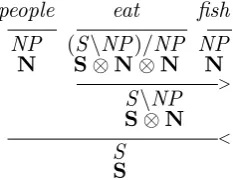
Figure 1 shows how the syntactic types com-bine with a transitive verb, and the corresponding tensor-based semantic types. Note that, after the verb has combined with its object NP, the type of the verb phrase is S\NP, with a correspond-ing meancorrespond-ing tensor (matrix) inS⊗N. This ma-trix then combines with the subject vector, through matrix multiplication, to give a sentence vector.
Some previous work in the Categorial frame-work has taken the sentence space to be the same as the noun space (Grefenstette and Sadrzadeh, 2011a,b; Kartsaklis et al., 2012; Kartsaklis and Sadrzadeh, 2014). The verb is defined, not as an
S⊗N⊗N tensor, but an N⊗N matrix sum-ming the outer products of its observed subjects and objects. Because this results in a type mis-match when presented with two noun vector argu-ments, tensor contraction cannot be used directly to produce a sentence vector. Instead, various combinations of matrix multiplication, pointwise multiplication, and addition are employed. As a
result, the sentence representation is a purely com-positional function of the context vectors of its component words; the observed contexts of SVO triples are not part of the representation.
One effect of reducing a verb tensor to a matrix is to reduce the number of parameters required to learn the verb. However, recent work in the Cat-egorial framework offers other ways to reduce the number of parameters while retaining the higher type of the tensor. Fried et al. (2015) introduce low-rank approximations for verb tensors, which provide a large reduction in the number of param-eters while increasing the speed of training, with-out substantial loss in accuracy on standard SVO tasks.
3 Sentence Spaces
We focus on SVO triples, which we also refer to as transitive sentences or simply sentences. Al-though real-world sentences are more complex, SVO is currently the standard grammatical con-struction for sentence composition within the Cat-egorial framework, because it is manageable for current learning methods.
This section describes our three contextual sen-tence spaces. The first follows Grefenstette et al. (2013) and Fried et al. (2015) in using intra-sentential word co-occurrenes with SVO triples. The others use extra-sentential co-occurrences. We consider the extra-sentential spaces to be a primitive way of incorporating the surrounding discourse into distributional representations. We know that individual sentences are linked to their neighbours in a coherent discourse, and investigate whether that linkage can be leveraged for natural language understanding. We make the assumption that Wikipedia articles, the source of our vectors, are a good source of coherent sequences of sen-tences.
3.1 Intra-Sentential Context
Following previous work, our first sentence space is the intra-sentential context of the SVO triple. We call this the Internal Distributional (IDist) space. We first select the top N = 10,000most frequent words from the corpus (excluding stop-words) as contexts. Any of these words appear-ing inside the same sentence as the SVO triple are counted as features for that triple. Figure 2 shows an example of IDist.
St−2: M. Atget captured the old Paris in
his pictures. St−1: His photographs show
the city in its various facets. St: He
pho-tographed stairwells and architectural details.
St+1:His interests also extended to the
envi-rons of Paris. St+2: He also photographed
street-hawkers and small tradesmen, as well as popular amusements.
IDist: stairwell, architectural, detail
DDist: capture, old, paris, picture, photo-graph, show, city, various, interest, extend, popular, amusement
DVerb: capture, show, extend, photograph Figure 2: Example features in sentence spaces for a target sentenceSt.
to be one of the context words, we had to decide whether to retain or discard it as context for the triple. We chose to discard the verb, because it is the verb tensor itself that is being learned. On the other hand, if either the S or O is one of the con-text words, we retained it as concon-text for the triple. The reasoning is related to a somewhat strange aspect of using intra-sentential context for a sen-tence: as composition methods become more so-phisticated, and more of the sentence is included in the composition, there would eventually be no intra-sentential context left to use if all composed words were removed.
3.2 Extra-Sentential Contexts
Our other sentence spaces use the surrounding dis-course as context for a sentence. There are many ways one could create a discourse context for an SVO triple, with the size of the context ranging from the surrounding sentences to the full docu-ment, and the context features ranging from the same words as in IDist, to specific parts of speech, phrase types, or discourse markers deemed more representative of sentence meaning.
We define two extra-sentential sentence spaces. Both use a window of two sentences on either side of the target sentenceSt. The first space is the
Dis-course Distributional (DDist) space, which takes as context features any of the top 10,000 words from the corpus occurring in the two sentences ei-ther side ofSt(but not inStitself). This sentence
space is analogous to IDist, but using an extra-rather than intra-sentential window.
The second space is the Discourse Verb (DVerb)
space, which takes as context features any verbs occurring in the two sentences either side of St.
This space was loosely inspired by work on unsu-pervised learning of narrative event chains (Cham-bers and Jurafsky, 2008, 2009), in which se-quences of events such as accuse – claim – ar-gue – dismissor appoint – work – oversee – re-tireare extracted from text. That work links event types which share a protagonist in a connected discourse; in contrast, we do not check whether neighbouring verbs share arguments, but simply hypothesise that verbs near the target verb repre-sent related events and are therefore particularly suited to be context features. Figure 2 shows ex-amples of DVerb and DDist.
We expect DVerb to suffer from a certain amount of data sparsity since the number of verbs in a window of two sentences on either side of the target can be expected to be low, despite the fact that we do not restrict the context features to the main verbs of those sentences. DVerb is therefore the most speculative of our sentence spaces.
3.3 Combined Spaces
In order to examine the interaction between the intra- and extra-sentential contexts, we also cre-ate two combined spaces: ID.DD, a conccre-atena- tion of IDist and DDist, and ID.DV, a concatena-tion of IDist and DVerb. To create the combined spaces, we use the vector spaces as defined above which are created separately and reduced to 20-dimensions (Section 4). Then for each triple we concatenate the vector from each of the spaces we are combining to create a 40-dimensional vector.
4 Training
To train the noun vectors and verb tensors we used an October 2013 download of Wikipedia arti-cles, which was tokenised using the Stanford NLP tools,2 lemmatised with the Morpha lemmatiser
(Minnen et al., 2001), and parsed with the C&C parser (Clark and Curran, 2007).
We selected a total of 345 verbs, which include the verbs in our test datasets, along with some ad-ditional high-frequency verbs included to produce more representative sentence spaces. To train the verbs, we required high-quality SVO triples that occurred enough times in the corpus to provide us with distributional representations of their con-texts. For each verb we therefore selected up to
600 triples which occurred more than once and contained subject and object nouns that occurred at least 100 times. This resulted inM ≈150,000
triples overall.
We first generated distributional vectors for all the nouns contained in the training triples and the test datasets. We used Wikipedia as the source cor-pus, with sentences as the context window and the topN = 10,000most frequent words (excluding stopwords) as the context words. Following the procedure outlined in Polajnar and Clark (2014), we employed t-test weighting (Curran, 2004) and context selection, and reduced our noun vectors (n) toK = 100dimensions using Singular Value Decomposition (SVD).
For each verb V we have a set of MV
train-ing instances, where each instance i ∈ MV
con-sists of subject and object noun vectors n(s)i, n(o)
iand a true sentence space representation
vec-tor ti. The vector ti is the SVD-reduced
ver-sion of the Wikipedia context vector for the triple
n(s)
iV n(o)i.
The true IDist and DDist vectors were generated using the sameN = 10,000context words as for the nouns, weighted by t-test. The entireM ×N
matrix was reduced toS = 20orS = 40 dimen-sions.3
The DVerb context words consist ofN = 2,641
verbs that occurred at least 10 times within the two sentences surrounding our triples. DVerb was also weighted using t-test and the matrix encoding the co-occurrence of triples with verb contexts was re-duced with SVD to produce anM ×Smatrix.
Regression (reg) We learn the values of theS× K×Ktensor representing the verb as parameters (V) of a regression algorithm. To train the tensor we minimise the sum of the mean squared errors (MSQE) between each of the training sentence space vectorstiand classifier predictionssiusing
the following regularised objective:
O(V) =−MV1
"M
v
X
i=1
MSQE(ti,si) +λ2||V||
#
where thel-th index of the predicted sentence vec-tor is produced by tensor contraction
3We examined other configurations of noun and sentence
space dimensions. Larger tensors learned by regression or distributionally did not consistently lead to increased scores. Although the dimensionality of the sentence space is small, theK×K×Stensors are sufficiently large that we believe they are already capturing a significant amount of information from the interaction of the noun and sentence spaces.
sl=X
jk
Vljkn(js)n(ko) (1)
between the tensor and the subject and ob-ject noun vectors n(s) and n(o). The
train-ing was performed through gradient descent with ADADELTA (Zeiler, 2012), with minibatches, and with 10% of the training triples reserved as a validation set for early stopping. The regularisa-tion parameter was set toλ= 0.05without tuning.
Distributional Tensors (dist) As an alternative to learning the verb function, we produce a verb tensor using a procedure inspired by Grefenstette and Sadrzadeh (2011a). The intuition behind this method is that the tensor should encode higher val-ues for topics that frequently co-occur within the subject, object, and sentence vectors in the triples used to train a particular verb. Specifically, we generate an S ×K ×K tensorV for each verb as the average of the tensor products (⊗) of K -dimensional subject and object vectors and theS -dimensional sentence space vector (s) from the training triples:
V= 1MV "M
V
X
i=1
si⊗n(s) i⊗n(o)i
#
whereMV is the number of training triples for the
verbV. Our procedure differs from Grefenstette and Sadrzadeh (2011a) because it generates a ten-sor, while they treated verbs as matrices and effec-tively disregarded the sentence space.
5 Quantitative Experiments
We perform two experiments using composed sen-tence vectors. The first involves disambiguation of a polysemous verb in the context of its subject and object, and the second involves measurement of sentence similarity, without disambiguation. We make use of two existing SVO datasets.
5.1 Datasets
GS11 The first dataset is from Grefenstette and Sadrzadeh (2011a) (GS11), and consists of 200 sentence pairs (400 sentences total). Each sen-tence pair shares a subject and an object. The first member of the pair has an ambiguous verb, while the second has a ‘landmark’ disambiguating verb. Gold standard annotation provides similarity rat-ings for each pair on a scale of 1 (low) to 7 (high). For example,people try doorandpeople test door
have high similarity ratings, whilepeople try door
GS11 Distributional Regression
S=20 S=40 S=20 S=40
IDist 0.18 0.15 0.31 0.33 DDist 0.18 0.20 0.26 0.27
DVerb 0.21 0.21 0.32 0.32
ID.DV - 0.22 - 0.33 ID.DD - 0.19 - 0.29
KS14 Distributional Regression
S=20 S=40 S=20 S=40
IDist 0.15 0.07 0.42 0.43 DDist 0.17 0.17 0.34 0.37
DVerb 0.18 0.14 0.33 0.37
[image:6.595.105.497.63.136.2]ID.DV - 0.22 - 0.40 ID.DD - 0.16 - 0.38
Table 1: Spearman-ρresults for the GS11 dataset (left) and KS14 dataset (right).
KS14 The second dataset (Kartsaklis and Sadrzadeh, 2014) (KS14), consists of 72 sen-tences arranged into 108 sentence pairs. The sentences in each pair do not share verbs, sub-jects, or objects. Gold standard annotation provides similarity ratings for each pair on a scale of 1 (low) to 7 (high). For example, medication achieve resultand drug produce effecthave high similarity ratings, while author write book and
delegate buy land have low ratings. Sentence
pairs with mid-similarity ratings tend to have high relatedness but are not mutually substitutable, e.g.
team win matchandpeople play game.
Both tasks are formulated as ranking tasks. Each SVO triple is composed as in Equation 1 and the resulting vectors are compared using cosine to give a similarity value. Sentence pairs are ordered according to similarity and Spearman’sρ is used to compare the automatically-obtained similarity ranking with that obtained from the gold standard judgements.
5.2 Results
Table 1 shows the results for the two tasks. Each task is evaluated with both the distributionally-built tensors and regression trained tensors and with 20 and 40 dimensional sentence spaces. This led to eight separate experiments. Overall, dif-ferent conditions favour difdif-ferent sentence spaces. DVerb achieves the highest or near-highest score for all the GS11 experiments, which is interest-ing given that DVerb is the sparsest sentence space of the three. Although it is well known that the arguments of an ambiguous verb are impor-tant for disambiguation, this result suggests that extra-sentential verb co-occurrences may also re-flect different verb senses. On the other hand, IDist achieves some of the highest overall scores with regression training, on both GS11 and KS14. DDist and DVerb lag somewhat behind IDist on KS14. We also note that the results on all experi-ments are higher with regression-trained tensors.
In the combined space experiments, we find that
IDist and DVerb provide mutually complementary information and high scores that are close to or outperform single space models.
To put these results in context, our regression results for IDist, DVerb, and ID.DV are com-parable with the highest distributional results in Fried et al. (2015) (ρ = 0.34 on GS11 and
ρ = 0.42 on KS14), which were obtained with a sentence-internal space with 100-dimensional vectors, much higher dimensionality than ours. Kartsaklis and Sadrzadeh (2014) obtainρ = 0.42
on GS11, using a distributional matrix with a composition method which effectively disregards the sentence space, and a 300-dimensional noun space. The state-of-the art for KS14 isρ = 0.58
with vector addition and 100- or 300-dimensional vectors (Polajnar et al., 2014b; Kartsaklis and Sadrzadeh, 2014), demonstrating that so far, no sophisticated composition method has been able to beat vector addition on this dataset.4 Although
our contextual sentence spaces do not reach the state of the art, their performance is good enough to show that the method is viable and merits con-tinued development.
6 Qualitative Analysis
In this section we provide a qualitative analysis of how the sentence spaces represent meaning. We contrast the space that has been used in previous literature (IDist) with the extra-sentential spaces (DDist, DVerb) to highlight the differences en-coded by different contextual information.
6.1 Topic Comparison
In a word-context matrix, it is common to per-form qualitative analyses of dimensionally re-duced spaces by looking at the top-weighted words per topic, where the topics are induced by a dimensionality reduction technique. In our case,
4The results of Milajevs et al. (2014) and Hashimoto and
IDist DDist DVerb
Topic 5 Topic 9 Topic 2
1 firedestroy building -fire building
downtown rebuild disastrous main manpany businessman work shopstartbusiness -business com- windcause dissipate report total destroycausedamage -damage flood
2 firedamagebuilding -building fire
severely rebuild badly disastrous manlaw solicitor company businessbecomepartner - firm partner tornadoage destroy dissipate cause ratecausedamage -touch
dam-3 buildingsufferfire -fire building
re-build restore severe porch remodel manbusinessman firm educate companyjoinbusiness -business father tornadotouch injure destroy spawn causedestroy home - damage
4 Firedestroybuilding -fire building
great salem rebuilt displacement companyproduct inc. acquire subsidiarychange name - company tornadotouch destroy damage kill dissipatekillpeople -strike confirm
5 buildingreplacebuilding -building
consulate construct current manness purchase businessman servebecome owner - owner busi- stormflood strike estimate destroykillpeople -dissipate cause
20 firedestroyBuilding -building fire
disastrous syndicate richardson manmarry die son widow sir marriagemarrywidow -daughter firstly tornadodamage injure destroy rate sweepstrike town - touch strike
21 buildingreplaceone -building brick
wooden one demolish companysurance products customer companyofferproduct -product in- stormdestroy neighbor dissipate affectdestroyhouse -flood damage
22 buildingcoverarea -building area
meter floor square storey companymillion announce mergerannounceplan -company floodingpact amount isolate collapsedamagehome -cause
im-23 manenterbuilding -building petrol
thor suspected printing randall manelizabeth die tudor eldest burymarryElizabeth -son daughter windpate damage estimate evacuatedestroyhouse -weaken
dissi-24 peopledestroy building - building
[image:7.595.71.525.60.287.2]machinery explosive withdrawal mantorney partner practice serve clerkjoinfirm -firm law counsel at- stormweaken cause flood total damagedrop rainfall - dissipate
Table 2: Top triples (in roman type, with verb in bold) for two sample topics per space with S=20. The top distributional terms for each triple are listed in italics.
the sentence space was trained by using, not the co-occurrences ofwordsand contexts, but ofSVO triplesand contexts. Therefore, we can look at the highest-weighted triples from the training data for each topic.
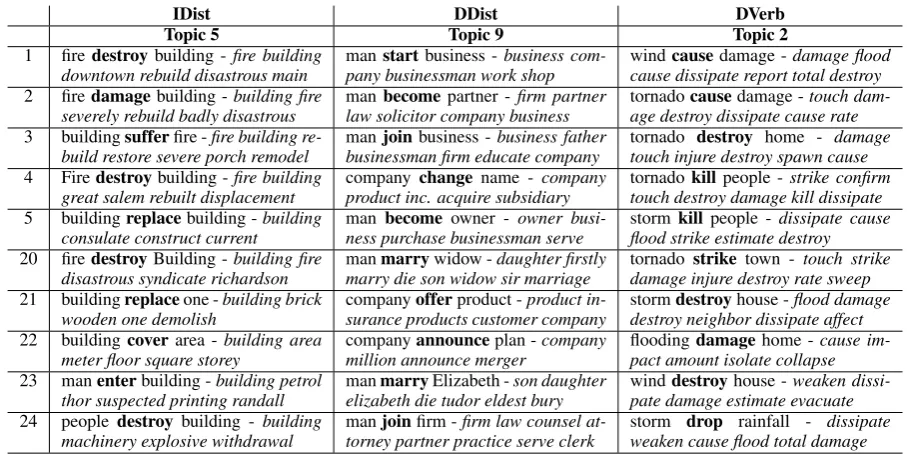
Table 2 shows sample topics from IDist, DDist, and DVerb. Every triple has a weighting in every dimension; here we show the five top-weighted triples from the chosen topics, as well as five triples at ranks 20-24. We also show the top-weighted context words for that triple from the original unreduced space.
All three spaces show strong topical coherence; however, lexical coherence seems a greater fac-tor in the clustering of triples for IDist. The IDist topic seems to rely heavily on the wordbuilding, which occurs as either subject or object (or both) in all of the triples shown here, and in fact in 23 of the top 30 triples. It can also be seen as a top con-text for many of the triples. Although the overall topic appears to be mostly about damaged build-ings, there are several instances of triples that have to do with buildings, but not with damage, for ex-amplebuilding replace oneandman enter build-ing.5 Since the arguments can serve as contexts, it
is very likely that triples containing similar argu-ments will be clustered together.
The DDist topic exhibits moderate coherence,
5To avoid sparsity, all instances of masculine pronouns
were replaced with “man” and feminine pronouns with “woman” during preprocessing.
but also more lexical variety in the argument slots than IDist. This topic is also an example of the interleaving that occurs when there are over 150,000 triples grouped into only 20 topics, with marriage triples interspersed with business-related ones. The top highest ranked context words for DDist triples often contain the subject or the ob-ject from the triple. Since the subob-ject and obob-ject were not counted as co-occurrences for DDist (as they are intra-sentential, and DDist contexts are explicitly extra-sentential), this would seem to in-dicate that DDist does indeed incorporate some discourse continuity, as the entities are mentioned in surrounding sentences.
The DVerb topic appears quite coherent, and also exhibits more lexical diversity in the sub-ject and obsub-ject slots than IDist. Some top triples include light verbs such as cause, with the sub-jects and obsub-jects making it clear that they are rel-evant to the topic: wind cause damage, tornado cause damage. This is particularly exciting be-cause the subjects and objects were not encoded in the feature space that was used to produce the topics. This space only contains the surrounding verbs, so the topical grouping ofwindandtornado
6.2 Coherence Analysis
To further explore the coherence of the topics in each sentence space, we introduce a triple intru-sion task. This task is based on the word intru-sion task for evaluation of topic models (Chang et al., 2009). In the word intrusion task, the top five words from a topic are grouped together with a sixth word which ranks low in that topic, but high in other topics. Human annotators must pick the “intruder” from a randomly-ordered list of these six words. The more coherent the topic, the easier it is for humans to identify the intruder.
Analogously, we ask human annotators to iden-tify an intruding SVO triple. In the first version of this experiment (top5), we carry the word intrusion method over directly to triples. The top five SVO triples from each topic are chosen. The intruder is chosen as the lowest-ranking SVO triple from a topic that is also ranked in the top 1% of triples in at least one other topic. This ensures that the intruder is semantically plausible in its own right.
In the second version of the triple intrusion task (lexdiv), we explore the interaction of topic co-herence with lexical coco-herence, by choosing from each topic the five highest-ranked SVO triples hav-ing no lexical overlap with one another. In this way we seek to test the intuition that arose from direct examination of the topics, namely that some sentence spaces have topics exhibiting semantic coherence along with greater lexical diversity.
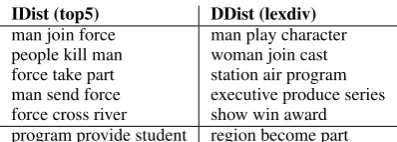
To obtain the lexdiv triples for a topic, we be-gin with the top-ranked triple. We then add the next highest ranked triple which shares no lexical items (subject, verb, or object) with the first triple. We proceed to add triples in this way until we have a set of five triples. In some cases it is necessary to go fairly far down the topic rankings to find such a set; the average rank of the lowest-ranked triple for IDist is 186.5, 64.3 for DDist, and 63.9 for DVerb. These rankings themselves indicate that IDist is less lexically diverse than DDist and DVerb. The intruder is obtained as in the top5 setting, except that we also require it not to have any lexical over-lap with any of the five high-ranked triples, to en-sure that it blends in. Sample triple sets are shown in Figure 3. The triples were randomised and the rank was not displayed to the annotators.
We created sets of six triples for all topics from our three sentence spaces and two experiment set-tings, yielding 120 sets in all. We randomised the order of sets and distributed them among four
an-IDist (top5) DDist (lexdiv)
[image:8.595.317.516.60.131.2]man join force man play character people kill man woman join cast force take part station air program man send force executive produce series force cross river show win award program provide student region become part
Figure 3: Intrusion examples before randomisa-tion. The intruder is shown as the last item in each set.
notators such that each set of triples was anno-tated by two annotators. The annotators were PhD students and postdoctoral researchers in computer science or linguistics. They were given no back-ground on the source of the triples, and were in-structed to pick the odd one out from each set.
We report model accuracy and Fleiss’ kappa (κ) for each sentence space and setting. Model accu-racy is the proportion of examples for which the annotator chose the correct intruder. For model accuracy, we report the average accuracy over two annotators. Since no single annotator saw all the sets of triples, we arbitrarily assigned annotators to be the first or second annotator on a given division of the data. Higher model accuracy corresponds to greater topic coherence.
Higher human accuracy on the lexdiv setting would imply that a topic exhibits greater lexi-cal diversity at higher ranks, or else that it main-tains greater semantic coherence further down the ranks. Either way, the property of semantic coher-ence with greater lexical diversity is an interesting one from the perspective of utility for tasks such as paraphrasing and automatic summarisation.
Fleiss’ κ provides a slightly different perspec-tive on topic coherence, as a measurement of how often the annotators agreed on their choice of in-truder, serving also as a check on model accuracy since it rules out random success on intruder iden-tification. Again, the higher the inter-annotator agreement, the more coherent the topic.
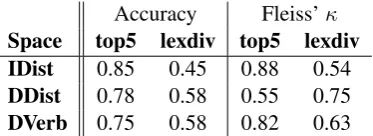
The results are given in Table 3. We observe that accuracy was consistenty lower for lexdiv than for top, which is unsurprising, since the task is much harder: in many cases for top5, all five top triples share at least one lexical item and some-times more, while the intruder is often lexically distinct. For top5, IDist shows the highest accu-racy (0.85), indicating that its topics are most co-herent, or possibly that because they are the most
iden-Accuracy Fleiss’κ Space top5 lexdiv top5 lexdiv IDist 0.85 0.45 0.88 0.54
DDist 0.78 0.58 0.55 0.75
[image:9.595.89.276.62.130.2]DVerb 0.75 0.58 0.82 0.63 Table 3: Triple intrusion task: model accuracy average over two (amalgamated) annotators and Fleiss’κ.
tify. However, IDist shows the lowest accuracy for lexdiv (0.45), as well as the greatest dropoff in accuracy from top5 to lexdiv, a drop of 0.40, compared to 0.20 for DDist and 0.27 for DVerb. It appears that when triples are restricted to be lexi-cally diverse, DDist and DVerb are more semanti-cally coherent, with an accuracy of 0.58. We note that DVerb results would likely improve with more data and more stringent triple selection. Since we allow triples that occur two or more times, there are some triples in DVerb that are extremely sparse, and occur with only one verb., e.g. saint
pray temple which only co-occurs with use, or
man plug setup which only co-occurs withplay, and also appears to be a result of parser error. There is at least one topic where many such triples have been grouped together, making DVerb evalu-ation more difficult for annotators.
We observe similar effects for Fleiss’κ. Anno-taters generally achieved much higher agreement on top5 than lexdiv. The exception is DDist-top5, where agreement was much lower than for lex-div; since model accuracy was high, it appears that each annotator had trouble with different amples, a fact for which we find no obvious ex-planation. IDist-top5 again achieves the highest agreement (0.88), indicating the task is fairly easy, but there is a steep dropoff to lexdiv, whereas DVerb shows a much smaller dropoff, and DDist and DVerb both show higher agreement for lexdiv than IDist does
7 Conclusions
We have introduced and evaluated two distribu-tional vector spaces based on extra-sentential con-texts. Results on two standard similarity tasks demonstrate that these spaces are effective in modelling sentence meaning for SVO sentences. Furthermore, a qualitative analysis indicates that extra-sentential spaces differ from the standard intra-sentential space in ways that may not be
cap-tured by the similarity tasks. The next step, there-fore, is to experiment on tasks where discourse plays a larger role, such as script induction or au-tomatic summarisation.
We have also explored only a small fraction of the many possible contextual sentence spaces. At a minimum, the role of the size and symmetry of the extra-sentential context in the quality of sen-tence vectors should be investigated. Future work could also investigate other, more sophisticated models that go beyond simple sentence adjacency; for example, making use of the Penn Discourse Treebank (Prasad et al., 2008, 2014).
Acknowledgments
Tamara Polajnar and Stephen Clark are supported by ERC Starting Grant DisCoTex (306920). Laura Rimell and Stephen Clark are supported by EP-SRC grant EP/I037512/1.
References
Marco Baroni, Raffaella Bernardi, and Roberto Zamparelli. 2014. Frege in space: A program for compositional distributional semantics. Lin-guistic Issues in Language Technology, 9:5–110. Nathanael Chambers and Dan Jurafsky. 2008.
Un-supervised learning of narrative event chains. In
Proceedings of ACL-HLT.
Nathanael Chambers and Dan Jurafsky. 2009. Un-supervised learning of narrative schemas and their participants. InProceedings of ACL-IJCNLP. J. Chang, J. Boyd-Graber, S. Gerrish, C. Wang, and D. Blei. 2009. Reading tea leaves: How humans interpret topic models. In Advances in Neural Information Processing Systems 21 (NIPS-09), page 288296, Vancouver, Canada.
Stephen Clark. Vector space models of lexical meaning. In Shalom Lappin and Chris Fox, edi-tors,Handbook of Contemporary Semantics second edition (to appear). Wiley-Blackwell, 2015. Stephen Clark. Type-driven syntax and
se-mantics for composing meaning vectors. In Chris Heunen, Mehrnoosh Sadrzadeh, and Ed-ward Grefenstette, editors, Quantum Physics and Linguistics: A Compositional, Diagrammatic Discourse, pages 359–377. Oxford University Press, 2013.
and log-linear models.Computational Linguistics, 33(4):493–552.
Bob Coecke, Mehrnoosh Sadrzadeh, and Stephen Clark. Mathematical foundations for a compositional distributional model of mean-ing. In J. van Bentham, M. Moortgat, and W. Buszkowski, editors, Linguistic Analysis (Lambek Festschrift), volume 36, pages 345–384. 2010.
James R. Curran. From Distributional to Semantic Similarity. PhD thesis, University of Edinburgh, 2004.
Daniel Fried, Tamara Polajnar, and Stephen Clark. 2015. Low-rank tensors for verbs in compo-sitional distributional semantics. In Proceed-ings of the 53nd Annual Meeting of the Association for Computational Linguistics (ACL 2015), Bejing, China.
Edward Grefenstette. Category-Theoretic Quantita-tive Compositional Distributional Models of Natural Language Semantics. PhD thesis, University of Oxford, 2013.
Edward Grefenstette and Mehrnoosh Sadrzadeh. July 2011a. Experimental support for a cat-egorical compositional distributional model of meaning. In Proceedings of the 2011 Conference on Empirical Methods in Natural Language Pro-cessing, pages 1394–1404, Edinburgh, Scotland, UK.
Edward Grefenstette and Mehrnoosh Sadrzadeh. 2011b. Experimenting with transitive verbs in a discocat. InProceedings of the GEMS 2011 Work-shop on Geometrical Models of Natural Languge, Edinburgh, Scotland, UK.
Edward Grefenstette, Georgiana Dinu, Yao-Zhong Zhang, Mehrnoosh Sadrzadeh, and Marco Ba-roni. 2013. Multi-step regression learning for compositional distributional semantics. Pro-ceedings of the 10th International Conference on Computational Semantics (IWCS 2013).
Kazuma Hashimoto and Yoshimasa Tsuruoka. 2015. Learning embeddings for transitive verb disambiguation by implicit tensor factorization. In Proceedings of the 3rd Workshop on Continu-ous Vector Space Models and their Compositionality (CVSC), Beijing, China.
Dimitri Kartsaklis and Mehrnoosh Sadrzadeh. June 2014. A study of entanglement in a cat-egorical framework of natural language. In
Pro-ceedings of the 11th Workshop on Quantum Physics and Logic (QPL), Kyoto, Japan.
Dimitri Kartsaklis, Mehrnoosh Sadrzadeh, and Stephen Pulman. 2012. A unified sen-tence space for categorical distributional-compositional semantics: Theory and experi-ments. In Proceedings of COLING, pages 549– 558.
Ryan Kiros, Yukun Zhu, Ruslan Salakhutdinov, Richard S. Zemel, Antonio Torralba, Raquel Urtasun, and Sanja Fidler. 2015. Skip-thought vectors. CoRR, abs/1506.06726. URL http: //arxiv.org/abs/1506.06726.
Quoc Le and Tomas Mikolov. 2014. Distributed representations of sentences and documents. In
Proceedings of ICML.
K. McRae, V. R. de Sa, and M. S. Seidenberg. Jun 1997. On the nature and scope of featu-ral representations of word meaning. Journal of experimental psychology. General, 126(2):99–130. ISSN 0096-3445.
Dmitrijs Milajevs, Dimitri Kartsaklis, Mehrnoosh Sadrzadeh, and Matthew Purver. 2014. Eval-uating neural word representations in tensor-based compositional settings. InProceedings of EMNLP, Doha Qatar.
Guido Minnen, John Carroll, and Darren Pearce. 2001. Applied morphological processing of En-glish. Natural Language Engineering, 7(3):207– 223.
Tamara Polajnar and Stephen Clark. 2014. Im-proving distributional semantic vectors through context selection and normalisation. In 14th Conference of the European Chapter of the As-sociation for Computational Linguistics, EACL’14, Gothenburg, Sweden.
Tamara Polajnar, Luana Fagarasan, and Stephen Clark. 2014a. Reducing dimensions of tensors in type-driven distributional semantics. In Pro-ceedings of EMNLP 2014, Doha, Qatar.
Tamara Polajnar, Laura Rimell, and Stephen Clark. 2014b. Using sentence plausibility to learn the semantics of transitive verbs. CoRR, abs/1411.7942. URL http://arxiv.org/ abs/1411.7942.
Rashmi Prasad, Bonnie Webber, and Aravind Joshi. 2014. Reflections on the Penn dis-course TreeBank, comparable corpora and com-plementary annotation. Computational Linguis-tics, 40(4):921–950.
Richard Socher, Eric H. Huang, Jeffrey Penning-ton, Andrew Y. Ng, and Christopher D. Man-ning. 2011a. Dynamic pooling and unfold-ing recursive autoencoders for paraphrase de-tection. InProceedings of NIPS.
Richard Socher, Cliff Lin, Andrew Y. Ng, and Christopher D. Manning. 2011b. Parsing nat-ural scenes and natnat-ural language with recursive neural networks. InProceedings of the 28th Inter-national Conference on Machine Learning (ICML 2011), Bellevue, Washington.
Richard Socher, Brody Huval, Christopher D. Manning, and Andrew Y. Ng. 2012. Seman-tic compositionality through recursive matrix-vector spaces. InProceedings of the Conference on Empirical Methods in Natural Language Process-ing, pages 1201–1211, Jeju, Korea.
Richard Socher, John Bauer, Christopher D. Man-ning, and Andrew Y. Ng. 2013. Parsing with compositional vector grammars. InProceedings of ACL.
Peter D. Turney and Patrick Pantel. 2010. From frequency to meaning: Vector space models of semantics. Journal of Artificial Intelligence Re-search, 37:141–188.